
Bryan Sykes
Bryan Clifford Sykes was a renowned British geneticist and science writer who served as a Fellow of Wolfson College and Emeritus Professor of Human Genetics at the University of Oxford. He was a pioneering researcher in the field of ancient DNA and was among the first to retrieve DNA from ancient human remains, with his landmark 1989 study published in Nature. He played a significant role in high-profile cases, including the analysis of DNA from Ötzi the Iceman. Sykes gained widespread recognition for his popular science books, especially The Seven Daughters of Eve (2001), in which he explained how mitochondrial DNA could trace maternal ancestry back to prehistoric women, whom he described as "clan mothers". In Blood of the Isles (2006), he explored the genetic roots of the British and Irish people, arguing that modern populations largely descended from early Mesolithic and Neolithic settlers, with limited genetic input from later groups like the Celts, Romans, Anglo-Saxons, and Vikings. He was also known for investigating cryptozoological mysteries, including the alleged Yeti, suggesting some samples might belong to a rare bear hybrid, though later studies contested his findings. Educated at Eltham College, the University of Liverpool, Bristol, and Oxford, Sykes authored numerous scientific papers. He died in December 2020, leaving a lasting impact on genetic genealogy and public understanding of human ancestry.
10 Books Written

In 1994 Professor Bryan Sykes, a leading world authority on DNA and human evolution, was called in to examine the frozen remains of a man trapped in glacial ice in northern Italy. News of the discovery of the Ice Man and his age, which was put at over five thousand years old, fascinated the world. But what made the story particularly extraordinary was that Professor Sykes was also able to track down a living genetic relative of the Ice Man, a woman living in Britain today.How was he able to locate a living relative of a man who died thousands of years ago? In The Seven Daughters of Eve, Bryan Sykes gives us a first hand account of his research into a remarkable gene which passes undiluted from generation to generation through the maternal line and shows how it is being used to track our genetic ancestors through time and space. After plotting thousands of DNA sequences from all over the world he found that they had clustered around a handful of distinct groups. In Europe there are only seven. The conclusion: almost everyone of native European descent, wherever they live in the world, can trace their ancestry back to one of seven women, the Seven Daughters of Eve. He has named them Ursula, Xenia, Helena, Velda, Tara, Katrine and Jasmine.In this remarkable scientific adventure story we learn exactly how our origins can be traced, how and where our ancient genetic ancestors lived, what their lives were like and how we are each living proof of the almost miraculous strength of our DNA which has survived and prospered over so many thousands of years to reach us today. It is a book that not only presents the story of our evolution in a wholly new light, but also strikes right at the heart of ourselves as individuals and of our sense of identity.
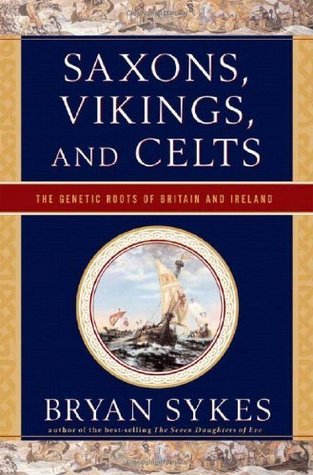
One of the world's leading geneticists, Bryan Sykes has helped thousands find their ancestry in the British Isles. Saxons, Vikings, and Celts, which resulted from a systematic ten-year DNA survey of more than 10,000 volunteers, traces the true genetic makeup of the British Isles and its descendants, taking readers from the Pontnewydd cave in North Wales to the resting place of "The Red Lady" of Paviland and the tomb of King Arthur. Genealogy has become a popular pastime of Americans interested in their heritage, and this is the perfect work for anyone interested in finding their heritage in England, Scotland, or Ireland.

By the nationally best-selling author of "The Seven Daughters of Eve," "Adam's Curse" investigates the ultimate evolutionary a man-free future. How is it possible that the Y chromosome, which separated the sexes and allowed humans to rise to the apex of the animal kingdom, also threatens to destroy sexual reproduction altogether? Bryan Sykes confronts recent advances in evolutionary theory to find the answers to the questions that inexorably Is there a genetic cause for men's greed, aggression, and promiscuity? Could a male homosexual gene possibly exist? A must read for anyone interested in popular science, family genealogy, and today's infertility crisis, "Adam's Curse" provokes a shocking debate on the nature of sexual reproduction.

The best-selling author of The Seven Daughters of Eve now turns his sights on the United States, one of the most genetically variegated countries in the world. From the blue-blooded pockets of old-WASP New England to the vast tribal lands of the Navajo, Bryan Sykes takes us on a historical genetic tour, interviewing genealogists, geneticists, anthropologists, and everyday Americans with compelling ancestral stories. His findings suggest:• Of Americans whose ancestors came as slaves, virtually all have some European DNA.• Racial intermixing appears least common among descendants of early New England colonists.• There is clear evidence of Jewish genes among descendants of southwestern Spanish Catholics.• Among white Americans, evidence of African DNA is most common in the South.• European genes appeared among Native Americans as early as ten thousand years ago.An unprecedented look into America's genetic mosaic and an impressive contribution to how we perceive race, this is a fascinating book about what it means to be American.

The evolution of dogs and the forces that drove its amazing transformation from a fierce wild carnivore, the wolf, to the astonishing range of comparatively docile domesticated dogs that we know today. How is it that Homo sapiens formed such a special relationship with what, on the face of it, is a most unlikely ally? It is more than just a story of domestication but an astonishing example of the co-evolution of two species, man and wolf, to each others' mutual benefit. This co-evolution was a vital step in helping Homo sapiens overcome competition from other human species and to expand in numbers from relative obscurity on the margins towards the overwhelming numerical superiority and influence that we enjoy today. The book draws on the rich scientific detail of the genomes, both dog and human, that has accumulated over the past two decades. In each case we see a clear pattern of the origins of both species, resolving questions that have puzzled scientists for centuries. Sykes explores the breadth of this `special relationship' between man and dog. We know that dogs descend from wolves. We know that their domesticated descendants form close bonds with ourselves and there are a multitude of theories to account for our compatible social organisations. But to a geneticist, this is nowhere near powerful enough to explain this most peculiar situation. Many theories explore what it was that propelled Homo sapiens from the position of a scarce, medium-sized primate to the position of complete domination that we enjoy today. The ability to control fire, the evolution of language and the invention of agriculture are three prominent examples. Sykes crucially adds a fourth: our transformation of the wolf into the multi-purpose helpmate that is the dog. We owe our dominance and our survival to the dog.

Bigfoot, Yeti, and the Last Neanderthal: A Geneticist's Search for Modern Apemen
by Bryan Sykes
Rating: 3.9 ⭐
Almost, but not quite human, the yeti and its counterparts from wild regions of the world, still exert a powerful atavistic influence on us. Is the yeti just a phantasm of our imagination, or is it a real creature? A survivor from our own savage ancestry? This is the mystery that Bryan Sykes set out to unlock.Three hair samples from the remote Himalayan kingdom of Bhutan are the cause of the investigation. The hair samples were from the miogi, the Bhutanese yeti, that legendary creature of the high snows that has haunted the imagination of travellers for centuries. Professor Sykes was asked to identify the hairs using DNA analysis. The miogi hairs did not surrender their secrets easily, but eventually two were identified as known species of bear. The third remained a mystery. Ten years later two scientific developments caused the migoi to enter Professor Sykes' thoughts again. The first, a purely technical improvement, meant that it was now possible to get a very good DNA signal from a single hair. The second development came from the surprising conclusion of an article published in 2010. This paper contained the details of the DNA sequence from another human species, Homo neanderthalensis, the Neanderthals, widely thought to be extinct. One of the many theories to account for the yeti legend is that there were small groups of Neanderthals that had managed to survive until recent times, or maybe even until the present day. If so, would it be possible to detect recent interbreeding between our own species and Neanderthals in the genomes of indigenous people living in remote regions. Locations where the yeti legends are strongest and the sightings most numerous?Professor Sykes set a goal to locate and analyse as many hair samples as possible, with links the yeti. In doing so Professor Sykes found himself entering a strange world of mystery and sensationalism, fraud and obsession and even the supernatural. Protected by the ruthless vigour of genetic analysis he was able to listen to the stories of the yeti without having to form an opinion. The only opinion that mattered was the DNA.Two years on the project is almost complete, and there have been some surprising and significant discoveries. The yeti remains an enigma. There is something out there. But what?


アダムの呪い
by Bryan Sykes

Bay Nang Con Gai Cua Eva
by Bryan Sykes