
Erwin Schrödinger
Erwin Rudolf Josef Alexander Schrödinger, sometimes written as Erwin Schrodinger or Erwin Schroedinger, was a Nobel Prize-winning Austrian physicist who developed a number of fundamental results in the field of quantum theory, which formed the basis of wave mechanics: he formulated the wave equation (stationary and time-dependent Schrödinger equation) and revealed the identity of his development of the formalism and matrix mechanics. Schrödinger proposed an original interpretation of the physical meaning of the wave function. He won the 1933 Nobel prize in physics with colleague Paul Adrien Maurice Dirac "for the discovery of new productive forms of atomic theory"
30 Books Written

What is Life?: With Mind and Matter and Autobiographical Sketches
by Erwin Schrödinger
Rating: 4.2 ⭐
• 2 recommendations ❤️
¿Qué es la vida? se publicó por primera vez en 1944, y es fruto de una serie de conferencias dictadas por el autor en el Institute for Advanced Studies del Trinity College de Dublín, en febrero de 1943. El revuelo que levantó en su momento entre científicos y pensadores todavía no ha cesado, por lo que ya es considerado, unánimamente, un clásico en la materia.

A Nobel prize winner, a great man and a great scientist, Erwin Sebrodinger has made his mark in physics, but his eye scans a far wider here are two stimulating and discursive essays which summarize his philosophical views on the nature of the world. Schrodinger's world view, derived from the Indian writings of the Vedanta, is that there is only a single consciousness of which we are all different aspects. He admits that this view is mystical and metaphysical and incapable of logical deduction. But he also insists that this is true of the belief in an external world capable of influencing the mind and of being influenced by it. Schrodinger's world view leads naturally to a philosophy of reverence for life.

Al preguntarse si la mente y la materia (el sujeto y el objeto, el yo y el mundo exterior, etcétera) son dos cosas muy distintas o, por el contrario, la misma y única cosa, así como qué lugar ocupa la conciencia en la evolución de la vida y qué papel desempeña en las cuestiones morales el estado de desarrollo de la mente humana, Erwin Schrödinger, Premio Nobel de Física, invade sin reparos terrenos tradicionalmente ocupados por filósofos, teólogos, psicoanalistas y hasta, en determinados aspectos, políticos. Cuando Schrödinger plantea, por ejemplo, la cuestión de si todavía puede esperarse algún desarrollo biológico en el hombre de hoy o la de cómo puede darse su evolución intelectual paralela, las respuestas, rotundas, inquietarán a algunos y escandalizarán a otros. Además de la luz que aporta a la cada vez más candente discusión sobre el porvenir del hombre, el mayor mérito de este libro es el de obligar a pensar. Es difícil que quien lo lea permanezca indiferente e, indefectiblemente, algo se pondrá en movimiento en sus criterios preconcebidos. Como muy bien dijo de este librito el crítico del Scientific American, J.R. Newman: “Lo lees en unas horas; lo recuerdas durante toda la vida...”.
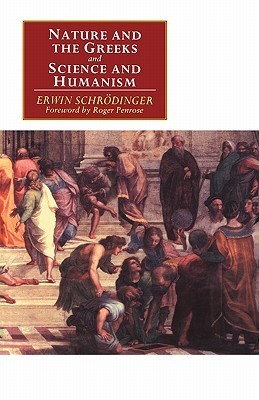
Nobel laureate Erwin Schrödinger was one of the most distinguished scientists and philosophers of the twentieth century, and his lectures are legendary. Here the texts of two of Schrödinger's most famous lecture series are made available again. In the first, entitled "Nature and the Greeks," Schrödinger offers a historical account of the scientific world picture. In the second, called "Science and Humanism," he addresses fundamental questions about the link between scientific and spiritual matters. As Roger Penrose confirms, these are the profound thoughts of a great mind, and as relevant today as when they were first published in the 1950s.

Four public lectures delivered by the author at university College Dublin in February, 1950.

Why would we want to read a scientific book from 1943? Because of who wrote it - Erwin Schrödinger was a part of the generation of physicists that thrust the world into the Quantum Age. Included in that constellation of minds were Einstein, Bohr, Sommerfeld, Fermi, Heisenberg, Pauli and Geiger. Schrödinger's equation, which calculates wave functions within a system, remains one of the foundations of quantum mechanics. He is best known, however, for the thought experiment, "Schrödinger's Cat." Schrödinger was the first to hypothesis that molecules could store information. Crick and Watson credited "What is Life?" for helping them toward the discovery of DNA. Topics include the hereditary mechanism, mutations, the interrelation of order, disorder and entropy, and an epilogue on determinism vs. free will.

Nobel laureate's brilliant attempt to develop a simple, unified standard method of dealing with all cases of statistical thermodynamics — classical, quantum, Bose-Einstein, Fermi-Dirac, and more.The work also includes discussions of Nernst theorem, Planck's oscillator, fluctuations, the n-particle problem, problem of radiation, and much more.

El siglo XX pasará sin duda como uno de los periodos en que la humanidad habrá presenciado los cambios científicos más revolucionarios de su historia. Erwin Schrödinger, Premio Nobel de Física, fue, junto con Einstein, uno de los primeros en contribuir a estos cambios. Sin embargo, en 1948, cuando dictó el curso que, poco después, se convirtió en el libro que publicamos ahora, aconsejaba a sus discípulos que volvieran su atención hacia los pensadores de la Antigüedad, pese a todos los adelantos científicos de que entonces ya se disponía.Su interés por los orígenes del pensamiento científico parte de la preocupación por conocer las causas intrínsecas del conflicto entre religión y ciencia, entre filosofía y física, conflicto que se ha ido agravando desde el renacer de la ciencia en el siglo XVII hasta nuestros días y que surge de una pregunta primordial, aún no resuelta: ¿de dónde vengo y adónde voy? Pues, Schrödinger, sumergido por su propia actividad en la investigación de la naturaleza profunda de la realidad física, se propuso intentar descubrir cuál es el lugar de la humanidad en relación con esta «realidad» y averiguar cómo los grandes pensadores del pasado examinaron esta cuestión. ¿Quién mejor que él para guiarnos a nosotros en esta apasionante exploración de los orígenes, cuando filosofía y ciencia formaban parte de un único pensamiento?

This third, augmented edition contains the six original, famous papers in which Schrödinger created and developed the subject of Wave Mechanics as published in the original edition. As the author points out, at the time each paper was written the results of the later papers were largely unknown to him. The papers and lectures in this volume were revised by the author and translated into English, and afford the reader a striking and valuable insight into how Wave Mechanics developed.
Reprint of a classical book first published in 1950. This lucid and profound exposition of Einstein's 1915 theory of gravitation is essential reading.

Questo libro presenta una raccolta di saggi, eseguita su indicazione dell'autore stesso, che abbraccia un periodo compreso tra il 1929 e il 1958; essa include il discorso tenuto da Schrodinger in occasione del conferimento del premio Nobel, in cui egli espone "L'idea fondamentale della meccanica ondulatoria". Tre sono i motivi guida che ricorrono in questo libro, e nel pensiero dell'autore. Innanzitutto, il grande dibattito sui fondamenti della meccanica quantistica, rispetto alla quale Schrodinger, che pure ne fu uno dei creatori, mantenne una posizione critica, con un'inflessibilità filosoficamente motivata. In un secondo gruppo di saggi, l'autore ritrova le radici della comprensione razionale del mondo nel pensiero greco classico, del quale mette in luce lo straordinario sforzo teorico e individua alcuni caratteri essenziali, comuni ai Greci e a noi. In terzo luogo, egli dedica la propria riflessione all'impossibilità di sottoporre il soggetto a indagine scientifica: emergono qui le sue più vaste conoscenze filosofiche (e religiose) sulla coscienza individuale e sulla natura del reale. Accessibili anche al lettore sprovvisto di conoscenze tecniche, questi saggi tratteggiano una figura affascinante di scienziato filosofo, e sono illuminanti per l'originalità delle concezioni e per la chiarezza incisiva dello stile.


The Interpretation of Quantum Mechanics: Dublin Seminars(1949-1955) and Other Unpublished Essays
by Erwin Schrödinger
Rating: 3.9 ⭐

Originally published in 1956, this book was based on a brief course of lectures delivered during the summer term of 1954 at the Dublin Institute for Advanced Studies. It provides a concise interpretation of universe expansion and contemporary theories relating to it.

Эту книгу называют философским завещанием Эрвина Шредингера. В ней изложено мировоззрение ученого-естественника, который оказал значительное влияние на развитие современной физики.Все возможно ровно до тех пор, пока не сделан выбор.Представьте, что у вас есть ящик с радиоактивным ядром и емкостью с ядовитым газом. Вероятность того, что ядро распадется и приведет в действие механизм, открывающий емкость, составляет 50 %. Если в этот ящик поместить кота и закрыть его, возникнет парадокс Шредингера. Согласно квантовой механике, если над ядром не производится наблюдения, то его состояние описывается смешением двух состояний – распавшегося и нераспавшегося ядра, следовательно, кот, сидящий в ящике, и жив, и мертв одновременно.Для тех, кто хочет знать больше, для тех, кто осмелится выяснить, в чем именно заключается парадокс теории Шредингера, для тех, кто хочет узнать, что такое жизнь с точки зрения физики, великий ученый написал свое последнее и лучшее произведение.
![What is Life? The Physical Aspect of the Living Cell & Mind and Matter. [2 books in 1]](https://m.media-amazon.com/images/S/compressed.photo.goodreads.com/books/1698014899i/130039384.jpg)
What is Life? The Physical Aspect of the Living Cell & Mind and Matter. [2 books in 1]
by Erwin Schrödinger
Rating: 4.3 ⭐

Nobel fizik ödülü sahibi Erwin Schrödinger'in “Yaşam Nedir?” isimli kitabı 20. yüzyılın en önemli bilim klasiklerinden biridir. Kitap genel okur için yazılmıştır. Ancak moleküler biyolojinin doğuşu sırasında ve bunu takiben DNA'nın keşfedilmesi sürecinde bu kitabın esin kaynağı olduğu söylenmektedir. Üç bölümden oluşan kitapta “Yaşam Nedir?” makalesini takiben ilkçağlardan bu yana filozofları en çok uğraştıran konulardan birinin ele alındığı “Zihin ve Madde” makalesi yer almaktadır. Klasikleşmiş bu iki makalenin ardından “Otobiyografik Denemeler” gelir. Bu bölümde okur Schrödinger'in yaşamından kesitleri takip ederek bilimsel yazılarının arka planını görebilir. Bu kitap çok yüzeyli bir mücevher gibi... birkaç saat içinde okunur; ömür boyu unutulmaz.Scientific AmericanBu küçük kitapta Erwin Schrödinger yaşamın sırlarını çözmeye çalışan bir bilimcinin karşılaştığı büyük kavramsal meseleleri açıklıkla ve özlü bir biçimde anlatıyor. Bütün öğrenciler bu kitabı okumalıdır.Paul Davies

La nueva mecánica ondulatoria y otros escritos (Clásicos del Pensamiento nº 15)
by Erwin Schrödinger
Rating: 3.2 ⭐
Erwin Schrödinger (premio Nobel de Física, 1933) no sólo ha sido uno de los científicos más relevantes del siglo XX, sino que siempre tuvo inquietudes filosóficas que le llevaron a reflexiones cuyo interés no ha decaído desde el momento en que fueron formuladas. Este libro recoge una selección de las muestras más significativas de su pensamiento, así como el texto de las conferencias del curso que impartió en Santander durante el verano de 1934, en la versión que realizó Xavier Zubiri, donde sintetiza los principales aspectos de la entonces recién descubierta teoría cuántica.


Erwin Schrödinger, Premio Nobel de física en 1933, no sólo fue un gran científico sino un verdadero humanista, que se interesó prácticamente por todos los aspectos de la cultura y el arte. Amante de la poesía, él mismo se expresó en este género literario recogiendo parte de sus poemas en un libro en 1949. En la selección aquí presentada se han sumado otros poemas hasta ahora dispersos, así como un fingido diálogo de Galileo, también debido a su pluma —todo ello traducido por primera vez a la lengua española—. La sutileza y humor que se detectan en estos escritos no estaba ausente de su obra científica: enormemente popular es su ficticio experimento referido a un aspecto de la teoría cuántica, según el cual un gato podría estar a la vez vivo y muerto en una caja. Su descubrimiento fundamental fue la ecuación de ondas, que lleva su nombre, de la que Max Planck dijo que «hacía época» y Einstein que era obra de «un auténtico genio». La importancia de dicha ecuación, afirma Jesús Navarro Faus (Schrödinger: una ecuación y un gato), «deriva de que es el punto de partida para estudiar los sistemas cuánticos no relativistas y juega en ellos el mismo papel que la ecuación de Newton en la física clásica».«Muchas fueron las páginas que escribió Erwin Schrödinger, y entre ellas figuran diarios y poemas. (…) Su lectura revela que entretejía poesía y vida; podía emplearla para invitar a una cerveza, celebrar su cuarenta cumpleaños con un “Epitafio por si muero hoy”, expresar respeto a su predecesor —Max Planck— en el momento de sucederle en la cátedra de Berlín, crear un relato épico para su tía Rhoda o cantar el temblor de una amada en sus brazos. Erwin Schrödinger, pues, no sólo se acercaba intelectualmente a distintos campos, sino vitalmente, logrando ese “milagro”, esa conjunción de las “diversas áreas de experiencia personal”.»Clara Janés


Paperback first edition 1956

''What Is Life? The Physical Aspect of the Living Cell'' is a science book written for the lay reader by the physicist Erwin Schrödinger. The book was based on a course of public lectures delivered by Schrödinger. Schrödinger's lecture focused on one important "how can the events in space and time which take place within the spatial boundary of a living organism be accounted for by physics and chemistry?"In the book, Schrödinger introduced the idea of an "aperiodic solid" that contained genetic information in its configuration of covalent chemical bonds. In the 1940s, this idea stimulated enthusiasm for discovering the chemical basis of genetic inheritance. Although the existence of some form of hereditary information had been hypothesized since 1869, its role in reproduction and its helical shape were still unknown at the time of Schrödinger's lecture. In 1953, James D. Watson and Francis Crick jointly proposed the double helix structure of deoxyribonucleic acid (DNA) on the basis of, amongst other theoretical insights,X-ray diffraction experiments conducted by Rosalind Franklin. They both credited Schrödinger's book with presenting an early theoretical description of how the storage of genetic information would work, and each independently acknowledged the book as a source of inspiration for their researches.

The Historical Development of Quantum Theory : Volume 5 - Part 2: Erwin Schrodinger & the Rise of Wave Mechanics: The Creation of Wave Mechanics, Early Response & Applications 1925-26
by Erwin Schrödinger
Rating: 4.0 ⭐
Quantum Theory, together with the principles of special and general relativity, constitute a scientific revolution that has profoundly influenced the way in which we think about the universe and the fundamental forces that govern it. The Historical Development of Quantum Theory is a definitive historical study of that scientific work and the human struggles that accompanied it from the beginning. Drawing upon such materials as the resources of the Archives for the History of Quantum Physics, the Niels Bohr Archives, and the archives and scientific correspondence of the principal quantum physicists, as well as Jagdish Mehra's personal discussions over many years with most of the architects of quantum theory, the authors have written a rigorous scientific history of quantum theory in a deeply human context. This multivolume work presents a rich account of an intellectual triumph: a unique analysis of the creative scientific process. The Historical Development of Quantum Theory is science, history, and biography, all wrapped in the story of a great human enterprise. Its lessons will be an aid to those working in the sciences and humanities alike.

Der Wiener Physiker Erwin Schrödinger (1887-1961) leistete bahnbrechende Arbeiten zur Wellenmechanik und Quantentheorie, für die er unter anderem mit dem Nobelpreis ausgezeichnet wurde. Untrennbar mit seinem Namen verbunden sind die von ihm entdeckte "Schrödinger-Gleichung" sowie sein berühmtes Gedankenexperiment "Schrödinger's Katze". Die vorliegende Audio-Edition versammelt die beiden einzigen vollständig erhaltenen Originaltonaufnahmen Schrö einen Vortrag von 1952 in deutscher "Unsere Vorstellung von der Materie" (71 Minuten) und einen, 1949 auf Wachsplatten aufgenommenen Kurzvortrag in Do Electrons Think? (15 Minuten)."Es ist für mich - aber auch für Sie, meine verehrten Zuhörer - recht fatal, daß das Bild der Materie, das ich vor Ihnen aufbauen soll, noch gar nicht existiert, sondern bloß Bruchstücke von mehr oder weniger partiellem Wahrheitswert. Das hat nämlich zur Folge, daß man bei einer solchen Erzählung nicht umhin kann, an einer späteren Stelle dem zu widersprechen, was man an einer früheren gesagt hat; etwa so wie Cervantes einmal den Sancho Pansa sein liebes Eselchen, auf dem er reitet, verlieren läßt, aber ein paar Kapitel später hat der Autor das vergessen, und das gute Tier ist wieder da..."
What is Life? The Physical Aspect of the Living Cell. Based on Lectures Delivered Under the Auspices of the Institute at Trinity College, Dublin, in Feb. 1943
by Erwin Schrödinger
Rating: 5.0 ⭐
What Is Life?: The Physical Aspect of the Living Cell & Mind & Matter
by Erwin Schrödinger
Rating: 5.0 ⭐


peer-review report, research fascicle, electronic matter, QED, Scrodinger, expanding universe