
Freeman Dyson
Freeman Dyson was a physicist and educator best known for his speculative work on extraterrestrial civilizations and for his work in quantum electrodynamics, solid-state physics, astronomy and nuclear engineering. He theorized several concepts that bear his name, such as Dyson's transform, Dyson tree, Dyson series, and Dyson sphere. The son of a musician and composer, Dyson was educated at the University of Cambridge. As a teenager he developed a passion for mathematics, but his studies at Cambridge were interrupted in 1943, when he served in the Royal Air Force Bomber Command. He received a B.A. from Cambridge in 1945 and became a research fellow of Trinity College. In 1947 he went to the United States to study physics and spent the next two years at Cornell University, Ithaca, N.Y., and Princeton, where he studied under J. Robert Oppenheimer, then director of the Institute for Advanced Study. Dyson returned to England in 1949 to become a research fellow at the University of Birmingham, but he was appointed professor of physics at Cornell in 1951 and two years later at the Institute for Advanced Study, where he became professor emeritus in 2000. He became a U.S. citizen in 1957.
28 Books Written

Imagine a world where whole epochs will pass, cultures rise and fall, between a telephone call and the reply. Think of the human race multiplying 500-million fold, or evolving new, distinct species. Consider the technology of space colonization, computer-assisted reproduction, the “Martian potato.” One hundred years after H. G. Wells visited the future in The Time Machine , Freeman Dyson marshals his uncommon gifts as a scientist and storyteller to take us once more to that ever-closer, ever-receding time to come.Since Disturbing the Universe , the book that first brought him international renown, Freeman Dyson has been helping us see ourselves and our world from a scientist’s point of view. In Imagined Worlds he brings this perspective to a speculative future to show us where science and technology, real and imagined, may be taking us. The stories he tells―about “Napoleonic” versus “Tolstoyan” styles of doing science; the coming era of radioneurology and radiotelepathy; the works of writers from Aldous Huxley to Michael Crichton to William Blake; Samuel Gompers and the American labor movement―come from science, science fiction, and history. Sharing in the joy and gloom of these sources, Dyson seeks out the lessons we must learn from all three if we are to understand our future and guide it in hopeful directions.Whether looking at the Gaia theory or the future of nuclear weapons, science fiction or the dangers of “science worship,” seagoing kayaks or the Pluto Express , Dyson is concerned with ethics, with how we might mitigate the evil consequences of technology and enhance the good. At the heart of it all is the belief once expressed by the biologist J. B. S. Haldane, that progress in science will bring enormous confusion and misery to humankind unless it is accompanied by progress in ethics.
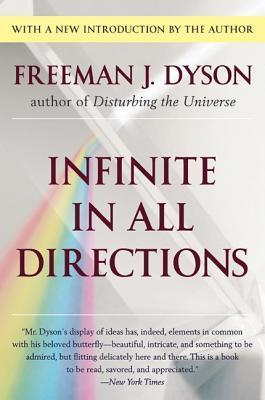
Infinite in All Directions is a popularized science at its best. In Dyson's view, science and religion are two windows through which we can look out at the world around us. The book is a revised version of a series of the Gifford Lectures under the title "In Praise of Diversity" given at Aberdeen, Scotland. They allowed Dyson the license to express everything in the universe, which he divided into two parts in polished focusing on the diversity of the natural world as the first, and the diversity of human reactions as the second half. Chapter 1 is a brief explanation of Dyson's attitudes toward religion and science. Chapter 2 is a one–hour tour of the universe that emphasizes the diversity of viewpoints from which the universe can be encountered as well as the diversity of objects which it contains. Chapter 3 is concerned with the history of science and describes two contrasting styles in one welcoming diversity and the other deploring it. He uses the cities of Manchester and Athens as symbols of these two ways of approaching science. Chapter 4, concerned with the origin of life, describes the ideas of six illustrious scientists who have struggled to understand the nature of life from various points of view. Chapter 5 continues the discussion of the nature and evolution of life. The question of why life characteristically tends toward extremes of diversity remains central in all attempts to understand life's place in the universe. Chapter 6 is an exercise in eschatology, trying to define possible futures for life and for the universe, from here to infinity. In this chapter, Dyson crosses the border between science and science fiction and he frames his speculations in a slightly theological context.

The autobiography of one of the world's greatest scientistsSpanning the years from World War II, when he was a civilian statistician in the operations research section of the Royal Air Force Bomber Command, through his studies with Hans Bethe at Cornell University, his early friendship with Richard Feynman, and his postgraduate work with J. Robert Oppenheimer, Freeman Dyson has composed an autobiography unlike any other. Dyson evocatively conveys the thrill of a deep engagement with the world-be it as scientist, citizen, student, or parent. Detailing a unique career not limited to his groundbreaking work in physics, Dyson discusses his interest in minimizing loss of life in war, in disarmament, and even in thought experiments on the expansion of our frontiers into the galaxies.

An illuminating collection of essays by an award-winning scientist whom the London Times calls “one of the world’s most original minds.” From Galileo to today’s amateur astronomers, scientists have been rebels, writes Freeman Dyson. Like artists and poets, they are free spirits who resist the restrictions their cultures impose on them. In their pursuit of Nature’s truths, they are guided as much by imagination as by reason, and their greatest theories have the uniqueness and beauty of great works of art.Dyson argues that the best way to understand science is by understanding those who practice it. He tells stories of scientists at work, ranging from Isaac Newton’s absorption in physics, alchemy, theology, and politics, to Ernest Rutherford’s discovery of the structure of the atom, to Albert Einstein’s stubborn hostility to the idea of black holes. His descriptions of brilliant physicists like Edward Teller and Richard Feynman are enlivened by his own reminiscences of them. He looks with a skeptical eye at fashionable scientific fads and fantasies, and speculates on the future of climate prediction, genetic engineering, the colonization of space, and the possibility that paranormal phenomena may exist yet not be scientifically verifiable.Dyson also looks beyond particular scientific questions to reflect on broader philosophical issues, such as the limits of reductionism, the morality of strategic bombing and nuclear weapons, the preservation of the environment, and the relationship between science and religion. These essays, by a distinguished physicist who is also a lovely writer, offer informed insights into the history of science and fresh perspectives on contentious current debates about science, ethics, and faith.

How did life on Earth originate? Did replication or metabolism come first in the history of life? In the second edition of the acclaimed Origins of Life, distinguished scientist and science writer Freeman Dyson examines these questions and discusses the two main theories that try to explain how naturally occurring chemicals could organize themselves into living creatures. The majority view is that life began with replicating molecules, the precursors of modern genes. The minority belief is that random populations of molecules evolved metabolic activities before exact replication existed and that natural selection drove the evolution of cells toward greater complexity for a long time without the benefit of genes. Dyson analyzes both of these theories with reference to recent important discoveries by geologists and chemists, aiming to stimulate new experiments that could help decide which theory is correct. This second edition covers the impact revolutionary discoveries such as the existence of ribozymes, enzymes made of RNA; the likelihood that many of the most ancient creatures are thermophilic, living in hot environments; and evidence of life in the most ancient of all terrestrial rocks in Greenland have had on our ideas about how life began. It is a clearly written, fascinating book that will appeal to anyone interested in the origins of life.
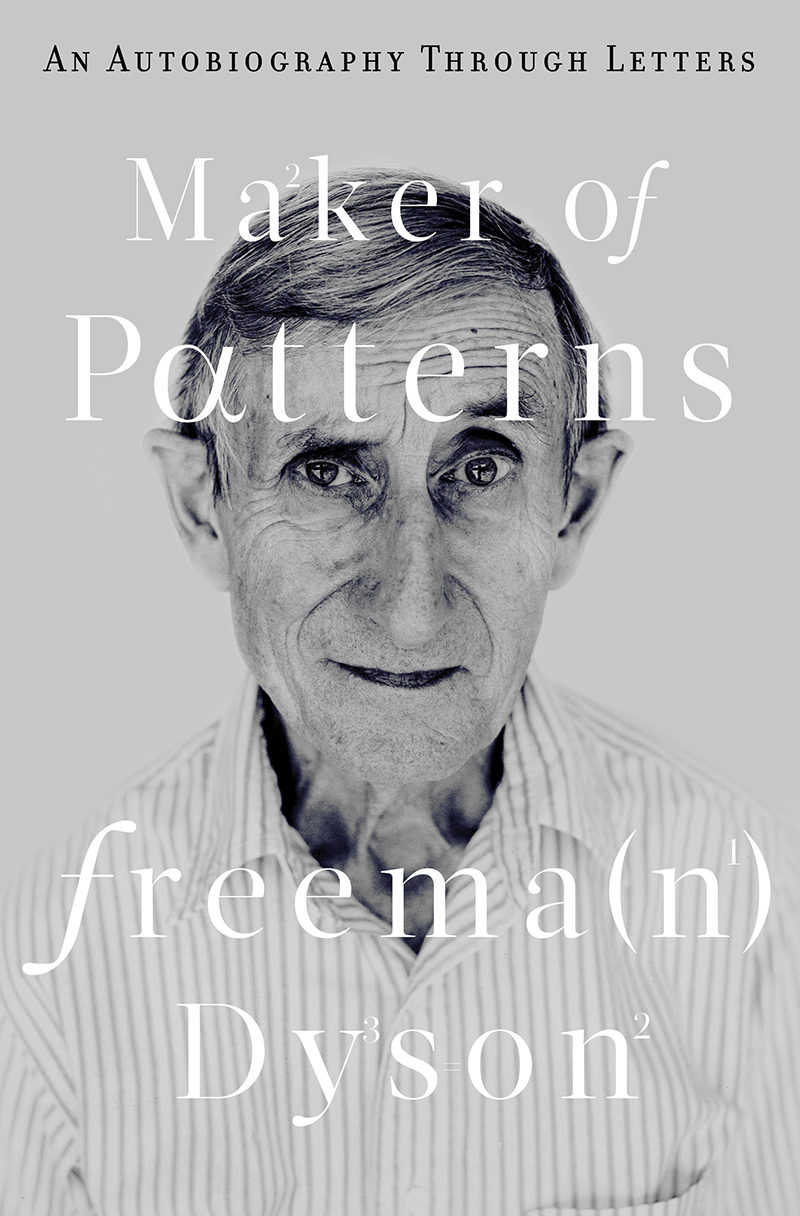
Having penned hundreds of letters to his family over four decades, Freeman Dyson has framed them with the reflections made by a man now in his nineties. While maintaining that “the letters record the daily life of an ordinary scientist doing ordinary work,” Dyson nonetheless has worked with many of the twentieth century’s most renowned physicists, mathematicians, and intellectuals, so that Maker of Patterns presents not only his personal story but chronicles through firsthand accounts an exciting era of twentieth-century science.Though begun in the dark year of 1941 when Hitler’s armies had already conquered much of Europe, Dyson’s letters to his parents, written at Trinity College, Cambridge, often burst with the curiosity of a precocious seventeen-year-old. Pursuing mathematics and physics with a cast of legendary professors, Dyson thrived in Cambridge’s intellectual ferment, working on, for example, the theory of partitions or reading about Kurt Gödel’s hypotheses, while still finding time for billiards and mountain climbing. After graduating and serving with the Royal Air Force’s Bomber Command operational research section, whose job it was “to demolish German cities and kill as many German civilians as possible,” Dyson visited a war-torn Germany, hoping through his experience to create a “tolerably peaceful world.”Juxtaposing descriptions of scientific breakthroughs with concerns for mankind’s future, Dyson’s postwar letters reflect the quandaries faced by an entire scientific generation that was dealing with the aftereffects of nuclear detonations and concentration camp killings. Arriving in America in 1947 to study with Cornell’s Hans Bethe, Dyson continued to send weekly missives to England that were never technical but written with grace and candor, creating a portrait of a generation that was eager, as Einstein once stated, to solve “deep mysteries that Nature intend[ed] to keep for herself.”We meet, among others, scientists like Richard Feynman, who took Dyson across country on Route 66, Robert Oppenheimer, Eugene Wigner, Niels Bohr, James Watson, and a young Stephen Hawking; and we encounter intellectuals and leaders, among them Reinhold Niebuhr, George Kennan, Arthur C. Clarke, as well as Martin Luther King, Jr.The “patterns of comparable beauty in the dance of electrons jumping around atoms” invariably replicate themselves in this autobiography told through letters, one that combines accounts of wanton arms development with the not-inconsiderable demands of raising six children. As we once again attempt to guide society toward a more hopeful future, these letters, with their reenactment of what, at first, seems like a distant past, reveal invaluable truths about human nature.

In this visionary look into the future, Freeman Dyson argues that technological changes fundamentally alter our ethical and social arrangements and that three rapidly advancing new technologies--solar energy, genetic engineering, and world-wide communication--together have the potential to create a more equal distribution of the world's wealth.Dyson begins by rejecting the idea that scientific revolutions are primarily concept driven. He shows rather that new tools are more often the sparks that ignite scientific discovery. Such tool-driven revolutions have profound social consequences--the invention of the telescope turning the Medieval world view upside down, the widespread use of household appliances in the 1950s replacing servants, to cite just two examples. In looking ahead, Dyson suggests that solar energy, genetics, and the Internet will have similarly transformative effects, with the potential to produce a more just and equitable society. Solar power could bring electricity to even the poorest, most remote areas of third world nations, allowing everyone access to the vast stores of information on the Internet and effectively ending the cultural isolation of the poorest countries. Similarly, breakthroughs in genetics may well enable us to give our children healthier lives and grow more efficient crops, thus restoringthe economic and human vitality of village cultures devalued and dislocated by the global market.Written with passionate conviction about the ethical uses of science, The Sun, the Genome, and the Internet is both a brilliant reinterpretation of the scientific process and a challenge to use new technologies to close, rather than widen, the gap between rich and poor.

In this sequel to The Scientist as Rebel (2006), Freeman Dyson—whom The Times of London calls “one of the world’s most original minds”—celebrates openness to unconventional ideas and “the spirit of joyful dreaming” in which he believes that science should be pursued. Throughout these essays, which range from the creation of the Royal Society in the seventeenth century to the scientific inquiries of the Romantic generation to recent books by Daniel Kahneman and Malcolm Gladwell, he seeks to “break down the barriers that separate science from other sources of human wisdom.” Dyson discusses twentieth-century giants of physics such as Richard Feynman, J. Robert Oppenheimer, Paul Dirac, and Steven Weinberg, many of whom he knew personally, as well as Winston Churchill’s pursuit of nuclear weapons for Britain and Wernher von Braun’s pursuit of rockets for space travel. And he takes a provocative, often politically incorrect approach to some of today’s most controversial scientific global warming, the current calculations of which he thinks are probably wrong; the future of biotechnology, which he expects to dominate our lives in the next half-century as the tools to design new living creatures become available to everyone; and the flood of information in the digital age. Dyson offers fresh perspectives on the history, the philosophy, and the practice of scientific inquiry—and even on the blunders, the wild guesses and wrong theories that are also part of our struggle to understand the wonders of the natural world.

The most comprehensive collection of Einstein quotations ever publishedHere is the definitive new edition of the hugely popular collection of Einstein quotations that has sold tens of thousands of copies worldwide and been translated into twenty-five languages.The Ultimate Quotable Einstein features 400 additional quotes, bringing the total to roughly 1,600 in all. This ultimate edition includes new sections―"On and to Children," "On Race and Prejudice," and "Einstein's A Small Selection"―as well as a chronology of Einstein’s life and accomplishments, Freeman Dyson’s authoritative foreword, and new commentary by Alice Calaprice.In The Ultimate Quotable Einstein , readers will also find quotes by others about Einstein along with quotes attributed to him. Every quotation in this informative and entertaining collection is fully documented, and Calaprice has carefully selected new photographs and cartoons to introduce each section.

Freeman Dyson's latest book does not attempt to bring together all of the celebrated physicist's thoughts on science and technology into a unified theory. The emphasis is, instead, on the myriad ways in which the universe presents itself to us--and how, as observers and participants in its processes, we respond to it. "Life, like a dome of many-colored glass," wrote Percy Bysshe Shelley, "stains the white radiance of eternity." The author seeks here to explore the variety that gives life its beauty.Taken from Dyson's recent public lectures--delivered to audiences with no specialized knowledge in hard sciences--the book begins with a consideration of the practical and political questions surrounding biotechnology. As he seeks how best to explain the place of life in the universe, Dyson then moves from the ethical to the purely scientific. The book concludes with an attempt to understand the implications of biology for philosophy and religion.The pieces in this collection touch on numerous disciplines, from astronomy and ecology to neurology and theology, speaking to the lay reader as well as to the scientist. As always, Dyson's view of human nature and behavior is balanced, and his predictions of a world to come serve primarily as a means for thinking about the world as it is today.

This collection of essays and articles range across the author's many interests including theoretical physics, the origins of life, technological development, the bomb and nuclear politics.

Explores ways to live and survive in a nuclear age and examines the key areas of public morality, weapons technology, and international policy. (Amazon.com)

This book is a sequel to the volume published by the American Mathematical Society in 1996 — Selected Papers of Freeman Dyson with Commentary — that contains a selection of Dyson's papers up to 1990. The current edition comprises a collection of the most interesting writings of Freeman Dyson from the period 1990–2014, and was personally selected by the author.The first of five sections introduces how the various items came to be written, while the second includes Talks about Science. The most substantial is a lecture to the American Mathematical Society — Birds and Frogs — describing two kinds of mathematician, with examples from real life. An important tribute to Yang Chen Ning written for his retirement banquet at Stony Brook University can be found in the third, which is then followed by a section on Politics and History, the most substantial contribution being A Failure of Intelligence, a historical account of the failure of the Operational Research at RAF Bomber Command in World War II. The last and final section carries a recent article — Is a Graviton Detectable? — discussing the question whether any conceivable experiment could detect single gravitons, to provide direct evidence of the quantization of gravity. The question is still open. Various possible graviton-detectors are examined, and they all fail for one reason or another.This invaluable compilation, that also contains some unpublished lectures, surveys many subjects, in science, mathematics, history and politics, in which Freeman Dyson has been active and so well respected around the world.

Renowned physicist and mathematician Freeman Dyson is famous for his work in quantum mechanics, nuclear weapons policy and bold visions for the future of humanity. In the 1940s, he was responsible for demonstrating the equivalence of the two formulations of quantum electrodynamics -- Richard Feynman's diagrammatic path integral formulation and the variational methods developed by Julian Schwinger and Sin-Itiro Tomonoga -- showing the mathematical consistency of QED.This invaluable volume comprises the legendary, never-before-published, lectures on quantum electrodynamics first given by Dyson at Cornell University in 1951. The late theorist Edwin Thompson Jaynes once remarked "For a generation of physicists they were the happy clearer and motivated than Feynman, and getting to the point faster than Schwinger".Future generations of physicists are bound to read these lectures with pleasure, benefiting from the lucid style that is so characteristic of Dyson's exposition.

This book offers a unique compilation of papers in mathematics and physics from Freeman Dyson's 50 years of activity and research. These are the papers that Dyson considers most worthy of preserving, and many of them are classics. The papers are accompanied by commentary explaining the context from which they originated and the subsequent history of the problems that either were solved or left unsolved. This collection offers a connected narrative of the developments in mathematics and physics in which the author was involved, beginning with his professional life as a student of G. H. Hardy.



《宇宙波澜:科技与人类前途的自省》是一代量子力学巨擘弗里曼·戴森从事科学工作五十年以来的回忆,对科技与人类前途的浪漫的人文思考。 他把科学生活比作个人灵魂的航程,浪漫而生动地记述了许多著名科学家的风范与成就,原子炉、生命科技以及太空探索的研究历程与争议,同时由着作者的引导开始寻求科学对于人类的真正意义以及科学人在钻研探索时所应持的正确态度,还包括对科技发展与人类前途的一些深刻的省思。

Freeman Dyson (1923-2020) è considerato una figura di primissimo piano del mondo scientifico contemporaneo. Fisico e matematico inglese, naturalizzato americano, insegnava all’Institute for Advanced Studies di Princeton. Nel 1993 ha ottenuto il Premio Enrico Fermi dal Dipartimento per l’Energia degli Stati Uniti. Nel 2000 gli è stato assegnato il Premio Templeton. È autore di numerosi articoli e libri tradotti nelle principali lingue, tra i Turbare l’Universo (1981), Il Sole, il genoma e internet (2000) e Lo scienziato come ribelle (2008), Origini della vita (2014).«Se riusciremo a fuggire dalla Terra e a diffonderci nell’universo, le prossime migliaia di anni potranno rappresentare un’età dell’oro per la i viaggi spaziali esplorativi potranno aver superato i confini del sistema solare, a distanze interstellari, e i viaggi di esplorazione mentale si saranno forse già mossi in direzioni oggi difficili da immaginare. Non conosciamo nemmeno i nomi delle nuove scienze che potranno nascere e morire nell’arco di mille anni». Così Freeman Dyson, grande esploratore del mondo fisico, presenta la sua visione del futuro. Un futuro quasi fantascientifico, che diventa ogni giorno di più una realtà. Proprietà letteraria riservataI libri di questa collana sono il risultato di interviste dell’Editore con l’Autore. Stimolato da domande simili a quelle che Voi avreste voluto porre, l’Autore sviluppa chiaramente la materia oggetto della sua ricerca, qui riproposta in forma narrativa. Nessuna parte di questo libro può essere riprodotta o trasmessa in qualsiasi forma o con qualsiasi mezzo senza l’autorizzazione scritta dei proprietari dei diritti e dell’editore.Le fotocopie per uso personale del lettore possono essere effettuate nei limiti del 15% di ciascun volume/fascicolo di periodico dietro pagamento alla SIAE del compenso previsto dall’art. 68, commi 4 e 5, della Legge 22 aprile 1941 n. 633.Le fotocopie effettuate per finalità di carattere professionale, economico o commerciale o comunque per uso diverso da quello personale possono essere effettuate a seguito di specifica autorizzazione rilasciata da CLEARedi, Centro Licenze e Autorizzazioni per le Riproduzioni Editoriali, Corso di Porta Romana 108, 20122 Milano, autorizzazioni@clearedi.org e sito www.clearedi.org.In Pier Augusto Breccia, Oltre il sole.©1998 Di Renzo Editore2021 ebookViale Manzoni, 5900185 RomaTel. +39 06.77.20.90.20Fax +39 06.70.47.40.67 newsletter@direnzo.it


Vögel und Frösche (Die weltweit besten mathematischen Artikel im 21. Jahrhundert 1)
by Freeman Dyson
Rating: 3.0 ⭐
Freeman Dyson erzählt in seiner berühmten Einstein-Rede 'Birds and Frogs' von Vögeln und Fröschen. Vögel sind die, die hoch oben fliegen und weit sehen. Sie entwickeln großartige Konzepte und vereinigen unterschiedliche Disziplinen. Frösche sind solche, die die Blumen und die Erde sehen. Sie lösen unten im Dreck Probleme, eins nach dem anderen. Er erzählt von Vögeln und Fröschen, die die Mathematik, die Physik und die mathematische Physik vorantrieben und mit ihren Entdeckungen unser naturwissenschaftliches Weltbild geprägt haben. Die Art des wissenschaftlichen Arbeitens, Kommunizierens und natürlich auch die Entdeckungen des 20. Jahrhunderts stehen im Mittelpunkt der Rede. Er berichtet ganz persönlich von bedeutenden Mathematikern und Nobelpreisträgern. Mit einem Augenzwinkern gibt er Hinweise, wie man die Fields-Medaille gewinnen kann.Freeman Dyson hielt die Rede 'Birds and Frogs' 2008 in Vancouver. 2009 wurde sie von der American Mathematical Society veröffentlicht. Sie erscheint hier erstmals in Deutsch. Die Fotos von Yuuichirou Yamanishi geben dem Text eine neue Dimension. Zahlreiche Illustrationen vereinfachen das Verständnis mathematischer Zusammenhänge.Das Buch wendet sich an interessierte Leserinnen und Leser aus Naturwissenschaft, Mathematik, Physik und Geschichte der Wissenschaften.

Dyson Quantenfeldtheorie: Die weltbekannte Einführung von einem der Väter der QED
by Freeman Dyson
Rating: 2.0 ⭐
Die berühmte Vorlesung von Freeman Dyson - nun erstmals auf Deutsch. In den 1940er Jahren zeigte Freeman Dyson die Äquivalenz zwischen den beiden Formulierungen der QED - des Pfadintegralansatzes von Richard Feynman und der Variationsmethoden von Julian Schwinger - und bewies somit die Konsistenz der QED. Dieses Buch beinhaltet die wertvollen - nie zuvor auf Deutsch publizierten - Vorlesungen über Quantenfeldtheorie, die Dyson an der Cornell Universität 1951 gehalten hat. Der Theoretiker Edwin Thompson Jaynes bemerkte "Für eine Generation von Physikern waren diese Vorlesungen ein klarer und besser motiviert als Feynmans Vorlesungen, und schneller und kompakter als Schwingers." Zukünftige Leser werden diese Vorlesungen ebenfalls mit großem Genuss lesen und von dem klaren Stil profitieren, der für Dyson stets so charakteristisch gewesen ist. Aus dem 1 - Die Diracgleichung, 2 - Streuprobleme und die Born-Approximation, 3 - Die klassische und quantenmechanische Feldtheorie, 4 - Beispiele quantisierter Feldtheorien (Maxwellfeld, Diracelektronen), 5 - Streuprobleme freier Teilchen (Paar Annihilation, Möller-Streuung, Klein-Nishina-Formel), 6 - Allgemeine Theorie der Streuung (Feynman-Graphen, Infrarotkatastrophe), 7 - Streuung an einem statischen Potenzial und experimentelle Ergebnisse.

Leben, Was Ist Das? Ursprünge, Phänomene und die Zukunft Unserer Wirklichkeit
by Freeman Dyson
Rating: 2.0 ⭐
Rare Book
The Love of Gaia
by Freeman Dyson
![29 chapters around the science and humanity and space - real face of Gaia ISBN: 4875023855 (2005) [Japanese Import]](https://m.media-amazon.com/images/S/compressed.photo.goodreads.com/books/1678235773i/77116765.jpg)
29 chapters around the science and humanity and space - real face of Gaia ISBN: 4875023855 (2005) [Japanese Import]
by Freeman Dyson

宇宙をかき乱すべきか〈上〉
by Freeman Dyson