Loading genres...
Explore the best books about Design genre.


The ultimate guide to human-centered design Even the smartest among us can feel inept as we fail to figure out which light switch or oven burner to turn on, or whether to push, pull, or slide a door. The fault, argues this ingenious -- even liberating -- book, lies not in ourselves, but in product design that ignores the needs of users and the principles of cognitive psychology. The problems range from ambiguous and hidden controls to arbitrary relationships between controls and functions, coupled with a lack of feedback or other assistance and unreasonable demands on memorization. The Design of Everyday Things shows that good, usable design is possible. The rules are make things visible, exploit natural relationships that couple function and control, and make intelligent use of constraints. The guide the user effortlessly to the right action on the right control at the right time. The Design of Everyday Things is a powerful primer on how -- and why -- some products satisfy customers while others only frustrate them.
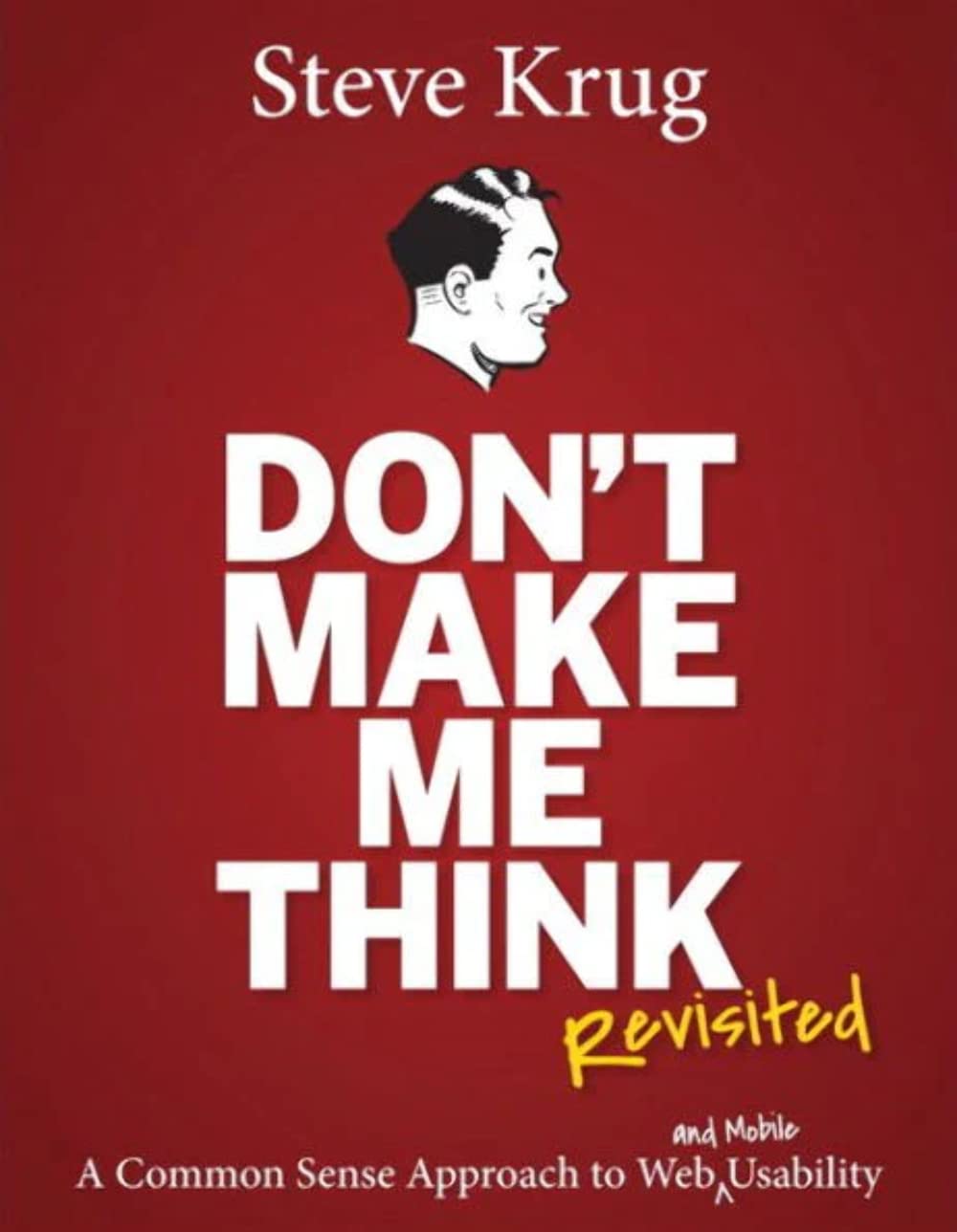
Since Don’t Make Me Think was first published in 2000, over 400,000 Web designers and developers have relied on Steve Krug’s guide to help them understand the principles of intuitive navigation and information design.In this 3rd edition, Steve returns with fresh perspective to reexamine the principles that made Don’t Make Me Think a classic-–with updated examples and a new chapter on mobile usability. And it’s still short, profusely illustrated…and best of all–fun to read.If you’ve read it before, you’ll rediscover what made Don’t Make Me Think so essential to Web designers and developers around the world. If you’ve never read it, you’ll see why so many people have said it should be required reading for anyone working on Web sites.

Praised throughout the cartoon industry by such luminaries as Art Spiegelman, Matt Groening, and Will Eisner, this innovative comic book provides a detailed look at the history, meaning, and art of comics and cartooning.

Meadows’ Thinking in Systems, is a concise and crucial book offering insight for problem solving on scales ranging from the personal to the global. Edited by the Sustainability Institute’s Diana Wright, this essential primer brings systems thinking out of the realm of computers and equations and into the tangible world, showing readers how to develop the systems-thinking skills that thought leaders across the globe consider critical for 21st-century life.Some of the biggest problems facing the world—war, hunger, poverty, and environmental degradation—are essentially system failures. They cannot be solved by fixing one piece in isolation from the others, because even seemingly minor details have enormous power to undermine the best efforts of too-narrow thinking.While readers will learn the conceptual tools and methods of systems thinking, the heart of the book is grander than methodology. Donella Meadows was known as much for nurturing positive outcomes as she was for delving into the science behind global dilemmas. She reminds readers to pay attention to what is important, not just what is quantifiable, to stay humble, and to stay a learner.In a world growing ever more complicated, crowded, and interdependent, Thinking in Systems helps readers avoid confusion and helplessness, the first step toward finding proactive and effective solutions.

A fascinating deep dive on innovation from the New York Times bestselling author of How We Got To Now and FarsightedThe printing press, the pencil, the flush toilet, the battery--these are all great ideas. But where do they come from? What kind of environment breeds them? What sparks the flash of brilliance? How do we generate the breakthrough technologies that push forward our lives, our society, our culture? Steven Johnson's answers are revelatory as he identifies the seven key patterns behind genuine innovation, and traces them across time and disciplines. From Darwin and Freud to the halls of Google and Apple, Johnson investigates the innovation hubs throughout modern time and pulls out the approaches and commonalities that seem to appear at moments of originality.

‘A breakthrough book. Wonderfully applicable to everything in life, and funny as hell.’ Nassim Nicholas TalebTo be brilliant, you have to be irrationalWhy is Red Bull so popular – even though everyone hates the taste? Why do countdown boards on platforms take away the pain of train delays? And why do we prefer stripy toothpaste?We think we are rational creatures. Economics and business rely on the assumption that we make logical decisions based on evidence.But we aren’t, and we don’t.In many crucial areas of our lives, reason plays a vanishingly small part. Instead we are driven by unconscious desires, which is why placebos are so powerful. We are drawn to the beautiful, the extravagant and the absurd – from lavish wedding invitations to tiny bottles of the latest fragrance. So if you want to influence people’s choices you have to bypass reason. The best ideas don’t make rational sense: they make you feel more than they make you think.Rory Sutherland is the Ogilvy advertising legend whose TED Talks have been viewed nearly 7 million times. In his first book he blends cutting-edge behavioural science, jaw-dropping stories and a touch of branding magic, on his mission to turn us all into idea alchemists. The big problems we face every day, whether as an individual or in society, could very well be solved by letting go of logic and embracing the irrational.

Written for anyone who wants to grow at work—from young grads navigating their first jobs to CEOs deciding whether to sell their company—Build is full of personal stories, practical advice and fascinating insights into some of the most impactful products and people of the 20th century.Each quick 5-20 page entry builds on the previous one, charting Tony’s personal journey from a product designer to a leader, from a startup founder to an executive to a mentor. Tony uses examples that are instantly captivating, like the process of building the very first iPod and iPhone. Every chapter is designed to help readers with a problem they’re facing right now—how to get funding for their startup, whether to quit their job or not, or just how to deal with the jerk in the next cubicle.Tony forged his path to success alongside mentors like Steve Jobs and Bill Campbell, icons of Silicon Valley who succeeded time and time again. But Tony doesn’t follow the Silicon Valley credo that you have to reinvent everything from scratch to make something great. His advice is unorthodox because it’s old school. Because Tony’s learned that human nature doesn’t change. You don’t have to reinvent how you lead and manage—just what you make.

In this book about the darker side of technology's impact on our lives, Alan Cooper begins by explaining that unlike other devices throughout history, computers have a "meta function": an unwanted, unforeseen option that users may accidentally invoke with what they thought was a normal keystroke. Cooper details many of these meta functions to explain his central thesis: programmers need to seriously re-evaluate the many user-hostile concepts deeply embedded within the software development process. Rather than provide users with a straightforward set of options, programmers often pile on the bells and whistles and ignore or de-prioritise lingering bugs. For the average user, increased functionality is a great burden, adding to the recurrent chorus that plays: "computers are hard, mysterious, unwieldy things." (An average user, Cooper asserts, who doesn't think that way or who has memorised all the esoteric commands and now lords it over others, has simply been desensitised by too many years of badly designed software.) Cooper's writing style is often overblown, with a pantheon of cutesy terminology (i.e. "dancing bearware") and insider back-patting. (When presenting software to Bill Gates, he reports that Gates replied: "How did you do that?" to which he writes: "I love stumping Bill!") More seriously, he is also unable to see beyond software development's importance--a sin he accuses programmers of throughout the book. Even with that in mind, the central questions Cooper asks are too important to ignore: Are we making users happier? Are we improving the process by which they get work done? Are we making their work hours more effective? Cooper looks to programmers, business managers and what he calls "interaction designers" to question current assumptions and mindsets. Plainly, he asserts that the goal of computer usage should be "not to make anyone feel stupid." Our distance from that goal reinforces the need to rethink entrenched priorities in software planning. -- Jennifer Buckendorff, Amazon.com

THE classic work about improving creativity from world-renowned writer and philosopher Edward de Bono.In schools we are taught to meet problems head-on: what Edward de Bono calls 'vertical thinking'. This works well in simple situations - but we are at a loss when this approach fails. What then?Lateral thinking is all about freeing up your imagination. Through a series of special techniques, in groups or working alone, Edward de Bono shows how to stimulate the mind in new and exciting ways.Soon you will be looking at problems from a variety of angles and offering up solutions that are as ingenious as they are effective. You will become much more productive and a formidable thinker in your own right.

Here's something you may not know about today's Internet. Simply by designing your product the right way, you can build a flourishing business from scratch. No advertising or marketing budget, no need for a sales force, and venture capitalists will flock to throw money at you. Many of the most successful Web 2.0 companies, including MySpace, YouTube, eBay, and rising stars like Twitter and Flickr, are prime examples of what journalist Adam L. Penenberg calls a "viral loop"--to use it, you have to spread it. After all, what's the sense of being on Facebook if none of your friends are? The result: Never before has there been the potential to create wealth this fast, on this scale, and starting with so little. In this game-changing must-read, Penenberg tells the fascinating story of the entrepreneurs who first harnessed the unprecedented potential of viral loops to create the successful online businesses--some worth billions of dollars--that we have all grown to rely on. The trick is that they created something people really want, so much so that their customers happily spread the word about their product for them. All kinds of businesses--from the smallest start-ups to nonprofit organizations to the biggest multinational corporations--can use the paradigm-busting power of viral loops to enable their business through technology. Viral Loop is a must-read for any entrepreneur or business interested in uncorking viral loops to benefit their bottom line.

In his New York Times bestseller Steal Like an Artist, Austin Kleon showed readers how to unlock their creativity by “stealing” from the community of other movers and shakers. Now, in an even more forward-thinking and necessary book, he shows how to take that critical next step on a creative journey—getting known. Show Your Work! is about why generosity trumps genius. It’s about getting findable, about using the network instead of wasting time “networking.” It’s not self-promotion, it’s self-discovery—let others into your process, then let them steal from you. Filled with illustrations, quotes, stories, and examples, Show Your Work! offers ten transformative rules for being open, generous, brave, productive. In chapters such as You Don’t Have to Be a Genius; Share Something Small Every Day; and Stick Around, Kleon creates a user’s manual for embracing the communal nature of creativity— what he calls the “ecology of talent.” From broader life lessons about work (you can’t find your voice if you don’t use it) to the etiquette of sharing—and the dangers of oversharing—to the practicalities of Internet life (build a good domain name; give credit when credit is due), it’s an inspiring manifesto for succeeding as any kind of artist or entrepreneur in the digital age.

With a foreword from Steve Blank, Talking to Humans is a practical guide to the qualitative side of customer development, an indispensable skill for vetting and improving any new startup or innovation. This book will teach you how to structure and run effective customer interviews, find candidates, and turn learnings into action.

The foremost authority on innovation and growth presents a path-breaking book every company needs to transform innovation from a game of chance to one in which they develop products and services customers not only want to buy, but are willing to pay premium prices for.How do companies know how to grow? How can they create products that they are sure customers want to buy? Can innovation be more than a game of hit and miss? Harvard Business School professor Clayton Christensen has the answer. A generation ago, Christensen revolutionized business with his groundbreaking theory of disruptive innovation. Now, he goes further, offering powerful new insights.After years of research, Christensen has come to one critical conclusion: our long held maxim—that understanding the customer is the crux of innovation—is wrong. Customers don’t buy products or services; they "hire" them to do a job. Understanding customers does not drive innovation success, he argues. Understanding customer jobs does. The "Jobs to Be Done" approach can be seen in some of the world’s most respected companies and fast-growing startups, including Amazon, Intuit, Uber, Airbnb, and Chobani yogurt, to name just a few. But this book is not about celebrating these successes—it’s about predicting new ones.Christensen contends that by understanding what causes customers to "hire" a product or service, any business can improve its innovation track record, creating products that customers not only want to hire, but that they’ll pay premium prices to bring into their lives. Jobs theory offers new hope for growth to companies frustrated by their hit and miss efforts.This book carefully lays down Christensen’s provocative framework, providing a comprehensive explanation of the theory and why it is predictive, how to use it in the real world—and, most importantly, how not to squander the insights it provides.

Big data entrepreneur Allen Gannett overturns the mythology around creative genius, and reveals the science and secrets behind achieving breakout commercial success in any field. We have been spoon-fed the notion that creativity is the province of genius -- of those favored, brilliant few whose moments of insight arrive in unpredictable flashes of divine inspiration. And if we are not a genius, we might as well pack it in and give up. Either we have that gift, or we don’t. But Allen shows that simply isn’t true. Recent research has shown that there is a predictable science behind achieving commercial success in any creative endeavor, from writing a popular novel to starting up a successful company to creating an effective marketing campaign. As the world’s most creative people have discovered, we are enticed by the novel and the familiar. By understanding the mechanics of what Gannett calls “the creative curve” – the point of optimal tension between the novel and the familiar – everyone can better engineer mainstream success. In a thoroughly entertaining book that describes the stories and insights of everyone from the Broadway team behind Dear Evan Hansen , to the founder of Reddit, from the Chief Content Officer of Netflix to Michelin star chefs, Gannett reveals the four laws of creative success and identifies the common patterns behind their achievement.

The celebrated design professor here tackles the question of how best to communicate real-life experience in a two-degree format, whether on the printed page or the computer screen. The Whole Earth Review called Envisioning Information a "passionate, elegant revelation."

Few would disagree: Life in the information age can be overwhelming. Through computers, the Internet, the media, and even our daily newspapers, we are awash in a seemingly endless stream of charts, maps, infographics, diagrams, and data. Visual Explanations is a navigational guide through this turbulent sea of information. The book is an essential reference for anyone involved in graphic, web, or multimedia design, as well as for educators and lecturers who use graphics in presentations or classes.Jacket design: Dmitry Krasny.Other artwork by Bonnie Scranton, Dmitry Krasny, and Weilin Wu.

Illustrates outdoor sculptures created with a range of natural materials, including snow, ice, leaves, rock, clay, stones, feathers, and twigs

Creativity is about capturing those moments that make life worth living. The author's objective is to offer an understanding of what leads to these moments, be it the excitement of the artist at the easel or the scientist in the lab, so that knowledge can be used to enrich people's lives. Drawing on 100 interviews with exceptional people, from biologists and physicists to politicians and business leaders, poets and artists, as well as his 30 years of research on the subject, Csikszentmihalyi uses his famous theory to explore the creative process. He discusses such ideas as why creative individuals are often seen as selfish and arrogant, and why the tortured genius is largely a myth. Most important, he clearly explains why creativity needs to be cultivated and is necessary for the future of our country, if not the world.

Creativity is not a gift from the gods, says Twyla Tharp, bestowed by some divine and mystical spark. It is the product of preparation and effort, and it's within reach of everyone who wants to achieve it. All it takes is the willingness to make creativity a habit, an integral part of your life: In order to be creative, you have to know how to prepare to be creative. In The Creative Habit, Tharp takes the lessons she has learned in her remarkable thirty-five-year career and shares them with you, whatever creative impulses you follow -- whether you are a painter, composer, writer, director, choreographer, or, for that matter, a businessperson working on a deal, a chef developing a new dish, a mother wanting her child to see the world anew. When Tharp is at a creative dead end, she relies on a lifetime of exercises to help her get out of the rut, and The Creative Habit contains more than thirty of them to ease the fears of anyone facing a blank beginning and to open the mind to new possibilities. Tharp's exercises are practical and immediately doable -- for the novice or expert. In "Where's Your Pencil?" she reminds us to observe the world -- and get it down on paper. In "Coins and Chaos," she provides the simplest of mental games to restore order and peace. In "Do a Verb," she turns your mind and body into coworkers. In "Build a Bridge to the Next Day," she shows how to clean your cluttered mind overnight. To Tharp, sustained creativity begins with rituals, self-knowledge, harnessing your memories, and organizing your materials (so no insight is ever lost). Along the way she leads you by the hand through the painful first steps of scratching for ideas, finding the spine of your work, and getting out of ruts into productive grooves. In her creative realm, optimism rules. An empty room, a bare desk, a blank canvas can be energizing, not demoralizing. And in this inventive, encouraging book, Twyla Tharp shows us how to take a deep breath and begin!

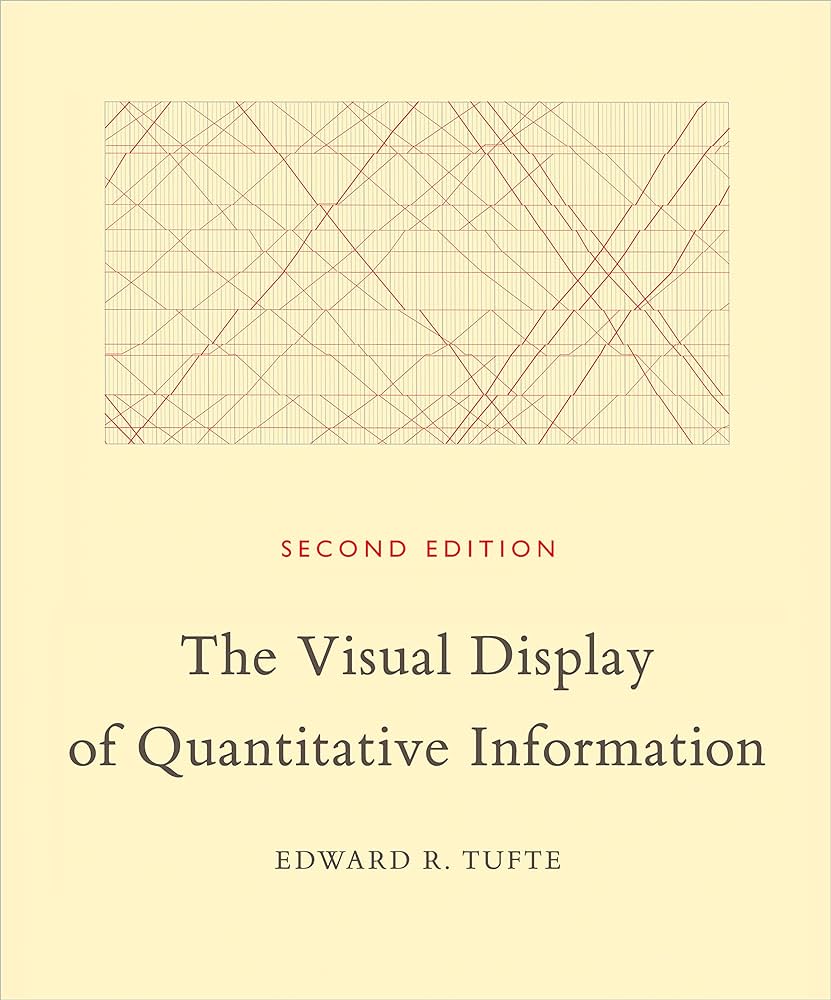
The classic book on statistical graphics, charts, tables. Theory and practice in the design of data graphics, 250 illustrations of the best (and a few of the worst) statistical graphics, with detailed analysis of how to display data for precise, effective, quick analysis. Design of the high-resolution displays, small multiples. Editing and improving graphics. The data-ink ratio. Time-series, relational graphics, data maps, multivariate designs. Detection of graphical deception: design variation vs. data variation. Sources of deception. Aesthetics and data graphical displays. This is the second edition of The Visual Display of Quantitative Information. Recently published, this new edition provides excellent color reproductions of the many graphics of William Playfair, adds color to other images, and includes all the changes and corrections accumulated during 17 printings of the first edition.

Book is in Good condition

A candid and indispensable primer on all aspects of advertising from the man Time has called "the most sought after wizard in the business."Told with brutal candor and prodigal generosity, David Ogilvy • How to get a job in advertising• How to choose an agency for your product• The secrets behind advertising that works• How to write successful copy—and get people to read it• Eighteen miracles of research• What advertising can do for charitiesAnd much, much more.

The bestselling classic that launched 10,000 startups and new corporate ventures - The Four Steps to the Epiphany is one of the most influential and practical business books of all time. The Four Steps to the Epiphany launched the Lean Startup approach to new ventures. It was the first book to offer that startups are not smaller versions of large companies and that new ventures are different than existing ones. Startups search for business models while existing companies execute them. The book offers the practical and proven four-step Customer Development process for search and offers insight into what makes some startups successful and leaves others selling off their furniture. Rather than blindly execute a plan, The Four Steps helps uncover flaws in product and business plans and correct them before they become costly. Rapid iteration, customer feedback, testing your assumptions are all explained in this book. Packed with concrete examples of what to do, how to do it and when to do it, the book will leave you with new skills to organize sales, marketing and your business for success. If your organization is starting a new venture, and you're thinking how to successfully organize sales, marketing and business development you need The Four Steps to the Epiphany. Essential reading for anyone starting something new.3,000 fixed sentences, 10,000 new commas. Same revolutionary ideas. New edition at amzn.to/1aQaf1M

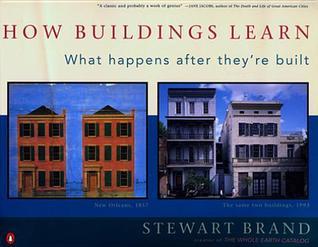
Buildings have often been studies whole in space, but never before have they been studied whole in time. How Buildings Learn is a masterful new synthesis that proposes that buildings adapt best when constantly refined and reshaped by their occupants, and that architects can mature from being artists of space to becoming artists of time.From the connected farmhouses of New England to I.M. Pei's Media Lab, from "satisficing" to "form follows funding," from the evolution of bungalows to the invention of Santa Fe Style, from Low Road military surplus buildings to a High Road English classic like Chatsworth-this is a far-ranging survey of unexplored essential territory.More than any other human artifacts, buildings improve with time-if they're allowed to. How Buildings Learn shows how to work with time rather than against it.

"Without The Artist's Way , there would have been no Eat, Pray, Love .” —Elizabeth GilbertA stunning gift edition of the powerful bestselling book on creativity. The Artist’s Way is one of the bestselling gift books of all time. Beautifully packaged with a slipcase and ribbon, this tenth anniversary gift edition is the ideal gift for loved ones engaged in creative lives.

While the study of psychology has offered little in the way of explaining the creative process, Koestler examines the idea that we are at our most creative when rational thought is suspended--for example, in dreams and trancelike states. All who read The Act of Creation will find it a compelling and illuminating book.

One of the great but often unmentioned causes of both happiness and misery is the quality of our environment: the kinds of walls, chairs, buildings and streets that surround us.And yet a concern for architecture and design is too often described as frivolous, even self-indulgent. The Architecture of Happiness starts from the idea that where we are heavily influences who we can be, and it argues that it is architecture's task to stand as an eloquent reminder of our full potential.Whereas many architects are wary of openly discussing the word beauty, this book has at its center the large and naïve question: What is a beautiful building? It is a tour through the philosophy and psychology of architecture that aims to change the way we think about our homes, our streets and ourselves.

To Steve Jobs, Simplicity was a religion. It was also a weapon.Simplicity isn’t just a design principle at Apple—it’s a value that permeates every level of the organization. The obsession with Simplicity is what separates Apple from other technology companies. It’s what helped Apple recover from near death in 1997 to become the most valuable company on Earth in 2011.Thanks to Steve Jobs’s uncompromising ways, you can see Simplicity in everything Apple the way it’s structured, the way it innovates, and the way it speaks to its customers.It’s by crushing the forces of Complexity that the company remains on its stellar trajectory.As ad agency creative director, Ken Segall played a key role in Apple’s resurrection, helping to create such critical marketing campaigns as Think different. By naming the iMac, he also laid the foundation for naming waves of i-products to come.Segall has a unique perspective, given his years of experience creating campaigns for other iconic tech companies, including IBM, Intel, and Dell. It was the stark contrast of Apple’s ways that made Segall appreciate the power of Simplicity—and inspired him to help others benefit from it.In Insanely Simple , you’ll be a fly on the wall inside a conference room with Steve Jobs, and on the receiving end of his midnight phone calls. You’ll understand how his obsession with Simplicity helped Apple perform better and faster, sometimes saving millions in the process. You’ll also learn, for example, how • Think Distilling choices to a minimum brings clarity to a company and its customers—as Jobs proved when he replaced over twenty product models with a lineup of four.• Think Swearing allegiance to the concept of “small groups of smart people” raises both morale and productivity.• Think Keeping project teams in constant motion focuses creative thinking on well-defined goals and minimizes distractions.• Think Using a simple, powerful image to symbolize the benefit of a product or idea creates a deeper impression in the minds of customers.• Think Giving yourself an unfair advantage—using every weapon at your disposal—is the best way to ensure that your ideas survive unscathed.Segall brings Apple’s quest for Simplicity to life using fascinating (and previously untold) stories from behind the scenes. Through his insight and wit, you’ll discover how companies that leverage this power can stand out from competitors—and individuals who master it can become critical assets to their organizations.

A revelatory look at how our environment unconsciously yet dramatically shapes the judgments and decisions we make every day.Most of us go through life believing that we are in control of the choices we make, that we think and behave almost independently from the world around us, but as Drunk Tank Pink illustrates, the truth is our environment shapes our thoughts and actions in myriad ways without our permission or even our knowledge. Armed with surprising data and endlessly fascinating examples, Adam Alter addresses the subtle but substantial ways in which outside forces influence us--such as color’s influence on mood, our bias in favor of names with which we identify, and how sunny days can induce optimism as well as aggression. Drunk Tank Pink proves that the truth behind our feelings and actions goes much deeper than the choices we take for granted every day.

Web designers are no longer just web designers. To create a successful web product that’s as large as Etsy, Facebook, Twitter, or Pinterest–or even as small as a tiny app–you need to know more than just HTML and CSS. You need to understand how to create meaningful online experiences so that users want to come back again and again.In other words, you have to stop thinking like a web designer or a visual designer or a UX designer or an interaction designer and start thinking like a product designer.In this breakthrough introduction to modern product design, Etsy Creative Director Randy Hunt explains the skills, processes, types of tools, and recommended workflows for creating world-class web products. After reading this book, you’ll have a complete understanding of what product design really is and you’ll be equipped with the best practices necessary for building your own successful online products.

Government, business, the lives we lead, the food we eat, the way our children are brought up, the way we relate to the natural world around us – it's all become too big and distant and industrialised. Inhuman. It's time to do something about it. It's time to put people first. It's time to make the world more human.Steve Hilton, visiting professor at Stanford University and former senior adviser to Prime Minister David Cameron, believes that the frustrations people have with government, politics, their economic circumstances and their daily lives are caused by deep structural problems in the systems that dominate our modern world – systems that are broken because they've grown too far from the human scale. He shows us how change is possible, offering the latest research, compelling stories and case studies from all over the world across industry, politics, education, design and social action to show us what can happen when we make our world more human. This book is a manifesto and call to action for a more local, more accountable and more human way of living that will make us more productive, more fulfilled and ultimately happier.

This "brilliant and provocative" (Walter Isaacson) guide shares nine principles to adapt and survive the technological changes shaping our future from the director of the MIT Media Lab and a veteran Wired journalist.The world is more complex and volatile today than at any other time in our history. The tools of our modern existence are getting faster, cheaper, and smaller at an exponential rate, transforming every aspect of society, from business to culture and from the public sphere to our most private moments. The people who succeed will be the ones who learn to think differently.In Whiplash , Joi Ito and Jeff Howe distill that logic into nine organizing principles for navigating and surviving this tumultuous Filled with incredible case studies and cutting-edge research and philosophies from the MIT Media Lab and beyond, Whiplash will help you adapt and succeed in this unpredictable world.

Surprising rules for successful monetizationInnovation is the most important driver of growth. Today, more than ever, companies need to innovate to survive. But successful innovation—measured in dollars and cents—is a very hard target to hit. Companies obsess over being creative and innovative and spend significant time and expense in designing and building products, yet struggle to monetize 72% of innovations fail to meet their financial targets—or fail entirely. Many companies have come to accept that a high failure rate, and the billions of dollars lost annually, is just the cost of doing business.Monetizing Innovations argues that this is tragic, wasteful, and wrong.Radically improving the odds that your innovation will succeed is just a matter of removing the guesswork. That happens when you put customer demand and willingness to pay in the driver seat—when you design the product around the price. It’s a new paradigm, and that opens the door to true game You can stop hoping to monetize, and start knowing that you will.The authors at Simon Kucher know what they’re talking about. As the world’s premier pricing and monetization consulting services company, with 800 professionals in 30 cities around the globe, they have helped clients ranging from massive pharmaceuticals to fast-growing startups find success. In Monetizing Innovation, they distil the lessons of thirty years and over 10,000 projects into a practical, nine-step approach. Whether you are a CEO, executive leadership, or part of the team responsible for innovation and new product development, this book is for you, with special sections and checklist-driven summaries to make monetizing innovation part of your company’s DNA. Illustrative case studies show how some of the world’s best innovative companies like LinkedIn, Uber, Porsche, Optimizely, Draeger, Swarovski and big pharmaceutical companies have used principles outlined in this book.A direct challenge to the status quo “spray and pray” style of innovation, Monetizing Innovation presents a practical approach that can be adopted by any organization, in any industry. Most monetizing innovation failure point home. Now more than ever, companies must rethink the practices that have lost countless billions of dollars. Monetizing Innovation presents a new way forward, and a clear Go from hope to certainty.

An insider's account of Apple's creative process during the golden years of Steve Jobs.Hundreds of millions of people use Apple products every day; several thousand work on Apple's campus in Cupertino, California; but only a handful sit at the drawing board. Creative Selection recounts the life of one of the few who worked behind the scenes, a highly-respected software engineer who worked in the final years the Steve Jobs era--the Golden Age of Apple.Ken Kocienda offers an inside look at Apple's creative process. For fifteen years, he was on the ground floor of the company as a specialist, directly responsible for experimenting with novel user interface concepts and writing powerful, easy-to-use software for products including the iPhone, the iPad, and the Safari web browser. His stories explain the symbiotic relationship between software and product development for those who have never dreamed of programming a computer, and reveal what it was like to work on the cutting edge of technology at one of the world's most admired companies.Kocienda shares moments of struggle and success, crisis and collaboration, illuminating each with lessons learned over his Apple career. He introduces the essential elements of innovation--inspiration, collaboration, craft, diligence, decisiveness, taste, and empathy--and uses these as a lens through which to understand productive work culture.An insider's tale of creativity and innovation at Apple, Creative Selection shows readers how a small group of people developed an evolutionary design model, and how they used this methodology to make groundbreaking and intuitive software which countless millions use every day.

#1 WALL STREET JOURNAL BESTSELLER & INSTANT NEW YORK TIMES BESTSELLERA game-changing approach to marketing, sales, and advertising.For the first time Seth Godin offers the core of his marketing wisdom in one compact, accessible, timeless package. This is Marketing shows you how to do work you're proud of, whether you're a tech startup founder, a small business owner, or part of a large corporation.No matter what your product or service, this book will help you reframe how it's presented to the world, in order to meaningfully connect with people who want it. Seth employs his signature blend of insight, observation, and memorable examples to teach How to build trust and permission with your target market.* The art of positioning--deciding not only who it's for, but who it's not for.* Why the best way to achieve your goals is to help others become who they want to be.* Why the old approaches to advertising and branding no longer work.* The surprising role of tension in any decision to buy (or not).* How marketing is at its core about the stories we tell ourselves about our social status.You can do work that matters for people who care. This book shows you the way.'A very accessible way into Godin's thinking . . . Godin writes in pacy, jargon-free prose and this book is interesting and useful for anyone who wants an insight into how, and why, we buy things or change our habits in any way ' The Financial TimesIf you enjoyed reading this, check out Seth Godin's Purple Cow, a true business classic.

שום דבר בספר הזהאינו אמת ידועה.אלה הרהורים על דברים שהבחנתי בהם —לא עוּבדות, אלא מחשבות.כמה מהרעיונות עשויים לדבר אליכם,אחרים אולי לא.מעטים עשויים לעורר ידיעה פנימיתששכחתם שיש לכם.השתמשו במה שמועיל לכם.עזבו את השאר.כל אחד מהרגעים האלההוא הזמנהלבירור נוסף:הצעה להתבוננות עמוקה יותר,מרחוק, או מקרוב.פתיחת אפשרויותלהוויה חדשה.

Science and art have in common intense seeing, the wide-eyed observing that generates visual information. Beautiful Evidence is about how seeing turns into showing, how data and evidence turn into explanation. The book identifies excellent and effective methods for showing nearly every kind of information, suggests many new designs (including sparklines), and provides analytical tools for assessing the credibility of evidence presentations (which are seen from both sides: how to produce and how to consume presentations). For alert consumers of presentations, there are chapters on diagnosing evidence corruption and PowerPoint pitches. Beautiful Evidence concludes with two chapters that leave the world of pixel and paper flatland representations - and move onto seeing and thinking in space land, the real-land of three-space and time.

Now in full color, the 10th anniversary edition of this classic book packs more insight into what it means to design games for fun. Theory of Fun for Game Design challenges and inspires game designers as well as game enthusiasts looking for products and experiences that are truly fun and entertaining.The book discusses the impact of designing in a multidimensional landscape, where computer science, environmental design, and storytelling all play a role in creating an interactive game design. For the professional game developer to the interested young gamer, this updated edition takes you on an illustrated ride in fun and games.Learn why some games are fun and others are boringDiscover how playing a game and learning are connectedUnderstand why making a game too hard--or too easy--is a mistakeFind out why games have to balance deprivation and overload, order and chaos, silence and noiseExplore why you need to balance challenges of task mastery, pattern recognition, discovery, and time attacks

Users experience the usability of a web site before they have committed to using it and before making any purchase decisions. The web is the ultimate environment for empowerment, and he or she who clicks the mouse decides everything. Designing Web Usability is the definitive guide to usability from Jakob Nielsen, the world's leading authority. Over 250,000 Internet professionals around the world have turned to this landmark book, in which Nielsen shares the full weight of his wisdom and experience. From content and page design to designing for ease of navigation and users with disabilities, he delivers complete direction on how to connect with any web user, in any situation. Nielsen has arrived at a series of principles that work in support of his findings: 1. That web users want to find what they're after quickly; 2. If they don't know what they're after, they nevertheless want to browse quickly and access information they come across in a logical manner. This book is a must-have for anyone who thinks seriously about the web.

This is a book about how we see: the environment around us (its surfaces, their layout, and their colors and textures); where we are in the environment; whether or not we are moving and, if we are, where we are going; what things are good for; how to do things (to thread a needle or drive an automobile); or why things look as they do. The basic assumption is that vision depends on the eye which is connected to the brain. The author suggests that natural vision depends on the eyes in the head on a body supported by the ground, the brain being only the central organ of a complete visual system. When no constraints are put on the visual system, people look around, walk up to something interesting and move around it so as to see it from all sides, and go from one vista to another. That is natural vision -- and what this book is about.

Traces the life and career of the California artist, who currently works with pure light and the subtle modulation of empty space

"As our machines are increasingly jacked into global networks of information, it becomes more and more difficult to imagine the dataspace at our fingertips, to picture all that complexity in our mind's eye . . . Representing all that information is going to require a new visual language, as complex and meaningful as the great metropolitan narratives of the 19th-century novel."--from Interface Culture In this hip, erudite manifesto, Steven Johnson--one of the most influential people in cyberspace, according to Newsweek bridges the gap that yawns between technology and the arts. Drawing on his own expertise in the humanities and on the Web, he not only demonstrates how interfaces--those buttons, graphics and words on the screen through which we control information--influence our daily lives, but also tracks their roots back to Victorian novels, early cinema and even medieval urban planning. The result is a lush cultural and historical tableau in which today's interfaces take their rightful place in the lineage of artistic innovation. With Interface Culture , Johnson brilliantly charts the vital role interface design plays in modern society. Just as the great novels of Melville, Dickens and Zola explain a rapidly industralizing society to itself, he argues, web sites, Microsoft Bob, flying toasters and the landscapes of video games tell the digital society how to imagine itself and how to get around in cyberspace's unfamiliar realm. The role once played by novelists is now fulfilled by the interface designer, who has bridged the gap between technology and everyday life by providing a conceptual framework for the vast amounts of information and computation that surround us. Johnson boldly explores the past--a terrain few tech thinkers have dared enter, and one that throws dazzling light on the modern interface's roots. From the great cathedrals of the Middle Ages to the rise of perspective drawing in the Renaissance, from Enlightenment satire to the golden age of television, Interface Culture uses a wealth of venerable "interface innovation" to place newfangled creations like Windows 95 and the Web in a rich historical context. Controversial, clear-sighted and challenging, Interface Culture also looks at the future--from what PC screens will look like in 10 years to how new interfaces will alter the style of our conversation, prose and thoughts. With a distinctively accessible style, Interface Culture brings new intellectual depth to the vital discussion of how technology has transformed society, and is sure to provoke wide debate in both literary and technological circles.

Most programmers' fear of user interface (UI) programming comes from their fear of doing UI design. They think that UI design is like graphic design―the mysterious process by which creative, latte-drinking, all-black-wearing people produce cool-looking, artistic pieces. Most programmers see themselves as analytic, logical thinkers instead―strong at reasoning, weak on artistic judgment, and incapable of doing UI design. In this brilliantly readable book, author Joel Spolsky proposes simple, logical rules that can be applied without any artistic talent to improve any user interface, from traditional GUI applications to websites to consumer electronics. Spolsky's primary axiom, the importance of bringing the program model in line with the user model, is both rational and simple. In a fun and entertaining way, Spolky makes user interface design easy for programmers to grasp. After reading User Interface Design for Programmers , you'll know how to design interfaces with the user in mind. You'll learn the important principles that underlie all good UI design, and you'll learn how to perform usability testing that works.

David Ogilvy was an advertising genius. At the age of 37, he founded the New York-based agency that later merged to form the international company known as Ogilvy & Mather. Regarded as the father of modern advertising, Ogilvy was responsible for some of the most memorable advertising campaigns ever created. Confessions of an Advertising Man is the distillation of all the Ogilvy concepts, tactics, and techniques that made this international best-seller a blueprint for sound business practice. If you aspire to be a good manager in any business, this seminal work is a must-read.

After a lifetime of writing and editing prose, Jacques Barzun has set down his view of the best ways to improve one's style. His discussions of diction, syntax, tone, meaning, composition, and revision guide the reader through the technique of making the written word clear and agreeable to read. Exercises, model passages both literary and casual, and hundreds of amusing examples of usage gone wrong show how to choose the right path to self-expression in forceful and distinctive words.

What is the nature of the aesthetic experience? Is it the same for everyone? It is possible to facilitate its occurrence? This book focuses on the psychology of the aesthetic experience and on the perception and understanding of art, suggesting ways to raise levels of visual literacy andenhance artistic enjoyment. The findings will be of importance not only to museum professionals and art educators, but also to psychologists and those interested in the nature of the aesthetic experience.

The organization of letters on a blank sheet—or screen—is the most basic challenge facing anyone who practices design. What type of font to use? How big? How should those letters, words, and paragraphs be aligned, spaced, ordered, shaped, and otherwise manipulated? In this groundbreaking new primer, leading design educator and historian Ellen Lupton provides clear and concise guidance for anyone learning or brushing up on their typographic skills. Thinking with Type is divided into three sections: letter, text, and grid. Each section begins with an easy-to-grasp essay that reviews historical, technological, and theoretical concepts, and is then followed by a set of practical exercises that bring the material covered to life. Sections conclude with examples of work by leading practitioners that demonstrate creative possibilities (along with some classic no-no's to avoid).

"Caindo na Real" detalha os princípios de negócios, design, programação e marketing da 37signals. O livro é repleto de insights de simplicidade, pontos de vista contrários e abordagens não convencionais ao design de software. Este não é um livro técnico ou um tutorial de design, é um livro de ideias. Qualquer pessoa trabalhando em um aplicativo web - incluindo empreendedores, designers, programadores, executivos ou profissionais de marketing - encontrará valor e inspiração neste livro. A 37signals usou o processo de Cair na Real para lançar várias aplicações web de sucesso (como Basecamp, Campfire, Backpack, Writeboard, Ta-da List) e Ruby on Rails, um framework de aplicação web de código aberto, em apenas dois anos sem financiamento externo, sem dívidas e com apenas 7 pessoas (distribuídas por 7 fusos horários). Mais de 500.000 pessoas ao redor do mundo usam essas aplicações para realizar suas tarefas. Agora você pode descobrir como eles fizeram isso e como você também pode fazer. Não é tão difícil quanto você pensa, se você Cair na Real.

Now in its fifth edition, Diffusion of Innovations is a classic work on the spread of new ideas. It has sold 30,000 copies in each edition and will continue to reach a huge academic audience.In this renowned book, Everett M. Rogers, professor and chair of the Department of Communication & Journalism at the University of New Mexico, explains how new ideas spread via communication channels over time. Such innovations are initially perceived as uncertain and even risky. To overcome this uncertainty, most people seek out others like themselves who have already adopted the new idea. Thus the diffusion process consists of a few individuals who first adopt an innovation, then spread the word among their circle of acquaintances--a process which typically takes months or years. But there are exceptions: use of the Internet in the 1990s, for example, may have spread more rapidly than any other innovation in the history of humankind. Furthermore, the Internet is changing the very nature of diffusion by decreasing the importance of physical distance between people. The fifth edition addresses the spread of the Internet, and how it has transformed the way human beings communicate and adopt new ideas.

J. E. Gordon's classic introduction to the properties of materials used in engineering answers some fascinating and fundamental questions about how the structural world around us works. Gordon focuses on so-called strong materials--such as metals, wood, ceramics, glass, and bone--explaining in engaging and accessible terms the unique physical and chemical basis for their inherent structural qualities. He also shows how an in-depth understanding of these materials’ intrinsic strengths--and weaknesses--guides our engineering choices, allowing us to build the structures that support our society. This work is an enduring example of first-rate scientific communication. Philip Ball's introduction describes Gordon's career and the impact of his innovations in materials research, while also discussing how the field has evolved since Gordon wrote this enduring example of first-rate scientific communication.

In a book that Business Insider noted as one of the "14 Books that inspired Elon Musk," J.E. Gordon strips engineering of its confusing technical terms, communicating its founding principles in accessible, witty prose.For anyone who has ever wondered why suspension bridges don't collapse under eight lanes of traffic, how dams hold back--or give way under--thousands of gallons of water, or what principles guide the design of a skyscraper, a bias-cut dress, or a kangaroo, this book will ease your anxiety and answer your questions. Or Why Things Don't Fall Down is an informal explanation of the basic forces that hold together the ordinary and essential things of this world--from buildings and bodies to flying aircraft and eggshells. In a style that combines wit, a masterful command of his subject, and an encyclopedic range of reference, Gordon includes such chapters as "How to Design a Worm" and "The Advantage of Being a Beam," offering humorous insights in human and natural creation.Architects and engineers will appreciate the clear and cogent explanations of the concepts of stress, shear, torsion, fracture, and compression. If you're building a house, a sailboat, or a catapult, here is a handy tool for understanding the mechanics of joinery, floors, ceilings, hulls, masts--or flying buttresses.Without jargon or oversimplification, Structures opens up the marvels of technology to anyone interested in the foundations of our everyday lives.

What increasingly affects all of us, whether professional planners or individuals preparing for a better future, is not the tangibles of life—bottom-line numbers, for instance—but the intangibles: our hopes and fears, our beliefs and dreams. Only stories—scenarios—and our ability to visualize different kinds of futures adequately capture these intangibles.In The Art of the Long View, now for the first time in paperback and with the addition of an all-new User's Guide, Peter Schwartz outlines the "scenaric" approach, giving you the tools for developing a strategic vision within your business.Schwartz describes the new techniques, originally developed within Royal/Dutch Shell, based on many of his firsthand scenario exercises with the world's leading institutions and companies, including the White House, EPA, BellSouth, PG&E, and the International Stock Exchange.

As its title implies, this book deals with revising, not with original composition. Stressing the importance of the single sentence, The Paramedic Method of revision provides an easily learned method of revision to combat the obscurities of meaning that plague The Official Style, and demonstrates how to revise this stilted, dense prose into plain English. This book has been used with success wherever extensive writing is required, and also at every level of higher education. Addresses the specific stylistic patterns that characterize most bad writing and gives an eight-step revision method called The Paramedic Method to break those patterns and improve writing. Helps with writing tasks in business, government, and the university, where The Official Style is rampant, and provides an indispensable guide to revising in every writing context. For anyone interested in revising, specifically at the sentence level.

This completely updated volume presents the effective and practical tools you need to design great desktop applications, Web 2.0 sites, and mobile devices. You’ll learn the principles of good product behavior and gain an understanding of Cooper’s Goal-Directed Design method, which involves everything from conducting user research to defining your product using personas and scenarios. Ultimately, you’ll acquire the knowledge to design the best possible digital products and services.

THE BRAND GAP is the first book to present a unified theory of brand-building. Whereas most books on branding are weighted toward either a strategic or creative approach, this book shows how both ways of thinking can unite to produce a “charismatic brand”―a brand that customers feel is essential to their lives. In an entertaining two-hour read you’ll learn:• the new definition of brand• the five essential disciplines of brand-building• how branding is changing the dynamics of competition• the three most powerful questions to ask about any brand• why collaboration is the key to brand-building• how design determines a customer’s experience• how to test brand concepts quickly and cheaply• the importance of managing brands from the inside• 220-word brand glossaryFrom the back cover:Not since McLuhan’s THE MEDIUM IS THE MESSAGE has a book compressed so many ideas into so few pages. Using the visual language of the boardroom, Neumeier presents the first unified theory of branding―a set of five disciplines to help companies bridge the gap between brand strategy and customer experience. Those with a grasp of branding will be inspired by the new perspectives they find here, and those who would like to understand it better will suddenly “get it.” This deceptively simple book offers everyone in the company access to “the most powerful business tool since the spreadsheet.”

Edwin Hutchins combines his background as an anthropologist and an open ocean racing sailor and navigator in this account of how anthropological methods can be combined with cognitive theory to produce a new reading of cognitive science. His theoretical insights are grounded in an extended analysis of ship navigation -- its computational basis, its historical roots, its social organization, and the details of its implementation in actual practice aboard large ships. The result is an unusual interdisciplinary approach to cognition in culturally constituted activities outside the laboratory -- "in the wild."Hutchins examines a set of phenomena that have fallen in the cracks between the established disciplines of psychology and anthropology, bringing to light a new set of relationships between culture and cognition. The standard view is that culture affects the cognition of individuals. Hutchins argues instead that cultural activity systems have cognitive properties of their own that are different from the cognitive properties of the individuals who participate in them. Each action for bringing a large naval vessel into port, for example, is informed by culture: the navigation team can be seen as a cognitive and computational system.Introducing Navy life and work on the bridge, Hutchins makes a clear distinction between the cognitive properties of an individual and the cognitive properties of a system. In striking contrast to the usual laboratory tasks of research in cognitive science, he applies the principal metaphor of cognitive science -- cognition as computation (adopting David Marr's paradigm) -- to the navigation task. After comparing modern Western navigation with the method practiced in Micronesia, Hutchins explores the computational and cognitive properties of systems that are larger than an individual. He then turns to an analysis of learning or change in the organization of cognitive systems at several scales. Hutchins's conclusion illustrates the costs of ignoring the cultural nature of cognition, pointing to the ways in which contemporary cognitive science can be transformed by new meanings and interpretations. A Bradford Book

Explains what type is, demonstrates how to select it, and examines its use in printed communication.

Q.E.D. presents some of the most famous mathematical proofs in a charming book that will appeal to nonmathematicians and math experts alike. Grasp in an instant why Pythagoras's theorem must be correct. Follow the ancient Chinese proof of the volume formula for the frustrating frustum, and Archimedes' method for finding the volume of a sphere. Discover the secrets of pi and why, contrary to popular belief, squaring the circle really is possible. Study the subtle art of mathematical domino tumbling, and find out how slicing cones helped save a city and put a man on the moon.

Take a peek inside the heads of some of the world’s greatest living graphic designers. How do they think, how do they connect to others, what special skills do they have? In honest and revealing interviews, nineteen designers, including Stefan Sagmeister, Michael Beirut, David Carson, and Milton Glaser, share their approaches, processes, opinions, and thoughts about their work with noted brand designer Debbie Millman. The internet radio talk host of Design Matters, Millman persuades the greatest graphic designers of our time to speak frankly and openly about their work. How to Think Like a Great GraphicDesigners offers a rare opportunity to observe and understand the giants of the industry. Designers interviewed —Milton Glaser —Stefan Sagmeister —David Carson —Paula Scher —Abbott Miler —Lucille Tenazas —Paul Sahre —Emily Oberman and Bonnie Siegler —Chip Kidd —James Victore —Carin Goldberg —Michael Bierut —Seymour Chwast —Jessica Helfand and William Drenttel —Steff Geissbuhler —John MaedaAllworth Press, an imprint of Skyhorse Publishing, publishes a broad range of books on the visual and performing arts, with emphasis on the business of art. Our titles cover subjects such as graphic design, theater, branding, fine art, photography, interior design, writing, acting, film, how to start careers, business and legal forms, business practices, and more. While we don't aspire to publish a New York Times bestseller or a national bestseller, we are deeply committed to quality books that help creative professionals succeed and thrive. We often publish in areas overlooked by other publishers and welcome the author whose expertise can help our audience of readers.

The Fantasy ContinuesThe Art of Spirited Away collects color illustrations of Spirited Away (Sen to Chihiro no Kamikakushi) for the first time in an English edition! This book includes paintings and designs from the new animated film from the director of Kiki's Delivery Service and Princess Mononoke.Large-size, hardcover coffee-table book featuring artwork from the renowned animated film, Spirited Away , directed by Hayao Miyazaki. Features commentary, color stills, sketches, storyboards, and illustrations used to envision the rich fantasy world of the film. Also includes a complete English-language script.

A step-by-step technique for sparking breakthrough creativity in advertising--or any fieldSince its publication in 1965, A Technique for Producing Ideas has helped thousands of advertising copywriters smash through internal barriers to unleash their creativity. Professionals from poets and painters to scientists and engineers have also used the techniques in this concise, powerful book to generate exciting ideas on demand, at any time, on any subject. Now let James Webb Young's unique insights help you look inside yourself to find that big, elusive idea--and once and for all lift the veil of mystery from the creative process."James Webb Young is in the tradition of some of our greatest thinkers when he describes the workings of the creative process. The results of many years in advertising have proved to him that the key element in communications success is the production of relevant and dramatic ideas. He not only makes this point vividly for us but shows us the road to that goal."--William Bernbach, Former Chairman and CEO, Doyle Dane Bernbach Inc.

"Ideas move mountains, especially in turbulent times. Lovemarks is the product of the fertile-iconoclast mind of Kevin Roberts, CEO Worldwide of Saatchi & Saatchi. Roberts argues vociferously, and with a ton of data to support him, that traditional branding practices have become stultified. What's needed are customer Love affairs. Roberts lays out his grand scheme for mystery, magic, sensuality, and the like in his gloriously designed book Lovemarks."-Tom PetersTom Peters, one of the most influential business thinkers of all time, described the first edition of Lovemarks: the future beyond brands as "brilliant." He also announced it as the "Best Business Book" published in the first five years of this century. Now translated into fourteen languages, with more than 150,000 copies in print, Lovemarks is back in a revised edition featuring a new chapter on the peculiarly human experience of shopping. The new chapter, "Diamonds in the Mine," is an insightful collection of ideas for producers and consumers, for owners of small stores and operators of superstores. So forget making lists! Shopping, says Kevin Roberts, is an emotional event. With this as a starting point, he looks at the history of shopping and how it has changed so dramatically over the last ten years. Using the Lovemark elements of Mystery, Sensuality, and Intimacy, Roberts delves into the secrets of success that can be used to create the ultimate shopping experience.

Maira Kalman paints her highly personal worldview in this inimitable combination of image and textAn irresistible invitation to experience life through a beloved artist's psyche, The Principles of Uncertainty is a compilation of Maira Kalman's New York Times columns. Part personal narrative, part documentary, part travelogue, part chapbook, and all Kalman, these brilliant, whimsical paintings, ideas, and images - which initially appear random - ultimately form an intricately interconnected worldview, an idiosyncratic inner monologue.

With a new Afterword to the 2002 edition, No Logo employs journalistic savvy and personal testament to detail the insidious practices and far-reaching effects of corporate marketing—and the powerful potential of a growing activist sect that will surely alter the course of the 21st century. First published before the World Trade Organization protests in Seattle, this is an infuriating, inspiring, and altogether pioneering work of cultural criticism that investigates money, marketing, and the anti-corporate movement.As global corporations compete for the hearts and wallets of consumers who not only buy their products but willingly advertise them from head to toe—witness today's schoolbooks, superstores, sporting arenas, and brand-name synergy—a new generation has begun to battle consumerism with its own best weapons. In this provocative, well-written study, a front-line report on that battle, we learn how the Nike swoosh has changed from an athletic status-symbol to a metaphor for sweatshop labor, how teenaged McDonald's workers are risking their jobs to join the Teamsters, and how "culture jammers" utilize spray paint, computer-hacking acumen, and anti-propagandist wordplay to undercut the slogans and meanings of billboard ads (as in "Joe Chemo" for "Joe Camel").No Logo will challenge and enlighten students of sociology, economics, popular culture, international affairs, and marketing."This book is not another account of the power of the select group of corporate Goliaths that have gathered to form our de facto global government. Rather, it is an attempt to analyze and document the forces opposing corporate rule, and to lay out the particular set of cultural and economic conditions that made the emergence of that opposition inevitable." —Naomi Klein, from her Introduction

Renowned typographer and poet Robert Bringhurst brings clarity to the art of typography with this masterful style guide. Combining practical, theoretical, and historical, this book is a must for graphic artists, editors, or anyone working with the printed page using digital or traditional methods.Having established itself as a standard in its field The Elements of Typographic Style is house manual at most American university presses, a standard university text, and a reference work in studios of designers around the world. It has been translated into italian and greek, and dutch.

In the mid twentieth century the philosopher Ludwig Wittgenstein famously asserted that games are indefinable; there are no common threads that link them all. "Nonsense," says the sensible Bernard "playing a game is a voluntary attempt to overcome unnecessary obstacles." The short book Suits wrote demonstrating precisely that is as playful as it is insightful, as stimulating as it is delightful. Suits not only argues that games can be meaningfully defined; he also suggests that playing games is a central part of the ideal of human existence, so games belong at the heart of any vision of Utopia. Originally published in 1978, The Grasshopper is now re-issued with a new introduction by Thomas Hurka and with additional material (much of it previously unpublished) by the author, in which he expands on the ideas put forward in The Grasshopper and answers some questions that have been raised by critics.

Uncovers the elements of creative collaboration by examining six of the century's most extraordinary groups and distill their successful practices into lessons that virtually any organization can learn and commit to in order to transform its own management into a collaborative and successful group of leaders. Paper. DLC: Organizational effectiveness - Case studies.

"For the first time, man has the chance to be a complete success in his environment." This startling thesis is supported in I Seem to Be a Verb, by the out-of-the-ordinary R. Buckminster Comprehensive designer, inventor, engineer, mathematician, architect, cartographer, philosopher, poet, cosmogonist, choreographer, visionary -- celebrated for developing geodesic houses that fly and for dysmaxion ways of living. Jerome Conceived and produced The Medium is the Massage, produced War and Peace in the Global Village, wrote The Making of Kubricks 2001, is writing with Arthur C. Clarke Arthur C. Clarke Meets Hieronymus Bosch, conceived and wrote the CBS lp record based on The Medium is the Massage. Quentin Graphics designer and author, co-author with Marshall McLuhan of The Medium is the Massage and War and Peace in the Global Village, media and telecommunications consultant, Director of By Other Means Foundation. This book is revolutionary in both its content and its design, it has to be seen and used, no description can do it justice.

In the tradition of Being Digital and The Tipping Point, Steven Johnson, acclaimed as a "cultural critic with a poet's heart" (The Village Voice), takes readers on an eye-opening journey through emergence theory and its applications. Explaining why the whole is sometimes smarter than the sum of its parts, Johnson presents surprising examples of feedback, self-organization, and adaptive learning. How does a lively neighborhood evolve out of a disconnected group of shopkeepers, bartenders, and real estate developers? How does a media event take on a life of its own? How will new software programs create an intelligent World Wide Web? In the coming years, the power of self-organization -- coupled with the connective technology of the Internet -- will usher in a revolution every bit as significant as the introduction of electricity. Provocative and engaging, Emergence puts you on the front lines of this exciting upheaval in science and thought.

How did a maverick English inventor manage to design, market and make money from his own invention, toppling market leaders in the process? This inspirational autobiography tells the remarkable story behind James Dyson and his most successful invention to date Â- the Dual Cyclone. This revolutionary (bagless) vacuum cleaner has taken the market by storm, but not without years of personal struggle and crises for its inventor. Faced with little or no support at every turn, DysonÂ's extraordinary story shows how his unswerving optimism and self-belief has brought him spectacular success.

The Medium is the Massage is Marshall McLuhan's most condensed, and perhaps most effective, presentation of his ideas. Using a layout style that was later copied by Wired, McLuhan and coauthor/designer Quentin Fiore combine word and image to illustrate and enact the ideas that were first put forward in the dense and poorly organized Understanding Media. McLuhan's ideas about the nature of media, the increasing speed of communication, and the technological basis for our understanding of who we are come to life in this slender volume. Although originally printed in 1967, the art and style in The Medium is the Massage seem as fresh today as in the summer of love, and the ideas are even more resonant now that computer interfaces are becoming gateways to the global village.

Tibor Perverse Optimist is the definitive and exuberant document of the late Tibor Kalman's work and ideas. This full-color, oversize title reveals Kalman's thoughts on magazines, advertising, sex, bookstores, food, and the design profession. Product designs, stills and storyboards from his film and video projects, and spreads from his book and magazine work are included. The impressive list of contributors includes Kurt Andersen, Paola Antonelli, David Byrne, Jay Chiat, Steven Heller, Isaac Mizrahi, Chee Pearlman, Rick Poynor, and Ingrid Sischy.

It’s Not How Good You Are, It’s How Good You Want to Be is a handbook of how to succeed in the world: a pocket bible for the talented and timid alike to help make the unthinkable thinkable and the impossible possible.The world’s top advertising guru, Paul Arden, offers up his wisdom on issues as diverse as problem solving, responding to a brief, communicating, playing your cards right, making mistakes, and creativity – all endeavors that can be applied to aspects of modern life.This uplifting and humorous little book provides a unique insight into the world of advertising and is a quirky compilation of quotes, facts, pictures, wit and wisdom – all packed into easy-to-digest, bite-sized spreads. If you want to succeed in life or business, this book is a must.

The classic work that introduced the concept of the Garden City. Originally published in 1898 as A Peaceful Path to Real Reform and reissued in 1902 under its present title, Garden Cities of To-Morrow holds a unique place in town planning literature. The book led directly to two experiments in town-founding that have had a profound influence on practical urban development around the world. The book was also responsible for the introduction of the term Garden City, and set into motion ideas that helped transform town planning.

"Reduce, reuse, recycle," urge environmentalists; in other words, do more with less in order to minimize damage. But as architect William McDonough and chemist Michael Braungart point out in this provocative, visionary book, such an approach only perpetuates the one-way, "cradle to grave" manufacturing model, dating to the Industrial Revolution, that creates such fantastic amounts of waste and pollution in the first place. Why not challenge the belief that human industry must damage the natural world? In fact, why not take nature itself as our model for making things? A tree produces thousands of blossoms in order to create another tree, yet we consider its abundance not wasteful but safe, beautiful, and highly effective.Waste equals food. Guided by this principle, McDonough and Braungart explain how products can be designed from the outset so that, after their useful lives, they will provide nourishment for something new. They can be conceived as "biological nutrients" that will easily reenter the water or soil without depositing synthetic materials and toxins. Or they can be "technical nutrients" that will continually circulate as pure and valuable materials within closed-loop industrial cycles, rather than being "recycled" -- really, downcycled -- into low-grade materials and uses. Drawing on their experience in (re)designing everything from carpeting to corporate campuses, McDonough and Braungart make an exciting and viable case for putting eco-effectiveness into practice, and show how anyone involved with making anything can begin to do as well.

An essay on aesthetics by the Japanese novelist, this book explores architecture, jade, food, and even toilets, combining an acute sense of the use of space in buildings. The book also includes descriptions of laquerware under candlelight, and women in the darkness of the house of pleasure.

TASCHEN's 25th anniversary - Special edition! Special bestseller price Leonardo da Vinci (1452-1519) possessed one of the greatest minds of all time; his importance and influence are inestimable. This XXL-format comprehensive survey is the most complete book ever made on the subject of this Italian painter, sculptor, architect, engineer, scientist and all-around genius. With huge, full-bleed details of Leonardo's masterworks, this highly original publication allows the reader to inspect the subtlest facets of his brushstrokes. * Part I explores Leonardo's life and work in ten chapters. All of his paintings are interpreted in depth, with The Annunciation and The Last Supper featured on large double-spreads. * Part II comprises a catalogue raisonn? of Leonardo's paintings, which covers all of his surviving and lost painted works and includes texts describing their states of preservation. * Part III contains an extensive catalogue of his drawings (numbering in the thousands, they cannot all be reproduced in one book); 663 are presented, arranged by category (architecture, technical, anatomical, figures, proportion, cartography, etc). This sumptuous TASCHEN offering is the most thorough and beautifully produced Leonardo book ever published, and this special edition offers it for a third of the usual price.

When Drawing on the Right Side of the Brain was first published in 1979, it hit the New York Times bestseller list within two weeks and stayed there for more than a year. In 1989, when Dr. Betty Edwards revised the book, it went straight to the Times list again. Now Dr. Edwards celebrates the twentieth anniversary of her classic book with a second revised edition.Over the last decade, Dr. Edwards has refined her material through teaching hundreds of workshops and seminars. Truly The New Drawing on the Right Side of the Brain, this edition includes:the very latest developments in brain researchnew material on using drawing techniques in the corporate world and in educationinstruction on self-expression through drawingan updated section on using colordetailed information on using the five basic skills of drawing for problem solving

Continuing his exploration of the organization of complexity and the science of design, this new edition of Herbert Simon's classic work on artificial intelligence adds a chapter that sorts out the current themes and tools -- chaos, adaptive systems, genetic algorithms -- for analyzing complexity and complex systems. There are updates throughout the book as well. These take into account important advances in cognitive psychology and the science of design while confirming and extending the book's basic thesis: that a physical symbol system has the necessary and sufficient means for intelligent action. The chapter "Economic Reality" has also been revised to reflect a change in emphasis in Simon's thinking about the respective roles of organizations and markets in economic systems."People sometimes ask me what they should read to find out about artificial intelligence. Herbert Simon's book The Sciences of the Artificial is always on the list I give them. Every page issues a challenge to conventional thinking, and the layman who digests it well will certainly understand what the field of artificial intelligence hopes to accomplish. I recommend it in the same spirit that I recommend Freud to people who ask about psychoanalysis, or Piaget to those who ask about child psychology: If you want to learn about a subject, start by reading its founding fathers." -- George A. Miller
Defines symmetry through a discussion of its many uses in a wide variety of fields both academic and natural.

A bold new way to tackle tough business problems—even if you draw like a second grader When Herb Kelleher was brainstorming about how to beat the traditional hub-and- spoke airlines, he grabbed a bar napkin and a pen. Three dots to represent Dallas, Houston, and San Antonio. Three arrows to show direct flights. Problem solved, and the picture made it easy to sell Southwest Airlines to investors and customers. Used properly, a simple drawing on a humble napkin is more powerful than Excel or PowerPoint. It can help crystallize ideas, think outside the box, and communicate in a way that people simply “get”. In this book Dan Roam argues that everyone is born with a talent for visual thinking, even those who swear they can’t draw. Drawing on twenty years of visual problem solving combined with the recent discoveries of vision science, this book shows anyone how to clarify a problem or sell an idea by visually breaking it down using a simple set of visual thinking tools – tools that take advantage of everyone’s innate ability to look, see, imagine, and show. THE BACK OF THE NAPKIN proves that thinking with pictures can help anyone discover and develop new ideas, solve problems in unexpected ways, and dramatically improve their ability to share their insights. This book will help readers literally see the world in a new way.

John Berger’s Classic Text on ArtWays of Seeing is one of the most stimulating and the most influential books on art in any language. First published in 1972, it was based on the BBC television series about which the (London) Sunday Times a critic commented: "This is an eye-opener in more ways than one: by concentrating on how we look at paintings . . . he will almost certainly change the way you look at pictures." By now he has."Berger has the ability to cut right through the mystification of the professional art critics . . . He is a liberator of images: and once we have allowed the paintings to work on us directly, we are in a much better position to make a meaningful evaluation" —Peter Fuller, Arts Review"The influence of the series and the book . . . was enormous . . . It opened up for general attention to areas of cultural study that are now commonplace" —Geoff Dyer in Ways of Telling.

Argues that future generations are being harmed by a restrictive copyright system that protects corporate interests, in a report that calls for an end of the practice of criminalizing artists who build on the creative works of others and for implementing a collaborative and profitable "hybrid economy" that protects both creative and ethical needs. 30,000 first printing.

Good game design happens when you view your game from as many perspectives as possible. Written by one of the world's top game designers, The Art of Game Design presents 100+ sets of questions, or different lenses, for viewing a game’s design, encompassing diverse fields such as psychology, architecture, music, visual design, film, software engineering, theme park design, mathematics, puzzle design, and anthropology. This Second Edition of a Game Developer Front Line Award winner: The Art of Game Design, Second Edition gives readers useful perspectives on how to make better game designs faster. It provides practical instruction on creating world-class games that will be played again and again.

Here,Wally Olins sets out the ground rules for branding success in the 21st century, explaining why understanding the links between business, brand and consumer has never been more vital for commercial success, and reflecting the recent enormous changes in the branding world. It will be an essential purchase for everyone in advertising, marketing and business who needs to understand why the most successful brands in the world triumph by making insiders believe in them – and consumers buy into them.Table of ContentsPreface • Introduction • Definitions and Guidelines • Part What Branding is About 1. Brand Visibility 2. Brand Architecture 3. Why and When to Introduce Branding 4. The Brand as a Corporate Resource • Part Making Brands Work 5. Developing the Branding Programme 6. Control, Cost and Timing • Part Belief in Branding 7. About Courage 8. Risks 9. Brand Value

How the world's leading innovators push their ideas to fruition again and again Edison famously said that genius is 1 percent inspiration, 99 percent perspiration. Ideas for new businesses, solutions to the world's problems, and artistic breakthroughs are common, but great execution is rare. According to Scott Belsky, the capacity to make ideas happen can be developed by anyone willing to develop their organizational habits and leadership capability. That's why he founded Behance, a company that helps creative people and teams across industries develop these skills. Belsky has spent six years studying the habits of creative people and teams that are especially productive-the ones who make their ideas happen time and time again. After interviewing hundreds of successful creatives, he has compiled their most powerful-and often counterintuitive-practices, such as: •Generate ideas in moderation and kill ideas liberally •Prioritize through nagging •Encourage fighting within your team While many of us obsess about discovering great new ideas, Belsky shows why it's better to develop the capacity to make ideas happen-a capacity that endures over time.

How do we explain the breakthrough market success of businesses like Nike, Starbucks, Ben & Jerry's, and Jack Daniel's? Conventional models of strategy and innovation simply don't work. The most influential ideas on innovation are shaped by the worldview of engineers and economists - build a better mousetrap and the world will take notice. Holt and Cameron challenge this conventional wisdom and take an entirely different champion a better ideology and the world will take notice as well. Holt and Cameron build a powerful new theory of cultural innovation. Brands in mature categories get locked into a form of cultural mimicry, what the authors call a cultural orthodoxy. Historical changes in society create demand for new culture - ideological opportunities that upend this orthodoxy. Cultural innovations repurpose cultural content lurking in subcultures to respond to this emerging demand, leapfrogging entrenched incumbents.Cultural Strategy guides managers and entrepreneurs on how to leverage ideological - How managers can use culture to out-innovate their competitors- How entrepreneurs can identify new market opportunities that big companies miss- How underfunded challengers can win against category Goliaths- How technology businesses can avoid commoditization- How social entrepreneurs can develop businesses that appeal to more than just fellow activists- How subcultural brands can break out of the 'cultural chasm' to mass market success- How global brands can pursue cross-cultural strategies to succeed in local markets- How organizations can maximize their innovation capabilities by avoiding the brand bureaucracy trapWritten by leading authorities on branding in the world today, along with one of the advertising industry's leading visionaries, Cultural Strategy transforms what has always been treated as the "intuitive" side of market innovation into a systematic strategic discipline.

Beginning with his hometown of San Francisco and traveling to cities such as Paris, Rome, Buenos Aires, and Tokyo, Paul Madonna delivers his second body of drawings and writings. This stunning new collection, a testament to an artist and storyteller's careful observation of both the external and internal worlds, outdoes the masterful performance of his first book All Over Coffee, offering an even richer catalog of pen and ink cityscapes, short stories, conversations, and thoughts. Entertaining and moving, gorgeous to look at, Madonna's work remains unique and unclassifiable. This full color, hardbound edition comes complete with a removable poster.

Arguably the most influential, imaginative, and provocative designer of his generation, Alexander McQueen both challenged and expanded fashion conventions to express ideas about race, class, sexuality, religion, and the environment. Alexander McQueen: Savage Beauty examines the full breadth of the designer’s career, from the start of his fledgling label to the triumphs of his own world-renowned London house. It features his most iconic and radical designs, revealing how McQueen adapted and combined the fundamentals of Savile Row tailoring, the specialized techniques of haute couture, and technological innovation to achieve his distinctive aesthetic. It also focuses on the highly sophisticated narrative structures underpinning his collections and extravagant runway presentations, with their echoes of avant-garde installation and performance art.Published to coincide with an exhibition at The Metropolitan Museum of Art organized by The Costume Institute, this stunning book includes a preface by Andrew Bolton; an introduction by Susannah Frankel; an interview by Tim Blanks with Sarah Burton, creative director of the house of Alexander McQueen; illuminating quotes from the designer himself; provocative and captivating new photography by renowned photographer Sølve Sundsbø; and a lenticular cover by Gary James McQueen.Alexander McQueen: Savage Beauty celebrates the astounding creativity and originality of a designer who relentlessly questioned and confronted the requisites of fashion.

Richard Rumelt's Grand Strategy Softcover

An inspiring case study for the next generation of start-ups by the unconventional founders of Method.Founded ten years ago by childhood pals Eric Ryan and Adam Lowry, Method has been making headlines and profits with a revolutionary blend of culture and commerce, style and substance. Today, Method's ecofriendly soaps, detergents, and cleaners are ubiquitous in stores, capturing valuable shelf space long dominated by the tired old products of giants P&G and Unilever.Ryan and Lowry obsess over seven principles at the heart of Method's business philosophy, *Kick Ass at Use small size to your advantage; by bringing innovations to market faster, you can stay out in front of larger rivals.*Inspire Rather than getting caught up in costly battles for market share, foster deeper relationships with fewer customers in pursuit of greater wallet share.*Win on Product Beyond satisfying your customers' rational needs, design experiences for them.The Method Method is an irreverent, candid, firsthand case study. Readers will learn how today's consumers behave, how today's companies compete, and how both groups are acting together to drive profound global change.

Before Prince of Persia was a best-selling video game franchise and a Jerry Bruckheimer movie, it was an Apple II computer game created and programmed by one person, Jordan Mechner.Mechner's candid and revealing journals from the time capture his journey from his parents' basement to the forefront of the fast-growing 1980s video game industry... and the creative, technical and personal struggles that brought the prince into being and ultimately into the homes of millions of people worldwide.== What Other Creators Say =="Jordan's journals are remarkable. I so wish I had kept a similar record. Reading them transports me back to that place and time. We all knew this was an exciting new industry, but I don't think we had any clue what it was going to turn into during our careers. There were no schools, no books, no theories covering what we were doing. Everyone was just figuring it out on their own. Following Jordan's creative path is a great example of how to go with your own gut instinct. It's also a great inspiration, showing how persistence and determination can lead to unexpected and wonderful results."-- Will Wright, game designer, creator of The Sims"Mechner's journals are a time machine that takes us back to a weirdly familiar era, when ambitious young creators were making strange new video games all by themselves and making up the rules as they went. It is not a retrospective; instead, it is a present-tense diary written by the creator throughout the creation of his most influential work. It is a humbling and inspiring record of what it was like to make one of the best video games of all time. I love these journals."-- Adam "Atomic" Saltsman, game designer, creator of Canabalt"When an industry is brand-new, its innovators are generally so busy creating the future that they rarely have time to document the present. Luckily, Jordan Mechner did. With these journals, we can track the development of Prince of Persia from a few penciled squiggles to a global franchise. For anyone aspiring to create a game -- or any endeavor that takes months and man-hours -- Jordan's journal is sobering and inspiring."-- John August, screenwriter of Go, Big Fish and Charlie and the Chocolate Factory== About the Author ==Jordan Mechner is a game designer, screenwriter, filmmaker, and graphic novelist. He created Prince of Persia, Karateka, and The Last Express.His graphic novel Solomon's Thieves is also featured on Amazon.

You don’t need to be a genius, you just need to be yourself. That’s the message from Austin Kleon, a young writer and artist who knows that creativity is everywhere, creativity is for everyone. A manifesto for the digital age, Steal Like an Artist is a guide whose positive message, graphic look and illustrations, exercises, and examples will put readers directly in touch with their artistic side.

Charles Montgomery’s Happy City will revolutionize the way we think about urban life.After decades of unchecked sprawl, more people than ever are moving back to the city. Dense urban living has been prescribed as a panacea for the environmental and resource crises of our time. But is it better or worse for our happiness? Are subways, sidewalks and condo towers an improvement on the car-dependence of sprawl?The award-winning journalist Charles Montgomery finds answers to such questions at the intersection between urban design and the emerging science of happiness, during an exhilarating journey through some of the world’s most dynamic cities. He meets the visionary mayor who introduced a “sexy” bus to ease status anxiety in Bogotá; the architect who brought the lessons of medieval Tuscan hill towns to modern-day New York City; the activist who turned Paris’s urban freeways into beaches; and an army of American suburbanites who have hacked the design of their own streets and neighborhoods.Rich with new insights from psychology, neuroscience and Montgomery’s own urban experiments, Happy City reveals how our cities can shape our thoughts as well as our behavior. The message is as surprising as it is hopeful: by retrofitting cities and our own lives for happiness, we can tackle the urgent challenges of our age. The happy city can save the world--and all of us can help build it.

Jeff Speck has dedicated his career to determining what makes cities thrive. And he has boiled it down to one key factor: walkability. The very idea of a modern metropolis evokes visions of bustling sidewalks, vital mass transit, and a vibrant, pedestrian-friendly urban core. But in the typical American city, the car is still king, and downtown is a place that's easy to drive to but often not worth arriving at. Making walkability happen is relatively easy and cheap; seeing exactly what needs to be done is the trick. In this essential new book, Speck reveals the invisible workings of the city, how simple decisions have cascading effects, and how we can all make the right choices for our communities. Bursting with sharp observations and real-world examples, giving key insight into what urban planners actually do and how places can and do change, Walkable City lays out a practical, necessary, and eminently achievable vision of how to make our normal American cities great again.