
Donella H. Meadows
Donella H. "Dana" Meadows was a pioneering American environmental scientist, teacher, and writer. She was educated in science, receiving a B.A. in chemistry from Carleton College in 1963, and a Ph.D. in biophysics from Harvard in 1968. After a year-long trip with her husband, Dennis Meadows, from England to Sri Lanka and back, she became, along with him, a research fellow at MIT, as a member of a team in the department created by Jay Forrester, the inventor of system dynamics as well as the principle of magnetic data storage for computers. She taught at Dartmouth College for 29 years, beginning in 1972.
15 Books Written
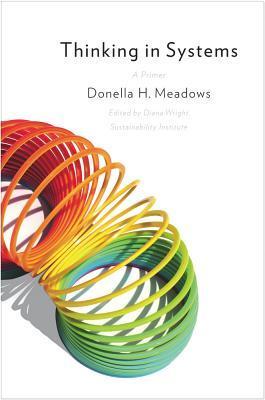
Meadows’ Thinking in Systems, is a concise and crucial book offering insight for problem solving on scales ranging from the personal to the global. Edited by the Sustainability Institute’s Diana Wright, this essential primer brings systems thinking out of the realm of computers and equations and into the tangible world, showing readers how to develop the systems-thinking skills that thought leaders across the globe consider critical for 21st-century life.Some of the biggest problems facing the world—war, hunger, poverty, and environmental degradation—are essentially system failures. They cannot be solved by fixing one piece in isolation from the others, because even seemingly minor details have enormous power to undermine the best efforts of too-narrow thinking.While readers will learn the conceptual tools and methods of systems thinking, the heart of the book is grander than methodology. Donella Meadows was known as much for nurturing positive outcomes as she was for delving into the science behind global dilemmas. She reminds readers to pay attention to what is important, not just what is quantifiable, to stay humble, and to stay a learner.In a world growing ever more complicated, crowded, and interdependent, Thinking in Systems helps readers avoid confusion and helplessness, the first step toward finding proactive and effective solutions.

Les Limites à la croissance (dans un monde fini) : Le rapport Meadows, 30 ans après
by Donella H. Meadows
Rating: 4.3 ⭐
• 1 recommendation ❤️
En 1972, quatre jeunes scientifiques du MIT rédigent à la demande du Club de Rome un rapport qu'ils intitulent The Limits to Growth. Celui-ci va choquer le monde et devenir un best-seller international. Pour la première fois, leur recherche établit les conséquences dramatiques sur le plan écologique d'une croissance économique et démographique exponentielle dans un monde fini. Leur analyse repose sur le modèle « World3 », qui permet une simulation informatique des interactions entre population, croissance industrielle, production alimentaire et limites des écosystèmes terrestres.Ce rapport paraît avant la première crise pétrolière de 1973, et pour beaucoup d'esprits, la croissance économique est alors un fait durable, qui ne saurait être discuté. En 2004, les auteurs reprennent leur analyse et l'enrichissent de données accumulées durant trois décennies d'expansion sans limites : l'impact destructeur des activités humaines sur les processus naturels les conforte définitivement dans leur raisonnement.En 1972, la problématique centrale du livre était : « comment éviter le dépassement » ; l'enjeu est désormais : « comment procéder pour que nos activités ralentissent et puissent tenir dans les limites de la planète ».Ce livre propose donc la dernière version du Rapport Meadows, à un moment où la crise majeure que nous traversons jette une lumière crue sur la dynamique de la croissance et ses effets.

The message of this book is urgent and sobering: The earth's interlocking resources-the global system of nature in which we all live-probably cannot support present rates of economic and population growth much beyond the year 2100, if that long, even with advanced technology. In the summer of 1970, an international team of researchers at the Massachusetts Institute of Technology began a study of the implications of continued worldwide growth. They examined the five basic factors that determine and, in their interactions, ultimately limit growth on this planet-population increase, agricultural production, nonrenewable resource depletion, industrial output, and pollution generation. The MIT team fed data on these five factors into a global computer model and then tested the behavior of the model under several sets of assumptions to determine alternative patterns for mankind's future. THE LIMITS TO GROWTH is the nontechnical report of their findings. The book contains a message of hope, as well: Man can create a society in which he can live indefinitely on earth if he imposes limits on himself and his production of material goods to achieve a state of global equilibrium with population and production in carefully selected balance.


Beyond the Limits: Confronting Global Collapse, Envisioning a Sustainable Future
by Donella H. Meadows
Rating: 4.0 ⭐
Twenty years after their influential book, The Limits to Growth, was published to worldwide acclaim, the authors revise several scenarios of growth, concluding that the global industrial system has already overshot some of the Earth's vital ecological limits.

In The Global Citizen , Donella Meadows challenges us to view the world as an interconnected system for which we are all responsible. This collection of the best of Meadows's environmental writings demonstrates her rare ability to discuss complex issues such as population, poverty and development, and solid waste disposal in a clear, concise, engaging way for a wide audience.


An in-depth analysis of the strengths and limitations of computer models in helping solve social, economic and political problems, using nine recent models as examples. Addressing the growing disillusionment with models among researchers and policymakers, the authors discuss what has been done and what still needs to be done to make modeling a more viable and realistic analytical tool.

As global population and material standard of living continue to grow it becomes necessary to understand the consequences of growth within the context of our finite world. It is now being increasingly accepted that growth cannot continue unchecked, and must in time give way to equilibrium. What are the factors which necessitate such a transition, and how can we systematically analyze and cope with the problems arising from growth? Toward Global Equilibrium collects in one volume 13 papers which identify and deal with specific issues connected with growth. Two introductory papers in the first section provide background material on system dynamics and the MIT-Club of Rome Project under which this research was undertaken. Reports in the second section of the book describe seven complete system dynamic models for analyzing such important global problems as DDT and mercury pollution, natural resource depletion, solid waste disposal, etc. Complete description and model equations are included to enable the reader to reproduce and extend the simulation results reported in the text. Four papers in the third section examine the economic, political, and ethical implications of growth and the transition to equilibrium. These papers were originally disseminated as individual statements. A brief summary of the circumstances leading to its preparation precedes each paper. These papers also identify critical areas of future research in the fields of population, environment, resources, and social ethics. Edited by Dennis L. Meadows and Donella H. Meadows.

Chikyū No Hōsoku To Erabubeki Mirai: Donera Medōzu Hakushi Kara No Messēji
by Donella H. Meadows
Rating: 4.3 ⭐

I nuovi limiti dello sviluppo: La salute del pianeta nel terzo millennio.
by Donella H. Meadows
Rating: 5.0 ⭐
Nel 1972 tre giovani scienziati, pionieri delle scienze informatiche, pubblicarono I limiti dello sviluppo: un rapporto destinato a fare epoca, in cui gettavano uno sguardo verso il futuro e, grazie a modelli di calcolo computerizzati, riuscivano a mostrare le conseguenze della crescita incontrollata su un pianeta dalle risorse non infinite. Parecchi anni dopo, armati di strumenti informatici ben più raffinati e di una mole enorme di dati statistici, quegli stessi autori lanciano ancora il loro grido d'allarme, confermando le previsioni e mettendoci in guardia sui devastanti effetti dell'azione umana sul clima, la qualità delle acque, la biodiversità marina, le foreste e tutte le altre risorse naturali. Prima che sia troppo tardi.

「成長の限界」からカブ・ヒル村へ―ドネラ・H・メドウズと持続可能なコミュニティ
by Donella H. Meadows

PONS Taschenwortschatz Italienisch. 5000 parole. Mit VHS- Wortschatz.
by Donella H. Meadows

Indicators and Information Systems for Sustainable Development: A Report to the Balaton Group, September 1998
by Donella H. Meadows
Softbound. From "The origin of this work": "This paper grew ou of a five-day workshop on sustainable development indicators attended by a small subset of the two hundred members of the Balaton Group."

Learning Environment, Limits to Growth (CD-ROM): The 30-Year Update by Donella Meadows
by Donella H. Meadows