
Jakob Nielsen
Jakob Nielsen is a leading web usability consultant. He holds a Ph.D. in human-computer interaction from the Technical University of Denmark in Copenhagen. He is also the principal of the Nielsen Norman Group which he co-founded with Dr. Donald A. Norman (former VP of research at Apple Computer). Before starting NNG in 1998 he was a Sun Microsystems Distinguished Engineer. Nielsen founded the "discount usability engineering" movement for fast and cheap improvements of user interfaces and has invented several usability methods, including heuristic evaluation. He holds 79 United States patents, mainly on ways of making the Web easier to use. Nielsen has also given his five quality components of Usability Goals, which are: Learnability, Efficiency, Memorability, Errors (as in low error rate), Satisfaction.
30 Books Written
Users experience the usability of a web site before they have committed to using it and before making any purchase decisions. The web is the ultimate environment for empowerment, and he or she who clicks the mouse decides everything. Designing Web Usability is the definitive guide to usability from Jakob Nielsen, the world's leading authority. Over 250,000 Internet professionals around the world have turned to this landmark book, in which Nielsen shares the full weight of his wisdom and experience. From content and page design to designing for ease of navigation and users with disabilities, he delivers complete direction on how to connect with any web user, in any situation. Nielsen has arrived at a series of principles that work in support of his findings: 1. That web users want to find what they're after quickly; 2. If they don't know what they're after, they nevertheless want to browse quickly and access information they come across in a logical manner. This book is a must-have for anyone who thinks seriously about the web.
Describes Web site usability through critiques of real-world sites, covering such factors as legibility, navigability, searchability, and design.
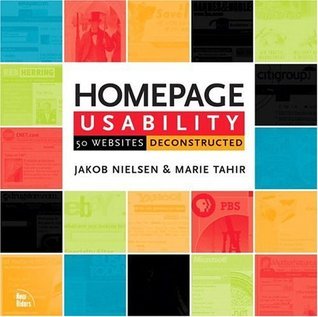
The book begins with a briefing on Jakob's web usability principles, themselves culled from years of research. The 50 sites fall under such categories as Fortune 500 Sites, Highest-Traffic Sites, and E-Commerce Sites.The content is simply presented: Four book pages are devoted to each homepage. The first page is a clean screenshot of the site's homepage (for readers to make their own, unbiased judgments), followed by a page that explains the site's purpose and summarizes its success--or failure--at usabilty. The third and fourth pages are devoted to crtiques, where Jakob and Marie present no-holds-barred commentary for specific usability practices, as well as suggestions for improvement. Although only the homepage of each site is analyzed, many of the critiques can be applied to overall website design.

Written by the author of the best-selling HyperText & HyperMedia, this book is an excellent guide to the methods of usability engineering. The book provides the tools needed to avoid usability surprises and improve product quality. Step-by-step information on which method to use at various stages during the development lifecycle are included, along with detailed information on how to run a usability test and the unique issues relating to international usability.* Emphasizes cost-effective methods that developers can implement immediately* Instructs readers about which methods to use when, throughout the development lifecycle, which ultimately helps in cost-benefit analysis.* Shows readers how to avoid the four most frequently listed reasons for delay in software projects.* Includes detailed information on how to run a usability test.* Covers unique issues of international usability.* Features an extensive bibliography allowing readers to find additional information.* Written by an internationally renowned expert in the field and the author of the best-selling HyperText & HyperMedia.

Eyetracking Web Usability is based on one of the largest studies of eyetracking usability in existence. Best-selling author Jakob Nielsen and coauthor Kara Pernice used rigorous usability methodology and eyetracking technology to analyze 1.5 million instances where users look at Web sites to understand how the human eyes interact with design. Their findings will help designers, software developers, writers, editors, product managers, and advertisers understand what people see or don’t see, when they look, and why.With their comprehensive three-year study, the authors confirmed many known Web design conventions and the book provides additional insights on those standards. They also discovered important new user behaviors that are revealed here for the first time. Using compelling eye gaze plots and heat maps, Nielsen and Pernice guide the reader through hundreds of examples of eye movements, demonstrating why some designs work and others don’t. They also provide valuable advice for page layout, navigation menus, site elements, image selection, and advertising. This book is essential reading for anyone who is serious about doing business on the Web.

207 design guidelines to improve the usability (and thus the conversion rate) for e-commerce sites. Richly illustrated with 221 color screenshots of designs that worked particularly well or that caused problems for shoppers. All the design guidelines are based on findings from detailed usability studies of twenty e-commerce sites with real users in the United States and Europe, showing what they did as they shopped on real e-commerce sites. Covers the following

Computer Science/Computers-Human Interaction Usability Inspection Methods is the first comprehensive, book-length work in this important new field. Designed to get you quickly up and running with the full complement of UI strategies, tools, and techniques, this extremely practical guide offers you a unique opportunity to learn them from the women and men who invented them. With the help of numerous real-life case studies, the authors give Step-by-step guidance on all important methods now in use, including the heuristic evaluation method, the pluralistic walkthrough method, the cognitive walkthrough method, and more Proven techniques for integrating usability inspections with other methods now in use An in-depth, comparative analysis of UI versus user testing A cost-benefit analysis of UI as compared to other approaches Program prototypes that provide UI computer support for interface designers An important resource for user interface developers, software designers, as well as graduate students and researchers

Making really good beer at home can actually be fun, easy and cheap – and take less than a day! In Kitchen Brewing , beer enthusiasts Jakob Nielsen and Mikael Zetterberg show you how to create delicious-tasting beers on a budget in just a matter of hours, without losing any quality along the way.Using regular, everyday kitchen equipment, plus a basic home-brew starter kit, you'll soon discover that brewing beer can be as simple as you don't need to be an expert but with a bit of patience and the right know-how you'll soon see just how simple and fun it is to make beer at home. Learn how to brew small volumes of a range of different styles of from beautiful fruity IPAs and fresh and herbal lagers to a cracking porter and Swedish folköl with a real punch of hops, these are fun, manageable recipes that anyone can master.Featuring comprehensive instructions on tools, bottling, equipment hygiene, as well as helpful hints and tips on the best season to brew each beer, it won't be long until you are making your own unique beer creations in your very own kitchen brewery.

Journalisten der snød Gestapo - Historien om Børge Outze og den illegale presse
by Jakob Nielsen
Rating: 3.7 ⭐

L'informatica è sempre più presente, nelle attività lavorative come nella vita quotidiana, mentre il tempo che si può dedicare allo studio e alla formazione è sempre più ridotto. I libri della serie Pocket Apogeo rispondono alla sfida: volumi da portare con sé, brevi corsi per imparare tutto quello che serve di un linguaggio, di un sistema operativo, di un programma applicativo o di un particolare campo delle tecnologie dell'informazione e della comunicazione. Volumi compatti, dunque, ma non a scapito della qualità: la brevità è ottenuta eliminando il superfluo ed escludendo l'inessenziale, puntando invece a quanto serve veramente per avere le idee chiare e sapersi orientare. In questo volume: "Web usabilità 2.0"

A comprehensive, clearly written overview of hypertext, this book gives broad coverage of different hypertext systems, as well as their features and applications using many concrete examples and illustrations of real systems. Nielsen provides a history of the subject and explores the social issues related to hypertext.

L'informatica è sempre più presente, nelle attività lavorative come nella vita quotidiana, mentre il tempo che si può dedicare allo studio e alla formazione è sempre più ridotto. I libri della serie Pocket Apogeo rispondono alla sfida: volumi da portare con sé, brevi corsi per imparare tutto quello che serve di un linguaggio, di un sistema operativo, di un programma applicativo o di un particolare campo delle tecnologie dell'informazione e della comunicazione. Volumi compatti, dunque, ma non a scapito della qualità: la brevità è ottenuta eliminando il superfluo ed escludendo l'inessenziale, puntando invece a quanto serve veramente per avere le idee chiare e sapersi orientare. In questo volume: "Web usabilità 2.0"

In the years since Jakob Nielsen's classic collection on interface consistency first appeared, much has changed, and much has stayed the same. On the one hand, there's been exponential growth in the opportunities for following or disregarding the principles of interface consistency-more computers, more applications, more users, and of course the vast expanse of the Web. On the other, there are the principles themselves, as persistent and as valuable as ever. In these contributed chapters, you'll find details on many methods for seeking and enforcing consistency, along with bottom-line analyses of its benefits and some warnings about its possible dangers. Most of what you'll learn applies equally to hardware and software development, and all of it holds real benefits for both your organization and your users.

Based on his best-selling HyperText and HpyerMedia, Jakob Nielsen takes hypertext a step further--to the Internet. Multimedia and The Internet and Beyond explores new and developing applications in multimedia and hypertext as well as offering coverage of the use of HTML (hypertext markup language) and the World Wide Web with interfaces such as Mosaic and Netscape.* Includes a large number of richly illustrated examples of a wide variety of new hypermedia systems.* Provides a range of strategies for overcoming information overload.* Thorougly discusses a number of new applications, including distribution of hypertext tools via the Internet.* Explains copyright issues for users and develeopers, and usability issues for hypertext.* Forecasts the future of the field in the long and short term.

Swedish / Svenska

Increasing technological sophistication in many countries and the resulting larger world trade has indicated a need to pay greater attention to the international aspects of user interfaces. Many American companies are approaching a situation where half of their sales are outside the United States, and companies in smaller countries often have a much larger proportion of their sales outside their own country. This means that software sales will increasingly depend on their international usability and not just their domestic usability. Seen from a user's perspective more than half of the world's software users will be using interfaces which were originally designed in a foreign country. Usability for this large market of users will depend upon increased awareness of the issues involved in designing user interfaces for international use. As the European community aims to establish the so-called Single Market by the end of 1992, international software will become even more important in that part of the world. And as if it wasn't hard enough to design user interfaces for use in Europe, there are a further set of problems connected with user interfaces for Asia. Both of these issues are examined in depth. This is the first publication of its kind to appear on the topic of international user interfaces, and presents both general guidelines and a number of detailed case studies on the many aspects entailed. The book will be of considerable interest to project managers, lecturers, students, developers of basic software and user interface designers.

You can’t sell a product that your customers can’t find. Your site must accommodate all types of searches and return relevant results for categories, products, and product characteristics. Search is a critical element of building a profitable website. In our recent e-commerce usability study, 83% of users searched on one or more sites.This 148-page report contains 62 design recommendations based on our usability research. Discussions and 130 screenshot illustrations supplement the findings.Even though some of the design guidelines are specific to searching for products, many of the guidelines apply to all forms of web searches, including general websites and intranets.Topics Exploiting search to meet customer needs Feeling for breadth or depth of the site's product selection Quickly locate a product category or something specific Fallback option to site navigation Narrow options Return to an item previously located Customer queries Search queries, what people type Query length Within site searches versus web-wide searches Best practices for search on e-commerce websites Placement of search Accommodating different lengths and types of searches Interpreting the query Narrowing options Returning useful results Advanced and scoped searches Presenting search results Sorting results Narrowing product choices Guided navigation versus faceted searchResearch MethodThe information in these reports is based on two separate rounds of e-commerce studies, including: One-on-one usability testing Diary-based longitudinal study EyetrackingRepresentative users tested 206 e-commerce websites. The studies took place in the United States, the United Kingdom, Denmark, and China (Hong Kong).


SITE WEB PRIORITE A LA SIMPLICITE NOUVEAU PRIX
by Jakob Nielsen

SITE WEB : PRIORITE A LA SIMPLICITE
by Jakob Nielsen

新ウェブ・ユーザビリティ
by Jakob Nielsen
Oma pikku panimo
by Jakob Nielsen

L'art de la page d'accueil: 50 sites Web passés au crible
by Jakob Nielsen

Usabilidad en dispositivos móviles
by Jakob Nielsen
¿Cómo podemos mejorar el diseño de sitios web y aplicaciones pensando en los usuarios de smartphones y tablets? Jakob Nielsen y Raluca Budiu son dos autores de éxito que nos presentan en esta obra sus conocimientos y experiencia en el desarrollo de estrategias para los dispositivos móviles, haciendo especial hincapié en que tanto el diseño como el contenido deben ir dirigidos a pantallas pequeñas. Mediante un sistema basado en los datos del usuario que ayudará a diseñadores, desarrolladores de software, escritores, editores, responsables de producto y publicitarios, esta obra nos ayuda a comprender cómo crear aplicaciones y sitios web para dispositivos móviles, destacando como elemento clave " la usabilidad " y sin perder de vista las futuras tendencias. Basado en diferentes estudios internacionales donde han participado más de 150 personas, este libro ofrece una visión completa del mundo de los dispositivos móviles. Además cuenta con más de 200 ilustraciones que ayudarán al lector a comprender cómo optimizar la experiencia de usuario en estos dispositivos.

Multimedia, Hypertext und Internet: Grundlagen und Praxis des elektronischen Publizierens (Multimedia-Engineering)
by Jakob Nielsen
Die Informationstechnologie im Zeitalter nach Gutenberg bedeutet neue Herausforderungen für Autoren, Journalisten und Medienschaffende jeglicher Provenienz. Das Buch vermittelt praxisnah und beispielorientiert das grundlegende Wissen, wie Artikel, Bücher, Zeitschriften online oder offline konzipiert und realisiert werden. Dabei wird insbesondere gezeigt, wie im Internet selbst Möglichkeiten der Unterstützung bei der Realisierung genutzt werden können.Die Stärke des Buches liegt vor allem da, wo sich die Darstellung an die Vermittlung des Wesentlichen hält und nicht bei den Zufälligkeiten konkreter Autorensysteme haften bleibt. Das Buch bleibt auf seine Weise aktuell und grundlegend gleichermaßen.Rezension in "Die Zeit im Buch" 51.Jg., 1/97, S. 15 1997(...) Kein Ratgeber, sondern ein seriöses, umfangreiches Buch mit vielen ung gut recherierten Hintergrundinformationen, (...)
Jakob Nielsen Set
by Jakob Nielsen
This special set contains these three titles from the usability expert * Coordinating User Interfaces for Consistency* Usability Engineering* Multimedia and The Internet and Beyond
Conceptual Analysis of the Web
by Jakob Nielsen