
Robert Bringhurst
Robert Bringhurst is a Canadian poet, typographer and author. He is the author of The Elements of Typographic Style – a reference book of typefaces, glyphs and the visual and geometric arrangement of type. He has also translated works of epic poetry from Haida mythology into English. He lives on Quadra Island, near Campbell River, British Columbia (approximately 170 km northwest of Vancouver).
30 Books Written

Renowned typographer and poet Robert Bringhurst brings clarity to the art of typography with this masterful style guide. Combining practical, theoretical, and historical, this book is a must for graphic artists, editors, or anyone working with the printed page using digital or traditional methods.Having established itself as a standard in its field The Elements of Typographic Style is house manual at most American university presses, a standard university text, and a reference work in studios of designers around the world. It has been translated into italian and greek, and dutch.

This new edition of a collaboration between one of the finest living artists in North America and one of Canada's finest poets includes a new introduction by the distinguished anthropologist Claude Lévi-Strauss. Ten masterful, complex drawings by Bill Reid and ten tales demonstrate the richness and range of Haida mythology, from bawdy yet profound tales of the trickster Raven to poignant, imagistic narratives of love and its complications in a world where animals speak, dreams come real, and demigods, monsters, and men live side by side.

A Story As Sharp As a Knife: The Classical Haida Mythtellers and Their World
by Robert Bringhurst
Rating: 4.3 ⭐
The Haida world is a misty archipelago a hundred stormy miles off the coasts of British Columbia and Alaska. For more than a thousand years before the Europeans came, a great culture flourished on these islands. In 1900 and 1901 the linguist and ethnographer John Swanton took dictation from the last traditional Haida-speaking storytellers, poets, and historians. Robert Bringhurst worked for many years with these manuscripts, and here he brings them to life in the English language. A Story as Sharp as a Knife brings a lifetime of passion and a broad array of skills—humanistic, scientific, and poetic—to focus on a rich and powerful tradition that the world has long ignored.

In this powerful little book, two leading intellectuals illuminate the truth about where our environmental crisis is taking us. Writing from an island on Canada's Northwest coast, Robert Bringhurst and Jan Zwicky weigh in on the death of the planet versus the death of the individual. For Zwicky, awareness and humility are the foundation of the equanimity with which Socrates faced his death: he makes a good model when facing the death of the planet, as well as facing our own immortality. Bringhurst urges readers to tune their minds to the wild. The wild has healed the world before, and it is the only thing that stands any chance of healing the world now - though it is unlikely to save Homo sapiens in the process.

The Tree of Meaning is a collection of thirteen lectures given by internationally-renowned poet, linguist and typographer Robert Bringhurst. Together these lectures present a superbly grounded approach to the study of language, focusing on storytelling, mythology, comparative literature, humanity and the breadth of oral culture. Bringhurst’s commitment to what he calls ‘ecological linguistics’ emerges in his studies of Native American art and storytelling, his understanding of poetry, and his championing of a more truly universal conception of what constitutes literature. The collection features a sustained focus on Haida culture (including the work of storytellers Skaay and Ghandl, and artist Bill Reid), on the process of translation, and on the relationship between beings and language. Spanning ten years of lecturing, The Tree of Meaning is remarkable not only for the cohesion of its author’s own ideas but for the synthesis of such wide-ranging perspectives and examples of cultures both human and non-human. These thirteen lectures draw together a highly personalized and active study of Native American art and literature, world languages, philosophy and natural history. To each subject Bringhurst brings an ecologically conscious, humanitarian approach and an enthusiastic interest in the world around him. “When the border guards ask, I say I’m a writer,” remarks Bringhurst. “If they ask still more, I’ll say I write both poetry and prose. That’s usually enough; they’ll shake their heads and wave me on. I wouldn’t attempt to tell them the truth, which is that writing is just a disguise. I do my work by talking to the air. Sooner or later the talk is disguised as writing and printing, because those are the simplest, least obtrusive ways of miming something spoken. “For poetry at least, speaking also seems to me a better delivery method than writing. Doing readings pays better than publishing books of poems. It reaches a wider audience too. It allows for nuances no typographer can match. And speaking is much older and more universal than writing. It seems to me a better venue, much of the time, for the evanescent, mutable agelessness that is apt to distinguish a poem. “So poems, where I come from, are spoken to be written and written to be spoken. The Tree of Meaning is a book of critical prose composed in the same way. “The book has several the nature of language; the nature of meaning; the destruction of the earth as we have known it, occurring side by side with the evident persistence of poetry and meaning. And the book has an agenda connected to these themes. That agenda is learning to read and understand a few significant examples of Native American oral works preserved often by accident, often in damaged form, which have, I think, a lot to teach us all. “In cultures that have writing, the usual way of capturing oral literature is to write it down and put it in a book. We’ve done that with the Iliad, the Odyssey, the Beowulf; we do it now with the works of Cree and Crow and Haida storytellers, phonetically transcribed in the past century and a half. It makes good sense to me that a book about oral literature should be spoken before it is written, and written to be spoken, not just read.”

“Drop a word in the ocean of meaning and concentric ripples form. To define a single word means to try to catch those ripples. No one’s hands are fast enough.” With this concise and broadly informative essay, renowned poet, typographer and linguist Robert Bringhurst presents a brief history of writing and a new way of classifying and understanding the relationship between script and meaning. Beginning with the original relationship between a language and its written script, Bringhurst takes us on a history of reading and writing that begins with the interpretation of animal tracks and fast-forwards up to the typographical abundance of more recent times. The first four sections of the essay describe the earliest creation of scripts, their movement across the globe and the typographic developments within and across languages. In the fifth and final section of the essay, Bringhurst introduces his system of classifying scripts. Placing four established categories of written language–semographic, syllabic, alphabetic and prosodic–on a wheel adjacent to one another, he uses the location, size and shape of points on the wheel to show the degree to which individual world languages incorporate these aspects of recorded meaning. Bringhurst’s system is based on an appreciation that indeed no one’s hands are fast enough and that no single script adheres to or can be understood within the confines of a single method of transcription. Readers will find this combination of anthropology, typography, literature, mathematics, music and linguistics surprisingly accessible and thought provoking. The text is accompanied by diagrams and typographic examples that make for an experiential study of the relationship between writing and meaning. This book is a Smyth-sewn paperback with a letterpress printed jacket. The book was designed by Robert Bringhurst and Andrew Steeves, and printed on Zephyr Laid paper. The cover was hand-printed letterpress on St. Armand handmade paper.

In this companion volume to The Tree of Meaning (GP, 2006), Robert Bringhurst collects talks and meditations under the principle that “everything is related to everything else.” His studies of poetry, polyphonics, oral literature, storytelling, translation, mythology, homogeny, cultural ecology, literary criticism and typography all build upon this sense of basic connection. Across the collection emerges a sustained interest in poetry–the existence of a poetry to which poems are answers, an examination of philosophy in poetry, the relationship between poetry and music, and the concept of polyphonics. Bringhurst’s thinking involves the work of poets, musicians and philosophers as varied as Ezra Pound, John Thompson, Don McKay, Empedokles, Parmenides, Aristotle, Skaay, Plato, George Clutesi, Elizabeth Nyman, Ludwig Wittgenstein, Dennis Lee and Glenn Gould. The value Bringhurst places on translation–the process of, the dialogue between one language and another, and the sheer experience of witnessing translation by reading and hearing poems, stories and songs in their original languages–is another strong presence in this collection. Accompanying the English narrative are passages in Tlingit, Haida, Chinese, Greek, German, Cree and Russian, for readers who want to find the patterns and taste some of the vocabulary for themselves, for those interested in meeting the languages part way. Winner of the 2008 Hubert Evans Noon-Fiction Prize.

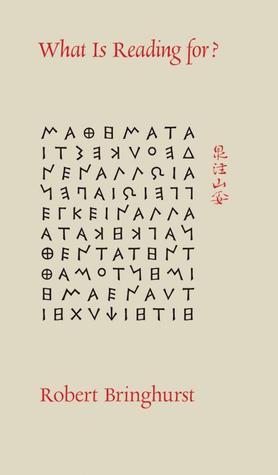
“Reading could have a rich and interesting future, because it does have a rich and interesting past. But if no one remembers that past, it may not mean much to the future.”This succinct and thoughtful essay is the text of a talk commissioned for a symposium entitled The Future of Reading which was held at RIT in June 2010. Written and designed by Robert Bringhurst, this limited edition is carefully crafted and letterpress printed. 450 copies, printed on Mohawk Ticonderoga paper.

Book by Bringhurst, Robert

A new collection from one of Canada’s finest contemporary poets. In The Ridge , Robert Bringhurst offers a work of nonfiction in poetic form, intensely focused on the ecological past, present and future of the West Coast of Canada. At the book’s heart is a long poem, “The Ridge,” in which Bringhurst makes meticulous use of scientific language and, with a poet’s perspective and precision, translates abstract concepts into tangible and devastating imagery. Global energy consumption is measured in cords of wood instead of BTUs or megawatts; subatomic particles demarcating time and space are prayer flags tearing free in the slow destruction of the solar system. In dazzling prose that weaves together the physical and the metaphysical, Bringhurst shifts his attention from tiny spores to fish farms, the spirit world, telescopes and epistemology. Beautiful, profound and insightful, The Ridge reflects the author’s reputation as one of Canada’s most esteemed poets.

Dazzling collection of poems, songs and lyric meditations.

For the past four decades, Robert Bringhurst has been writing some of the most powerful poetry in English. Distinguished by engaged and passionate curiosity, a wide-ranging intelligence and true originality, his poetry has sometimes been mistaken as austere and opaque. In fact, his work engages in ideas about the human condition, myth, the natural world, language and philosophy, and is unusual for having both a pared simplicity and profound wisdom.His watchword is clarity, and the elements he considers crucial to effective typography could just as easily be looked for - and found - in his poetry: 'invite the reader into the text; reveal the tenor and meaning of the text; clarify the structure and the order of the text; link the text with other existing elements; induce a state of energetic repose, which is the ideal condition for reading.'There is such relish for the tactile, physical nature of words, for spare, elemental imagery and for rhetorical weight - in the voice, and the sound of the voice - that each poem has a sense of gem-like purity. While Bringhurst's work may not be the most fashionable poetry being written today, it is certainly amongst the most compelling in its truth, power and beauty.

In this fascinating study, Robert Bringhurst takes readers on a walking tour through the bramble of book design, from the mid-18th century to the present day. Along the way, he discovers a true “image trove” of identity, culture, and history. Transcending other works on the subject, Bringhurst here creates a truly national survey by bringing Canada’s long history of aboriginal storytelling into a context of “book” — a context that goes far beyond the printed page.

An essay on thinking typographically. Includes references to architecture, design, language and poetry.

It is rare for a single work of sculpture to become the subject of a book at any time, much less at the moment of its installation. But Bill Reid's Spirit of Haida Gwaii is no ordinary sculpture. Commissioned for the courtyard of the new Canadian chancery in Washington, DC, it sits directly across the street from the National Gallery and is destined to become one of the major artistic landmarks of the capital and of the North American continent.Of Haida and white parentage, Canadian artist Bill Reid has spent his life resurrecting the indigenous Northwest Coast tradition in the visual arts. Yet has never lost touch with the European media and techniques in which he was trained. He is equally famed for his totem poles and other large pieces in wood and bronze, and for his work on a minute scale in precious metal.The Spirit of Haida Gwaii is a black bronze canoe, 6 metres long and filled to overflowing with the creatures of Haida mythology. Its passengers include the Raven, the Eagle, the Grizzly and his human wife, the Mouse Woman and the Dogfish Woman, among others. Amidships stands a human being, wrapped in the stylized skin of the mythical Seawolf, holding in his hand a smaller sculpture: a staff on which the story of creation, in Haida terms, is told.

The biography of one of world’s most popular typefaces. “Whether one likes Palatino or not, Mr. Bringhurst’s book is an instant classic.”― The Wall Street JournalHermann Zapf was one of the great practitioners of the graphic arts and Palatino is probably the most widely known and used of all Zapf faces. Author Robert Bringhurst traces Palatino’s development, with all its infinite permutations, and often invisible refinements through a long and fascinating history of variations and permutations, imitations and conflations―from hot metal, through the brief interlude of film setting and finally into the digital world.It is all here, in encompassing a fully illustrated account of Palatino and its extended foundry and Linotype, Michelangelo, Sistina, Aldus, Heraklit, Phidias, Zapf Renaissance, PostScript Palatino, Palatino and Aldus Nova, and Palatino Sans. Included with the text are over 200 illustrations of design sketches, working drawings, smoke proofs and test prints, matrices, foundry and Linotype patterns.But beyond that, the book is an argument that artists who create letters can, and should, be judged by the same standards and held in the same esteem as composers who write music and artists who paint on canvas. Bringhurst asks the question, “Can a penstroke or a letterform be so beautiful it will stop you in your tracks and maybe break your heart?” In this groundbreaking and totally original book, he answers the “It can.”

In March 2002, the Regina-based dance company New Dance Horizons performed Robert Bringhurst's Ursa Major: A Polyphonic Masque for Speakers & Dancers, a work that had been commissioned as part of an evening of modern performance and dance entitled Invisible Ceremonies. In Ursa Major, Bringhurst explores a polyphonic technique that allows multiple speakers – and multiple languages and traditions – to collaborate in the story's telling. The subject of the masque is Ursa Major, the great bear constellation, one of the most universal themes in world mythology. In setting the Cree tradition alongside the mythologies of ancient Greece and Rome, Bringhurst demonstrates the richness of metaphor that North Americans have inherited. This publication is an attempt to express the masque's performance in typographic form.

Wild Language by Robert Bringhurst is the first title in the Ralph Gustafson Distinguished Poets Lecture Series. The series publishes the lecture presented annually by the Gustafson Chair of Poetry at Malaspina University-College in Nanaimo, British Columbia, Canada.
"The type is hand-set Meridien printed on Moulin du Verger handmade paper. The book is bound in Barcham Green Renaissance as is the wrapper. The photographs are platinum. Judi Conant assembled the wrapper and the photographs were printed by Gordon Mark. The photographs were taken by Carolee Campbell who designed, printed letterpress and bound the edition ... This edition consists of one hundred signed & numbered copies with twelve lettered hors commerce"--Colophon.


Eta kniga, vpervye izdannaja v 1992 godu, bystro stala professionalnym bestsellerom i ostaetsja im v mire anglo-jazychnoj tipografiki do sikh por. Ee avtoritet byl srazu priznan v tipograficheskom soobschestve kak priverzhentsami klassiki, tak i storonnikami avangarda. Ona pereizdavalas s ispravlenijami i dopolnenijami mnogo raz, byla perevedena na italjanskij, grecheskij, portugalskij i polskij jazyki. V 1996 godu, a zatem v 2005-m, kniga byla pererabotana i suschestvenno rasshirena.Nastojaschee izdanie – perevod originalnoj versii 3.2, vyshedshej v 2008 godu. K nemu dobavleny primechanija redaktora i izdatelja, delajuschimi nekotorye detali bolee ponjatnymi dlja rossijskogo chitatelja. V tretem russkom izdanii ispravleny opechatki i netochnosti perevoda, znachitelnoe kolichestvo stranits pereverstana, a takzhe skorrektirovany risun�... Rekomenduem!


Cet essai nous présente une brève histoire de l’écriture et une nouvelle méthode pour classifier et comprendre ses rapports avec le sens. Il nous emporte dans une histoire de la lecture et de l’écriture qui commence par l’interprétation des traces animales et progresse rapidement jusqu’à l’abondance typographique de nos jours. Robert Bringhurst est poète, typographe et linguiste, connu pour sa traduction de Parménide et des contes Haida de Skaay et Ghandl. Son manuel, The Elements of Typographic Style, est une référence en matière de design typographique.
Tending The Fire: An Unparable Of The Relations Of Rabbits & Dogs & Old Women, &C
by Robert Bringhurst

Cadastre
by Robert Bringhurst
Prosodies of Meaning: Literary Form in Native North America.
by Robert Bringhurst
Tzuhalem's Mountain
by Robert Bringhurst
The Solid Form of Language : An Essay on Writing and Meaning
by Robert Bringhurst