
Jacques Barzun
Works of French-American educator, author, and historian Jacques Martin Barzun include Darwin, Marx, Wagner (see Charles Robert Darwin, Karl Marx, and Richard Wagner) (1941) and The American University (1968). He presented ideas and culture. https://en.wikipedia.org/wiki/Jacques...
27 Books Written
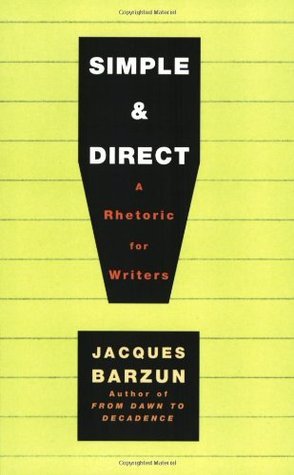
After a lifetime of writing and editing prose, Jacques Barzun has set down his view of the best ways to improve one's style. His discussions of diction, syntax, tone, meaning, composition, and revision guide the reader through the technique of making the written word clear and agreeable to read. Exercises, model passages both literary and casual, and hundreds of amusing examples of usage gone wrong show how to choose the right path to self-expression in forceful and distinctive words.
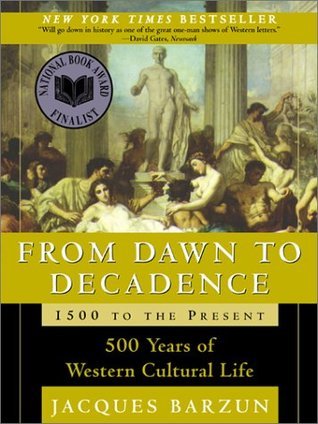
From Dawn to Decadence: 500 Years of Western Cultural Life, 1500 to the Present
by Jacques Barzun
Rating: 4.1 ⭐
Highly regarded here and abroad for some thirty works of cultural history and criticism, master historian Jacques Barzun has now set down in one continuous narrative the sum of his discoveries and conclusions about the whole of Western culture since 1500.In this account, Barzun describes what Western Man wrought from the Renaisance and Reformation down to the present in the double light of its own time and our pressing concerns. He introduces characters and incidents with his unusual literary style and grace, bringing to the fore those that have "Puritans as Democrats," "The Monarch's Revolution," "The Artist Prophet and Jester" -- show the recurrent role of great themes throughout the eras.The triumphs and defeats of five hundred years form an inspiring saga that modifies the current impression of one long tale of oppression by white European males. Women and their deeds are prominent, and freedom (even in sexual matters) is not an invention of the last decades. And when Barzun rates the present not as a culmination but a decline, he is in no way a prophet of doom. Instead, he shows decadence as the creative novelty that will burst forth -- tomorrow or the next day.Only after a lifetime of separate studies covering a broad territory could a writer create with such ease the synthesis displayed in this magnificent volume.

In this international bestseller, originally published in 1959, Jacques Barzun, acclaimed author of From Dawn to Decadence, takes on the whole intellectual -- or pseudo-intellectual -- world, attacking it for its betrayal of Intellect. "Intellect is despised and neglected," Barzun says, "yet intellectuals are well paid and riding high." He details this great betrayal in such areas as public administrations, communications, conversation and home life, education, business, and scholarship.In this edition's new Preface, Jacques Barzun discussess the intense -- and controversial -- reaction the world had to The House of Intellect.

This classic introduction to the techniques of research and the art of expression is used widely in history courses, but is also appropriate for writing and research methods courses in other departments. Barzun and Graff thoroughly cover every aspect of research, from the selection of a topic through the gathering, analysis, writing, revision, and publication of findings presenting the process not as a set of rules but through actual cases that put the subtleties of research in a useful context. Part One covers the principles and methods of research; Part Two covers writing, speaking, and getting one's work published.

Throughout his career Jacques Barzun, author of the New York Times bestseller and National Book Award Finalist From Dawn to Decadence , has always been known as a witty and graceful essayist, one who combines a depth of knowledge and a rare facility with words. Now Michael Murray has carefully selected eighty of Barzun's most inventive, accomplished, and insightful essays, and compiled them in one impressive volume. With subjects ranging from history to baseball to crime novels, A Jacques Barzun Reader is a feast for any reader.

Twelve essays exploring aspects of literacy and art criticism, retrospective sociology and the effects of relativism on moral behavior.

From the celebrated cultural historian and bestselling author, a provocative history of the evolution of our ideas about art since the early nineteenth centuryIn this witty, provocative, and learned book, acclaimed cultural historian and writer Jacques Barzun traces our changing attitudes to the arts over the past 150 years, suggesting that we are living in a period of cultural liquidation, nothing less than the ending of the modern age that began with the Renaissance. He challenges our conceptions and misconceptions about art “in order to reach a conclusion about its value and its drawbacks for life at the present time.”

With his customary wit and grace, Dr. Barzun contrasts the ritual of education with the lost art of teaching. Twenty-one chapters deal with three major the practice of teaching, the subject matter to be taught, and the institutional and cultural aspects of teaching. Jacques Barzun is a renowned scholar, teacher, and author who lectures widely since his retirement in 1993.

One of the great turning points in modern history came in 1859 when Darwin's Origin of Species, Marx's Critique of Political Economy, and Wagner's Tristain und Isolde made their first appearance. As THE scientist, THE sociologist, and THE artist of the late nineteenth century, Darwin, Marx, and Wagner dominate the epoch, and their theories epitomize a century of thought which continues, as a single stream of influence, down to the present day. Cover by Leonard Baskin.Typography by Edward Gorey.

In this powerful, eloquent, and timely book, Jacques Barzun offers guidance for resolving the crisis in America's schools and colleges. Drawing on a lifetime of distinguished teaching, he issues a clear call to action for improving what goes on in America's classrooms. The result is an extraordinarily fresh, sensible, and practical program for better schools."It is difficult to imagine a more pungent, perceptive or eloquent commentary on contemporary American education than this collection of 15 pieces by Jacques Barzun."—Jonathan Yardley, Washington Post Book World"Mr. Barzun's style is elegant, distinctive, philosophically consistent and much better-humored than that of many contemporary invective-hurlers."—David Alexander, New York Times Book Review

Drawing from the works of influential figures in art and literature, the author traces the development of romanticism from classicism and the emergence of the modern ego

With this book, Jacques Barzun pays what he describes as an "intellectual debt" to William James—psychologist, philosopher, and, for Barzun, guide and mentor. Commenting on James's life, thought, and legacy, Barzun leaves us with a wise and civilized distillation of the great thinker's work.

In this abridgment of his monumental study, Berlioz and the Romantic Century , Jacques Barzun recounts the events and extraordinary achievements of the great composer's life against the background of the romantic era. As the author eloquently demonstrates, Berloiz was an archetype whose destiny was the story of an age, the incarnation of an artistic style and a historical spirit. "In order to understand the nineteenth century, it is essential to understand Berlioz," notes W. H. Auden, "and in order to understand Berlioz, it is essential to read Professor Barzun."

On Writing, Editing, and Publishing: Essays, Explicative and Hortatory
by Jacques Barzun
Rating: 3.7 ⭐
Book by

A Catalogue of Crime: Being a Reader's Guide to the Literature of Mystery, Detection, and Related Genres
by Jacques Barzun
Rating: 4.5 ⭐
An annotated list of more than five thousand books, including novels, short story collections, histories of the genre, true crime tales, and Sherlock Holmes studies

The renowned scholar and author of "Teacher in America" and "The House of Intellect," examines how the urge to be snobbish, prestigious, technical, scientific, and abstract has led the English language astray

Barzun, Essay on French Verse. From the author of From Dawn to Decadence.

The Glorious Entertainment by Barzun, Jacques

In this work Jacques Barzun presents his credo as a historian, defending Clio, the muse of history, against the “doctors” – those historians who apply the techniques of psychohistory and statistics to historiography. Measuring the usefulness of psycho- and quanto-history by the four criteria of substance, methodology, evidence, and motivation, Barzun contrasts the application of technology to historiography with his idea of the true spirit of historical inquiry. For Barzun, the study of history is for the cultivation of minds rather than for instruction in facts. He posits the historians' efforts to transform history into a science result from their attempts to overcome the necessary uncertainty of the discipline. Barzun's defense of his craft raises fundamental questions of theory and practice about both history and the methods applied to it.

Critical Questions: On Music and Letters, Culture and Biography, 1940-1980
by Jacques Barzun
Rating: 4.3 ⭐
This collection of writings allows the reader a rare opportunity to see Barzun's lively, engaging, rich, and original mind at work on several strategic areas of cultural music and the musical life, esthetics, biography, criticism, and social commentary. Barzun makes use of a variety of contexts as a forum for evidence and opinion, including essays, program notes, letters, and reviews. And he approaches a wide variety of particular and general questions. What is it like to sit in on a recording session with a great orchestra? What is the role of the piano in Western culture? What is art in relation to objective reality and to the perceiving mind? Can one translate music into words? What is cultural history?For anyone unfamiliar with Barzun's work, Critical Questions will serve as a valuable introduction to one of the most important cultural historians of our time. Others will be glad to have these pieces—most of them no longer easily available—brought together in a single volume. Uniformly insightful, provocative, and a pleasure to read, they show the consistency of Barzun's thought even as they exhibit diversity.

When it was published in 1968, a year noted for historic student protests on campuses across the country, The American University spoke in Jacques Barzun's characteristically wise and lucid voice about what colleges and universities were really meant to do—and how they actually worked. Drawing on a lifetime of extraordinary accomplishment as a teacher, administrator, and scholar, Barzun here describes the immense demands placed on the university by its competing constituencies—students, faculty, administrators, alumni, trustees, and the political world around it all."American higher education is fortunate to have had a scholar and intellectual of Jacques Barzun's stature give so many years of service to the daily bread-and-butter details of running a great university and then share his reflections with us in a literate, humane, and engaging book."—Charles Donovan, America

Art critiques.
God's Country and Mine: A Declaration of Love Spiced With a Few Harsh Words
by Jacques Barzun
Rating: 4.2 ⭐
Book by Barzun, Jacques
"A penetrating look at the virtues and vices of our musical culture by the author of The House of Intellect."


Ebook..Lincoln, the literary genius.Published 1960 by Schori Private Press in Evanston, Ill . Written in English.Edition Notes"Printing ... limited to five hundred numbered and signed copies."ClassificationsLibrary of CongressE457.2 .B295The Physical ObjectPagination49 p.Number of pages49ID NumbersOpen LibraryOL5818112MInternet Archivelincolnliteraryg00barzLC Control Number61003287OCLC/WorldCat586466

An introduction essay by Jacques Barzun to the Time-Life book series "Great Ages of Man". Booklet also includes a fold-out chart entitled 'The Great Ages of Man'.