
Lawrence Weschler
Lawrence Weschler, a graduate of Cowell College of the University of California at Santa Cruz (1974), was for over twenty years (1981-2002) a staff writer at The New Yorker, where his work shuttled between political tragedies and cultural comedies. He is a two-time winner of the George Polk Award (for Cultural Reporting in 1988 and Magazine Reporting in 1992) and was also a recipient of Lannan Literary Award (1998). His books of political reportage include The Passion of Poland (1984); A Miracle, A Universe: Settling Accounts with Torturers (1990); and Calamities of Exile: Three Nonfiction Novellas (1998). His “Passions and Wonders” series currently comprises Seeing is Forgetting the Name of the Thing One Sees: A Life of Contemporary Artist Robert Irwin (1982); David Hockney’s Cameraworks (1984); Mr. Wilson’s Cabinet of Wonder (1995); A Wanderer in the Perfect City: Selected Passion Pieces (1998) Boggs: A Comedy of Values (1999); Robert Irwin: Getty Garden (2002); Vermeer in Bosnia (2004); and Everything that Rises: A Book of Convergences (February 2006). Mr. Wilson was shortlisted for both the Pulitzer Prize and the National Book Critics Circle Award; and Everything that Rises received the 2007 National Book Critics Circle Award for Criticism. Recent books include a considerably expanded edition of Seeing is Forgetting the Name of the Thing One Sees, comprising thirty years of conversations with Robert Irwin; a companion volume, True to Life: Twenty Five Years of Conversation with David Hockney; Liza Lou (a monograph out of Rizzoli); Tara Donovan, the catalog for the artist’s recent exhibition at Boston’s Institute for Contemporary Art, and Deborah Butterfield, the catalog for a survey of the artist’s work at the LA Louver Gallery. His latest addition to “Passions and Wonders,” the collection Uncanny Valley: Adventures in the Narrative, came out from Counterpoint in October 2011. Weschler has taught, variously, at Princeton, Columbia, UCSC, Bard, Vassar, Sarah Lawrence, and NYU, where he is now distinguished writer in residence at the Carter Journalism Institute. He recently graduated to director emeritus of the New York Institute for the Humanities at NYU, where he has been a fellow since 1991 and was director from 2001-2013, and from which base he had tried to start his own semiannual journal of writing and visual culture, Omnivore. He is also the artistic director emeritus, still actively engaged, with the Chicago Humanities Festival, and curator for New York Live Ideas, an annual body-based humanities collaboration with Bill T. Jones and his NY Live Arts. He is a contributing editor to McSweeney’s, the Threepeeny Review, and The Virginia Quarterly Review; curator at large of the DVD quarterly Wholphin; (recently retired) chair of the Sundance (formerly Soros) Documentary Film Fund; and director of the Ernst Toch Society, dedicated to the promulgation of the music of his grandfather, the noted Weimar emigre composer. He recently launched “Pillow of Air,” a monthly “Amble through the worlds of the visual” column in The Believer. (from www.lawrenceweschler.com)
28 Books Written
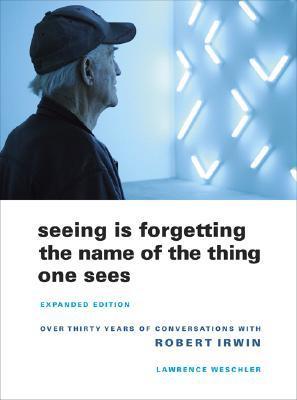
Seeing Is Forgetting the Name of the Thing One Sees
by Lawrence Weschler
Rating: 4.5 ⭐
• 2 recommendations ❤️
When this book first appeared in 1982, it introduced readers to Robert Irwin, the Los Angeles artist "who one day got hooked on his own curiosity and decided to live it." Now expanded to include six additional chapters and twenty-four pages of color plates, Seeing Is Forgetting the Name of the Thing One Sees chronicles three decades of conversation between Lawrence Weschler and light and space master Irwin. It surveys many of Irwin's site-conditioned projects―in particular the Central Gardens at the Getty Museum (the subject of an epic battle with the site's principal architect, Richard Meier) and the design that transformed an abandoned Hudson Valley factory into Dia's new Beacon campus―enhancing what many had already considered the best book ever on an artist.

And How Are You, Dr. Sacks?: A Biographical Memoir of Oliver Sacks
by Lawrence Weschler
Rating: 3.8 ⭐
• 1 recommendation ❤️
The untold story of Dr. Oliver Sacks, his own most singular patient"[An] engrossing biographical memoir. This is Sacks at full on endless ward rounds, observing his post-encephalitic patients . . . exulting over horseshoe crabs and chunks of Iceland spar." ―Barbara Kiser, NatureThe author Lawrence Weschler began spending time with Oliver Sacks in the early 1980s, when he set out to profile the neurologist for his own new employer, The New Yorker . Almost a decade earlier, Dr. Sacks had published his masterpiece Awakenings― the account of his long-dormant patients’ miraculous but troubling return to life in a Bronx hospital ward. But the book had hardly been an immediate success, and the rumpled clinician was still largely unknown. Over the ensuing four years, the two men worked closely together until, for wracking personal reasons, Sacks asked Weschler to abandon the profile, a request to which Weschler acceded. The two remained close friends, however, across the next thirty years and then, just as Sacks was dying, he urged Weschler to take up the project once again. This book is the result of that entreaty.Weschler sets Sacks’s brilliant table talk and extravagant personality in vivid relief, casting himself as a beanpole Sancho to Sacks’s capacious Quixote. We see Sacks rowing and ranting and caring deeply; composing the essays that would form The Man Who Mistook His Wife for a Hat ; recalling his turbulent drug-fueled younger days; helping his patients and exhausting his friends; and waging intellectual war against a medical and scientific establishment that failed to address his greatest the spontaneous specificity of the individual human soul. And all the while he is pouring out a stream of glorious, ribald, hilarious, and often profound conversation that establishes him as one of the great talkers of the age. Here is the definitive portrait of Sacks as our preeminent romantic scientist, a self-described “clinical ontologist” whose entire practice revolved around the single fundamental question he effectively asked each of his How are you? Which is to say, How do you be ?A question which Weschler, with this book, turns back on the good doctor himself.

Mr. Wilson's Cabinet Of Wonder: Pronged Ants, Horned Humans, Mice on Toast, and Other Marvels of Jurassic Technology
by Lawrence Weschler
Rating: 4.0 ⭐
Finalist for Pulitzer Prize for General NonfictionFinalist for National Book Critics Circle Award for NonfictionPronged ants, horned humans, a landscape carved on a fruit pit--some of the displays in David Wilson's Museum of Jurassic Technology are hoaxes. But which ones? As he guides readers through an intellectual hall of mirrors, Lawrence Weschler revisits the 16th-century "wonder cabinets" that were the first museums and compels readers to examine the imaginative origins of both art and science.

From a cuneiform tablet to a Chicago prison, from the depths of the cosmos to the text on our T-shirts, Lawrence Weschler finds strange connections wherever he looks. The farther one travels (through geography, through art, through science, through time), the more everything seems to converge — at least, it does if you're looking through Weschler's giddy, brilliant eyes. Weschler combines his keen insights into art, his years of experience as a chronicler of the fall of Communism, and his triumphs and failures as the father of a teenage girl into a series of essays sure to illuminate, educate, and astound.

There are writers who specialize in the strange and others whose genius is to find the strangeness in the familiar, the unexpected meanings in stories we thought we knew. Of that second category, Lawrence Weschler is the master. Witness the pieces in this splendidly disorienting collection, spanning twenty years of his career and the full range of his concerns–which is to say, practically everything.Only Lawrence Weschler could reveal the connections between the twentieth century’s Yugoslav wars and the equally violent Holland in which Vermeer created his luminously serene paintings. In his profile of Roman Polanski, Weschler traces the filmmaker’s symbolic negotiations with his nightmarish childhood during the Holocaust . Here, too, are meditations on artists Ed Kienholz and David Hockney, on the author’s grandfather and daughter, and on the light and earthquakes of his native Los Angeles. Haunting, elegant, and intoxicating, Vermeer in Bosnia awakens awe and wonder at the world around us.

In this highly entertaining book, Lawrence Weschler chronicles the antics of J. S. G. Boggs, an artist whose consuming passion is money, or perhaps more precisely, value. Boggs draws money-paper notes in standard currencies from all over the world-and tries to spend his drawings. It is a practice that regularly lands him in trouble with treasury police around the globe and provokes fundamental questions regarding the value of art and the value of money.

True to Life: Twenty-Five Years of Conversations with David Hockney
by Lawrence Weschler
Rating: 4.6 ⭐
Soon after the book's publication in 1982, artist David Hockney read Lawrence Weschler's Seeing Is Forgetting the Name of the Thing One A Life of Contemporary Artist Robert Irwin and invited Weschler to his studio to discuss it, initiating a series of engrossing dialogues, gathered here for the first time. Weschler chronicles Hockney's protean production and speculations, including his scenic designs for opera, his homemade xerographic prints, his exploration of physics in relation to Chinese landscape painting, his investigations into optical devices, his taking up of watercolor―and then his spectacular return to oil painting, around 2005, with a series of landscapes of the East Yorkshire countryside of his youth. These conversations provide an astonishing record of what has been Hockney's grand endeavor, nothing less than an exploration of "the structure of seeing" itself.

During the past fifteen years, one of the most vexing issues facing fledgling transitional democracies around the world—from South Africa to Eastern Europe, from Cambodia to Bosnia—has been what to do about the still-toxic security apparatuses left over from the previous regime. In this now-classic and profoundly influential study, the New Yorker 's Lawrence Weschler probes these dilemmas across two gripping narratives (set in Brazil and Uruguay, among the first places to face such concerns), true-life thrillers in which torture victims, faced with the paralysis of the new regime, themselves band together to settle accounts with their former tormentors."Disturbing and often enthralling."— New York Times Book Review"Extraordinarily moving. . . . Weschler writes brilliantly."— Newsday"Implausible, intricate and dazzling."— Times Literary Supplement"As Weschler's interviewees told their tales, I paced agitatedly, choked back tears. . . . Weschler narrates these two episodes with skill and tact. . . . An inspiring book."—George Scialabba, Los Angeles Weekly

“There is something both marvelous and hilarious,” writes Lawrence Weschler, “in watching the humdrum suddenly take flight. This is, in part, a collection of such launchings.”Indeed, the eight essays collected in A Wanderer in the Perfect City do soar into the realm of passion as Weschler profiles people who “were just moseying down the street one day, minding their own business, when suddenly and almost spontaneously, they caught fire, they became obsessed, they became intensely focused and intensely alive.” With keen observations and graceful prose, Weschler carries us along as a teacher of rudimentary English from India decides that his destiny is to promote the paintings of an obscure American abstract expressionist; a gifted poker player invents a more exciting version of chess; an avant-garde Russian émigré conductor speaks Latin, exclusively, to his infant daughter; and Art Spiegelman composes Maus . But simple summaries can’t do these stories like music, they derive their character from digressions and details, cadence and tone. And like the upwelling of passion Weschler’s characters feel, they are better experienced than explained. “Weschler seems so hungry for life that the rest of us become hungry for him . . . a magician, a performer, and a scholar. All in one.”—from the Foreword by Pico Iyer “Weschler’s essays are exquisitely written—so perfectly and unobtrusively organized that one can’t imagine telling them a better way.” — New York Times Book Review“Weschler is the owner of a large dose of novelistic vision, and a particularly poetic set of ears, but . . . as important an endowment as a novelist’s eye or a poet’s ear is still the journalistic nose which led him down the proverbial alley.”— National Post (Canada) “Weschler is a thoughtful observer and a superb storyteller.”— Minneapolis Star Tribune

Shuttling between cultural comedies and political tragedies, Lawrence Weschler’s articles have throughout his long career intrigued readers with his unique insight into everything he examines, from the ordinary to the extraordinary.Uncanny Valley continues the page-turning conversation as Weschler collects the best of his narrative nonfiction from the past fifteen years. The title piece surveys the hapless efforts of digital animators to fashion a credible human face, the endlessly elusive gold standard of the profession. Other highlights include profiles of novelist Mark Salzman, as he wrestles with a hilariously harrowing bout of writer’s block; the legendary film and sound editor Walter Murch, as he is forced to revisit his work on Apocalypse Now in the context of the more recent Iraqi war film Jarhead; and the artist Vincent Desiderio, as he labors over an epic canvas portraying no less than a dozen sleeping figures.With his signature style and endless ability to wonder, Weschler proves yet again that the “world is strange, beautiful, and connected” (The Globe and Mail). Uncanny Valley demonstrates his matchless ability to analyze the marvels he finds in places and people and offers us a new, sublime way of seeing the world.

From the author of Mr. Wilson's Cabinet of Wonder, Calamities of Exile combines three gripping narratives that afford a sort of double CAT scan into the natures of both modern totalitarianism and timeless exile.

Waves Passing in the Night: Walter Murch in the Land of the Astrophysicists
by Lawrence Weschler
Rating: 3.6 ⭐
From Pulitzer Prize nominee Lawrence Weschler, a fascinating profile of Walter Murch, a film legend and amateur astrophysicist whose investigations could reshape our understanding of the universe.For film aficionados, Walter Murch is legendary--a three-time Academy Award winner, arguably the most admired sound and film editor in the world for his work on Apocalypse Now , The Godfather trilogy, The English Patient , and many others. Outside of the studio, his mind is wide-ranging; his passion, pursued for several decades, has been astrophysics, in particular the rehabilitation of Titius-Bode, a long-discredited 18th century theory regarding the patterns by which planets and moons array themselves in gravitational systems across the universe. Though as a consummate outsider he's had a hard time attracting any sort of comprehensive hearing from professional astrophysicists, Murch has made advances that even some of them find intriguing, including a connection between Titius Bode and earlier notions--going back past Kepler and Pythagorus--of musical harmony in the heavens. Unfazed by rejection, ever probing, Murch perseveres in the highest traditions of outsider science.Lawrence Weschler brings Murch's quest alive in all its seemingly quixotic, yet still plausible, splendor, probing the basis for how we know what we know, and who gets to say. "The wholesale rejection of alternative theories has repeatedly held back the progress of vital science," Weschler observes, citing early twentieth-century German amateur Alfred Wegener, whose speculations about continental drift were ridiculed at first, only to be accepted as fact decades later. Theoretical physicist Lee Smolin says "It is controversy that brings science alive"--and Murch's quest does that in spades. His fascination with the way the planets and their moons are arranged opens up the field of celestial mechanics for general readers, sparking an awareness of the vast and (to us) invisible forces constantly at play in the universe.

Lawrence Weschler has created six remarkable stories of people who suddenly seem to catch fire, becoming utterly obsessed and ending up somewhere entirely different from where they thought they were headed.


In the early 1990s the design and creation of the Central Garden at the Getty Center were entrusted to the distinguished contemporary visual artist Robert Irwin. Irwin-a member of California's "light and space" movement-was an unexpected choice for this major commission, and his work hasaroused intense interest in the art world and among gardening enthusiasts and visitors to the Getty Center. In Robert Irwin Getty Garden, Lawrence Weschler offers a lively account of the creation of what Irwin has playfully termed "a sculpture in the form of a garden aspiring to be art." Weschler'snarrative is followed by a transcript of conversations in which he and Irwin, in a series of walks through the garden, discuss in detail the decisions, both philosophical and practical, that shaped the making of this major art work in Southern California. The book contains more than one hundredcolor illustrations, many of them specially commissioned from photographer Becky Cohen. The photographs capture the stunning variety of colors and textures of the plant forms selected by Irwin. They also reveal the care and precision that went into the creation of each element of the gardenenvironment, from the handrails and lighting fixtures to the huge azalea rings and waterfall that make a visit to the Getty Central Garden an unusually thought-provoking experience.Robert Irwin has exhibited widely in galleries and museums in North America and abroad.

Award-winning author Lawrence Weschler’s book on the young Mexican American artist Ramiro Gomez explores questions of social equity and the chasms between cultures and classes in America.Gomez, born in 1986 in San Bernardino, California, to undocumented Mexican immigrant parents, bridges the divide between the affluent wealthy and their usually invisible domestic help—the nannies, gardeners, housecleaners, and others who make their lifestyles possible—by inserting images of these workers into sly pastiches of iconic David Hockney paintings, subtly doctoring glossy magazine ads, and subversively slotting life-size painted cardboard cutouts into real-life situations.Domestic Scenes engages with Gomez and his work, offering an inspiring vision of the purposes and possibilities of art.

Traces the history of the Polish trade union, Solidarity, and describes the economic and social conditions in modern Poland

Poland in the season of its pasion

So Lawrence Weschler was minding his own business, as all his stories begin, when he got a call from Gravity Goldberg .Gravity (her real name!) introduced herself as the Director of Public Programs and Visitor Experience at The Contemporary Jewish Museum in San Francisco. She was calling, she told him, to apprise him of an upcoming show—an inaugural exhibition, that is, of a recently uncovered trove of work by Shimmel Zohar, a mid-19th-century Lithuanian immigrant photographer (contemporary of Mathew Brady), who had chronicled the Jewish immigrant community of the Lower East Side of 1860s–1870s Manhattan in unparalleled detail, compiling a complete inventory of professions and types. Or not. There was, she suggested, some slippage in the whole story, and they were trying to find someone who might be willing to investigate things, and they were wondering, might he be interested? Thus begins an antic tale of investigative perplex and vertiginous inquiry, as Weschler tracks down Stephen Berkman, the wet-collodion devotee who claims to have discovered the trove in question, but it’s a long and loopy story. And indeed, Weschler’s account evolves into the fourth volume of his ongoing “Chronicles of Slippage” series, doing for the early history of photography and the long heritance of Judaism what the series’ first volume, the Pulitzer-shortlisted Mr. Wilson’s Cabinet of Wonder , once did for the history of museums and the phenomenology of marvel. And that’s just the half of it, for the main text sprouts a veritable delirium of digressive footnotes (taking up more than half the book), constituting what may be the closest we are going to ever get by way of memoir from this confounding and beloved writer.

This Land: An Epic Postcard Mural on the Future of a Country in Ecological Peril
by Lawrence Weschler
Rating: 4.7 ⭐
David Opdyke's massive collage This Land (as elucidated in this book by award-winning author Lawrence Weschler) presents a slow-burning satire of the American Dream as it blunders into the reality of climate change. This Land is an epic mural fashioned by New York artist David Opdyke out of vintage American postcards which he then treated with disconcerting painted interventions. What at first reads as a panoramic bird's-eye view of an idyllic alpine valley reveals itself, upon closer examination, to be an array of connected scenes and vignettes. Across more than five hundred postcards, each one portraying a distinct slice of idealized Americana (town squares, mountain highways, main streets and county seats), Opdyke's acerbic, emotionally jarring alterations gradually become evident. In this prophetic refashioning, forests are aflame, tornadoes torque from one card into the next, a steamboat gets swallowed up whole by some sort of new megafauna, frogs fall like Biblical hail from the sky. The human responses form a cacophony of desires and demands, panic and denial. Biplanes trail banners urging Repent Now!, others insist Legislative Action Would Be Premature, while still others advertise seats on an actual Ark. The book This Land affords readers a closer and closer viewing of Opdyke’s devastatingly sardonic take on our impending ecological future, one in turn enlivened by Lawrence Weschler's vividly sly blend of artist profile and critical interpretation. Featuring introductory essays providing background on the artist and the project as a whole, This Land also divides the sprawling mural into eight sections to allow for a more intimate viewing. Interspersed among the detailed visual sections are insightful thematic essays by Lawrence Weschler and an afterword that serves as a stirring call to action by civil rights attorney Maya Wiley. Additionally, the book's jacket is printed on both sides, folding out to reveal the work in its full grandeur.

Er war ein großartiger Arzt und ein begnadeter Erzä Mit seinen Fallgeschichten hat Oliver Sacks Millionen Lesern ein neues, anderes Bild von Krankheit vermittelt. Voller Empathie und mit großer Fachkenntnis hat Sacks immer wieder Menschen beschrieben, deren Leben durch eine schwere Krankheit oder Behinderung geprägt wurde – und die unser Interesse und Mitgefühl verdienen. Schon 1981, als Sacks noch weitgehend unbekannt war, beschloss der Journalist Lawrence Weschler, die Biographie von Oliver Sacks zu schreiben. Er konnte ihn bei seiner täglichen Arbeit als Arzt erleben, begleitete ihn auf Reisen und führte zahlreiche intensive Gespräche mit ihm. Auf dieser Grundlage entstand eine sehr persönliche Nahaufnahme. Weschler erzählt ausführlich von der Entstehung der ersten Sacks-Bücher, die zu Bestsellern wurden, und verfolgt den Weg des Autors Oliver Sacks bis zu dessen Tod im Jahre 2015. Das einzigartige Porträt eines empathischen Menschenfreundes und Seelenforschers, der unser Bild von Krankheit und Gesundheit nachhaltig verändert hat.
Strandbeest: The Dream Machines of Theo Jansen by Lawrence Weschler
by Lawrence Weschler
Rating: 5.0 ⭐

Opowieści środkowoeuropejskie to pięć esejów Lawrence’a Weschlera opublikowanych w latach 1986–1998. Autor, zafascynowany zwłaszcza polityką i sztuką, w sposób niezwykle plastyczny kreśli sylwetki takich postaci jak Roman Polański, Jerzy Urban, Art Spiegelman (wybitny grafik, autor komiksowej historii Holocaustu), Jan Kavan (działacz czechosłowackiej opozycji antykomunistycznej, później minister spraw zagranicznych Republiki Czeskiej) oraz Nicolas Slonimsky (zmarły niedawno muzyk i leksykograf). Rozmowy prowadzone z bohaterami opowieści i osobami, które się z nimi prywatnie czy też zawodowo stykały, ukazują, jak wielki wpływ na dalsze życie – osobiste i zawodowe – wywierają traumatyczne przeżycia z okresu dzieciństwa. W ich zawikłanych życiorysach odbijają się jak w lustrze skomplikowane dzieje tej części Europy.

David Hockney - Recent Paintings 2009 [Jan 25, 2011] Weschler, Lawrence …

ウィルソン氏の驚異の陳列室
by Lawrence Weschler

The United States and the International Criminal Court: National Security and International Law
by Lawrence Weschler
Threadworkers of the Seventeenth Century
by Lawrence Weschler
This rare and vintage book is a perfect addition to any bibliophile's collection
David Hockney: Looking at Landscape / Being in Landscape
by Lawrence Weschler