
R. Buckminster Fuller
Richard Buckminster "Bucky" Fuller was an American architect, systems theorist, author, designer, and inventor. Fuller published more than 30 books, coining or popularizing terms such as "Spaceship Earth", ephemeralization, and synergetic. He also developed numerous inventions, mainly architectural designs, and popularized the widely known geodesic dome. Carbon molecules known as fullerenes were later named by scientists for their structural and mathematical resemblance to geodesic spheres. Buckminster Fuller was the second president of Mensa from 1974 to 1983.
28 Books Written

I Seem To Be a Verb [Mass Market Paperback] [Jan 01, 1970] Fuler, R. Buckminster; Agel, Jerome; Fiore, Quentin
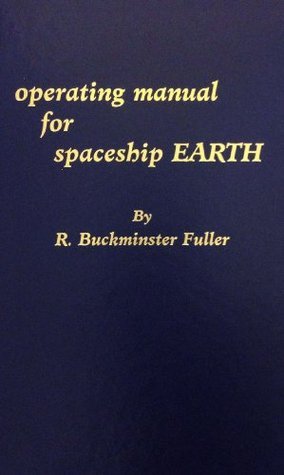
In this essay on man Mr. Fuller expresses what may well be his penultimate view of the human condition. Here, in a mood at once philosophical and involved, Mr. Fuller traces man's intellectual evolution and weighs his capability for survival on this magnificent craft, this Spaceship Earth, this superbly designed sphere of almost negligible dimension in the great vastness of space.Mr. Fuller is optimistic that man will survive and, through research and development and increased industrialization, generate wealth so rapidly that he can do very great things. But, he notes, there must be an enormous educational task successfully accomplished right now to convert man's tendency toward oblivion into a realization of his potential, to a universe-exploring advantage from this Spaceship Earth.It has been noted that Mr. Fuller spins ideas in clusters, and clusters of his ideas generate still other clusters. The concept spaceship earth is Mr. Fuller's, and though used by Barbara Ward as the title of a work of her own the idea was acknowledged by her there as deriving from Mr. Fuller. The brilliant syntheses of some fundamental Fuller principles given here makes of this book a microcosm of the Fuller system.

R. Buckminster Fuller is regarded as one of the most important figures of the 20th century, renowned for his achievements as an inventor, designer, architect, philosopher, mathematician, and dogged individualist. Perhaps best remembered for the Geodesic Dome and the term "Spaceship Earth," his work and his writings have had a profound impact on modern life and thought.Critical Path is Fuller's master work--the summing up of a lifetime's thought and concern--as urgent and relevant as it was upon its first publication in 1981. Critical Path details how humanity found itself in its current situation--at the limits of the planet's natural resources and facing political, economic, environmental, and ethical crises.The crowning achievement of an extraordinary career, Critical Path offers the reader the excitement of understanding the essential dilemmas of our time and how responsible citizens can rise to meet this ultimate challenge to our future.

Here Buckminster Fuller takes on the gigantic corporate megaliths that exert increasing control over every aspect of daily life. In the form of a modern allegory, he traces the evolution of these multinational giants from the post-World War II military-industrial complex to the current army of abstract legal entities known as the corporate world.

Using an inspired combination of geometric logic and metaphors from familiar human experience, Bucky invites readers to join him on a trip through a four-dimensional Universe, where concepts as diverse as entropy, Einstein's relativity equations, and the meaning of existence become clear, understandable, and immediately involving. In his own "Dare to be naive... It is one of our most exciting discoveries that local discovery leads to a complex of further discoveries."

Utopia or Oblivion

Ideas and Integrities: A Spontaneous Autobiographical Disclosure
by R. Buckminster Fuller
Rating: 4.0 ⭐
In Ideas and Integrities Buckminster Fuller, one of the most influential designers and thinkers of the modern world, describes the revolutionary designs and concepts he has pioneered - among them the geodesic dome, the Dymaxion world map, the Dymaxion 4-D house, the Dymaxion 4-D automobile, and countless other structures and creations that have changed the face of America and the world. And he sets forth his amazing and challenging ideas for the world of the future - ideas that would revolutionize everything from university education to bathroom design, ideas that, above all, demonstrate how we can and must make for more imaginative and efficient use of the resources now available to us to ensure a better standard of living for all men. --- from book's back cover

1963. Reprinted. 375 pages. Illustrated paper covers. Light staining, foxing and tanning to pages. More prominent to text block edges and reverse of covers. Binding remains firm. Paper covers have light edge-wear and corner curling with visible tanning and scuffing overall. Spine has visible staining, rolling and creasing.

And It Came To Not To Stay by Fuller, R. Buckminster
Education Automation: Freeing the scholar to return to his studies
by R. Buckminster Fuller
Rating: 4.5 ⭐
In a perceptive and penetrating essay devoted ot a definition of the modern world as he sees it, the world-reknowned inventor of the Geodesic dome discusses the place of education in that world. In applying his dymaxion principles to educational planning Mr. Fuller makes a strong case for technological aids in teaching and for comprehensive planning of campuses of the future

"...an expression of one of his most fundamental that humanity is suffering from a kind of cosmic near-sightedness, an inability to comprehend universal principles, due to our concentration on special 'parts'." Fuller was "philosopher, designer, cosmologist, adviser to heads of state and corporation presidents, and First Citizen of the Global Village."

Book by R Buckminster Fuller

Buckminster Fuller, inventor, thinker and architect, was one of the best known Americans of the twentieth century. Often compared to Leonardo da Vinci and called "the planet's friendly genius," he was the inventor of the geodesic dome, the man who coined the term "spaceship earth," and an educator without parallel. Yet, most of his books are out of print today.To remedy this situation, his longtime friend and architectural partner, Thomas Zung, has compiled a Bucky Fuller reader. This anthology consists of chapters selected from twenty of Bucky's many books, each with a new Introduction by such notables as Arthur C. Clarke, Steve Forbes, Calvin Tomkins, Dr. Martin Meyerson, Sir Harold W. Kroto, Arthur L. Loeb, E. J. Applewhite, and others.Altogether, this book provides an overview of a remarkable intellectual career and the best possible introduction to the man and his thought. Bucky Fuller was one of the most original thinkers and builders that America has ever produced, and this book makes his work available to a new generation at the beginning of a new millennium.

Tetrascroll: Goldilocks and the Three Bears, A Cosmic Fairy Tale
by R. Buckminster Fuller
Rating: 4.2 ⭐
Includes the complete text and drawings from a series of twenty-one lithographs Fuller made to give an overview of his philosophy and recounts how the triangular prints were assembled into the Tetrascroll

Published in 1983, this slim volume contains some of Bucky's most shining observations on his 87 years of living on Spaceship Earth. The foreward by Bucky's daughter, Allegra Fuller Snyder, gives us some personal glimpses of this intellectual giant, who applied his mind to developing theories and principles to help guide humans through the naturally occurring evolutionary process of the planet. Contains a full listing of Bucky's patents, honorary doctorates, and published works.

Near Fine Paperback Garden City, Anchor Press-Doubleday, 1973. Book. Near Fine. Soft cover. First Thus. 4to - over 9¾" - 12" tall. Stiff color pictorial wraps. Mild stress creasing along firm, square binding, otherwise only slight shelf wear. 1st 1973. [vii],246 pp., illus..

Synergetics 2: Further Explorations in the Geometry of Thinking
by R. Buckminster Fuller
Rating: 4.4 ⭐
"It is the essence of synergy to produce unpredicted - indeed, unpredictable - results like the surprise geometrical discoveries of this second volume."

edited and introduced by James Meller.This collection originally published, London: Cape, 1970.Bibl.p.387-389. - Index.Dates of available copies: 1972.398,[16]p. : ill., facsim., maps ; 20cm.

Ten lectures and essays spanning the period from 1961 to 1978 contain explicit statements by Fuller on education and reflect his concern that education assist minds to function with a minimum of blockage and wasted motion

This book collects some of R. Buckminster Fuller's most important recent writings on the subject of spaceship Earth: the big, inter-connected, total system that is "the only one we've got." These articles stress the need for considering our planet as a whole, rather than breaking it into its parts- as most of us continue to do. This theme is crucial to the thinking of Bucky Fuller, who, in addition to his many other appellations, has been called the "godfather" of the Whole Earth Catalog. -- From the cover

Explains the concept of synergetics and its relationship with politics and history to illustrate the crucial link between humanity and nature

For Fuller, nature is the most exquisite technology we know; and what underlies all of his work is the quest to uncover nature’s fundamental principles―in order to foster their manifestation as a pattern integrity 'for successfully regenerating all life aboard our planetary spaceship.'" –Jaime Lawrence Snyder,Lars Müller Fuller Series Editor A Los Angeles Times 2021 holiday gift guide pickThe work of R. Buckminster Fuller (1895–1983) is among the most extraordinary and inventive in 20th-century design and architecture, not least for its incorporation of a range of intellectual and technical disciplines. Fuller described himself as an “engineer, inventor, mathematician, architect, cartographer, philosopher, poet, cosmogonist, comprehensive designer and choreographer.''R. Buckminster Pattern-Thinking is a major reassessment of Fuller’s legacy in the context of design, examining his singular vision of new conceptual models for design and architecture, alongside his ideas on their potentially world-altering consequences. Drawing extensively on his archive and with over 300 images, the book follows Fuller’s explorations of geometry, language and intellectual property in their relation to design principles and pedagogy, organizing its survey of Fuller’s work through parallel conceptual threads rather than in a linear chronology of his career.Daniel López-Pérez is an associate professor and a founding faculty member of the Architecture Program at the University of San Diego. By way of several publications and curatorial projects, López-Pérez has emerged as an authority on Fuller, having edited Fuller in Mexico (2015) and R. Buckminster World Man (2013), the latter of which was picked as Design Book of the Year by Architect magazine. He was also the curator of a week of lectures and exhibitions on Fuller at the Venice Architecture Biennale in 2014.

In My Mental Autobiography, Buckminster Fuller describes the evolution of his own way of thinking, and the development of what he called "comprehensive anticipatory design science exploration." In his distinctive manner of approaching the problems of humanity, Fuller was able to think in new ways to create truly original inventions aimed at holistic progress and the evolution of the species. In this text, Fuller describes his manner of thinking and its underpinnings.

This is an epic poem in a decidedly unlovely prose style, doomed to be so, no doubt, by the facts, figures and terminology of its subject matter. The free verse format performs the familiar role for Fuller of measuring out his discourse in digestible gobbets.description by:© Paul Taylor 2006

Very Good Paperback New St Martins Press, 1983. First edition, first printing, 1983. Oversize softcover generously illustrated throughout in black and white in photographs and diagrams. Some light cover wear, a little more to the edges, firm binding with uncreased spine, clean pages, no names or other markings.. First Edition. Soft Cover. Very Good. 4to - over 9¾" - 12" tall.

Book by Fuller, R.Buckminster, etc.

Book by Fuller, Richard Buckminster
During a day spent with three children--one tenand two twelve-year-olds--inventor Buckminster Fuller talks about the universe and how it works and answers the children's wide-ranging questions.