
Herbert A. Simon
30 Books Written

Continuing his exploration of the organization of complexity and the science of design, this new edition of Herbert Simon's classic work on artificial intelligence adds a chapter that sorts out the current themes and tools -- chaos, adaptive systems, genetic algorithms -- for analyzing complexity and complex systems. There are updates throughout the book as well. These take into account important advances in cognitive psychology and the science of design while confirming and extending the book's basic thesis: that a physical symbol system has the necessary and sufficient means for intelligent action. The chapter "Economic Reality" has also been revised to reflect a change in emphasis in Simon's thinking about the respective roles of organizations and markets in economic systems."People sometimes ask me what they should read to find out about artificial intelligence. Herbert Simon's book The Sciences of the Artificial is always on the list I give them. Every page issues a challenge to conventional thinking, and the layman who digests it well will certainly understand what the field of artificial intelligence hopes to accomplish. I recommend it in the same spirit that I recommend Freud to people who ask about psychoanalysis, or Piaget to those who ask about child psychology: If you want to learn about a subject, start by reading its founding fathers." -- George A. Miller

In this candid and witty autobiography, Nobel laureate Herbert A. Simon looks at his distinguished and varied career, continually asking himself whether (and how) what he learned as a scientist helps to explain other aspects of his life. A brilliant polymath in an age of increasing specialization, Simon is one of those rare scholars whose work defines fields of inquiry. Crossing disciplinary lines in half a dozen fields, Simon's story encompasses an explosion in the information sciences, the transformation of psychology by the information-processing paradigm, and the use of computer simulation for modeling the behavior of highly complex systems. Simon's theory of bounded rationality led to a Nobel Prize in economics, and his work on building machines that think—based on the notion that human intelligence is the rule-governed manipulation of symbols—laid conceptual foundations for the new cognitive science. Subsequently, contrasting metaphors of the maze (Simon's view) and of the mind (neural nets) have dominated the artificial intelligence debate. There is also a warm account of his successful marriage and of an unconsummated love affair, letters to his children, columns, a short story, and political and personal intrigue in academe.

In this fourth edition of his ground-breaking work, Herbert A. Simon applies his pioneering theory of human choice and administrative decision-making to concrete organizational problems. To commemorate the fiftieth anniversary of the book's original publication, Professor Simon enhances his timeless observations on the human decision-making process with commentaries examining new facets of organizational behavior. Investigating the impact of changing social values and modem technology on the operation of organizations, the new ideas featured in this revised edition update a book that has become a worldwide classic.Named by Public Administration Review as "Book of the Half Century," Administrative Behavior is considered one of the most influential books on social science thinking, and was referred to by the Nobel Committee as "epoch-making."Written for managers and other professionals who wish to understand the decision-making processes at the heart of organization and management, it is also essential reading for students in business and management, economics, sociology, psychology computer science, government, and law.

What can reason (or more broadly, thinking) do for us and what can't it do? This is the question examined by the author, who received the 1978 Nobel Prize in Economic Sciences "for his pioneering work on decision-making processes in economic organizations."

Models of Bounded Rationality, Volume 2: Behavioral Economics and Business Organization
by Herbert A. Simon
Rating: 4.0 ⭐
The Nobel Prize in Economics was awarded to Herbert Simon in 1978. At Carnegie-Mellon University he holds the title of Professor of Computer Science and Psychology. These two facts together delineate the range and uniqueness of his contributions in creating meaningful interactions among fields that developed in isolation but that are all concerned with human decision-making and problem-solving processes.In particular, Simon has brought the insights of decision theory, organization theory (especially as it applies to the business firm), behavior modeling, cognitive psychology, and the study of artificial intelligence to bear on economic questions. This has led not only to new conceptual dimensions for theoretical constructions, but also to a new humanizing realism in economics, a way of taking into account and dealing with human behavior and interactions that lie at the root of all economic activity.The sixty papers and essays contained in these two volumes are grouped under eight sections, each with a brief introductory essay. These Some Questions of Public Policy, Dynamic Programming Under Uncertainty; Technological Change; The Structure of Economic Systems; The Business Firm as an Organization; The Economics of Information Processing; Economics and Psychology; and Substantive and Procedural Reality.Most of Simon's papers on classical and neoclassical economic theory are contained in volume one. The second volume collects his papers on behavioral theory, with some overlap between the two volumes.The second edition of Simon's widely read and referenced The Sciences of the Artificial was published by The MIT Press 1981 and is available in both hardcover and paperback.
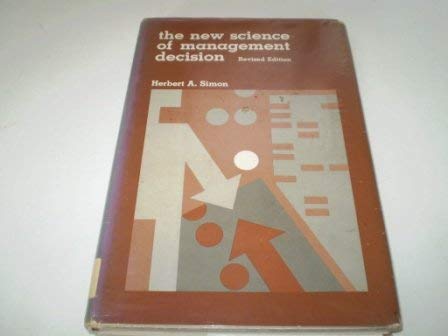
The Ford Distinguished Lectures at New York University, Volume III. The New Science of Management Decision by Herbert A Simon. --- This eminent social scientist delivered the lectures iin 1960, while a visiting professor at the University. --- Dr Simon had been engaged in fundamental research on the processes of decision making over the previous five years, using computeres to simulate human thinking. In these lectures he discusses some of the results of this research and the future consequences for American business. --- Foreward by Thomas L. Norton, Dean of NYU School of COmmerce, Accounts and Finance -- the Executive as Decision Maker -- Traditional Decision Making Methods -- New Techniques for Programmed Decisioni Making -- Heuristic Problem Solving -- Organizational Man-Machine Systems for Decision Making.

John Wiley & Sons, Inc. Fourth printing, July 1966. No dust jacket. Green boards with white title on front and spine clean, mild edge wear. Binding tight. Erasure marks and name in ink on ffep. Pages otherwise clean, no marks or highlights. Proceeds benefit the Oro Valley Library.

Nobel Laureate Herbert A. Simon has in the past quarter century been in the front line of the information-processing revolution; in fact, to a remarkable extent his and his colleagues’ contributions have written the history of that revolution in cognitive psychology.Research in this burgeoning new branch of knowledge seeks to describe with precision the workings of the human mind in terms of a small number of basic mechanisms organized into strategies. Newly developed computer languages express theories of mental processes, so that computers can then simulate the predicted human behavior.This book brings together papers dating from the start of Simon’s career to the present. Its focus is on modeling the chief components of human cognition and on testing these models experimentally. After considering basic structural elements of the human information-processing system (especially search, selective attention, and storage in memory), Simon builds from these components a system capable of solving problems, inducing rules and concepts, perceiving, and understanding.These essays describe a relatively austere, simple, and unified processing system capable of highly complex and various tasks. They provide strong evidence for an explanation of human thinking in terms of basic information processes.
In his Mattioli Lectures, Nobel Laureate Professor Herbert A. Simon directs attention to the kinds of empirical research that are necessary for progress in microeconomics. He traces the development of neoclassical economic theory and its gradual retreat from empiricism to abstraction. He then discusses the importance of business firms to the economic system, and the need for a thoroughly empirical understanding of how organisations work and reach their decisions. Finally, he examines innovative approaches to empirical research, including experimental economics, observational methods for studying economic behaviour, and the kinds of simulation models that are needed to interpret decision process. A round-table discussion of these issues follows; the participants, in addition to Professor Simon, are Professors Claudio Dematte, Massimo Egidi, Richard M. Goodwin, Robert Marris, Aldo Montesano and Riccardo Viale.
"In this volume I bring together some of my thinking new and old, on the subject of computers and automation. The old thinking is a description of the computer technology and its implications for management. The new thinking is an analysis of the economic implications of automation . . . . My research activities during the pas decade have brought me into contact with developments in the use of electronic digital computers. These computers are startling even in a world that takes atomic energy and the prospects of space travel in its stride. The computer and the new decision-making techniques associated with it are bringing changes in white-collar, executive, and professional work as momentous as those the introduction of machinery has brought to manual jobs. These essays record the product of my reflections about the organizational and social implications of these rapid technical developments." - Herbert A. Simon in the Preface.

We respect Herbert A. Simon as an established leader of empirical and logical analysis in the human sciences while we happily think of him as also the loner; of course he works with many colleagues but none can match him. He has been writing fruitfully and steadily for four decades in many fields, among them psychology, logic, decision theory, economics, computer science, management, production engineering, information and control theory, operations research, confirmation theory, and we must have omitted several. With all of them, he is at once the technical scientist and the philosophical critic and analyst. When writing of decisions and actions, he is at the interface of philosophy of science, decision theory, philosophy of the specific social sciences, and inventory theory (itself, for him, at the interface of economic theory, production engineering and information theory). When writing on causality, he is at the interface of methodology, metaphysics, logic and philosophy of physics, systems theory, and so on. Not that the interdisciplinary is his orthodoxy; we are delighted that he has chosen to include in this book both his early and little-appreciated treatment of straightforward philosophy of physics - the axioms of Newtonian mechanics, and also his fine papers on pure confirmation theory.

The purpose of this book is to publish the ideas of the late Herbert Simon and sympathetic economists, on the subject of bounded rationality, economics, cognitive science and related disciplines, and to reprint some of Professor Simon's classic papers which have appeared in journals not widely read by economists. Not only on account of his Nobel Prize in Economics, but also because of the widespread applications of his ideas and theories, it is especially valuable to readers to have a book of this kind at the present time. Currently in this whole field, there is increasing emphasis on computer-related theory building. Herbert Simon, beginning from the time when microcomputers did not exist, was a pioneer of this approach.The book begins with an edited transcript of a colloquium, held between Herbert Simon and a group of Italian economists in Italy in 1988. It continues with the reprinted Simon papers and papers by three scholars, Raymond Boudon, Massimo Egidi and Riccardo Viale coming from different disciplines but holding a common interest in bounded rationality and ends with a response by a sympathetic economist, Robin Marris.

Administrative Behavior [ Behaviour ] - A Study Of Decision Making Processes In Administrative Organization
by Herbert A. Simon
Rating: 4.0 ⭐
Administrative A Study of Decision Making Processes in Administrative Organization [Hardcover] [Jan 01, 1964] Herbert A. Simon and Chester I. Barnard

本书是著名心理学家和人工智能开创者赫伯特·西蒙关于人类认知的作品。本书介绍了人的认知结构,包括注意力、记忆等方面,然后分析了人们思维过程中问题解决的途径和策略。书中进一步分析了对于复杂问题,专家和普通人不同的心理表征,以及应该如何应对复杂问题。最后,作者介绍了学习的基本原理和过程,并说明如何探索发现新规律。无论是关注人工智能还是关注心理学的读者,本书都是不可多得的经典读物。
Models of Bounded Rationality, Vol. 3: Emperically Grounded Economic Reason
by Herbert A. Simon
Rating: 3.0 ⭐
Throughout Herbert Simon's wide-ranging career—in public administration, business administration, economics, cognitive psychology, philosophy, artificial intelligence, and computer science—his central aim has been to explain the nature of the thought processes that people use in making decisions.

As Ciencias Do Artificial
by Herbert A. Simon
«Artificial» e usado neste livro num sentido muito para indicar sistemas que tem uma determinada forma ou comportamento apenas porque se adaptam (ou sao adaptados) ao ambiente, em vista de certos objetivos ou finalidades a atingir. Assim, sao artificiais em termos de comportamento, quer os artefactos feitos pelo homem, quer o proprio homem.
Non-Agricultural Applications of Soil Surveys
by Herbert A. Simon
NON-AGRICULTURAL APPLICATIONS OF SOIL SURVEYS

Causalità, Razionalità, Organizzazione
by Herbert A. Simon

学者人生のモデル
by Herbert A. Simon

行政評価の基準―自治体活動の測定
by Herbert A. Simon

意思決定と合理性
by Herbert A. Simon

La ragione nelle vicende umane
by Herbert A. Simon

Les organisations
by Herbert A. Simon


Reasoning With Diagrammatic Representations: Papers from the 1992 Spring Symposium
by Herbert A. Simon
Reason in Human Affairs by Herbert A. Simon
by Herbert A. Simon