Loading genres...
Explore the best books about Reference genre.

"Long live the King" hailed Entertainment Weekly upon the publication of Stephen King's On Writing. Part memoir, part master class by one of the bestselling authors of all time, this superb volume is a revealing and practical view of the writer's craft, comprising the basic tools of the trade every writer must have. King's advice is grounded in his vivid memories from childhood through his emergence as a writer, from his struggling early career to his widely reported near-fatal accident in 1999 -- and how the inextricable link between writing and living spurred his recovery. Brilliantly structured, friendly and inspiring, On Writing will empower and entertain everyone who reads it -- fans, writers, and anyone who loves a great story well told.(back cover)
In his monumental 1687 work Philosophiae Naturalis Principia Mathematica, known familiarly as the Principia, Isaac Newton laid out in mathematical terms the principles of time, force, and motion that have guided the development of modern physical science. Even after more than three centuries and the revolutions of Einsteinian relativity and quantum mechanics, Newtonian physics continues to account for many of the phenomena of the observed world, and Newtonian celestial dynamics is used to determine the orbits of our space vehicles.This completely new translation, the first in 270 years, is based on the third (1726) edition, the final revised version approved by Newton; it includes extracts from the earlier editions, corrects errors found in earlier versions, and replaces archaic English with contemporary prose and up-to-date mathematical forms. Newton's principles describe acceleration, deceleration, and inertial movement; fluid dynamics; and the motions of the earth, moon, planets, and comets. A great work in itself, the Principia also revolutionized the methods of scientific investigation. It set forth the fundamental three laws of motion and the law of universal gravity, the physical principles that account for the Copernican system of the world as emended by Kepler, thus effectively ending controversy concerning the Copernican planetary system.The illuminating Guide to the Principia by I. Bernard Cohen, along with his and Anne Whitman's translation, will make this preeminent work truly accessible for today's scientists, scholars, and students.

The best-selling author of The 4-Hour Workweek outlines a program for healthy living that draws on 15 years of research and interviews with leading doctors and health-care experts to offer insight into genetic factors, nutrition requirements and fitness practices.

Karen Pryor’s clear and entertaining explanation of behavioral training methods made Don’t Shoot the Dog a bestselling classic with revolutionary insights into animal—and human—behavior.In her groundbreaking approach to improving behavior, behavioral biologist Karen Pryor says, “Whatever the task, whether keeping a four-year-old quiet in public, housebreaking a puppy, coaching a team, or memorizing a poem, it will go fast, and better, and be more fun, if you know how to use reinforcement.”Now Pryor clearly explains the underlying principles of behavioral training and reveals how this art can be applied to virtually any common situation. And best of all, she tells how to do it without yelling threats, force, punishment, guilt trips—or shooting the dog. From the eight methods for putting an end to all kinds of undesirable behavior to the ten laws of “shaping” behavior, Pryor helps you combat your own addictions and deal with such difficult problems as a moody spouse, an impossible teen, or an aged parent. Plus, there’s also incredibly helpful information on house training the dog, improving your tennis game, keeping the cat off the table, and much more!“In the course of becoming a renowned dolphin trainer, Karen Pryor learned that positive reinforcement…is even more potent that prior scientific work had suggested…Don’t Shoot the Dog looks like the very best on the subject—a full-scale mind-changer” (The Coevolution Quarterly). Learn why pet owners rave, “This book changed our lives!” and how these pioneering techniques can work for you, too.Karen Pryor is a behavioral biologist with an international reputation in marine mammal biology and behavioral psychology. She is a founder and leading proponent of “clicker training,” a training system based on operant conditioning (isolate wanted behaviors and ignore the unwanted) and the all-positive methods developed by marine mammal trainers. Pryor is the CEO of KCPT/Sunshine Books, Inc., a publishing, training product, and online company. In addition to her bestselling Don’t Shoot the Dog, Pryor wrote Nursing Your Baby (more than 2 million copies in print) along with several other books and many scientific papers and popular articles on learning and behavior. She has three grown children and lives in Boston with two clicker-trained dogs and a clicker-trained cat.

This style manual offers practical advice on improving writing skills. Throughout, the emphasis is on promoting a plain English style. This little book can help you communicate more effectively by showing you how to enliven your sentences.

Here’s what started the phenomenon: the best seller, for over 15 years, that’s been used by screenwriters around the world! Blake Snyder tells all in this fast, funny and candid look inside the movie business. “Save the Cat” is just one of many ironclad rules for making your ideas more marketable and your script more satisfying, including: The four elements of every winning logline The seven immutable laws of screenplay physics The 10 genres that every movie ever made can be categorized by ― and why they’re important to your script Why your Hero must serve your Idea Mastering the 15 Beats Creating the “Perfect Beast” by using The Board to map 40 scenes with conflict and emotional change How to get back on track with proven rules for script repair This ultimate insider’s guide reveals the secrets that none dare admit, told by a showbiz veteran who’s proven that you can sell your script if you can save the cat.

At the core of A Pattern Language is the philosophy that in designing their environments people always rely on certain ‘languages,’ which, like the languages we speak, allow them to articulate and communicate an infinite variety of designs within a formal system which gives them coherence.This book provides a language of this kind. It will enable making a design for almost any kind of building, or any part of the built environment. ‘Patterns,’ the units of this language, are answers to design problems: how high should a window sill be?; how many stories should a building have?; how much space in a neighborhood should be devoted to grass and trees?More than 250 of the patterns in this language are outlined, each consisting of a problem statement, a discussion of the problem with an illustration, and a solution. As the authors say in their introduction, many of the patterns are archetypal, so deeply rooted in the nature of things that it seems likely that they will be a part of human nature and human action as much in five hundred years as they are today.A Pattern Language is related to Alexander’s other works in the Center for Environmental Structure series: The Timeless Way of Building (introductory volume) and The Oregon Experiment.

Vagabonding is about taking time off from your normal life--from six weeks to four months to two years--to discover and experience the world on your own terms. Veteran shoestring traveler Rolf Potts shows how anyone with an independent spirit can achieve the dream of extended overseas travel. Visit the vagabonding community's hub at www dot vagabonding dot net.

On Writing Well has been praised for its sound advice, its clarity and the warmth of its style. It is a book for everybody who wants to learn how to write or who needs to do some writing to get through the day, as almost everybody does in the age of e-mail and the Internet. Whether you want to write about people or places, science and technology, business, sports, the arts or about yourself in the increasingly popular memoir genre, On Writing Well offers you fundamental priciples as well as the insights of a distinguished writer and teacher. With more than a million copies sold, this volume has stood the test of time and remains a valuable resource for writers and would-be writers.

Title: Emergency( This Book Will Save Your Life) <>Binding: Paperback <>Author: NeilStrauss <>Publisher: HarperPaperbacks

An assemblage of reflections on the nature of writing and the writer from one the greatest American writers of the twentieth century.Throughout Hemingway’s career as a writer, he maintained that it was bad luck to talk about writing—that it takes off “whatever butterflies have on their wings and the arrangement of hawk’s feathers if you show it or talk about it.”Despite this belief, by the end of his life he had done just what he intended not to do. In his novels and stories, in letters to editors, friends, fellow artists, and critics, in interviews and in commissioned articles on the subject, Hemingway wrote often about writing. And he wrote as well and as incisively about the subject as any writer who ever lived…This book contains Hemingway’s reflections on the nature of the writer and on elements of the writer’s life, including specific and helpful advice to writers on the craft of writing, work habits, and discipline. The Hemingway personality comes through in general wisdom, wit, humor, and insight, and in his insistence on the integrity of the writer and of the profession itself.—From the Preface by Larry W. Phillips
With nearly a million copies sold, Security Analysis has been continuously in print for more than sixty years. No investment book in history had either the immediate impact, or the long-term relevance and value, of its first edition in 1934. By 1951, seventeen years past its original publication and more than a decade beyond its revised and acclaimed 1940 second edition, authors Benjamin Graham and David Dodd had seen business and investment markets travel from the depths of Depression to the heights of recovery, and had observed investor behavior during both the calm of peacetime and the chaos of World War II. The prescient thinking and insight displayed by Graham and Dodd in the first two editions of Security Analysis reached new heights in the third edition. In words that could just as easily have been written today as fifty years ago, they detail techniques and strategies for attaining success as individual investors, as well as the responsibilities of corporate decision makers to build shareholder value and transparency for those investors. The focus of the book, however, remains its timeless guidance and advice--that careful analysis of balance sheets is the primary road to investment success, with all other considerations little more than distractions. The authors had seen and survived the Great Depression as well as the political and financial instabilities of World War II and were now better able to outline a program for sensible and profitable investing in the latter half of the century. Security The Classic 1951 Edition marks the return of this long-out-of-print work to the investment canon. It will reacquaint you with the foundations of value investing--more relevant than ever in tumultuous twenty-first century markets--and allow you to own the third installment in what has come to be regarded as the most accessible and usable title in the history of investment publishing.

World-renowned anthropologist and ethnopharmacologist Christian Ratsch provides the latest scientific updates to this classic work on psychoactive flora by two eminent researchers.• Numerous new and rare color photographs complement the completely revised and updated text.• Explores the uses of hallucinogenic plants in shamanic rituals throughout the world.• Cross-referenced by plant, illness, preparation, season of collection, and chemical constituents.Three scientific titans join forces to completely revise the classic text on the ritual uses of psychoactive plants. They provide a fascinating testimony of these "plants of the gods," tracing their uses throughout the world and their significance in shaping culture and history. In the traditions of every culture, plants have been highly valued for their nourishing, healing, and transformative properties. The most powerful of those plants, which are known to transport the human mind into other dimensions of consciousness, have always been regarded as sacred. The authors detail the uses of hallucinogens in sacred shamanic rites while providing lucid explanations of the biochemistry of these plants and the cultural prayers, songs, and dances associated with them. The text is lavishly illustrated with 400 rare photographs of plants, people, ceremonies, and art related to the ritual use of the world's sacred psychoactive flora.

Praised throughout the cartoon industry by such luminaries as Art Spiegelman, Matt Groening, and Will Eisner, this innovative comic book provides a detailed look at the history, meaning, and art of comics and cartooning.

This #1 New York Times best-selling guide to decluttering your home from Japanese cleaning consultant Marie Kondo takes readers step-by-step through her revolutionary KonMari Method for simplifying, organizing, and storing.Despite constant efforts to declutter your home, do papers still accumulate like snowdrifts and clothes pile up like a tangled mess of noodles?Japanese cleaning consultant Marie Kondo takes tidying to a whole new level, promising that if you properly simplify and organize your home once, you’ll never have to do it again. Most methods advocate a room-by-room or little-by-little approach, which doom you to pick away at your piles of stuff forever. The KonMari Method, with its revolutionary category-by-category system, leads to lasting results. In fact, none of Kondo’s clients have lapsed (and she still has a three-month waiting list). With detailed guidance for determining which items in your house “spark joy” (and which don’t), this international bestseller featuring Tokyo’s newest lifestyle phenomenon will help you clear your clutter and enjoy the unique magic of a tidy home—and the calm, motivated mindset it can inspire.From the Hardcover edition.

The most important, consulted, and enjoyed Italian cookbook of all time, from the woman who introduced Americans to a whole new world of Italian food.Essentials of Italian Cooking is a culinary bible for anyone looking to master the art of Italian cooking, bringing together Marcella Hazan’s most beloved books, The Classic Italian Cook Book and More Classic Italian Cooking, in a single volume, updated and expanded with new entries and 50 new recipes. Designed as a basic manual for cooks of all levels of expertise—from beginners to accomplished professionals—it offers both an accessible and comprehensive guide to techniques and ingredients and a collection of the most delicious recipes from the Italian repertoire. As home cooks who have used Marcella’s classic books for years (and whose copies are now splattered and worn) know, there is no one more gifted at teaching us just what we need to know about the taste and texture of a dish and how to achieve it, and there is no one more passionate and inspiring about authentic Italian food.

This valuable book provides a complete manual for the study and practice of Raja Yoga, the path of concentration and meditation. This new deluxe printing of these timeless teachings is a treasure to be read and referred to again and again by seekers treading the spiritual path. The classic Sutras (thought-threads), at least 4,000 years old, cover the yogic teachings on ethics, meditation, and physical postures, and provide directions for dealing with situations in daily life. The Sutras are presented here in the purest form, with the original Sanskrit and with translation, transliteration, and commentary by Sri Swami Satchidananda, one of the most respected and revered contemporary Yoga masters. In this classic context, Sri Swamiji offers practical advice based on his own experience for mastering the mind and achieving physical, mental and emotional harmony.

Provides new insights and observations from Vogler's pioneering work in mythic structure for writers.

NOW IN PAPERBACK"€"Starting from a collection of simple computer experiments"€"illustrated in the book by striking computer graphics"€"Stephen Wolfram shows how their unexpected results force a whole new way of looking at the operation of our universe.

In this book are the essential beliefs and theories of a great teacher and American artist, Robert Henri. While it embodies the entire system of his teaching, with much technical advice and critical comment for the student, it also contains inspiration for those to whom the happiness to be found through all the arts is important.No other American painter attracted such a large, intensely personal group of followers as Henri, whose death in 1929 brought to an end a life that has been completely devoted to art. He was an inspired artist and teacher who believed that everyone is vitally concerned in the happiness and wisdom to be found through the arts. Many of his paintings have been acquired by museums and private collectors. Among them are the Baltimore Museum of Art, the Metropolitan Museum of Art, the National Gallery of Art, the Whitney Museum of American Art, the Wichita Art Museum, and Yale University Art Gallery.

Bu kitabı okudum ve hayatımı değiştirmeye karar verdim.”– Demir SABANCI –Beslenme konusunda şu ana kadar yapılmış en kapsamlı araştırma…Bu kitap hayatınızı kurtarabilir Kanser, Kalp hastalıkları, diyabet ve obeziteye karşı kendinizi koruyabilmenin en etkili yöntemi: ÇİN MUCİZESİ…“Colin Campbell'in Çin Mucize'si önemli ve ziyadesiyle okumaya değer bir kitap. Oğlu Tom'la birlikte Colin, beslenme ve hastalık arasındaki bağlantıyı araştırıyor ve buldukları sonuçlar çok ürkütücü. Çin Mucizesi duyulması elzem bir öyküdür.”ROBERT C. RICHARDSONNobel ödüllü Fizik Profesörü ve Araştırma Dekan Yardımcısı, Cornell Üniversitesi“Çin Mucizesi beslenme vasıtasıyla kalp hastalıkları, kanser ve diğer Batılı hastalıkları önlemenin şimdiye dek bulunmuş en ikna edici kanıtlarını sunuyor. Hem ekonomik olarak gelişmiş hem de hızlı bir ekonomik değişimden geçen ve yaşam biçimleri değişen ülkeler için de önemli bir kitap.”JUNSHI CHEN, Araştırma Profesörü,Beslenme ve Gıda Güvenliği Enstitüsü Çin Hastalık Kontrol ve Önleme MerkeziBİLİMSEL DOĞRULAR KESİNDİR. SONUÇLARDA HATA PAYI YOKTUR. BESLENME ALIŞKANLIKLARINIZI DEĞİŞTİRİN, KANSER, KALP HASTALIKLARI, DİYABET VE OBEZİTE RİSKİNİZİ AZALTIN.Ne açıdan bakarsak bakalım, dünyadaki insanların sağlığı gün geçtikçe kötüleşiyor ve bireyler olarak sağlık gelirlerimiz de bu durumla doğru olantılı olarak artıyor. Artık nüfusun büyük bir çoğunluğu obez ve milyonlarcası da diyabet hastalığına yakalanmış durumda veya bugün, otuz yıl önce kalp hastalığına yakalanma oranımızdan çok daha fazla. 1970'ler ortasında kansere karşı açılan savaş büyük bir hüsranla sonuçlanmaktan öteye gidemedi ve sözkonusu insanlar-yani rahatsızlığı olan insanlar-haftanın belirli günleri ya da tüm günleri reçeteli ilaçlar kullanmak zorunda. Bunlara ek olarak dörtte üçümüz yüksek kolestrol sahibiyiz.Daha da kötü noktalardan bahsetmek gerekirse, gelecek nesilleri yani çocuklarımızı ufacık yaşta hastalıklarla karşı karşıya bırakmak durumda kalıyoruz. Artık çocuklarımızın çoğu obez veya obez olma yolunda ya da daha önce çocukların nadiren yakalandığı diyabet, artık onların da korkulu rüyası haline gelmiş durumda. Hem de çok daha sinsice.Ve çocuklarımız da düzenli ilaçlar kullanmak zorunda kalıyor.Yukarıda anlattıklarımız üç ana başlıkta birleşiyor: Kahvaltı, öğle yemeği ve akşam yemeği.

The New One Minute Manager offers a way for you to succeed sooner with less stress in changing times—both at work and at home.Based on the original book The One Minute Manager that helped millions of people around the world in organizations large and small, The New One Minute Manager is a concise, easily read story that reveals three very practical secrets: One Minute Goals, One Minute Praisings, and One Minute Re-Directs, the new third secret. The story is based on studies in the behavioral sciences and medicine that support why these apparently simple methods work so well with so many people. And by the book's end, you will know how to apply what you discover to your own situation and enjoy the benefits.

This is the completely revised and updated version of the hardcover in paperback for the first time in this books 20 year history.

Challenging, with several powerful arguments, some of our deepest beliefs about rationality, morality, and personal identity, Parfit claims that we have a false view about our own nature. It is often rational to act against our own best interests, he argues, and most of us have moral views that are self-defeating. We often act wrongly, although we know there will be no one with serious grounds for complaint, and when we consider future generations it is very hard to avoid conclusions that most of us will find very disturbing.

Credited with sparking the current memoir explosion, Mary Karr’s The Liars’ Club spent more than a year at the top of the New York Times list. She followed with two other smash bestsellers: Cherry and Lit, which were critical hits as well.For thirty years Karr has also taught the form, winning graduate teaching prizes for her highly selective seminar at Syracuse, where she mentored such future hit authors as Cheryl Strayed, Keith Gessen, and Koren Zailckas. In The Art of Memoir, she synthesizes her expertise as professor and therapy patient, writer and spiritual seeker, recovered alcoholic and “black belt sinner,” providing a unique window into the mechanics and art of the form that is as irreverent, insightful, and entertaining as her own work in the genre.Anchored by excerpts from her favorite memoirs and anecdotes from fellow writers’ experience, The Art of Memoir lays bare Karr’s own process. (Plus all those inside stories about how she dealt with family and friends get told— and the dark spaces in her own skull probed in depth.) As she breaks down the key elements of great literary memoir, she breaks open our concepts of memory and identity, and illuminates the cathartic power of reflecting on the past; anybody with an inner life or complicated history, whether writer or reader, will relate.Joining such classics as Stephen King’s On Writing and Anne Lamott’s Bird by Bird, The Art of Memoir is an elegant and accessible exploration of one of today’s most popular literary forms—a tour de force from an accomplished master pulling back the curtain on her craft.

Negotiating the ImpossibleHow to Break Deadlocks and Resolve Ugly Conflicts (without Money or Muscle) Some negotiations are easy. Others are more difficult. And then there are situations that seem hopeless. Conflict is escalating, people are getting aggressive, and no one is willing to back down. And to top it off, you have little power, money, or other resources to work with. Harvard professor (and negotiation consultant advisor to organizations around the world) Deepak Malhotra shows how to defuse even the most potentially explosive situations and to find success when things seem impossible. Malhotra illustrates key lessons using behind-the-scenes stories of fascinating real-life negotiations, including drafting the US Constitution, resolving the Cuban Missile Crisis, bringing peace to Northern Ireland, ending bitter disputes in the NFL and NHL, and beating the odds in complex business situations. But he also shows how these same principles and tactics can be applied in everyday life as well, from making corporate deals, negotiating job offers, and resolving business disputes to tackling obstacles in personal relationships and even negotiating with children.

The uplifting message of Reinventing Organizations has resonated with readers all over the world, and they have turned it, one conversation at a time, into a word-of-mouth phenomenon. The book has helped shift the conversation from what's broken with management today to what's possible. It is inspiring thousands of organizations--corporations and nonprofits, schools and hospitals--to adopt radically more powerful, soulful, and purposeful practices.The book resonates widely, but not everyone has time to devote to a dense 360-page management book. This illustrated version conveys the main ideas of the original book and shares many of its real-life stories in a lively, engaging way. Don't be surprised if you find it hard to put down and end up reading it almost in one sitting. Welcome to the conversation on next-stage organizations!

Molecular Biology of the Cell is the classic in-dept text reference in cell biology. By extracting the fundamental concepts from this enormous and ever-growing field, the authors tell the story of cell biology, and create a coherent framework through which non-expert readers may approach the subject. Written in clear and concise language, and beautifully illustrated, the book is enjoyable to read, and it provides a clear sense of the excitement of modern biology. Molecular Biology of the Cell sets forth the current understanding of cell biology (completely updated as of Autumn 2001), and it explores the intriguing implications and possibilities of the great deal that remains unknown. The hallmark features of previous editions continue in the Fourth Edition. The book is designed with a clean and open, single-column layout. The art program maintains a completely consistent format and style, and includes over 1,600 photographs, electron micrographs, and original drawings by the authors. Clear and concise concept headings introduce each section. Every chapter contains extensive references. Most important, every chapter has been subjected to a rigorous, collaborative revision process where, in addition to incorporating comments from expert reviewers, each co-author reads and reviews the other authors' prose. The result is a truly integrated work with a single authorial voice. Features : - Places the latest hot topics sensibly in context - including genomics, protein structure, array technology, stem cells and genetics diseases. - Incorporates and emphasises new genomic data. - All of molecular biology is brought together into one section (chapters 4-7) covering classically defined molecular biology and molecular genetics. - Two chapters deal exclusively with methods and contain information on the latest tools and techniques. - New chapters on "Pathogens, Infection, and Innate Immunity". - Cell Biology Interactive CD-ROM is packaged with every copy of the book. - Contains over 1,600 illustrations, electron micrographs and photographs, of which over 1,000 are originally conceived by the authors.

The celebrated design professor here tackles the question of how best to communicate real-life experience in a two-degree format, whether on the printed page or the computer screen. The Whole Earth Review called Envisioning Information a "passionate, elegant revelation."

Few would disagree: Life in the information age can be overwhelming. Through computers, the Internet, the media, and even our daily newspapers, we are awash in a seemingly endless stream of charts, maps, infographics, diagrams, and data. Visual Explanations is a navigational guide through this turbulent sea of information. The book is an essential reference for anyone involved in graphic, web, or multimedia design, as well as for educators and lecturers who use graphics in presentations or classes.Jacket design: Dmitry Krasny.Other artwork by Bonnie Scranton, Dmitry Krasny, and Weilin Wu.

Do You Do What You Do Best Every Day?Chances are, you don't. From the cradle to the cubicle, we devote more time to fixing our shortcomings than to developing our strengths.To help people uncover their talents, Gallup introduced StrengthsFinder in the 2001 management book Now, Discover Your Strengths. The book ignited a global conversation, while StrengthsFinder helped millions discover their top five talents.In StrengthsFinder 2.0, Gallup unveils the new and improved version of its popular online assessment. With hundreds of strategies for applying your strengths, StrengthsFinder 2.0 will change the way you look at yourself and the world forever.

Secrets of lightning calculation and how to perform mind-boggling mental feats.

From Chocolate to Morphine is the definitive guide to drugs and drug use from one of America’s most respected and best-known doctors. This enormously popular book — the best and most authoritative resource for unbiased information about how drugs affect the mind and the body — covers a wide range of available substances, from coffee to marijuana, antihistamines to psychedelics, steroids to smart drugs, and discusses likely effects, precautions, and alternatives. Now expanded and updated to cover such drugs as oxycontin, Ecstasy, Prozac, and ephedra and to address numerous ongoing issues, including the United States’ war on drugs, marijuana for therapeutic use, the overuse of drugs for children diagnosed with ADHD, and more, From Chocolate to Morphine is an invaluable resource.

A generation of screenwriters has used Syd Field’s bestselling books to ignite successful careers in film. Now the celebrated producer, lecturer, teacher, and bestselling author has updated his classic guide for a new generation of filmmakers, offering a fresh insider’s perspective on the film industry today. From concept to character, from opening scene to finished script, here are easily understood guidelines to help aspiring screenwriters—from novices to practiced writers—hone their craft. Filled with updated material—including all-new personal anecdotes and insights, guidelines on marketing and collaboration, plus analyses of recent films, from American Beauty to Lord of the Rings—Screenplay presents a step-by-step, comprehensive technique for writing the screenplay that will succeed in Hollywood. Discover:•Why the first ten pages of your script are crucially important•How to visually “grab” the reader from page one, word one •Why structure and character are the essential foundation of your screenplay•How to adapt a novel, a play, or an article into a screenplay•Tips on protecting your work—three legal ways to claim ownership of your screenplay•The essentials of writing great dialogue, creating character, building a story line, overcoming writer’s block, getting an agent, and much more.With this newly updated edition of his bestselling classic, Syd Field proves yet again why he is revered as the master of the screenplay—and why his celebrated guide has become the industry’s gold standard for successful screenwriting.

Green Lion Press has prepared a new one-volume edition of T.L. Heath's translation of the thirteen books of Euclid's Elements. In keeping with Green Lion's design commitment, diagrams have been placed on every spread for convenient reference while working through the proofs; running heads on every page indicate both Euclid's book number and proposition numbers for that page; and adequate space for notes is allowed between propositions and around diagrams. The all-new index has built into it a glossary of Euclid's Greek terms.Heath's translation has stood the test of time, and, as one done by a renowned scholar of ancient mathematics, it can be relied upon not to have inadvertantly introduced modern concepts or nomenclature. We have excised the voluminous historical and scholarly commentary that swells the Dover edition to three volumes and impedes classroom use of the original text. The single volume is not only more convenient, but less expensive as well.

Spacetime and Geometry is an introductory textbook on general relativity, specifically aimed at students. Using a lucid style, Carroll first covers the foundations of the theory and mathematical formalism, providing an approachable introduction to what can often be an intimidating subject. Three major applications of general relativity are then discussed: black holes, perturbation theory and gravitational waves, and cosmology. Students will learn the origin of how spacetime curves (the Einstein equation) and how matter moves through it (the geodesic equation). They will learn what black holes really are, how gravitational waves are generated and detected, and the modern view of the expansion of the universe. A brief introduction to quantum field theory in curved spacetime is also included. A student familiar with this book will be ready to tackle research-level problems in gravitational physics.

A continuation of the classic PIHKAL, TIHKAL focuses on the family of psychoactive drugs in the tryptamine family and provides a blend of biography, botanical facts, scientific speculation, and psychological and political commentary written by renowned psychopharmacologist Alexander Shulgin and his wife Ann Shulgin. Where PiHKAL focuses on a class of compounds called phenethylamines, TiHKAL is written about a family of psychoactive drugs known as tryptamines with TiHKAL being an acronym for Tryptamines I Have Known and Loved". Like its predecessor, it is divided into two parts. The first part of the book begins with the story of Alice and Shura, a fictionalized autobiography, which picks up where the similar section of PiHKAL left off. The book opens with the story about the DEA raid that occurred a few years after the publication of their first book, PiHKAL. It's a window into the DEA, the institutional aspect and human side of it as well, and the price that Shura and Alice pay for doing what they do, including exercising their first amendment rights. It then continues with a collection of essays on topics ranging from psychotherapy and the Jungian mind, to the prevalence of DMT in nature, ayahuasca, the War on Drugs, and even the Big Bang. It is a blend of travel, botanical facts, scientific speculation, psychological and political commentary. It is fascinating getting to know the mind of the man behind the compounds - his thoughts on science, technology, law, and society. And the mind of the woman who brought his work and their story into the light of the world. The second part of TiHKAL is "The Chemistry Continues". It is a detailed manual for 55 psychedelic compounds (many discovered by Shulgin himself). For each compound there is information on synthesis, effective dosage, duration of effects, and commentary on the subjective effects that were experienced. The Shulgin's' two big books span autobiography, organic chemistry, politics, ethnobotany and psychopharmacology and the cultural impact of these works has been profound and will continue to be so in the future.

This new and revised edition of Fighting for Your Marriage is based on the widely acclaimed PREP(r) (Prevention and Relationship Enhancement Program) approach. Groundbreaking studies have found that couples can use the strategies of this approach to handle conflict more constructively, protect their happiness, and reduce the odds of breaking up.Based on twenty years of university research, this popular book will show you how to:* Talk more and fight less* Deepen and protect your friendship* Have a more intimate, sensual relationship* Keep the fun alive* Clarify and act on your priorities* Develop a vision for your future together

Practical English Usage is a major new reference guide for intermediate and advanced students of English (of all nationalities) and their teachers. It contains short clear articles on all the grammatical problems which regularly cause difficulty to foreign learners. In addition, it deals with selected points of vocabulary, idiom, style, pronunciation and spelling. The main differences between British and American usage are also dealt with. Each entry contains an explanation of a problem, examples of correct usage, and - when this is useful - examples of typical mistakes.Special features of this book include:- simple and practical presentation- alphabetical arrangement of numbered entries- detailed index and cross-reference system- distinction between formal and informal usageA hardback edition is also available.

The first definitive guide to using the wisdom of the enneagram for spiritual and psychological growthThe ancient symbol of the Enneagram has become one of today's most popular systems for self-understanding, based on nine distinct personality types. Now, two of the world's foremost Enneagram authorities introduce a powerful new way to use the Enneagram as a tool for personal transformation and development. Whatever your spiritual background, the Enneagram shows how you can overcome your inner barriers, realize your unique gifts and strengths, and discover your deepest direction in life.The Wisdom of the Enneagram includes:Two highly accurate questionnaires for determining your typeVivid individual profiles focused on maximizing each type's potential and minimizing predictable pitfallsSpiritual Jump Starts, Wake-Up Calls, and Red Flags for each typeDozens of individualized exercises and practical strategies for letting go of troublesome habits, improving relationships, and increasing inner freedomRevealing insights into the deepest motivations, fears, and desires of each typeHighly accessible, yet filled with sophisticated concepts and techniques found nowhere else, The Wisdom of the Enneagram is a strikingly new fusion of psychology and spirituality. It offers an exciting vision of human possibility and a clear map of the nine paths to our highest self-expression.

A study of twenty-six canonical writers details the qualities that make them literary essentials, and includes Shakespeare, Chaucer, Milton, Beckett, Tolstoy, Freud, Molie+a6re, and others. By the author of The Book of J. 100,000 first printing. National ad/promo.

Undoubtedly the most famous work of military history of the nineteenth century, Edward S. Creasy's Fifteen Decisive Battles of the World has been read and re-read for close to 150 years. It is not only the authoritative account of each battle that makes Creasy's work such a classic--it is his command of narrative, his interest in human struggle, his profound deductions as to effects of the battles, and his striving after truth. Furthermore, his selections seem as wise and well-considered today as when Fifteen Decisive Battles first appeared in 1851: Nobody since has made better ones, nor given us better accounts.Apart from the scholarship and literary skill of Creasy's book, there is another reason it has Creasy was essentially fair-minded. He had been a judge, and when he became England's great military critic and historian, he maintained a thoroughly judicial attitude. He was not a British partisan, nor French, nor German--he was a cosmopolitan observer of great events.Out of 2300 years, Creasy only found fifteen battles which he called decisive in the highest sense. He chose them not for the number of killed and wounded, nor for their status in myth and lore, but because they fundamentally changed the course of world history. In doing so, he made his book a miniature military history of the western world, a classic that will repay continued study for generations to come, as it has for generations.

The classic 1940 study of con men and con games that Luc Sante in Salon called “a bonanza of wild but credible stories, told concisely with deadpan humor, as sly and rich in atmosphere as anything this side of Mark Twain.” “Of all the grifters, the confidence man is the aristocrat,” wrote David Maurer, a proposition he definitely proved in The Big Con, one of the most colorful, well-researched, and entertaining works of criminology ever written. A professor of linguistics who specialized in underworld argot, Maurer won the trust of hundreds of swindlers, who let him in on not simply their language but their folkways and the astonishingly complex and elaborate schemes whereby unsuspecting marks, hooked by their own greed and dishonesty, were “taken off” – i.e. cheated—of thousands upon thousands of dollars. The Big Con is a treasure trove of American lingo (the write, the rag, the payoff, ropers, shills, the cold poke, the convincer, to put on the send) and indelible characters (Yellow Kid Weil, Barney the Patch, the Seldom Seen Kid, Limehouse Chappie, Larry the Lug). It served as the source for the Oscar-winning film The Sting.

The latest edition of this classic is updated with new problem sets and material The Second Edition of this fundamental textbook maintains the book's tradition of clear, thought-provoking instruction. Readers are provided once again with an instructive mix of mathematics, physics, statistics, and information theory.All the essential topics in information theory are covered in detail, including entropy, data compression, channel capacity, rate distortion, network information theory, and hypothesis testing. The authors provide readers with a solid understanding of the underlying theory and applications. Problem sets and a telegraphic summary at the end of each chapter further assist readers. The historical notes that follow each chapter recap the main points.The Second Edition features: * Chapters reorganized to improve teaching * 200 new problems * New material on source coding, portfolio theory, and feedback capacity * Updated referencesNow current and enhanced, the Second Edition of Elements of Information Theory remains the ideal textbook for upper-level undergraduate and graduate courses in electrical engineering, statistics, and telecommunications.

From Pulitzer Prize-winning Annie Dillard, a collection that illuminates the dedication and daring that characterizes a writer's life.In these short essays, Annie Dillard—the author of Pilgrim at Tinker Creek and An American Childhood—illuminates the dedication, absurdity, and daring that characterize the existence of a writer. A moving account of Dillard’s own experiences while writing her works, The Writing Life offers deep insight into one of the most mysterious professions.

A revised edition of the definitive translation of the world's most important book of divination • More than 64,000 copies sold of the first edition • The first English translation from within the tradition by a Chinese Taoist Master • Includes translations of the Ten Wings--the commentaries by Confucius essential to the I Ching’s insights Translated by the eminent Taoist Master Alfred Huang, The Complete I Ching has been praised by scholars and new students of the I Ching since its first edition. A native Chinese speaker, Master Huang first translated the original ideograms of the I Ching into contemporary Chinese and then into English, bringing forth the intuitive meanings embodied in the images of the I Ching and imbuing his translation with an accuracy and authenticity not possible in other English translations. However, what makes his translation truly definitive is his return to prominence of the Ten Wings, the commentaries by Confucius that are essential to the I Ching’s insights. This 10th anniversary edition offers a thorough introduction to the history of the I Ching, how to use it, and several new divination methods; in-depth and easy-to-reference translations of each hexagram name, description, and pictogram; and discussions of the interrelations between the hexagrams and the spiritual meaning of their sequence.

The classic book on statistical graphics, charts, tables. Theory and practice in the design of data graphics, 250 illustrations of the best (and a few of the worst) statistical graphics, with detailed analysis of how to display data for precise, effective, quick analysis. Design of the high-resolution displays, small multiples. Editing and improving graphics. The data-ink ratio. Time-series, relational graphics, data maps, multivariate designs. Detection of graphical deception: design variation vs. data variation. Sources of deception. Aesthetics and data graphical displays. This is the second edition of The Visual Display of Quantitative Information. Recently published, this new edition provides excellent color reproductions of the many graphics of William Playfair, adds color to other images, and includes all the changes and corrections accumulated during 17 printings of the first edition.

A candid and indispensable primer on all aspects of advertising from the man Time has called "the most sought after wizard in the business."Told with brutal candor and prodigal generosity, David Ogilvy • How to get a job in advertising• How to choose an agency for your product• The secrets behind advertising that works• How to write successful copy—and get people to read it• Eighteen miracles of research• What advertising can do for charitiesAnd much, much more.

In The New Market Wizards, successful traders relate the financial strategies that have rocketed them to success. Asking questions that readers with an interest or involvement in the financial markets would love to pose to the financial superstars, Jack D. Schwager encourages these financial wizards to share their insights. Entertaining, informative, and invaluable, The New Market Wizards is destined to become another Schwager classic.

Pihkal (phenethylamines I have known and loved) is a unique book written by renowned psychopharmacologist Alexander shulgin and his wife Ann shulgin. This book gives details of their research and investigations into the use of psychedelic drugs for the study of the human mind, and is also a love story. The second half of the book describes in detail a wealth of phenethlyamines, their physical properties, dosages used, duration of effects observed, and commentary on effects.

McKinsey & Company's #1 best-selling guide to corporate valuation--the fully updated seventh editionValuation has been the foremost resource for measuring company value for nearly three decades. Now in its seventh edition, this acclaimed volume continues to help financial professionals around the world gain a deep understanding of valuation and help their companies create, manage, and maximize economic value for their shareholders.This latest edition has been carefully revised and updated throughout, and includes new insights on topics such as digital, ESG (environmental, social and governance), and long-term investing, as well as fresh case studies.Clear, accessible chapters cover the fundamental principles of value creation, analyzing and forecasting performance, capital structure and dividends, valuing high-growth companies, and much more. The Financial Times calls the book "one of the practitioners' best guides to valuation."This book:Provides complete, detailed guidance on every crucial aspect of corporate valuation Explains the strategies, techniques, and nuances of valuation every manager needs to know Covers both core and advanced valuation techniques and management strategies Features/Includes a companion website that covers key issues in valuation, including videos, discussions of trending topics, and real-world valuation examples from the capital markets For over 90 years, McKinsey & Company has helped corporations and organizations make substantial and lasting improvements in their performance. Through seven editions and 30 years, Valuation: Measuring and Managing the Value of Companies, has served as the definitive reference for finance professionals, including investment bankers, financial analysts, CFOs and corporate managers, venture capitalists, and students and instructors in all areas of finance.

Do you have a keen imagination and vivid dreams? Is time alone each day as essential to you as food and water? Are you "too shy" or "too sensitive" according to others? Do noise and confusion quickly overwhelm you? If your answers are yes, you may be a Highly Sensitive Person (HSP).Most of us feel overstimulated every once in a while, but for the HSP, it's a way of life. In this groundbreaking book, Dr. Elaine Aron, a clinical psychologist, workshop leader, and an HSP herself, shows you how to identify this trait in yourself and make the most of it in everyday situations. Drawing on her many years of research and hundreds of interviews, she shows how you can better understand yourself and your trait to create a fuller, richer life.

For more than twenty years Natalie Goldberg has been challenging and cheering on writers with her books and workshops. In her groundbreaking first book, she brings together Zen meditation and writing in a new way. Writing practice, as she calls it, is no different from other forms of Zen practice—"it is backed by two thousand years of studying the mind." This edition includes a new preface and an interview with the author.

For over twenty years, psychologist Professor Richard Wiseman has examined the quirky science of everyday life. In Quirkology , he navigates the backwaters of human behavior, discovering the tell-tale signs that give away a liar, the secret science behind speed-dating and personal ads, and what a person's sense of humor reveals about the innermost workings of their mind- all along paying tribute to others who have carried out similarly weird and wonderful work. Wiseman's research has involved secretly observing people as they go about their daily business, conducting unusual experiments in art exhibitions and music concerts, and even staging fake séances in allegedly haunted buildings. With thousands of research subjects from all over the world, including enamored couples, unwitting pedestrians, and guileless dinner guests, Wiseman presents a fun, clever, and unexpected picture of the human mind.

Buildings have often been studies whole in space, but never before have they been studied whole in time. How Buildings Learn is a masterful new synthesis that proposes that buildings adapt best when constantly refined and reshaped by their occupants, and that architects can mature from being artists of space to becoming artists of time.From the connected farmhouses of New England to I.M. Pei's Media Lab, from "satisficing" to "form follows funding," from the evolution of bungalows to the invention of Santa Fe Style, from Low Road military surplus buildings to a High Road English classic like Chatsworth-this is a far-ranging survey of unexplored essential territory.More than any other human artifacts, buildings improve with time-if they're allowed to. How Buildings Learn shows how to work with time rather than against it.

This is a one-of-a-kind reference for anyone with a serious interest in mathematics. Edited by Timothy Gowers, a recipient of the Fields Medal, it presents nearly two hundred entries, written especially for this book by some of the world's leading mathematicians, that introduce basic mathematical tools and vocabulary; trace the development of modern mathematics; explain essential terms and concepts; examine core ideas in major areas of mathematics; describe the achievements of scores of famous mathematicians; explore the impact of mathematics on other disciplines such as biology, finance, and musi—and much, much more.Unparalleled in its depth of coverage, The Princeton Companion to Mathematics surveys the most active and exciting branches of pure mathematics. Accessible in style, this is an indispensable resource for undergraduate and graduate students in mathematics as well as for researchers and scholars seeking to understand areas outside their specialties.- Features nearly 200 entries, organized thematically and written by an international team of distinguished contributors- Presents major ideas and branches of pure mathematics in a clear, accessible style- Defines and explains important mathematical concepts, methods, theorems, and open problems- Introduces the language of mathematics and the goals of mathematical research- Covers number theory, algebra, analysis, geometry, logic, probability, and more- Traces the history and development of modern mathematics- Profiles more than ninety-five mathematicians who influenced those working today- Explores the influence of mathematics on other disciplines- Includes bibliographies, cross-references, and a comprehensive indexContributors include:Graham Allan, Noga Alon, George Andrews, Tom Archibald, Sir Michael Atiyah, David Aubin, Joan Bagaria, Keith Ball, June Barrow-Green, Alan Beardon, David D. Ben-Zvi, Vitaly Bergelson, Nicholas Bingham, Béla Bollobás, Henk Bos, Bodil Branner, Martin R. Bridson, John P. Burgess, Kevin Buzzard, Peter J. Cameron, Jean-Luc Chabert, Eugenia Cheng, Clifford C. Cocks, Alain Connes, Leo Corry, Wolfgang Coy, Tony Crilly, Serafina Cuomo, Mihalis Dafermos, Partha Dasgupta, Ingrid Daubechies, Joseph W. Dauben, John W. Dawson Jr., Francois de Gandt, Persi Diaconis, Jordan S. Ellenberg, Lawrence C. Evans, Florence Fasanelli, Anita Burdman Feferman, Solomon Feferman, Charles Fefferman, Della Fenster, José Ferreirós, David Fisher, Terry Gannon, A. Gardiner, Charles C. Gillispie, Oded Goldreich, Catherine Goldstein, Fernando Q. Gouvêa, Timothy Gowers, Andrew Granville, Ivor Grattan-Guinness, Jeremy Gray, Ben Green, Ian Grojnowski, Niccolò Guicciardini, Michael Harris, Ulf Hashagen, Nigel Higson, Andrew Hodges, F. E. A. Johnson, Mark Joshi, Kiran S. Kedlaya, Frank Kelly, Sergiu Klainerman, Jon Kleinberg, Israel Kleiner, Jacek Klinowski, Eberhard Knobloch, János Kollár, T. W. Körner, Michael Krivelevich, Peter D. Lax, Imre Leader, Jean-François Le Gall, W. B. R. Lickorish, Martin W. Liebeck, Jesper Lützen, Des MacHale, Alan L. Mackay, Shahn Majid, Lech Maligranda, David Marker, Jean Mawhin, Barry Mazur, Dusa McDuff, Colin McLarty, Bojan Mohar, Peter M. Neumann, Catherine Nolan, James Norris, Brian Osserman, Richard S. Palais, Marco Panza, Karen Hunger Parshall, Gabriel P. Paternain, Jeanne Peiffer, Carl Pomerance, Helmut Pulte, Bruce Reed, Michael C. Reed, Adrian Rice, Eleanor Robson, Igor Rodnianski, John Roe, Mark Ronan, Edward Sandifer, Tilman Sauer, Norbert Schappacher, Andrzej Schinzel, Erhard Scholz, Reinhard Siegmund-Schultze, Gordon Slade, David J. Spiegelhalter, Jacqueline Stedall, Arild Stubhaug, Madhu Sudan, Terence Tao, Jamie Tappenden, C. H. Taubes, Rüdiger Thiele, Burt Totaro, Lloyd N. Trefethen, Dirk van Dalen, Richard Weber, Dominic Welsh, Avi Wigderson, Herbert Wilf, David Wilkins, B. Yandell, Eric Zaslow, Doron Zeilberger

How to Read a Book, originally published in 1940, has become a rare phenomenon, a living classic. It is the best and most successful guide to reading comprehension for the general reader. And now it has been completely rewritten and updated. You are told about the various levels of reading and how to achieve them—from elementary reading, through systematic skimming and inspectional reading, to speed reading, you learn how to pigeonhole a book, X-ray it, extract the author's message, criticize. You are taught the different reading techniques for reading practical books, imaginative literature, plays, poetry, history, science and mathematics, philosophy and social science. Finally, the authors offer a recommended reading list and supply reading tests whereby you can measure your own progress in reading skills, comprehension and speed. This a previously-published edition of ISBN 9780671212094

This book first covers exact and approximate analytical techniques (ordinary differential and difference equations, partial differential equations, variational principles, stochastic processes); numerical methods (finite differences for ODE's and PDE's, finite elements, cellular automata); model inference based on observations (function fitting, data transforms, network architectures, search techniques, density estimation); as well as the special role of time in modeling (filtering and state estimation, hidden Markov processes, linear and nonlinear time series). Each of the topics in the book would be the worthy subject of a dedicated text, but only by presenting the material in this way is it possible to make so much material accessible to so many people. Each chapter presents a concise summary of the core results in an area, providing an orientation to what they can (and cannot) do, enough background to use them to solve typical problems, and pointers to access the literature for particular applications.

What if there had been no American War of Independence? What if Hitler had invaded Britain? What if Kennedy had lived? What if Russia had won the Cold War? Niall Ferguson, author of the highly acclaimed The Pity of War, leads the charge in this historically rigorous series of separate voyages into “imaginary time” and provides far-reaching answers to these intriguing questions.Ferguson’s brilliant 90-page introduction doubles as a manifesto on the methodology of counter-factual history. His equally masterful afterword traces the likely historical ripples that would have proceeded from the maintenance of Stuart rule in England. This breathtaking narrative gives us a convincing, detailed “alternative history” of the West—from the accession of “James III” in 1701, to a Nazi-occupied England, to a U.S. Prime Minister Kennedy who lives to complete his term.

A collection of Franklin's maxims, rules, and aphorisms.

Lauded by critics and devoured by countless readers as a companion to the acclaimed PBS series, this work traces the development of science as an expression of the special gifts that characterize man and make him preeminent among animals. Bronowski's exciting, splendidly illustrated investigation offers a new perspective not just on science, but on civilization itself. Photographs.

Starting Basic Barbell Training is the new expanded version of the book that has been called "the best and most useful of fitness books." It picks up where Starting A Simple and Practical Guide for Coaching Beginners leaves off. With all new graphics and more than 750 illustrations, a more detailed analysis of the five most important exercises in the weight room, and a new chapter dealing with the most important assistance exercises, Basic Barbell Training offers the most complete examination in print of the most effective way to exercise.

"Without The Artist's Way , there would have been no Eat, Pray, Love .” —Elizabeth GilbertA stunning gift edition of the powerful bestselling book on creativity. The Artist’s Way is one of the bestselling gift books of all time. Beautifully packaged with a slipcase and ribbon, this tenth anniversary gift edition is the ideal gift for loved ones engaged in creative lives.

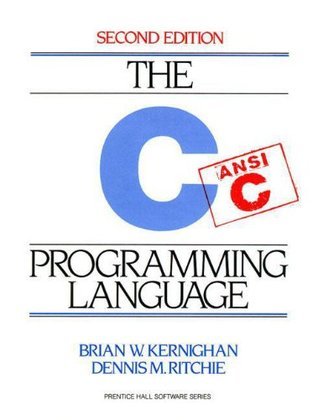
This book is meant to help the reader learn how to program in C. It is the definitive reference guide, now in a second edition. Although the first edition was written in 1978, it continues to be a worldwide best-seller. This second edition brings the classic original up to date to include the ANSI standard. From the Preface: We have tried to retain the brevity of the first edition. C is not a big language, and it is not well served by a big book. We have improved the exposition of critical features, such as pointers, that are central to C programming. We have refined the original examples, and have added new examples in several chapters. For instance, the treatment of complicated declarations is augmented by programs that convert declarations into words and vice versa. As before, all examples have been tested directly from the text, which is in machine-readable form. As we said in the first preface to the first edition, C "wears well as one's experience with it grows." With a decade more experience, we still feel that way. We hope that this book will help you to learn C and use it well.

Famous the world over for the creative brilliance of his insights into the physical world, Nobel Prize-winning physicist Richard Feynman also possessed an extraordinary talent for explaining difficult concepts to the nonscientist. QED--the edited version of four lectures on quantum electrodynamics that Feynman gave to the general public at UCLA as part of the Alix G. Mautner Memorial Lecture series--is perhaps the best example of his ability to communicate both the substance and the spirit of science to the layperson.The focus, as the title suggests, is quantum electrodynamics (QED), the part of the quantum theory of fields that describes the interactions of the quanta of the electromagnetic field-light, X rays, gamma rays--with matter and those of charged particles with one another. By extending the formalism developed by Dirac in 1933, which related quantum and classical descriptions of the motion of particles, Feynman revolutionized the quantum mechanical understanding of the nature of particles and waves. And, by incorporating his own readily visualizable formulation of quantum mechanics, Feynman created a diagrammatic version of QED that made calculations much simpler and also provided visual insights into the mechanisms of quantum electrodynamic processes.In this book, using everyday language, spatial concepts, visualizations, and his renowned "Feynman diagrams" instead of advanced mathematics, Feynman successfully provides a definitive introduction to QED for a lay readership without any distortion of the basic science. Characterized by Feynman's famously original clarity and humor, this popular book on QED has not been equaled since its publication.

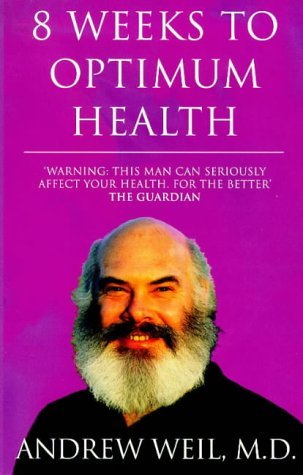
From the best-selling author of SPONTANEOUS HEALING, a brilliantly conceived, safe and effective eight-week programme for improving and maintaining health. Dr Weil first explains, then shows how, week by week, gradual changes can lead to long-term benefits such as greater vitality, weight loss and a body which heals itself. Incorporating alternative medicines and treatments, he provides specific and detailed information on diet (with 50 recipes), exercise, stress reduction techniques, and vitamins and supplements. He also customizes programmes for a dozen categories, such as pregnant women, people at risk of cancer, overweight people, and senior citizens. Building on the breakthrough thinking of SPONTANEOUS HEALING, Dr Weil provides an invaluable means to maintain health and lessen the need for medical intervention.

Modernist Cuisine: The Art and Science of Cooking is a revolutionary treatment of cooking that pushes the boundaries of culinary arts. Winner of the 2012 James Beard Award for Cookbook of the Year, inducted into the Gourmand Cookbook Hall of Fame, and named one of the best cookbooks of the century by the New Yorker, its six volumes comprising 2,438 pages explore the history of cuisine and explain the science of cooking in a way that’s accessible to both professional chefs and home cooks. Created by a team of scientists, chefs, editors, and writers, these volumes explore research spanning the field of culinary science with careful attention to practicality and applicability in the kitchen. Through gorgeous illustrations and otherworldly techniques, this set will inspire you to innovate in your own kitchen.

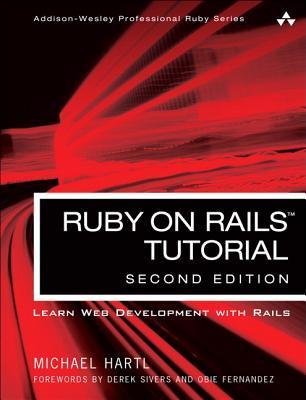
“ Ruby on Rails™ Tutorial by Michael Hartl has become a must-read for developers learning how to build Rails apps.” — Peter Cooper, Editor of Ruby Inside Using Rails, developers can build web applications of exceptional elegance and power. Although its remarkable capabilities have made Ruby on Rails one of the world’s most popular web development frameworks, it can be challenging to learn and use. Ruby on Rails™ Tutorial, Second Edition, is the solution. Best-selling author and leading Rails developer Michael Hartl teaches Rails by guiding you through the development of your own complete sample application using the latest techniques in Rails web development. The updates to this edition include all-new site design using Twitter’s Bootstrap; coverage of the new asset pipeline, including Sprockets and Sass; behavior-driven development (BDD) with Capybara and RSpec; better automated testing with Guard and Spork; roll your own authentication with has_secure_password; and an introduction to Gherkin and Cucumber. You’ll find integrated tutorials not only for Rails, but also for the essential Ruby, HTML, CSS, JavaScript, and SQL skills you’ll need when developing web applications. Hartl explains how each new technique solves a real-world problem, and he demonstrates this with bite-sized code that’s simple enough to understand, yet novel enough to be useful. Whatever your previous web development experience, this book will guide you to true Rails mastery. This book will help you

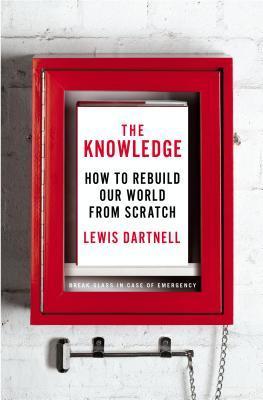
How would you go about rebuilding a technological society from scratch? If our technological society collapsed tomorrow, perhaps from a viral pandemic or catastrophic asteroid impact, what would be the one book you would want to press into the hands of the postapocalyptic survivors? What crucial knowledge would they need to survive in the immediate aftermath and to rebuild civilization as quickly as possible—a guide for rebooting the world? Human knowledge is collective, distributed across the population. It has built on itself for centuries, becoming vast and increasingly specialized. Most of us are ignorant about the fundamental principles of the civilization that supports us, happily utilizing the latest—or even the most basic—technology without having the slightest idea of why it works or how it came to be. If you had to go back to absolute basics, like some sort of postcataclysmic Robinson Crusoe, would you know how to re-create an internal combustion engine, put together a microscope, get metals out of rock, accurately tell time, weave fibers into clothing, or even how to produce food for yourself? Regarded as one of the brightest young scientists of his generation, Lewis Dartnell proposes that the key to preserving civilization in an apocalyptic scenario is to provide a quickstart guide, adapted to cataclysmic circumstances. The Knowledge describes many of the modern technologies we employ, but first it explains the fundamentals upon which they are built. Every piece of technology rests on an enormous support network of other technologies, all interlinked and mutually dependent. You can’t hope to build a radio, for example, without understanding how to acquire the raw materials it requires, as well as generate the electricity needed to run it. But Dartnell doesn’t just provide specific information for starting over; he also reveals the greatest invention of them all—the phenomenal knowledge-generating machine that is the scientific method itself. This would allow survivors to learn technological advances not explicitly explored in The Knowledge as well as things we have yet to discover. The Knowledge is a brilliantly original guide to the fundamentals of science and how it built our modern world as well as a thought experiment about the very idea of scientific knowledge itself.

From the creators of the groundbreaking documentary (and bestselling book) Forks Over Knives comes a four-week plan, showing anyone how to transition to a delicious whole-food, plant-based diet.The trailblazing film Forks Over Knives exposed an entirely new generation to the whole-food, plant-based nutrition revolution and inspired thousands to want to transform their diets, and their lives. With so many people looking for change, the outstanding question became, &#8220;How can we put these dietary ideas into practice?&#8221; That&#8217;s what authors Alona Pulde and Matthew Lederman reveal in The Forks Over Knives Plan: The 4-Week Guide to Whole-Food, Plant-Based Health&#8212;a clear, easy-to-follow plan that outlines the steps to take each week to transform your diet by cutting out animal-based and processed foods.Forks Over Knives is a leading authority in the &#8220;food as medicine&#8221; movement, showing how simple dietary changes are proven to prevent, and even reverse, chronic disease such as type-2 diabetes and heart disease and improve your overall health. This is no fad diet; the Forks Over Knives program is backed by original research and has received rave reviews from physicians like Dr. Sanjay Gupta and Dr. Mehmet Oz, to athletes like pro football star Arian Foster and pro basketball player Steve Nash, to healthy lifestyle pioneers like Alicia Silverstone, to name a few. Whether you&#8217;re already a convert and just want a dietary reboot, or you are trying a plant-based diet for the first time, The Forks Over Knives Plan makes it easier than ever to transition into this new way of eating.

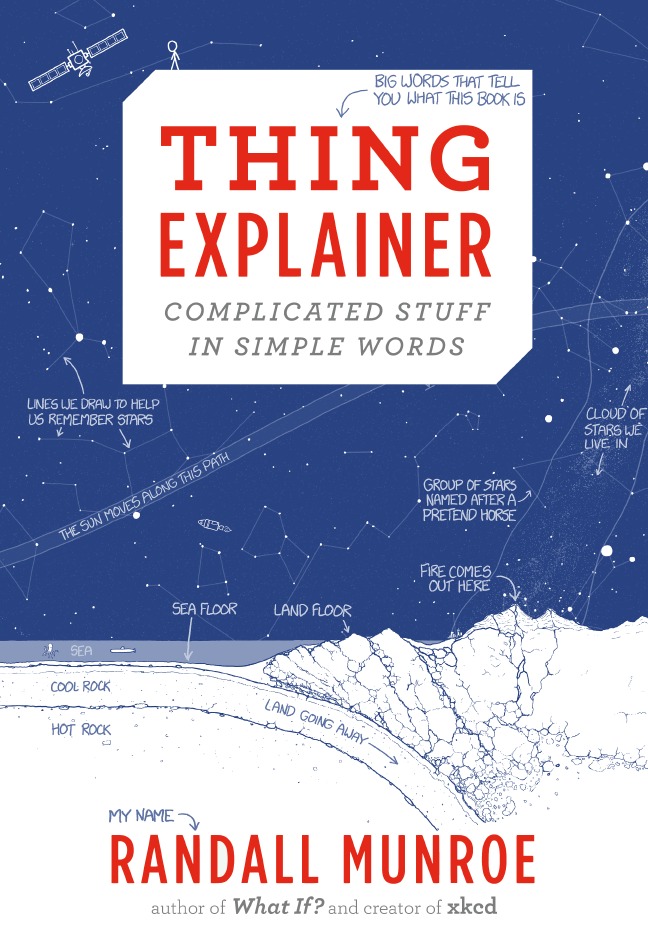
In Thing Explainer: Complicated Stuff in Simple Words, things are explained in the style of Up Goer Five, using only drawings and a vocabulary of the 1,000 (or "ten hundred") most common words. Explore computer buildings (datacenters), the flat rocks we live on (tectonic plates), the things you use to steer a plane (airliner cockpit controls), and the little bags of water you're made of (cells).

A New York Times Bestseller For anyone who has ever been inspired by a TED talk… ...this is an insider’s guide to creating talks that are unforgettable. Since taking over TED in the early 2000s, Chris Anderson has shown how carefully crafted short talks can be the key to unlocking empathy, stirring excitement, spreading knowledge, and promoting a shared dream. Done right, a talk can electrify a room and transform an audience’s worldview. Done right, a talk is more powerful than anything in written form. This book explains how the miracle of powerful public speaking is achieved, and equips you to give it your best shot. There is no set formula; no two talks should be the same. The goal is for you to give the talk that only you can give. But don’t be intimidated. You may find it more natural than you think. Chris Anderson has worked behind the scenes with all the TED speakers who have inspired us the most, and here he shares insights from such favorites as Sir Ken Robinson, Amy Cuddy, Bill Gates, Elizabeth Gilbert, Salman Khan, Dan Gilbert, Mary Roach, Matt Ridley, and dozens more — everything from how to craft your talk’s content to how you can be most effective on stage. This is the 21st-century’s new manual for truly effective communication and it is a must-read for anyone who is ready to create impact with their ideas.

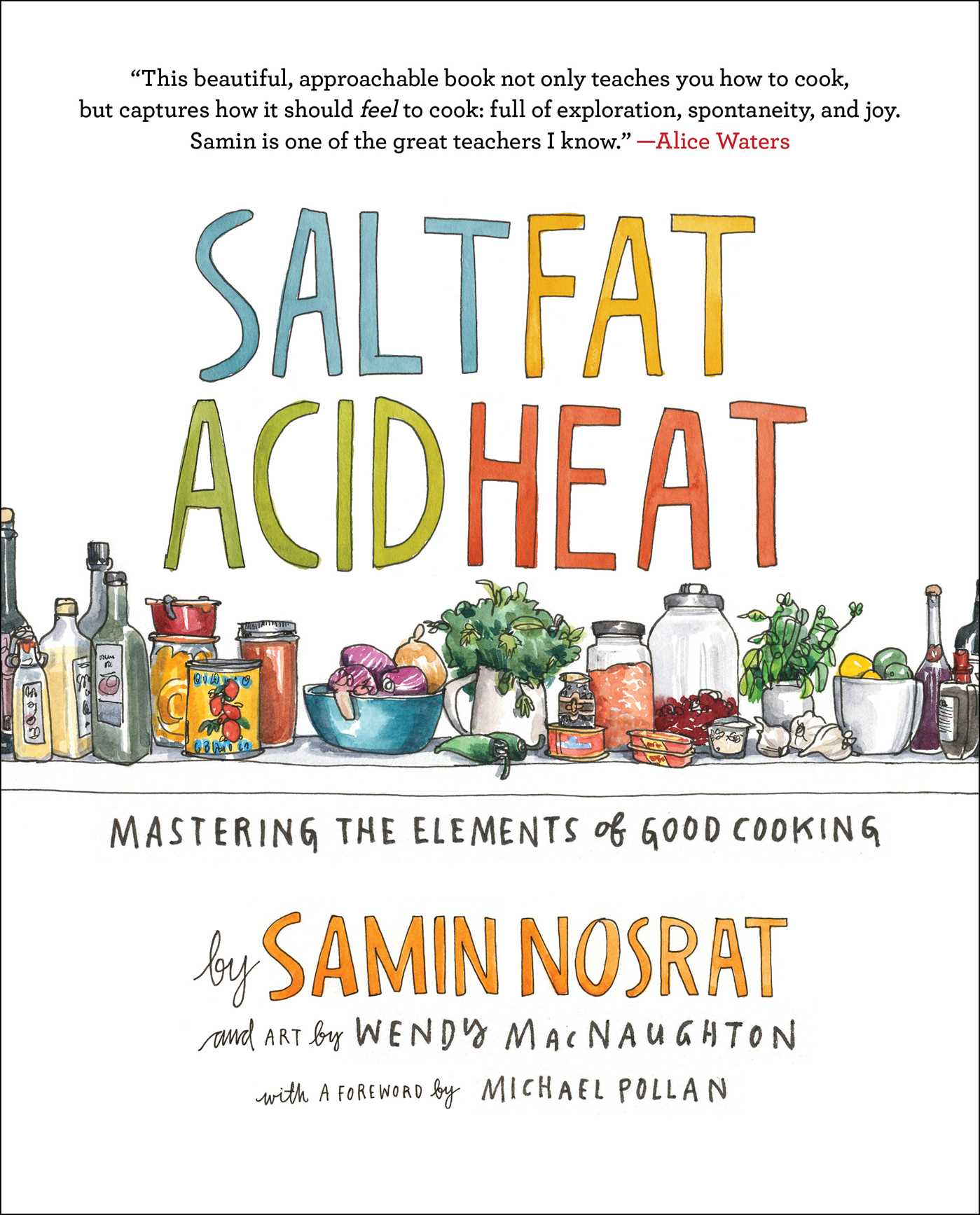
A visionary new master class in cooking that distills decades of professional experience into just four simple elements, from the woman declared “America’s next great cooking teacher” by Alice Waters.In the tradition of The Joy of Cooking and How to Cook Everything comes Salt, Fat, Acid, Heat, an ambitious new approach to cooking by a major new culinary voice. Chef and writer Samin Nosrat has taught everyone from professional chefs to middle school kids to author Michael Pollan to cook using her revolutionary, yet simple, philosophy. Master the use of just four elements—Salt, which enhances flavor; Fat, which delivers flavor and generates texture; Acid, which balances flavor; and Heat, which ultimately determines the texture of food—and anything you cook will be delicious. By explaining the hows and whys of good cooking, Salt, Fat, Acid, Heat will teach and inspire a new generation of cooks how to confidently make better decisions in the kitchen and cook delicious meals with any ingredients, anywhere, at any time. Echoing Samin’s own journey from culinary novice to award-winning chef, Salt, Fat Acid, Heat immediately bridges the gap between home and professional kitchens. With charming narrative, illustrated walkthroughs, and a lighthearted approach to kitchen science, Samin demystifies the four elements of good cooking for everyone. Refer to the canon of 100 essential recipes—and dozens of variations—to put the lessons into practice and make bright, balanced vinaigrettes, perfectly caramelized roast vegetables, tender braised meats, and light, flaky pastry doughs. Featuring 150 illustrations and infographics that reveal an atlas to the world of flavor by renowned illustrator Wendy MacNaughton, Salt, Fat, Acid, Heat will be your compass in the kitchen. Destined to be a classic, it just might be the last cookbook you’ll ever need. With a foreword by Michael Pollan.

In 2005, Joel Greenblatt published a book that is already considered one of the classics of finance literature. In The Little Book that Beats the Market—a New York Times bestseller with 300,000 copies in print—Greenblatt explained how investors can outperform the popular market averages by simply and systematically applying a formula that seeks out good businesses when they are available at bargain prices. Now, with a new Introduction and Afterword for 2010, The Little Book that Still Beats the Market updates and expands upon the research findings from the original book. Included are data and analysis covering the recent financial crisis and model performance through the end of 2009. In a straightforward and accessible style, the book explores the basic principles of successful stock market investing and then reveals the author’s time-tested formula that makes buying above average companies at below average prices automatic. Though the formula has been extensively tested and is a breakthrough in the academic and professional world, Greenblatt explains it using 6th grade math, plain language and humor. He shows how to use his method to beat both the market and professional managers by a wide margin. You’ll also learn why success eludes almost all individual and professional investors, and why the formula will continue to work even after everyone “knows” it. While the formula may be simple, understanding why the formula works is the true key to success for investors. The book will take readers on a step-by-step journey so that they can learn the principles of value investing in a way that will provide them with a long term strategy that they can understand and stick with through both good and bad periods for the stock market. As the Wall Street Journal stated about the original edition, “Mr. Greenblatt…says his goal was to provide advice that, while sophisticated, could be understood and followed by his five children, ages 6 to 15. They are in luck. His ‘Little Book’ is one of the best, clearest guides to value investing out there.”

An intimate and profound reckoning with the changes buffeting the $2 trillion global advertising and marketing business from the perspective of its most powerful players, by the bestselling author of GoogledAdvertising and marketing touches on every corner of our lives, and is the invisible fuel powering almost all media. Complain about it though we might, without it the world would be a darker place. And of all the industries wracked by change in the digital age, few have been turned on its head as dramatically as this one has. We are a long way from the days of Don Draper; as Mad Men is turned into Math Men (and women--though too few), as an instinctual art is transformed into a science, the old lions and their kingdoms are feeling real fear, however bravely they might roar.Frenemies is Ken Auletta's reckoning with an industry under existential assault. He enters the rooms of the ad world's most important players, some of them business partners, some adversaries, many "frenemies," a term whose ubiquitous use in this industry reveals the level of anxiety, as former allies become competitors, and accusations of kickbacks and corruption swirl. We meet the old guard, including Sir Martin Sorrell, the legendary head of WPP, the world's largest ad agency holding company; while others play nice with Facebook and Google, he rants, some say Lear-like, out on the heath. There is Irwin Gotlieb, maestro of the media agency GroupM, the most powerful media agency, but like all media agencies it is staring into the headlights as ad buying is more and more done by machine in the age of Oracle and IBM. We see the world from the vantage of its new powers, like Carolyn Everson, Facebook's head of Sales, and other brash and scrappy creatives who are driving change, as millennials and others who disdain ads as an interruption employ technology to zap them. We also peer into the future, looking at what is replacing traditional advertising. And throughout we follow the industry's peerless matchmaker, Michael Kassan, whose company, MediaLink, connects all these players together, serving as the industry's foremost power broker, a position which feasts on times of fear and change.Frenemies is essential reading, not simply because of what it says about this world, but because of the potential consequences: the survival of media as we know it depends on the money generated by advertising and marketing--revenue that is in peril in the face of technological changes and the fraying trust between the industry's key players.

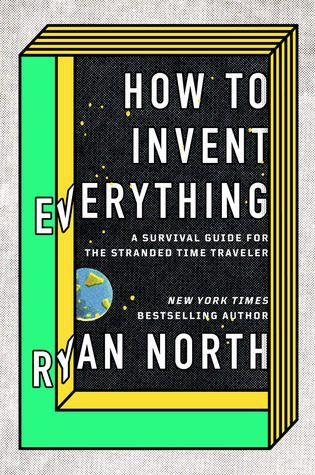
What would you do if a time machine hurled you thousands of years into the past. . . and then broke? How would you survive? Could you improve on humanity's original timeline? And how hard would it be to domesticate a giant wombat? With this book as your guide, you'll survive--and thrive--in any period in Earth's history. Bestselling author and time-travel enthusiast Ryan North shows you how to invent all the modern conveniences we take for granted--from first principles. This illustrated manual contains all the science, engineering, art, philosophy, facts, and figures required for even the most clueless time traveler to build a civilization from the ground up. Deeply researched, irreverent, and significantly more fun than being eaten by a saber-toothed tiger, How to Invent Everything will make you smarter, more competent, and completely prepared to become the most important and influential person ever.

Some of the most rewarding pages in Henry Miller's books concern his self-education as a writer. He tells, as few great writers ever have, how he set his goals, how he discovered the excitement of using words, how the books he read influenced him, and how he learned to draw on his own experience.
Are you lacking direction in how to whip up a swanky soiree for lumberjacks? A dinner party for white-collar workers? A festive gathering for the grieving? Don't despair. Take a cue from entertaining expert Amy Sedaris and host an unforgettable fete that will have your guests raving. No matter the style or size of the gathering-from the straightforward to the bizarre-I LIKE YOU provides jackpot recipes and solid advice laced with Amy's blisteringly funny take on entertaining, plus four-color photos and enlightening sidebars on everything it takes to pull off a party with extraordinary flair. You don't even need to be a host or hostess to benefit-Amy offers tips for guests, too! (Number one: don't be fifteen minutes early.) Readers will discover unique dishes to serve alcoholics (Broiled Frozen Chicken Wings with Applesauce), the secret to a successful children's party (a half-hour time limit, games included), plus a whole appendix chock-full of arts and crafts ideas (from a mini-pantyhose plant-hanger to a do-it-yourself calf stretcher), and much, much more!

Widely considered one of the best practical guides to programming, Steve McConnell’s original code complete has been helping developers write better software for more than a decade. Now this classic book has been fully updated and revised with leading-edge practices—and hundreds of new code samples—illustrating the art and science of software construction. Capturing the body of knowledge available from research, academia, and everyday commercial practice, McConnell synthesizes the most effective techniques and must-know principles into clear, pragmatic guidance. No matter what your experience level, development environment, or project size, this book will inform and stimulate your thinking—and help you build the highest quality code.Discover the timeless techniques and strategies that help you:

A new edition of the revolutionary bestseller, with four million copies in print. Allen Carr’s innovative Easyway method—which he discovered after his own 100-cigarette-a-day habit nearly drove him to despair—has helped millions kick smoking without feeling anxious and deprived. That’s because he helps smokers discover the psychological reasons behind their dependency, explains in detail how to handle the withdrawal symptoms, shows them how to avoid situations when temptation might become too strong, and enables them to stay smoke-free. Carr discusses such issues as nicotine addiction; the social “brainwashing” that encourages smoking; the false belief that a cigarette relieves stress; the role boredom plays in sabotaging efforts to stop; and the main reasons for failure. With this proven program, smokers will be throwing away their packs for good.

Writing for science fiction and fantasy audiences can be the most exciting writing you've ever done. Your readers are curious and want you to take them beyond ""The Fields We Know,"" to help them explore the infinite boundaries of the worlds you create.Here, science fiction great Orson Scott Card shares his expertise in these genres. You'll learn:- What is and isn't science fiction and fantasy, and by whose standards -- and where your work fits in.- How to build, populate, and dramatize a credible, inviting world your readers will want to explore.- How to use the MICE quotient -- milieu, idea, character, event -- to structure a successful story.- Where the markets are and how to reach them to get published.The knowledge and skills you gain through this book will help you effectively lead your readers into the strangeness you create -- one tantalizing step at a time.

A classic in the field of sustainable gardening, HOW TO GROW MORE VEGETABLES shows how to produce a beautiful organic garden with minimal watering and care, whether it's just a few tomatoes in a tiny backyard or enough food to feed a family of four on less than half an acre. Updated with the latest biointensive tips and techniques, this is an essential reference for gardeners of all skill levels seeking to grow some or all of their own food.

Learn all the French argot (slang), dirty words, and necessary tools of communication your teachers left out of their lesson plans with this essential survival guide to understanding everyday French.Deliciously saucy and full of wit Merde! is a practical guide for understanding French, as it really is spoken. This real-life resource is for anyone who remembers thumbing through English/French dictionaries for such words as "toilet paper" and "damn," as well as for the far more interesting, titillating terms that would never be used in polite conversation. But real French isn't spoken with the intent of being polite... With epithets for every occasion, a range of colorful idioms, and a wealth of come-ons and put-downs, this is the only language book you'll need to prepare for a trip to the city of lights.

National Geographic Field Guide to the Birds of North America continues to be the most sought-after, the most authoritative, and the easiest to access field guide to birds on the market. Now in its 4th Edition, revisions include 250 updated range maps, and new classification information National Geographic is reissuing the Field Guide to the Birds of North America in the 4th edition, focusing on its accuracy and easy use in the field. This is the ultimate birders field guide - sturdy, easy to carry and use, and featuring the most complete information among bird guides. It features all species known to breed in North America, including those that are regular visitors to our continent or that drop in occasionally - more than 800 in all. The edition is lavishly illustrated with specially commissioned full-colour illustrations, plus newly updated range maps and detailed descriptions. A superb new index allows birders in the field to quickly identify a species.

David Allen Sibley, America's most gifted contemporary painter of birds, is the author and illustrator of this comprehensive guide. His beautifully detailed illustrations—more than 6,600 in all—and descriptions of 810 species and 350 regional populations will enrich every birder's experience.The Sibley Guide 's innovative design makes it entirely user friendly. The illustrations are arranged to facilitate comparison, yet still capture the unique character of each species.The Sibley Guide to Birds provides a wealth of new —Captioned illustrations show many previously unpublished field marks and revisions of known marks—Nearly every species is shown in flight—Measurements include length, wingspan, and weight for every species—Subspecies and geographic varients are covered thoroughly—Complete voice descriptions are included for every species—Maps show the complete distribution of every summer and winter ranges, migration routes, and rare occurrencesBoth novice and experienced birders will appreciate these and other innovative —An introductory page for each family or group of related families makes comparisons simple—Clear and concise labels with pointers identify field marks directly—Birds are illustrated in similar poses to make comparisons between species quick and easy—Illustrations emphasize the way birds look in the fieldWith The Sibley Guide to Birds , the National Audubon Society makes the art and expertise of David Sibley available to the world in a comprehensive, handsome, easy-to-use volume that will be the indispensable identification guide every birder must own.

The aim of this groundbreaking new book is to bring general relativity into the undergraduate curriculum and make this fundamental theory accessible to all physics majors. Using a "physics first" approach to the subject, renowned relativist James B. Hartle provides a fluent and accessible introduction that uses a minimum of new mathematics and is illustrated with a wealth of exciting applications. The emphasis is on the exciting phenomena of gravitational physics and the growing connection between theory and observation. The Global Positioning System, black holes, X-ray sources, pulsars, quasars, gravitational waves, the Big Bang, and the large scale structure of the universe are used to illustrate the widespread role of how general relativity describes a wealth of everyday and exotic phenomena.

Science and art have in common intense seeing, the wide-eyed observing that generates visual information. Beautiful Evidence is about how seeing turns into showing, how data and evidence turn into explanation. The book identifies excellent and effective methods for showing nearly every kind of information, suggests many new designs (including sparklines), and provides analytical tools for assessing the credibility of evidence presentations (which are seen from both sides: how to produce and how to consume presentations). For alert consumers of presentations, there are chapters on diagnosing evidence corruption and PowerPoint pitches. Beautiful Evidence concludes with two chapters that leave the world of pixel and paper flatland representations - and move onto seeing and thinking in space land, the real-land of three-space and time.

Now in full color, the 10th anniversary edition of this classic book packs more insight into what it means to design games for fun. Theory of Fun for Game Design challenges and inspires game designers as well as game enthusiasts looking for products and experiences that are truly fun and entertaining.The book discusses the impact of designing in a multidimensional landscape, where computer science, environmental design, and storytelling all play a role in creating an interactive game design. For the professional game developer to the interested young gamer, this updated edition takes you on an illustrated ride in fun and games.Learn why some games are fun and others are boringDiscover how playing a game and learning are connectedUnderstand why making a game too hard--or too easy--is a mistakeFind out why games have to balance deprivation and overload, order and chaos, silence and noiseExplore why you need to balance challenges of task mastery, pattern recognition, discovery, and time attacks

Craft an Engaging PlotHow does plot influence story structure? What's the difference between plotting for commercial and literary fiction? How do you revise a plot or structure that's gone off course?With "Write Great Fiction: Plot & Structure," you'll discover the answers to these questions and more. Award-winning author James Scott Bell offers clear, concise information that will help you create a believable and memorable plot, including: Techniques for crafting strong beginnings, middles, and endsEasy-to-understand plotting diagrams and chartsBrainstorming techniques for original plot ideasThought-provoking exercises at the end of each chapterStory structure models and methods for all genresTips and tools for correcting common plot problemsFilled with plot examples from popular novels, comprehensive checklists, and practical hands-on guidance, "Write Great Fiction: Plot & Structure" gives you the skills you need to approach plot and structure like an experienced pro.

From the most eloquent of American presidents, nearly 400 astute observations on subjects ranging from women to warfare: "Bad promises are better broken than kept"; "Marriage is neither heaven nor hell; it is simply purgatory"; "Whenever I hear anyone arguing for slavery, I feel a strong impulse to see it tried on him personally."

Users experience the usability of a web site before they have committed to using it and before making any purchase decisions. The web is the ultimate environment for empowerment, and he or she who clicks the mouse decides everything. Designing Web Usability is the definitive guide to usability from Jakob Nielsen, the world's leading authority. Over 250,000 Internet professionals around the world have turned to this landmark book, in which Nielsen shares the full weight of his wisdom and experience. From content and page design to designing for ease of navigation and users with disabilities, he delivers complete direction on how to connect with any web user, in any situation. Nielsen has arrived at a series of principles that work in support of his findings: 1. That web users want to find what they're after quickly; 2. If they don't know what they're after, they nevertheless want to browse quickly and access information they come across in a logical manner. This book is a must-have for anyone who thinks seriously about the web.

Originally titled The Religions of Man, this completely revised and updated edition of Smith′s masterpiece, now with an engaging new foreword, explores the essential elements and teachings of the world′s predominant faiths, including:Hinduism,Buddhism,Confucianism,Taoism,Islam,Judaism,Christianity,and the native traditions of the Americas, Australia, Africa, and Oceania.Emphasising the inner -- rather than institutional -- dimensions of these religions, Smith devotes special attention to Zen and Tibetan Buddhism, Sufism, and the teachings of Jesus. He convincingly conveys the unique appeal and gifts of each of the traditions and reveals their hold on the human heart and imagination.

“Each of these little books is witty and dramatic and creates a sense of time, place, and character....I cannot think of a better way to introduce oneself and one's friends to Western civilization.”―Katherine A. Powers, Boston Globe . “Well-written, clear and informed, they have a breezy wit about them....I find them hard to stop reading.”―Richard Bernstein, New York Times . “Witty, illuminating, and blessedly concise.”―Jim Holt, Wall Street Journal . These brief and enlightening explorations of our greatest thinkers bring their ideas to life in entertaining and accessible fashion. Philosophical thought is deciphered and made comprehensive and interesting to almost everyone. Far from being a novelty, each book is a highly refined appraisal of the philosopher and his work, authoritative and clearly presented.

"A Guide to the I Ching" is an interpretive manual to the classic Wilhelm/Baynes translation of the I Ching. Now a classic in its own right and translated into other languages (German, Spanish, Portuguese, Croatian, and Italian), the "Guide" is recognized by teachers and long time students of the I Ching as indispensable to its understanding and use. Developed from notes taken over many years, the Guide mirrors the reader's true inner feelings, helping him to bring his life and fate into harmony with the Tao — the way of the Universe.

Most programmers' fear of user interface (UI) programming comes from their fear of doing UI design. They think that UI design is like graphic design―the mysterious process by which creative, latte-drinking, all-black-wearing people produce cool-looking, artistic pieces. Most programmers see themselves as analytic, logical thinkers instead―strong at reasoning, weak on artistic judgment, and incapable of doing UI design. In this brilliantly readable book, author Joel Spolsky proposes simple, logical rules that can be applied without any artistic talent to improve any user interface, from traditional GUI applications to websites to consumer electronics. Spolsky's primary axiom, the importance of bringing the program model in line with the user model, is both rational and simple. In a fun and entertaining way, Spolky makes user interface design easy for programmers to grasp. After reading User Interface Design for Programmers , you'll know how to design interfaces with the user in mind. You'll learn the important principles that underlie all good UI design, and you'll learn how to perform usability testing that works.