
Annie Dillard
Annie Dillard (born April 30, 1945) is an American author, best known for her narrative prose in both fiction and non-fiction. She has published works of poetry, essays, prose, and literary criticism, as well as two novels and one memoir. Her 1974 work Pilgrim at Tinker Creek won the 1975 Pulitzer Prize for General Nonfiction. Dillard taught for 21 years in the English department of Wesleyan University, in Middletown, Connecticut. (from Wikipedia)
27 Books Written

From Pulitzer Prize-winning Annie Dillard, a collection that illuminates the dedication and daring that characterizes a writer's life.In these short essays, Annie Dillard—the author of Pilgrim at Tinker Creek and An American Childhood—illuminates the dedication, absurdity, and daring that characterize the existence of a writer. A moving account of Dillard’s own experiences while writing her works, The Writing Life offers deep insight into one of the most mysterious professions.

Pilgrim at Tinker Creek is the story of a dramatic year in Virginia's Blue Ridge valley. Annie Dillard sets out to see what she can see. What she sees are astonishing incidents of "mystery, death, beauty, violence."

Annie Dillard remembers. She remembers the exhilaration of whipping a snowball at a car and having it hit straight on. She remembers playing with the skin on her mother's knuckles, which "didn't snap back; it lay dead across her knuckle in a yellowish ridge." She remembers the compulsion to spend a whole afternoon (or many whole afternoons) endlessly pitching a ball at a target. In this intoxicating account of her childhood, Dillard climbs back inside her 5-, 10-, and 15-year-old selves with apparent effortlessness. The voracious young Dillard embraces headlong one fascination after another--from drawing to rocks and bugs to the French symbolists. "Everywhere, things snagged me," she writes. "The visible world turned me curious to books; the books propelled me reeling back to the world." From her parents she inherited a love of language--her mother's speech was "an endlessly interesting, swerving path"--and the understanding that "you do what you do out of your private passion for the thing itself," not for anyone else's approval or desire. And one would be mistaken to call the energy Dillard exhibits in An American Childhood merely youthful; "still I break up through the skin of awareness a thousand times a day," she writes, "as dolphins burst through seas, and dive again, and rise, and dive."
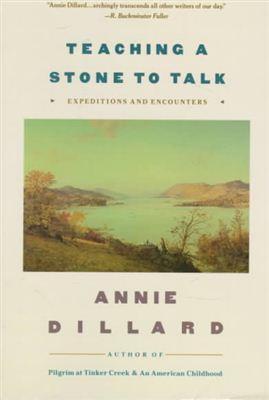
"A collection of meditations like polished stones — painstakingly worded, tough-minded, yet partial to mystery, and peerless when it comes to injecting larger resonances into the natural world." — Kirkus Reviews Here, in this compelling assembly of writings, Pulitzer Prize-winning author Annie Dillard explores the world of natural facts and human meanings. Veering away from the long, meditative studies of Pilgrim at Tinker Creek or Holy the Firm, Annie Dillard explores and celebrates moments of spirituality, dipping into descriptions of encounters with flora and fauna, stars, and more, from Ecuador to Miami. There is no writer quite like Dillard when it comes to the mysteries and wonder of the natural world.

In spare, elegant prose, Dillard traces the lives of Toby and Lou Maytree. She presents willed bonds of loyalty, friendship, and abiding love. Warm and hopeful, The Maytrees is the surprising capstone of Annie Dillard's original body of work.Toby Maytree first sees Lou Bigelow on her bicycle in postwar Provincetown, Massachusetts. Her laughter and loveliness catch his breath. Maytree is a Provincetown native, an educated poet of thirty. As he courts Lou, just out of college, her stillness draws him. Hands-off, he hides his serious wooing, and idly shows her his poems. Dillard recounts the Maytrees' decades of loving and longing. They live cheaply among the nonconformist artists and writers that the bare tip of Cape Cod attracts. Lou takes up painting. When their son Petie appears, their innocent Bohemian friend Deary helps care for him. But years later it is Deary who causes the town to talk. In this moving novel, Dillard intimately depicts nature's vastness and nearness. She presents willed bonds of loyalty, friendship, and abiding love. Warm and hopeful, The Maytrees is the surprising capstone of Annie Dillard's original body of work.

From Pulitzer Prize-winning Annie Dillard, a book about the grace, beauty, and terror of the natural world. In the mid 1970s, Annie Dillard spent two years on an island in Puget Sound in a room with a solitary window, a cat, and a spider for company, asking herself questions about memory, time, sacrifice, reality, death, and God. Holy the Firm , the diary-like collection of her thoughts, feelings, and ruminations during this time, is a lyrical gift to any reader who have ever wondered how best to live with grace and wonder in the natural world.

With her keen eye, penchant for paradox, and yearning for truth, Dillard renews our ability to discover wonder in life's smallest--and often darkest--corners.Why do we exist? Where did we come from? How can one person matter? Dillard searches for answers in a powerful array of images: pictures of bird-headed dwarfs in the standard reference of human birth defects; ten thousand terra-cotta figures fashioned for a Chinese emperor in place of the human court that might have followed him into death; the paleontologist and theologian Teilhard de Chardin crossing the Gobi Desert; the dizzying variety of clouds. Vivid, eloquent, haunting, For the Time Being evokes no less than the terrifying grandeur of all that remains tantalizingly and troublingly beyond our understanding.

Ninety miles north of Seattle on the Washington coast lies Bellingham Bay, where a rough settlement founded in the 1850s would become the town of Whatcom. Here, the Lummi and Nooksack Indian people fish and farm, hermits pay their debts in sockeye salmon, and miners track gold-bearing streams.Here, too, is the intimate, murderous tale of three men. Clare Fishburn believes that greatness lies in store for him. John Ireland Sharp, an educated orphan, abandons hope when he sees socialists expel the Chinese workers from the region. Beal Obenchain, who lives in a cedar stump, threatens Clare Fishburn's life.A killer lashes a Chinese worker to a wharf piling at low tide. Settlers pour in to catch the boom the railroads bring. People give birth, drown, burn, inherit rich legacies, and commit expensive larcenies. All this takes place a hundred years ago, when these vital, ruddy men and women were ''the living.''

in recognition of this pulitzer prize–winning author’s lauded career as a master essayist, a landmark collection, including her most beloved pieces and some rarely seen work the abundance includes the best of Annie Dillard’s essays, delivered in her fierce and muscular prose, filled with absorbing detail and metaphysical fact. Intense, vivid, and fearless, her work endows the true and seemingly ordinary aspects of life—a commuter chases snowball-throwing children through backyards, a bookish teenager memorizes the poetry of Rimbaud—with beauty and irony. These essays invite readers into sweeping landscapes, to join Dillard in exploring the complexities of time and death, often with wry humor. On one page, an eagle falls from the sky with a weasel attached to its throat; on another, a man walks into a bar.Marking the vigor of this powerful writer, The Abundance highlights Annie Dillard’s elegance of mind.

A beautiful repackaging of Annie Dillard's classic work of literary criticism."Everyone who timidly, bombastically, reverently, scholastically--even fraudulently--essays to 'live the life of the mind' should read this book. It's elegant and classy, like caviar and champagne, and like these two items, it's over much too soon." — Carolyn See, Los Angeles Times Living by Fiction is written for--and dedicated to--people who love literature. Dealing with writers such as Nabokov, Barth, Coover, Pynchon, Borges, García Márquez, Beckett, and Calvino, Annie Dillard shows why fiction matters and how it can reveal more of the modern world and modern thinking than all the academic sciences combined. Readers of Pilgrim at Tinker Creek, An American Childhood , and Holy the Firm will recognize Dillard's vivid writing, her humor, and the lively way she tackles the urgent questions of meaning in experience itself.

Three by Annie Dillard: Pilgrim at Tinker Creek, An American Childhood, The Writing Life
by Annie Dillard
Rating: 4.3 ⭐
One of the most distinctive voices in American letters today. --Boston GlobeA stunning collection of Annie Dillard's most popular books in one volume.Pilgrim at Tinker Creek took American letters by storm when it was published in 1974, winning the Pulitzer Prize, the accolades of the critics, and over the years hundreds of thousands of devoted readers. It was followed by many more books by Annie Dillard, two of which, An American Childhood and The Writing Life, became national bestsellers and cemented Dillard's reputation as one of our national literary treasures.

The Annie Dillard Reader is a selection by the author from some of her work. There are many chapters from Pilgrim at Tinker Creek and An American Childhood. Holy the Firm appears in its entirety, and revised. Also included is a new version of a short story first published in 1978 in Harper's, called "The Living." The characters of the original story became the nucleus of the 1992 novel The Living. Finally there are a few poems, old and new, one uncollected essay, and some narratives from her sole book of essays, Teaching a Stone to Talk.Annie Dillard's Pilgrim at Tinker Creek won the Pulitzer Prize for general nonfiction in 1975. She is the author of eleven other books, including the memoir An American Childhood, the novel The Living, and a volume of found poems Mornings Like This. She has received fellowship grants from the John Simon Guggenheim Foundation and the National Endowment for the Arts.Born in 1945 in Pittsburgh, Dillard attended Hollins College in Virginia. After living for five years in the Pacific Northwest, she returned to the East Coast, where she lives with her husband Robert D. Richardson Jr. and daughter Rosy.

A stunning poetry collection by the Pulitzer Prize-winning author of whom The New Yorker said, "She has the ability to write with enduring grace." The Boston Globe called her "one of the most distinctive voices in American letters today."

"Found poems are to their poet what no-fault insurance is to payoffs waiting to happen where everyone wins and no one is blamed. Dillard culls about 40 such happy accidents from sources as diverse as a The American Boys Handy Book (1882) and the letters of Van Gogh. . . . the poet aims for a lucky, loaded symbolism that catapults the reader into an epiphany never imagined by the original authors." — Publishers Weekly In Mornings Like This, beloved author Annie Dillard has given us a witty and moving collection of poems in a wholly original form, sure to charm her fans, both old and new. Extracting and rearranging sentences from old and odd books—From D.C. Beard's "The American Boys Handy Book" in 1882 to Van Gogh's letters to David Greyson's "The Countryman's Year" in 1936—Dillard has composed poems on poetry’s most heartfelt themes of love, nature, nostalgia, and death. A unique, clever, and original collection, Dillard’s characteristic voice sounds throughout the pages.

Bizarre encounters between Chinese and American writersWinner of the New England Book Show AwardIt's been a pilgrimage for Annie Dillard: from Tinker Creek to the Galapagos Islands, the high Arctic, the Pacific Northwest, the Amazon Jungle―and now, China. This informative narrative is full of fascinating people: Chinese people, mostly writers, who encounter American writers in various bizarre circumstances in both China and the U.S. There is a toasting scene at a Chinese banquet; a portrait of a bitter, flirtatious diplomat at a dance hall; a formal meeting with Chinese writers; a conversation with an American businessman in a hotel lobby; an evening with long-suffering Chinese intellectuals in their house; a scene in the Beijing foreigners' compound with an excited European journalist; and a scene of unwarranted hilarity at the Beijing Library. In the U.S., there is Allen Ginsberg having a bewildering conversation in Disneyland with a Chinese journalist; there is the lovely and controversial writer Zhang Jie suiting abrupt mood changes to a variety of actions; and there is the fiercely spirited Jiange Zilong singing in a Connecticut dining room, eyes closed. These are real stories told with a warm and lively humor, with a keen eye for paradox, and with fresh insight into the human drama.

Two years after seeing the eclipse, Dillard wrote about the experience. The total eclipse leads Dillard to evaluate her beliefs about the moral connectivity of humans to each other and to the world they inhabit.


For anyone who has ever feared the best isn't yet to come, Give It All, Give It Now is an inspiration. Originally intended to inspire writers and aspiring writers, Pulitzer-Prize-winning author Annie Dillard's words are empowering and energizing, making this book the perfect gift for anyone undertaking a creative endeavor, including someone beginning a new career, turning over a new leaf, or celebrating a milestone.The message of this surprising little book is brought to life by the remarkable artistry of Sam Fink. His astonishing calligraphy and full-color illustrations brilliantly complement the passion of Dillard's text.Featuring an introduction by bestselling author Susan Cheever, this distinctive accordion-page book contains 20 color illustrations and is enclosed in a slip case. It is a gift book for all occasions, one that will be revisited time and again for inspiration and encouragement.

In this interview, Ms. Dillard, author of Pilgrim at Tinker Creek, says she is a "composer of texts," as opposed to a revealer of self and confesses that she originally tried to write Pilgrim as though she was a man, but was dissuaded from doing so by her editors.
Walden Pond and Thoreau
by Annie Dillard
FIELD 11 - FALL 1974
by Annie Dillard
Oberlin, Ohio. 1974 first edition. Oberline. octavo wraps. 90p. Amusing front cover illustration shows a young woman in bathing attire on top of a sea bouy with title "Girl and B(u)oy on the Maine Coast. " VG no owner marks.
DREAM BIRDS, THINK CONTINUALLY OF THOSE WHO WENT TRULY APE, THE LAST THING I SAW BEFORE I CLOSED MY EYES - THREE POEMS
by Annie Dillard
1966. Appearing at pp. 6-8 in anthology, Cargoes, Winter 1966, Hollis College, Virginia. The complete issue is octavo, 76pp., wraps. Fine.

This is a gift for the New Year, 1992, from Kepler's Books & Magazines. From the book An American Childhood by Annie Dillard. Copyright © 1987 by Annie Dillard. Reprinted by permission of Harper Collins Publishers. Okeanos Press Design.
Antaeus - No. 36 - Winter 1980
by Annie Dillard