
Alexander Shulgin
Alexander "Sasha" Theodore Shulgin[1] (born June 17, 1925) was an American pharmacologist, chemist and drug developer. Shulgin was credited with the popularization of MDMA, commonly known as ecstasy, in the late 1970s and early 1980s, especially for psychopharmaceutical use and the treatment of depression and post-traumatic stress disorder. In subsequent years, Shulgin discovered, synthesized, and bioassayed over 230 psychoactive compounds. In 1991 and 1997, he and his wife Ann Shulgin authored the books PiHKAL and TiHKAL on the topic of psychoactive drugs. Shulgin discovered many noteworthy phenethylamines including the 2C* family of which 2C-T-2, 2C-T-7, 2C-E, 2C-I, and 2C-B are most well known. Additionally, Shulgin performed seminal work into the descriptive synthesis of compounds based on the organic compound tryptamine.
15 Books Written

Pihkal (phenethylamines I have known and loved) is a unique book written by renowned psychopharmacologist Alexander shulgin and his wife Ann shulgin. This book gives details of their research and investigations into the use of psychedelic drugs for the study of the human mind, and is also a love story. The second half of the book describes in detail a wealth of phenethlyamines, their physical properties, dosages used, duration of effects observed, and commentary on effects.

Tihkal: The Continuation by Alexander Shulgin
by Alexander Shulgin
Rating: 5.0 ⭐
• 4 recommendations ❤️
A continuation of the classic PIHKAL, TIHKAL focuses on the family of psychoactive drugs in the tryptamine family and provides a blend of biography, botanical facts, scientific speculation, and psychological and political commentary written by renowned psychopharmacologist Alexander Shulgin and his wife Ann Shulgin. Where PiHKAL focuses on a class of compounds called phenethylamines, TiHKAL is written about a family of psychoactive drugs known as tryptamines with TiHKAL being an acronym for Tryptamines I Have Known and Loved". Like its predecessor, it is divided into two parts. The first part of the book begins with the story of Alice and Shura, a fictionalized autobiography, which picks up where the similar section of PiHKAL left off. The book opens with the story about the DEA raid that occurred a few years after the publication of their first book, PiHKAL. It's a window into the DEA, the institutional aspect and human side of it as well, and the price that Shura and Alice pay for doing what they do, including exercising their first amendment rights. It then continues with a collection of essays on topics ranging from psychotherapy and the Jungian mind, to the prevalence of DMT in nature, ayahuasca, the War on Drugs, and even the Big Bang. It is a blend of travel, botanical facts, scientific speculation, psychological and political commentary. It is fascinating getting to know the mind of the man behind the compounds - his thoughts on science, technology, law, and society. And the mind of the woman who brought his work and their story into the light of the world. The second part of TiHKAL is "The Chemistry Continues". It is a detailed manual for 55 psychedelic compounds (many discovered by Shulgin himself). For each compound there is information on synthesis, effective dosage, duration of effects, and commentary on the subjective effects that were experienced. The Shulgin's' two big books span autobiography, organic chemistry, politics, ethnobotany and psychopharmacology and the cultural impact of these works has been profound and will continue to be so in the future.

The Nature of Drugs Vol. 1: History, Pharmacology, and Social Impact
by Alexander Shulgin
Rating: 4.3 ⭐
• 1 recommendation ❤️
The Nature of History, Pharmacology, and Social Impact, Volume 1, presents lectures from Alexander “Sasha” Shulgin’s popular course on what drugs are, how they work, how they are processed by the body, and how they affect our society. Transcribed from the original lectures recorded at San Francisco State University in 1987, The Nature of Drugs series highlights Shulgin’s engaging lecture style peppered with illuminating anecdotes and amusing asides. Ostensibly taught as an introductory course on drugs and biochemistry, these books serve as both a historical record of Shulgin’s teaching style and the culmination of his philosophy on drugs, psychopharmacology, states of consciousness, and societal and individual freedoms pertaining to their use, both medicinal and exploratory. The Nature of Drugs, Volume 1 features course lectures 1 through 8 and offers Shulgin’s view on the origin of drugs, the history of U.S. drug law enforcement, human anatomy, the nervous system, the range of drug administrations, varieties of drug actions, memory and states of consciousness, and research methods. It lays the groundwork for Shulgin’s philosophy on psychopharmacology and society. The Nature of Drugs series presents the story of humanity’s relationship with psychoactive substances from the perspective of a master psychopharmacologist and beloved luminary in the study of chemistry, pharmacology and consciousness. Audiobook The Nature of Drugs, Volume 1 audiobook contains portions of the original 1987 recordings of Shulgin himself conducting his course and interacting with his students. Those original clips are interlaced with newly recorded narration that fills in portions with more optimal audio quality.

The Shulgin Index: Psychedelic Phenethylamines and Related Compounds: 1
by Alexander Shulgin
Rating: 4.8 ⭐
Book is new and unopened. In original sealed plastic. Bottom corners have slight dents from storage.

In a single book... * An alphabeticallisting of the common names of all simple isoquinolines, with immediate access to their structures, the plants that contain them, and a leading reference. * A searchable listing of the structuresd of all simple isoquinolines with access to common names, plants containing them, and references. * An alphabetical index of plants containing the simple isonquinolines Written by Alexander Shulgin with step-daughter Wendy Perry, this is a massive collection of data on a fascinating new area of plants and chemicals with vast potential medicinal and psychopharmacological potential

The Nature of Drugs Vol. 2: History, Pharmacology, and Social Impact
by Alexander Shulgin
Rating: 4.7 ⭐
The Nature of History, Pharmacology, and Social Impact, Volume 2, presents lectures from Alexander “Sasha” Shulgin’s popular course on what drugs are, how they work, how they are processed by the body, and how they affect our society. Transcribed from the original lectures recorded at San Francisco State University in 1987, The Nature of Drugs series highlight Shulgins’s engaging lecture style peppered with illuminating anecdotes and amusing asides. Ostensibly taught as an introductory course on drugs and biochemistry, these books serve as both a historical record of Shulgin’s teaching style and the culmination of his philosophy on drugs, psychopharmacology, states of consciousness, and societal and individual freedoms pertaining to their use, both medicinal and exploratory. Building on the introductory lectures in The Nature of Drugs, Volume 1, this second volume contains extensive examinations of dozens of compounds, featuring lectures 9 through 23 of the course. The Nature of Drugs series presents the story of humanity’s relationship with psychoactive substances from the perspective of a master psychopharmacologist and beloved luminary in the study of chemistry, pharmacology and consciousness.

Controlled Substances: A Chemical and Legal Guide to the Federal Drugs Laws
by Alexander Shulgin
Rating: 4.4 ⭐
An essential reference for anyone concerned with controlled substances & maintaining a drug free workplace & community. Lists every currently & formerly scheduled (illegal) drug, authority for inclusion in the law, its exact names, its chemical abstract identification number, & all known synonyms. Lists all chemical structures of controlled substances, arranged by structural families. Lists drug code numbers assigned to drugs, solvents, vitamins, food stuffs, & things recognized. Has a complete empirical formula index of all compounds mentioned in the current laws. Includes the original Controlled Substance Act of 1970, the Designer Drug Act of 1986 & the present form it has taken, the working of the Emergency Scheduling Act, the Analogue Enforcement Act, & the current Federal Sentencing Guidelines. Contains 5 schedules for controlled substances & their criteria & defines the vague & misleading terms used in the laws, like "high abuse potential" & "substantially similar." Forewords by Dr. James Bakalar, for lawyers; Dr. John Thornton, for criminalists; Dr. Peyton Jacob III, for scientists. Author, Dr. Alexander Shulgin is one of the world's foremost psychopharmacological research chemists & a professor at U.C. Berkeley.

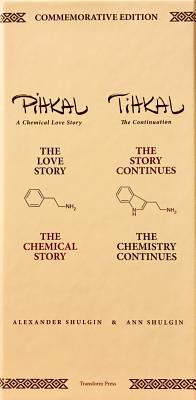
This Commemorative edition of A Chemical Love Story and The Continuation features the original texts but with complete errata, new essays, anecdotes & reminiscences by numerous colleagues, over 200 photographs, and original art. PiHKAL is the fictionalized autobiographical account of Sasha and Ann Shulgin's research and romance, exploring altered state experiences in the context of intimacy. It describes a wide variety of phenethylamines, their dosage, and their effects. The second volume, TiHKAL, uses the same format as Pihkal to describe the effects of a range of tryptamines, and continues the Shulgin's chemical love story. It also includes appendices that relate to cactus alkaloids, natural beta-carbolines, and drug law. In this edition, each book has been split into two to make a collection of four books. The set, housed in a beautiful slipcase, The Love Story The Chemical Story The Story Continues The Chemistry Continues

This 30th Anniversary Commemorative edition of PIHKAL: A Chemical Love Story and TIHKAL: The Continuation features the original texts with complete errata, new essays, anecdotes & reminiscences by numerous colleagues, over 200 photographs, original art, and never before published items from the Shulgin archives including the DEA file from the 1994 raid on the Shulgin Farm, correspondences, and other fascinating material from the Shulgin file drawers. In addition a sneak peak of the third book in the trilogy is included! PIHKAL is the fictionalized autobiographical account of Sasha and Ann Shulgin's research and romance, exploring altered state experiences in the context of intimacy. It describes a wide variety of phenethylamines, their dosage, and their effects. The second volume, TIHKAL, uses the same format as PIHKAL to describe the effects of a range of tryptamines, and continues the Shulgin's chemical love story. It also includes appendices that relate to cactus alkaloids, natural beta-carbolines, and drug law. In this edition, each book has been split into two to make a collection of four hardcover books housed in a beautiful slipcase.

PIKHAL (Vol 1 de 2): Una historia química de amor (por el padre del MDMA, 2-CB y otros compuestos)
by Alexander Shulgin
Rating: 3.0 ⭐
![Chem Notes Volume 8 [Hardcover]](https://m.media-amazon.com/images/S/compressed.photo.goodreads.com/books/1698716919i/108775007.jpg)
eng, Volume 8, Pages 240. Reprinted in 2016 with the help of original edition published long back. This book is in black & white, Hardcover, sewing binding for longer life with Matt laminated multi-Colour Dust Cover, Printed on high quality Paper, re-sized as per Current standards, professionally processed without changing its contents. As these are old books, there may be some pages which are blur or missing or black spots. We expect that you will understand our compulsion in these books. We found this book important for the readers who want to know more about our old treasure so we brought it back to the shelves. (Customisation is possible). Hope you will like it and give your comments and suggestions. Original Chem Notes Volume 8 [Hardcover], Original Alexander Shulgin
Pihkal 1st (first) editon Text Only
by Alexander Shulgin

TIHKAL: The Continuation
by Alexander Shulgin
The Continuation by Alexander and Ann Shulgin is the sequel to their classic text, A Chemical Love Story , but can stand alone to any reader!Where PiHKAL focuses on a class of compounds called phenethylamines, TiHKAL is written about a family of psychoactive drugs known as tryptamines with TiHKAL being an acronym for Tryptamines I Have Known and Loved”. Like its predecessor, this book is divided into two parts. The first part of the book begins with the story of Alice and Shura, a fictionalized autobiography, which picks up where the similar section of PiHKAL left off. The book opens with the story about the DEA raid that occurred a few years after the publication of their first book, PiHKAL. It’s a window into the DEA, the institutional aspect and human side of it as well, and the price that Shura and Alice pay for doing what they do, including exercising their first amendment rights. It then continues with a collection of essays on topics ranging from psychotherapy and the Jungian mind, to the prevalence of DMT in nature, ayahuasca, the War on Drugs, and even the Big Bang. It is a blend of travel, botanical facts, scientific speculation, psychological and political commentary. It is fascinating getting to know the mind of the man behind the compounds - his thoughts on science, technology, law, and society. And the mind of the woman who brought his work and their story into the light of the world. The second part of TiHKAL is “The Chemistry Continues”. It is a detailed manual for 55 psychedelic compounds (many discovered by Shulgin himself). For each compound there is information on synthesis, effective dosage, duration of effects, and commentary on the subjective effects that were experienced. The Shulgins' two big books span autobiography, organic chemistry, politics, ethnobotany and psychopharmacology and the cultural impact of these works has been profound and will continue to be so in the future.Book The Story Continues This is the continuation of the love story from A Chemical Love Story with a blend of travel, botanical facts, scientific speculation, psychological and political commentary.Book The Chemistry Continues Describes in detail a wealth of tryptamines in the same format as Book II of PIHKAL, plus appendices presenting topics such as cactus alkaloids, natural beta-carbolines, current drug law, and all known tryptamines (from the literature) that might be psychedelic.This audiobook is expertly read by Fred Sanders and Petrea Burchard, and was produced and published by Echo Point Books & Media, an independent bookseller in Brattleboro, Vermont. Audio engineering by Blake Rook.PLEASE When you purchase this title, the accompanying PDF will be available in your Audible Library along with the audio.

PIHKAL (Vol 1 de 2): Una historia química de amor (por el padre del MDMA, 2-CB y otros compuestos)
by Alexander Shulgin
Pihkal (parte narrativa y parte química) son más que un libro, podría decirse sin miedo a equivocarse que ambos volúmenes son ventanas hacia el vasto y fascinante universo de las fenetilaminas y las triptaminas, moléculas que transforman nuestra percepción de la realidad y la conciencia que tenemos de ella.Estas obras conjugan ciencia, historia y experiencia personal, revelando un mundo de exploración psicoactiva que ha sido objeto de admiración y controversia por igual. En sus páginas se entrelazan las experiencias íntimas de los autores con rigurosos estudios químicos, invitando al lector a un viaje que desafía los límites del conocimiento y la autocomprensión. No solo se estudian compuestos sino que se explora la psique humana en toda su profundidad y complejidad.Este viaje literario, único en su género, no solo ofrece fórmulas químicas y experiencias sino una reflexión profunda sobre el papel de las sustancias psicoactivas en la expansión de la mente. Con una narrativa que mezcla el rigor científico y la crónica personal, estos textos invitan a los lectores a cuestionar las fronteras del conocimiento y aventurarse en el fascinante mundo de las sustancias psicoactivas.Esta nueva edición de Pihkal, por primera vez editada en dos volúmenes, trata de acercar a los lectores hispanoparlantes un libro prácticamente desconocido hasta la fecha para quienes tienen el español por lengua materna.