Loading themes...
Explore the best books about Technology theme.


Walter Isaacson’s “enthralling” ( The New Yorker ) worldwide bestselling biography of Apple cofounder Steve Jobs.Based on more than forty interviews with Steve Jobs conducted over two years—as well as interviews with more than 100 family members, friends, adversaries, competitors, and colleagues—Walter Isaacson has written a riveting story of the roller-coaster life and searingly intense personality of a creative entrepreneur whose passion for perfection and ferocious drive revolutionized six personal computers, animated movies, music, phones, tablet computing, and digital publishing.At a time when America is seeking ways to sustain its innovative edge, Jobs stands as the ultimate icon of inventiveness and applied imagination. He knew that the best way to create value in 21st century was to connect creativity with technology. He built a company where leaps of the imagination were combined with remarkable feats of engineering.Although Jobs cooperated with the author, he asked for no control over what was written. He put nothing off-limits. He encouraged the people he knew to speak honestly. And Jobs speaks candidly, sometimes brutally so, about the people he worked with and competed against. His friends, foes, and colleagues provide an unvarnished view of the passions, perfectionism, obsessions, artistry, devilry, and compulsion for control that shaped his approach to business and the innovative products that resulted.Driven by demons, Jobs could drive those around him to fury and despair. But his personality and products were interrelated, just as Apple’s hardware and software tended to be, as if part of an integrated system. His tale is instructive and cautionary, filled with lessons about innovation, character, leadership, and values.Steve Jobs is the inspiration for the movie of the same name starring Michael Fassbender, Kate Winslet, Seth Rogen, and Jeff Daniels, directed by Danny Boyle with a screenplay by Aaron Sorkin.
Yuval Noah Harari, author of the critically-acclaimed New York Times bestseller and international phenomenon Sapiens, returns with an equally original, compelling, and provocative book, turning his focus toward humanity’s future, and our quest to upgrade humans into gods.Over the past century humankind has managed to do the impossible and rein in famine, plague, and war. This may seem hard to accept, but, as Harari explains in his trademark style—thorough, yet riveting—famine, plague and war have been transformed from incomprehensible and uncontrollable forces of nature into manageable challenges. For the first time ever, more people die from eating too much than from eating too little; more people die from old age than from infectious diseases; and more people commit suicide than are killed by soldiers, terrorists and criminals put together. The average American is a thousand times more likely to die from binging at McDonalds than from being blown up by Al Qaeda.What then will replace famine, plague, and war at the top of the human agenda? As the self-made gods of planet earth, what destinies will we set ourselves, and which quests will we undertake? Homo Deus explores the projects, dreams and nightmares that will shape the twenty-first century—from overcoming death to creating artificial life. It asks the fundamental questions: Where do we go from here? And how will we protect this fragile world from our own destructive powers? This is the next stage of evolution. This is Homo Deus.With the same insight and clarity that made Sapiens an international hit and a New York Times bestseller, Harari maps out our future.

'Science has never had an advocate quite like David Deutsch ... A computational physicist on a par with his touchstones Alan Turing and Richard Feynman, and a philosopher in the line of his greatest hero, Karl Popper. His arguments are so clear that to read him is to experience the thrill of the highest level of discourse available on this planet and to understand it' Peter Forbes, IndependentIn our search for truth, how far have we advanced? This uniquely human quest for good explanations has driven amazing improvements in everything from scientific understanding and technology to politics, moral values and human welfare. But will progress end, either in catastrophe or completion - or will it continue infinitely?In this profound and seminal book, David Deutsch explores the furthest reaches of our current understanding, taking in the Infinity Hotel, supernovae and the nature of optimism, to instill in all of us a wonder at what we have achieved - and the fact that this is only the beginning of humanity's infinite possibility.'This is Deutsch at his most ambitious, seeking to understand the implications of our scientific explanations of the world ... I enthusiastically recommend this rich, wide-ranging and elegantly written exposition of the unique insights of one of our most original intellectuals' Michael Berry, Times Higher Education Supplement'Bold ... profound ... provocative and persuasive' Economist'David Deutsch may well go down in history as one of the great scientists of our age' Scotsman

LinkedIn co-founder, legendary investor and author of the NYT Bestseller The Start-up of You reveals the secret to starting and scaling massively valuable companies.For most of the world, the terms "Silicon Valley" and "startup" are synonymous. Indeed, Silicon Valley is home to a disproportionate number of companies that have grown from garage startups into global giants. But what is the secret to these startups' extraordinary success? Contrary to the popular narrative, it's not their superhuman founders or savvy venture capitalists. Rather, it's that they have learned how to Blitzscale. Blitzscaling is a specific set of practices for igniting and managing dizzying growth; an accelerated path to the stage in a startup's life-cycle where the most value is created. It prioritizes speed over efficiency in an environment of uncertainty, and allows a company to go from "startup" to "scaleup" at a furious pace that captures the market. Drawing on their experiences scaling startups into billion-dollar businesses, Hoffman and Yeh offer a framework for blitzscaling that can be replicated in any region or industry. Readers will learn how to design business models that support lightning-fast growth, navigate necessary shifts in strategy at each level of scale, and weather the management challenges that arise as their company grows.

“Startling in scope and bravado.” —Janet Maslin, The New York Times“Artfully envisions a breathtakingly better world.” — Los Angeles Times“Elaborate, smart and persuasive.” — The Boston Globe“A pleasure to read.” — The Wall Street JournalOne of CBS News ’s Best Fall Books of 2005 • Among St Louis Post-Dispatch ’s Best Nonfiction Books of 2005 • One of Amazon.com’s Best Science Books of 2005A radical and optimistic view of the future course of human development from t he bestselling author of How to Create a Mind and The Singularity is Nearer who Bill Gates calls “the best person I know at predicting the future of artificial intelligence”For over three decades, Ray Kurzweil has been one of the most respected and provocative advocates of the role of technology in our future. In his classic The Age of Spiritual Machines , he argued that computers would soon rival the full range of human intelligence at its best. Now he examines the next step in this inexorable evolutionary the union of human and machine, in which the knowledge and skills embedded in our brains will be combined with the vastly greater capacity, speed, and knowledge-sharing ability of our creations.

Under Andy Grove’s leadership, Intel became the world’s largest chip maker and one of the most admired companies in the world. In Only the Paranoid Survive, Grove reveals his strategy for measuring the nightmare moment every leader dreads–when massive change occurs and a company must, virtually overnight, adapt or fall by the wayside–in a new way.Grove calls such a moment a Strategic Inflection Point, which can be set off by almost anything: mega-competition, a change in regulations, or a seemingly modest change in technology. When a Strategic Inflection Point hits, the ordinary rules of business go out the window. Yet, managed right, a Strategic Inflection Point can be an opportunity to win in the marketplace and emerge stronger than ever.Grove underscores his message by examining his own record of success and failure, including how he navigated the events of the Pentium flaw, which threatened Intel’s reputation in 1994, and how he has dealt with the explosions in growth of the Internet. The work of a lifetime, Only the Paranoid Survive is a classic of managerial and leadership skills.

#1 New York Times Bestseller There have been many books—on a large and small scale—about Steve Jobs, one of the most famous CEOs in history. But this book is different from all the others.Becoming Steve Jobs takes on and breaks down the existing myth and stereotypes about Steve Jobs. The conventional, one-dimensional view of Jobs is that he was half-genius, half-jerk from youth, an irascible and selfish leader who slighted friends and family alike. Becoming Steve Jobs answers the central question about the life and career of the Apple cofounder and CEO: How did a young man so reckless and arrogant that he was exiled from the company he founded become the most effective visionary business leader of our time, ultimately transforming the daily life of billions of people?Drawing on incredible and sometimes exclusive access, Schlender and Tetzeli tell a different story of a real human being who wrestled with his failings and learned to maximize his strengths over time. Their rich, compelling narrative is filled with stories never told before from the people who knew Jobs best, and who decided to open up to the authors, including his family, former inner circle executives, and top people at Apple, Pixar and Disney, most notably Tim Cook, Jony Ive, Eddy Cue, Ed Catmull, John Lasseter, Robert Iger and many others. In addition, Brent knew Jobs personally for 25 years and draws upon his many interviews with him, on and off the record, in writing the book. He and Rick humanize the man and explain, rather than simply describe, his behavior. Along the way, the book provides rich context about the technology revolution we all have lived through, and the ways in which Jobs changed our world.Schlender and Tetzeli make clear that Jobs's astounding success at Apple was far more complicated than simply picking the right products: he became more patient, he learned to trust his inner circle, and discovered the importance of growing the company incrementally rather than only shooting for dazzling game-changing products.A rich and revealing account that will change the way we view Jobs, Becoming Steve Jobs shows us how one of the most colorful and compelling figures of our times was able to combine his unchanging, relentless passion with a more mature management style to create one of the most valuable and beloved companies on the planet.

Elon Musk, the entrepreneur and innovator behind SpaceX, Tesla, and SolarCity, sold one of his internet companies, PayPal, for $1.5 billion. Ashlee Vance captures the full spectacle and arc of the genius's life and work, from his tumultuous upbringing in South Africa and flight to the United States to his dramatic technical innovations and entrepreneurial pursuits. Vance uses Musk's story to explore one of the pressing questions of our age: can the nation of inventors and creators who led the modern world for a century still compete in an age of fierce global competition? He argues that Musk is an amalgam of legendary inventors and industrialists including Thomas Edison, Henry Ford, Howard Hughes, and Steve Jobs. More than any other entrepreneur today, Musk has dedicated his energies and his own vast fortune to inventing a future that is as rich and far-reaching as the visionaries of the golden age of science-fiction fantasy

Shortlisted for the Financial Times Business Book of the Year Named a Best Book of 2022 by The Economist“A gripping fly-on-the-wall story of the rise of this unique and important industry based on extensive interviews with some of the most successful venture capitalists.” - Daniel Rasmussen, Wall Street Journal“A must-read for anyone seeking to understand modern-day Silicon Valley and even our economy writ large.” -Bethany McLean, The Washington Post"A rare and unsettling look inside a subculture of unparalleled influence.” —Jane Mayer"A classic...A book of exceptional reporting, analysis and storytelling.” —Charles DuhiggFrom the New York Times bestselling author of More Money Than God comes the astonishingly frank and intimate story of Silicon Valley’s dominant venture-capital firms—and how their strategies and fates have shaped the path of innovation and the global economyInnovations rarely come from “experts.” Elon Musk was not an “electric car person” before he started Tesla. When it comes to improbable innovations, a legendary tech VC told Sebastian Mallaby, the future cannot be predicted , it can only be discovered . It is the nature of the venture-capital game that most attempts at discovery fail, but a very few succeed at such a scale that they more than make up for everything else. That extreme ratio of success and failure is the power law that drives the VC business, all of Silicon Valley, the wider tech sector, and, by extension, the world. In The Power Law , Sebastian Mallaby has parlayed unprecedented access to the most celebrated venture capitalists of all time—the key figures at Sequoia, Kleiner Perkins, Accel, Benchmark, and Andreessen Horowitz, as well as Chinese partnerships such as Qiming and Capital Today—into a riveting blend of storytelling and analysis that unfurls the history of tech incubation, in the Valley and ultimately worldwide. We learn the unvarnished truth, often for the first time, about some of the most iconic triumphs and infamous disasters in Valley history, from the comedy of errors at the birth of Apple to the avalanche of venture money that fostered hubris at WeWork and Uber. VCs’ relentless search for grand slams brews an obsession with the ideal of the lone entrepreneur-genius, and companies seen as potential “unicorns” are given intoxicating amounts of power, with sometimes disastrous results. On a more systemic level, the need to make outsized bets on unproven talent reinforces bias, with women and minorities still represented at woefully low levels. This does not just have social justice as Mallaby relates, China’s homegrown VC sector, having learned at the Valley’s feet, is exploding and now has more women VC luminaries than America has ever had. Still, Silicon Valley VC remains the top incubator of business innovation anywhere—it is not where ideas come from so much as where they go to become the products and companies that create the future. By taking us so deeply into the VCs’ game, The Power Law helps us think about our own future through their eyes.

Masters of Doom is the amazing true story of the Lennon and McCartney of video games: John Carmack and John Romero. Together, they ruled big business. They transformed popular culture. And they provoked a national controversy. More than anything, they lived a unique and rollicking American Dream, escaping the broken homes of their youth to produce the most notoriously successful game franchises in history - Doom and Quake - until the games they made tore them apart. This is a story of friendship and betrayal, commerce and artistry - a powerful and compassionate account of what it's like to be young, driven, and wildly creative.

**Winner of the 2013 Financial Times and Goldman Sachs Business Book of the Year Award**Though Amazon.com started off delivering books through the mail, its visionary founder, Jeff Bezos, was never content with being just a bookseller. He wanted Amazon to become ‘the everything store’, offering limitless selection and seductive convenience at disruptively low prices. To achieve that end, he developed a corporate culture of relentless ambition and secrecy that's never been cracked. Until now...Jeff Bezos stands out for his relentless pursuit of new markets, leading Amazon into risky new ventures like the Kindle and cloud computing, and transforming retail in the same way that Henry Ford revolutionized manufacturing. Amazon placed one of the first and largest bets on the Internet. Nothing would ever be the same again.

The unbelievable true story of the man who built a billion-dollar online drug empire from his bedroom—and almost got away with it. In 2011, a twenty-six-year-old libertarian programmer named Ross Ulbricht launched the ultimate free market: the Silk Road, a clandestine Web site hosted on the Dark Web where anyone could trade anything—drugs, hacking software, forged passports, counterfeit cash, poisons—free of the government’s watchful eye. It wasn’t long before the media got wind of the new Web site where anyone—not just teenagers and weed dealers but terrorists and black hat hackers—could buy and sell contraband detection-free. Spurred by a public outcry, the federal government launched an epic two-year manhunt for the site’s elusive proprietor, with no leads, no witnesses, and no clear jurisdiction. All the investigators knew was that whoever was running the site called himself the Dread Pirate Roberts. The Silk Road quickly ballooned into $1.2 billion enterprise, and Ross embraced his new role as kingpin. He enlisted a loyal crew of allies in high and low places, all as addicted to the danger and thrill of running an illegal marketplace as their customers were to the heroin they sold. Through his network he got wind of the target on his back and took drastic steps to protect himself—including ordering a hit on a former employee. As Ross made plans to disappear forever, the Feds raced against the clock to catch a man they weren’t sure even existed, searching for a needle in the haystack of the global Internet.Drawing on exclusive access to key players and two billion digital words and images Ross left behind, Vanity Fair correspondent and New York Times bestselling author Nick Bilton offers a tale filled with twists and turns, lucky breaks and unbelievable close calls. It’s a story of the boy next door’s ambition gone criminal, spurred on by the clash between the new world of libertarian-leaning, anonymous, decentralized Web advocates and the old world of government control, order, and the rule of law. Filled with unforgettable characters and capped by an astonishing climax, American Kingpin might be dismissed as too outrageous for fiction. But it’s all too real.
Instant Wall Street Journal Bestseller! Congratulations, you're a manager! After you pop the champagne, accept the shiny new title, and step into this thrilling next chapter of your career, the truth descends like a fog: you don't really know what you're doing.That's exactly how Julie Zhuo felt when she became a rookie manager at the age of 25. She stared at a long list of logistics--from hiring to firing, from meeting to messaging, from planning to pitching--and faced a thousand questions and uncertainties. How was she supposed to spin teamwork into value? How could she be a good steward of her reports' careers? What was the secret to leading with confidence in new and unexpected situations?Now, having managed dozens of teams spanning tens to hundreds of people, Julie knows the most important lesson of all: great managers are made, not born. If you care enough to be reading this, then you care enough to be a great manager.The Making of a Manager is a modern field guide packed everyday examples and transformative insights, including:* How to tell a great manager from an average manager (illustrations included) * When you should look past an awkward interview and hire someone anyway * How to build trust with your reports through not being a boss * Where to look when you lose faith and lack the answersWhether you're new to the job, a veteran leader, or looking to be promoted, this is the handbook you need to be the kind of manager you wish you had.

Our ability to pay attention is collapsing. From the New York Times bestselling author of Chasing the Scream and Lost Connections comes a groundbreaking examination of why this is happening--and how to get our attention back. In the United States, teenagers can focus on one task for only sixty-five seconds at a time, and office workers average only three minutes. Like so many of us, Johann Hari was finding that constantly switching from device to device and tab to tab was a diminishing and depressing way to live. He tried all sorts of self-help solutions--even abandoning his phone for three months--but nothing seemed to work. So Hari went on an epic journey across the world to interview the leading experts on human attention--and he discovered that everything we think we know about this crisis is wrong.We think our inability to focus is a personal failure to exert enough willpower over our devices. The truth is even more disturbing: our focus has been stolen by powerful external forces that have left us uniquely vulnerable to corporations determined to raid our attention for profit. Hari found that there are twelve deep causes of this crisis, from the decline of mind-wandering to rising pollution, all of which have robbed some of our attention. In Stolen Focus, he introduces readers to Silicon Valley dissidents who learned to hack human attention, and veterinarians who diagnose dogs with ADHD. He explores a favela in Rio de Janeiro where everyone lost their attention in a particularly surreal way, and an office in New Zealand that discovered a remarkable technique to restore workers' productivity.Crucially, Hari learned how we can reclaim our focus--as individuals, and as a society--if we are determined to fight for it. Stolen Focus will transform the debate about attention and finally show us how to get it back.

“The computer world is like an intellectual Wild West, in which you can shoot anyone you wish with your ideas, if you’re willing to risk the consequences.” —from Hackers & Painters: Big Ideas from the Computer Age, by Paul GrahamWe are living in the computer age, in a world increasingly designed and engineered by computer programmers and software designers, by people who call themselves hackers. Who are these people, what motivates them, and why should you care?Consider these facts: Everything around us is turning into computers. Your typewriter is gone, replaced by a computer. Your phone has turned into a computer. So has your camera. Soon your TV will. Your car was not only designed on computers, but has more processing power in it than a room-sized mainframe did in 1970. Letters, encyclopedias, newspapers, and even your local store are being replaced by the Internet.Hackers & Painters: Big Ideas from the Computer Age, by Paul Graham, explains this world and the motivations of the people who occupy it. In clear, thoughtful prose that draws on illuminating historical examples, Graham takes readers on an unflinching exploration into what he calls “an intellectual Wild West.”The ideas discussed in this book will have a powerful and lasting impact on how we think, how we work, how we develop technology, and how we live. Topics include the importance of beauty in software design, how to make wealth, heresy and free speech, the programming language renaissance, the open-source movement, digital design, internet startups, and more.

Two renowned investment advisors and authors of the best seller The Great Reckoning bring to light both currents of disaster and the potential for prosperity and renewal in the face of radical changes in human history as we move into the next century. The Sovereign Individual details strategies necessary for adapting financially to the next phase of Western civilization.Few observers of the late-20th century have their fingers so presciently on the pulse of the global political and economic realignment ushering in the new millennium as do James Dale Davidson and Lord William Rees-Mogg. Their bold prediction of disaster on Wall Street in Blood in the Streets was borne out by Black Tuesday. In their ensuing best sellar, The Great Reckoning, published just weeks before the coup attempt against Gorbachev, they analyzed the pending collapse of the Soviet Union and foretold the civil war in Yugoslavia and other events that have proved to be among the most searing developments of the past few years.In The Sovereign Individual, Davidson and Rees-Mogg explore the greatest economic and political transition in centuries - the shift from an industrial to an information-based society. This transition, which they have termed "the fourth stage of human society", will liberate individuals as never before, irrevocably altering the power of government. This outstanding book will replace false hopes and fictions with new understanding and clarified values.

How did salesforce.com grow from a start up in a rented apartment into the world's fastest growing software company in less than a decade? For the first time, Marc Benioff, the visionary founder, chairman and CEO of salesforce.com, tells how he and his team created and used new business, technology, and philanthropic models tailored to this time of extraordinary change. Showing how salesforce.com not only survived the dotcom implosion of 2001, but went on to define itself as the leader of the cloud computing revolution and spark a $46-billion dollar industry, Benioff's story will help business leaders and entrepreneurs stand out, innovate better, and grow faster in any economic climate. In Behind the Cloud , Benioff shares the strategies that have inspired employees, turned customers into evangelists, leveraged an ecosystem of partners, and allowed innovation to flourish.

Shortlisted for the 2020 Financial Times & McKinsey Business Book of the Year Netflix cofounder Reed Hastings reveals for the first time the unorthodox culture behind one of the world's most innovative, imaginative, and successful companies There has never before been a company like Netflix. It has led nothing short of a revolution in the entertainment industries, generating billions of dollars in annual revenue while capturing the imaginations of hundreds of millions of people in over 190 countries. But to reach these great heights, Netflix, which launched in 1998 as an online DVD rental service, has had to reinvent itself over and over again. This type of unprecedented flexibility would have been impossible without the counterintuitive and radical management principles that cofounder Reed Hastings established from the very beginning. Hastings rejected the conventional wisdom under which other companies operate and defied tradition to instead build a culture focused on freedom and responsibility, one that has allowed Netflix to adapt and innovate as the needs of its members and the world have simultaneously transformed.Hastings set new standards, valuing people over process, emphasizing innovation over efficiency, and giving employees context, not controls. At Netflix, there are no vacation or expense policies. At Netflix, adequate performance gets a generous severance, and hard work is irrel-evant. At Netflix, you don't try to please your boss, you give candid feedback instead. At Netflix, employees don't need approval, and the company pays top of market. When Hastings and his team first devised these unorthodox principles, the implications were unknown and untested. But in just a short period, their methods led to unparalleled speed and boldness, as Netflix quickly became one of the most loved brands in the world.Here for the first time, Hastings and Erin Meyer, bestselling author of The Culture Map and one of the world's most influential business thinkers, dive deep into the controversial ideologies at the heart of the Netflix psyche, which have generated results that are the envy of the business world. Drawing on hundreds of interviews with current and past Netflix employees from around the globe and never-before-told stories of trial and error from Hastings's own career, No Rules Rules is the fascinating and untold account of the philosophy behind one of the world's most innovative, imaginative, and successful companies.

Television has conditioned us to tolerate visually entertaining material measured out in spoonfuls of time, to the detriment of rational public discourse and reasoned public affairs. In this eloquent, persuasive book, Neil Postman alerts us to the real and present dangers of this state of affairs, and offers compelling suggestions as to how to withstand the media onslaught. Before we hand over politics, education, religion, and journalism to the show business demands of the television age, we must recognize the ways in which the media shape our lives and the ways we can, in turn, shape them to serve out highest goals.

How will Artificial Intelligence affect crime, war, justice, jobs, society and our very sense of being human? The rise of AI has the potential to transform our future more than any other technology--and there's nobody better qualified or situated to explore that future than Max Tegmark, an MIT professor who's helped mainstream research on how to keep AI beneficial.How can we grow our prosperity through automation without leaving people lacking income or purpose? What career advice should we give today's kids? How can we make future AI systems more robust, so that they do what we want without crashing, malfunctioning or getting hacked? Should we fear an arms race in lethal autonomous weapons? Will machines eventually outsmart us at all tasks, replacing humans on the job market and perhaps altogether? Will AI help life flourish like never before or give us more power than we can handle?What sort of future do you want? This book empowers you to join what may be the most important conversation of our time. It doesn't shy away from the full range of viewpoints or from the most controversial issues--from superintelligence to meaning, consciousness and the ultimate physical limits on life in the cosmos.

For women in tech, Silicon Valley is not a fantasyland where millions of dollars grow on trees. It's a "Brotopia," where men hold all the cards and make all the rules. Vastly outnumbered, women face toxic workplaces rife with discrimination and sexual harassment, where investors take meetings in hot tubs and network at sex parties.In this powerful exposé, Bloomberg TV journalist Emily Chang reveals how Silicon Valley got so sexist despite its utopian ideals, why bro culture endures despite decades of companies claiming the moral high ground (Don't Be Evil! Connect the World!)--and how women are finally starting to speak out and fight back.Drawing on her deep network of Silicon Valley insiders, Chang opens the boardroom doors of male-dominated venture capital firms like Kleiner Perkins, the subject of Ellen Pao's high-profile gender discrimination lawsuit, and Sequoia, where a partner once famously said they "won't lower their standards" just to hire women. Interviews with Facebook COO Sheryl Sandberg, YouTube CEO Susan Wojcicki, and former Yahoo! CEO Marissa Mayer--who got their start at Google, where just one in five engineers is a woman--reveal just how hard it is to crack the Silicon Ceiling. And Chang shows how women such as former Uber engineer Susan Fowler, entrepreneur Niniane Wang, and game developer Brianna Wu, have risked their careers and sometimes their lives to pave a way for other women.Silicon Valley's aggressive, misogynistic, work-at-all costs culture has shut women out of the greatest wealth creation in the history of the world. It's time to break up the boys' club. Emily Chang shows us how to fix this toxic culture--to bring down Brotopia, once and for all.

New York Times and Wall Street Journal BestsellerA New York Times technology correspondent presents the dramatic story of Uber, the Silicon Valley startup at the center of one of the great venture capital power struggles of our time. In June 2017, Travis Kalanick, the hard-charging CEO of Uber, was ousted in a boardroom coup that capped a brutal year for the transportation giant. Uber had catapulted to the top of the tech world, yet for many came to symbolize everything wrong with Silicon Valley. Award-winning New York Times technology correspondent Mike Isaac’s Super Pumped presents the dramatic rise and fall of Uber, set against an era of rapid upheaval in Silicon Valley. Backed by billions in venture capital dollars and led by a brash and ambitious founder, Uber promised to revolutionize the way we move people and goods through the world. A near instant “unicorn,” Uber seemed poised to take its place next to Amazon, Apple, and Google as a technology giant. What followed would become a corporate cautionary tale about the perils of startup culture and a vivid example of how blind worship of startup founders can go wildly wrong. Isaac recounts Uber’s pitched battles with taxi unions and drivers, the company’s toxic internal culture, and the bare-knuckle tactics it devised to overcome obstacles in its quest for dominance. With billions of dollars at stake, Isaac shows how venture capitalists asserted their power and seized control of the startup as it fought its way toward its fateful IPO. Based on hundreds of interviews with current and former Uber employees, along with previously unpublished documents, Super Pumped is a page-turning story of ambition and deception, obscene wealth, and bad behavior that explores how blistering technological and financial innovation culminated in one of the most catastrophic twelve-month periods in American corporate history.

NEW YORK TIMES BESTSELLER • The founder and co-CEO of Salesforce delivers an inspiring vision for successful companies of the future—in which changing the world is everyone’s business.“An urgent and compelling book for anyone in business who yearns to fulfill a higher mission in the world.”—Richard BransonWhat’s the secret to business growth and innovation and a purpose-driven career in a world that is becoming vastly more complicated by the day? According to Marc Benioff, the answer is embracing a culture in which your values permeate everything you do.In Trailblazer, Benioff gives readers a rare behind-the-scenes look at the inner workings of one of the world’s most admired companies. He reveals how Salesforce’s core values—trust, customer success, innovation, and equality—and commitment to giving back have become the company’s greatest competitive advantage and the most powerful engine of its success. Because no matter what business you’re in, Benioff says, values are the bedrock of a resilient company culture that inspires all employees, at every level, to do the best work of their lives. Along the way, he shares insights and best practices for anyone who wants to cultivate a company culture positioned to thrive in the face of the inevitable disruption ahead.None of us in the business world can afford to sit on the sidelines and ignore what’s going on outside the walls of our workplaces. In the future, profits and progress will no longer be sustainable unless they serve the greater good. Whether you run a company, lead a small team, or have just draped an ID badge around your neck for the first time, Trailblazer reveals how anyone can become an agent of change.Praise for Trailblazer“A guide for what every business and organization must do to thrive in this period of profound political and economic change.”—Jamie Dimon, chairman and CEO of JPMorgan Chase“In Trailblazer, Benioff explores how companies can nurture a values-based culture to become powerful platforms for change.”—Susan Wojcicki, CEO of YouTube

Founders at Work recounts the early struggles for independence and acceptance of many of modern technology’s giants, through personal interviews that are at times hilarious, at times painful, and always inspiring. As human-interest stories they will interest the same audience that enjoys reading about the Google founders in PEOPLE magazine. These stories are exceptionally interesting, because they're about the early stages, when the founders were younger and inexperienced. Most readers know startup founders only as confident millionaires. As novices trying to find their way by trial and error, they're more human, and easier for the reader to identify with.

Few books on software project management have been as influential and timeless as The Mythical Man-Month. With a blend of software engineering facts and thought-provoking opinions, Fred Brooks offers insight for anyone managing complex projects. These essays draw from his experience as project manager for the IBM System/360 computer family and then for OS/360, its massive software system. Now, 45 years after the initial publication of his book, Brooks has revisited his original ideas and added new thoughts and advice, both for readers already familiar with his work and for readers discovering it for the first time.The added chapters contain (1) a crisp condensation of all the propositions asserted in the original book, including Brooks' central argument in The Mythical Man-Month: that large programming projects suffer management problems different from small ones due to the division of labor; that the conceptual integrity of the product is therefore critical; and that it is difficult but possible to achieve this unity; (2) Brooks' view of these propositions a generation later; (3) a reprint of his classic 1986 paper "No Silver Bullet"; and (4) today's thoughts on the 1986 assertion, "There will be no silver bullet within ten years."

Illustrated in B/W. A sweeping, atmospheric history of Bell Labs that highlights its unparalleled role as an incubator of innovation and birthplace of the century's most influential technologies.

Providing abundance is humanity’s grandest challenge—this is a book about how we rise to meet it. We will soon be able to meet and exceed the basic needs of every man, woman and child on the planet. Abundance for all is within our grasp. This bold, contrarian view, backed up by exhaustive research, introduces our near-term future, where exponentially growing technologies and three other powerful forces are conspiring to better the lives of billions. An antidote to pessimism by tech entrepreneur turned philanthropist, Peter H. Diamandis and award-winning science writer Steven Kotler. Since the dawn of humanity, a privileged few have lived in stark contrast to the hardscrabble majority. Conventional wisdom says this gap cannot be closed. But it is closing—fast. The authors document how four forces—exponential technologies, the DIY innovator, the Technophilanthropist, and the Rising Billion—are conspiring to solve our biggest problems. Abundance establishes hard targets for change and lays out a strategic roadmap for governments, industry and entrepreneurs, giving us plenty of reason for optimism.Examining human need by category—water, food, energy, healthcare, education, freedom—Diamandis and Kotler introduce dozens of innovators making great strides in each area: Larry Page, Steven Hawking, Dean Kamen, Daniel Kahneman, Elon Musk, Bill Joy, Stewart Brand, Jeff Skoll, Ray Kurzweil, Ratan Tata, Craig Venter, among many, many others.

The full inside story of the breathtaking rise and shocking collapse of a multibillion-dollar startup, by the prize-winning journalist who first broke the story and pursued it to the end in the face of pressure and threats from the CEO and her lawyers. In 2014, Theranos founder and CEO Elizabeth Holmes was widely seen as the female Steve Jobs: a brilliant Stanford dropout whose startup "unicorn" promised to revolutionize the medical industry with a machine that would make blood tests significantly faster and easier. Backed by investors such as Larry Ellison and Tim Draper, Theranos sold shares in a fundraising round that valued the company at $9 billion, putting Holmes's worth at an estimated $4.7 billion. There was just one problem: The technology didn't work. For years, Holmes had been misleading investors, FDA officials, and her own employees. When Carreyrou, working at The Wall Street Journal, got a tip from a former Theranos employee and started asking questions, both Carreyrou and the Journal were threatened with lawsuits. Undaunted, the newspaper ran the first of dozens of Theranos articles in late 2015. By early 2017, the company's value was zero and Holmes faced potential legal action from the government and her investors. Here is the riveting story of the biggest corporate fraud since Enron, a disturbing cautionary tale set amid the bold promises and gold-rush frenzy of Silicon Valley.

The fascinating story of brothers Tyler and Cameron Winklevoss's big bet on crypto-currency and its dazzling pay-off.Planning to start careers as venture capitalists, the brothers quickly discover that no one will take their money after their fight with Zuckerberg. While nursing their wounds in Ibiza, they accidentally run into an eccentric character who tells them about a brand-new idea: cryptocurrency. Immersing themselves in what is then an obscure and sometimes sinister world, they begin to realize “crypto” is, in their own words, "either the next big thing or total bulls--t." There’s nothing left to do but make a bet.From the Silk Road to the halls of the Securities and Exchange Commission, Bitcoin Billionaires will take us on a wild and surprising ride while illuminating a tantalizing economic future. On November 26, 2017, the Winklevoss brothers became the first bitcoin billionaires. Here’s the story of how they got there—as only Ben Mezrich could tell it.

The ultimate guide to human-centered design Even the smartest among us can feel inept as we fail to figure out which light switch or oven burner to turn on, or whether to push, pull, or slide a door. The fault, argues this ingenious -- even liberating -- book, lies not in ourselves, but in product design that ignores the needs of users and the principles of cognitive psychology. The problems range from ambiguous and hidden controls to arbitrary relationships between controls and functions, coupled with a lack of feedback or other assistance and unreasonable demands on memorization. The Design of Everyday Things shows that good, usable design is possible. The rules are make things visible, exploit natural relationships that couple function and control, and make intelligent use of constraints. The guide the user effortlessly to the right action on the right control at the right time. The Design of Everyday Things is a powerful primer on how -- and why -- some products satisfy customers while others only frustrate them.

In April 1956, a refitted oil tanker carried fifty-eight shipping containers from Newark to Houston. From that modest beginning, container shipping developed into a huge industry that made the boom in global trade possible. "The Box" tells the dramatic story of the container's creation, the decade of struggle before it was widely adopted, and the sweeping economic consequences of the sharp fall in transportation costs that containerization brought about.Published on the fiftieth anniversary of the first container voyage, this is the first comprehensive history of the shipping container. It recounts how the drive and imagination of an iconoclastic entrepreneur, Malcom McLean, turned containerization from an impractical idea into a massive industry that slashed the cost of transporting goods around the world and made the boom in global trade possible.But the container didn't just happen. Its adoption required huge sums of money, both from private investors and from ports that aspired to be on the leading edge of a new technology. It required years of high-stakes bargaining with two of the titans of organized labor, Harry Bridges and Teddy Gleason, as well as delicate negotiations on standards that made it possible for almost any container to travel on any truck or train or ship. Ultimately, it took McLean's success in supplying U.S. forces in Vietnam to persuade the world of the container's potential.Drawing on previously neglected sources, economist Marc Levinson shows how the container transformed economic geography, devastating traditional ports such as New York and London and fueling the growth of previously obscure ones, such as Oakland. By making shipping so cheap that industry could locate factories far from its customers, the container paved the way for Asia to become the world's workshop and brought consumers a previously unimaginable variety of low-cost products from around the globe.

Since Don’t Make Me Think was first published in 2000, over 400,000 Web designers and developers have relied on Steve Krug’s guide to help them understand the principles of intuitive navigation and information design.In this 3rd edition, Steve returns with fresh perspective to reexamine the principles that made Don’t Make Me Think a classic-–with updated examples and a new chapter on mobile usability. And it’s still short, profusely illustrated…and best of all–fun to read.If you’ve read it before, you’ll rediscover what made Don’t Make Me Think so essential to Web designers and developers around the world. If you’ve never read it, you’ll see why so many people have said it should be required reading for anyone working on Web sites.

Toàn cầu hóa là chủ đề vốn phức tạp và thu hút sự quan tâm của dư luận với không ít những ý kiến trái ngược nhau, được Thomas L.Friedman phân tích một cách độc đáo, với lập luận trung tâm về quá trình “trở nên phẳng” của thế giới. Khái niệm “phẳng” ở đây đồng nghĩa với “sự kết nối”. Những dở bỏ rào cản về chính trị cùng với những tiến bộ vượt bậc của cách mạng số đang làm cho thế giới “phẳng ra” và không còn nhiều trở ngại về địa lý như trước. Điều này mở ra cho các nước những phương thức sản xuất kinh doanh, những tình thế địa chính trị và địa kinh tế hoàn toàn mới.Thông điệp Friedman chuyển tải không xa lạ đối với nhiều bạn độc giả. Toàn cầu hoá là hiện tượng khách quan, từng được biểu hiện lẻ tẻ có khi như một trạng huống, một tiến trình, nhưng giờ đây được nhìn nhận rõ nét và khái quát hơn, khi nó trỗi dậy trở thành một hệ thống quốc tế. Điểm mấu chốt ở đây là, đôi lúc dư luận có dấu hiệu sao nhãng đối với các đòi hỏi mang tính tất yếu để thúc đẩy toàn cầu hoá (do sự kiện 11/9, cuộc chiến tranh Irag hoặc các lý do tương tự), Friedman đã giống lên hồi chuông cảnh báo rằ Toàn cầu hoá 3.0 thực chất đang ở vào giai đoạn tăng tốc, nó làm cho thế giới chuyển từ cỡ nhỏ xuống cỡ siêu nhỏ và đồng thời san phẳng thế giới. Chúng ta đang sống trong một thế giới phẳng! Trong thế giới này, không chỉ các quốc gia, những tập đoàn kinh tế lớn như Dell, IBM, Wal-Mart, mà là các cá nhân ở khắp mọi nơi trên hành tinh này (chỉ cần kết nối internet và tiếp cận các công cụ của thế giới mới) có thể cộng với nhau trong những chuỗi cung toàn cầu để tạo ra những giá trị gia tăng lớn hơn. Chiếc “bánh” toàn cầu ngày càng trở nên to hơn nhưng đồng thời cũng khó chia hơn….Xu thế toàn cầu hóa đang là đặc điểm chi phối thời đại, như chính Nghị quyết Đại hội Đảng Cộng Sản Việt Nam lần thứ X đã khẳng định. Quá trình chúng ta chủ động hội nhập quốc tế, mà việc gia nhập WTO là một biểu hiện, có cả cơ hội lẫn thách thức. Chính vì thế, việc tiếp cận và tham khảo những tri thức đương đại từ những nước đã phát triển về sự chuyển động của thế giới (đang ở bước ngoặt từ “tròn” sang “phẳng”, như cách nói của tác giả) có lẽ sẽ giúp chúng ta có thêm những thông tin bổ ích để có sự chủ động trong quá trình hội nhập.Với mục đích cung cấp và cập nhật những thông tin đang là sự kiện dẫn đầu có giá trị tham khảo, xin giới thiệu tới bạn đọc bản dịch Việt ngữ của THE WORLD IS FLAT – tác phẩm được xếp vào danh mục sách bán chạy nhất ở Mỹ (kể từ lần xuất bản đầu tiên tháng 4/ 2005, và lần tái bản gần đây tháng 1/ 2006). Đây là bản dịch từ bản sách gốc mới nhất được cập nhật, bổ sung bởi chính tác giả.

The Barnes & Noble Review March 1999 While Gates, Jobs, and the other big boys of Silicon Valley are basking in the glory of the information age, renowned Los Angeles Times reporter Michael Hiltzik reveals how, back in the early '70s, a group of inventors at Xerox's Palo Alto Research Center (PARC) blazed the trail for all of today's indispensable technology from the PC to email to ATMs to meteorologists' weather maps. And they did it without fanfare or recognition from their employer. Hiltzik's Dealers of Lightning provides a fascinating look at technohistory that sets the record straight. In Dealers of Lightning, Hiltzik describes the forces and faces behind the revolution that the Xerox PARC team single-handedly spawned. The Xerox PARC group was composed solely of top technical minds. The decision was made at Xerox headquarters to give the team complete freedom from deadlines and directives, in hopes of fostering a true creative environment. It worked perhaps too well. The team responded with a steady output of amazing technology, including the first version of the Internet, the first personal computer, user-friendly word-processing programs, and pop-up menus. Xerox, far from ready for the explosion of innovation, failed to utilize the technology dreamed up by the group. Out of all the dazzling inventions born at Xerox PARC, only a handful were developed and marketed by Xerox. However, one of these inventions, the laser printer, proved successful enough to earn billions for the company, therefore justifying its investment in the research center. Most oftheteam's creations would go on to be developed and perfected by other companies, such as IBM, Apple, and Microsoft. Drawing from interviews with the engineers, executives, and scientists involved in the Xerox PARC, Dealers of Lightning chronicles an amazing era of egos, ideas, and inventions at the dawn of the computer age.

In this fascinating exposé, two investigative reporters trace the hugely successful career of Microsoft founder Bill Gates. Part entrepreneur, part enfant terrible, Gates has become the most powerful -- and feared -- player in the computer industry, and arguably the richest man in America. In Hard Drive, investigative reporters Wallace and Erickson follow Gates from his days as an unkempt thirteen-year-old computer hacker to his present-day status as a ruthless billionaire CEO. More than simply a "revenge of the nerds" story though, this is a balanced analysis of a business triumph, and a stunningly driven personality. The authors have spoken to everyone who knows anything about Bill Gates and Microsoft -- from childhood friends to employees and business rivals who reveal the heights, and limits, of his wizardry. From Gates's singular accomplishments to his equally extraordinary brattiness, arrogance, and hostility (the atmosphere is so intense at Microsoft that stressed-out programmers have been known to ease the tension of their eighty-hour workweeks by exploding homemade bombs), this is a uniquely revealing glimpse of the person who has emerged as the undisputed king of a notoriously brutal industry.

In the weird glow of the dying millennium, Michael Lewis set out on a safari through Silicon Valley to find the world’s most important technology entrepreneur. He found this in Jim Clark, a man whose achievements include the founding of three separate billion-dollar companies. Lewis also found much more, and the result—the best-selling book The New New Thing—is an ingeniously conceived history of the Internet revolution.

Meadows’ Thinking in Systems, is a concise and crucial book offering insight for problem solving on scales ranging from the personal to the global. Edited by the Sustainability Institute’s Diana Wright, this essential primer brings systems thinking out of the realm of computers and equations and into the tangible world, showing readers how to develop the systems-thinking skills that thought leaders across the globe consider critical for 21st-century life.Some of the biggest problems facing the world—war, hunger, poverty, and environmental degradation—are essentially system failures. They cannot be solved by fixing one piece in isolation from the others, because even seemingly minor details have enormous power to undermine the best efforts of too-narrow thinking.While readers will learn the conceptual tools and methods of systems thinking, the heart of the book is grander than methodology. Donella Meadows was known as much for nurturing positive outcomes as she was for delving into the science behind global dilemmas. She reminds readers to pay attention to what is important, not just what is quantifiable, to stay humble, and to stay a learner.In a world growing ever more complicated, crowded, and interdependent, Thinking in Systems helps readers avoid confusion and helplessness, the first step toward finding proactive and effective solutions.

"Verbalizing visceral feelings about technology, whether attraction or repulsion, Kelly explores the “technium,” his term for the globalized, interconnected stage of technological development. Arguing that the processes creating the technium are akin to those of biological evolution, Kelly devotes the opening sections of his exposition to that analogy, maintaining that the technium exhibits a similar tendency toward self-organizing complexity. Having defined the technium, Kelly addresses its discontents, as expressed by the Unabomber (although Kelly admits to trepidation in taking seriously the antitechnology screeds of a murderer) and then as lived by the allegedly technophobic Amish. From his observations and discussions with some Amish people, Kelly extracts some precepts of their attitudes toward gadgets, suggesting folk in the secular world can benefit from the Amish approach of treating tools as servants of self and society rather than as out-of-control masters. Exploring ramifications of technology on human welfare and achievement, Kelly arrives at an optimistic outlook that will interest many, coming, as it does, from the former editor of Wired magazine."Gilbert Taylor, Booklist

A fascinating deep dive on innovation from the New York Times bestselling author of How We Got To Now and FarsightedThe printing press, the pencil, the flush toilet, the battery--these are all great ideas. But where do they come from? What kind of environment breeds them? What sparks the flash of brilliance? How do we generate the breakthrough technologies that push forward our lives, our society, our culture? Steven Johnson's answers are revelatory as he identifies the seven key patterns behind genuine innovation, and traces them across time and disciplines. From Darwin and Freud to the halls of Google and Apple, Johnson investigates the innovation hubs throughout modern time and pulls out the approaches and commonalities that seem to appear at moments of originality.

As Alexis Ohanian learned when he helped to co-found the immensely popular reddit.com, the internet is the most powerful and democratic tool for disseminating information in human history. And when that power is harnessed to create new communities, technologies, businesses or charities, the results can be absolutely stunning.In this book, Alexis will share his ideas, tips and even his own doodles about harnessing the power of the web for good, and along the way, he will share his philosophy with young entrepreneurs all over the globe.At 29, Ohanian has come to personify the dorm-room tech entrepreneur, changing the world without asking permission. Within a couple of years of graduating from the University of Virginia, Ohanian did just that, selling reddit for millions of dollars. He's gone on to start many other companies, like hipmunk and breadpig, all while representing Y Combinator and investing in over sixty other tech startups. Without Their Permission is his personal guidebook as to how other aspiring entrepreneurs can follow in his footsteps.

A New York Times technology and business reporter charts the dramatic rise of Bitcoin and the fascinating personalities who are striving to create a new global money for the Internet age.Digital Gold is New York Times reporter Nathaniel Popper’s brilliant and engrossing history of Bitcoin, the landmark digital money and financial technology that has spawned a global social movement.The notion of a new currency, maintained by the computers of users around the world, has been the butt of many jokes, but that has not stopped it from growing into a technology worth billions of dollars, supported by the hordes of followers who have come to view it as the most important new idea since the creation of the Internet. Believers from Beijing to Buenos Aires see the potential for a financial system free from banks and governments. More than just a tech industry fad, Bitcoin has threatened to decentralize some of society’s most basic institutions.An unusual tale of group invention, Digital Gold charts the rise of the Bitcoin technology through the eyes of the movement’s colorful central characters, including an Argentinian millionaire, a Chinese entrepreneur, Tyler and Cameron Winklevoss, and Bitcoin’s elusive creator, Satoshi Nakamoto. Already, Bitcoin has led to untold riches for some, and prison terms for others.

An introduction to a broad range of topics in deep learning, covering mathematical and conceptual background, deep learning techniques used in industry, and research perspectives.Deep learning is a form of machine learning that enables computers to learn from experience and understand the world in terms of a hierarchy of concepts. Because the computer gathers knowledge from experience, there is no need for a human computer operator to formally specify all the knowledge that the computer needs. The hierarchy of concepts allows the computer to learn complicated concepts by building them out of simpler ones; a graph of these hierarchies would be many layers deep. This book introduces a broad range of topics in deep learning.The text offers mathematical and conceptual background, covering relevant concepts in linear algebra, probability theory and information theory, numerical computation, and machine learning. It describes deep learning techniques used by practitioners in industry, including deep feedforward networks, regularization, optimization algorithms, convolutional networks, sequence modeling, and practical methodology; and it surveys such applications as natural language processing, speech recognition, computer vision, online recommendation systems, bioinformatics, and videogames. Finally, the book offers research perspectives, covering such theoretical topics as linear factor models, autoencoders, representation learning, structured probabilistic models, Monte Carlo methods, the partition function, approximate inference, and deep generative models.Deep Learning can be used by undergraduate or graduate students planning careers in either industry or research, and by software engineers who want to begin using deep learning in their products or platforms. A website offers supplementary material for both readers and instructors.

Feeling attention challenged? Even assaulted? American business depends on it. In nearly every moment of our waking lives, we face a barrage of messaging, advertising enticements, branding, sponsored social media, and other efforts to harvest our attention. Few moments or spaces of our day remain uncultivated by the "attention merchants," contributing to the distracted, unfocused tenor of our times. Tim Wu argues that this condition is not simply the byproduct of recent technological innovations but the result of more than a century's growth and expansion in the industries that feed on human attention. From the pre-Madison Avenue birth of advertising to the explosion of the mobile web; from AOL and the invention of email to the attention monopolies of Google and Facebook; from Ed Sullivan to celebritypower brandslike Oprah Winfrey, Kim Kardashian and Donald Trump, the basic business model of "attention merchants" has never changed: free diversion in exchange for a moment of your consideration, sold in turn to the highest-bidding advertiser. Wu describes the revolts that have risen against the relentless siege of our awareness, from the remote control to the creation of public broadcasting to Apple's ad-blocking OS. But he makes clear that attention merchants are always growing new heads, even as their means of getting inside our heads are changing our very nature--cognitive, social, political and otherwise--in ways unimaginable even a generation ago.

An NPR Book Concierge Best Book of 2018!A stunning story about how power works in the modern age--the book the New York Times called "one helluva page-turner" and The Sunday Times of London celebrated as "riveting...an astonishing modern media conspiracy that is a fantastic read." Pick up the book everyone is talking about.In 2007, a short blogpost on Valleywag, the Silicon Valley-vertical of Gawker Media, outed PayPal founder and billionaire investor Peter Thiel as gay. Thiel's sexuality had been known to close friends and family, but he didn't consider himself a public figure, and believed the information was private. This post would be the casus belli for a meticulously plotted conspiracy that would end nearly a decade later with a $140 million dollar judgment against Gawker, its bankruptcy and with Nick Denton, Gawker's CEO and founder, out of a job. Only later would the world learn that Gawker's demise was not incidental--it had been masterminded by Thiel.For years, Thiel had searched endlessly for a solution to what he'd come to call the "Gawker Problem." When an unmarked envelope delivered an illegally recorded sex tape of Hogan with his best friend's wife, Gawker had seen the chance for millions of pageviews and to say the things that others were afraid to say. Thiel saw their publication of the tape as the opportunity he was looking for. He would come to pit Hogan against Gawker in a multi-year proxy war through the Florida legal system, while Gawker remained confidently convinced they would prevail as they had over so many other lawsuit--until it was too late. The verdict would stun the world and so would Peter's ultimate unmasking as the man who had set it all in motion. Why had he done this? How had no one discovered it? What would this mean--for the First Amendment? For privacy? For culture?In Holiday's masterful telling of this nearly unbelievable conspiracy, informed by interviews with all the key players, this case transcends the narrative of how one billionaire took down a media empire or the current state of the free press. It's a study in power, strategy, and one of the most wildly ambitious--and successful--secret plots in recent memory.Some will cheer Gawker's destruction and others will lament it, but after reading these pages--and seeing the access the author was given--no one will deny that there is something ruthless and brilliant about Peter Thiel's shocking attempt to shake up the world.

An unforgettable story of four women who, through grit and ingenuity, became stars in the cutthroat, high-stakes, male dominated world of venture capital in Silicon Valley, and helped build some of the foremost companies of our time.In Alpha Girls , award-winning journalist Julian Guthrie takes readers behind the closed doors of venture capital, an industry that transforms economies and shapes how we live. We follow the lives and careers of four women who were largely written out of history - until now.Magdalena Yesil, who arrived in America from Turkey with $43 to her name, would go on to receive her electrical engineering degree from Stanford, found some of the first companies to commercialize internet access, and help Marc Benioff build Salesforce. Mary Jane Elmore went from the corn fields of Indiana to Stanford and on to the storied venture capital firm IVP - where she was one of the first women in the U.S. to make partner - only to be pulled back from the glass ceiling by expectations at home. Theresia Gouw, an overachieving first-generation Asian American from a working-class town, dominated the foosball tables at Brown (she would later reluctantly let Sergey Brin win to help Accel Partners court Google), before she helped land and build companies including Facebook, Trulia, Imperva, and ForeScout. Sonja Hoel, a Southerner who became the first woman investing partner at white-glove Menlo Ventures, invested in McAfee, Hotmail, Acme Packet, and F5 Networks. As her star was still rising at Menlo, a personal crisis would turn her into an activist overnight, inspiring her to found an all-women's investment group and a national nonprofit for girls.These women, juggling work and family, shaped the tech landscape we know today while overcoming unequal pay, actual punches, betrayals, and the sexist attitudes prevalent in Silicon Valley and in male-dominated industries everywhere. Despite the setbacks, they would rise again to rewrite the rules for an industry they love. In Alpha Girls , Guthrie reveals their untold stories.

Gregory Zuckerman, the bestselling author of The Greatest Trade Ever and The Frackers, answers the question investors have been asking for decades: How did Jim Simons do it?Shortlisted for the Financial Times/McKinsey Business Book of the Year AwardJim Simons is the greatest money maker in modern financial history. No other investor--Warren Buffett, Peter Lynch, Ray Dalio, Steve Cohen, or George Soros--can touch his record. Since 1988, Renaissance's signature Medallion fund has generated average annual returns of 66 percent. The firm has earned profits of more than $100 billion; Simons is worth twenty-three billion dollars.Drawing on unprecedented access to Simons and dozens of current and former employees, Zuckerman, a veteran Wall Street Journal investigative reporter, tells the gripping story of how a world-class mathematician and former code breaker mastered the market. Simons pioneered a data-driven, algorithmic approach that's sweeping the world.As Renaissance became a market force, its executives began influencing the world beyond finance. Simons became a major figure in scientific research, education, and liberal politics. Senior executive Robert Mercer is more responsible than anyone else for the Trump presidency, placing Steve Bannon in the campaign and funding Trump's victorious 2016 effort. Mercer also impacted the campaign behind Brexit.The Man Who Solved the Market is a portrait of a modern-day Midas who remade markets in his own image, but failed to anticipate how his success would impact his firm and his country. It's also a story of what Simons's revolution means for the rest of us.

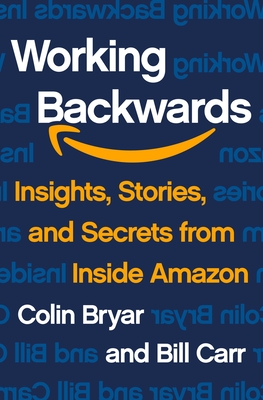
Working Backwards is an insider's breakdown of Amazon's approach to culture, leadership, and best practices from two long-time, top-level Amazon executives.Colin started at Amazon in 1998; Bill joined in 1999. In Working Backwards, these two long-serving Amazon executives reveal and codify the principles and practices that drive the success of one of the most extraordinary companies the world has ever known. With twenty-seven years of Amazon experience between them, much of it in the early aughts—a period of unmatched innovation that brought products and services including Kindle, Amazon Prime, Amazon Studios, and Amazon Web Services to life—Bryar and Carr offer unprecedented access to the Amazon way as it was refined, articulated, and proven to be repeatable, scalable, and adaptable.With keen analysis and practical steps for applying it at your own company—no matter the size—the authors illuminate how Amazon’s fourteen leadership principles inform decision-making at all levels and reveal how the company’s culture has been defined by four characteristics: customer obsession, long-term thinking, eagerness to invent, and operational excellence. Bryar and Carr explain the set of ground-level practices that ensure these are translated into action and flow through all aspects of the business.Working Backwards is a practical guidebook and a corporate narrative, filled with the authors’ in-the-room recollections of what “Being Amazonian” is like and how it has affected their personal and professional lives. They demonstrate that success on Amazon’s scale is not achieved by the genius of any single leader, but rather through commitment to and execution of a set of well-defined, rigorously-executed principles and practices—shared here for the very first time. A Macmillan Audio production from St. Martin's Press

NAMED A BEST BOOK OF 2022 BY THE NEW YORKERNational Bestseller * New York Times Editors’ Choice * Financial Times “Books to Read in 2022”A SABEW BEST IN BUSINESS BOOK AWARDS FINALIST“A gripping account of PayPal’s origins and a vivid portrait of the geeks and contrarians who made its meteoric rise possible” ( The Wall Street Journal )—including Elon Musk, Amy Rowe Klement, Peter Thiel, Julie Anderson, Max Levchin, Reid Hoffman, and many others whose stories have never been shared.Today, PayPal’s founders and earliest employees are considered the technology industry’s most powerful network. Since leaving PayPal, they have formed, funded, and advised the leading companies of our era, including Tesla, Facebook, YouTube, SpaceX, Yelp, Palantir, and LinkedIn, among many others. As a group, they have driven twenty-first-century innovation and entrepreneurship. Their names stir passions; they’re as controversial as they are admired.Yet for all their influence, the story of where they first started has gone largely untold. Before igniting the commercial space race or jumpstarting social media’s rise, they were the unknown creators of a scrappy online payments start-up called PayPal. In building what became one of the world’s foremost companies, they faced bruising competition, internal strife, the emergence of widespread online fraud, and the devastating dot-com bust of the 2000s. Their success was anything but certain.In The The Story of PayPal and the Entrepreneurs Who Shaped Silicon Valley , award-winning author and biographer Jimmy Soni explores PayPal’s turbulent early days. With hundreds of interviews and unprecedented access to thousands of pages of internal material, he shows how the seeds of so much of what shapes our world today—fast-scaling digital start-ups, cashless currency concepts, mobile money transfer—were planted two decades ago. He also reveals the stories of countless individuals who were left out of the front-page features and banner headlines but who were central to PayPal’s success.Described as “an intensely magnetic chronicle” ( The New York Times ) and “engrossing” ( Business Insider ), The Founders is a story of iteration and inventiveness—the products of which have cast a long and powerful shadow over modern life. This narrative illustrates how this rare assemblage of talent came to work together and how their collaboration changed our world forever.

What can you learn from a Silicon Valley legend and a pantheon of iconic leaders? The key to scaling a successful business isn't talent, network or strategy. It's an entrepreneurial mindset - and that mindset can be cultivated.Behind the scenes in Silicon Valley, Reid Hoffman (founder of LinkedIn, investor at Greylock) is a sought-after advisor to heads of companies and heads of state. On his podcast Masters of Scale, he sits down with an all-star list of visionary founders and leaders, digging into the surprising strategies that power their growth. In this book, he draws on their most riveting, revealing stories - as well his own experience as a founder and investor - to distil the counterintuitive secrets behind the most extraordinary success stories of our times.Here, Hoffman teams up with Masters of Scale's executive producers to offer a rare window into the entrepreneurial mind. They share surprising, never-before-told stories from leaders of the world's most iconic companies, including Apple, Nike, Netflix, Spotify, Starbucks, Google, Instagram and Microsoft, as well as the bold, disruptive startups - from 23andMe to TaskRabbit, from the Black List to the Bevel razor - solving the problems of the twenty-first century.Through vivid storytelling and straightforward analysis, Masters of Scale distils their collective insights into a set of counterintuitive principles that anyone can use. How do you find a winning idea and turn it into a scalable venture? What can you learn from a 'squirmy no'? When should you stop listening to your customers? Which fires should you put out right away, and which should you let burn? And can you really make money while making the world a better place? ( Yes. But you have to do the work to keep your profits and values aligned.)Based on more than 100 interviews, and incorporating new material never aired on the podcast, Masters of Scale offers a unique insider's guide, filled with insights, wisdom, and strategies that will inspire you to reimagine how you do business today.

Written for anyone who wants to grow at work—from young grads navigating their first jobs to CEOs deciding whether to sell their company—Build is full of personal stories, practical advice and fascinating insights into some of the most impactful products and people of the 20th century.Each quick 5-20 page entry builds on the previous one, charting Tony’s personal journey from a product designer to a leader, from a startup founder to an executive to a mentor. Tony uses examples that are instantly captivating, like the process of building the very first iPod and iPhone. Every chapter is designed to help readers with a problem they’re facing right now—how to get funding for their startup, whether to quit their job or not, or just how to deal with the jerk in the next cubicle.Tony forged his path to success alongside mentors like Steve Jobs and Bill Campbell, icons of Silicon Valley who succeeded time and time again. But Tony doesn’t follow the Silicon Valley credo that you have to reinvent everything from scratch to make something great. His advice is unorthodox because it’s old school. Because Tony’s learned that human nature doesn’t change. You don’t have to reinvent how you lead and manage—just what you make.

From the inventor of the PalmPilot comes a new and compelling theory of intelligence, brain function, and the future of intelligent machinesJeff Hawkins, the man who created the PalmPilot, Treo smart phone, and other handheld devices, has reshaped our relationship to computers. Now he stands ready to revolutionize both neuroscience and computing in one stroke, with a new understanding of intelligence itself.Hawkins develops a powerful theory of how the human brain works, explaining why computers are not intelligent and how, based on this new theory, we can finally build intelligent machines.The brain is not a computer, but a memory system that stores experiences in a way that reflects the true structure of the world, remembering sequences of events and their nested relationships and making predictions based on those memories. It is this memory-prediction system that forms the basis of intelligence, perception, creativity, and even consciousness.In an engaging style that will captivate audiences from the merely curious to the professional scientist, Hawkins shows how a clear understanding of how the brain works will make it possible for us to build intelligent machines, in silicon, that will exceed our human ability in surprising ways.Written with acclaimed science writer Sandra Blakeslee, On Intelligence promises to completely transfigure the possibilities of the technology age. It is a landmark book in its scope and clarity.

In this book about the darker side of technology's impact on our lives, Alan Cooper begins by explaining that unlike other devices throughout history, computers have a "meta function": an unwanted, unforeseen option that users may accidentally invoke with what they thought was a normal keystroke. Cooper details many of these meta functions to explain his central thesis: programmers need to seriously re-evaluate the many user-hostile concepts deeply embedded within the software development process. Rather than provide users with a straightforward set of options, programmers often pile on the bells and whistles and ignore or de-prioritise lingering bugs. For the average user, increased functionality is a great burden, adding to the recurrent chorus that plays: "computers are hard, mysterious, unwieldy things." (An average user, Cooper asserts, who doesn't think that way or who has memorised all the esoteric commands and now lords it over others, has simply been desensitised by too many years of badly designed software.) Cooper's writing style is often overblown, with a pantheon of cutesy terminology (i.e. "dancing bearware") and insider back-patting. (When presenting software to Bill Gates, he reports that Gates replied: "How did you do that?" to which he writes: "I love stumping Bill!") More seriously, he is also unable to see beyond software development's importance--a sin he accuses programmers of throughout the book. Even with that in mind, the central questions Cooper asks are too important to ignore: Are we making users happier? Are we improving the process by which they get work done? Are we making their work hours more effective? Cooper looks to programmers, business managers and what he calls "interaction designers" to question current assumptions and mindsets. Plainly, he asserts that the goal of computer usage should be "not to make anyone feel stupid." Our distance from that goal reinforces the need to rethink entrenched priorities in software planning. -- Jennifer Buckendorff, Amazon.com

In Medieval Technology and Social Change, Lynn White considers the effects of technological innovation on the societies of medieval Europe: the slow collapse of feudalism with the development of machines and tools that introduced factories in place of cottage industries, and the development of the manorial system with the introduction of new kinds of plows and new methods of crop rotation. One invention of particular import, writes White, was the stirrup, which in turn introduced heavy, long-range cavalry to the medieval battlefield. The development thus escalated small-scale conflict to "shock combat." Cannons and flamethrowers followed, as did more peaceful inventions, such as watermills and reapers.

Examines the effects of rapid industrial and technological changes upon the individual, the family, and society.

In the final decades of the nineteenth century, three brilliant and visionary titans of America’s Gilded Age—Thomas Edison, Nikola Tesla, and George Westinghouse—battled bitterly as each vied to create a vast and powerful electrical empire. In Empires of Light , historian Jill Jonnes portrays this extraordinary trio and their riveting and ruthless world of cutting-edge science, invention, intrigue, money, death, and hard-eyed Wall Street millionaires. At the heart of the story are Thomas Alva Edison, the nation’s most famous and folksy inventor, creator of the incandescent light bulb and mastermind of the world’s first direct current electrical light networks; the Serbian wizard of invention Nikola Tesla, elegant, highly eccentric, a dreamer who revolutionized the generation and delivery of electricity; and the charismatic George Westinghouse, Pittsburgh inventor and tough corporate entrepreneur, an industrial idealist who in the era of gaslight imagined a world powered by cheap and plentiful electricity and worked heart and soul to create it.Edison struggled to introduce his radical new direct current (DC) technology into the hurly-burly of New York City as Tesla and Westinghouse challenged his dominance with their alternating current (AC), thus setting the stage for one of the eeriest feuds in American corporate history, the War of the Electric Currents. The battlegrounds: Wall Street, the 1893 Chicago World’s Fair, Niagara Falls, and, finally, the death chamber—Jonnes takes us on the tense walk down a prison hallway and into the sunlit room where William Kemmler, convicted ax murderer, became the first man to die in the electric chair.Empires of Light is the gripping history of electricity, the “mysterious fluid,” and how the fateful collision of Edison, Tesla, and Westinghouse left the world utterly transformed.

Highly effective thinking is an art that engineers and scientists can be taught to develop. By presenting actual experiences and analyzing them as they are described, the author conveys the developmental thought processes employed and shows a style of thinking that leads to successful results is something that can be learned. Along with spectacular successes, the author also conveys how failures contributed to shaping the thought processes.Provides the reader with a style of thinking that will enhance a person's ability to function as a problem-solver of complex technical issues. Consists of a collection of stories about the author's participation in significant discoveries, relating how those discoveries came about and, most importantly, provides analysis about the thought processes and reasoning that took place as the author and his associates progressed through engineering problems.

A study of the evolution of the modern computer profiles the work of MIT psychologist J. C. R. Licklider, whose visionary dream of a human-computer symbiosis transformed the course of modern science and led to the development of the personal computer. Reprint.

Structure and Interpretation of Computer Programs has had a dramatic impact on computer science curricula over the past decade. This long-awaited revision contains changes throughout the text. There are new implementations of most of the major programming systems in the book, including the interpreters and compilers, and the authors have incorporated many small changes that reflect their experience teaching the course at MIT since the first edition was published. A new theme has been introduced that emphasizes the central role played by different approaches to dealing with time in computational models: objects with state, concurrent programming, functional programming and lazy evaluation, and nondeterministic programming. There are new example sections on higher-order procedures in graphics and on applications of stream processing in numerical programming, and many new exercises. In addition, all the programs have been reworked to run in any Scheme implementation that adheres to the IEEE standard.

The computer revolution brought with it new methods of getting work done—just look at today's news for reports of hard-driven, highly-motivated young software and online commerce developers who sacrifice evenings and weekends to meet impossible deadlines. Tracy Kidder got a preview of this world in the late 1970s when he observed the engineers of Data General design and build a new 32-bit minicomputer in just one year. His thoughtful, prescient book, The Soul of a New Machine, tells stories of 35-year-old "veteran" engineers hiring recent college graduates and encouraging them to work harder and faster on complex and difficult projects, exploiting the youngsters' ignorance of normal scheduling processes while engendering a new kind of work ethic.These days, we are used to the "total commitment" philosophy of managing technical creation, but Kidder was surprised and even a little alarmed at the obsessions and compulsions he found. From in-house political struggles to workers being permitted to tease management to marathon 24-hour work sessions, The Soul of a New Machine explores concepts that already seem familiar, even old-hat, less than 20 years later. Kidder plainly admires his subjects; while he admits to hopeless confusion about their work, he finds their dedication heroic. The reader wonders, though, what will become of it all, now and in the future. —Rob Lightner

Longitude is the dramatic human story of an epic scientific quest. The "longitude problem" was the thorniest dilemma of the eighteenth century. Lacking the ability to measure longitude, sailors throughout the great ages of exploration had been literally lost at sea.At the heart of Dava Sobel's fascinating brief history of astronomy, navigation and horology stands the figure of John Harrison, self-taught Yorkshire clockmaker, and his forty-year obsession with building the perfect timekeeper. Battling against the establishment, Harrison stood alone in pursuit of his solution and the £20,000 reward offered by Parliament.

Here's something you may not know about today's Internet. Simply by designing your product the right way, you can build a flourishing business from scratch. No advertising or marketing budget, no need for a sales force, and venture capitalists will flock to throw money at you. Many of the most successful Web 2.0 companies, including MySpace, YouTube, eBay, and rising stars like Twitter and Flickr, are prime examples of what journalist Adam L. Penenberg calls a "viral loop"--to use it, you have to spread it. After all, what's the sense of being on Facebook if none of your friends are? The result: Never before has there been the potential to create wealth this fast, on this scale, and starting with so little. In this game-changing must-read, Penenberg tells the fascinating story of the entrepreneurs who first harnessed the unprecedented potential of viral loops to create the successful online businesses--some worth billions of dollars--that we have all grown to rely on. The trick is that they created something people really want, so much so that their customers happily spread the word about their product for them. All kinds of businesses--from the smallest start-ups to nonprofit organizations to the biggest multinational corporations--can use the paradigm-busting power of viral loops to enable their business through technology. Viral Loop is a must-read for any entrepreneur or business interested in uncorking viral loops to benefit their bottom line.

“Is Google making us stupid?” When Nicholas Carr posed that question, in a celebrated Atlantic Monthly cover story, he tapped into a well of anxiety about how the Internet is changing us. He also crystallized one of the most important debates of our time: As we enjoy the Net’s bounties, are we sacrificing our ability to read and think deeply?Now, Carr expands his argument into the most compelling exploration of the Internet’s intellectual and cultural consequences yet published. As he describes how human thought has been shaped through the centuries by “tools of the mind”—from the alphabet to maps, to the printing press, the clock, and the computer—Carr interweaves a fascinating account of recent discoveries in neuroscience by such pioneers as Michael Merzenich and Eric Kandel. Our brains, the historical and scientific evidence reveals, change in response to our experiences. The technologies we use to find, store, and share information can literally reroute our neural pathways.Building on the insights of thinkers from Plato to McLuhan, Carr makes a convincing case that every information technology carries an intellectual ethic—a set of assumptions about the nature of knowledge and intelligence. He explains how the printed book served to focus our attention, promoting deep and creative thought. In stark contrast, the Internet encourages the rapid, distracted sampling of small bits of information from many sources. Its ethic is that of the industrialist, an ethic of speed and efficiency, of optimized production and consumption—and now the Net is remaking us in its own image. We are becoming ever more adept at scanning and skimming, but what we are losing is our capacity for concentration, contemplation, and reflection.Part intellectual history, part popular science, and part cultural criticism, The Shallows sparkles with memorable vignettes—Friedrich Nietzsche wrestling with a typewriter, Sigmund Freud dissecting the brains of sea creatures, Nathaniel Hawthorne contemplating the thunderous approach of a steam locomotive—even as it plumbs profound questions about the state of our modern psyche. This is a book that will forever alter the way we think about media and our minds.

Imagine, if you can, the world in the year 2100.In Physics of the Future, Michio Kaku—the New York Times bestselling author of Physics of the Impossible—gives us a stunning, provocative, and exhilarating vision of the coming century based on interviews with over three hundred of the world's top scientists who are already inventing the future in their labs. The result is the most authoritative and scientifically accurate description of the revolutionary developments taking place in medicine, computers, artificial intelligence, nanotechnology, energy production, and astronautics.In all likelihood, by 2100 we will control computers via tiny brain sensors and, like magicians, move objects around with the power of our minds. Artificial intelligence will be dispersed throughout the environment, and Internet-enabled contact lenses will allow us to access the world's information base or conjure up any image we desire in the blink of an eye.Meanwhile, cars will drive themselves using GPS, and if room-temperature superconductors are discovered, vehicles will effortlessly fly on a cushion of air, coasting on powerful magnetic fields and ushering in the age of magnetism.Using molecular medicine, scientists will be able to grow almost every organ of the body and cure genetic diseases. Millions of tiny DNA sensors and nanoparticles patrolling our blood cells will silently scan our bodies for the first sign of illness, while rapid advances in genetic research will enable us to slow down or maybe even reverse the aging process, allowing human life spans to increase dramatically.In space, radically new ships—needle-sized vessels using laser propulsion—could replace the expensive chemical rockets of today and perhaps visit nearby stars. Advances in nanotechnology may lead to the fabled space elevator, which would propel humans hundreds of miles above the earth's atmosphere at the push of a button.But these astonishing revelations are only the tip of the iceberg. Kaku also discusses emotional robots, antimatter rockets, X-ray vision, and the ability to create new life-forms, and he considers the development of the world economy. He addresses the key questions: Who are the winner and losers of the future? Who will have jobs, and which nations will prosper?All the while, Kaku illuminates the rigorous scientific principles, examining the rate at which certain technologies are likely to mature, how far they can advance, and what their ultimate limitations and hazards are. Synthesizing a vast amount of information to construct an exciting look at the years leading up to 2100, Physics of the Future is a thrilling, wondrous ride through the next 100 years of breathtaking scientific revolution. (From the Hardcover Edition)(Duration: 15:39:15)

In as little as a decade, artificial intelligence could match, then surpass human intelligence. Corporations & government agencies around the world are pouring billions into achieving AI’s Holy Grail—human-level intelligence. Once AI has attained it, scientists argue, it will have survival drives much like our own. We may be forced to compete with a rival more cunning, more powerful & more alien than we can imagine. Thru profiles of tech visionaries, industry watchdogs & groundbreaking AI systems, James Barrat's Our Final Invention explores the perils of the heedless pursuit of advanced AI. Until now, human intelligence has had no rival. Can we coexist with beings whose intelligence dwarfs our own? Will they allow us to?

The “work from home” phenomenon is thoroughly explored in this illuminating new book from bestselling 37signals founders Fried and Hansson, who point to the surging trend of employees working from home (and anywhere else) and explain the challenges and unexpected benefits. Most important, they show why – with a few controversial exceptions such as Yahoo -- more businesses will want to promote this new model of getting things done.The Industrial Revolution's "under one roof" model of conducting work is steadily declining owing to technology that is rapidly creating virtual workspaces and allowing workers to provide their vital contribution without physically clustering together. Today, the new paradigm is "move work to the workers, rather than workers to the workplace." According to Reuters, one in five global workers telecommutes frequently and nearly ten percent work from home every day. Moms in particular will welcome this trend. A full 60% wish they had a flexible work option. But companies see advantages too in the way remote work increases their talent pool, reduces turnover, lessens their real estate footprint, and improves the ability to conduct business across multiple time zones, to name just a few advantages. In Remote, inconoclastic authors Fried and Hansson will convince readers that letting all or part of work teams function remotely is a great idea--and they're going to show precisely how a remote work setup can be accomplished.

An adventure deep inside the everyday materials that surround us, packed with surprising stories and fascinating science. Why is glass see-through? What makes elastic stretchy? Why does a paper clip bend? Why does any material look and behave the way it does? These are the sorts of questions that Mark Miodownik a globally-renowned materials scientist has spent his life exploring In this book he examines the materials he encounters in a typical morning, from the steel in his razor and the graphite in his pencil to the foam in his sneakers and the concrete in a nearby skyscraper.

Comment un groupe de hackers, de génies et de geeks a créé la révolution numériqueL’auteur de la biographie magistrale de Steve Jobs parue quelques mois après la mort du patron d’Apple et aujourd’hui adaptée au cinéma nous livre un nouveau travail monumental et unique.Depuis le milieu du XIXe siècle et jusqu’à nos jours, Walter Isaacson dresse l’histoire des premières machines, de la naissance de l’ordinateur jusqu’à l’explosion de l’ère numérique. Une formidable saga qui met en scène des hommes et des femmes de génie, des intuitions spectaculaires, des aventures industrielles totalement hors du commun.De la vision d’Ada Lovelace – fille de Byron – qui fut la première à imaginer que les calculatrices deviendraient des ordinateurs multitâches, aux nouvelles réflexions vertigineuses des créateurs de Google, Walter Isaacson nous offre la plus stimulante galerie de portraits. L’aventure numérique n’est pas uniquement associée à l’inventivité de quelques génies – c’est une aventure collective faite de centaines d’étapes, chacune associée à la créativité d’une équipe. Comment fonctionnaient leurs esprits, quel terrain économique et social les a rendus si inventifs, qui furent les pionniers de la programmation, des circuits intégrés, d’internet, du web… quelles idées ont inspiré des personnalités aussi fascinantes, que John Von Neumann, Alan Turing, Robert Noyce, Steve Jobs, Larry Page…À partir d’un travail de recherche colossal, d’interviews avec les grands acteurs encore vivants, d’une réflexion puissante et originale sur cette révolution en marche, Walter Isaacson fait vivre avec force l’histoire de ces bâtisseurs d’un nouveau monde.

Most startups end in failure.Almost every failed startup has a product. What failed startups don't have are enough customers.Founders and employees fail to spend time thinking about (and working on) traction in the same way they work on building a product. This shortsighted approach has startups trying random tactics - some ads, a blog post or two - in an unstructured way that's guaranteed to fail. This book changes that. Traction Book provides startup founders and employees with the framework successful companies have used to get traction. It allows you to think about which marketing channels make sense for you, given your industry and company stage. This framework has been used by founders like Jimmy Wales (Wikipedia), Alexis Ohanian (Reddit), Paul English (Kayak.com), and Alex Pachikov (Evernote) to build some of the biggest companies and organizations in the world. We interviewed each of the above founders - along with 35+ others - and pulled out the repeatable tactics and strategies they used to get traction. We then cover every possible marketing channel you can use to get traction, and show you which channels will be your key to growth. This book shows you how to grow at a time when getting traction is more important than ever. Below are the channels we cover in the book:Viral Marketing Public Relations (PR) Unconventional PR Search Engine Marketing (SEM) Social and Display Ads Offline Ads Search Engine Optimization (SEO) Content Marketing Email Marketing Engineering as Marketing Target Market Blogs Business Development (BD) Sales Affiliate Programs Existing Platforms Trade Shows Offline Events Speaking Engagements Community BuildingThis book draws on interviews with the following individuals: Jimmy Wales, Co-founder of Wikipedia Alexis Ohanian, Co-founder of reddit Eric Ries, Author of The Lean Startup Rand Fishkin, Founder of SEOmoz Noah Kagan, Founder of AppSumo Patrick McKenzie, CEO of Bingo Card Creator Sam Yagan, Co-founder of OkCupid Andrew Chen, Investor at 500 Startups Justin Kan, Founder of Justin.tv Mark Cramer, CEO of SurfCanyon Colin Nederkoorn, CEO of Customer.io Jason Cohen, Founder of WP Engine Chris Fralic, Partner at First Round Paul English, CEO of Kayak.com Rob Walling, Founder of MicroConf Brian Riley, Co-founder of SlidePad Steve Welch, Co-founder of DreamIt Jason Kincaid, Blogger at TechCrunch Nikhil Sethi, Founder of Adaptly Rick Perreault, CEO of Unbounce Alex Pachikov, Co-founder of Evernote David Skok, Partner at Matrix Ashish Kundra, CEO of myZamana David Hauser, Founder of Grasshopper Matt Monahan, CEO of Inflection Jeff Atwood, Co-founder of Discourse Dan Martell, CEO of Clarity.fm Chris McCann, Founder of StartupDigest Ryan Holiday, Exec at American Apparel Todd Vollmer, Enterprise Sales Veteran Sandi MacPherson, Founder of Quibb Andrew Warner, Founder of Mixergy Sean Murphy, Founder of SKMurphy Satish Dharmaraj, Partner at Redpoint Garry Tan, Partner at Y Combinator Steve Barsh, CEO of Packlate Michael Bodekaer, Co-founder of Smart Launch Zack Linford, Founder of Optimozo

From the visionary head of Google's innovative People Operations comes a groundbreaking inquiry into the philosophy of work-and a blueprint for attracting the most spectacular talent to your business and ensuring that they succeed. "We spend more time working than doing anything else in life. It's not right that the experience of work should be so demotivating and dehumanizing." So says Laszlo Bock, head of People Operations at the company that transformed how the world interacts with knowledge. This insight is the heart of WORK RULES!, a compelling and surprisingly playful manifesto that offers lessons including:Take away managers' power over employeesLearn from your best employees-and your worstHire only people who are smarter than you are, no matter how long it takes to find themPay unfairly (it's more fair!)Don't trust your gut: Use data to predict and shape the futureDefault to open-be transparent and welcome feedbackIf you're comfortable with the amount of freedom you've given your employees, you haven't gone far enough. Drawing on the latest research in behavioral economics and a profound grasp of human psychology, WORK RULES! also provides teaching examples from a range of industries-including lauded companies that happen to be hideous places to work and little-known companies that achieve spectacular results by valuing and listening to their employees. Bock takes us inside one of history's most explosively successful businesses to reveal why Google is consistently rated one of the best places to work in the world, distilling 15 years of intensive worker R&D into principles that are easy to put into action, whether you're a team of one or a team of thousands. WORK RULES! shows how to strike a balance between creativity and structure, leading to success you can measure in quality of life as well as market share. Read it to build a better company from within rather than from above; read it to reawaken your joy in what you do.

Both Eric Schmidt and Jonathan Rosenberg came to Google as seasoned Silicon Valley business executives, but over the course of a decade they came to see the wisdom in Coach John Wooden's observation that 'it's what you learn after you know it all that counts'. As they helped grow Google from a young start-up to a global icon, they relearned everything they knew about management. How Google Works is the sum of those experiences distilled into a fun, easy-to-read primer on corporate culture, strategy, talent, decision-making, communication, innovation, and dealing with disruption.The authors explain how the confluence of three seismic changes - the internet, mobile, and cloud computing - has shifted the balance of power from companies to consumers. The companies that will thrive in this ever-changing landscape will be the ones that create superior products and attract a new breed of multifaceted employees whom the authors dub 'smart creatives'. The management maxims ('Consensus requires dissension', 'Exile knaves but fight for divas', 'Think 10X, not 10%') are illustrated with previously unreported anecdotes from Google's corporate history.'Back in 2010, Eric and I created an internal class for Google managers,' says Rosenberg. 'The class slides all read 'Google confidential' until an employee suggested we uphold the spirit of openness and share them with the world. This book codifies the recipe for our secret sauce: how Google innovates and how it empowers employees to succeed.'

THE BASIS FOR IFC FILMS' BLACKBERRYNamed a Best Business Book by The Wall Street Journal, Forbes, Financial Times, and more The riveting, true story of the BlackBerry empire—and how it would eventually come crumbling down in the wake of the smartphone revolution"One helluva story.” ―Toronto StarLosing the Signal is a riveting story of a company that toppled global giants before succumbing to the ruthlessly competitive forces of Silicon Valley. This is not a conventional tale of modern business failure by fraud and greed. The rise and fall of BlackBerry reveals the dangerous speed at which innovators race along the information superhighway. With unprecedented access to key players, senior executives, directors and competitors, Losing the Signal unveils the remarkable rise of a company that started above a bagel store in Ontario. At the heart of the story is an unlikely partnership between a visionary engineer, Mike Lazaridis, and an abrasive Harvard Business school grad, Jim Balsillie. Together, they engineered a pioneering pocket email device that became the tool of choice for presidents and CEOs. The partnership enjoyed only a brief moment on top of the world, however. At the very moment BlackBerry was ranked the world's fastest growing company internal feuds and chaotic growth crippled the company as it faced its gravest Apple and Google's entry in to mobile phones. Expertly told by acclaimed journalists, Jacquie McNish and Sean Silcoff, this is an entertaining, whirlwind narrative that goes behind the scenes to reveal one of the most compelling business stories of the new century.

Endless terror. Refugee waves. An unfixable global economy. Surprising election results. New billion-dollar fortunes. Miracle medical advances. What if they were all connected? What if you could understand why?The Seventh Sense is the story of what all of today's successful figures see and the forces that are invisible to most of us but explain everything from explosive technological change to uneasy political ripples. The secret to power now is understanding our new age of networks. Not merely the Internet, but also webs of trade, finance, and even DNA. Based on his years of advising generals, CEOs, and politicians, Ramo takes us into the opaque heart of our world's rapidly connected systems and teaches us what the losers are not yet seeing -- and what the victors of this age already know.

This is the remarkable behind-the-scenes story of the creation and growth of Airbnb, the online lodging platform that has become, in under a decade, the largest provider of accommodations in the world. At first just the wacky idea of cofounders Brian Chesky, Joe Gebbia, and Nathan Blecharczyk, Airbnb has disrupted the $500 billion hotel industry, and its $30 billion valuation is now larger than that of Hilton and close to that of Marriott. Airbnb is beloved by the millions of members in its “host” community and the travelers they shelter every night. And yet, even as the company has blazed such an unexpected path, this is the first book solely dedicated to the phenomenon of Airbnb.Fortune editor Leigh Gallagher explores the success of Airbnb along with the more controversial side of its story. Regulators want to curb its rapid expansion; hotel industry leaders wrestle with the disruption it has caused them; and residents and customers alike struggle with the unintended consequences of opening up private homes for public consumption. This is also the first in‑depth study of Airbnb's leader, Brian Chesky, the quirky and curious young CEO, as he steers the company into new markets and increasingly uncharted waters.

A rallying cry for working mothers everywhere that demolishes the "distracted, emotional, weak" stereotype and definitively shows that these professionals are more focused, decisive, and stronger than any other force.Working mothers aren’t a liability. They are assets you—and every manager and executive—want in your company, in your investment portfolio, and in your corner.There is copious academic research showing the benefits of working mothers on families and the benefits to companies who give women longer and more flexible parental leave. There are even findings that demonstrate women with multiple children actually perform better at work than those with none or one.Yet despite this concrete proof that working mothers are a lucrative asset, they still face the "Maternal Wall"—widespread unconscious bias about their abilities, contributions, and commitment. Nearly eighty percent of women are less likely to be hired if they have children—and are half as likely to be promoted. Mothers earn an average $11,000 less in salary and are held to higher punctuality and performance standards. Forty percent of Silicon Valley women said they felt the need to speak less about their family to be taken more seriously. Many have been told that having a second child would cost them a promotion.Fortunately, this prejudice is slowly giving way to new attitudes, thanks to more women starting their own businesses, and companies like Netflix, Facebook, Apple, and Google implementing more parent-friendly policies. But the most important barrier to change isn’t about men. Women must rethink the way they see themselves after giving birth. As entrepreneur Sarah Lacy makes clear in this cogent, persuasive analysis and clarion cry, the strongest, most lucrative, and most ambitious time of a woman’s career may easily be after she sees a plus sign on a pregnancy test.

The narrative of the Silicon Valley generation that launched five major high-tech industries in seven years, laying the foundation for today’s technology-driven world.At a time when the five most valuable companies on the planet are high-tech firms and nearly half of Americans say they cannot live without their cell phones, Troublemakers reveals the untold story of how we got here. This is the gripping tale of seven exceptional men and women, pioneers of Silicon Valley in the 1970s and early 1980s. Together, they worked across generations, industries, and companies to bring technology from Pentagon offices and university laboratories to the rest of us. In doing so, they changed the world. In Troublemakers, historian Leslie Berlin introduces the people and stories behind the birth of the Internet and the microprocessor, as well as Apple, Atari, Genentech, Xerox PARC, ROLM, ASK, and the iconic venture capital firms Sequoia Capital and Kleiner Perkins Caufield & Byers. In the space of only seven years and thirty-five miles, five major industries—personal computing, video games, biotechnology, modern venture capital, and advanced semiconductor logic—were born.During these same years, the first ARPANET transmission came into a Stanford lab, the university began licensing faculty innovations to businesses, and the Silicon Valley tech community began mobilizing to develop the lobbying clout and influence that have become critical components of modern American politics. In other words, these were the years when one of the most powerful pillars of our modern innovation and political systems was first erected.Featured among well-known Silicon Valley innovators like Steve Jobs, Regis McKenna, Larry Ellison, and Don Valentine are Mike Markkula, the underappreciated chairman of Apple who owned one-third of the company; Bob Taylor, who kick-started the Arpanet and masterminded the personal computer; software entrepreneur Sandra Kurtzig, the first woman to take a technology company public; Bob Swanson, the cofounder of Genentech; Al Alcorn, the Atari engineer behind the first wildly successful video game; Fawn Alvarez, who rose from an assembler on a factory line to the executive suite; and Niels Reimers, the Stanford administrator who changed how university innovations reach the public. Together, these troublemakers rewrote the rules and invented the future.

A Turing Award-winning computer scientist and statistician shows how understanding causality has revolutionized science and will revolutionize artificial intelligence"Correlation is not causation." This mantra, chanted by scientists for more than a century, has led to a virtual prohibition on causal talk. Today, that taboo is dead. The causal revolution, instigated by Judea Pearl and his colleagues, has cut through a century of confusion and established causality -- the study of cause and effect -- on a firm scientific basis. His work explains how we can know easy things, like whether it was rain or a sprinkler that made a sidewalk wet; and how to answer hard questions, like whether a drug cured an illness. Pearl's work enables us to know not just whether one thing causes another: it lets us explore the world that is and the worlds that could have been. It shows us the essence of human thought and key to artificial intelligence. Anyone who wants to understand either needs The Book of Why .

Bitcoin is the newest technology for money—find out how it fits in the future.Bitcoin is the digital age's novel, decentralized, and automated solution to the problem of money: accessible worldwide, controlled by nobody. Can this young upstart money challenge the global monetary order? Economist Saifedean Ammous traces the history of the technologies of money to seashells, limestones, cattle, salt, beads, metals, and government debt, explaining what gave these technologies their monetary role, what makes for sound money, and the benefits of a sound monetary regime to economic growth, innovation, culture, trade, individual freedom, and international peace.The monetary and historical analysis sets the stage for understanding the mechanics of the operation of Bitcoin, the reasons for its initial success, and the role it could play in an information economy. Rather than serving as a currency and network for consumer purchases, the author argues Bitcoin is better suited as a store of value and network for settlement between large financial institutions. With an automated and perfectly predictable monetary policy, and the ability to perform final settlement of large sums across the world in a matter of minutes, Bitcoin's true importance may just lie in providing a decentralized, neutral, free-market alternative to national central banks.

A Science Friday pick for book of the year, 2019One of America's top doctors reveals how AI will empower physicians and revolutionize patient care Medicine has become inhuman, to disastrous effect. The doctor-patient relationship--the heart of medicine--is doctors are too distracted and overwhelmed to truly connect with their patients, and medical errors and misdiagnoses abound. In Deep Medicine, leading physician Eric Topol reveals how artificial intelligence can help. AI has the potential to transform everything doctors do, from notetaking and medical scans to diagnosis and treatment, greatly cutting down the cost of medicine and reducing human mortality. By freeing physicians from the tasks that interfere with human connection, AI will create space for the real healing that takes place between a doctor who can listen and a patient who needs to be heard.Innovative, provocative, and hopeful, Deep Medicine shows us how the awesome power of AI can make medicine better, for all the humans involved.

Minimalism is the art of knowing how much is just enough. Digital minimalism applies this idea to our personal technology. It's the key to living a focused life in an increasingly noisy world.In this timely and enlightening book, the bestselling author of Deep Work introduces a philosophy for technology use that has already improved countless lives.Digital minimalists are all around us. They're the calm, happy people who can hold long conversations without furtive glances at their phones. They can get lost in a good book, a woodworking project, or a leisurely morning run. They can have fun with friends and family without the obsessive urge to document the experience. They stay informed about the news of the day, but don't feel overwhelmed by it. They don't experience "fear of missing out" because they already know which activities provide them meaning and satisfaction.Now, Newport gives us a name for this quiet movement, and makes a persuasive case for its urgency in our tech-saturated world. Common sense tips, like turning off notifications, or occasional rituals like observing a digital sabbath, don't go far enough in helping us take back control of our technological lives, and attempts to unplug completely are complicated by the demands of family, friends and work. What we need instead is a thoughtful method to decide what tools to use, for what purposes, and under what conditions.Drawing on a diverse array of real-life examples, from Amish farmers to harried parents to Silicon Valley programmers, Newport identifies the common practices of digital minimalists and the ideas that underpin them. He shows how digital minimalists are rethinking their relationship to social media, rediscovering the pleasures of the offline world, and reconnecting with their inner selves through regular periods of solitude. He then shares strategies for integrating these practices into your life, starting with a thirty-day "digital declutter" process that has already helped thousands feel less overwhelmed and more in control.Technology is intrinsically neither good nor bad. The key is using it to support your goals and values, rather than letting it use you. This book shows the way.

When the technologies we use every day collapse our experiences into 24/7 availability, platforms for personal branding, and products to be monetized, nothing can be quite so radical as… doing nothing. Here, Jenny Odell sends up a flare from the heart of Silicon Valley, delivering an action plan to resist capitalist narratives of productivity and techno-determinism, and to become more meaningfully connected in the process.

Innovation is the main event of the modern age, the reason we experience both dramatic improvements in our living standards and unsettling changes in our society. Forget short-term symptoms like Donald Trump and Brexit, it is innovation itself that explains them and that will itself shape the 21st century for good and ill. Yet innovation remains a mysterious process, poorly understood by policy makers and businessmen, hard to summon into existence to order, yet inevitable and inexorable when it does happen.Matt Ridley argues in this book that we need to change the way we think about innovation, to see it as an incremental, bottom-up, fortuitous process that happens to society as a direct result of the human habit of exchange, rather than an orderly, top-down process developing according to a plan. Innovation is crucially different from invention, because it is the turning of inventions into things of practical and affordable use to people. It speeds up in some sectors and slows down in others. It is always a collective, collaborative phenomenon, not a matter of lonely genius. It is gradual, serendipitous, recombinant, inexorable, contagious, experimental and unpredictable. It happens mainly in just a few parts of the world at any one time. It still cannot be modelled properly by economists, but it can easily be discouraged by politicians. Far from there being too much innovation, we may be on the brink of an innovation famine.Ridley derives these and other lessons, not with abstract argument, but from telling the lively stories of scores of innovations, how they started and why they succeeded or in some cases failed. He goes back millions of years and leaps forward into the near future. Some of the innovation stories he tells are about steam engines, jet engines, search engines, airships, coffee, potatoes, vaping, vaccines, cuisine, antibiotics, mosquito nets, turbines, propellers, fertiliser, zero, computers, dogs, farming, fire, genetic engineering, gene editing, container shipping, railways, cars, safety rules, wheeled suitcases, mobile phones, corrugated iron, powered flight, chlorinated water, toilets, vacuum cleaners, shale gas, the telegraph, radio, social media, block chain, the sharing economy, artificial intelligence, fake bomb detectors, phantom games consoles, fraudulent blood tests, faddish diets, hyperloop tubes, herbicides, copyright and even – a biological innovation -- life itself.

Edward Snowden, the man who risked everything to expose the US government’s system of mass surveillance, reveals for the first time the story of his life, including how he helped to build that system and what motivated him to try to bring it down.In 2013, twenty-nine-year-old Edward Snowden shocked the world when he broke with the American intelligence establishment and revealed that the United States government was secretly pursuing the means to collect every single phone call, text message, and email. The result would be an unprecedented system of mass surveillance with the ability to pry into the private lives of every person on earth. Six years later, Snowden reveals for the very first time how he helped to build this system and why he was moved to expose it.Spanning the bucolic Beltway suburbs of his childhood and the clandestine CIA and NSA postings of his adulthood, Permanent Record is the extraordinary account of a bright young man who grew up online—a man who became a spy, a whistleblower, and, in exile, the Internet’s conscience. Written with wit, grace, passion, and an unflinching candor, Permanent Record is a crucial memoir of our digital age and destined to be a classic.

This urgent and eye-opening book makes the case that protecting humanity's future is the central challenge of our time.If all goes well, human history is just beginning. Our species could survive for billions of years - enough time to end disease, poverty, and injustice, and to flourish in ways unimaginable today. But this vast future is at risk. With the advent of nuclear weapons, humanity entered a new age, where we face existential catastrophes - those from which we could never come back. Since then, these dangers have only multiplied, from climate change to engineered pathogens and artificial intelligence. If we do not act fast to reach a place of safety, it will soon be too late.Drawing on over a decade of research, The Precipice explores the cutting-edge science behind the risks we face. It puts them in the context of the greater story of humanity: showing how ending these risks is among the most pressing moral issues of our time. And it points the way forward, to the actions and strategies that can safeguard humanity.An Oxford philosopher committed to putting ideas into action, Toby Ord has advised the US National Intelligence Council, the UK Prime Minister's Office, and the World Bank on the biggest questions facing humanity. In The Precipice, he offers a startling reassessment of human history, the future we are failing to protect, and the steps we must take to ensure that our generation is not the last.

Jeff Lawson, software developer turned CEO of Twilio, creates a new playbook for unleashing the full potential of software developers in any organization, showing how to help management utilize this coveted and valuable workforce to enable growth, solve a wide range of business problems and drive digital transformation.From banking and retail to insurance and finance, every industry is turning digital, and every company needs the best software to win the hearts and minds of customers. The landscape has shifted from the classic build vs. buy question, to one of build vs. die. Companies have to get this right to survive. But how do they make this transition?Software developers are sought after, highly paid, and desperately needed to compete in the modern, digital economy. Yet most companies treat them like digital factory workers without really understanding how to unleash their full potential. Lawson argues that developers are the creative workforce who can solve major business problems and create hit products for customers—not just grind through rote tasks. From Google and Amazon, to one-person online software companies—companies that bring software developers in as partners are winning. Lawson shows how leaders who build industry changing software products consistently do three things well. First, they understand why software developers matter more than ever. Second, they understand developers and know how to motivate them. And third, they invest in their developers' success.As a software developer and public company CEO, Lawson uses his unique position to bridge the language and tools executives use with the unique culture of high performing, creative software developers. Ask Your Developer is a toolkit to help business leaders, product managers, technical leaders, software developers, and executives achieve their common goal—building great digital products and experiences.How to compete in the digital economy? In short: Ask Your Developer.

From Neanderthal string to 3D knitting, an “expansive” global history that highlights “how textiles truly changed the world” (Wall Street Journal)The story of humanity is the story of textiles—as old as civilization itself. Since the first thread was spun, the need for textiles has driven technology, business, politics, and culture.In The Fabric of Civilization, Virginia Postrel synthesizes groundbreaking research from archaeology, economics, and science to reveal a surprising history. From Minoans exporting wool colored with precious purple dye to Egypt, to Romans arrayed in costly Chinese silk, the cloth trade paved the crossroads of the ancient world. Textiles funded the Renaissance and the Mughal Empire; they gave us banks and bookkeeping, Michelangelo’s David and the Taj Mahal. The cloth business spread the alphabet and arithmetic, propelled chemical research, and taught people to think in binary code. Assiduously researched and deftly narrated, The Fabric of Civilization tells the story of the world’s most influential commodity.“We are taken on a journey as epic, and varying, as the Silk Road itself.… [The Fabric of Civilization is] like a swatch of a Florentine Renaissance brocade: carefully woven, the technique precise, the colors a mix of shade and shine and an accurate representation of the whole cloth."—New York Times“Textile-making hasn’t gotten enough credit for its own sophistication, and for all the ways it undergirds human technological innovation—an error Virginia Postrel’s erudite and complete book goes a long way toward correcting at last.”—Wired

When Peter Thiel and Max Levchin launched an online payment website in 1999, they hoped their service could improve the lives of millions around the globe. But when their start-up, PayPal, survived the dot.com crash only to find itself besieged by unimaginable challenges, that dream threatened to become a nightmare. PayPal's history - as told by former insider Eric Jackson - is an engrossing study of human struggle and perseverance against overwhelming odds. The entrepreneurs that Thiel and Levchin recruited to overhaul world currency markets first had to face some of the greatest trials ever thrown at a Silicon Valley company before they could make internet history. Business guru Tom Peters, author of In Search of Excellence, called the hardcover edition of The PayPal Wars a real page turner that featured what he called the best description of business strategy unfolding in a world changing at warp speed. The new paperback edition will feature updated material and even more insights on the state of internet commerce.

Straight from the programming trenches, The Pragmatic Programmer cuts through the increasing specialization and technicalities of modern software development to examine the core process--taking a requirement and producing working, maintainable code that delights its users. It covers topics ranging from personal responsibility and career development to architectural techniques for keeping your code flexible and easy to adapt and reuse. Read this book, and you'll learn how toFight software rot; Avoid the trap of duplicating knowledge; Write flexible, dynamic, and adaptable code; Avoid programming by coincidence; Bullet-proof your code with contracts, assertions, and exceptions; Capture real requirements; Test ruthlessly and effectively; Delight your users; Build teams of pragmatic programmers; and Make your developments more precise with automation. Written as a series of self-contained sections and filled with entertaining anecdotes, thoughtful examples, and interesting analogies, The Pragmatic Programmer illustrates the best practices and major pitfalls of many different aspects of software development. Whether you're a new coder, an experienced programmer, or a manager responsible for software projects, use these lessons daily, and you'll quickly see improvements in personal productivity, accuracy, and job satisfaction. You'll learn skills and develop habits and attitudes that form the foundation for long-term success in your career. You'll become a Pragmatic Programmer.

The celebrated design professor here tackles the question of how best to communicate real-life experience in a two-degree format, whether on the printed page or the computer screen. The Whole Earth Review called Envisioning Information a "passionate, elegant revelation."

Few would disagree: Life in the information age can be overwhelming. Through computers, the Internet, the media, and even our daily newspapers, we are awash in a seemingly endless stream of charts, maps, infographics, diagrams, and data. Visual Explanations is a navigational guide through this turbulent sea of information. The book is an essential reference for anyone involved in graphic, web, or multimedia design, as well as for educators and lecturers who use graphics in presentations or classes.Jacket design: Dmitry Krasny.Other artwork by Bonnie Scranton, Dmitry Krasny, and Weilin Wu.

The world's most infamous hacker offers an insider's view of the low-tech threats to high-tech security Kevin Mitnick's exploits as a cyber-desperado and fugitive form one of the most exhaustive FBI manhunts in history and have spawned dozens of articles, books, films, and documentaries. Since his release from federal prison, in 1998, Mitnick has turned his life around and established himself as one of the most sought-after computer security experts worldwide. Now, in The Art of Deception, the world's most notorious hacker gives new meaning to the old adage, "It takes a thief to catch a thief." Focusing on the human factors involved with information security, Mitnick explains why all the firewalls and encryption protocols in the world will never be enough to stop a savvy grifter intent on rifling a corporate database or an irate employee determined to crash a system. With the help of many fascinating true stories of successful attacks on business and government, he illustrates just how susceptible even the most locked-down information systems are to a slick con artist impersonating an IRS agent. Narrating from the points of view of both the attacker and the victims, he explains why each attack was so successful and how it could have been prevented in an engaging and highly readable style reminiscent of a true-crime novel. And, perhaps most importantly, Mitnick offers advice for preventing these types of social engineering hacks through security protocols, training programs, and manuals that address the human element of security.

Demarco and Lister demonstrate that the major issues of software development are human, not technical. Their answers aren't easy--just incredibly successful. New second edition features eight all-new chapters. Softcover. Previous edition: c1987. DLC: Management.

In a 1950 conversation at Los Alamos, four world-class scientists generally agreed, given the size of the Universe, that advanced extraterrestrial civilizations must be present. But one of the four, Enrico Fermi, asked, "If these civilizations do exist, where is everybody?" Given the fact that there are perhaps 400 million stars in our Galaxy alone, and perhaps 400 million galaxies in the Universe, it stands to reason that somewhere out there, in the 14 billion-year-old cosmos, there is or once was a civilization at least as advanced as our own. Webb discusses in detail the 50 most cogent and intriguing solutions to Fermi's famous paradox.

Traces the life and career of the enigmatic former CEO of Intel, drawing on private papers and interviews with his closest friends and associates to discuss such topics as the persecution he survived as a Jewish Hungarian in the 1930s, his relationships with such figures as Gordon Moore and Robert Noyce, and his management talents.

In a business where great risks, huge fortunes, and even bigger egos are common, Larry Ellison stands out as one of the most outspoken, driven, and daring leaders of the software industry. The company he cofounded and runs, Oracle, is the number one business software company. Perhaps even more than Microsoft's, Oracle's products are essential to today's networked world.In Softwar, journalist Matthew Symonds gives readers exclusive and intimate insight into both Oracle and the man who made it and runs it. As well as relating the story of Oracle's often bumpy path to industry dominance, Symonds deals with the private side of Ellison's life. With unlimited insider access granted by Ellison himself, Symonds captures the intensity and, some would say, the recklessness that have made Ellison a legend.With a new and expanded epilogue for the paperback edition that tells the story behind Oracle's epic struggle to win control of PeopleSoft, Softwar is the most complete portrait undertaken of the man and his empire -- a unique and gripping account of both the way the computing industry really works and an extraordinary life.

In eBOYS, Randall Stross takes us behind the scenes and inside the heads of the gutsy entrepreneurs who are financing the hottest businesses on the Web. The six tall men who started Benchmark, Silicon Valley's most exciting venture capital firm, put themselves at the cutting edge of the new economy by backing billion dollar start-ups like eBay and Webvan. The risks were enormous--but the rewards have proven to be staggering. Within two years, eBay's net worth grew from $20 million to more than $21 billion, while each Benchmark founding partner saw his own personal net worth soar by hundreds of millions of dollars.For two roller-coaster years, Stross had total access not only to Benchmark's executives but to the companies they financed. He was a fly on the wall as fortunes were made in an instant, snap decisions got locked in, and new ventures took off--and sometimes crashed. Here are the testosterone-pumped conversations, round-the-clock meetings, and gutsy deals that launched the eBoys and their clients into the stratosphere of mega-wealth. Written like a novel but absolutely true, eBOYS brings to vivid life the glory days of the greatest business adventure of our time.