
Tom DeMarco
Tom DeMarco is the author of fifteen books, including five novels, a collection of short stories and the rest business books. His most recent work is a seemingly jinxed love story, The One-Way Time Traveler. Before that he wrote Dark Harbor House, and before that Slack and Peopleware and The Deadline.
30 Books Written

Peopleware asserts that most software development projects fail because of failures within the team running them. This strikingly clear, direct book is written for software development-team leaders and managers, but it's filled with enough commonsense wisdom to appeal to anyone working in technology. Authors Tom DeMarco and Timothy Lister include plenty of illustrative, often amusing anecdotes; their writing is light, conversational, and filled with equal portions of humor and wisdom, and there is a refreshing absence of "new age" terms and multistep programs. The advice is presented straightforwardly and ranges from simple issues of prioritization to complex ways of engendering harmony and productivity in your team. Peopleware is a short read that delivers more than many books on the subject twice its size.

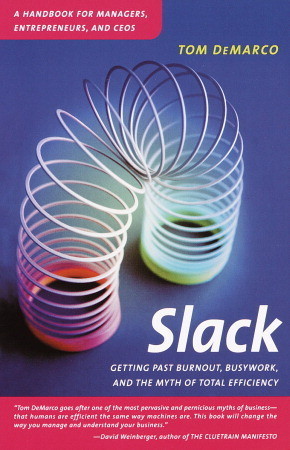
If your company’s goal is to become fast, responsive, and agile, more efficiency is not the answer--you need more slack.Why is it that today’s superefficient organizations are ailing? Tom DeMarco, a leading management consultant to both Fortune 500 and up-and-coming companies, reveals a counterintuitive principle that explains why efficiency efforts can slow a company down. That principle is the value of slack, the degree of freedom in a company that allows it to change. Implementing slack could be as simple as adding an assistant to a department and letting high-priced talent spend less time at the photocopier and more time making key decisions, or it could mean designing workloads that allow people room to think, innovate, and reinvent themselves. It means embracing risk, eliminating fear, and knowing when to go slow. Slack allows for change, fosters creativity, promotes quality, and, above all, produces growth.With an approach that works for new- and old-economy companies alike, this revolutionary handbook debunks commonly held assumptions about real-world management, and gives you and your company a brand-new model for achieving and maintaining true effectiveness.

Any software project that's worth starting will be vulnerable to risk. Since greater risks bring greater rewards, a company that runs away from risk will soon find itself lagging behind its more adventurous competition. By ignoring the threat of negative outcomes—in the name of positive thinking or a Can-Do attitude—software managers drive their organizations into the ground. In Waltzing with Bears, Tom DeMarco and Timothy Lister—the best-selling authors of Peopleware—show readers how to identify and embrace worthwhile risks. Developers are then set free to push the limits. You'll find that risk management * makes aggressive risk-taking possible* protects management from getting blindsided* provides minimum-cost downside protection* reveals invisible transfers of responsibility* isolates the failure of a subproject. Readers are taught to identify the most common risks faced by software projects: * schedule flaws* requirements inflation* turnover* specification breakdown* and under-performance. Packed with provocative insights, real-world examples, and project-saving tips, Waltzing with Bears is your guide to mitigating the risks—before they turn into problems.

Adrenaline Junkies and Template Zombies: Understanding Patterns of Project Behavior
by Tom DeMarco
Rating: 4.0 ⭐
Adrenaline junkies, dead fish, project sluts, true believers, Lewis and Clark, template zombies . . .Most developers, testers, and managers on IT projects are pretty good at recognizing patterns of behavior and gut-level hunches, as in, I sense that this project is headed for disaster.But it has always been more difficult to transform these patterns and hunches into a usable form, something a team can debate, refine, and use. Until now.In Adrenaline Junkies and Template Zombies, the six principal consultants of The Atlantic Systems Guild present the patterns of behavior they most often observe at the dozens of IT firms they transform each year, around the world.The result is a quick-read guide to identifying nearly ninety typical scenarios, drawing on a combined one-hundred-and-fifty years of project management experience. Project by project, you'll improve the accuracy of your hunches and your ability to act on them. The patterns are presented in an easy-reference format, with names designed to ease communication with your teammates. In just a few words, you can describe what's happening on your project. Citing the patterns of behavior can help you quickly move those above and below you to the next step on your project. You'll find classic patterns such as these:* News Improvement* Management By Mood Ring* Piling On* Rattle Yer Dags* Natural Authority* Food++* Fridge Door* and more than eighty more!Not every pattern will be evident in your organization, and not every pattern is necessarily good or bad. However, you'll find many patterns that will apply to your current and future assignments, even in the most ambiguous circumstances. When you assess your situation and follow your next hunch, you'll have the collective wisdom of six world-class consultants at your side.

Welcome to the future. Women are in charge. Of everything.""Thought-provoking and unabashedly erotic." - Harvey Ardman (author of The Final Crossing)"A Handmaid's Tale in reverse."American astronaut John Donegal makes a desperate decision: with his damaged orbiter spinning away from the earth he floods its cabin with liquid nitrogen from the reserve air supply to freeze himself in the hopes of eventual rescue when next passing near the earth, decades or even centuries in the future. His last thoughts before the sleeping pills and cold overtake him are of his lifelong love, Jill. When he is awakened, Donegal finds himself in what is surely a hospital, but seems more like a lavish manor house. He is in the care of two doctors and two nurses, all women. He seems to have been gone for something more than three hundred years. The patriarchy of his past has been replaced by a powerful and aggressive matriarchy. After an initial exuberance at being alive at all, he is overcome with a mounting sense of loss: Jill, has now been dead for centuries. Can he even grieve for someone who has been dead for so long? And yet, in his own frame of reference she was alive only weeks ago. He believes he knows her well enough to be sure of one thing: She would not have let him go off into the unknown future without something from her. There must be a message somewhere waiting for him, a message from Jill. He sets out to find it. The traces of the past are so long forgotten that he begins to lose hope of finding anything about Jill and how the rest of her life played out. He has only a few dreams to sustain him, dreams in which she tries and fails to tell him something. On the brink of defeat, he hears a haunting melody in a fairground, a song one of the performers tells him is "as old as the hills." The words make no sense to him at all, but as he encounters it again and again he comes to suspect that the song is the message, a cryptic love note that has reached out to him across the centuries.

Why Does Software Cost So Much?: And Other Puzzles of the Information Age
by Tom DeMarco
Rating: 3.7 ⭐
dust cover intact. pages unmarked.

This classic book of tools and methods for the analyst brings order and precisions to the specification process as it provides guidance and development of a structured specification. Covers functional decomposition; data dictionary; process specification; system modeling; structured analysis for a future system. Suitable for practicing systems analysts.

Suggests quantitative methods for estimating software development time, describes various system models, and explains how to gather numerical information about a project

The world has gone dark. Nothing works. Cars and trucks and airplanes and guns and bombs are nothing more than paperweights. A mysterious disturbance propagated onto the earth's magnetic field has the effect of inhibiting all explosions. It has repealed most of the twentieth and twenty-first centuries, leaving the world as it was in your great great grandparents' time. The villain (or hero, depending on your perspective) who has made this happen is the physicist Homer Layton. He must be destroyed. And his stupid machine that injects the disturbance must be destroyed. Because as long as it is running there can never be another real war. That is unacceptable. Fortunes of treasure and innovation have been invested in war materiel, all of it now useless. Most people would like to have their cars and computers and televisions working again, but that's not what really matters. What really matters is that governments cannot get on with the business of war. The power elites around the world have determined to track down Layton and his little colony of war opponents and smash them. Then the nuclear war that that was just about to happen when he turned on his damnable machine can finally get started . . .

Bring together a wonderfully varied mix of characters in a once-grand Maine island summer cottage, leave them to their own devices over the course of a long, idyllic summer in the late 1940s, and you have all the ingredients for a fine comedy of manners. Author Tom DeMarco starts with a simple little love story, weaves in tantalizing details of the old mansion's not totally respectable history, and adds a hint of gentle satire to create a novel that is touching, memorable, and deliciously entertaining.

The papers were selected from more than a dozen sources, including IEEE Computer, Software—Practice & Experience, IEEE Transactions on Software Engineering, and Communications of the ACM.

These stories poke fun at college professors and religion, examine the complex mathematics of finding both love and the proverbial needle in a haystack, and deftly probe the boundary between imagination and reality. From a dying man who makes a blanket for himself from his favorite books to a young boy who discovers love in the unlikeliest form, the characters come wonderfully to life.

Book by DeMarco, Tom

The world has gone dark. Nothing works. Cars and trucks and airplanes and guns and bombs are nothing more than paperweights. A mysterious disturbance propagated onto the earth’s magnetic field has the effect of inhibiting all explosions. It has repealed most of the twentieth and twenty-first centuries, leaving the world as it was in your great great grandparents’ time. The villain (or hero, depending on your perspective) who has made this happen is the physicist Homer Layton. He must be destroyed. And his stupid machine that injects the disturbance must be destroyed. Because without it we can never have another real war. This is unacceptable. Fortunes of treasure and innovation have been invested in war materiel, all of it now useless. Most people would like to have their cars and computers and televisions working again, but that’s not what really matters. What really matters is that governments cannot get on with the business of war. The power elites around the world have determined to track down Layton and his little colony of war opponents and smash them. Then the nuclear war that was just about to happen when he turned on his damnable machine can finally get started . . . And now Volume Two: Homer Layton’s young protégé, Loren Martine, is charged with the defense of the Baracoa colony and preservation of the Layton Effect transmitter that has made the world go dark. He knows an attack is imminent, that the colony’s success in defeating the earlier attack will not be so easily repeated. The shadowy Rupert Paule in Washington is determined to pulverize them. His forces will come again, under sail, and Loren’s few sailing vessels will have to be quick to repel them. He sets out to invent a more effective keel to make his boats sail higher and faster. The invention he comes up with is staggering: a variation of the Layton Effect causes a drastic local slowing of the flow of time in one dimension, so a keel which is free to move forward and back and up and down is effectively locked in its plane from side to side. His sailing craft will not slip to windward and they won’t heal over in the wind. To his utter astonishment, he discovers that the keel also works when turned on its side. It is falling, but so slowly as not to be noticed due locally modified time in the vertical dimension. The vertical keel floats in the air like a skyhook. He and his colleagues set out to use the new technology to fashion a fleet of airships. The airships are propelled by wind and held aloft by Layton Effect transmitters. What this changes is only everything. Let the enemy come in their ridiculous old-fashioned ships. Loren will defeat them from above.
![Peopleware( Productive Projects and Teams)[PEOPLEWARE REV/E 3/E][Paperback]](https://m.media-amazon.com/images/S/compressed.photo.goodreads.com/books/1697881596i/148049170.jpg)
Peopleware( Productive Projects and Teams)[PEOPLEWARE REV/E 3/E][Paperback]
by Tom DeMarco
Rating: 4.0 ⭐
Peopleware( Productive Projects and Teams) <> Paperback <> TomDeMarco <> Addison-WesleyProfessional

DAS BETRIEBSKLIMA, DAS SIE SICH WÜNSCHEN //Unser Arbeitsumfeld unterliegt einem stetigen und immer schnelleren Wandel. Manchmal sind die Veränderungen beabsichtigt – wie zum Beispiel mehr selbstorganisierte Teams. Und manchmal werden sie uns aufgezwungen – wie etwa das Home Office. Aber trotz all dieser Veränderungen sind es immer noch Menschen, die zusammenarbeiten müssen und sich dafür ein angenehmes Betriebsklima wünschen.Deshalb ist eine gute Arbeitskultur ein ganz wesentlicher Faktor, denn nur in einem angenehmen Arbeitsklima bleibt der Mitarbeiter motiviert – und somit auch ein nachhaltiger Unternehmenserfolg gesichert.Das Betriebsklima ist wahrscheinlich der am wenigsten durchleuchtete Aspekt in Ihrem Arbeitsumfeld, aber er ist keineswegs undurchschaubar. Dieses Buch zeigt Ihnen, wie die Verbesserung des Betriebsklimas zu einem glücklicheren Arbeitsumfeld führt.Es ermöglicht Ihnen, - das existierende Betriebsklima zu verstehen,- Strukturen aufzudecken und die daraus resultierenden Verhaltensweisen zu begreifen,- unausgesprochene Regeln, die sich vergiftend auf das Betriebsklima auswirken, zu entschlüsseln,- ein ungesundes Betriebsklima so zu verändern, dass Sie und Ihr Umfeld sich wohlfühlen.Die Autoren haben ihre Beobachtungen und Erfahrungen aus Hunderten von Organisationen destilliert und dabei die Einflussfaktoren identifiziert, die ein gutes oder schlechtes Betriebsklima ausmachen. Sie zeigen Ihnen, wie man diese Faktoren wirksam beeinflussen kann, damit Sie und Ihre Kollegen sagen kö»Es macht Spaß, hier zu arbeiten.«Ihr exklusiver E-Book inside beim Kauf des gedruckten Buches


Peopleware: Productive Projects and Teams
by Tom DeMarco
Few books in computing have had as profound an influence on software management as "peopleware". The unique insight of this longtime best seller is that the major issues of software development are human, not technical. They’re not easy issues; but solve them, and you’ll maximize your chances of success.For this third edition, the authors have added six new chapters and updated the text throughout, bringing it in line with today’s development environments and challenges. For example, the audiobook now discusses pathologies of leadership that hadn’t previously been judged to be pathological; an evolving culture of meetings; hybrid teams made up of people from seemingly incompatible generations; and a growing awareness that some of our most common tools are more like anchors than propellers.Anyone who needs to manage a software project or software organization will find invaluable advice throughout the audiobook.

Lucy
by Tom DeMarco
Johnny teve sua vida virada de cabeça pra baixo ao ser acusado de um brutal assassinato. Expulso da faculdade e sem qualquer perspectiva de vida até que seu julgamento seja finalizado, é obrigado a voltar à casa da mãe em San Diego, Califórnia. Nesse retorno, ele acaba conhecendo Lucy, sua vizinha, uma garota de 19 anos e pouco convencional. Lucy, depois de sofrer um grave acidente, sem ânimo e superprotegida pela mãe capacitista, tenta sobreviver um dia de cada vez enquanto luta com seus próprios demônios e inseguranças. Mas tudo muda de foco com a chegada de seu misterioso vizinho, a qual é instigada a satisfazer sua curiosidade sobre o caso. Lucy começa uma inesperada amizade com Johnny, que parece ser o único a tratá-la como alguém digna e capaz. Com o passar dos dias, ambos acabam criando uma forte conexão, mas o que Johnny não sabia era que Lucy é filha de uma das advogadas de acusação.
Structure Analysis and System Specification
by Tom DeMarco
![Hallelujah City [9/1/2007] Tom LaMarr](https://m.media-amazon.com/images/S/compressed.photo.goodreads.com/books/1696976966i/150813387.jpg)
Hallelujah City [9/1/2007] Tom LaMarr
by Tom DeMarco

(Slack) By Tom DeMarco (Author) Paperback on
by Tom DeMarco

Verhaltensweisen, die Ihre Projekte erfolgreich machen oder zum Scheitern verurteilen!Die Mitglieder der Atlantic Systems Guild, Verfasser von Bestsellern wie „Der Termin“, „Happy to Work Here“, „Wien wartet auf Dich!“ und vielen mehr, haben Tausende von Projekten unter die Lupe genommen und beschreiben hier typische Verhaltensweisen – schädliche wie nützliche.Sie zeigen, wie man mit Schönreden, Management nach Gemütslage oder Endlosdebatten Projekte in Schwierigkeiten bringen kann. Dagegen lässt sich die Arbeit der Entwicklungsteams mit Nicht lange schnacken, dem großen Basar, Natürlicher Autorität und – nicht zu vergessen – Essen++ erfolgreich fördern.„Brillant aufschlussreich. In einem Moment denkt ‚Verflixt, ich mache das ... wir sind erledigt‘, gefolgt von der ‚Ich bin nicht der Einzige. Es gibt Hoffnung!‘“Howard Look · Vizepräsident, Software, Pixar Animation Studios„Ein weiteres Meisterwerk von den Leuten, die Peopleware entwickelt haben. Jeder, der schon das eine oder andere Softwareprojekt überlebt hat, wird sicherlich viele dieser Muster wiedererkennen und aus den meisten von ihnen lernen können. Adrenalin-Junkies und Formular-Zombies ist eine wahre Freude.“Joel Spolsky · Autor von „Joel on Software“Ihr exklusiver E-Book inside beim Kauf des gedruckten Buches
ピープルウエア
by Tom DeMarco

品質と生産性を重視したソフトウェア開発プロジェクト技法―見積り・設計・テストの効果的な構造化
by Tom DeMarco

Kōzōka bunseki to shisutemu shiyō
by Tom DeMarco

Demaruko ooini kataru : Sofutōea 24 no hirameki to sae
by Tom DeMarco