Paul Graham
Paul Graham is an essayist, programmer, and programming language designer. In 1995 he developed with Robert Morris the first web-based application, Viaweb, which was acquired by Yahoo in 1998. In 2002 he described a simple statistical spam filter that inspired a new generation of filters. He's currently working on a new programming language called Arc, a new book on startups, and is one of the partners in Y Combinator. Paul is the author of On Lisp (Prentice Hall, 1993), ANSI Common Lisp (Prentice Hall, 1995), and Hackers & Painters (O'Reilly, 2004). He has an AB from Cornell and a PhD in Computer Science from Harvard, and studied painting at RISD and the Accademia di Belle Arti in Florence. Paulgraham.com got 10.6 million page views in 2008.
5 Books Written
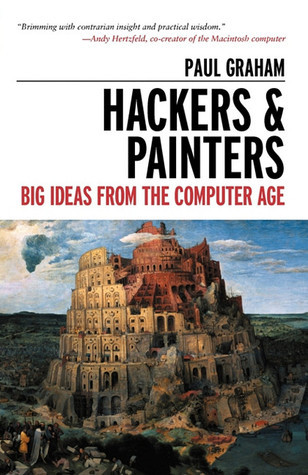
Hackers & Painters: Big Ideas from the Computer Age
by Paul Graham
Rating: 4.2 ⭐
• 14 recommendations ❤️
"The computer world is like an intellectual Wild West, in which you can shoot anyone you wish with your ideas, if you're willing to risk the consequences. " --from Hackers & Big Ideas from the Computer Age , by Paul Graham We are living in the computer age, in a world increasingly designed and engineered by computer programmers and software designers, by people who call themselves hackers. Who are these people, what motivates them, and why should you care? Consider these Everything around us is turning into computers. Your typewriter is gone, replaced by a computer. Your phone has turned into a computer. So has your camera. Soon your TV will. Your car was not only designed on computers, but has more processing power in it than a room-sized mainframe did in 1970. Letters, encyclopedias, newspapers, and even your local store are being replaced by the Internet. Hackers & Big Ideas from the Computer Age , by Paul Graham, explains this world and the motivations of the people who occupy it. In clear, thoughtful prose that draws on illuminating historical examples, Graham takes readers on an unflinching exploration into what he calls "an intellectual Wild West." The ideas discussed in this book will have a powerful and lasting impact on how we think, how we work, how we develop technology, and how we live. Topics include the importance of beauty in software design, how to make wealth, heresy and free speech, the programming language renaissance, the open-source movement, digital design, internet startups, and more.

Starting in the 1980s, Lisp began to be used in several large systems, including Emacs, Autocad, and Interleaf. On Lisp explains the reasons behind Lisp's growing popularity as a mainstream programming language. On Lisp is a comprehensive study of advanced Lisp techniques, with bottom-up programming as the unifying theme. It gives the first complete description of macros and macro applications. The book also covers important subjects related to bottom-up programming, including functional programming, rapid prototyping, interactive development, and embedded languages. The final chapter takes a deeper look at object-oriented programming than previous Lisp books, showing the step-by-step construction of a working model of the Common Lisp Object System (CLOS). As well as an indispensable reference, On Lisp is a source of software. Its examples form a library of functions and macros that readers will be able to use in their own Lisp programs.
ANSI Common Lisp combines an introduction to Lisp programming, and a convenient, up-to-date reference manual for ANSI Common Lisp. Beginners will find that its careful explanations and interesting examples make Lisp programming easy to learn. Professional programmers will appreciate its thorough, practical approach.FEATURES:• An up-to-date reference manual for ANSI Common Lisp.• An in-depth look at object-oriented programming. Explains the Common Lisp Object System (CLOS), and also shows how to write your own object-oriented language.• Over 20 substantial examples, including programs for ray-tracing, text generation, pattern-matching, logical inference, generating HTML, sorting and searching, file I/O, compression, and date arithmetic.• Special attention to critical concepts, including prefix syntax, code vs. data, recursion, functional programming, types, implicit pointers, dynamic allocation, closures, macros, class precedence, and generic functions vs. message-passing.• A complete guide to optimization.• The clearest and most thorough explanation of macros in any introductory book.• Examples that illustrate Lisp programming styles, including rapid prototyping, bottom-up programming, object-oriented programming, and embedded languages.• An appendix on debugging, with examples of common errors.