
Nicholas Carr
Nicholas Carr is the bestselling author of several books on how technology shapes our lives and thoughts, including the Pulitzer Prize finalist The Shallows and the new Superbloom. His other books include The Glass Cage, Utopia Is Creepy, The Big Switch, and Does IT Matter? Former executive editor of the Harvard Business Review, Nick writes for The Atlantic, New York Times, Wall Street Journal, and Wired, among other publications. He lives in Massachusetts.
10 Books Written

The Shallows: What the Internet Is Doing to Our Brains
by Nicholas Carr
Rating: 3.9 ⭐
• 6 recommendations ❤️
“Is Google making us stupid?” When Nicholas Carr posed that question, in a celebrated Atlantic Monthly cover story, he tapped into a well of anxiety about how the Internet is changing us. He also crystallized one of the most important debates of our time: As we enjoy the Net’s bounties, are we sacrificing our ability to read and think deeply?Now, Carr expands his argument into the most compelling exploration of the Internet’s intellectual and cultural consequences yet published. As he describes how human thought has been shaped through the centuries by “tools of the mind”—from the alphabet to maps, to the printing press, the clock, and the computer—Carr interweaves a fascinating account of recent discoveries in neuroscience by such pioneers as Michael Merzenich and Eric Kandel. Our brains, the historical and scientific evidence reveals, change in response to our experiences. The technologies we use to find, store, and share information can literally reroute our neural pathways.Building on the insights of thinkers from Plato to McLuhan, Carr makes a convincing case that every information technology carries an intellectual ethic—a set of assumptions about the nature of knowledge and intelligence. He explains how the printed book served to focus our attention, promoting deep and creative thought. In stark contrast, the Internet encourages the rapid, distracted sampling of small bits of information from many sources. Its ethic is that of the industrialist, an ethic of speed and efficiency, of optimized production and consumption—and now the Net is remaking us in its own image. We are becoming ever more adept at scanning and skimming, but what we are losing is our capacity for concentration, contemplation, and reflection.Part intellectual history, part popular science, and part cultural criticism, The Shallows sparkles with memorable vignettes—Friedrich Nietzsche wrestling with a typewriter, Sigmund Freud dissecting the brains of sea creatures, Nathaniel Hawthorne contemplating the thunderous approach of a steam locomotive—even as it plumbs profound questions about the state of our modern psyche. This is a book that will forever alter the way we think about media and our minds.

The Big Switch: Rewiring the World, from Edison to Google
by Nicholas Carr
Rating: 3.9 ⭐
• 2 recommendations ❤️
The definitive guide to the cloud computing revolution.Hailed as "the most influential book so far on the cloud computing movement" (Christian Science Monitor), The Big Switch makes a simple and profound statement: Computing is turning into a utility, and the effects of this transition will ultimately change society as completely as the advent of cheap electricity did. In a new chapter for this edition that brings the story up-to-date, Nicholas Carr revisits the dramatic new world being conjured from the circuits of the "World Wide Computer."

In The Glass Cage, best-selling author Nicholas Carr digs behind the headlines about factory robots and self-driving cars, wearable computers and digitized medicine, as he explores the hidden costs of granting software dominion over our work and our leisure. Even as they bring ease to our lives, these programs are stealing something essential from us.Drawing on psychological and neurological studies that underscore how tightly people’s happiness and satisfaction are tied to performing hard work in the real world, Carr reveals something we already suspect: shifting our attention to computer screens can leave us disengaged and discontented.From nineteenth-century textile mills to the cockpits of modern jets, from the frozen hunting grounds of Inuit tribes to the sterile landscapes of GPS maps, The Glass Cage explores the impact of automation from a deeply human perspective, examining the personal as well as the economic consequences of our growing dependence on computers.With a characteristic blend of history and philosophy, poetry and science, Carr takes us on a journey from the work and early theory of Adam Smith and Alfred North Whitehead to the latest research into human attention, memory, and happiness, culminating in a moving meditation on how we can use technology to expand the human experience.
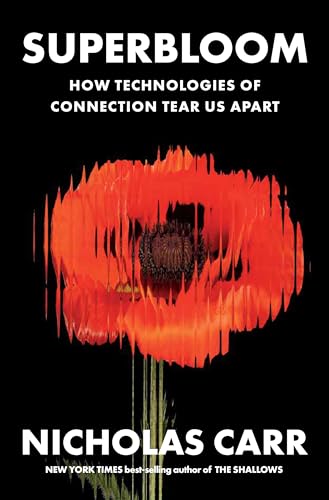
From the author of The Shallows, a bracing exploration of how social media has warped our sense of self and society.From the telegraph and telephone in the 1800s to the internet and social media in our own day, the public has welcomed new communication systems. Whenever people gain more power to share information, the assumption goes, society prospers. Superbloom tells a startlingly different story. As communication becomes more mechanized and efficient, it breeds confusion more than understanding, strife more than harmony. Media technologies all too often bring out the worst in us.A celebrated interpreter of technology’s impacts on human life, Nicholas Carr guides the reader through the dark trends that have always shadowed how telegrams disrupted diplomacy, how radio aided autocrats, how the Facebook feed sowed division, how AI now blurs reality and fantasy. With vivid examples from history, science, and politics, Superbloom unmasks a fundamental flaw in our perception of, and revolutionizes our understanding of, how media shapes society. It may be too late to curb the “superbloom” of information—but it’s not too late to change ourselves.

Does IT Matter?: Information Technology and the Corrosion of Competitive Advantage
by Nicholas Carr
Rating: 3.8 ⭐
Over the last decade, and even since the bursting of the technology bubble, pundits, consultants, and thought leaders have argued that information technology provides the edge necessary for business success. IT expert Nicholas G. Carr offers a radically different view in this eloquent and explosive book. As IT's power and presence have grown, he argues, its strategic relevance has actually decreased. IT has been transformed from a source of advantage into a commoditized "cost of doing business" - with huge implications for business management.Expanding on Carr's seminal Harvard Business Review article that generated a storm of controversy, Does IT Matter? provides a truly compelling - and unsettling - account of IT's changing business role and its leveling influence on competition. Through astute analysis of historical and contemporary examples, Carr shows that the evolution of IT closely parallels that of earlier technologies such as railroads and electric power. He goes on to lay out a new agenda for IT management, stressing cost control and risk management over innovation and investment. And he examines the broader implications for business strategy and organization as well as for the technology industry.A frame-changing statement on one of the most important business phenomena of our time, Does IT Matter? marks a crucial milepost in the debate about IT's future.An acclaimed business writer and thinker, Nicholas G. Carr is a former executive editor of the Harvard Business Review.

With a razor wit, Nicholas Carr cuts through Silicon Valley’s unsettlingly cheery vision of the technological future to ask a hard question: Have we been seduced by a lie? Gathering a decade’s worth of posts from his blog, Rough Type, as well as his seminal essays, Utopia Is Creepy offers an alternative history of the digital age, chronicling its roller-coaster crazes and crashes, its blind triumphs, and its unintended consequences.Carr’s favorite targets are those zealots who believe so fervently in computers and data that they abandon common sense. Cheap digital tools do not make us all the next Fellini or Dylan. Social networks, diverting as they may be, are not vehicles for self-enlightenment. And “likes” and retweets are not going to elevate political discourse. When we expect technologies—designed for profit—to deliver a paradise of prosperity and convenience, we have forgotten ourselves. In response, Carr offers searching assessments of the future of work, the fate of reading, and the rise of artificial intelligence, challenging us to see our world anew.In famous essays including “Is Google Making Us Stupid?” and “Life, Liberty, and the Pursuit of Privacy,” Carr dissects the logic behind Silicon Valley’s “liberation mythology,” showing how technology has both enriched and imprisoned us—often at the same time. Drawing on artists ranging from Walt Whitman to the Clash, while weaving in the latest findings from science and sociology, Utopia Is Creepy compels us to question the technological momentum that has trapped us in its flow. “Resistance is never futile,” argues Carr, and this book delivers the proof.

Nicholas Carr's blockbuster essay on how the Internet is changing the way we think, now available in a Kindle edition. Originally published in The Atlantic magazine in 2008, "Is Google Making Us Stupid?" set off a worldwide debate about the cognitive and cultural consequences of our infatuation with computers and online media. The essay served as the original inspiration for Carr's Pulitzer Prize-nominated book "The What the Internet Is Doing to Our Brains." This edition of the essay includes an author's note on his sources.

Engaging, surprising and filled with practical and often counterintuitive advice, these ten essays will change the way you think about technological progress and business innovation. Nicholas Carr, the former executive editor of the Harvard Business Review and the Pulitzer Prize-nominated author of THE SHALLOWS and THE BIG SWITCH, examines recent business and social phenomena, from the success of Apple to the rise of crowdsourcing, from the innovation strategy of Google to the disruptions of digital media, and ties them to illuminating historical precedents and economic laws. Not only will you enjoy the witty, lucid writing of this collection, but you'll come away from it with a fresh new perspective on innovation in the information age. The essays include "Let a Half-Dozen Flowers Bloom" (on the essential but underrated role that discipline plays in innovation), "Launchings and Landings" (on the dangers of out-innovating your customers), "Building Bridges" (on the most powerful way to take advantage of disruptive technologies), "The Dreams of Suits" (on the important role that bean-counters can play in creativity), "Disruption from Above" (on a new twist in the Clayton Christensen model of disruptive innovation), "With Complements" (on the essential role played by complements strategy in business success), "The Weakest Link" (on the best place to focus innovation efforts), "The Google Enigma" (on the dangers of using the search giant as an innovation model), "The Wizard and the Crowd" (on the limitations of crowdsourcing and the continued importance of talented individuals), and "The Sixth Force" (on how to think strategically about corporate responsibility).Praise for Nicholas Carr:"[Carr] is one of the most insightful thinkers about technology's impact on the world." -Chris Anderson, Wired"Carr's provocations are destined to influence CEOs and the boards and investors that support them as companies grapple with the constant change of the digital age." -L. Gordon Crovitz, Wall Street Journal"Mr. Carr is always interesting." -James V. Delong, Washington Times(Cover photo of bridge by mnsc: www.flickr.com/photos/mnsc/. Used under Creative Commons license: creativecommons.org/licenses/by-sa/2.0/.)


Płytki umysł. Jak internet wpływa na nasz mózg
by Nicholas Carr
Płytki umysł. Jak internet wpływa na nasz mózg Nominacja do nagrody Pulitzera 2011 Nominacja do nagrody literackiej PEN Center USA 2011 Międzynarodowy bestseller przetłumaczony na ponad dwadzieścia języków To książka o pielęgnowaniu mądrości i zdolności do refleksji w epoce, w której obie wydają się coraz bardziej zagrożone. Nicholas Carr przedstawia dający do myślenia, odważny intelektualnie wywód o tym, jak internet - jako medium - zmienia nasz sposób myślenia oraz wpływa na to, jak będą (lub nie będą) myślały kolejne pokolenia. Niewiele książek można uznać za równie istotne. Maryanne Wolf, autorka Proust and the Squid. The Story and Science of the Reading Brain Po co myśleć? Przecież masz internet! Doświadczamy właśnie odwrócenia intelektualnej ewolucji naszego gatunku. Z czcicieli wiedzy i mądrości jako przymiotu ściśle związanego z osobowością znów stajemy się myśliwymi i zbieraczami, tym razem w elektronicznym lesie pełnym informacji. Internet wkroczył w nasze życie i bezpowrotnie je przewartościował. Przekształcił sposób, w jaki myślimy i działamy. Nasze problemy z koncentracją, coraz krótsze i uboższe wypowiedzi oraz problemy z przyswajaniem długich tekstów nie są dziełem przypadku. Czyżbyśmy stawali się coraz bardziej płytcy? Czyżby narzędzie, które powstało po to, by nam służyć, przejęło nad nami władzę? Nicholas Carr pokazuje, jak nowe media zmieniają nas samych i otaczającą nas rzeczywistość. Wyrasta przy tym na współczesnego Marshalla McLuhana. Jego książka wywołała w USA zażartą dyskusję, w którą zaangażowało się wielu publicystów i prestiżowych wydawców. Carr serwuje nam coś więcej niż tylko dogłębną i zaskakującą analizę socjologiczną: jego wywód to przede wszystkim wspaniała intelektualna uczta, pełna nieszablonowych przemyśleń i frapujących anegdot. Bez względu na to, czy jesteś zafascynowany możliwościami globalnej sieci, czy też raczej podejrzewasz, że konsekwencją jej rozwoju będzie zagłada rodzaju ludzkiego, warto dowiedzieć się, jak internet oddziałuje na Twój mózg i jak zmieni to Twoją przyszłość.