
Thomas L. Friedman
Thomas L. Friedman is an internationally renowned author, reporter, and, columnist—the recipient of three Pulitzer Prizes and the author of six bestselling books, among them From Beirut to Jerusalem and The World Is Flat. In a book review for The Village Voice, Edward Said criticized what he saw as a naive, arrogant, and orientalist account of the Israel–Palestine conflict in Friedman's From Beirut to Jerusalem. In January 1995, Friedman took over the New York Times Foreign Affairs column. “It was the job I had always aspired to,” he recalled. “I had loved reading columns and op-ed articles ever since I was in high school, when I used to wait around for the afternoon paper, the Minneapolis Star, to be delivered. It carried Peter Lisagor. He was a favorite columnist of mine. I used to grab the paper from the front step and read it on the living room floor.” Friedman has been the Times‘s Foreign Affairs columnist since 1995, traveling extensively in an effort to anchor his opinions in reporting on the ground. “I am a big believer in the saying ‘If you don’t go, you don’t know.’ I tried to do two things with the column when I took it over. First was to broaden the definition of foreign affairs and explore the impacts on international relations of finance, globalization, environmentalism, biodiversity, and technology, as well as covering conventional issues like conflict, traditional diplomacy, and arms control. Second, I tried to write in a way that would be accessible to the general reader and bring a broader audience into the foreign policy conversation—beyond the usual State Department policy wonks. It was somewhat controversial at the time. So, I eventually decided to write a book that would explain the framework through which I was looking at the world. It was a framework that basically said if you want to understand the world today, you have to see it as a constant tension between what was very old in shaping international relations (the passions of nationalism, ethnicity, religion, geography, and culture) and what was very new (technology, the Internet, and the globalization of markets and finance). If you try to see the world from just one of those angles, it won’t make sense. It is all about the intersection of the two.”
18 Books Written

The World Is Flat: A Brief History of the Twenty-First Century
by Thomas L. Friedman
Rating: 3.6 ⭐
• 8 recommendations ❤️
A New Edition of the Phenomenal #1 Bestseller"One mark of a great book is that it makes you see things in a new way, and Mr. Friedman certainly succeeds in that goal," the Nobel laureate Joseph E. Stiglitz wrote in The New York Times reviewing The World Is Flat in 2005. In this new edition, Thomas L. Friedman includes fresh stories and insights to help us understand the flattening of the world. Weaving new information into his overall thesis, and answering the questions he has been most frequently asked by parents across the country, this third edition also includes two new chapters—on how to be a political activist and social entrepreneur in a flat world; and on the more troubling question of how to manage our reputations and privacy in a world where we are all becoming publishers and public figures.The World Is Flat 3.0 is an essential update on globalization, its opportunities for individual empowerment, its achievements at lifting millions out of poverty, and its drawbacks—environmental, social, and political, powerfully illuminated by the Pulitzer Prize—winning author of The Lexus and the Olive Tree.

Hot, Flat, and Crowded: Why We Need a Green Revolution--and How It Can Renew America
by Thomas L. Friedman
Rating: 3.8 ⭐
• 2 recommendations ❤️
A New York Times Book Review Notable Book of the Year A Washington Post Best Book of the Year A Businessweek Best Business Book of the Year A Chicago Tribune Best Book of the Year In this brilliant, essential book, Pulitzer Prize-winning author Thomas L. Friedman speaks to America's urgent need for national renewal and explains how a green revolution can bring about both a sustainable environment and a sustainable America.Friedman explains how global warming, rapidly growing populations, and the expansion of the world's middle class through globalization have produced a dangerously unstable planet--one that is "hot, flat, and crowded." In this Release 2.0 edition, he also shows how the very habits that led us to ravage the natural world led to the meltdown of the financial markets and the Great Recession. The challenge of a sustainable way of life presents the United States with an opportunity not only to rebuild its economy, but to lead the world in radically innovating toward cleaner energy. And it could inspire Americans to something we haven't seen in a long time--nation-building in America--by summoning the intelligence, creativity, and concern for the common good that are our greatest national resources.Hot, Flat, and Crowded is classic Thomas L. Friedman: fearless, incisive, forward-looking, and rich in surprising common sense about the challenge--and the promise--of the future.

A New York Times Book Review Editors' ChoiceA Los Angeles Times Best Book of 2011In That Used to Be Us , Thomas L. Friedman and Michael Mandelbaum analyze the four major challenges we face as a country---globalization, the revolution in information technology, chronic deficits, and our pattern of energy consumption---and spell out what we need to do now to preserve American power in the world. The end of the Cold War blinded the nation to the need to address these issues seriously, and China's educational successes, industrial might, and technological prowess in many ways remind us of a time when "that used to be us." But Friedman and Mandelbaum show how America's history, when properly understood, offers a five-part formula for prosperity that will enable us to cope successfully with the challenges we face. That Used to Be Us is both a searching exploration of the American condition today and a rousing manifesto for American renewal.
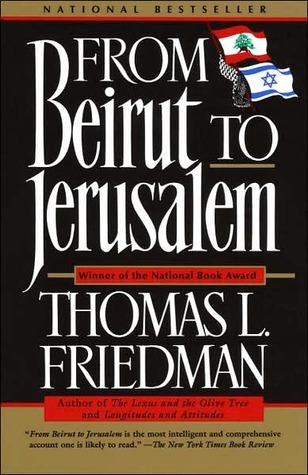
From Beirut to Jerusalem (1989) is a book by American journalist Thomas L. Friedman chronicling his days as a reporter in Beirut during the Lebanese Civil War and in Jerusalem through the first year of the Intifada.Friedman wrote a 17-page epilogue for the first paperback edition (Anchor Books, 1990) concerning the potential for peaceful resolution in Israel and Palestine. In a book review for The Village Voice, Edward Said criticized what he saw as a naive, arrogant, and orientalist account of the Israel–Palestine conflict.

Thank You for Being Late: An Optimist's Guide to Thriving in the Age of Accelerations
by Thomas L. Friedman
Rating: 3.8 ⭐
A field guide to the twenty-first century, written by one of its most celebrated observersIn his most ambitious work to date, Thomas L. Friedman shows that we have entered an age of dizzying acceleration--and explains how to live in it. Due to an exponential increase in computing power, climbers atop Mount Everest enjoy excellent cell-phone service and self-driving cars are taking to the roads. A parallel explosion of economic interdependency has created new riches as well as spiraling debt burdens. Meanwhile, Mother Nature is also seeing dramatic changes as carbon levels rise and species go extinct, with compounding results.How do these changes interact, and how can we cope with them? To get a better purchase on the present, Friedman returns to his Minnesota childhood and sketches a world where politics worked and joining the middle class was an achievable goal. Today, by contrast, it is easier than ever to be a maker (try 3-D printing) or a breaker (the Islamic State excels at using Twitter), but harder than ever to be a leader or merely "average." Friedman concludes that nations and individuals must learn to be fast (innovative and quick to adapt), fair (prepared to help the casualties of change), and slow (adept at shutting out the noise and accessing their deepest values). With vision, authority, and wit, Thank You for Being Late establishes a blueprint for how to think about our times.

In The Lexus and the Olive Tree, Thomas L. Friedman, the Pulitzer Prize-winning foreign affairs columnist for The New York Times, offers an engrossing look at the new international system that is transforming world affairs today. Globalization has replaced the Cold War system with the integration of capital, technology, and information across national borders—uniting Brazilian peasants, Indonesian entrepreneurs, Chinese villagers, and Silicon Valley technocrats in a single global village. You cannot understand the morning news, know where to invest your money, or think about the future unless you understand this new system, which is profoundly influencing virtually every country in the world today. Friedman tells you what this electronic global economy is all about and what it will take to live within it.With vivid stories drawn from his extensive travels, he dramatizes the conflict of “the Lexus and the olive tree”—the tension between the globalization system and the ancient forces of culture, geography, tradition, and community. He also details the powerful backlash that globalization produces among those who feel brutalized by it, and he spells out what we all need to do to keep the Lexus and the olive tree in balance. For this new paperback edition, Friedman has substantially expanded and updated his provocative analysis, making it essential reading for all who care about how the world works now.
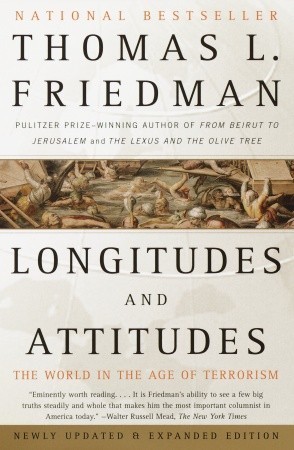
From the Pulitzer Prize–winning New York Times columnist and bestselling author of From Beirut to Jerusalem and The Lexus and the Olive Tree comes this smart, penetrating, brilliantly informed book that is indispensable for understanding today’s radically new world and America’s complex place in it.Thomas L. Freidman received his third Pulitzer Prize in 2002 “for his clarity of vision, based on extensive reporting, in commenting on the worldwide impact of the terrorist threat.” In Longitudes and Attitudes he gives us all of the columns he has published about the most momentous news story of our time, as well as a diary of his private experiences and reflections during his post–September 11 travels. Updated for this new paperback edition, with over two years’ worth of Friedman’s columns and an expanded version of his diary, Longitudes and Attitudes is a broadly influential work from our most trusted observer of the international scene.

Closely observed portraits of four managers of varying experience and at different levels of authority provide the background for expert advice on making the right moves at the right time, dealing with uncertainty, and gaining control of one's career

Thank You for Being Late & The World is Flat By Thomas L. Friedman 2 Books Collection Set
by Thomas L. Friedman
Rating: 3.0 ⭐
本套装集结了美国美国三次普利策奖得主托马斯·弗里德曼的两部著作:《谢谢你迟到:以慢制胜,破题未来格局》和《世界是平的:21世纪简史》(内容升级和扩充版)。《谢谢你迟到:以慢制胜,破题未来格局》是托马斯·弗里德曼的新著。从一个充满正能量的乐观主义者角度,他以流程、智慧的笔触写下正在世界发生的故事,有理有据的告诉我们:世界正在发生什么?当今世界三大重要力量正在经历前所未有的加速过程:一是市场,尤其是数字全球化,脸书、阿里巴巴、推特、亚马逊、云计划等是今天市场的主导力量;其次是自然生态,尤其是气候变化、生物多样性的丧失、发展中国家的人口增加;第三大力量是摩尔定律,具体来说,就是科技产品每24个月就会迎来更新换代。从昨日世界反思,2007年发生的科技变革具有根本性的意义,深刻地改变了人类社会:这一年,苹果手机出来了,脸书出来了,推特出来了,安卓系统出来了。但却没有人深刻意识到如此集中的技术变革。其后果就是一年后的2008年,我们迎来了全球经济衰退,也就是说当实体科技已经大步跃进时,与之相适应的社会、政治调整却落在了后面。为今日世界把脉,我们当如何趋其利而避其害?三大力量重塑了世界的五个方面:工作岗位、国家政治、地缘政治、社会伦理和社区生活。我们看到一个耳目一新的世界:新闻的深意,工作的内涵,孩子所需的教育,雇主应当进行的投资,以及一个国家必须作出的社会道德和地缘政治抉择等等。我们如何应对这样的加速,规避糟糕的后果。《世界是平的:21世纪简史》中,托马斯·弗里德曼描述了当代世界发生的重大变化。科技和通信领域如闪电般迅速的进步,使全世界的人们可以空前地彼此接近——在印度和中国创造爆炸式增长的财富;挑战我们中的一些人,比他们更快占领地盘。《世界是平的》(内容升级和扩充版)为《世界是平的》3.0版。该版新增两章,更新了报告和注释方面的内容,这些内容均采自作者考察世界各地特别是整个美国中心地带的见闻,在美国本土,世界的平坦化正在剧烈地改变人们的生活方式。首先展示了“全球化正在滑入扭曲飞行的原因和方式”(罗伯特莱特),揭开这个世界的神秘面纱,深入浅出地讲述复杂的外交政策和经济问题,为读者释疑解惑。作者通过其对复杂外交政策和经济问题的非凡的解读能力,解释了世界的平坦化趋势是如何在21世纪来临之时发生的;这个趋势对于国家、公司、社会和个人而言意味着什么;政府和组织如何才能接受而且必须接受;为什么恐怖分子仍然想继续妄为。世界变得平坦,是不是迫使我们跑得更快才能拥有一席之地?《谢谢你迟到:以慢制胜,破题未来格局》是作者托马斯·弗里德曼极具抱负的一本书,也是各界领导人必读的一本书,在世界加速变化的这一刻,有什么大事正在发生,你更不该错过。《世界是平的:21世纪简史》被认为是全球化的基本读物,既是成功作品,两年来稳居《纽约时报》畅销书排行榜。托马斯·弗里德曼,《纽约时报》专栏作家,三次普利策奖得主。他在《纽约时报》的专栏文章,同步在全球超过七百多个媒体上刊登。著有全球畅销书《世界是平的》《世界又热又平又挤》《曾经的辉煌》《谢谢你迟到》。
![Look heroes of things forgotten, that ~, book to read when it came out it is Tsu it so (2007) ISBN: 4087734560 [Japanese Import]](https://m.media-amazon.com/images/S/compressed.photo.goodreads.com/books/1678236622i/77313657.jpg)
Look heroes of things forgotten, that ~, book to read when it came out it is Tsu it so (2007) ISBN: 4087734560 [Japanese Import]
by Thomas L. Friedman
Thomas L. Friedman's The World Is Flat and Hot, Flat, and Crowded Audio CD Books
by Thomas L. Friedman
Friedman, Thomas

Thomas L. Friedman Collection
by Thomas L. Friedman
A New Edition of the Phenomenal #1 Bestseller About the Author Thomas L. Friedman has won the Pulitzer Prize three times for his work at The New York Times, where he serves as the foreign affairs columnist. He is the author of three previous books, all of them From Beirut to Jerusalem, winner of the National Book Award for nonfiction; The Lexus and the Olive Understanding Globalization; and Longitudes and Exploring the World After September 11. In 2005 The World Is Flat was given the first Financial Times and Goldman Sachs Business Book of the Year Award, and Friedman was named one of America's Best Leaders by U.S. News & World Report. He lives in Bethesda, Maryland, with his family.

2002 U S Master Tax Guide (Text Only)
by Thomas L. Friedman
2002 U S Master Tax Guide (Text Only) (85th, 01) by Friedman, Thomas L [Paperback (2007)]
The Harris Symposium on Middle East Communication, Covering War and Peace, December 6, 1988
by Thomas L. Friedman

Unforgettable Senior Moments Page-A-Day® Calendar 2026
by Thomas L. Friedman