
9 Books Written

The Mythical Man-Month: Essays on Software Engineering
by Frederick P. Brooks Jr.
Rating: 4.0 ⭐
• 10 recommendations ❤️
Few books on software project management have been as influential and timeless as The Mythical Man-Month. With a blend of software engineering facts and thought-provoking opinions, Fred Brooks offers insight for anyone managing complex projects. These essays draw from his experience as project manager for the IBM System/360 computer family and then for OS/360, its massive software system. Now, 45 years after the initial publication of his book, Brooks has revisited his original ideas and added new thoughts and advice, both for readers already familiar with his work and for readers discovering it for the first time.The added chapters contain (1) a crisp condensation of all the propositions asserted in the original book, including Brooks' central argument in The Mythical Man-Month: that large programming projects suffer management problems different from small ones due to the division of labor; that the conceptual integrity of the product is therefore critical; and that it is difficult but possible to achieve this unity; (2) Brooks' view of these propositions a generation later; (3) a reprint of his classic 1986 paper "No Silver Bullet"; and (4) today's thoughts on the 1986 assertion, "There will be no silver bullet within ten years."

Making Sense of Design Effective design is at the heart of everything from software development to engineering to architecture. But what do we really know about the design process? What leads to effective, elegant designs? The Design of Design addresses these questions. These new essays by Fred Brooks contain extraordinary insights for designers in every discipline. Brooks pinpoints constants inherent in all design projects and uncovers processes and patterns likely to lead to excellence. Drawing on conversations with dozens of exceptional designers, as well as his own experiences in several design domains, Brooks observes that bold design decisions lead to better outcomes. The author tracks the evolution of the design process, treats collaborative and distributed design, and illuminates what makes a truly great designer. He examines the nuts and bolts of design processes, including budget constraints of many kinds, aesthetics, design empiricism, and tools, and grounds this discussion in his own real-world examples—case studies ranging from home construction to IBM's Operating System/360. Throughout, Brooks reveals keys to success that every designer, design project manager, and design researcher should know.

No Silver Bullet Essence and Accidents of Software Engineering
by Frederick P. Brooks Jr.
Rating: 4.3 ⭐
All software construction involves essential tasks, the fashioning of the complex conceptual structures that compose the abstract software entity, and accidental tasks, the representation of these abstract entities in programming languages and the mapping of these onto machine languages within space and speed constraints. Most of the big past gains in software productivity have come from removing artificial barriers that have made theaccidental tasks inordinately hard, such as severe hardware constraints, awkward programming languages, lack of machine time. How much of what software engineers now do isstill devoted to the accidental, as opposed to the essential? Unless it is more than 9/10 of all effort, shrinking all the accidental activities to zero time will not give an order ofmagnitude improvement.Therefore it appears that the time has come to address the essential parts of the softwaretask, those concerned with fashioning abstract conceptual structures of great complexity. I suggest:• exploiting the mass market to avoid constructing what can be bought.• using rapid prototyping as part of a planned iteration in establishing software require- ·ments.• growing software organically, adding more and more function to systems as they arerun, used, and tested.• identifying and developing the great conceptual designers of the rising generation
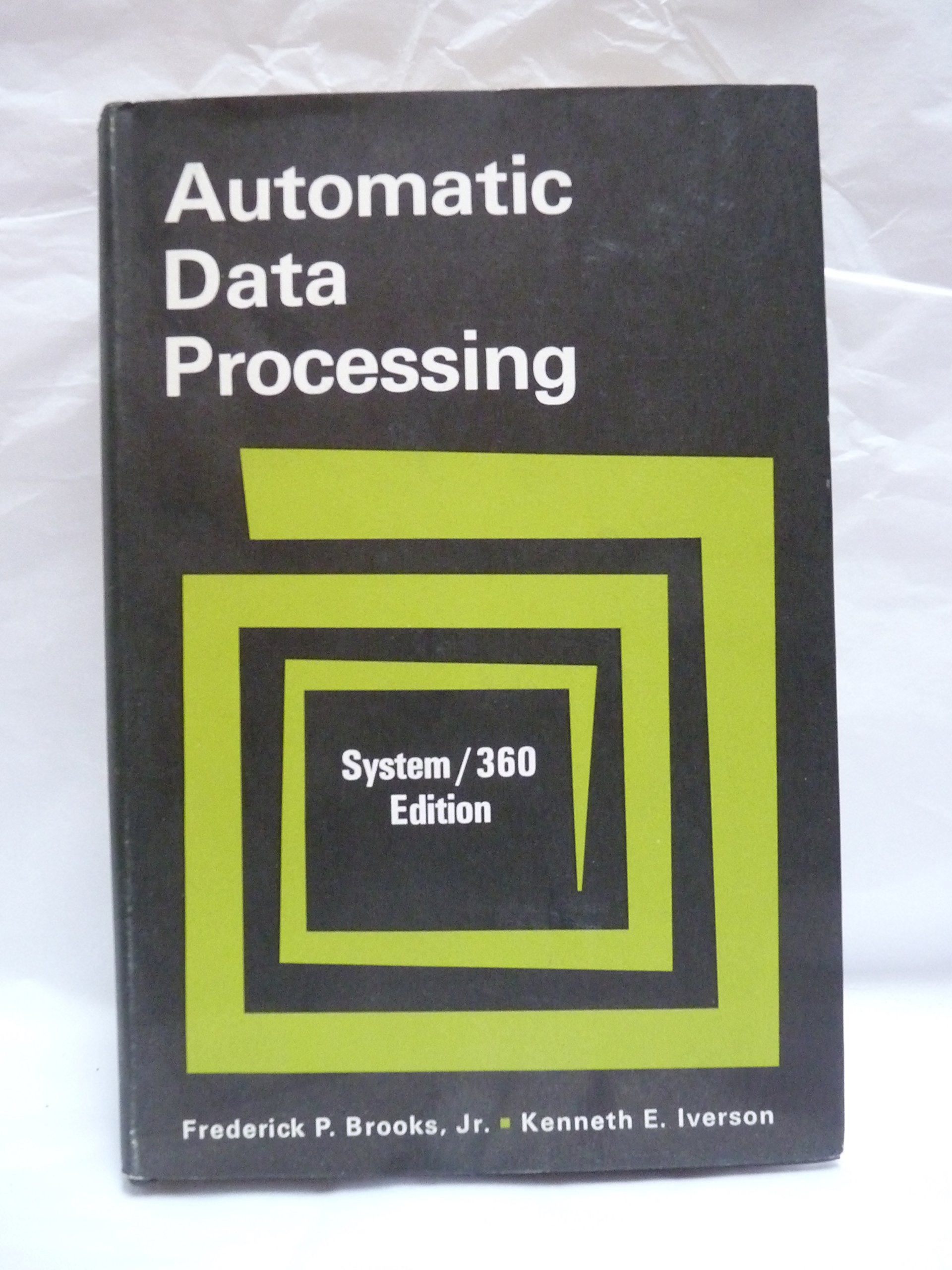
Automatic Data System/360 [hardcover] Brooks Jr., Frederick P.,Ireson, Kenneth E.,Iverson, Kenneth Eugene [Nov 01, 1969]

Grasping Reality Through Illusion: Interactive Graphics Serving Science
by Frederick P. Brooks Jr.
Advanced Technology for Portable Personal Visualization
by Frederick P. Brooks Jr.
Annual Progress Report (17th) and 1992-97 Renewal Proposal Interactive Graphics for Molecular Studies
by Frederick P. Brooks Jr.
The Infrastructure of Command Information Systems
by Frederick P. Brooks Jr.