Loading genres...
Explore the best books about Political Science genre.

The second volume of the bestselling landmark work on the history of the modern stateWriting in The Wall Street Journal, David Gress called Francis Fukuyama's Origins of Political Order "magisterial in its learning and admirably immodest in its ambition." In The New York Times Book Review, Michael Lind described the book as "a major achievement by one of the leading public intellectuals of our time." And in The Washington Post, Gerard DeGrott exclaimed "this is a book that will be remembered. Bring on volume two." Volume two is finally here, completing the most important work of political thought in at least a generation. Taking up the essential question of how societies develop strong, impersonal, and accountable political institutions, Fukuyama follows the story from the French Revolution to the so-called Arab Spring and the deep dysfunctions of contemporary American politics. He examines the effects of corruption on governance, and why some societies have been successful at rooting it out. He explores the different legacies of colonialism in Latin America, Africa, and Asia, and offers a clear-eyed account of why some regions have thrived and developed more quickly than others. And he boldly reckons with the future of democracy in the face of a rising global middle class and entrenched political paralysis in the West. A sweeping, masterful account of the struggle to create a well-functioning modern state, Political Order and Political Decay is destined to be a classic.
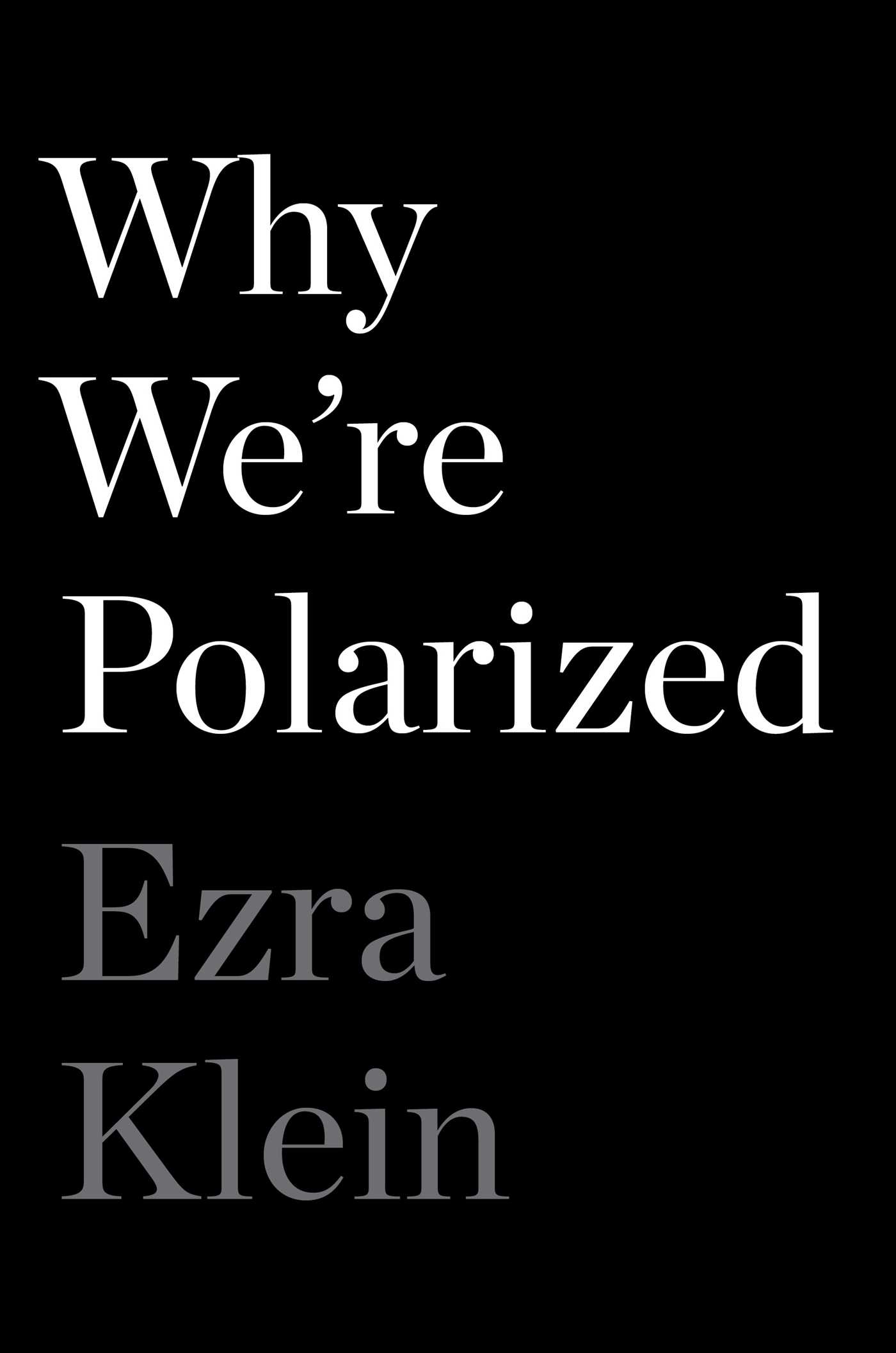
America is polarized by identity. Over the past fifty years in America, partisan identities have merged with racial, religious, geographic, ideological, and cultural identities, attaining a weight that is breaking much in politics and tearing at the bonds that hold the country together. Political analyst Ezra Klein shows how and why American politics polarized around identity in the twentieth century and what that polarization did to the way people see the world and one another. He traces the feedback loops—between polarized political identities and polarized political institutions—driving the system toward crisis.Why We’re Polarized reveals the structural and psychological forces behind America’s descent into division and dysfunction. Neither a polemic nor a lament, it offers a clear framework for understanding everything from Donald Trump’s rise to the Democratic Party’s leftward shift to the politicization of everyday culture.

Ever since its first publication in 1992, the New York Times bestselling The End of History and the Last Man has provoked controversy and debate. "Profoundly realistic and important...supremely timely and cogent...the first book to fully fathom the depth and range of the changes now sweeping through the world." —The Washington Post Book WorldFrancis Fukuyama's prescient analysis of religious fundamentalism, politics, scientific progress, ethical codes, and war is as essential for a world fighting fundamentalist terrorists as it was for the end of the Cold War. Now updated with a new afterword, The End of History and the Last Man is a modern classic.

The intelligence failures surrounding the invasion of Iraq dramatically illustrate the necessity of developing standards for evaluating expert opinion. This book fills that need. Here, Philip E. Tetlock explores what constitutes good judgment in predicting future events, and looks at why experts are often wrong in their forecasts.Tetlock first discusses arguments about whether the world is too complex for people to find the tools to understand political phenomena, let alone predict the future. He evaluates predictions from experts in different fields, comparing them to predictions by well-informed laity or those based on simple extrapolation from current trends. He goes on to analyze which styles of thinking are more successful in forecasting. Classifying thinking styles using Isaiah Berlin's prototypes of the fox and the hedgehog, Tetlock contends that the fox--the thinker who knows many little things, draws from an eclectic array of traditions, and is better able to improvise in response to changing events--is more successful in predicting the future than the hedgehog, who knows one big thing, toils devotedly within one tradition, and imposes formulaic solutions on ill-defined problems. He notes a perversely inverse relationship between the best scientific indicators of good judgement and the qualities that the media most prizes in pundits--the single-minded determination required to prevail in ideological combat.Clearly written and impeccably researched, the book fills a huge void in the literature on evaluating expert opinion. It will appeal across many academic disciplines as well as to corporations seeking to develop standards for judging expert decision-making.

Hayek gives the main arguments for the free-market case and presents his manifesto on the "errors of socialism." Hayek argues that socialism has, from its origins, been mistaken on factual, and even on logical, grounds and that its repeated failures in the many different practical applications of socialist ideas that this century has witnessed were the direct outcome of these errors. He labels as the "fatal conceit" the idea that "man is able to shape the world around him according to his wishes.""The achievement of The Fatal Conceit is that it freshly shows why socialism must be refuted rather than merely dismissed—then refutes it again."—David R. Henderson, Fortune."Fascinating. . . . The energy and precision with which Mr. Hayek sweeps away his opposition is impressive."—Edward H. Crane, Wall Street JournalF. A. Hayek is considered a pioneer in monetary theory, the preeminent proponent of the libertarian philosophy, and the ideological mentor of the Reagan and Thatcher "revolutions."

В излязлата през 1996 г. книга „Сблъсъкът на цивилизациите” Хънтингтън развива своите идеи, изложени първоначално в лекция, изнесена в American Enterprise Institute през 1993 г. и в статия от 1996 г. в сп. „Форин Афеърс”. Основната теза на неговото изследване е, че бъдещети световни конфликти ще се основават не на политическа идеология, а на национално културните и религиозни различия на човечеството. „Историята на човечеството е история на цивилизациите... Всяка цивилизация разглежда себе си като център на света и пише собствената си история като основен драматичен сюжет в историята на човечеството.Пришпорена от модернизацията, световната политика се преструктурира съобразно културни критерии. Сближават се народи и страни със сходни култури. Народите и страните с различни култури се разединяват. Съюзи, дефинирани от идеологията и от отношенията между свръхсилите, отстъпват място на съюзи, основаващи се на обща култура и цивилизация. Политическите граници се преначертават така, че да съвпаднат с културните граници: етнически, религиозни и цивилизационни. Културни общности заменят блоковете от периода на Студената война, а разломите между цивилизациите се превръщат във фронтови линии на глобалната политика.”Самюъл Хънтингтън„Сблъсъкът на цивилииациите” е една от най-значимите книги, появили се след края на Студената война. ~Хенри Кисинджър„Върховно интелектуално постижение, смело, провокативно и наситено с въображение. Основополагащ и оригинален труд, който ще предизвика революция в представите ни за международна политика.” ~Збигнев Бжежински

In this classic work of economic history and social theory, Karl Polanyi analyzes the economic and social changes brought about by the "great transformation" of the Industrial Revolution. His analysis explains not only the deficiencies of the self-regulating market, but the potentially dire social consequences of untempered market capitalism. New introductory material reveals the renewed importance of Polanyi's seminal analysis in an era of globalization and free trade.

Alternate cover edition of ISBN 9780140432077Published in 1859, John Stuart Mill's On Liberty presented one of the most eloquent defenses of individual freedom in nineteenth-century social and political philosophy and is today perhaps the most widely-read liberal argument in support of the value of liberty. Mill's passionate advocacy of spontaneity, individuality, and diversity, along with his contempt for compulsory uniformity and the despotism of popular opinion, has attracted both admiration and condemnation.

How is it that the law enforcer itself does not have to keep the law? How is it that the law permits the state to lawfully engage in actions which, if undertaken by individuals, would land them in jail? These are among the most intriguing issues in political and economic philosophy. More specifically, the problem of law that itself violates law is an insurmountable conundrum of all statist philosophies. The problem has never been discussed so profoundly and passionately as in this essay by Frederic Bastiat from 1850. The essay might have been written today. It applies in ever way to our own time, which is precisely why so many people credit this one essay for showing them the light of liberty. Bastiat's essay here is timeless because applies whenever and wherever the state assumes unto itself different rules and different laws from that by which it expects other people to live. And so we have this legendary essay, written in a white heat against the lead

#1 NEW YORK TIMES BESTSELLERIt was never supposed to be this close. And of course she was supposed to win. How Hillary Clinton lost the 2016 election to Donald Trump is the riveting story of a sure thing gone off the rails. For every Comey revelation or hindsight acknowledgment about the electorate, no explanation of defeat can begin with anything other than the core problem of Hillary's campaign--the candidate herself. Through deep access to insiders from the top to the bottom of the campaign, political writers Jonathan Allen and Amie Parnes have reconstructed the key decisions and unseized opportunities, the well-intentioned misfires and the hidden thorns that turned a winnable contest into a devastating loss. Drawing on the authors' deep knowledge of Hillary from their previous book, the acclaimed biography HRC, Shattered offers an object lesson in how Hillary herself made victory an uphill battle, how her difficulty articulating a vision irreparably hobbled her impact with voters, and how the campaign failed to internalize the lessons of populist fury from the hard-fought primary against Bernie Sanders. Moving blow-by-blow from the campaign's difficult birth through the bewildering terror of election night, Shattered tells an unforgettable story with urgent lessons both political and personal, filled with revelations that will change the way readers understand just what happened to America on November 8, 2016.

From former Chairman and President of the Export-Import Bank of the United States Fred P. Hochberg comes an illuminating and engaging tutorial on the basics of modern trade. Trade—the exchange that powers the world—allows us to sell what we produce at home and purchase what we don’t. In the age of globalization, trade has joined together more people than ever before, providing access to major new markets and countless new products that have revolutionized our lives. However, for millions of people, global trade has become a popular target for blame and the frustrations of modern life. Much of the public only connects trade with unfathomable, high-level deals causing the fundamental principles to often seem inaccessible and confusing. Through the lens of six quintessential American goods, Fred P. Hochberg breaks down colorful and compelling real-world examples to dispel the widespread myths and confusions surrounding trade. By using six widely consumed American goods—the taco salad, the minivan, the banana, the iPhone, the college degree, and the HBO series Game of Thrones—Hochberg highlights the story of America’s most surprising trade relationships while sharing the essentials of trade that everyone should know.

Leading political innovation activist Katherine Gehl and world-renowned business strategist Michael Porter bring fresh perspective, deep scholarship, and a real and actionable solution, Final Five Voting, to the grand challenge of our broken political and democratic system. Final Five Voting has already been adopted in Alaska and is being advanced in states across the country. The truth is, the American political system is working exactly how it is designed to work, and it isn't designed or optimized today to work for us—for ordinary citizens. Most people believe that our political system is a public institution with high-minded principles and impartial rules derived from the Constitution. In reality, it has become a private industry dominated by a textbook duopoly—the Democrats and the Republicans—and plagued and perverted by unhealthy competition between the players. Tragically, it has therefore become incapable of delivering solutions to America's key economic and social challenges. In fact, there's virtually no connection between our political leaders solving problems and getting reelected. In The Politics Industry , business leader and path-breaking political innovator Katherine Gehl and world-renowned business strategist Michael Porter take a radical new approach. They ingeniously apply the tools of business analysis—and Porter's distinctive Five Forces framework—to show how the political system functions just as every other competitive industry does, and how the duopoly has led to the devastating outcomes we see today. Using this competition lens, Gehl and Porter identify the most powerful lever for change—a strategy comprised of a clear set of choices in two key how our elections work and how we make our laws. Their bracing assessment and practical recommendations cut through the endless debate about various proposed fixes, such as term limits and campaign finance reform. The true political innovation. The Politics Industry is an original and completely nonpartisan guide that will open your eyes to the true dynamics and profound challenges of the American political system and provide real solutions for reshaping the system for the benefit of all. THE INSTITUTE FOR POLITICAL INNOVATIONThe authors will donate all royalties from the sale of this book to the Institute for Political Innovation.

Controversies in politics arise from many sources, but the conflicts that endure for generations or centuries show a remarkably consistent pattern. In this classic work, Thomas Sowell analyzes this pattern. He describes the two competing visions that shape our debates about the nature of reason, justice, equality, and power: the "constrained" vision, which sees human nature as unchanging and selfish, and the "unconstrained" vision, in which human nature is malleable and perfectible. A Conflict of Visions offers a convincing case that ethical and policy disputes circle around the disparity between both outlooks.

"One of the most profound and illuminating studies of this century to have been published in recent decades." —John Gray, New York Times Book ReviewHailed as "a magisterial critique of top-down social planning" by the New York Times, this essential work analyzes disasters from Russia to Tanzania to uncover why states so often fail—sometimes catastrophically—in grand efforts to engineer their society or their environment, and uncovers the conditions common to all such planning disasters."Beautifully written, this book calls into sharp relief the nature of the world we now inhabit." —New Yorker"A tour de force." —Charles Tilly, Columbia University

One of America’s pre-eminent economists offers a provocative critique of the failures of liberalismIn The Vision of the Anointed , Thomas Sowell presents a devastating critique of the mind-set behind the failed social policies of the past thirty years. Sowell sees what has happened during that time not as a series of isolated mistakes but as a logical consequence of a tainted vision whose defects have led to crises in education, crime, and family dynamics, and to other social pathologies. In this book, he describes how elites—the anointed—have replaced facts and rational thinking with rhetorical assertions, thereby altering the course of our social policy.

John Pocock's edition of Burke's Reflections is two classics in Burke's Reflections and Pocock's reflections on Burke and the eighteenth century.

From the bestselling author of The Ascent of Money and The Square and the TowerIs America an empire? Certainly not, according to our government. Despite the conquest of two sovereign states in as many years, despite the presence of more than 750 military installations in two thirds of the world’s countries and despite his stated intention "to extend the benefits of freedom...to every corner of the world," George W. Bush maintains that "America has never been an empire." "We don’t seek empires," insists Defense Secretary Rumsfeld. "We’re not imperialistic." Nonsense, says Niall Ferguson. In Colossus he argues that in both military and economic terms America is nothing less than the most powerful empire the world has ever seen. Just like the British Empire a century ago, the United States aspires to globalize free markets, the rule of law, and representative government. In theory it’s a good project, says Ferguson. Yet Americans shy away from the long-term commitments of manpower and money that are indispensable if rogue regimes and failed states really are to be changed for the better. Ours, he argues, is an empire with an attention deficit disorder, imposing ever more unrealistic timescales on its overseas interventions. Worse, it’s an empire in denial—a hyperpower that simply refuses to admit the scale of its global responsibilities. And the negative consequences will be felt at home as well as abroad. In an alarmingly persuasive final chapter Ferguson warns that this chronic myopia also applies to our domestic responsibilities. When overstretch comes, he warns, it will come from within—and it will reveal that more than just the feet of the American colossus is made of clay.

The greatest obstacle to sound economic policy is not entrenched special interests or rampant lobbying, but the popular misconceptions, irrational beliefs, and personal biases held by ordinary voters. This is economist Bryan Caplan's sobering assessment in this provocative and eye-opening book. Caplan argues that voters continually elect politicians who either share their biases or else pretend to, resulting in bad policies winning again and again by popular demand.Boldly calling into question our most basic assumptions about American politics, Caplan contends that democracy fails precisely because it does what voters want. Through an analysis of Americans' voting behavior and opinions on a range of economic issues, he makes the convincing case that noneconomists suffer from four prevailing biases: they underestimate the wisdom of the market mechanism, distrust foreigners, undervalue the benefits of conserving labor, and pessimistically believe the economy is going from bad to worse. Caplan lays out several bold ways to make democratic government work better--for example, urging economic educators to focus on correcting popular misconceptions and recommending that democracies do less and let markets take up the slack.The Myth of the Rational Voter takes an unflinching look at how people who vote under the influence of false beliefs ultimately end up with government that delivers lousy results. With the upcoming presidential election season drawing nearer, this thought-provoking book is sure to spark a long-overdue reappraisal of our elective system.

First published in 1971, Rules for Radicals is Saul Alinsky's impassioned counsel to young radicals on how to effect constructive social change and know “the difference between being a realistic radical and being a rhetorical one.” Written in the midst of radical political developments whose direction Alinsky was one of the first to question, this volume exhibits his style at its best. Like Thomas Paine before him, Alinsky was able to combine, both in his person and his writing, the intensity of political engagement with an absolute insistence on rational political discourse and adherence to the American democratic tradition.ContentsThe PurposeOf Means and EndsA Word about WordsThe Education of an OrganizerCommunicationIn the BeginningTacticsThe Genesis of Tactic ProxyThe Way Ahead

In this classic discussion about economics, freedom, and the relationship between the two, Milton and Rose Friedman explain how our freedom has been eroded and our affluence undermined through the explosion of laws, regulations, agencies, and spending in Washington. Also they carefully examine how good intentions often produce deplorable results when government steps in as a middleman. The Friedmans also provide remedies for those economic ills-energetically informing us about what we should do in order to expand our freedom and promote prosperity. Powerful and persuasive, here is the important analysis of what has gone wrong in America in the past and what is necessary for our economic health to flourish.

Written in political exile in New Zealand during the Second World War and published in two volumes in 1945, The Open Society and its Enemies was hailed by Bertrand Russell as a 'vigorous and profound defence of democracy'. This legendary attack on the philosophies of Plato, Hegel and Marx prophesied the collapse of communism in Eastern Europe and exposed the fatal flaws of socially engineered political systems. It remains highly readable, erudite and lucid and as essential reading today as on publication in 1945. It is available here in a special centenary single-volume edition.

Virtually all human societies were once organized tribally, yet over time most developed new political institutions which included a central state that could keep the peace and uniform laws that applied to all citizens. Some went on to create governments that were accountable to their constituents. We take these institutions for granted, but they are absent or are unable to perform in many of today’s developing countries—with often disastrous consequences for the rest of the world.Francis Fukuyama, author of the bestselling The End of History and the Last Man and one of our most important political thinkers, provides a sweeping account of how today’s basic political institutions developed. The first of a major two-volume work, The Origins of Political Order begins with politics among our primate ancestors and follows the story through the emergence of tribal societies, the growth of the first modern state in China, the beginning of the rule of law in India and the Middle East, and the development of political accountability in Europe up until the eve of the French Revolution.Drawing on a vast body of knowledge—history, evolutionary biology, archaeology, and economics—Fukuyama has produced a brilliant, provocative work that offers fresh insights on the origins of democratic societies and raises essential questions about the nature of politics and its discontents.

Brilliant and engagingly written, Why Nations Fail answers the question that has stumped the experts for centuries: Why are some nations rich and others poor, divided by wealth and poverty, health and sickness, food and famine? Is it culture, the weather, geography? Perhaps ignorance of what the right policies are? Simply, no. None of these factors is either definitive or destiny. Otherwise, how to explain why Botswana has become one of the fastest growing countries in the world, while other African nations, such as Zimbabwe, the Congo, and Sierra Leone, are mired in poverty and violence? Daron Acemoglu and James Robinson conclusively show that it is man-made political and economic institutions that underlie economic success (or lack of it). Korea, to take just one of their fascinating examples, is a remarkably homogeneous nation, yet the people of North Korea are among the poorest on earth while their brothers and sisters in South Korea are among the richest. The south forged a society that created incentives, rewarded innovation, and allowed everyone to participate in economic opportunities. The economic success thus spurred was sustained because the government became accountable and responsive to citizens and the great mass of people. Sadly, the people of the north have endured decades of famine, political repression, and very different economic institutions—with no end in sight. The differences between the Koreas is due to the politics that created these completely different institutional trajectories. Based on fifteen years of original research Acemoglu and Robinson marshall extraordinary historical evidence from the Roman Empire, the Mayan city-states, medieval Venice, the Soviet Union, Latin America, England, Europe, the United States, and Africa to build a new theory of political economy with great relevance for the big questions of today, including: - China has built an authoritarian growth machine. Will it continue to grow at such high speed and overwhelm the West? - Are America’s best days behind it? Are we moving from a virtuous circle in which efforts by elites to aggrandize power are resisted to a vicious one that enriches and empowers a small minority? - What is the most effective way to help move billions of people from the rut of poverty to prosperity? More philanthropy from the wealthy nations of the West? Or learning the hard-won lessons of Acemoglu and Robinson’s breakthrough ideas on the interplay between inclusive political and economic institutions? Why Nations Fail will change the way you look at—and understand—the world.

Who is Vladimir Putin? Observers have described him as a "man from nowhere"-someone without a face, substance, or soul. Russia experts Fiona Hill and Clifford Gaddy argue that Putin is in fact a man of many and complex identities. Drawing on a range of sources, including their own personal encounters, they describe six that are most essential: the Statist, the History Man, the Survivalist, the Outsider, the Free Marketeer, and the Case Officer. Understanding Putin's multiple dimensions is crucial for policy-makers trying to decide how best to deal with Russia.Hill and Gaddy trace the identities back to formative experiences in Putin's past, including his early life in Soviet Leningrad, his KGB training and responsibilities, his years as deputy mayor in the crime and corruption-ridden city of St. Petersburg, his first role in Moscow as the "operative" brought in from the outside by liberal reformers in the Kremlin to help control Russia's oligarchs, and his time at the helm of a resurgent Russian state. The authors examine the nature of the political system Putin has built, explaining it as a logical result of these six identities.Vladimir Putin has his own idealized view of himself as CEO of "Russia, Inc." But rather than leading a transparent public corporation, he runs a closed boardroom, not answerable to its stakeholders. Now that his corporation seems to be in crisis, with political protests marking Mr. Putin's return to the presidency in 2012, will the CEO be held accountable for its failings?

In the words of economist and scholar Arnold Kling, Martin Gurri saw it coming.Technology has categorically reversed the information balance of power between the public and the elites who manage the great hierarchical institutions of the industrial age government, political parties, the media.The Revolt of the Public tells the story of how insurgencies, enabled by digital devices and a vast information sphere, have mobilized millions of ordinary people around the world.Originally published in 2014, this updated edition of The Revolt of the Public includes an extensive analysis of Donald Trump's improbable rise to the presidency and the electoral triumphs of Brexit and concludes with a speculative look forward, pondering whether the current elite class can bring about a reformation of the democratic process and whether new organizing principles, adapted to a digital world, can arise out of the present political turbulence.

CHINA AND THE UNITED STATES ARE HEADING TOWARD A WAR NEITHER WANTS. The reason is Thucydides’s Trap, a deadly pattern of structural stress that results when a rising power challenges a ruling one. This phenomenon is as old as history itself. About the Peloponnesian War that devastated ancient Greece, the historian Thucydides explained: “It was the rise of Athens and the fear that this instilled in Sparta that made war inevitable.” Over the past 500 years, these conditions have occurred sixteen times. War broke out in twelve of them. Today, as an unstoppable China approaches an immovable America and both Xi Jinping and Donald Trump promise to make their countries “great again,” the seventeenth case looks grim. Unless China is willing to scale back its ambitions or Washington can accept becoming number two in the Pacific, a trade conflict, cyberattack, or accident at sea could soon escalate into all-out war. In Destined for War, the eminent Harvard scholar Graham Allison explains why Thucydides’s Trap is the best lens for understanding U.S.-China relations in the twenty-first century. Through uncanny historical parallels and war scenarios, he shows how close we are to the unthinkable. Yet, stressing that war is not inevitable, Allison also reveals how clashing powers have kept the peace in the past — and what painful steps the United States and China must take to avoid disaster today.

Has liberalism failed because it has succeeded? Of the three dominant ideologies of the twentieth century—fascism, communism, and liberalism—only the last remains. This has created a peculiar situation in which liberalism’s proponents tend to forget that it is an ideology and not the natural end-state of human political evolution. As Patrick Deneen argues in this provocative book, liberalism is built on a foundation of contradictions: it trumpets equal rights while fostering incomparable material inequality; its legitimacy rests on consent, yet it discourages civic commitments in favor of privatism; and in its pursuit of individual autonomy, it has given rise to the most far-reaching, comprehensive state system in human history. Here, Deneen offers an astringent warning that the centripetal forces now at work on our political culture are not superficial flaws but inherent features of a system whose success is generating its own failure.

From the Pulitzer Prize–winning critic comes an impassioned critique of America’s retreat from reason.We live in a time when the very idea of objective truth is mocked and discounted by the occupants of the White House. Discredited conspiracy theories and ideologies have resurfaced, proven science is once more up for debate, and Russian propaganda floods our screens. The wisdom of the crowd has usurped research and expertise, and we are each left clinging to the beliefs that best confirm our biases. How did truth become an endangered species in contemporary America? This decline began decades ago, and in The Death of Truth, former New York Times critic Michiko Kakutani takes a penetrating look at the cultural forces that contributed to this gathering storm. In social media and literature, television, academia, and politics, Kakutani identifies the trends—originating on both the right and the left—that have combined to elevate subjectivity over factuality, science, and common values. And she returns us to the words of the great critics of authoritarianism, writers like George Orwell and Hannah Arendt, whose work is newly and eerily relevant. With remarkable erudition and insight, Kakutani offers a provocative diagnosis of our current condition and points toward a new path for our truth-challenged times.

A recent poll showed 43% of Americans think more socialism would be a good thing. What do these people not know? Socialism has killed millions, but it’s now the ideology du jour on American college campuses and among many leftists. Reintroduced by leaders such as Bernie Sanders and Alexandria Ocasio-Cortez, the ideology manifests itself in starry-eyed calls for free-spending policies like Medicare-for-all and student loan forgiveness.In The Case Against Socialism, Rand Paul outlines the history of socialism, from Stalin’s gulags to the current famine in Venezuela. He tackles common misconceptions about the “utopia” of socialist Europe. As it turns out, Scandinavian countries love capitalism as much as Americans, and have, for decades, been cutting back on the things Bernie loves the most.Socialism’s return is only possible because many Americans have forgotten the true dangers of the twentieth-century’s deadliest ideology. Paul reveals the devastating truth: for every college student sporting a Che Guevara T-shirt, there’s a Venezuelan child dying of starvation. Desperate refugees flee communist Cuba to escape oppressive censorship, rationed food and squalid hospitals, not “free” healthcare. Socialist dictatorships like the People’s Republic of China crush freedom of speech and run massive surveillance states while masquerading as enlightened modern nations. Far from providing economic freedom, socialist governments enslave their citizens. They offer illusory promises of safety and equality while restricting personal liberty, tightening state power, sapping human enterprise and making citizens dependent on the dole.If socialism takes hold in America, it will imperil the fate of the world’s freest nation, unleashing a plague of oppressive government control. The Case Against Socialism is a timely response to that threat and a call to action against the forces menacing American liberty.

'A must-read. Acemoglu and Robinson are intellectual heavyweights of the first rank . . . erudite and fascinating' Paul Collier, Guardian, on Why Nations FailBy the authors of the international bestseller Why Nations Fail, based on decades of research, this powerful new big-picture framework explains how some countries develop towards and provide liberty while others fall to despotism, anarchy or asphyxiating norms- and explains how liberty can thrive despite new threats.Liberty is hardly the 'natural' order of things; usually states have been either too weak to protect individuals or too strong for people to protect themselves from despotism. There is also a happy Western myth that where liberty exists, it's a steady state, arrived at by 'enlightenment'. But liberty emerges only when a delicate and incessant balance is struck between state and society - between elites and citizens. This struggle becomes self-reinforcing, inducing both state and society to develop a richer array of capacities, thus affecting the peacefulness of societies, the success of economies and how people experience their daily lives.Explaining this new framework through compelling stories from around the world, in history and from today - and through a single diagram on which the development of any state can be plotted - this masterpiece helps us understand the past and present, and analyse the future.'An intellectually rich book that develops an important thesis with verve' Martin Wolf, Financial Times, on Why Nations Fail

The defining geopolitical contest of the twenty-first century is between China and the US. But is it avoidable? And if it happens, is the outcome already inevitable?China and America are world powers without serious rivals. They eye each other warily across the Pacific; they communicate poorly; there seems little natural empathy. A massive geopolitical contest has begun.America prizes freedom; China values freedom from chaos.America values strategic decisiveness; China values patience.America is becoming society of lasting inequality; China a meritocracy.America has abandoned multilateralism; China welcomes it.Kishore Mahbubani, a diplomat and scholar with unrivalled access to policymakers in Beijing and Washington, has written the definitive guide to the deep fault lines in the relationship, a clear-eyed assessment of the risk of any confrontation, and a bracingly honest appraisal of the strengths and weaknesses, and superpower eccentricities, of the US and China.

An invaluable primer from Richard Haass, president of the Council on Foreign Relations, that will help anyone, expert and non-expert alike, navigate our fast-changing worldToday's headlines generate more questions than answers. Should the United States attack North Korea and Iran or negotiate with them? What are the implications of climate change and what should be done about it? Are tariffs a good idea? What do we owe refugees and others who want to enter our country? Should democratic countries promote democracy and human rights elsewhere? What can be done to stop terrorism? Are the United States and China heading for a second cold war--and, if so, what can be done to head it off?The World is designed to provide readers of any age and experience with the essential background and building blocks needed to answer these and other critical questions for themselves. It will empower them to manage the flood of daily news. Readers will become more informed, discerning citizens, better able to arrive at sound, independent judgments and to hold elected representatives to account. Those who read The World will be less vulnerable to being misled by politicians and others claiming to be experts.In short, this book will make readers more globally literate. Global literacy--knowing how the world works--is a must, as what goes on outside a country matters enormously to what happens inside. Although the United States is bordered by two oceans, those oceans are not moats. And the so-called Vegas rule--what happens there stays there--does not apply in today's globalized world to anyone anywhere. U.S. foreign policy is uniquely American, but the world Americans seek to shape is not.The tectonic plates of international relations are moving. This is a critical time for high school and college students and others to understand what is taking place around the world, why it is taking place, and how it will affect our lives. Toward these ends, The World focuses on essential history, what makes each region of the world tick, the many challenges globalization presents, and the most influential countries, events, and ideas. Explaining complex ideas with wisdom and clarity, Richard Haass's The World is an evergreen book that will remain relevant and useful even as history continues to unfold.

SHORTLISTED FOR THE LIONEL GELBER PRIZE 2022Disasters are inherently hard to predict. But when catastrophe strikes, we ought to be better prepared than the Romans were when Vesuvius erupted or medieval Italians when the Black Death struck. We have science on our side, after all. Yet the responses of many developed countries to a new pathogen from China were badly bungled. Why?While populist rulers certainly performed poorly in the face of the pandemic, Niall Ferguson argues that more profound pathologies were at work - pathologies already visible in our responses to earlier disasters.Drawing from multiple disciplines, including economics and network science, Doom: The Politics of Catastrophe offers not just a history but a general theory of disaster. As Ferguson shows, governments must learn to become less bureaucratic if we are to avoid the impending doom of irreversible decline.

The abridged edition of the enduring masterwork—a classic portrait of America's culture and people. Originally penned in the mid-nineteenth century by Frenchman Alexis de Tocqueville, Democracy in America remains the most comprehensive, penetrating, and astute picture of American life, politics, and morals ever written, as relevant today as when it first appeared in print nearly two hundred years ago. This abridged edition by scholar and historian Scott A. Sandage includes a new introduction and editorial notes, and offers students and the general reader alike easy access to the preeminent translation by George Lawrence, widely recognized as the best translation based on the second revised and corrected text of the 1961 French edition, edited by J. P. Mayer.

With a new Introduction by the author, this “erudite and brilliantly readable book” (The Observer, London) expertly dissects the political, economic, and social origins of Western civilization to reveal a culture cripplingly enslaved to crude notions of rationality and expertise.With a new introduction by the author, this “erudite and brilliantly readable book” (The Observer, London) astutely dissects the political, economic and social origins of Western civilization to reveal a culture cripplingly enslaved to crude notions of rationality and expertise. The Western world is full of paradoxes. We talk endlessly of individual freedom, yet we’ve never been under more pressure to conform. Our business leaders describe themselves as capitalists, yet most are corporate employees and financial speculators. We call our governments democracies, yet few of us participate in politics. We complain about invasive government, yet our legal, educational, financial, social, cultural and legislative systems are deteriorating. All these problems, John Ralston Saul argues, are largely the result of our blind faith in the value of reason. Over the past 400 years, our “rational elites” have turned the modern West into a vast, incomprehensible, directionless machine, run by process-minded experts—“Voltaire’s bastards”—whose cult of scientific management is empty of both sense and morality. Whether in politics, art, business, the military, entertainment, science, finance, academia or journalism, these experts share the same outlook and methods. The result, Saul maintains, is a civilization of immense technological power whose ordinary citizens are increasingly excluded from the decision-making process. In this wide-ranging anatomy of modern society and its origins—whose “pages explode with insight, style and intellectual rigor” (Camille Paglia, The Washington Post)—Saul presents a shattering critique of the political, economic and cultural establishments of the West.

Drawing on more than 40 years of experience with policy analysis, best-selling authors Eugene Bardach and Eric M. Patashnik use real-world examples to teach you how to be effective, accurate, and persuasive policy analysts. The Sixth Edition of A Practical Guide for Policy Analysis presents dozens of concrete tips, new case studies, and step-by-step strategies for the budding analyst as well as the seasoned professional.

In 1937, at the behest of Emma Goldman, Rocker penned this political and philosophical masterpiece as an introduction to the ideals fueling the Spanish social revolution and resistance to capitalism the world over. Within, Rocker offers an introduction to anarchist ideas, a history of the international workers’ movement, and an outline of the syndicalist strategies and tactics embraced at the time (direct action, sabotage and the general strike). Includes a lengthy introduction by Nicholas Walter and a Preface by Noam Chomsky.“[Rocker’s] approach is far from ‘utopian’; this is not an abstract discourse but a call to action.”—Noam ChomskyRudolf Rocker (1873–1958) was a leading figure in the international anarchist movement for over 60 years.In Oakland, California on March 24, 2015 a fire destroyed the AK Press warehouse along with several other businesses. Please consider visiting the AK Press website to learn more about the fundraiser to help them and their neighbors.

The prison writings of Kurdish freedom fighter and PKK leader Abdullah Ocalan

“Fascists,” “Brownshirts,” “jackbooted stormtroopers”—such are the insults typically hurled at conservatives by their liberal opponents. Calling someone a fascist is the fastest way to shut them up, defining their views as beyond the political pale. But who are the real fascists in our midst?Liberal Fascism offers a startling new perspective on the theories and practices that define fascist politics. Replacing conveniently manufactured myths with surprising and enlightening research, Jonah Goldberg reminds us that the original fascists were really on the left, and that liberals from Woodrow Wilson to FDR to Hillary Clinton have advocated policies and principles remarkably similar to those of Hitler's National Socialism and Mussolini's Fascism.Contrary to what most people think, the Nazis were ardent socialists (hence the term “National socialism”). They believed in free health care and guaranteed jobs. They confiscated inherited wealth and spent vast sums on public education. They purged the church from public policy, promoted a new form of pagan spirituality, and inserted the authority of the state into every nook and cranny of daily life. The Nazis declared war on smoking, supported abortion, euthanasia, and gun control. They loathed the free market, provided generous pensions for the elderly, and maintained a strict racial quota system in their universities—where campus speech codes were all the rage. The Nazis led the world in organic farming and alternative medicine. Hitler was a strict vegetarian, and Himmler was an animal rights activist.Do these striking parallels mean that today’s liberals are genocidal maniacs, intent on conquering the world and imposing a new racial order? Not at all. Yet it is hard to deny that modern progressivism and classical fascism shared the same intellectual roots. We often forget, for example, that Mussolini and Hitler had many admirers in the United States. W.E.B. Du Bois was inspired by Hitler's Germany, and Irving Berlin praised Mussolini in song. Many fascist tenets were espoused by American progressives like John Dewey and Woodrow Wilson, and FDR incorporated fascist policies in the New Deal.Fascism was an international movement that appeared in different forms in different countries, depending on the vagaries of national culture and temperament. In Germany, fascism appeared as genocidal racist nationalism. In America, it took a “friendlier,” more liberal form. The modern heirs of this “friendly fascist” tradition include the New York Times, the Democratic Party, the Ivy League professoriate, and the liberals of Hollywood. The quintessential Liberal Fascist isn't an SS storm trooper; it is a female grade school teacher with an education degree from Brown or Swarthmore.These assertions may sound strange to modern ears, but that is because we have forgotten what fascism is. In this angry, funny, smart, contentious book, Jonah Goldberg turns our preconceptions inside out and shows us the true meaning of Liberal Fascism.

Originally penned in the mid-eighteenth century by Frenchman Alexis de Tocqueville, Democracy in America remains one of the most penetrating and astute picture of American life, politics, and morals ever written, as relevant today as when it first appeared in print nearly two hundred years ago. This edition, based on the revised and corrected text of the 1961 French edition and meticulously edited by the distinguished de Tocqueville scholar J. P. Mayer, is widely recognized as the preeminent translation.

Already famous throughout Europe, this international bestseller plumbs recently opened archives in the former Soviet bloc to reveal the actual, practical accomplishments of Communism around the terror, torture, famine, mass deportations, and massacres. Astonishing in the sheer detail it amasses, the book is the first comprehensive attempt to catalogue and analyze the crimes of Communism over seventy years."Revolutions, like trees, must be judged by their fruit," Ignazio Silone wrote, and this is the standard the authors apply to the Communist experience―in the China of "the Great Helmsman," Kim Il Sung's Korea, Vietnam under "Uncle Ho" and Cuba under Castro, Ethiopia under Mengistu, Angola under Neto, and Afghanistan under Najibullah. The authors, all distinguished scholars based in Europe, document Communist crimes against humanity, but also crimes against national and universal culture, from Stalin's destruction of hundreds of churches in Moscow to Ceausescu's leveling of the historic heart of Bucharest to the widescale devastation visited on Chinese culture by Mao's Red Guards.As the death toll mounts―as many as 25 million in the former Soviet Union, 65 million in China, 1.7 million in Cambodia, and on and on―the authors systematically show how and why, wherever the millenarian ideology of Communism was established, it quickly led to crime, terror, and repression. An extraordinary accounting, this book amply documents the unparalleled position and significance of Communism in the hierarchy of violence that is the history of the twentieth century.

“In this fascinating book, Madeleine Albright weaves together history, personal experiences, and brilliant analysis in exploring how religion can be a force for liberty and tolerance rather than oppression and terror." -- Walter Isaacson, author of The Code Breaker The New York Times bestselling author and former secretary of state Madeleine Albright offers a provocative and very personal look at the role of religion in America’s foreign policy Traditionally, America’s foreign policy professionals have sought to downplay the impact of religious beliefs in international affairs. Reinforced by the constitutional separation between church and state, policymakers have shied away from this potentially volatile and divisive issue. In this timely precient book, one of the most renowned figures in American politic argues that in today’s climate, a secular approach is no longer sufficient. The 21st century seems to be devolving into a period of religious war, and in an era of confrontation between international terrorism and the West, our political leaders can no longer avoid dealing directly and explicitly with religious issues. In The Mighty and the Almighty, Madeleine Albright examines religion and foreign affairs through the lens of U.S. history as well as her own experience in public office. She offers a sharp critique of U.S. policy, condemnation for those who exploit religious fervor for violent ends, and praise for political, cultural, and spiritual leaders who seek to harness the values of faith to unite us in these confusing and dangerous times. Illuminating and engrossing, this is a provocative work calling for leadership that is bold enough to rein in divisive religious rivalries and lay the groundwork for a new moral consensus.

Few figures in intellectual history have proved as notorious and ambiguous as Niccolò Machiavelli. But while his treatise The Prince made his name synonymous with autocratic ruthlessness and cynical manipulation, The Discourses (c. 1517) shows a radically different outlook on the world of politics. In this carefully argued commentary on Livy's history of republican Rome, Machiavelli proposed a system of government that would uphold civic freedom and security by instilling the virtues of active citizenship, and that would also encourage citizens to put the needs of the state above selfish, personal interests. Ambitious in scope, but also clear-eyed and pragmatic, The Discourses creates a modern theory of republic politics.Leslie J. Walker's translation, revised by Brian Richardson, is accompanied by an introduction by Bernard Crick, which illuminates Machiavelli's historical context and his new theories of politics. This edition also includes suggestions for further reading and notes.

WHY DO COMPETENT ARMIES FAIL? Why did the American-led coalition in Iraq fail to wage a classic counter-insurgency campaign for so long after the fall of Baghdad? Why was the sophisticated Israeli intelligence service so thoroughly surprised by the onslaught of combined Arab armies during the Yom Kippur War of 1973? How did a dozen German U-boats manage to humiliate the U.S. Navy for nine months in 1942 -- sinking an average of 650,000 tons of shipping monthly? What made the 1915 British-led invasion of Gallipoli one of the bloodiest catastrophes of the First World War?Since it was first published in 1990, Military Misfortunes has become the classic analysis of the unexpected catastrophes that befall competent militaries. Now with a new Afterword discussing America's missteps in Iraq, Somalia, and the War on Terror, Eliot A. Cohen and John Gooch's gripping battlefield narratives and groundbreaking explanations of the hidden factors that undermine armies are brought thoroughly up to date. As recent events prove, Military Misfortunes will be required reading for as long as armies go to war.

The coup is the most frequently attempted method of changing government & the most successful. Coup d'Etat outlines the mechanism of the coup & analyzes the conditions political, military & social, that gives rise to it. In doing so, the book sheds much light on societies where power does indeed grow out of the barrel of a gun & the role of law is a concept little understood.List of FiguresList of TablesForewordPreace to the 1st EditionPreface to the 1979 EditionWhat is the coup d'état? --When is a coup d'état possible?The strategy of the coup d'étatThe planning of the coup d'étatThe execution of the coup d'étatAppendicesTablesIndex

This timely reissue of Richard Hofstadter's classic work on the fringe groups that influence American electoral politics offers an invaluable perspective on contemporary domestic affairs. In The Paranoid Style in American Politics, acclaimed historian Richard Hofstadter examines the competing forces in American political discourse and how fringe groups can influence — and derail — the larger agendas of a political party. He investigates the politics of the irrational, shedding light on how the behavior of individuals can seem out of proportion with actual political issues, and how such behavior impacts larger groups. With such other classic essays as “Free Silver and the Mind of 'Coin' Harvey” and “What Happened to the Antitrust Movement?”, The Paranoid Style in American Politics remains both a seminal text of political history and a vital analysis of the ways in which political groups function in the United States."Recent months have witnessed an attack of unprecedented passion and ferocity against the national government. The Republican Party has apparently embarked on a crusade to destroy national standards, national projects, and national regulations and to transfer domestic governing authority from the national government to the states. A near majority of the Supreme Court even seems to want to replace the Constitution by the Articles of Confederation…"Unbridled rhetoric is having consequences far beyond anything that antigovernment politicians intend. The flow of angry words seems to have activated and in a sense legitimized what the historian Richard Hofstadter called the 'paranoid strain' in American politics." - Arthur Schlesinger, Jr., Wall Street Journal, June 7, 1995

In 1960, Barry Goldwater set forth his brief manifesto in The Conscience of a Conservative. Written at the height of the Cold War and in the wake of America's greatest experiment with big government, the New Deal, Goldwater's message was not only remarkable, but radical. He argued for the value and importance of conservative principles--freedom, foremost among them--in contemporary political life. Using the principles he espoused in this concise but powerful book, Goldwater fundamentally altered the political landscape of his day--and ours.

In this classic work Hayek restates the ideals of freedom that he believes have guided, and must continue to guide, the growth of Western civilization. Hayek's book, first published in 1960, urges us to clarify our beliefs in today's struggle of political ideologies.

A series of closely interrelated essays on game theory, this book deals with an area in which progress has been least satisfactory―the situations where there is a common interest as well as conflict between adversaries: negotiations, war and threats of war, criminal deterrence, extortion, tacit bargaining. It proposes enlightening similarities between, for instance, maneuvering in limited war and in a traffic jam; deterring the Russians and one’s own children; the modern strategy of terror and the ancient institution of hostages.

The foundation for a general system of morals, this 1749 work is a landmark in the history of moral and political thought. Readers familiar with Adam Smith from The Wealth of Nations will find this earlier book a revelation. Although the author is often misrepresented as a calculating rationalist who advises the pursuit of self-interest in the marketplace, regardless of the human cost, he was also interested in the human capacity for benevolence — as The Theory of Moral Sentiments amply demonstrates.The greatest prudence, Smith suggests, may lie in following economic self-interest in order to secure the basic necessities. This is only the first step, however, toward the much higher goal of achieving a morally virtuous life. Smith elaborates upon a theory of the imagination inspired by the philosophy of David Hume. His reasoning takes Hume's logic a step further by proposing a more sophisticated notion of sympathy, leading to a series of highly original theories involving conscience, moral judgment, and virtue.Smith's legacy consists of his reconstruction of the Enlightenment idea of a moral, or social, science that embraces both political economy and the theory of law and government. His articulate expression of his philosophy continues to inspire and challenge modern readers.

The post-World War II years in the United States were marked by the business community's efforts to discredit New Deal liberalism and undermine the power and legitimacy of organized labor. In Selling Free Enterprise , Elizabeth Fones-Wolf describes how conservative business leaders strove to reorient workers away from their loyalties to organized labor and government, teaching that prosperity could be achieved through reliance on individual initiative, increased productivity, and the protection of personal liberty. Based on research in a wide variety of business and labor sources, this detailed account shows how business permeated every aspect of American life, including factories, schools, churches, and community institutions.

The grand, leading principle, towards which every argument . . . unfolded in these pages directly converges, is the absolute and essential importance of human development in its richest diversity.This description by Wilhelm von Humboldt of his purpose in writing The Limits of State Action animates John Stuart Mill's On Liberty and serves as its famous epigraph. Seldom has a book spoken so dramatically to another writer. Many commentators even believe that Humboldt's discussion of issues of freedom and individual responsibility possesses greater clarity and directness than Mill's. The Limits of State Action, by "Germany's greatest philosopher of freedom," as F. A. Hayek called him, has an exuberance and attention to principle that make it a valuable introduction to classical liberal political thought. It is also crucial for an understanding of liberalism as it developed in Europe at the turn of the nineteenth century. Humboldt explores the role that liberty plays in individual development, discusses criteria for permitting the state to limit individual actions, and suggests ways of confining the state to its proper bounds. In so doing, he uniquely combines the ancient concern for human excellence and the modern concern for what has come to be known as negative liberty.J. W. Burrow is Professor of History at the University of Sussex.

A brilliant and urgent appraisal of one of the most profound conflicts of our timeEven before George W. Bush gained reelection by wooing religiously devout "values voters," it was clear that church-state matters in the United States had reached a crisis. With Divided by God , Noah Feldman shows that the crisis is as old as this country--and looks to our nation's past to show how it might be resolved.Today more than ever, ours is a religiously diverse Muslim, Hindu, and Buddhist as well as Catholic, Protestant, and Jewish. And yet more than ever, committed Christians are making themselves felt in politics and culture.What are the implications of this paradox? To answer this question, Feldman makes clear that again and again in our nation's history diversity has forced us to redraw the lines in the church-state divide. In vivid, dramatic chapters, he describes how we as a people have resolved conflicts over the Bible, the Pledge of Allegiance, and the teaching of evolution through appeals to shared values of liberty, equality, and freedom of conscience. And he proposes a brilliant solution to our current crisis, one that honors our religious diversity while respecting the long-held conviction that religion and state should not mix.Divided by God speaks to the headlines, even as it tells the story of a long-running conflict that has made the American people who we are.

This is the first comprehensive, even-handed examination of U.S. policy in Latin America during the Reagan era. Drawing on interviews with United States officials and his own perspective as a former State Department lawyer, Carothers sheds new light on the much-discussed U.S. involvements in Nicaragua, El Salvador, and Panama, and turns up varied and often unexpected findings in less-studied countries such as Bolivia, Costa Rica, Paraguay, and Chile.

“Conventional analysis suffers from a profound failure of imagination. It imagines passing clouds to be permanent and is blind to powerful, long-term shifts taking place in full view of the world.” —George Friedman In his long-awaited and provocative new book, George Friedman turns his eye on the future—offering a lucid, highly readable forecast of the changes we can expect around the world during the twenty-first century. He explains where and why future wars will erupt (and how they will be fought), which nations will gain and lose economic and political power, and how new technologies and cultural trends will alter the way we live in the new century.The Next 100 Years draws on a fascinating exploration of history and geopolitical patterns dating back hundreds of years. Friedman shows that we are now, for the first time in half a millennium, at the dawn of a new era—with changes in store, • The U.S.-Jihadist war will conclude—replaced by a second full-blown cold war with Russia.• China will undergo a major extended internal crisis, and Mexico will emerge as an important world power.• A new global war will unfold toward the middle of the century between the United States and an unexpected coalition from Eastern Europe, Eurasia, and the Far East; but armies will be much smaller and wars will be less deadly.• Technology will focus on space—both for major military uses and for a dramatic new energy resource that will have radical environmental implications.• The United States will experience a Golden Age in the second half of the century.Written with the keen insight and thoughtful analysis that has made George Friedman a renowned expert in geopolitics and forecasting, The Next 100 Years presents a fascinating picture of what lies ahead. For continual, updated analysis and supplemental material, go to www.Stratfor.com

"Allison's comprehensive but accessible treatment of this vital subject is a major contribution to public understanding." -The New York Times Book ReviewAmericans in the twenty-first century are keenly aware of the many forms of hijackings, biological attacks, chemical weapons. But the deadliest form is almost too scary to think about-a terrorist group exploding a nuclear device in an American city.In this urgent call to action, Graham Allison, one of America's leading experts on nuclear weapons and national security, presents the evidence for two provocative, compelling conclusions. First, if policy makers in Washington keep doing what they are currently doing about the threat, a nuclear terrorist attack on America is inevitable. Second, the surprising and largely unrecognized good news is that nuclear terrorism is, in fact, preventable. In these pages, Allison offers an ambitious but feasible blueprint for eliminating the possibility of nuclear terrorist attacks, if we are willing to face the issue squarely.

This book is about the great moral issues underlying many of the headline-making political controversies of our times. It is not a comforting book but a book about disturbing and dangerous trends. The Quest for Cosmic Justice shows how confused conceptions of justice end up promoting injustice, how confused conceptions of equality end up promoting inequality, and how the tyranny of social visions prevents many people from confronting the actual consequences of their own beliefs and policies. Those consequences include the steady and dangerous erosion of fundamental principles of freedom - amounting to a quiet repeal of the American revolution. The Quest for Cosmic Justice is the summation of a lifetime of study and thought about where we as a society are headed - and why we need to change course before we do irretrievable damage.

The end of the Cold War has brought about more than the triumph of some political ideologies and the disappearance of others. In fact, the collapse of communism has created a vacuum quickly being filled by various alternative visions, ranging from ethnic nationalism to individualistic liberalism. But political ideologies are not merely a matter of governmental efficacy. Rather, political ideologies are intrinsically and inescapably religious --each carries certain assumptions about the nature of reality, individuals and society, as well as a particular vision for the common good. These fundamental beliefs transcend the political sphere, and the astute Christian observer should thus discern the subtle ways in which ideologies are rooted in idolatrous worldviews. In this comprehensive study, political scientist David Koyzis surveys the key political ideologies of our era, including liberalism, conservatism, nationalism, democracy and socialism. Each philosophy is given careful analysis and fair critique, unpacking the worldview issues inherent to each and pointing out essential strengths and weaknesses. Koyzis concludes by proposing alternative models that flow out of Christianity's historic engagement with the public square, retrieving approaches that hold promise for the complex political realities of the twenty-first century. Writing with broad, international perspective and keen analytical insight, Koyzis offers a sound guide for Christians working in the public square, culture watchers, political pundits and all students of modern political thought.

Forecasts a progressive era which is indicated by a rise of a diverse post-industrial society and offers opinions on such topics as health care and the environment.

'The life of man, solitary, poore, nasty, brutish, and short'Written during the chaos of the English Civil War, Thomas Hobbes' Leviathan asks how, in a world of violence and horror, can we stop ourselves from descending into anarchy? Hobbes' case for a 'common-wealth' under a powerful sovereign - or 'Leviathan' - to enforce security and the rule of law, shocked his contemporaries, and his book was publicly burnt for sedition the moment it was published. But his penetrating work of political philosophy - now fully revised and with a new introduction for this edition - opened up questions about the nature of statecraft and society that influenced governments across the world.

Hailed by Thomas Jefferson as “the best commentary on the principles of government which was ever written", The Federalist Papers is a collection of eighty-five essays published by Founding Fathers Alexander Hamilton, James Madison, and John Jay from 1787 to 1788, as a means to persuade the public to ratify the Constitution of the United States.With nearly two-thirds of the essays written by Hamilton, this enduring classic is perfect for modern audiences passionate about his work or seeking a deeper understanding of one of the most important documents in US history.AmazonClassics brings you timeless works from iconic authors. Ideal for anyone who wants to read a great work for the first time or revisit an old favorite, these new editions open the door to the stories and ideas that have shaped our world.

For nearly a decade distinguished scholars Richard Neustadt and Ernest May of Harvard's Kennedy School of Government have taught an unusual and influential course for high-level public officials and their aides, showing them how to make practical use of history in day-to-day decision making and management. And while the pioneering methods they have developed and introduced through their course are based on decision processes in government, their techniques can prove valuable in the upper echelons of business and industry as well. Now, in this long-awaited book, Neustadt and May describe their methods in full.

Examining how people want their democratic government to work, this study finds that Americans don't like many of the practices associated with democracy: the conflicts, the debates, the compromises. It finds that Americans don't want to have to see democracy in practice, nor do they want to be involved in politics. If American citizens had their way, political decisions would be made by unselfish decision-makers, lessening the need for monitoring government.

The focus of this book is on the Japanese economic bureaucracy, particularly on the famous Ministry of International Trade and Industry (MITI), as the leading state actor in the economy. Although MITI was not the only important agent affecting the economy, nor was the state as a whole always predominant, I do not want to be overly modest about the importance of this subject. The particular speed, form, and consequences of Japanese economic growth are not intelligible without reference to the contributions of MITI. Collaboration between the state and big business has long been acknowledged as the defining characteristic of the Japanese economic system, but for too long the state's role in this collaboration has been either condemned as overweening or dismissed as merely supportive, without anyone's ever analyzing the matter. The history of MITI is central to the economic and political history of modern Japan. Equally important, however, the methods and achievements of the Japanese economic bureaucracy are central to the continuing debate between advocates of the communist-type command economies and advocates of the Western-type mixed market economies. The fully bureaucratized command economies misallocate resources and stifle initiative; in order to function at all, they must lock up their populations behind iron curtains or other more or less impermeable barriers. The mixed market economies struggle to find ways to intrude politically determined priorities into their market systems without catching a bad case of the "English disease" or being frustrated by the American-type legal sprawl. The Japanese, of course, do not have all the answers. But given the fact that virtually all solutions to any of the critical problems of the late twentieth century―energy supply, environmental protection, technological innovation, and so forth―involve an expansion of official bureaucracy, the particular Japanese priorities and procedures are instructive. At the very least they should forewarn a foreign observer that the Japanese achievements were not won without a price being paid.

Religion's influence in American politics is obvious in recent debates about school prayer, abortion, and homosexuality, as well as in the success of grassroots religious organizations in mobilizing voters. Many liberal secularists decry this trend, rejecting any interaction between politics and religion. But in Why I Am Not a Secularist, distinguished political theorist William E. Connolly argues that secularism, although admirable in its pursuit of freedom and diversity, too often undercuts these goals through its narrow and intolerant understandings of public reason. In response, he crafts a new model of public life that more accurately reflects the needs of contemporary politics. Connolly first shows how the secular division between public and private life conceals the vital role of "the visceral register" in public life itself. Then, while elaborating an ethos of engagement that appreciates this element, he examines capital punishment, the War on Drugs, the liberal idea of the nation, the public role of atheism, and the right to die. The traditional formulations of secularism, Connolly contends, underestimate the vitality and complexity of real-life political judgments. At its best, secularism remains immodest in its claim to provide the authoritative basis for public reason; at its worst, it overlooks possibilities for selective collaboration between religious and nonreligious perspectives in politics. To correct these limitations, Connolly advances a bold new vision of public diversity that acknowledges questions about its own ideology, incorporates a wider variety of ethical views, and honors the desire of believers and nonbelievers alike to represent their faithsopenly in the civic forum. Throughout this provocative volume, Connolly presents convincing evidence of the need to refashion secularism to foster a more responsive public life and a more generous political culture. William E. Connolly is professor of political science at Johns Hopkins University. He is the author of numerous books including The Terms of Political Discourse (1983; winner of the 1999 Lippincott Award from the American Political Science Association), Identity\Difference (1991), and The Ethos of Pluralization (Minnesota, 1995).

The second edition of this seminal work includes the original text, first published in 1974, alongside two major new chapters. Power: A Radical View assesses the main debates about how to conceptualize and study power, including the influential contributions of Michel Foucault. Power Revisited reconsiders Steven Lukes' own views in light of these debates and of criticisms of his original argument.With a new introduction and bibliographical essay, this book has consolidated its reputation as a classic work and a major reference point within Social and Political Theory. It can be used on modules across the Social and Political Sciences dealing with the concept of power and its manifestation in the world. It is also essential reading for all undergraduate and postgraduates interested in the history of Social and Political Thought.

THE WIDELY ACCLAIMED BESTSELLER THAT BOLDLY AND LUCIDLY PUTS OUR CURRENT ECONOMIC AND POLITICAL DILEMMAS INTO THE PERSPECTIVE OF WORLD HISTORY."A work of almost Toynbeean sweep... When a scholar as careful and learned as Mr. Kennedy is prompted by contemporary issues to reexamine the great processes of the past, the result can only be an enhancement of our historical understanding.... When the study is written as simply and attractively as this work is, its publication may have a great and beneficient impact. It is to be hoped that Mr. Kennedy's will have one, at a potentially decisive moment in America's history."Michael Howard, The New York Times Book Review"Important, learned, and lucid... Paul Kennedy's great achievement is that he makes us see our current international problems against a background of empires that have gone under because they were unaible to sustain the material cost of greatness; and he does so in a universal historical perspective of which Ranke would surely have approved."James Joll, The New York Review of Books"His strategic-economic approach provides him with the context for a shapely narrative....Professor Kennedy not only exploits his framework eloquently, he also makes use of it to dig deeper and explore the historical contexts in which some 'power centers' prospered....But the most commanding purpose of his project...is the lesson he draws from 15 centuries of statecraft to apply to the present scene....[The book's] final section is for everyone concerned with the contemporary political scene."Christopher Lehmann-Haupt, The New York Times"Kennedy gives epic meaning to the nation's relative economic and industrial decline." Newsweek

A Powerful Assessment of How the U.S. Mass Media Fail to Provide the Kind of Information That We Need to Understand the WorldIn this pathbreaking work, Edward S. Herman and Noam Chomsky show that, contrary to the usual image of the news media as cantankerous, obstinate, and ubiquitous in their search for truth and defense of justice, in their actual practice they defend the economic, social, and political agendas of the privileged groups that dominate domestic society, the state, and the global order.Based on a series of case studies—including the media’s dichotomous treatment of “worthy” versus “unworthy” victims, “legitimizing” and “meaningless” Third World elections, and devastating critiques of media coverage of the U.S. wars against Indochina—Herman and Chomsky draw on decades of criticism and research to propose a Propaganda Model to explain the media’s behavior and performance. Their new introduction updates the Propaganda Model and the earlier case studies, and it discusses several other applications. These include the manner in which the media covered the passage of the North American Free Trade Agreement and subsequent Mexican financial meltdown of 1994-1995, the media’s handling of the protests against the World Trade Organization, World Bank, and International Monetary Fund in 1999 and 2000, and the media’s treatment of the chemical industry and its regulation. What emerges from this work is a powerful assessment of how propagandistic the U.S. mass media are, how they systematically fail to live up to their self-image as providers of the kind of information that people need to make sense of the world, and how we can understand their function in a radically new way.

The quest for freedom from hunger and repression has triggered in recent years a worldwide movement toward political democracy and economic rationality. Never have so many people experimented with democratic institutions. At the same time, traditional strategies of economic development have collapsed in Eastern Europe and Latin America and entire economic systems are being transformed on both continents. What should we expect in the countries that venture on the paths to democracy and markets? Will these transitions result in democracies or in new dictatorships? What economic system, new or old, will emerge? This major book analyzes recent events in Eastern Europe and Latin America, focusing on transitions to democracy and market-oriented economic reforms. The author underscores the interdependence of political and economic transformations and draws on extensive local data as part of his analysis. A distinctive feature of the book is that it employs models derived from politics, economics, and game theory. This book will be of particular interest to scholars and graduate students in political science and sociology.

The description for this book, Why Men Rebel, will be forthcoming.

A provocative discussion of recent wars and the issues that surround them, written by a preeminent political theoristMichael Walzer is one of the world’s most eminent philosophers on the subject of war and ethics. Now, for the first time since his classic Just and Unjust Wars was published almost three decades ago, this volume brings together his most provocative arguments about contemporary military conflicts and the ethical issues they raise.The essays in the book are divided into three sections. The first deals with issues such as humanitarian intervention, emergency ethics, and terrorism. The second consists of Walzer’s responses to particular wars, including the first Gulf War, Kosovo, Afghanistan, and Iraq. And the third presents an essay in which Walzer imagines a future in which war might play a less significant part in our lives. In his introduction, Walzer reveals how his thinking has changed over time.Written during a period of intense debate over the proper use of armed force, this book gets to the heart of difficult problems and argues persuasively for a moral perspective on war.

Congratulations to Elinor Ostrom, Co-Winner of The Sveriges Riksbank Prize in Economic Sciences in Memory of Alfred Nobel 2009!The governance of natural resources used by many individuals in common is an issue of increasing concern to policy analysts. Both state control and privatization of resources have been advocated, but neither the state nor the market have been uniformly successful in solving common pool resource problems. After critiquing the foundations of policy analysis as applied to natural resources, Elinor Ostrom here provides a unique body of empirical data to explore conditions under which common pool resource problems have been satisfactorily or unsatisfactorily solved. Dr. Ostrom first describes three models most frequently used as the foundation for recommending state or market solutions. She then outlines theoretical and empirical alternatives to these models in order to illustrate the diversity of possible solutions. In the following chapters she uses institutional analysis to examine different ways--both successful and unsuccessful--of governing the commons. In contrast to the proposition of the tragedy of the commons argument, common pool problems sometimes are solved by voluntary organizations rather than by a coercive state. Among the cases considered are communal tenure in meadows and forests, irrigation communities and other water rights, and fisheries.

A collection of his essays (several of them previously unpublished) on corporate propaganda were published "Taking the Risk Out of Democracy: Propaganda in the U.S. and Australia" (University of New South Wales Press). This book was reissued in 1997 by University of Illinois Press under the title "Taking the Risk Out of Democracy: Corporate Propaganda versus Freedom and Liberty".

This classic by an associate of Yugoslavia's Tito created a sensation when it was published in 1957 because it was the first time that a ranking Communist had publicly analyzed his disillusionment with the system.

A collection of statements Congressman Ron Paul has made over the past 30 years dealing with foreign policy from the date he was first elected to Congress.

This book originated as lectures for a course on political philosophy that Rawls taught regularly at Harvard in the 1980s. In time the lectures became a restatement of his theory of justice as fairness, revised in light of his more recent papers and his treatise Political Liberalism (1993). As Rawls writes in the preface, the restatement presents "in one place an account of justice as fairness as I now see it, drawing on all [my previous] works." He offers a broad overview of his main lines of thought and also explores specific issues never before addressed in any of his writings.Rawls is well aware that since the publication of A Theory of Justice in 1971, American society has moved farther away from the idea of justice as fairness. Yet his ideas retain their power and relevance to debates in a pluralistic society about the meaning and theoretical viability of liberalism. This book demonstrates that moral clarity can be achieved even when a collective commitment to justice is uncertain.

The Communist Manifesto, Marx and Engels' revolutionary 1848 summons to the working classes, is one of the most influential political theories ever formulated. After four years of collaboration, the authors produced this incisive account of their idea of Communism, in which they envisage a society without classes, private property, or a state. They argue that increasing exploitation of industrial workers will eventually lead to a revolution in which capitalism is overthrown. Their vision transformed the world irrevocably, and remains relevant as a depiction of global capitalism today.

A critical assessment of the 1984 election analyzes the decay of the Democratic party and the rise of a business-oriented political coalition in the GOP

A single-volume edition of the three-part study of Marxism provides a comprehensive history of the origins, structure, and posthumous development of the Marxist thought system, tracing its intellectual foundations from Plotonius through the philosophies of such figures as Lenin, Sarte, and Mao, in an publication complemented by a new preface and epilogue.

Among the most influential authors and reformers of his age, Thomas Paine (1737–1809) was born in England but went on to play an important role in both the American and French Revolutions. In 1774, he emigrated to America where, for a time, he helped to edit the Pennsylvania Magazine. On January 10, 1776, he published his pamphlet Common Sense, a persuasive argument for the colonies' political and economic separation from Britain.Common Sense cites the evils of monarchy, accuses the British government of inflicting economic and social injustices upon the colonies, and points to the absurdity of an island attempting to rule a continent. Credited by George Washington as having changed the minds of many of his countrymen, the document sold over 500,000 copies within a few months.Today, Common Sense remains a landmark document in the struggle for freedom, distinguished not only by Paine's ideas but also by its clear and passionate presentation. Designed to ignite public opinion against autocratic rule, the pamphlet offered a careful balance between imagination and judgment, and appropriate language and expression to fit the subject. It immediately found a receptive audience, heartened Washington's despondent army, and foreshadowed much of the phrasing and substance of the Declaration of Independence.

An American Iliad in the guise of contemporary political reportage, What It Takes penetrates the mystery at the heart of all presidential campaigns: How do presumably ordinary people acquire that mixture of ambition, stamina, and pure shamelessness that makes a true candidate? As he recounts the frenzied course of the 1988 presidential race -- and scours the psyches of contenders from George Bush and Robert Dole to Michael Dukakis and Gary Hart -- Pulitzer Prize-winning journalist Richard Ben Cramer comes up with the answers, in a book that is vast, exhaustively researched, exhilarating, and sometimes appalling in its revelations.

Named by the Times Literary Supplement as one of the 100 most influential books since the end of World War II, The End of Ideology has been a landmark in American social thought, regarded as a classic since its first publication in 1962.Daniel Bell postulated that the older humanistic ideologies derived from the nineteenth and early twentieth centuries were exhausted, and that new parochial ideologies would arise. In a new introduction to the year 2000 edition, he argues that with the end of communism, we are seeing a resumption of history, a lifting of the heavy ideological blanket and the return of traditional ethnic and religious conflicts in the many regions of the former socialist states and elsewhere.

The classic English statement of rational anarchism, attacking government for failing to promote the general good and for systematizing oppression in the name of law and order

In her ground-breaking reporting from Iraq, Naomi Klein exposed how the trauma of invasion was being exploited to remake the country in the interest of foreign corporations. She called it "disaster capitalism." Covering Sri Lanka in the wake of the tsunami, and New Orleans post-Katrina, she witnessed something remarkably similar. People still reeling from catastrophe were being hit again, this time with economic "shock treatment" losing their land and homes to rapid-fire corporate makeovers. The Shock Doctrine retells the story of the most dominant ideology of our time, Milton Friedman's free market economic revolution. In contrast to the popular myth of this movement's peaceful global victory, Klein shows how it has exploited moments of shock and extreme violence in order to implement its economic policies in so many parts of the world from Latin America and Eastern Europe to South Africa, Russia, and Iraq. At the core of disaster capitalism is the use of cataclysmic events to advance radical privatization combined with the privatization of the disaster response itself. By capitalizing on crises, created by nature or war, Klein argues that the disaster capitalism complex now exists as a booming new economy, and is the violent culmination of a radical economic project that has been incubating for fifty years.

Michel Foucault's lectures at the Collège de France in 1979, The Birth of Biopolitics, pursue and develop further the themes of his lectures from the previous year, Security, Territory, Population. Having shown how Eighteenth century political economy marks the birth of a new governmental rationality – seeking maximum effectiveness by governing less and in accordance with the naturalness of the phenomena to be governed – Michel Foucault undertakes the detailed analysis of this liberal governmentality. This involves describing the political rationality within which the specific problems of life and population were posed: "Studying liberalism as the general framework of biopolitics".What are the specific features of the liberal art of government as they were outlined in the Eighteenth century? What crisis of governmentality characterises the present world and what revisions of liberal government has it given rise to? This is the diagnostic task addressed by Foucault's study of the two major twentieth century schools of neo-liberalism: German ordo-liberalism and the neo-liberalism of the Chicago School. In the years he taught at the Collège de France, this was Michel Foucault's sole foray into the field of contemporary history. This course thus raises questions of political philosophy and social policy that are at the heart of current debates about the role and status of neo-liberalism in twentieth century politics. A remarkable feature of these lectures is their discussion of contemporary economic theory and practice, culminating in an analysis of the model of homo oeconomicus.Foucault's analysis also highlights the paradoxical role played by "society" in relation to government. "Society" is both that in the name of which government strives to limit itself, but it is also the target for permanent governmental intervention to produce, multiply, and guarantee the freedoms required by economic liberalism. Far from being opposed to the State, civil society is thus shown to be the correlate of a liberal technology of government.

1961 Common Reader Classic Bestseller. A narrative history of American politics in action. 2004 Barnes and Noble edition.

The average professional in this country wakes up in the morning, goes to work, comes home, eats dinner, and then goes to sleep, unaware that he or she has likely committed several federal crimes that day. Why? The answer lies in the very nature of modern federal criminal laws, which have exploded in number but also become impossibly broad and vague. In Three Felonies a Day, Harvey A. Silverglate reveals how federal criminal laws have become dangerously disconnected from the English common law tradition and how prosecutors can pin arguable federal crimes on any one of us, for even the most seemingly innocuous behavior. The volume of federal crimes in recent decades has increased well beyond the statute books and into the morass of the Code of Federal Regulations, handing federal prosecutors an additional trove of vague and exceedingly complex and technical prohibitions to stick on their hapless targets. The dangers spelled out in Three Felonies a Day do not apply solely to “white collar criminals,” state and local politicians, and professionals. No social class or profession is safe from this troubling form of social control by the executive branch, and nothing less than the integrity of our constitutional democracy hangs in the balance.

“Ferris is a master analogist who conveys his insights on the history of cosmology with a lyrical flair.” — The New York Times Book Review In The Science of Liberty , award-winning author Timothy Ferris—called “the best popular science writer in the English language today” by the Christian Science Monitor and “the best science writer of his generation” by the Washington Post —makes a passionate case for science as the inspiration behind the rise of liberalism and democracy. In the grand tradition of such luminaries of the field as Bill Bryson, Richard Dawkins, and Oliver Sacks—as well as his own The Whole Shebang and Coming of Age in the Milky Way —Ferris has written a brilliant chronicle of how science sparked the spread of liberal democracy and transformed today’s world.

The congressional agenda, Frances Lee contends, includes many issues about which liberals and conservatives generally agree. Even over these matters, though, Democratic and Republican senators tend to fight with each other. What explains this discord? Beyond Ideology argues that many partisan battles are rooted in competition for power rather than disagreement over the rightful role of government. The first book to systematically distinguish Senate disputes centering on ideological questions from the large proportion of them that do not, this volume foregrounds the role of power struggle in partisan conflict. Presidential leadership, for example, inherently polarizes legislators who can influence public opinion of the president and his party by how they handle his agenda. Senators also exploit good government measures and floor debate to embarrass opponents and burnish their own party’s image—even when the issues involved are broadly supported or low-stakes. Moreover, Lee contends, the congressional agenda itself amplifies conflict by increasingly focusing on issues that reliably differentiate the parties. With the new president pledging to stem the tide of partisan polarization, Beyond Ideology provides a timely taxonomy of exactly what stands in his way.

THE FACTS. THE FUTURE. THE FIGHT TO FIX AMERICA—BEFORE IT'S TOO LATE.In the words of Harvard historian Niall Ferguson, the United States is “an empire on the edge of chaos.” Why? Glenn Beck thinks the answer is pretty simple: Because we've turned our backs on the Constitution.Yes, our country is financially broke, but that's just a side effect of our broken spirit, our broken faith in government, the broken promises by our leaders, and a broken political system that has centralized power at the expense of individual rights.There is a lot of work ahead, but we can't move forward until we first understand how we got here. Starting with the American Revolution, Glenn takes readers on an express train through 234 years of history, culminating with the Great Recession and the bipartisan recklessness of Presidents Bush and Obama. It's the history lesson we all wished we'd had in school. (Did you know, for example, that FDR once made a key New Deal policy decision based on his lucky number?)Along the way, you'll see how everything you thought you knew about the political parties is a lie, how Democrats and Republicans alike used to fight for minimum government and maximum freedom, and how both parties have been taken over by a cancer called “progressivism.” By the end, you'll understand why no president, no congress and no court can fix this problem alone. Looking toward them for answers is like looking toward the ocean for drinking water—it looks promising, but the end result is catastrophic.After revealing the trail of lies that brought us here, Broke exposes the truth about what we're really facing. Most people have seen pieces of the puzzle, but very few have ever seen the whole picture—and for very good reason: Our leaders have done everything in their power to hide it. If Americans understood how dire things really are, they would be demanding radical reform right now. Despite the rhetoric, that's not the kind of change our politicians really believe in.Finally, Broke provides the hope that comes with knowing the truth. Once you see what we're really up against, it's much easier to develop a realistic plan. To fix ourselves financially, Glenn argues, we have to fix ourselves first. That means some serious introspection and, ultimately, a series of actions that will unite all Americans around the concept of shared sacrifice. After all, this generation may not be asked to storm beaches, but we are being asked to do something just as critical to preserving freedom.Packed with great stories from history, chalkboard-style teachable moments, custom illustrations, and Glenn Beck's trademark combination of entertainment and enlightenment, Broke makes the case that when you're traveling in the wrong direction, slight course corrections won't cut it—you need to take drastic action. Through a return to individual rights, an uncompromising adherence to the Constitution, and a complete rethinking about the role of government in a free society, Glenn exposes the idea of “transformation” for the progressive smokescreen that it is, and instead builds a compelling case that restoration is the only way forward.

On the world maps common in America, the Indian Ocean all but disappears. The Western Hemisphere lies front and center, while the Indian Ocean region is relegated to the edges, split up along the maps’ outer reaches. This convention reveals the geopolitical focus of the now-departed twentieth century, for it was in the Atlantic and Pacific theaters that the great wars of that era were lost and won. Thus, many Americans are barely aware of the Indian Ocean at all.But in the twenty-first century this will fundamentally change. In Monsoon, a pivotal examination of the Indian Ocean region and the countries known as “Monsoon Asia,” bestselling author Robert D. Kaplan deftly shows how crucial this dynamic area has become to American power in the twenty-first century. Like the monsoon itself, a cyclical weather system that is both destructive and essential for growth and prosperity, the rise of these countries (including India, Pakistan, China, Indonesia, Burma, Oman, Sri Lanka, Bangladesh, and Tanzania) represents a shift in the global balance that cannot be ignored. The Indian Ocean area will be the true nexus of world power and conflict in the coming years. It is here that the fight for democracy, energy independence, and religious freedom will be lost or won, and it is here that American foreign policy must concentrate if America is to remain dominant in an ever-changing world. From the Horn of Africa to the Indonesian archipelago and beyond, Monsoon explores the multilayered world behind the headlines. Kaplan offers riveting insights into the economic and naval strategies of China and India and how they will affect U.S. interests. He provides an on-the-ground perspective on the more volatile countries in the region, plagued by weak infrastructures and young populations tempted by extremism. This, in one of the most nuclearized areas of the world, is a dangerous mix.The map of this fascinating region contains Here lies the entire arc of Islam, from the Sahara Desert to the Indonesian archipelago, and it is here that the political future of Islam will most likely be determined. Here is where the five-hundred-year reign of Western power is slowly being replaced by the influence of indigenous nations, especially India and China, and where a tense dialogue is taking place between Islam and the United States. With Kaplan’s incisive mix of policy analysis, travel reportage, sharp historical perspective, and fluid writing, Monsoon offers a thought-provoking exploration of the Indian Ocean as a strategic and demographic hub and an in-depth look at the issues that are most pressing for American interests both at home and abroad. Exposing the effects of explosive population growth, climate change, and extremist politics on this unstable region—and how they will affect our own interests—Monsoon is a brilliant, important work about an area of the world Americans can no longer afford to ignore.

In this sweeping and insightful history, Henry Kissinger turns for the first time at book-length to a country he has known intimately for decades, and whose modern relations with the West he helped shape. Drawing on historical records as well as his conversations with Chinese leaders over the past forty years, Kissinger examines how China has approached diplomacy, strategy, and negotiation throughout its history, and reflects on the consequences for the global balance of power in the 21st century. Since no other country can claim a more powerful link to its ancient past and classical principles, any attempt to understand China's future world role must begin with an appreciation of its long history. For centuries, China rarely encountered other societies of comparable size and sophistication; it was the "Middle Kingdom," treating the peoples on its periphery as vassal states. At the same time, Chinese statesmen-facing threats of invasion from without, and the contests of competing factions within-developed a canon of strategic thought that prized the virtues of subtlety, patience, and indirection over feats of martial prowess. In On China, Kissinger examines key episodes in Chinese foreign policy from the classical era to the present day, with a particular emphasis on the decades since the rise of Mao Zedong. He illuminates the inner workings of Chinese diplomacy during such pivotal events as the initial encounters between China and modern European powers, the formation and breakdown of the Sino-Soviet alliance, the Korean War, Richard Nixon's historic trip to Beijing, and three crises in the Taiwan Straits. Drawing on his extensive personal experience with four generation of Chinese leaders, he brings to life towering figures such as Mao, Zhou Enlai, and Deng Xiaoping, revealing how their different visions have shaped China's modern destiny. With his singular vantage on U.S.-China relations, Kissinger traces the evolution of this fraught but crucial relationship over the past 60 years, following its dramatic course from estrangement to strategic partnership to economic interdependence, and toward an uncertain future. With a final chapter on the emerging superpower's 21st-century world role, On China provides an intimate historical perspective on Chinese foreign affairs from one of the premier statesmen of the 20th century.

America is in trouble. We face four major challenges on which our future depends, and we are failing to meet them―and if we delay any longer, soon it will be too late for us to pass along the American dream to future generations.In That Used to Be Us , Thomas L. Friedman, one of our most influential columnists, and Michael Mandelbaum, one of our leading foreign policy thinkers, offer both a wake-up call and a call to collective action. They analyze the four challenges we face―globalization, the revolution in information technology, the nation's chronic deficits, and our pattern of excessive energy consumption―and spell out what we need to do now to sustain the American dream and preserve American power in the world. They explain how the end of the Cold War blinded the nation to the need to address these issues seriously, and how China's educational successes, industrial might, and technological prowess remind us of the ways in which "that used to be us." They explain how the paralysis of our political system and the erosion of key American values have made it impossible for us to carry out the policies the country urgently needs.And yet Friedman and Mandelbaum believe that the recovery of American greatness is within reach. They show how America's history, when properly understood, offers a five-part formula for prosperity that will enable us to cope successfully with the challenges we face. They offer vivid profiles of individuals who have not lost sight of the American habits of bold thought and dramatic action. They propose a clear way out of the trap into which the country has fallen, a way that includes the rediscovery of some of our most vital traditions and the creation of a new thirdparty movement to galvanize the country.That Used to Be Us is both a searching exploration of the American condition today and a rousing manifesto for American renewal.

Selected by The New York Times Book Review as a Notable Book of the Year In this gripping account of the quest for the energy that our world needs, Daniel Yergin continues the riveting story begun in his Pulitzer Prize-winning book, The Prize. A master storyteller as well as a leading energy expert, Yergin shows us how energy is an engine of global political and economic change. It is a story that spans the energies on which our civilization has been built and the new energies that are competing to replace them. From the jammed streets of Beijing to the shores of the Caspian Sea, from the conflicts in the Mideast to Capitol Hill and Silicon Valley, Yergin takes us into the decisions that are shaping our future.The drama of oil-the struggle for access, the battle for control, the insecurity of supply, the consequences of use, its impact on the global economy, and the geopolitics that dominate it-continues to profoundly affect our world.. Yergin tells the inside stories of the oil market and the surge in oil prices, the race to control the resources of the former Soviet empire, and the massive mergers that transformed the landscape of world oil. He tackles the toughest questions: Will we run out of oil? Are China and the United States destined to come into conflict over oil? How will a turbulent Middle East affect the future of oil supply?Yergin also reveals the surprising and sometimes tumultuous history of nuclear and coal, electricity, and the "shale gale" of natural gas, and how each fits into the larger marketplace. He brings climate change into unique perspective by offering an unprecedented history of how the field of climate study went from the concern of a handful of nineteenth- century scientists preoccupied with a new Ice Age into one of the most significant issues of our times.He leads us through the rebirth of renewable energies and explores the distinctive stories of wind, solar, and biofuels. He offers a perspective on the return of the electric car, which some are betting will be necessary for a growing global economy.The Quest presents an extraordinary range of characters and dramatic stories that illustrate the principles that will shape a robust and flexible energy security system for the decades to come. Energy is humbling in its scope, but our future requires that we deeply understand this global quest that is truly reshaping our world.

For eighteen years, Bruce Bueno de Mesquita and Alastair Smith have been part of a team revolutionizing the study of politics by turning conventional wisdom on its head. They start from a single assertion: Leaders do whatever keeps them in power. They don’t care about the “national interest”—or even their subjects—unless they have to. This clever and accessible book shows that the difference between tyrants and democrats is just a convenient fiction. Governments do not differ in kind but only in the number of essential supporters, or backs that need scratching. The size of this group determines almost everything about politics: what leaders can get away with, and the quality of life or misery under them. The picture the authors paint is not pretty. But it just may be the truth, which is a good starting point for anyone seeking to improve human governance.