
Richard N. Haass
Dr. Richard Nathan Haass is in his fourteenth year as president of the Council on Foreign Relations, an independent, nonpartisan membership organization, think tank, publisher and educational institution dedicated to being a resource to help people better understand the world and the foreign policy choices facing the United States and other countries. In 2013, he served as the chair of the multiparty negotiations in Northern Ireland that provided the foundation for the 2014 Stormont House Agreement. For his efforts to promote peace and conflict resolution, he received the 2013 Tipperary International Peace Award. From January 2001 to June 2003, Dr. Haass was director of policy planning for the Department of State, where he was a principal advisor to Secretary of State Colin Powell. Confirmed by the U.S. Senate to hold the rank of ambassador, Dr. Haass also served as U.S. coordinator for policy toward the future of Afghanistan and U.S. envoy to the Northern Ireland peace process. In recognition of his service, he received the State Department’s Distinguished Honor Award. Dr. Haass has extensive additional government experience. From 1989 to 1993, he was special assistant to President George H.W. Bush and senior director for Near East and South Asian affairs on the staff of the National Security Council. In 1991, Dr. Haass was awarded the Presidential Citizens Medal for his contributions to the development and articulation of U.S. policy during Operations Desert Shield and Desert Storm. Previously, he served in the Departments of State (1981–1985) and Defense (1979–1980), and was a legislative aide in the U.S. Senate. Dr. Haass also was vice president and director of foreign policy studies at the Brookings Institution, the Sol M. Linowitz visiting professor of international studies at Hamilton College, a senior associate at the Carnegie Endowment for International Peace, a lecturer in public policy at the Harvard Kennedy School, and a research associate at the International Institute for Strategic Studies. A Rhodes scholar, Dr. Haass holds a bachelor’s degree from Oberlin College and master’s and doctorate degrees from Oxford University. He has also received numerous honorary degrees. Dr. Haass is the author or editor of thirteen books on American foreign policy and one book on management. His latest book is A World in Disarray: American Foreign Policy and the Crisis of the Old Order, published in 2017 by Penguin Press.
27 Books Written

An invaluable primer from Richard Haass, president of the Council on Foreign Relations, that will help anyone, expert and non-expert alike, navigate our fast-changing worldToday's headlines generate more questions than answers. Should the United States attack North Korea and Iran or negotiate with them? What are the implications of climate change and what should be done about it? Are tariffs a good idea? What do we owe refugees and others who want to enter our country? Should democratic countries promote democracy and human rights elsewhere? What can be done to stop terrorism? Are the United States and China heading for a second cold war--and, if so, what can be done to head it off?The World is designed to provide readers of any age and experience with the essential background and building blocks needed to answer these and other critical questions for themselves. It will empower them to manage the flood of daily news. Readers will become more informed, discerning citizens, better able to arrive at sound, independent judgments and to hold elected representatives to account. Those who read The World will be less vulnerable to being misled by politicians and others claiming to be experts.In short, this book will make readers more globally literate. Global literacy--knowing how the world works--is a must, as what goes on outside a country matters enormously to what happens inside. Although the United States is bordered by two oceans, those oceans are not moats. And the so-called Vegas rule--what happens there stays there--does not apply in today's globalized world to anyone anywhere. U.S. foreign policy is uniquely American, but the world Americans seek to shape is not.The tectonic plates of international relations are moving. This is a critical time for high school and college students and others to understand what is taking place around the world, why it is taking place, and how it will affect our lives. Toward these ends, The World focuses on essential history, what makes each region of the world tick, the many challenges globalization presents, and the most influential countries, events, and ideas. Explaining complex ideas with wisdom and clarity, Richard Haass's The World is an evergreen book that will remain relevant and useful even as history continues to unfold.
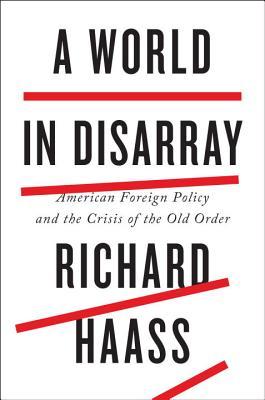
A World in Disarray: American Foreign Policy and the Crisis of the Old Order
by Richard N. Haass
Rating: 3.7 ⭐
An examination of a world increasingly defined by disorder and a United States unable to shape the world in its image, from the president of the Council on Foreign Relations.Things fall apart; the center cannot hold. The rules, policies, and institutions that have guided the world since World War II have largely run their course. Respect for sovereignty alone cannot uphold order in an age defined by global challenges from terrorism and the spread of nuclear weapons to climate change and cyberspace. Meanwhile, great power rivalry is returning. Weak states pose problems just as confounding as strong ones. The United States remains the world’s strongest country, but American foreign policy has at times made matters worse, both by what the U.S. has done and by what it has failed to do. The Middle East is in chaos, Asia is threatened by China’s rise and a reckless North Korea, and Europe, for decades the world’s most stable region, is now anything but. As Richard Haass explains, the election of Donald Trump and the unexpected vote for “Brexit” signals that many in modern democracies reject important aspects of globalization, including borders open to trade and immigrants.In A World in Disarray, Haass argues for an updated global operating system—call it world order 2.0—that reflects the reality that power is widely distributed and that borders count for less. One critical element of this adjustment will be adopting a new approach to sovereignty, one that embraces its obligations and responsibilities as well as its rights and protections. Haass also details how the U.S. should act towards China and Russia, as well as in Asia, Europe, and the Middle East. He suggests, too, what the country should do to address its dysfunctional politics, mounting debt, and the lack of agreement on the nature of its relationship with the world.A World in Disarray is a wise examination, one rich in history, of the current world, along with how we got here and what needs doing. Haass shows that the world cannot have stability or prosperity without the United States, but that the United States cannot be a force for global stability and prosperity without its politicians and citizens reaching a new understanding.

A New York Times Bestseller A provocative guide to how we must reenvision citizenship if American democracy is to surviveThe United States faces dangerous threats from Russia, China, North Korea, Iran, terrorists, climate change, and future pandemics. The greatest peril to the country, however, comes not from abroad but from within, from none other than ourselves. The question facing us is whether we are prepared to do what is necessary to save our democracy. The Bill of Obligations is a bold call for change. In these pages, New York Times bestselling author Richard Haass argues that the very idea of citizenship must be revised and expanded. The Bill of Rights is at the center of our Constitution, yet our most intractable conflicts often emerge from contrasting views as to what our rights ought to be. As former Supreme Court Justice Stephen Breyer pointed out, "Many of our cases, the most difficult ones, are not about right versus wrong. They are about right versus right." The lesson is clear: rights alone cannot provide the basis for a functioning, much less flourishing, democracy.But there is a cure: to place obligations on the same footing as rights. The ten obligations that Haass introduces here are essential for healing our divisions and safeguarding the country's future. These obligations reenvision what it means to be an American citizen. They are not a burden but rather commitments that we make to fellow citizens and to the government to uphold democracy and counter the growing apathy, anger, selfishness, division, disinformation, and violence that threaten us all. Through an expert blend of civics, history, and political analysis, this book illuminates how Americans can rediscover and recover the attitudes and behaviors that have contributed so much to this country's success over the centuries.As Richard Haass argues, "We get the government and the country we deserve. Getting the one we need, however, is up to us." The Bill of Obligations gives citizens across the political spectrum a plan of action to achieve it.

Foreign Policy Begins at Home: The Case for Putting America's House in Order
by Richard N. Haass
Rating: 3.5 ⭐
The biggest threat to the United States comes not from abroad but from within. This is the provocative, timely, and unexpected message of Council on Foreign Relations President Richard N. Haass’s Foreign Policy Begins at Home.A rising China, climate change, terrorism, a nuclear Iran, a turbulent Middle East, and a reckless North Korea all present serious challenges. But U.S. national security depends even more on the United States addressing its burgeoning deficit and debt, crumbling infrastructure, second class schools, and outdated immigration system.Foreign Policy Begins at Home describes a twenty-first century in which power is widely diffused. Globalization, revolutionary technologies, and the rise and decline of new and old powers have created a “nonpolar” world of American primacy but not domination. So far, it has been a relatively forgiving world, with no great rival threatening America directly. How long this strategic respite lasts, according to Haass, will depend largely on whether the United States puts its own house in order. Haass argues for a new American foreign policy: Restoration. At home, the new doctrine would have the country concentrate on restoring the economic foundations of American power. Overseas, the U.S. would stop trying to remake the Middle East with military force, instead emphasizing maintaining the balance of power in Asia, promoting economic integration and energy self-sufficiency in North America, and working to promote collective responses to global challenges.Haass rejects both isolationism and the notion of American decline. But he argues the United States is underperforming at home and overreaching abroad. Foreign Policy Begins at Home lays out a compelling vision for restoring America’s power, influence, and ability to lead the world.

A president of the Council on Foreign Relations compares the reasons behind the two Middle-East wars during the Bush administrations, drawing on senior-level interviews to argue that the first war was warranted while the second was not, in a critical assessment that examines U.S. policy today and what the author believes that policy should seek.

In this dramatic new perspective on international affairs, Richard N. Haass, one of the country's most brilliant analysts and able foreign policy practitioners, argues that it is hard to overstate the significance of there being no major power conflict in the world. America's great military, economic, and political power discourages traditional challenges; no ideological fault line divides the world into warring blocs. India, China, Japan, Russia, and Europe all seek a prolonged period of stability that would support economic growth. The opportunity thus exists for unprecedented cooperation among the major powers. This is good, because they share vulnerabilities. Globalization, which promotes trade and investment and eases travel and communication, also facilitates the spread of viruses (human and computer alike), weapons, terrorists, greenhouse gases, and drugs. And the United States, for all its strength, cannot defeat these threats alone. But opportunity is not inevitability. The question is whether the United States will be able to integrate other countries into global efforts against terrorism, the spread of nuclear weapons, genocide, and protectionist policies that jeopardize global economic prosperity. This compelling book explains why it must and how it can.

The Bureaucratic Entrepreneur: How to Be Effective in Any Unruly Organization
by Richard N. Haass
Rating: 3.9 ⭐
" How do you figure out what to do in a job? How do you get it done? How should you deal with demanding bosses? How can you get the most out of subordinates? What should you do to get along with difficult colleagues and handle powerful interest groups and the media? Just how can you succeed in a world where persuasion rather than direct command is the rule? Using a compass as his operating metaphor--your boss is north of you, your staff is south, colleagues are east and so on--Richard Haass provides clear, practical guidelines for setting goals and translating goals into results. The result is a lively, useful book for the tens of millions of Americans working in complex and unruly organizations of every sort and for students of both public administration and business. The Bureaucratic Entrepreneur is a new and updated edition of Haass's 1994 book, The Power to Persuade. "

It is now seven years since the end of the Cold War—and still there is no name for the present era, much less an American foreign policy to replace the obsolete doctrine of containment. The Reluctant Sheriff fills this void. It is the first book to provide a comprehensive understanding of the post-Cold War world and a compass to help the United States navigate it.Richard Haass proposes that the United States adopt a new foreign policy—"regulation"—and work to promote order in an often unruly world. Haass suggests that the United States will often need to assume the role of global sheriff, forging coalitions or posses of states and others for specific tasks. Haass also argues that Americans need to resist the lure of isolationism and maintain spending on defense, intelligence, foreign aid, and diplomacy at current (and affordable) levels. He warns that anything less risks squandering the spoils of winning the Cold War—and setting the stage for a new era of dangerous global competition.

Intervention: The Use of American Military Force in the Post-Cold War World
by Richard N. Haass
Rating: 3.5 ⭐
This new edition of the Carnegie Endowment bestseller—selected by Choice as "an outstanding academic book of 1995"—now also discusses the interventions in Haiti and Bosnia, the 1998 crisis (and earlier skirmishes) with Iraq, and the decision to not intervene to halt apparent genocide in Central Africa. In the core original study, which draws upon twelve cases—including Somalia, Lebanon, Panama, Grenada, and the Gulf War—Richard Haass suggests political and military guidelines for potential U.S. military interventions ranging from peacekeeping and humanitarian operations to preventive strikes and all-out warfare.

The Power to Persuade answers a fundamental how can you safely and successfully navigate a world where persuasion, rather than direct command, is the rule? Scores of business books suggest how to boost profits, but this is the only book to tell managers in government and other public sector organizations how to improve performance when there is no clear bottom line.While teaching at Harvard's Kennedy School of Government, Richard N. Haass realized that no existing book advised those in political settings how to become more effective. Now he has filled the gap. Using a compass as his operating metaphor - your boss is north of you, your staff is south of you, and so on - he provides guidelines for managing key relationships, setting agendas, and translating goals into results. His interviews with Colin Powell, James Baker, Robert Strauss, and dozens of others yield much practical insight.For the twenty million Americans now employed in the public sector, and for millions more working in complex or unruly organizations of every sort, here is a lively, useful book about practicing the delicate art of persuasion to gain influence and achieve success.

Richard N. Haass, Tuti Kitap'tan çıkan Yeni Amerika adlı kitabında, ABD'nin kendi sınırları içerisinde düzen sağlamadan, II. Dünya Savaşı'ndan bu yana dek sürdürdüğü liderliğini devam ettiremeyeceğini savunuyor. ABD'nin diğer ülkeler üzerindeki hâkimiyetinin önce kendi evini restore etmesinden geçeceğini vurgulayan Haass, küresel lider olabilmenin bir yol haritasını sunarak küresel gücün tek bir ülkenin hâkimiyetinden çıkarak geniş alanlara yayıldığı yeni bir 21. yüzyılı tanımlıyor.Hepimizin kabul edebileceği gibi; Amerika çok gelişmiş bir haberleşme ağına ve dünya üzerinde de çok etkin bir kültüre sahip. Buna karşın Amerikan dış politikası Kore’den Vietnam’a, Vietnam’dan Latin Amerika’ya ve son olarak da Ortadoğu ve Asya’ya kadar müttefiklerinin başını derde sokacak kadar yanılgılarla dolu ve bu dış politikanın kaynakları da Amerikan iç politikasında yatıyor. Haass kitabının bir yerinde; “…Büyük güçler büyük güçler gibi davrandıklarında diğerleri arasında rekabet, korku veya kindarlık yaratmazlar” diyor. Oysa Amerika’nın dış politikası diğer ülkeler üzerinde korku yaratmakla kalmıyor, kendisine karşı küskünlükler de yaratıyor. Bu duygular saldırganlığa ve teröre dönüşüyor.Haass, ABD’nin içeride uygulamasını gerekli gördüğü düzeni, yurtdışında uyguladığı sömürü düzeni üzerinden tartışıyor. Yeni Amerika-Dış Politika İçeride Başlar, -zamanımızın ötesinde- bir vizyon ortaya koyuyor.

Some international conflicts can be solved while others defy solution. Haass argues that for diplomatic efforts to succeed, conditions must be ripe for diplomacy. He studies conflicts in the Middle East, Cyprus and the Aegean, the Indian subcontinent, South Africa and Northern Ireland.

Restoring the Balance: A Middle East Strategy for the Next President
by Richard N. Haass
Rating: 4.0 ⭐
The next U.S. president will need to pursue a new strategic framework for advancing American interests in the Middle East. The mounting challenges include sectarian conflict in Iraq, Iran's pursuit of nuclear capabilities, failing Palestinian and Lebanese governments, a dormant peace process, and the ongoing war against terror. Compounding these challenges is a growing hostility toward U.S. involvement in the Middle East. The old policy paradigms, whether President George W. Bush's model of regime change and democratization or President Bill Clinton's model of peacemaking and containment, will no longer suit the likely circumstances confronting the next administration in the Middle East. In R estoring the Balance, experts from the Saban Center at the Brookings Institution and from the Council on Foreign Relations propose a new, nonpartisan strategy drawing on the lessons of past failures to address both the short-term and long-term challenges to U.S. interests. Following an overview chapter by Richard N. Haass, president of the Council on Foreign Relations, and Martin Indyk, director of the Saban Center, individual chapters address the Arab-Israeli conflict, counterterrorism, Iran, Iraq, political and economic development, and nuclear proliferation. Specific policy recommendations stem from in-depth research and extensive dialogue with individuals in government, media, academia, and the private sector throughout the region. The experts include Stephen Biddle, Isobel Coleman, Steven A. Cook, Steven Simon, and Ray Takeyh from the Council on Foreign Relations and Daniel L. Byman, Suzanne Maloney, Kenneth M. Pollack, Bruce Riedel, ShibleyTelhami, and Tamara Cofman Wittes from Brookings' Saban Center.

Bureaucratic Entrepreneur : How to Be Effective in Any Unruly Workplace
by Richard N. Haass
Rating: 4.5 ⭐


هذا ليس كتابا عاديا حول السياسة الخارجية. إنه سرد حي وصادق عن التاريخ الحديث، سرد ينضح بوجهات نظر فيها البلاغة وفيها الفرادة بقلم رجل كان محركا اساسياً داخل البيت الابيض ووزارة الخارجية. وهو مدخل الى التاريخ ومذكرات شخصية في آن معا، يقدم لنا اطلالة قيمة على عدد من اهم الاحداث الدولية المعاصرة، كما انه يعد بوصلة كانت الولايات المتحدة بأمس الحاجة اليها، كي تهتدي على ضوئها الى كيفية تطبيق الدروس المستقاة من كل من الحربين، بحيث تكون في موضع افضل مستقبلاً، يخولها استخدام الآليات والتكتيكات التي اثبتت جدواها، وتفادى تكرار تلك التي اثبتت تطبيقها عدم جدواه. "ريتشارد هاس" هو على الدوام رجل يتقد ذكاء. وفي هذا الكتاب الذي يعلمنا الكثير حول الطريقة التي يجب ان تصاغ بها السياسة الخارجية الامريكية، وما الذي يجب ان تسعى الى تحقيقه، والوسيلة المناسبة للاضطلاع بذلك. والنتيجة هي سيرة رائعة وتمهيد للمستقبل".

Policies of Thatcherism
by Richard N. Haass
This volume is a collection of pamphlets prepared over the years by the London thinktank which laid the foundation for the policies of Margaret Thatcher, and charted the course for the domestic and international policies of Great Britain over the years, in the longest tenure as prime minister of this century. Various pamphlets address in depth a broad range of key issues from privitisation, to new thoughts on the welfare state, to education. This compilation provides perhaps the most comprehensive and thorough exploration of Thatcher's policies available, as it is the product of those who developed them and understand them best, explaining how the ideas of the free market are combined with those of social responsibility. Such information is invaluable to anyone interested in gaining a genuine understanding of the inner workings of Great Britain and its role in the world today. Co-published with the Centre for Policy Studies.
Beyond the INF Treaty
by Richard N. Haass
With the signing of the intermediate-range nuclear forces (INF) treaty in December 1987, a chapter in NATO history came to an end. This agreement eliminated an entire class of nuclear weapons from Europe. This volume analyzes the possible repercussions of the INF treaty in the context of NATO's overall doctrine of flexible response, and concludes that the U.S. and NATO must adopt arms and arms control policies consistent with one another and with NATO doctrine. Co-published with the Center for Science and International Affairs, Harvard University.

A New U.S. Policy Toward India and Pakistan
by Richard N. Haass
The time has come to rethink the U.S. approach to the Indo-Pakistani nuclear rivalry, says a Council-sponsored independent Task Force. Instead of continuing the current policy of trying to roll back India's and Pakistan's de facto nuclear capabilities, the United States should work with both countries to pursue more limited but potentially achievable objectives, such as to discourage nuclear testing, nuclear weapons deployment, and the export of nuclear weapon or missile-related material and technology.According to the report, U.S. relations with the regional powers of South Asia have been hamstrung by differences between congressional and executive opinion, and action on a broad range of U.S. interests - from economics to security - has been held hostage to the unrealistic expectations of the current policy.The report further recommends that the United States expand its economic, political, and military relations with India and Pakistan simultaneously, seeking positive improvements in relations with both countries, as opposed to the either/or approach that marked past U.S. efforts to deal with the rivalry. It also urges a closer strategic relationship with India and the resumption of limited conventional arms sales to Pakistan.On the issue of Kashmir, the report calls for incremental steps to ease tensions and advises against ambitious diplomacy designed to solve this long-standing problem.Among the report's other key the United States should strongly support Indian and Pakistani economic reforms, work to promote robust democratic institutions in the region, and restructure its own bureaucracy to better deal with South Asia.The Task Force - chaired by Richard N. Haass, director of Foreign Policy Studies at the Brookings Institution, and directed by Council Fellow Gideon Rose - includes U.S. experts and former senior policy makers. This report, which includes important documentation as well as the additional and dissenting views of several Task Force members, provides a comprehensive and creative examination of U.S. policy toward India and Pakistan.

Beyond the INF Treaty
by Richard N. Haass
With the signing of the intermediate-range nuclear forces (INF) treaty in December 1987, a chapter in NATO history came to an end. This agreement eliminated an entire class of nuclear weapons from Europe. This volume analyzes the possible repercussions of the INF treaty in the context of NATO's overall doctrine of flexible response, and concludes that the U.S. and NATO must adopt arms and arms control policies consistent with one another and with NATO doctrine. Co-published with the Center for Science and International Affairs, Harvard University.

Economic sanctions: Too much of a bad thing
by Richard N. Haass
![Bureaucratic Entrepreneur, The unknown Edition by Haass, Richard N. [1998]](https://m.media-amazon.com/images/S/compressed.photo.goodreads.com/books/1698819272i/149280149.jpg)
Bureaucratic Entrepreneur, The unknown Edition by Haass, Richard N. [1998]
by Richard N. Haass
![[Economic Sanctions and American Diplomacy (Critical America)] [Author: x] [June, 1998]](https://m.media-amazon.com/images/S/compressed.photo.goodreads.com/books/1698040787i/167792348.jpg)
[Economic Sanctions and American Diplomacy (Critical America)] [Author: x] [June, 1998]
by Richard N. Haass
The Reluctant Sheriff. the United States After the Cold War
by Richard N. Haass

The Unraveling: How to Respond to a Disordered World
by Richard N. Haass
With US hegemony waning and no successor waiting to pick up the baton, the current international system will likely give way to a larger number of power centers acting with increasing autonomy. The post-Cold War order is unraveling, and it will be missed.