
Adam Przeworski
Adam Przeworski is the Carroll and Milton Professor of Politics and (by courtesy) Economics at New York University. Previously he taught at the University of Chicago, where he was the Martin A. Ryerson Distinguished Service Professor, and held visiting appointments in India, Chile, France, Germany, Spain, and Switzerland. A member of the American Academy of Arts and Sciences since 1991, he is the recipient of the 1985 Socialist Review Book Award, the 1998 Gregory M. Luebbert Article Award, the 2001 Woodrow Wilson Prize, the 2010 Lawrence Longley Award, the 2010 Johan Skytte Prize, the 2018 Sakip Sabanci Award, and the 2018 Juan Linz Prize.. He recently published Why Bother with Elections? (London: Polity Press 2018).
27 Books Written

Democracy and the Market: Political and Economic Reforms in Eastern Europe and Latin America
by Adam Przeworski
Rating: 3.8 ⭐
• 1 recommendation ❤️
The quest for freedom from hunger and repression has triggered in recent years a worldwide movement toward political democracy and economic rationality. Never have so many people experimented with democratic institutions. At the same time, traditional strategies of economic development have collapsed in Eastern Europe and Latin America and entire economic systems are being transformed on both continents. What should we expect in the countries that venture on the paths to democracy and markets? Will these transitions result in democracies or in new dictatorships? What economic system, new or old, will emerge? This major book analyzes recent events in Eastern Europe and Latin America, focusing on transitions to democracy and market-oriented economic reforms. The author underscores the interdependence of political and economic transformations and draws on extensive local data as part of his analysis. A distinctive feature of the book is that it employs models derived from politics, economics, and game theory. This book will be of particular interest to scholars and graduate students in political science and sociology.

Is democracy in crisis?The current threats to democracy are not just political: they are deeply embedded in the democracies of today, in current economic, social, and cultural conditions.In Crises of Democracy, Adam Przeworski presents a panorama of the political situation throughout the world of established democracies, places it in the context of misadventures of democratic regimes, and speculates on the prospects.Our present state of knowledge does not support facile conclusions. We should not believe the flood of writings that have all the answers.Avoiding technical aspects, this book is addressed not only to professional social scientists, but to everyone concerned about the prospects of democracy.

Three principal choices, confronted by socialist movements as they developed within capitalist societies, are examined to trace the development of socialist strategies since the mid-19th century.

With the collapse of traditional parties around the world and with many pundits predicting a "crisis of democracy", the value of elections as a method for selecting by whom and how we are governed is being questioned. What are the virtues and weaknesses of elections? Are there limitations to what they can realistically achieve? In this deeply informed book world-renowned democratic theorist Adam Przeworski offers a warts-and-all analysis of elections and the ways in which they affect our lives. Elections, he argues, are inherently imperfect but they remain the least bad way of choosing our rulers. According to Przeworski, the greatest value of elections, by itself sufficient to cherish them, is that they process whatever conflicts may arise in society in a way that maintains relative liberty and peace. Whether they succeed in doing so in today's turbulent political climate remains to be seen.
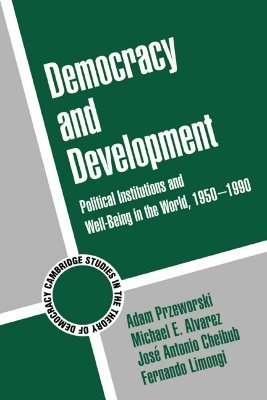
Democracy and Development: Political Institutions and Well-Being in the World, 1950–1990
by Adam Przeworski
Rating: 3.8 ⭐
Is economic development conducive to political democracy? Does democracy foster or hinder material welfare? These two questions are examined by looking at the experiences of 135 countries between 1950 and 1990. Descriptive information, statistical analyses, and historical narratives are interwoven to gain an understanding of the dynamic of political regimes and their impact on economic development. The often surprising findings dispel any notion of a tradeoff between democracy and development. Economic development does not generate democracies, but democracies are much more likely to survive in wealthy societies.

The political institutions under which we live today evolved from a revolutionary idea that shook the world in the second part of the eighteenth that a people should govern itself. Yet if we judge contemporary democracies by the ideals of self-government, equality, and liberty, we find that democracy is not what it was dreamt to be. This book addresses central issues in democratic theory by analyzing the sources of widespread dissatisfaction with democracies around the world. With attention throughout to historical and cross-national variations, the focus is on the generic limits of democracy in promoting equality, effective participation, control of governments by citizens, and liberty. The conclusion is that although some of this dissatisfaction has good reasons, some is based on an erroneous understanding of how democracy functions. Hence, although the analysis identifies the limits of democracy, it also points to directions for feasible reforms.

¿Por qué tomarse la molestia de hacer elecciones? Pequeño manual para entender el funcionamiento de la democracia
by Adam Przeworski
Rating: 3.5 ⭐
¿Qué es razonable esperar de las elecciones en el mundo real, en que los mercados distribuyen de manera desigual los ingresos y en que los políticos hacen su mejor esfuerzo para perpetuarse en el poder? ¿Podemos hablar de elecciones en casos en que se debe optar entre dos variantes de lo mismo? ¿Es suficiente con que una mayoría de votantes considere que algo es lo mejor para todos? ¿Por qué los comicios tal como los conocemos son "el menos malo de los mecanismos" para elegir a quienes nos gobiernan?Con enorme solvencia, Adam Przeworski, uno de los principales politólogos de la época contemporánea, nos guía por todas las peripecias de los países y sus ciudadanos a la hora de decidir quiénes guiarán sus rumbos. Así, entran en juego las desigualdades económicas, los trucos, engaños y virtudes de los políticos o los sentimientos de nacionalidad, tanto como un repaso de las principales teorías de la política, el derecho y la sociedad, de Montesquieu y Condorcet a Kelsen y el neoconservadurismo. De Inglaterra a Zimbabue, de Hong Kong a México, Przeworski concentra en estas páginas, con la claridad expositiva de un manual de fácil lectura, un exhaustivo y atrapante "estado de la cuestión" sobre las elecciones.Este libro es un ejemplo del método intelectual de no tomar por obvio lo que parece serlo, y hacerse las preguntas que otros dejan pasar de largo. Así, el autor explica en estas páginas por qué no podemos esperar mayor "justicia" de las elecciones, que tienden a ser "impotentes" frente a muchos de los principales obstáculos que enfrentan, y por qué son en general incapaces de concretar los ideales que les dieron origen como base de los sistemas democráticos. Pese a todo –argumenta Przeworski–, los comicios son un método irrenunciable, entre otras razones porque apuntan a procesar de manera pacífica los conflictos en sociedades con profundas divisiones.

No political party has every won an electoral majority on a program offering a socialist transformation of society. The authors explain why.

The purpose of this text is to introduce concepts for studying relationships between states and markets. The economy and the state are thus analyzed as networks of relationships between principals and agents, each occupying a particular position in the institutional structure. The book then analyzes systematically the effect of the organization of the state on the functioning of the economy. It isolates the conditions that trigger government's positive or negative responses to the economy.

Sustainable Democracy is a joint report of twenty-one social scientists, from eleven countries and four academic disciplines, who collaborated over the period of two years under the name of the Group on East-South Systems Transformations (ESST). Their report identifies the principal political and economic choices confronting new democracies in Southern and Eastern Europe and South America, while evaluating their merits and feasibility in the light of current social science knowledge. The scientists explore the social, political and economic conditions under which democracy is likely to generate desirable and politically desired objectives, as well as, whether it is likely to last. It is argued that the state has an essential role in promoting universal citizenship and in creating conditions for a sustained economic growth. Special emphasis is placed on the interdependence between political and economic reforms.

The purpose of this book is to identify problems encountered in one area of social scientific inquiry and to offer some solutions to them. But the identification of problems is not independent of the proposed solutions; both are based on a set of assumptions about the accepted goals and the postulated model of inquiry. Since the study of societies lies at the crossroad of several models of science, these assumptions are of crucial importance. As different models of science persist within and between various branches of the study of society, an attempt will be made to state some assumptions of the set of recommendations that will be presented.

How valid is the Marxian theory of imperialism? This book traces the historical development of the theory of imperialism, the internationalisation of capital and theories of capitalist nation-state formation.

Demokrasinin Krizleri;; -Otoriterleşmenin Kıyısında Çağdaş Siyasetin Ahvali-
by Adam Przeworski
Rating: 4.5 ⭐
Demokrasinin Krizleri;; -Otoriterleşmenin Kıyısında Çağdaş Siyasetin Ahvali-

En ce début de XXIe siècle, nous assistons à l’effondrement de nombreux partis politiques traditionnels et à l’émergence de nouveaux mouvements qui remettent radicalement en cause les élites établies. La valeur des élections, comme moyen de se choisir des dirigeants, est plus que jamais en question, et certains experts prédisent une crise imminente de la démocratie. Il devient donc urgent de s’interroger sur le fonctionnement des élections, sur leurs vertus et leurs faiblesses, sur ce qu’elles peuvent ou ne peuvent pas nous apporter.Dans ce livre, Adam Przeworski fait le bilan de nos connaissances actuelles des processus électoraux, en examinant leurs sources historiques, leur logique politique et économique et leurs effets sur notre vie quotidienne. Selon lui, si les élections sont intrinsèquement imparfaites, elles restent la moins mauvaise méthode de sélection des gouvernements. L’expérience montre qu’elles nous permettent de gérer les conflits politiques et sociaux qui traversent nos sociétés tout en y maintenant la liberté et la paix civile – telle est leur principale vertu, celle qui justifie à elle seule que nous les préférions à tout autre système politique. Reste à savoir si elles pourront continuer de jouer ce rôle essentiel à l’avenir.

Kapitalizm ve Sosyal Demokrasi
by Adam Przeworski
Kapitalizm ve Sosyal Demokrasi, Batili liberal demokratik ulkelerdeki isci sinifinin neden cok-sinifmerkezli, ekonomik acidan reformist (sosyal demokrat) partiler tarafindan orgutlendikleri ve orgutlenmekte olduklari sorusundan hareketle, sosyalist hareketin, "sosyal demokrasi deneyimlerinden" cikarabilecegi dersler olup olmadigini sorguluyor.Bunu yaparken hem sosyal demokrasiye hem de sosyalist harekete iliskin elestirel ve carpici tespitler de yapan Kapitalizm ve Sosyal Demokrasi, Sol'un sadece bir ozgurlesme gucu olarak vaadini degil, ayni zamanda secimlerde bir alternatif olarak ozgunlugunu de yitirmis gibi gorundugu bugun, bu acmazdan kurtulmanin yolunun, yeni toplumsal hareketler ve dinamiklerle de butunlesmekten gectigini iddia ediyor.Nihayet, Kapitalizm ve Sosyal Demokrasi, dunden nasibini alan ve yarini kurma iradesiyle donanmis bir sosyalist hareketin gecebilecegi yeni patikalarin kuramsal, pratik ve tarihsel izlerini suruyor.Sayfa 416Baski 2012 Phoenix

Democracia Sustentable
by Adam Przeworski
Libro usado en buenas condiciones, por su antiguedad podria contener señales normales de uso

À quoi bon voter ?
by Adam Przeworski
En ce début de XXI e siècle, nous assistons à l'effondrement de nombreux partis politiques traditionnels et à l'émergence de nouveaux mouvements qui remettent radicalement en cause les élites établies. La valeur des élections, comme moyen de se choisir des dirigeants, est plus que jamais en question, et certains experts prédisent une crise imminente de la démocratie. Il devient donc urgent de s'interroger sur le fonctionnement des élections, sur leurs vertus et leurs faiblesses, sur ce quelles peuvent ou ne peuvent pas nous apporter. Dans ce livre, Adam Przeworski fait le bilan de nos connaissances actuelles des processus électoraux, en examinant leurs sources historiques, leur logique politique et économique et leurs effets sur notre vie quotidienne. Selon lui, si les élections sont intrinsèquement imparfaites, elles restent la moins mauvaise méthode de sélection des gouvernements. L'expérience montre quelles nous permettent de gérer les conflits politiques et sociaux qui traversent nos sociétés tout en y maintenant la liberté et la paix civile - telle est leur principale vertu, celle qui justifie à elle seule que nous les préférions à tout autre système politique. Reste à savoir si elles pourront continuer de jouer ce rôle essentiel à l'avenir. Adam Przeworski connaît mieux que personne les élections et leurs enjeux. Ce petit livre distille une sagesse politique durement acquise, le fruit de toute une vie de recherche. Il ne pouvait mieux tomber.John Dunn, Université de Cambridge

Kapitalizmde Devlet ve Ekonomi
by Adam Przeworski

Democracy and Development: Political Institutions and Well-Being in the World, 1950-1990
by Adam Przeworski
Democracy and the Market: Political and Economic Reforms in Eastern Europe and Latin America: 1st (First) Edition
by Adam Przeworski
Some problems in the study of the transition to democracy
by Adam Przeworski
Democracy and the Market: Political and Economic Reforms in Eastern Europe and Latin America (Studies in Rationality and Social
by Adam Przeworski
Crisis de la democracia ¿Adónde pueden llevarnos el desgaste institucional y la polarización?, Las
by Adam Przeworski
¿Está en crisis la democracia? ¿El descontento social generalizado indica el fin de una era? ¿Cuáles son los desastres que pueden hacer tambalear la continuidad el colapso económico, los conflictos sociales intensos, las parálisis políticas? ¿En qué casos los conflictos se resuelven dentro de las instituciones y cuándo escalan hasta quebrarlas? Eludiendo los vaticinios que cada tanto anuncian la muerte de la historia, de las ideologías o del Estado-nación, y muy preocupado por el futuro, Adam Przeworski, uno de los politólogos más agudos y respetados, presenta un recorrido iluminador para comprender a fondo la situación actual de las democracias establecidas. Sin tecnicismos, a partir de definiciones básicas (¿qué entendemos por democracia y por crisis?), analizando las condiciones de países de América y Europa sobre el eje del pasado y el presente, Przeworski explora primero la experiencia histórica de democracias que se derrumbaron, como la Alemania de Weimar y el Chile de Salvador Allende, y de otras que sobrevivieron aun a costa de represión política y ruptura del orden, como Francia y los Estados Unidos en los años sesenta. Y pone el foco en el período más reciente, de 2008 hasta hoy, para indagar qué rasgos lo diferencian del pasado y obligan a pensar todo de nuevo. Así, examina la desestabilización de los sistemas tradicionales de partidos, el crecimiento de las derechas, el estancamiento de los bajos ingresos, la polarización que atraviesa el tejido social y afecta incluso la vida familiar, la caída de la creencia en el progreso material. Este libro reflexiona sobre los problemas profundos de las democracias más allá de los líderes coyunturales que ocupan el centro de la escenay sobre las razones de la desconfianza ciudadana, y nos invita a sostener una pregunta sin respuestas qué puede ocurrir si los gobiernos no logran mejorar la vida de las personas que votaron por ellos.
Democracy and the Market: Political and Economic Reforms in Eastern Europe and Latin America (Studies in Rationality and Social
by Adam Przeworski
States and Markets : A Primer in Political Economy (Paperback)--by Adam Przeworski [2003 Edition]
by Adam Przeworski
Sociological theory and the study of population: Reflections on the work of the Clacso Commission on population
by Adam Przeworski