
Thomas C. Schelling
Thomas Crombie Schelling was an American economist and professor of foreign affairs, national security, nuclear strategy, and arms control at the School of Public Policy at University of Maryland, College Park. He is also co-faculty at the New England Complex Systems Institute. He was awarded the 2005 Nobel Prize in Economics (shared with Robert Aumann) for "having enhanced our understanding of conflict and cooperation through game-theory analysis." Excerpted from Wikipedia.
19 Books Written

A series of closely interrelated essays on game theory, this book deals with an area in which progress has been least satisfactory―the situations where there is a common interest as well as conflict between adversaries: negotiations, war and threats of war, criminal deterrence, extortion, tacit bargaining. It proposes enlightening similarities between, for instance, maneuvering in limited war and in a traffic jam; deterring the Russians and one’s own children; the modern strategy of terror and the ancient institution of hostages.
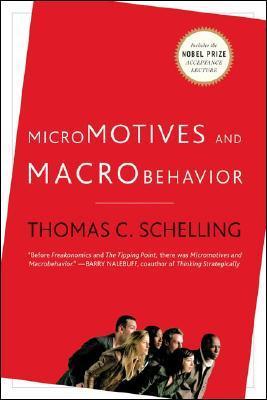
"Schelling here offers an early analysis of 'tipping' in social situations involving a large number of individuals." —official citation for the 2005 Nobel PrizeMicromotives and Macrobehavior was originally published over twenty-five years ago, yet the stories it tells feel just as fresh today. And the subject of these stories—how small and seemingly meaningless decisions and actions by individuals often lead to significant unintended consequences for a large group—is more important than ever. In one famous example, Thomas C. Schelling shows that a slight-but-not-malicious preference to have neighbors of the same race eventually leads to completely segregated populations.The updated edition of this landmark book contains a new preface and the author's Nobel Prize acceptance speech.
In this landmark book, Nobel laureate Thomas C. Schelling considers the ways in which military capabilities—real or imagined—are used as bargaining power. This edition contains a new foreword by the author where he considers the book’s relevance over forty years after its first publication. Included as an afterword is the text of Professor Schelling’s Nobel acceptance speech in which he reflects upon the global taboo that has emerged against nuclear weapons since Hiroshima."This is a brilliant and hardheaded book. It will frighten those who prefer not to dwell on the unthinkable and infuriate those who have taken refuge in stereotypes and moral attitudinizing."—Gordon A. Craig, New York Times Book ReviewThomas C. Schelling is Distinguished University Professor, Department of Economics and School of Public Affairs, University of Maryland and Lucius N. Littauer Professor of Political Economy, Emeritus, Harvard University. He is co-recipient of the 2005 Nobel Prize in Economics. The Henry L. Stimson Lectures Series

All of the essays in this new collection by Thomas Schelling convey his unique perspective on individuals and society. This perspective has several it is strategic in that it assumes that an important part of people's behavior is motivated by the thought of influencing other people's expectations; it views the mind as being separable into two or more parts (rational/irrational; present-minded/future-minded); it is motivated by policy concerns--smoking and other addictions, global warming, segregation, nuclear war; and while it accepts many of the basic assumptions of economics--that people are forward-looking, rational decision makers, that resources are scarce, and that incentives are important--it is open to modifying them when appropriate, and open to the findings and insights of other social science disciplines. Schelling--a 2005 Nobel Prize winner-- has been one of the four or five most important social scientists of the past fifty years, and this collection shows why.

2014 Reprint of 1961 Edition. Full facsimile of the original edition. Not reproduced with Optical Recognition Software. This study is an attempt to identify the meaning of arms control in the post war period. It presents an analysis of arms control with particular emphasis on the military policy involved. The general objectives of the study is to advance some aspects of the intellectual state of the art in arms control and to provide some concrete data on the technical and strategic problems of importance. Schelling remains relevant today for his work on game theory.

This book explores the extent to which pricing incentives such as charges on emissions, in contrast to regulatory standards, can be shaped into a practical policy that is technically effective, politically enactable, administratively enforceable, and equitable. It also compares he advantages and disadvantages of this approach to those that characterize the policy of compliance to regulatory standards. And it identifies the criteria on which either pricing mechanisms or regulatory standards should be based. Three case studies comprise the heart of the book. One investigates carcinogenic chemical emissions, another audits the tradeoffs in controlling aircraft noise near major airports, and the third treats the protection of air quality from pollution by primarily stationary sources. The case studies are introduced by a chapter that gives numerous examples of possible pricing approaches and identifies common lessons that the three diverse studies reinforce.: The studies are followed by a chapter which is based on interviews with Congressional staff, environmentalists, and industrial lobbyists and other interest groups in Washington, revealing their assessments of pricing mechanisms in environmental protection.Thomas C. Schelling and his co-authors - David Harrison, Jr., Albert L. Nichols, Robert Repetto, and Steven J. Kelman - are all affiliated with the Kennedy School of Government, Harvard University. The book is fifth in the series, Regulation of Economic Activity.
1979 Thomas C. Schelling working with the Design Committee on Long-Range Energy Policy, published by Committee for Economic Development. Focuses on THE NATURE OF THE ENERGY PROBLEM, THE SIZE OF THE ENERGY PROBLEM, THE CRITICAL ROLE OF OIL IMPORTS, THE PRICE SYSTEM AND ITS LIMITS. Working with Henry B. Schacht, A Robert Abboud, Robert C. Holland, Franklin A Lindsay, William F. May, John C. Sawhill

Little will be done in the near future to reduce greenhouse gas emissions. The divisions between European and American policymakers and between developed and developing countries will take many years to bridge. This is not necessarily a bad thing, as it will give all nations an opportunity to develop action programs for taxation, research, subsidization, and regulation. Besides, since future generations will undoubtedly be richer than their grandparents, postponing the cost of curtailing emissions makes good Future generations will be able to bear such costs more easily. "Costs and Benefits of Greenhouse Gas Reduction" is one in a series of new AEI studies related to the globalization of environmental policy. These studies will focus on specific issues, such as global climate change, and on the new institutional arrangements required to deal with them. A list of publications in this series appears inside. Thomas C. Schelling is Distinguished University Professor, Department of Economics and School of Public Affairs, University of Maryland. He has also served on the faculties of Yale and Harvard Universities.

The Terrorist Use of Nuclear Weapons
by Thomas C. Schelling
The Conventional Status of Nuclear Weapons
by Thomas C. Schelling

La Strategia del Conflitto
by Thomas C. Schelling

American Economic Review - March 1992
by Thomas C. Schelling
March 1992 edition of the American Economic Review. With articles by Thomas C. Schelling, Christina H. Paxson, Justin Yifu Lin and others. 369 pages.
NATIONAL ECONOMIC BEHAVIOR: An Introduction to Algebraic Analysis
by Thomas C. Schelling
Hockey Helmets, Concealed Weapons, and Daylight Savings / A Study of Binary Choices with Externalities
by Thomas C. Schelling
Arms and Influence: Library Edition
by Thomas C. Schelling
Strategy and Arms Control by Thomas C. Schelling, Morton H. Halperin(July 1, 1985) Paperback
by Thomas C. Schelling
Strategy of Conflict
by Thomas C. Schelling