Loading themes...
Explore the best books about Computer Science theme.

Illustrated in B/W. A sweeping, atmospheric history of Bell Labs that highlights its unparalleled role as an incubator of innovation and birthplace of the century's most influential technologies.

Since Don’t Make Me Think was first published in 2000, over 400,000 Web designers and developers have relied on Steve Krug’s guide to help them understand the principles of intuitive navigation and information design.In this 3rd edition, Steve returns with fresh perspective to reexamine the principles that made Don’t Make Me Think a classic-–with updated examples and a new chapter on mobile usability. And it’s still short, profusely illustrated…and best of all–fun to read.If you’ve read it before, you’ll rediscover what made Don’t Make Me Think so essential to Web designers and developers around the world. If you’ve never read it, you’ll see why so many people have said it should be required reading for anyone working on Web sites.

The Barnes & Noble Review March 1999 While Gates, Jobs, and the other big boys of Silicon Valley are basking in the glory of the information age, renowned Los Angeles Times reporter Michael Hiltzik reveals how, back in the early '70s, a group of inventors at Xerox's Palo Alto Research Center (PARC) blazed the trail for all of today's indispensable technology from the PC to email to ATMs to meteorologists' weather maps. And they did it without fanfare or recognition from their employer. Hiltzik's Dealers of Lightning provides a fascinating look at technohistory that sets the record straight. In Dealers of Lightning, Hiltzik describes the forces and faces behind the revolution that the Xerox PARC team single-handedly spawned. The Xerox PARC group was composed solely of top technical minds. The decision was made at Xerox headquarters to give the team complete freedom from deadlines and directives, in hopes of fostering a true creative environment. It worked perhaps too well. The team responded with a steady output of amazing technology, including the first version of the Internet, the first personal computer, user-friendly word-processing programs, and pop-up menus. Xerox, far from ready for the explosion of innovation, failed to utilize the technology dreamed up by the group. Out of all the dazzling inventions born at Xerox PARC, only a handful were developed and marketed by Xerox. However, one of these inventions, the laser printer, proved successful enough to earn billions for the company, therefore justifying its investment in the research center. Most oftheteam's creations would go on to be developed and perfected by other companies, such as IBM, Apple, and Microsoft. Drawing from interviews with the engineers, executives, and scientists involved in the Xerox PARC, Dealers of Lightning chronicles an amazing era of egos, ideas, and inventions at the dawn of the computer age.
A New York Times technology and business reporter charts the dramatic rise of Bitcoin and the fascinating personalities who are striving to create a new global money for the Internet age.Digital Gold is New York Times reporter Nathaniel Popper’s brilliant and engrossing history of Bitcoin, the landmark digital money and financial technology that has spawned a global social movement.The notion of a new currency, maintained by the computers of users around the world, has been the butt of many jokes, but that has not stopped it from growing into a technology worth billions of dollars, supported by the hordes of followers who have come to view it as the most important new idea since the creation of the Internet. Believers from Beijing to Buenos Aires see the potential for a financial system free from banks and governments. More than just a tech industry fad, Bitcoin has threatened to decentralize some of society’s most basic institutions.An unusual tale of group invention, Digital Gold charts the rise of the Bitcoin technology through the eyes of the movement’s colorful central characters, including an Argentinian millionaire, a Chinese entrepreneur, Tyler and Cameron Winklevoss, and Bitcoin’s elusive creator, Satoshi Nakamoto. Already, Bitcoin has led to untold riches for some, and prison terms for others.

An introduction to a broad range of topics in deep learning, covering mathematical and conceptual background, deep learning techniques used in industry, and research perspectives.Deep learning is a form of machine learning that enables computers to learn from experience and understand the world in terms of a hierarchy of concepts. Because the computer gathers knowledge from experience, there is no need for a human computer operator to formally specify all the knowledge that the computer needs. The hierarchy of concepts allows the computer to learn complicated concepts by building them out of simpler ones; a graph of these hierarchies would be many layers deep. This book introduces a broad range of topics in deep learning.The text offers mathematical and conceptual background, covering relevant concepts in linear algebra, probability theory and information theory, numerical computation, and machine learning. It describes deep learning techniques used by practitioners in industry, including deep feedforward networks, regularization, optimization algorithms, convolutional networks, sequence modeling, and practical methodology; and it surveys such applications as natural language processing, speech recognition, computer vision, online recommendation systems, bioinformatics, and videogames. Finally, the book offers research perspectives, covering such theoretical topics as linear factor models, autoencoders, representation learning, structured probabilistic models, Monte Carlo methods, the partition function, approximate inference, and deep generative models.Deep Learning can be used by undergraduate or graduate students planning careers in either industry or research, and by software engineers who want to begin using deep learning in their products or platforms. A website offers supplementary material for both readers and instructors.

From the inventor of the PalmPilot comes a new and compelling theory of intelligence, brain function, and the future of intelligent machinesJeff Hawkins, the man who created the PalmPilot, Treo smart phone, and other handheld devices, has reshaped our relationship to computers. Now he stands ready to revolutionize both neuroscience and computing in one stroke, with a new understanding of intelligence itself.Hawkins develops a powerful theory of how the human brain works, explaining why computers are not intelligent and how, based on this new theory, we can finally build intelligent machines.The brain is not a computer, but a memory system that stores experiences in a way that reflects the true structure of the world, remembering sequences of events and their nested relationships and making predictions based on those memories. It is this memory-prediction system that forms the basis of intelligence, perception, creativity, and even consciousness.In an engaging style that will captivate audiences from the merely curious to the professional scientist, Hawkins shows how a clear understanding of how the brain works will make it possible for us to build intelligent machines, in silicon, that will exceed our human ability in surprising ways.Written with acclaimed science writer Sandra Blakeslee, On Intelligence promises to completely transfigure the possibilities of the technology age. It is a landmark book in its scope and clarity.

In this book about the darker side of technology's impact on our lives, Alan Cooper begins by explaining that unlike other devices throughout history, computers have a "meta function": an unwanted, unforeseen option that users may accidentally invoke with what they thought was a normal keystroke. Cooper details many of these meta functions to explain his central thesis: programmers need to seriously re-evaluate the many user-hostile concepts deeply embedded within the software development process. Rather than provide users with a straightforward set of options, programmers often pile on the bells and whistles and ignore or de-prioritise lingering bugs. For the average user, increased functionality is a great burden, adding to the recurrent chorus that plays: "computers are hard, mysterious, unwieldy things." (An average user, Cooper asserts, who doesn't think that way or who has memorised all the esoteric commands and now lords it over others, has simply been desensitised by too many years of badly designed software.) Cooper's writing style is often overblown, with a pantheon of cutesy terminology (i.e. "dancing bearware") and insider back-patting. (When presenting software to Bill Gates, he reports that Gates replied: "How did you do that?" to which he writes: "I love stumping Bill!") More seriously, he is also unable to see beyond software development's importance--a sin he accuses programmers of throughout the book. Even with that in mind, the central questions Cooper asks are too important to ignore: Are we making users happier? Are we improving the process by which they get work done? Are we making their work hours more effective? Cooper looks to programmers, business managers and what he calls "interaction designers" to question current assumptions and mindsets. Plainly, he asserts that the goal of computer usage should be "not to make anyone feel stupid." Our distance from that goal reinforces the need to rethink entrenched priorities in software planning. -- Jennifer Buckendorff, Amazon.com

NOW IN PAPERBACK"€"Starting from a collection of simple computer experiments"€"illustrated in the book by striking computer graphics"€"Stephen Wolfram shows how their unexpected results force a whole new way of looking at the operation of our universe.

Highly effective thinking is an art that engineers and scientists can be taught to develop. By presenting actual experiences and analyzing them as they are described, the author conveys the developmental thought processes employed and shows a style of thinking that leads to successful results is something that can be learned. Along with spectacular successes, the author also conveys how failures contributed to shaping the thought processes.Provides the reader with a style of thinking that will enhance a person's ability to function as a problem-solver of complex technical issues. Consists of a collection of stories about the author's participation in significant discoveries, relating how those discoveries came about and, most importantly, provides analysis about the thought processes and reasoning that took place as the author and his associates progressed through engineering problems.

A study of the evolution of the modern computer profiles the work of MIT psychologist J. C. R. Licklider, whose visionary dream of a human-computer symbiosis transformed the course of modern science and led to the development of the personal computer. Reprint.

Structure and Interpretation of Computer Programs has had a dramatic impact on computer science curricula over the past decade. This long-awaited revision contains changes throughout the text. There are new implementations of most of the major programming systems in the book, including the interpreters and compilers, and the authors have incorporated many small changes that reflect their experience teaching the course at MIT since the first edition was published. A new theme has been introduced that emphasizes the central role played by different approaches to dealing with time in computational models: objects with state, concurrent programming, functional programming and lazy evaluation, and nondeterministic programming. There are new example sections on higher-order procedures in graphics and on applications of stream processing in numerical programming, and many new exercises. In addition, all the programs have been reworked to run in any Scheme implementation that adheres to the IEEE standard.

The computer revolution brought with it new methods of getting work done—just look at today's news for reports of hard-driven, highly-motivated young software and online commerce developers who sacrifice evenings and weekends to meet impossible deadlines. Tracy Kidder got a preview of this world in the late 1970s when he observed the engineers of Data General design and build a new 32-bit minicomputer in just one year. His thoughtful, prescient book, The Soul of a New Machine, tells stories of 35-year-old "veteran" engineers hiring recent college graduates and encouraging them to work harder and faster on complex and difficult projects, exploiting the youngsters' ignorance of normal scheduling processes while engendering a new kind of work ethic.These days, we are used to the "total commitment" philosophy of managing technical creation, but Kidder was surprised and even a little alarmed at the obsessions and compulsions he found. From in-house political struggles to workers being permitted to tease management to marathon 24-hour work sessions, The Soul of a New Machine explores concepts that already seem familiar, even old-hat, less than 20 years later. Kidder plainly admires his subjects; while he admits to hopeless confusion about their work, he finds their dedication heroic. The reader wonders, though, what will become of it all, now and in the future. —Rob Lightner

In as little as a decade, artificial intelligence could match, then surpass human intelligence. Corporations & government agencies around the world are pouring billions into achieving AI’s Holy Grail—human-level intelligence. Once AI has attained it, scientists argue, it will have survival drives much like our own. We may be forced to compete with a rival more cunning, more powerful & more alien than we can imagine. Thru profiles of tech visionaries, industry watchdogs & groundbreaking AI systems, James Barrat's Our Final Invention explores the perils of the heedless pursuit of advanced AI. Until now, human intelligence has had no rival. Can we coexist with beings whose intelligence dwarfs our own? Will they allow us to?

Comment un groupe de hackers, de génies et de geeks a créé la révolution numériqueL’auteur de la biographie magistrale de Steve Jobs parue quelques mois après la mort du patron d’Apple et aujourd’hui adaptée au cinéma nous livre un nouveau travail monumental et unique.Depuis le milieu du XIXe siècle et jusqu’à nos jours, Walter Isaacson dresse l’histoire des premières machines, de la naissance de l’ordinateur jusqu’à l’explosion de l’ère numérique. Une formidable saga qui met en scène des hommes et des femmes de génie, des intuitions spectaculaires, des aventures industrielles totalement hors du commun.De la vision d’Ada Lovelace – fille de Byron – qui fut la première à imaginer que les calculatrices deviendraient des ordinateurs multitâches, aux nouvelles réflexions vertigineuses des créateurs de Google, Walter Isaacson nous offre la plus stimulante galerie de portraits. L’aventure numérique n’est pas uniquement associée à l’inventivité de quelques génies – c’est une aventure collective faite de centaines d’étapes, chacune associée à la créativité d’une équipe. Comment fonctionnaient leurs esprits, quel terrain économique et social les a rendus si inventifs, qui furent les pionniers de la programmation, des circuits intégrés, d’internet, du web… quelles idées ont inspiré des personnalités aussi fascinantes, que John Von Neumann, Alan Turing, Robert Noyce, Steve Jobs, Larry Page…À partir d’un travail de recherche colossal, d’interviews avec les grands acteurs encore vivants, d’une réflexion puissante et originale sur cette révolution en marche, Walter Isaacson fait vivre avec force l’histoire de ces bâtisseurs d’un nouveau monde.

Both Eric Schmidt and Jonathan Rosenberg came to Google as seasoned Silicon Valley business executives, but over the course of a decade they came to see the wisdom in Coach John Wooden's observation that 'it's what you learn after you know it all that counts'. As they helped grow Google from a young start-up to a global icon, they relearned everything they knew about management. How Google Works is the sum of those experiences distilled into a fun, easy-to-read primer on corporate culture, strategy, talent, decision-making, communication, innovation, and dealing with disruption.The authors explain how the confluence of three seismic changes - the internet, mobile, and cloud computing - has shifted the balance of power from companies to consumers. The companies that will thrive in this ever-changing landscape will be the ones that create superior products and attract a new breed of multifaceted employees whom the authors dub 'smart creatives'. The management maxims ('Consensus requires dissension', 'Exile knaves but fight for divas', 'Think 10X, not 10%') are illustrated with previously unreported anecdotes from Google's corporate history.'Back in 2010, Eric and I created an internal class for Google managers,' says Rosenberg. 'The class slides all read 'Google confidential' until an employee suggested we uphold the spirit of openness and share them with the world. This book codifies the recipe for our secret sauce: how Google innovates and how it empowers employees to succeed.'

A Turing Award-winning computer scientist and statistician shows how understanding causality has revolutionized science and will revolutionize artificial intelligence"Correlation is not causation." This mantra, chanted by scientists for more than a century, has led to a virtual prohibition on causal talk. Today, that taboo is dead. The causal revolution, instigated by Judea Pearl and his colleagues, has cut through a century of confusion and established causality -- the study of cause and effect -- on a firm scientific basis. His work explains how we can know easy things, like whether it was rain or a sprinkler that made a sidewalk wet; and how to answer hard questions, like whether a drug cured an illness. Pearl's work enables us to know not just whether one thing causes another: it lets us explore the world that is and the worlds that could have been. It shows us the essence of human thought and key to artificial intelligence. Anyone who wants to understand either needs The Book of Why .

Jeff Lawson, software developer turned CEO of Twilio, creates a new playbook for unleashing the full potential of software developers in any organization, showing how to help management utilize this coveted and valuable workforce to enable growth, solve a wide range of business problems and drive digital transformation.From banking and retail to insurance and finance, every industry is turning digital, and every company needs the best software to win the hearts and minds of customers. The landscape has shifted from the classic build vs. buy question, to one of build vs. die. Companies have to get this right to survive. But how do they make this transition?Software developers are sought after, highly paid, and desperately needed to compete in the modern, digital economy. Yet most companies treat them like digital factory workers without really understanding how to unleash their full potential. Lawson argues that developers are the creative workforce who can solve major business problems and create hit products for customers—not just grind through rote tasks. From Google and Amazon, to one-person online software companies—companies that bring software developers in as partners are winning. Lawson shows how leaders who build industry changing software products consistently do three things well. First, they understand why software developers matter more than ever. Second, they understand developers and know how to motivate them. And third, they invest in their developers' success.As a software developer and public company CEO, Lawson uses his unique position to bridge the language and tools executives use with the unique culture of high performing, creative software developers. Ask Your Developer is a toolkit to help business leaders, product managers, technical leaders, software developers, and executives achieve their common goal—building great digital products and experiences.How to compete in the digital economy? In short: Ask Your Developer.

Straight from the programming trenches, The Pragmatic Programmer cuts through the increasing specialization and technicalities of modern software development to examine the core process--taking a requirement and producing working, maintainable code that delights its users. It covers topics ranging from personal responsibility and career development to architectural techniques for keeping your code flexible and easy to adapt and reuse. Read this book, and you'll learn how toFight software rot; Avoid the trap of duplicating knowledge; Write flexible, dynamic, and adaptable code; Avoid programming by coincidence; Bullet-proof your code with contracts, assertions, and exceptions; Capture real requirements; Test ruthlessly and effectively; Delight your users; Build teams of pragmatic programmers; and Make your developments more precise with automation. Written as a series of self-contained sections and filled with entertaining anecdotes, thoughtful examples, and interesting analogies, The Pragmatic Programmer illustrates the best practices and major pitfalls of many different aspects of software development. Whether you're a new coder, an experienced programmer, or a manager responsible for software projects, use these lessons daily, and you'll quickly see improvements in personal productivity, accuracy, and job satisfaction. You'll learn skills and develop habits and attitudes that form the foundation for long-term success in your career. You'll become a Pragmatic Programmer.

The world's most infamous hacker offers an insider's view of the low-tech threats to high-tech security Kevin Mitnick's exploits as a cyber-desperado and fugitive form one of the most exhaustive FBI manhunts in history and have spawned dozens of articles, books, films, and documentaries. Since his release from federal prison, in 1998, Mitnick has turned his life around and established himself as one of the most sought-after computer security experts worldwide. Now, in The Art of Deception, the world's most notorious hacker gives new meaning to the old adage, "It takes a thief to catch a thief." Focusing on the human factors involved with information security, Mitnick explains why all the firewalls and encryption protocols in the world will never be enough to stop a savvy grifter intent on rifling a corporate database or an irate employee determined to crash a system. With the help of many fascinating true stories of successful attacks on business and government, he illustrates just how susceptible even the most locked-down information systems are to a slick con artist impersonating an IRS agent. Narrating from the points of view of both the attacker and the victims, he explains why each attack was so successful and how it could have been prevented in an engaging and highly readable style reminiscent of a true-crime novel. And, perhaps most importantly, Mitnick offers advice for preventing these types of social engineering hacks through security protocols, training programs, and manuals that address the human element of security.

Demarco and Lister demonstrate that the major issues of software development are human, not technical. Their answers aren't easy--just incredibly successful. New second edition features eight all-new chapters. Softcover. Previous edition: c1987. DLC: Management.

The latest edition of this classic is updated with new problem sets and material The Second Edition of this fundamental textbook maintains the book's tradition of clear, thought-provoking instruction. Readers are provided once again with an instructive mix of mathematics, physics, statistics, and information theory.All the essential topics in information theory are covered in detail, including entropy, data compression, channel capacity, rate distortion, network information theory, and hypothesis testing. The authors provide readers with a solid understanding of the underlying theory and applications. Problem sets and a telegraphic summary at the end of each chapter further assist readers. The historical notes that follow each chapter recap the main points.The Second Edition features: * Chapters reorganized to improve teaching * 200 new problems * New material on source coding, portfolio theory, and feedback capacity * Updated referencesNow current and enhanced, the Second Edition of Elements of Information Theory remains the ideal textbook for upper-level undergraduate and graduate courses in electrical engineering, statistics, and telecommunications.

Book is in Good condition

If you pick your books by their popularity--how many and which other people are reading them--then know this about The Search: it's probably on Bill Gates' reading list, and that of almost every venture capitalist and startup-hungry entrepreneur in Silicon Valley. In its sweeping survey of the history of Internet search technologies, its gossip about and analysis of Google, and its speculation on the larger cultural implications of a Web-connected world, it will likely receive attention from a variety of businesspeople, technology futurists, journalists, and interested observers of mid-2000s zeitgeist. This ambitious book comes with a strong pedigree. Author John Battelle was a founder of The Industry Standard and then one of the original editors of Wired, two magazines which helped shape our early perceptions of the wild world of the Internet. Battelle clearly drew from his experience and contacts in writing The Search. In addition to the sure-handed historical perspective and easy familiarity with such dot-com stalwarts as AltaVista, Lycos, and Excite, he speckles his narrative with conversational asides from a cast of fascinating characters, such Google's founders, Larry Page and Sergey Brin; Yahoo's, Jerry Yang and David Filo; key executives at Microsoft and different VC firms on the famed Sandhill road; and numerous other insiders, particularly at the company which currently sits atop the search world, Google. The Search is not exactly the corporate history of Google. At the book's outset, Battelle specifically indicates his desire to understand what he calls the cultural anthropology of search, and to analyze search engines' current role as the "database of our intentions"--the repository of humanity's curiosity, exploration, and expressed desires. Interesting though that beginning is, though, Battelle's story really picks up speed when he starts dishing inside scoop on the darling business story of the decade, Google. To Battelle's credit, though, he doesn't stop just with historical retrospective: the final part of his book focuses on the potential future directions of Google and its products' development. In what Battelle himself acknowledges might just be a "digital fantasy train", he describes the possibility that Google will become the centralizing platform for our entire lives and quotes one early employee on the weightiness of Google's potential impact: "Sometimes I feel like I am on a bridge, twenty thousand feet up in the air. If I look down I'm afraid I'll fall. I don't feel like I can think about all the implications." Some will shrug at such words; after all, similar hype has accompanied other technologies and other companies before. Many others, though, will search Battelle's story for meaning--and fast. --Peter Han

This is a one-of-a-kind reference for anyone with a serious interest in mathematics. Edited by Timothy Gowers, a recipient of the Fields Medal, it presents nearly two hundred entries, written especially for this book by some of the world's leading mathematicians, that introduce basic mathematical tools and vocabulary; trace the development of modern mathematics; explain essential terms and concepts; examine core ideas in major areas of mathematics; describe the achievements of scores of famous mathematicians; explore the impact of mathematics on other disciplines such as biology, finance, and musi—and much, much more.Unparalleled in its depth of coverage, The Princeton Companion to Mathematics surveys the most active and exciting branches of pure mathematics. Accessible in style, this is an indispensable resource for undergraduate and graduate students in mathematics as well as for researchers and scholars seeking to understand areas outside their specialties.- Features nearly 200 entries, organized thematically and written by an international team of distinguished contributors- Presents major ideas and branches of pure mathematics in a clear, accessible style- Defines and explains important mathematical concepts, methods, theorems, and open problems- Introduces the language of mathematics and the goals of mathematical research- Covers number theory, algebra, analysis, geometry, logic, probability, and more- Traces the history and development of modern mathematics- Profiles more than ninety-five mathematicians who influenced those working today- Explores the influence of mathematics on other disciplines- Includes bibliographies, cross-references, and a comprehensive indexContributors include:Graham Allan, Noga Alon, George Andrews, Tom Archibald, Sir Michael Atiyah, David Aubin, Joan Bagaria, Keith Ball, June Barrow-Green, Alan Beardon, David D. Ben-Zvi, Vitaly Bergelson, Nicholas Bingham, Béla Bollobás, Henk Bos, Bodil Branner, Martin R. Bridson, John P. Burgess, Kevin Buzzard, Peter J. Cameron, Jean-Luc Chabert, Eugenia Cheng, Clifford C. Cocks, Alain Connes, Leo Corry, Wolfgang Coy, Tony Crilly, Serafina Cuomo, Mihalis Dafermos, Partha Dasgupta, Ingrid Daubechies, Joseph W. Dauben, John W. Dawson Jr., Francois de Gandt, Persi Diaconis, Jordan S. Ellenberg, Lawrence C. Evans, Florence Fasanelli, Anita Burdman Feferman, Solomon Feferman, Charles Fefferman, Della Fenster, José Ferreirós, David Fisher, Terry Gannon, A. Gardiner, Charles C. Gillispie, Oded Goldreich, Catherine Goldstein, Fernando Q. Gouvêa, Timothy Gowers, Andrew Granville, Ivor Grattan-Guinness, Jeremy Gray, Ben Green, Ian Grojnowski, Niccolò Guicciardini, Michael Harris, Ulf Hashagen, Nigel Higson, Andrew Hodges, F. E. A. Johnson, Mark Joshi, Kiran S. Kedlaya, Frank Kelly, Sergiu Klainerman, Jon Kleinberg, Israel Kleiner, Jacek Klinowski, Eberhard Knobloch, János Kollár, T. W. Körner, Michael Krivelevich, Peter D. Lax, Imre Leader, Jean-François Le Gall, W. B. R. Lickorish, Martin W. Liebeck, Jesper Lützen, Des MacHale, Alan L. Mackay, Shahn Majid, Lech Maligranda, David Marker, Jean Mawhin, Barry Mazur, Dusa McDuff, Colin McLarty, Bojan Mohar, Peter M. Neumann, Catherine Nolan, James Norris, Brian Osserman, Richard S. Palais, Marco Panza, Karen Hunger Parshall, Gabriel P. Paternain, Jeanne Peiffer, Carl Pomerance, Helmut Pulte, Bruce Reed, Michael C. Reed, Adrian Rice, Eleanor Robson, Igor Rodnianski, John Roe, Mark Ronan, Edward Sandifer, Tilman Sauer, Norbert Schappacher, Andrzej Schinzel, Erhard Scholz, Reinhard Siegmund-Schultze, Gordon Slade, David J. Spiegelhalter, Jacqueline Stedall, Arild Stubhaug, Madhu Sudan, Terence Tao, Jamie Tappenden, C. H. Taubes, Rüdiger Thiele, Burt Totaro, Lloyd N. Trefethen, Dirk van Dalen, Richard Weber, Dominic Welsh, Avi Wigderson, Herbert Wilf, David Wilkins, B. Yandell, Eric Zaslow, Doron Zeilberger

This book is meant to help the reader learn how to program in C. It is the definitive reference guide, now in a second edition. Although the first edition was written in 1978, it continues to be a worldwide best-seller. This second edition brings the classic original up to date to include the ANSI standard. From the Preface: We have tried to retain the brevity of the first edition. C is not a big language, and it is not well served by a big book. We have improved the exposition of critical features, such as pointers, that are central to C programming. We have refined the original examples, and have added new examples in several chapters. For instance, the treatment of complicated declarations is augmented by programs that convert declarations into words and vice versa. As before, all examples have been tested directly from the text, which is in machine-readable form. As we said in the first preface to the first edition, C "wears well as one's experience with it grows." With a decade more experience, we still feel that way. We hope that this book will help you to learn C and use it well.

“ Ruby on Rails™ Tutorial by Michael Hartl has become a must-read for developers learning how to build Rails apps.” — Peter Cooper, Editor of Ruby Inside Using Rails, developers can build web applications of exceptional elegance and power. Although its remarkable capabilities have made Ruby on Rails one of the world’s most popular web development frameworks, it can be challenging to learn and use. Ruby on Rails™ Tutorial, Second Edition, is the solution. Best-selling author and leading Rails developer Michael Hartl teaches Rails by guiding you through the development of your own complete sample application using the latest techniques in Rails web development. The updates to this edition include all-new site design using Twitter’s Bootstrap; coverage of the new asset pipeline, including Sprockets and Sass; behavior-driven development (BDD) with Capybara and RSpec; better automated testing with Guard and Spork; roll your own authentication with has_secure_password; and an introduction to Gherkin and Cucumber. You’ll find integrated tutorials not only for Rails, but also for the essential Ruby, HTML, CSS, JavaScript, and SQL skills you’ll need when developing web applications. Hartl explains how each new technique solves a real-world problem, and he demonstrates this with bite-sized code that’s simple enough to understand, yet novel enough to be useful. Whatever your previous web development experience, this book will guide you to true Rails mastery. This book will help you

In recent years, Google’s autonomous cars have logged thousands of miles on American highways and IBM’s Watson trounced the best human Jeopardy! players. Digital technologies—with hardware, software, and networks at their core—will in the near future diagnose diseases more accurately than doctors can, apply enormous data sets to transform retailing, and accomplish many tasks once considered uniquely human.In The Second Machine Age MIT’s Erik Brynjolfsson and Andrew McAfee—two thinkers at the forefront of their field—reveal the forces driving the reinvention of our lives and our economy. As the full impact of digital technologies is felt, we will realize immense bounty in the form of dazzling personal technology, advanced infrastructure, and near-boundless access to the cultural items that enrich our lives.Amid this bounty will also be wrenching change. Professions of all kinds—from lawyers to truck drivers—will be forever upended. Companies will be forced to transform or die. Recent economic indicators reflect this shift: fewer people are working, and wages are falling even as productivity and profits soar.Drawing on years of research and up-to-the-minute trends, Brynjolfsson and McAfee identify the best strategies for survival and offer a new path to prosperity. These include revamping education so that it prepares people for the next economy instead of the last one, designing new collaborations that pair brute processing power with human ingenuity, and embracing policies that make sense in a radically transformed landscape.A fundamentally optimistic book, The Second Machine Age alters how we think about issues of technological, societal, and economic progress.

A thought-provoking and wide-ranging exploration of machine learning and the race to build computer intelligences as flexible as our ownIn the world's top research labs and universities, the race is on to invent the ultimate learning algorithm: one capable of discovering any knowledge from data, and doing anything we want, before we even ask. In The Master Algorithm , Pedro Domingos lifts the veil to give us a peek inside the learning machines that power Google, Amazon, and your smartphone. He assembles a blueprint for the future universal learner--the Master Algorithm--and discusses what it will mean for business, science, and society. If data-ism is today's philosophy, this book is its bible.

What should we do, or leave undone, in a day or a lifetime? How much messiness should we accept? What balance of the new and familiar is the most fulfilling? These may seem like uniquely human quandaries, but they are not. Computers, like us, confront limited space and time, so computer scientists have been grappling with similar problems for decades. And the solutions they've found have much to teach us.In a dazzlingly interdisciplinary work, Brian Christian and Tom Griffiths show how algorithms developed for computers also untangle very human questions. They explain how to have better hunches and when to leave things to chance, how to deal with overwhelming choices and how best to connect with others. From finding a spouse to finding a parking spot, from organizing one's inbox to peering into the future, Algorithms to Live By transforms the wisdom of computer science into strategies for human living.

A Library Journal Best Book of the Year Tech-guru Brian McCullough delivers a rollicking history of the internet, why it exploded, and how it changed everything. The internet was never intended for you, opines Brian McCullough in this lively narrative of an era that utterly transformed everything we thought we knew about technology. In How the Internet Happened , he chronicles the whole fascinating story for the first time, beginning in a dusty Illinois basement in 1993, when a group of college kids set off a once-in-an-epoch revolution with what would become the first “dotcom.” Depicting the lives of now-famous innovators like Netscape’s Marc Andreessen and Facebook’s Mark Zuckerberg, McCullough also reveals surprising quirks and unknown tales as he tracks both the technology and the culture around the internet’s rise. Cinematic in detail and unprecedented in scope, the result both enlightens and informs as it draws back the curtain on the new rhythm of disruption and innovation the internet fostered, and helps to redefine an era that changed every part of our lives.

An inside look at modern open source software developers--and their applications to, and influence on, our online social world."Nadia is one of today's most nuanced thinkers about the depth and potential of online communities, and this book could not have come at a better time." --Devon Zuegel, director of product, communities at GitHubOpen source software--in which developers publish code that anyone can use--has long served as a bellwether for other online behavior. In the late 1990s, it provided an optimistic model for public

Widely considered one of the best practical guides to programming, Steve McConnell’s original code complete has been helping developers write better software for more than a decade. Now this classic book has been fully updated and revised with leading-edge practices—and hundreds of new code samples—illustrating the art and science of software construction. Capturing the body of knowledge available from research, academia, and everyday commercial practice, McConnell synthesizes the most effective techniques and must-know principles into clear, pragmatic guidance. No matter what your experience level, development environment, or project size, this book will inform and stimulate your thinking—and help you build the highest quality code.Discover the timeless techniques and strategies that help you:

Before the Internet became widely known as a global tool for terrorists, one perceptive U.S. citizen recognized its ominous potential. Armed with clear evidence of computer espionage, he began a highly personal quest to expose a hidden network of spies that threatened national security. But would the authorities back him up? Cliff Stoll's dramatic firsthand account is "a computer-age detective story, instantly fascinating [and] astonishingly gripping" (Smithsonian).Cliff Stoll was an astronomer turned systems manager at Lawrence Berkeley Lab when a 75-cent accounting error alerted him to the presence of an unauthorized user on his system. The hacker's code name was "Hunter" -- a mysterious invader who managed to break into U.S. computer systems and steal sensitive military and security information. Stoll began a one-man hunt of his spying on the spy. It was a dangerous game of deception, broken codes, satellites, and missile bases -- a one-man sting operation that finally gained the attention of the CIA...and ultimately trapped an international spy ring fueled by cash, cocaine, and the KGB.

There was a time, not too long ago, when the typewriter and notebook ruled, and the computer as an everyday tool was simply a vision. Revolution in the Valley traces this vision back to its earliest roots: the hallways and backrooms of Apple, where the groundbreaking Macintosh computer was born. The book traces the development of the Macintosh, from its inception as an underground skunkworks project in 1979 to its triumphant introduction in 1984 and beyond.The stories in Revolution in the Valley come on extremely good authority. That's because author Andy Hertzfeld was a core member of the team that built the Macintosh system software, and a key creator of the Mac's radically new user interface software. One of the chosen few who worked with the mercurial Steve Jobs, you might call him the ultimate insider.When Revolution in the Valley begins, Hertzfeld is working on Apple's first attempt at a low-cost, consumer-oriented computer: the Apple II. He sees that Steve Jobs is luring some of the company's most brilliant innovators to work on a tiny research effort the Macintosh. Hertzfeld manages to make his way onto the Macintosh research team, and the rest is history.Through lavish illustrations, period photos, and Hertzfeld's vivid first-hand accounts, Revolution in the Valley reveals what it was like to be there at the birth of the personal computer revolution. The story comes to life through the book's portrait of the talented and often eccentric characters who made up the Macintosh team. Now, over 20 years later, millions of people are benefiting from the technical achievements of this determined and brilliant group of people.

The Washington Post called this book "impressive" and "meticulously researched," with "much of the drama and suspense of a novel." The New York Times and USA Today found it "definitive." The Seattle Times said Gates "should be required reading for any new hire in the personal computer industry." Since its publication, Gates has been cited and used as a source by dozens of books and articles.Bill Gates is an American icon, the ultimate revenge of the nerd. The youngest self-made billionaire in history was for many years the most powerful person in the computer industry. His tantrums, his odd rocking tic, and his lavish philanthropy have become the stuff of legend. Gates is the one book that truly illuminates the early years of the man and his company.In high school he organized computer enterprises for profit. At Harvard he co-wrote Microsoft BASIC, the first commercial personal computer software, then dropped out and made it a global standard. At 25, he offered IBM a program he did not yet own--a program called DOS that would become the essential operating system for more than 100 million personal computers and the foundation of the Gates empire. As Microsoft's dominance extended around the globe, Bill Gates became idolized, hated, and feared.In this riveting independent biography, veteran computer journalists Stephen Manes and Paul Andrews draw on a dozen sessions with Gates himself and nearly a thousand hours of interviews with his friends, family, employees, and competitors to debunk the myths and paint the definitive picture of the real Bill Gates, "bugs" and all.Here is the shy but fearless competitor with the guts and brass to try anything once--on a computer, at a negotiation, or on water skis. Here is the cocky 23-year-old who calmly spurned an enormous buyout offer from Ross Perot. Here is the supersalesman who motivated his Smart Guys, fought bitter battles with giant IBM, and locked horns with Apple's Steve Jobs--and usually won.Here, too, is the workaholic pessimist who presided over Microsoft's meteoric rise while most other personal computer pioneers fell by the wayside. Gates extended his vision of software to art, entertainment, education, and even biotechnology, and made good on much of his promise to put his software "on every desk and in every home."Gates is a bracing, comprehensive portrait of the microcomputer industry, one of its leading companies, and the man who helped create a world where software is everything.

Someone once said that the task of a writer is to "make the familiar new and the new familiar". For years, Joel Spolsky has done exactly this at www.joelonsoftware.com. Now, for the first time, you can own a collection of the most important essays from his site in one book, with exclusive commentary and new insights from joel.

Most programmers' fear of user interface (UI) programming comes from their fear of doing UI design. They think that UI design is like graphic design―the mysterious process by which creative, latte-drinking, all-black-wearing people produce cool-looking, artistic pieces. Most programmers see themselves as analytic, logical thinkers instead―strong at reasoning, weak on artistic judgment, and incapable of doing UI design. In this brilliantly readable book, author Joel Spolsky proposes simple, logical rules that can be applied without any artistic talent to improve any user interface, from traditional GUI applications to websites to consumer electronics. Spolsky's primary axiom, the importance of bringing the program model in line with the user model, is both rational and simple. In a fun and entertaining way, Spolky makes user interface design easy for programmers to grasp. After reading User Interface Design for Programmers , you'll know how to design interfaces with the user in mind. You'll learn the important principles that underlie all good UI design, and you'll learn how to perform usability testing that works.

Starting in the 1980s, Lisp began to be used in several large systems, including Emacs, Autocad, and Interleaf. On Lisp explains the reasons behind Lisp's growing popularity as a mainstream programming language. On Lisp is a comprehensive study of advanced Lisp techniques, with bottom-up programming as the unifying theme. It gives the first complete description of macros and macro applications. The book also covers important subjects related to bottom-up programming, including functional programming, rapid prototyping, interactive development, and embedded languages. The final chapter takes a deeper look at object-oriented programming than previous Lisp books, showing the step-by-step construction of a working model of the Common Lisp Object System (CLOS). As well as an indispensable reference, On Lisp is a source of software. Its examples form a library of functions and macros that readers will be able to use in their own Lisp programs.

"The first edition of Programming Pearls was one of the most influential books I read early in my career, and many of the insights I first encountered in that book stayed with me long after I read it. Jon has done a wonderful job of updating the material. I am very impressed at how fresh the new examples seem." - Steve McConnell, author, Code CompleteWhen programmers list their favorite books, Jon Bentley's collection of programming pearls is commonly included among the classics. Just as natural pearls grow from grains of sand that irritate oysters, programming pearls have grown from real problems that have irritated real programmers. With origins beyond solid engineering, in the realm of insight and creativity, Bentley's pearls offer unique and clever solutions to those nagging problems. Illustrated by programs designed as much for fun as for instruction, the book is filled with lucid and witty descriptions of practical programming techniques and fundamental design principles. It is not at all surprising that Programming Pearls has been so highly valued by programmers at every level of experience. In this revision, the first in 14 years, Bentley has substantially updated his essays to reflect current programming methods and environments. In addition, there are three new essays on (1) testing, debugging, and timing; (2) set representations; and (3) string problems. All the original programs have been rewritten, and an equal amount of new code has been generated. Implementations of all the programs, in C or C++, are now available on the Web.What remains the same in this new edition is Bentley's focus on the hard core of programming problems and his delivery of workable solutions to those problems. Whether you are new to Bentley's classic or are revisiting his work for some fresh insight, this book is sure to make your own list of favorites.

"Caindo na Real" detalha os princípios de negócios, design, programação e marketing da 37signals. O livro é repleto de insights de simplicidade, pontos de vista contrários e abordagens não convencionais ao design de software. Este não é um livro técnico ou um tutorial de design, é um livro de ideias. Qualquer pessoa trabalhando em um aplicativo web - incluindo empreendedores, designers, programadores, executivos ou profissionais de marketing - encontrará valor e inspiração neste livro. A 37signals usou o processo de Cair na Real para lançar várias aplicações web de sucesso (como Basecamp, Campfire, Backpack, Writeboard, Ta-da List) e Ruby on Rails, um framework de aplicação web de código aberto, em apenas dois anos sem financiamento externo, sem dívidas e com apenas 7 pessoas (distribuídas por 7 fusos horários). Mais de 500.000 pessoas ao redor do mundo usam essas aplicações para realizar suas tarefas. Agora você pode descobrir como eles fizeram isso e como você também pode fazer. Não é tão difícil quanto você pensa, se você Cair na Real.

The practice of building software is a “new kid on the block” technology. Though it may not seem this way for those who have been in the field for most of their careers, in the overall scheme of professions, software builders are relative “newbies.” In the short history of the software field, a lot of facts have been identified, and a lot of fallacies promulgated. Those facts and fallacies are what this book is about. There’s a problem with those facts–and, as you might imagine, those fallacies. Many of these fundamentally important facts are learned by a software engineer, but over the short lifespan of the software field, all too many of them have been forgotten. While reading Facts and Fallacies of Software Engineering , you may experience moments of “Oh, yes, I had forgotten that,” alongside some “Is that really true?” thoughts. The author of this book doesn’t shy away from controversy. In fact, each of the facts and fallacies is accompanied by a discussion of whatever controversy envelops it. You may find yourself agreeing with a lot of the facts and fallacies, yet emotionally disturbed by a few of them! Whether you agree or disagree, you will learn why the author has been called “the premier curmudgeon of software practice.” These facts and fallacies are fundamental to the software building field–forget or neglect them at your peril!

Paradigms of AI Programming is the first text to teach advanced Common Lisp techniques in the context of building major AI systems. By reconstructing authentic, complex AI programs using state-of-the-art Common Lisp, the book teaches students and professionals how to build and debug robust practical programs, while demonstrating superior programming style and important AI concepts. The author strongly emphasizes the practical performance issues involved in writing real working programs of significant size. Chapters on troubleshooting and efficiency are included, along with a discussion of the fundamentals of object-oriented programming and a description of the main CLOS functions. This volume is an excellent text for a course on AI programming, a useful supplement for general AI courses and an indispensable reference for the professional programmer.

The first edition, published in 1973, has become a classic reference in the field. Now with the second edition, readers will find information on key new topics such as neural networks and statistical pattern recognition, the theory of machine learning, and the theory of invariances. Also included are worked examples, comparisons between different methods, extensive graphics, expanded exercises and computer project topics.An Instructor's Manual presenting detailed solutions to all the problems in the book is available from the Wiley editorial department.

A fundamental software engineering project management guide based on the practical requirements of "Taming Wild Software Schedules". Emphasizes possible, realistic and "best practice" approaches for managers, technical leads and self-managed teams. The author emphasizes efficient development concepts with an examination of rapid development strategies and a study of classic mistakes, within the context of software-development fundamentals and risk management. Dissects the core issues of rapid development, lifecycle planning, estimation and scheduling. Contains very good and practical discussions of customer-oriented development, motivation and teamwork. Explains such fundamental requirements as team structure, feature-set control (the dreaded feature creep in every project), availability and use of productivity tools and project recovery options. Relevant case studies are analyzed and discussed within the context of specific software development problems. Over 200 pages in this publication are devoted to a summary of best practices, everything from the daily build and smoke test, through prototyping, model selection, measurement, reuse, and the top-10 risks list. This publication is definitely recommended and will become a classic in the field, just as the author's prior publication, "Code Complete" already is.

The SUPERMEN"After a rare speech at the National Center for Atmospheric Research in Boulder, Colorado, in 1976, programmers in the audience had suddenly fallen silent when Cray offered to answer questions. He stood there for several minutes, waiting for their queries, but none came. When he left, the head of NCAR's computing division chided the programmers. 'Why didn't someone raise a hand?' After a tense moment, one programmer replied, 'How do you talk to God?'" -from The SUPERMEN The Story of Seymour Cray and the Technical Wizards behind the Supercomputer"They were building revolutionary, not evolutionary, machines. . . . They were blazing a trail-molding science into a product. . . . The freedom to create was extraordinary." -from The SupermenIn 1951, a soft-spoken, skinny young man fresh from the University of Minnesota took a job in an old glider factory in St. Paul. Computer technology would never be the same, for the glider factory was the home of Engineering Research Associates and the recent college grad was Seymour R. Cray. During his extraordinary career, Cray would be alternately hailed as "the Albert Einstein," "the Thomas Edison," and "the Evel Knievel" of supercomputing. At various times, he was all three-a master craftsman, inventor, and visionary whose disdain for the rigors of corporate life became legendary, and whose achievements remain unsurpassed.The Supermen is award-winning writer Charles J. Murray's exhilarating account of how the brilliant-some would say eccentric-Cray and his gifted colleagues blazed the trail that led to the Information Age. This is a thrilling, real-life scientific adventure, deftly capturing the daring, seat-of-the-pants spirit of the early days of computer development, as well as an audacious, modern-day David and Goliath battle, in which a group of maverick engineers beat out IBM to become the runaway industry leaders.Murray's briskly paced narrative begins during the final months of the Second World War, when men such as William Norris and Howard Engstrom began researching commercial applications for the code-breaking machines of wartime, and charts the rise of technological research in response to the Cold War. In those days computers were huge, cumbersome machines with names like Demon and Atlas. When Cray came on board, things quickly changed.Drawing on in-depth interviews-including the last interview Cray completed before his untimely and tragic death-Murray provides rare insight into Cray's often controversial approach to his work. Cray could spend exhausting hours in single-minded pursuit of a particular goal, and Murray takes us behind the scenes to witness late-night brainstorming sessions and miraculous eleventh-hour fixes. Cray's casual, often hostile attitude toward management, although alienating to some, was more than a passionate need for independence; he simply thought differently than others. Seymour Cray saw farther and faster, and trusted his vision with an unassailable confidence. Yet he inspired great loyalty as well, making it possible for his own start-up company, Cray Research, to bring the 54,000-employee conglomerate of Control Data to its knees.Ultimately, The Supermen is a story of genius, and how a unique set of circumstances-a small-team approach, corporate detachment, and a government-backed marketplace-enabled that genius to flourish. In an atmosphere of unparalleled freedom and creativity, Seymour Cray's vision and drive fueled a technological revolution from which America would emerge as the world's leader in supercomputing.

Appropriate for senior and graduate level courses in Computer Science Theory, Automata, and Theory of Computation. This is the long awaited Second Edition of Lewis and Papadimitriou's best-selling theory of computation text. In this substantially modified edition, the authors have enhanced the clarity of their presentation by making the material more accessible to a broader undergraduate audience with no special mathematical experience.

During the past decade there has been an explosion in computation and information technology. With it has come vast amounts of data in a variety of fields such as medicine, biology, finance, and marketing. The challenge of understanding these data has led to the development of new tools in the field of statistics, and spawned new areas such as data mining, machine learning, and bioinformatics. Many of these tools have common underpinnings but are often expressed with different terminology. This book describes the important ideas in these areas in a common conceptual framework. While the approach is statistical, the emphasis is on concepts rather than mathematics. Many examples are given, with a liberal use of color graphics. It should be a valuable resource for statisticians and anyone interested in data mining in science or industry. The book's coverage is broad, from supervised learning (prediction) to unsupervised learning. The many topics include neural networks, support vector machines, classification trees and boosting—the first comprehensive treatment of this topic in any book. Trevor Hastie, Robert Tibshirani, and Jerome Friedman are professors of statistics at Stanford University. They are prominent researchers in this area: Hastie and Tibshirani developed generalized additive models and wrote a popular book of that title. Hastie wrote much of the statistical modeling software in S-PLUS and invented principal curves and surfaces. Tibshirani proposed the Lasso and is co-author of the very successful An Introduction to the Bootstrap. Friedman is the co-inventor of many data-mining tools including CART, MARS, and projection pursuit.

Modern Operating Systems, Fourth Edition, is intended for introductory courses in Operating Systems in Computer Science, Computer Engineering, and Electrical Engineering programs.The widely anticipated revision of this worldwide best-seller incorporates the latest developments in operating systems (OS) technologies. The Fourth Edition includes up-to-date materials on relevant OS. Tanenbaum also provides information on current research based on his experience as an operating systems researcher.Modern Operating Systems, Third Edition was the recipient of the 2010 McGuffey Longevity Award. The McGuffey Longevity Award recognizes textbooks whose excellence has been demonstrated over time. http://taaonline.net/index.htmlTeaching and Learning ExperienceThis program will provide a better teaching and learning experience–for you and your students. It will help:* Provide Practical Detail on the Big Picture Concepts: A clear and entertaining writing style outlines the concepts every OS designer needs to master.* Keep Your Course Current: This edition includes information on the latest OS technologies and developments* Enhance Learning with Student and Instructor Resources: Students will gain hands-on experience using the simulation exercises and lab experiments.

A leading contributor to artificial intelligence offers insight into the numerous ways in which the mind works to demonstrate how emotions and feelings are just different ways of thinking, in an account that poses controversial ideas about the potential for designing machines that are capable of thinking like humans. By the author of The Society of Mind.

This informally written text provides students with a clear introduction into the subject of linear algebra. Topics covered include matrix multiplication, row reduction, matrix inverse, orthogonality and computation. The self-teaching book is loaded with examples and graphics and provides a wide array of probing problems, accompanying solutions, and a glossary. Chapter 1: Introduction to Vectors; Chapter 2: Solving Linear Equations; Chapter 3: Vector Spaces and Subspaces; Chapter 4: Orthogonality; Chapter 5: Determinants; Chapter 6: Eigenvalues and Eigenvectors; Chapter 7: Linear Transformations; Chapter 8: Applications; Chapter 9: Numerical Linear Algebra; Chapter 10: Complex Vectors and Matrices; Solutions to Selected Exercises; Final Exam. Matrix Factorizations. Conceptual Questions for Review. Glossary: A Dictionary for Linear Algebra Index Teaching Codes Linear Algebra in a Nutshell.

Hofstadter's collection of quirky essays is unified by its primary concern: to examine the way people perceive and think.

ONAG, as the book is commonly known, is one of those rare publications that sprang to life in a moment of creative energy and has remained influential for over a quarter of a century. Originally written to define the relation between the theories of transfinite numbers and mathematical games, the resulting work is a mathematically sophisticated but eminently enjoyable guide to game theory. By defining numbers as the strengths of positions in certain games, the author arrives at a new class, the surreal numbers, that includes both real numbers and ordinal numbers. These surreal numbers are applied in the author's mathematical analysis of game strategies. The additions to the Second Edition present recent developments in the area of mathematical game theory, with a concentration on surreal numbers and the additive theory of partizan games.

This textbook takes an innovative approach to the teaching of classical mechanics, emphasizing the development of general but practical intellectual tools to support the analysis of nonlinear Hamiltonian systems. The development is organized around a progressively more sophisticated analysis of particular natural systems and weaves examples throughout the presentation. Explorations of phenomena such as transitions to chaos, nonlinear resonances, and resonance overlap to help the student to develop appropriate analytic tools for understanding. Computational algorithms communicate methods used in the analysis of dynamical phenomena. Expressing the methods of mechanics in a computer language forces them to be unambiguous and computationally effective. Once formalized as a procedure, a mathematical idea also becomes a tool that can be used directly to compute results.The student actively explores the motion of systems through computer simulation and experiment. This active exploration is extended to the mathematics. The requirement that the computer be able to interpret any expression provides strict and immediate feedback as to whether an expression is correctly formulated. The interaction with the computer uncovers and corrects many deficiencies in understanding.

The CLOS metaobject protocol is an elegant, high-performance extension tothe CommonLisp Object System. The authors, who developed the metaobject protocol andwho were among the group that developed CLOS, introduce this new approach toprogramming language design, describe its evolution and design principles, andpresent a formal specification of a metaobject protocol for CLOS.Kiczales, desRivi?res, and Bobrow show that the "art of metaobject protocol design" lies increating a synthetic combination of object-oriented and reflective techniques thatcan be applied under existing software engineering considerations to yield a newapproach to programming language design that meets a broad set of designcriteria.One of the major benefits of including the metaobject protocol inprogramming languages is that it allows users to adjust the language to better suittheir needs. Metaobject protocols also disprove the adage that adding moreflexibility to a programming language reduces its performance. In presenting theprinciples of metaobject protocols, the authors work with actual code for asimplified implementation of CLOS and its metaobject protocol, providing anopportunity for the reader to gain hands-on experience with the design process. Theyalso include a number of exercises that address important concerns and openissues.Gregor Kiczales and Jim des Rivi?res, are Members of the Research Staff, andDaniel Bobrow is a Research Fellow, in the System Sciences Laboratory at Xerox PaloAlto Research Center.

Most people are baffled by how computers work and assume that they will never understand them. What they don't realize—and what Daniel Hillis's short book brilliantly demonstrates—is that computers' seemingly complex operations can be broken down into a few simple parts that perform the same simple procedures over and over again.Computer wizard Hillis offers an easy-to-follow explanation of how data is processed that makes the operations of a computer seem as straightforward as those of a bicycle. Avoiding technobabble or discussions of advanced hardware, the lucid explanations and colorful anecdotes in The Pattern on the Stone go straight to the heart of what computers really do.Hillis proceeds from an outline of basic logic to clear descriptions of programming languages, algorithms, and memory. He then takes readers in simple steps up to the most exciting developments in computing today—quantum computing, parallel computing, neural networks, and self-organizing systems.Written clearly and succinctly by one of the world's leading computer scientists, The Pattern on the Stone is an indispensable guide to understanding the workings of that most ubiquitous and important of machines: the computer.

This completely updated volume presents the effective and practical tools you need to design great desktop applications, Web 2.0 sites, and mobile devices. You’ll learn the principles of good product behavior and gain an understanding of Cooper’s Goal-Directed Design method, which involves everything from conducting user research to defining your product using personas and scenarios. Ultimately, you’ll acquire the knowledge to design the best possible digital products and services.

Create your own custom Visual Basic programs fast for Windows 95, Windows 98, and Windows NT! If you want to develop business applications for Windows, then Microsoft's Visual Basic 6 programming environment is for you. With its powerful and friendly object-oriented interface, Visual Basic 6 is the ideal tool for creating easy-to-use and attractive interfaces of your own. Whether you want to build original programs from the ground up or take advantage of existing wizards, Visual Basic 6 For Dummies will help you design and debug your work - and accomplish all your goals! From the fundamentals of writing BASIC code to the thrill of distributing your very own custom applications, Visual Basic 6 For Dummies brings a fresh perspective to programming in Visual Basic 6 that everyone can understand.

Man has within a single generation found himself sharing the world with a strange new the computers and computer-like machines. Neither history, nor philosophy, nor common sense will tell us how these machines will affect us, for they do not do "work" as did machines of the Industrial Revolution. Instead of dealing with materials or energy, we are told that they handle "control" and "information" and even "intellectual processes." There are very few individuals today who doubt that the computer and its relatives are developing rapidly in capability and complexity, and that these machines are destined to play important (though not as yet fully understood) roles in society's future. Though only some of us deal directly with computers, all of us are falling under the shadow of their ever-growing sphere of influence, and thus we all need to understand their capabilities and their limitations. It would indeed be reassuring to have a book that categorically and systematically described what all these machines can do and what they cannot do, giving sound theoretical or practical grounds for each judgment. However, although some books have purported to do this, it cannot be done for the following a) Computer-like devices are utterly unlike anything which science has ever considered---we still lack the tools necessary to fully analyze, synthesize, or even think about them; and b) The methods discovered so far are effective in certain areas, but are developing much too rapidly to allow a useful interpretation and interpolation of results. The abstract theory---as described in this book---tells us in no uncertain terms that the machines' potential range is enormous, and that its theoretical limitations are of the subtlest and most elusive sort. There is no reason to suppose machines have any limitations not shared by man.

Kurt Goouml;del's Incompleteness Theorems sent shivers through Vienna's intellectual circles and directly challenged Ludwig Wittgenstein's dominant philosophy. AlanTuring's mathematical genius helped him break the Nazi Enigma Code during WWII. Though they never met, their lives strangely mirrored one another-both were brilliant, and both met with tragic ends.Here, a mysterious narrator intertwines these parallel lives into a double helix of genius and anguish, wonderfully capturing not only two radiant, fragile minds but also the zeitgeist of theera. "From the Trade Paperback edition."

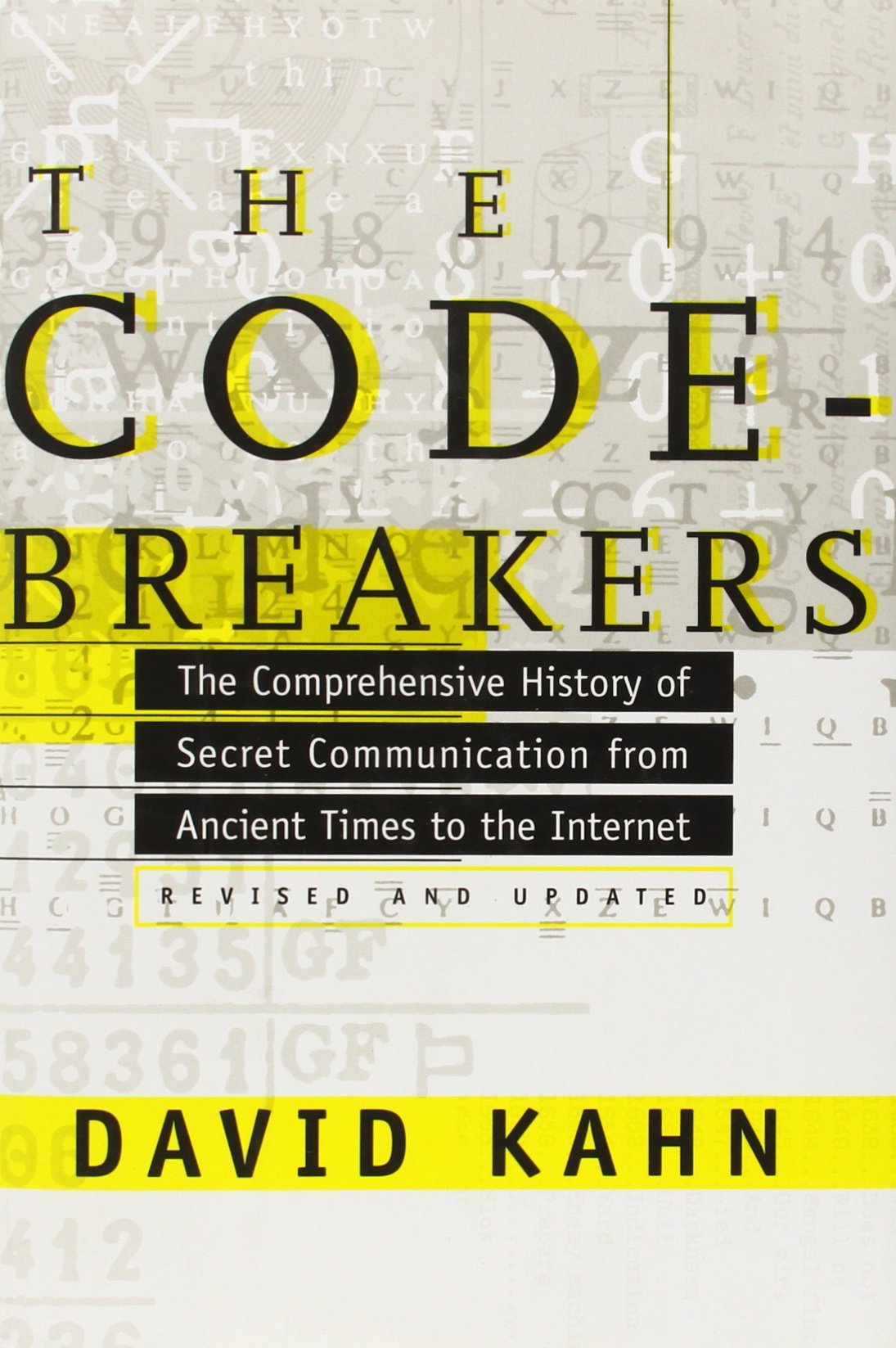
The magnificent, unrivaled history of codes and ciphers—how they're made, how they're broken, and the many and fascinating roles they've played since the dawn of civilization in war, business, diplomacy, and espionage—updated with a new chapter on computer cryptography and the Ultra secret.Man has created codes to keep secrets and has broken codes to learn those secrets since the time of the Pharaohs. For 4,000 years, fierce battles have been waged between codemakers and codebreakers, and the story of these battles is civilization's secret history, the hidden account of how wars were won and lost, diplomatic intrigues foiled, business secrets stolen, governments ruined, computers hacked. From the XYZ Affair to the Dreyfus Affair, from the Gallic War to the Persian Gulf, from Druidic runes and the kaballah to outer space, from the Zimmermann telegram to Enigma to the Manhattan Project, codebreaking has shaped the course of human events to an extent beyond any easy reckoning. Once a government monopoly, cryptology today touches everybody. It secures the Internet, keeps e-mail private, maintains the integrity of cash machine transactions, and scrambles TV signals on unpaid-for channels. David Kahn's The Codebreakers takes the measure of what codes and codebreaking have meant in human history in a single comprehensive account, astonishing in its scope and enthralling in its execution. Hailed upon first publication as a book likely to become the definitive work of its kind, The Codebreakers has more than lived up to that it remains unsurpassed. With a brilliant new chapter that makes use of previously classified documents to bring the book thoroughly up to date, and to explore the myriad ways computer codes and their hackers are changing all of our lives, The Codebreakers is the skeleton key to a thousand thrilling true stories of intrigue, mystery, and adventure. It is a masterpiece of the historian's art.

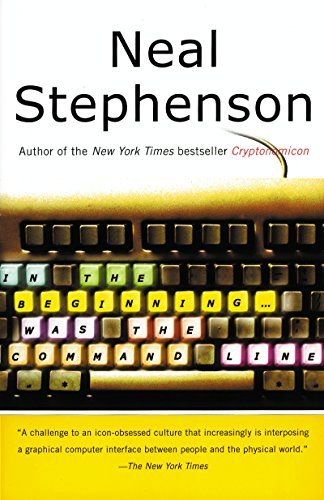
This is "the Word" -- one man's word, certainly -- about the art (and artifice) of the state of our computer-centric existence. And considering that the "one man" is Neal Stephenson, "the hacker Hemingway" (Newsweek) -- acclaimed novelist, pragmatist, seer, nerd-friendly philosopher, and nationally bestselling author of groundbreaking literary works (Snow Crash, Cryptonomicon, etc., etc.) -- the word is well worth hearing. Mostly well-reasoned examination and partial rant, Stephenson's In the Beginning... was the Command Line is a thoughtful, irreverent, hilarious treatise on the cyber-culture past and present; on operating system tyrannies and downloaded popular revolutions; on the Internet, Disney World, Big Bangs, not to mention the meaning of life itself.

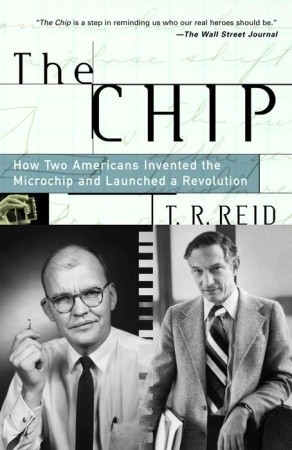
Barely fifty years ago a computer was a gargantuan, vastly expensive thing that only a handful of scientists had ever seen. The world’s brightest engineers were stymied in their quest to make these machines small and affordable until the solution finally came from two ingenious young Americans. Jack Kilby and Robert Noyce hit upon the stunning discovery that would make possible the silicon microchip, a work that would ultimately earn Kilby the Nobel Prize for physics in 2000. In this completely revised and updated edition of The Chip , T.R. Reid tells the gripping adventure story of their invention and of its growth into a global information industry. This is the story of how the digital age began.

Computers have completely changed the way we teach children. We have Mindstorms to thank for that. In this book, pioneering computer scientist Seymour Papert uses the invention of LOGO, the first child-friendly programming language, to make the case for the value of teaching children with computers. Papert argues that children are more than capable of mastering computers, and that teaching computational processes like de-bugging in the classroom can change the way we learn everything else. He also shows that schools saturated with technology can actually improve socialization and interaction among students and between students and teachers.

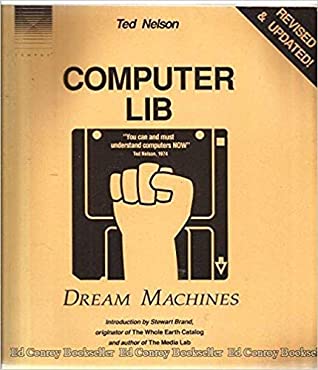
Nelson writes passionately about the need for people to understand computers deeply, more deeply than was generally promoted as computer literacy, which he considers a superficial kind of familiarity with particular hardware and software. His rallying cry "Down with Cybercrud" is against the centralization of computers such as that performed by IBM at the time, as well as against what he sees as the intentional untruths that "computer people" tell to non-computer people to keep them from understanding computers. In Dream Machines, Nelson covers the flexible media potential of the computer, which was shockingly new at the time.

“This makes entertaining reading. Many accounts of the birth of personal computing have been written, but this is the first close look at the drug habits of the earliest pioneers.” —New York TimesMost histories of the personal computer industry focus on technology or business. John Markoff’s landmark book is about the culture and consciousness behind the first PCs—the culture being counter– and the consciousness expanded, sometimes chemically. It’s a brilliant evocation of Stanford, California, in the 1960s and ’70s, where a group of visionaries set out to turn computers into a means for freeing minds and information. In these pages one encounters Ken Kesey and the phone hacker Cap’n Crunch, est and LSD, The Whole Earth Catalog and the Homebrew Computer Lab. What the Dormouse Said is a poignant, funny, and inspiring book by one of the smartest technology writers around.

In Go To , Steve Lohr chronicles the history of software from the early days of complex mathematical codes mastered by a few thousand to today's era of user-friendly software and over six million professional programmers worldwide. Lohr maps out the unique seductions of programming, and gives us an intimate portrait of the peculiar kind of genius that is drawn to this blend of art, science, and engineering, introducing us to the movers and shakers of the 1950s and the open-source movement of today. With original reporting and deft storytelling, Steve Lohr shows us how software transformed the world, and what it holds in store for our future.

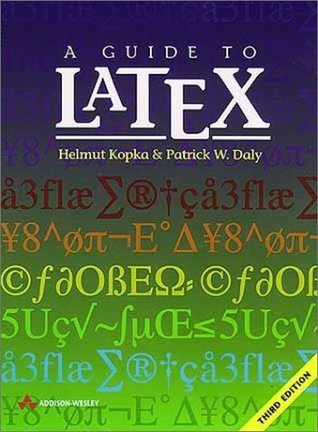
Describes how to use the text-preparation system to create documents, covering such topics as inputting text, symbols, and mathematics; how to include graphics; using LATEX with HTML and XML; and PDF outputing.

Twenty five years ago, it didn't exist. Today, twenty million people worldwide are surfing the Net. Where Wizards Stay Up Late is the exciting story of the pioneers responsible for creating the most talked about, most influential, and most far-reaching communications breakthrough since the invention of the telephone. In the 1960's, when computers where regarded as mere giant calculators, J.C.R. Licklider at MIT saw them as the ultimate communications devices. With Defense Department funds, he and a band of visionary computer whizzes began work on a nationwide, interlocking network of computers. Taking readers behind the scenes, Where Wizards Stay Up Late captures the hard work, genius, and happy accidents of their daring, stunningly successful venture.

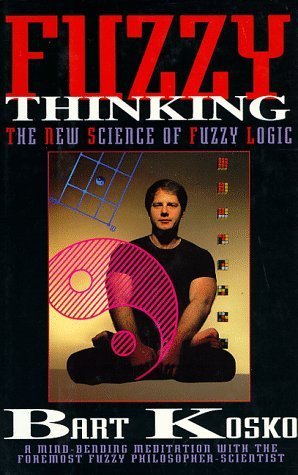
An authoritative introduction to "fuzzy logic" brings readers up to speed on the "smart" products and computers that will change all of our lives in the future.

A guide to attracting, recruiting, interviewing, and hiring the best technical talent.A comprehensive system for hiring top-notch technical employees Packed with useful information and specific advice written in a breezy, humorous style Learn how to find great people--and get them to work for you--in an afternoon!The top software developers are ten times more productive than average developers. Ten times. You can't afford not to hire them. But if you haven't been reading Joel Spolsky's books or blog, you probably don't know how to find them and make them want to work for you.In this brief book, Joel reveals all his secrets--from his years at Microsoft, and as the co-founder of Fog Creek Software--for recruiting the best developers in the world.If you've ever wondered what you should be looking for in a resume, if you've ever struggled to decide whether to hire someone at the end of an interview, or if you're wondering why you can't find great programmers, stop everything and read this book.

Confronting us at every turn, flowing from every imaginable source, information defines our era--and yet what we don't know about it could--and does--fill a book. In this indispensable volume, a primer for the information age, Hans Christian von Baeyer presents a clear description of what information is, how concepts of its measurement, meaning, and transmission evolved, and what its ever-expanding presence portends for the future. Information is poised to replace matter as the primary stuff of the universe, von Baeyer suggests; it will provide a new basic framework for describing and predicting reality in the twenty-first century. Despite its revolutionary premise, von Baeyer's book is written simply in a straightforward fashion, offering a wonderfully accessible introduction to classical and quantum information. Enlivened with anecdotes from the lives of philosophers, mathematicians, and scientists who have contributed significantly to the field, Information conducts readers from questions of subjectivity inherent in classical information to the blurring of distinctions between computers and what they measure or store in our quantum age. A great advance in our efforts to define and describe the nature of information, the book also marks an important step forward in our ability to exploit information--and, ultimately, to transform the nature of our relationship with the physical universe. (20040301)

The Business Value of Computers speaks to executives responsible for information technology. Some of the book's findings and 1) There is no relation between spending for computers, profits or productivity. 2) Conventional analysis that apply revenue ratios or return-on-asset measures are unreliable. 3) The published rankings of excellence in using computers do not relate to profitabiilty. 4) The effectiveness of information technology is difficult to evaluate because it mostly supports unmeasurable managerial work. 5) Business over-achievers do not spend more money on comptuers. They concentrate their information technology on business value-added. 6) Business over-achievers automate administrative operations to reduce overhead expenses. 7) Use business value-added to evaluate computer projects. 8) Apply the Return-on-Management to find out where to use computers. 9) Propose business plans with or without added spending to measure the financial contributions of information technology. 10) Rely primarily on financial plans and controls for balancing the costs and benefits of computers. 11) Take advantage of the steady cost reductions available from advances in electronics. 12) Make the communication network the key to future productivity gains. 13) Have computer experts concentrate on the delivery of efficient computer applications. 14) Require that information resources management becomes every manager's job.

Continuing his exploration of the organization of complexity and the science of design, this new edition of Herbert Simon's classic work on artificial intelligence adds a chapter that sorts out the current themes and tools -- chaos, adaptive systems, genetic algorithms -- for analyzing complexity and complex systems. There are updates throughout the book as well. These take into account important advances in cognitive psychology and the science of design while confirming and extending the book's basic thesis: that a physical symbol system has the necessary and sufficient means for intelligent action. The chapter "Economic Reality" has also been revised to reflect a change in emphasis in Simon's thinking about the respective roles of organizations and markets in economic systems."People sometimes ask me what they should read to find out about artificial intelligence. Herbert Simon's book The Sciences of the Artificial is always on the list I give them. Every page issues a challenge to conventional thinking, and the layman who digests it well will certainly understand what the field of artificial intelligence hopes to accomplish. I recommend it in the same spirit that I recommend Freud to people who ask about psychoanalysis, or Piaget to those who ask about child psychology: If you want to learn about a subject, start by reading its founding fathers." -- George A. Miller

In 1931 Kurt Gödel published his fundamental paper, "On Formally Undecidable Propositions of Principia Mathematica and Related Systems." This revolutionary paper challenged certain basic assumptions underlying much research in mathematics and logic. Gödel received public recognition of his work in 1951 when he was awarded the first Albert Einstein Award for achievement in the natural sciences--perhaps the highest award of its kind in the United States. The award committee described his work in mathematical logic as "one of the greatest contributions to the sciences in recent times."However, few mathematicians of the time were equipped to understand the young scholar's complex proof. Ernest Nagel and James Newman provide a readable and accessible explanation to both scholars and non-specialists of the main ideas and broad implications of Gödel's discovery. It offers every educated person with a taste for logic and philosophy the chance to understand a previously difficult and inaccessible subject.New York University Press is proud to publish this special edition of one of its bestselling books. With a new introduction by Douglas R. Hofstadter, this book will appeal to students, scholars, and professionals in the fields of mathematics, computer science, logic and philosophy, and science.

Ray Kurzweil is the inventor of the most innovative and compelling technology of our era, an international authority on artificial intelligence, and one of our greatest living visionaries. Now he offers a framework for envisioning the twenty-first century--an age in which the marriage of human sensitivity and artificial intelligence fundamentally alters and improves the way we live. Kurzweil's prophetic blueprint for the future takes us through the advances that inexorably result in computers exceeding the memory capacity and computational ability of the human brain by the year 2020 (with human-level capabilities not far behind); in relationships with automated personalities who will be our teachers, companions, and lovers; and in information fed straight into our brains along direct neural pathways. Optimistic and challenging, thought-provoking and engaging, The Age of Spiritual Machines is the ultimate guide on our road into the next century.

When, in 1984–86, Richard P. Feynman gave his famous course on computation at the California Institute of Technology, he asked Tony Hey to adapt his lecture notes into a book. Although led by Feynman, the course also featured, as occasional guest speakers, some of the most brilliant men in science at that time, including Marvin Minsky, Charles Bennett, and John Hopfield. Although the lectures are now thirteen years old, most of the material is timeless and presents a “Feynmanesque” overview of many standard and some not-so-standard topics in computer science such as reversible logic gates and quantum computers.

The LISP language is designed primarily for symbolic data processing used for symbolic calculations in differential and integral calculus, electrical circuit theory, mathematical logic, game playing, and other fields of artificial intelligence.The manual describes LISP, a formal mathematical language. LISP differs from most programming languages in three important ways. The first way is in the nature of the data. In the LISP language, all data are in the form of symbolic expressions usually referred to as S-expressions, of indefinite length, and which have a branching tree-type of structure, so that significant subexpressions can be readily isolated. In the LISP system, the bulk of the available memory is used for storing S-expressions in the form of list structures. The second distinction is that the LISP language is the source language itself which specifies in what way the S-expressions are to be processed. Third, LISP can interpret and execute programs written in the form of S-expressions. Thus, like machine language, and unlike most other high level languages, it can be used to generate programs for further executions.

The major differences between this book and richard's previous title published with TELOS in Jan. '94, are that a) in "Projects" theory was stated, then projects listed as exercises. In "Topics" there will be a set of problems. while the author will refer to some of the more useful algotithms in the "Prjects" text, most algorithms in the "Topics" vilume will be distincly new. Also, b) while "Prjects" in a course book (in context and design) with assigned Problems, "Topics" is inteded as a research reference with stated solutions. The author feels this is an extention of "Projects". "Topics" has a 40-page appendix and no diskette. Finally, the overall style and level of presentation are directed towars the research professional in "Topics", rather than a textbook approach.

What enables individually simple insects like ants to act with such precision and purpose as a group? How do trillions of neurons produce something as extraordinarily complex as consciousness? In this remarkably clear and companionable book, leading complex systems scientist Melanie Mitchell provides an intimate tour of the sciences of complexity, a broad set of efforts that seek to explain how large-scale complex, organized, and adaptive behavior can emerge from simple interactions among myriad individuals. Based on her work at the Santa Fe Institute and drawing on its interdisciplinary strategies, Mitchell brings clarity to the workings of complexity across a broad range of biological, technological, and social phenomena, seeking out the general principles or laws that apply to all of them. Richly illustrated, Complexity: A Guided Tour--winner of the 2010 Phi Beta Kappa Book Award in Science--offers a wide-ranging overview of the ideas underlying complex systems science, the current research at the forefront of this field, and the prospects for its contribution to solving some of the most important scientific questions of our time.


Take the guesswork out of using regular expressions. With more than 140 practical recipes, this cookbook provides everything you need to solve a wide range of real-world problems. Novices will learn basic skills and tools, and programmers and experienced users will find a wealth of detail. Each recipe provides samples you can use right away. This revised edition covers the regular expression flavors used by C#, Java, JavaScript, Perl, PHP, Python, Ruby, and VB.NET. You’ll learn powerful new tricks, avoid flavor-specific gotchas, and save valuable time with this huge library of practical solutions.

“Ferris is a master analogist who conveys his insights on the history of cosmology with a lyrical flair.” — The New York Times Book Review In The Science of Liberty , award-winning author Timothy Ferris—called “the best popular science writer in the English language today” by the Christian Science Monitor and “the best science writer of his generation” by the Washington Post —makes a passionate case for science as the inspiration behind the rise of liberalism and democracy. In the grand tradition of such luminaries of the field as Bill Bryson, Richard Dawkins, and Oliver Sacks—as well as his own The Whole Shebang and Coming of Age in the Milky Way —Ferris has written a brilliant chronicle of how science sparked the spread of liberal democracy and transformed today’s world.

We live in a society that is awash with information, but few of us really understand what information is. In this Very Short Introduction, one of the world's leading authorities on the philosophy of information and on information ethics, Luciano Floridi, offers an illuminating exploration of information as it relates to both philosophy and science. He discusses the roots of the concept of information in mathematics and science, and considers the role of information in several fields, including biology. Floridi also discusses concepts such as "Infoglut" (too much information to process) and the emergence of an information society, and he addresses the nature of information as a communication process and its place as a physical phenomenon. Perhaps more important, he explores information's meaning and value, and ends by considering the broader social and ethical issues relating to information, including problems surrounding accessibility, privacy, ownership, copyright, and open source. This book helps us understand the true meaning of the concept and how it can be used to understand our world.About the Series: Combining authority with wit, accessibility, and style, Very Short Introductions offer an introduction to some of life's most interesting topics. Written by experts for the newcomer, they demonstrate the finest contemporary thinking about the central problems and issues in hundreds of key topics, from philosophy to Freud, quantum theory to Islam.

James Gleick, the author of the best sellers Chaos and Genius, now brings us a work just as astonishing and masterly: a revelatory chronicle and meditation that shows how information has become the modern era's defining quality—the blood, the fuel, the vital principle of our world. The story of information begins in a time profoundly unlike our own, when every thought and utterance vanishes as soon as it is born. From the invention of scripts and alphabets to the long-misunderstood talking drums of Africa, Gleick tells the story of information technologies that changed the very nature of human consciousness. He provides portraits of the key figures contributing to the inexorable development of our modern understanding of information: Charles Babbage, the idiosyncratic inventor of the first great mechanical computer; Ada Byron, the brilliant and doomed daughter of the poet, who became the first true programmer; pivotal figures like Samuel Morse and Alan Turing; and Claude Shannon, the creator of information theory itself. And then the information age arrives. Citizens of this world become experts willy-nilly: aficionados of bits and bytes. And we sometimes feel we are drowning, swept by a deluge of signs and signals, news and images, blogs and tweets. The Information is the story of how we got here and where we are heading.

If they were a hall of fame or shame for computer hackers, a Kevin Mitnick plaque would be mounted the near the entrance. While other nerds were fumbling with password possibilities, this adept break-artist was penetrating the digital secrets of Sun Microsystems, Digital Equipment Corporation, Nokia, Motorola, Pacific Bell, and other mammoth enterprises. His Ghost in the Wires memoir paints an action portrait of a plucky loner motivated by a passion for trickery, not material game. (P.S. Mitnick's capers have already been the subject of two books and a movie. This first-person account is the most comprehensive to date.)

“It is possible to invent a single machine which can be used to compute any computable sequence,” twenty-four-year-old Alan Turing announced in 1936. In Turing’s Cathedral, George Dyson focuses on a small group of men and women, led by John von Neumann at the Institute for Advanced Study in Princeton, New Jersey, who built one of the first computers to realize Alan Turing’s vision of a Universal Machine. Their work would break the distinction between numbers that mean things and numbers that do things—and our universe would never be the same. Using five kilobytes of memory (the amount allocated to displaying the cursor on a computer desktop of today), they achieved unprecedented success in both weather prediction and nuclear weapons design, while tackling, in their spare time, problems ranging from the evolution of viruses to the evolution of stars. Dyson’s account, both historic and prophetic, sheds important new light on how the digital universe exploded in the aftermath of World War II. The proliferation of both codes and machines was paralleled by two historic the decoding of self-replicating sequences in biology and the invention of the hydrogen bomb. It’s no coincidence that the most destructive and the most constructive of human inventions appeared at exactly the same time. How did code take over the world? In retracing how Alan Turing’s one-dimensional model became John von Neumann’s two-dimensional implementation, Turing’s Cathedral offers a series of provocative suggestions as to where the digital universe, now fully three-dimensional, may be heading next.

Written by noted quantum computing theorist Scott Aaronson, this book takes readers on a tour through some of the deepest ideas of maths, computer science and physics. Full of insights, arguments and philosophical perspectives, the book covers an amazing array of topics. Beginning in antiquity with Democritus, it progresses through logic and set theory, computability and complexity theory, quantum computing, cryptography, the information content of quantum states and the interpretation of quantum mechanics. There are also extended discussions about time travel, Newcomb's Paradox, the anthropic principle and the views of Roger Penrose. Aaronson's informal style makes this fascinating book accessible to readers with scientific backgrounds, as well as students and researchers working in physics, computer science, mathematics and philosophy.

An insightful, engaging tour by a noted Silicon Valley insider of how accelerating developments in Artificial Intelligence will transform the way we live and workSelected as one of the 10 best science and technology books of 2015 by The Economist After billions of dollars and fifty years of effort, researchers are finally cracking the code on artificial intelligence. As society stands on the cusp of unprecedented change, Jerry Kaplan unpacks the latest advances in robotics, machine learning, and perception powering systems that rival or exceed human capabilities. Driverless cars, robotic helpers, and intelligent agents that promote our interests have the potential to usher in a new age of affluence and leisure — but as Kaplan warns, the transition may be protracted and brutal unless we address the two great scourges of the modern developed world: volatile labor markets and income inequality. He proposes innovative, free-market adjustments to our economic system and social policies to avoid an extended period of social turmoil. His timely and accessible analysis of the promise and perils of artificial intelligence is a must-read for business leaders and policy makers on both sides of the aisle.

Why does modern life revolve around objectives? From how science is funded, to improving how children are educated -- and nearly everything in-between -- our society has become obsessed with a seductive that greatness results from doggedly measuring improvement in the relentless pursuit of an ambitious goal. In Why Greatness Cannot Be Planned, Stanley and Lehman begin with a surprising scientific discovery in artificial intelligence that leads ultimately to the conclusion that the objective obsession has gone too far. They make the case that great achievement can't be bottled up into mechanical metrics; that innovation is not driven by narrowly focused heroic effort; and that we would be wiser (and the outcomes better) if instead we whole-heartedly embraced serendipitous discovery and playful creativity.Controversial at its heart, yet refreshingly provocative, this book challenges readers to consider life without a destination and discovery without a compass.

Increase profitability, elevate work culture, and exceed productivity goals through DevOps practices.More than ever, the effective management of technology is critical for business competitiveness. For decades, technology leaders have struggled to balance agility, reliability, and security. The consequences of failure have never been greater whether it's the healthcare.gov debacle, cardholder data breaches, or missing the boat with Big Data in the cloud.And yet, high performers using DevOps principles, such as Google, Amazon, Facebook, Etsy, and Netflix, are routinely and reliably deploying code into production hundreds, or even thousands, of times per day.Following in the footsteps of The Phoenix Project, The DevOps Handbook shows leaders how to replicate these incredible outcomes, by showing how to integrate Product Management, Development, QA, IT Operations, and Information Security to elevate your company and win in the marketplace."Table of contentsPrefaceSpreading the Aha! MomentIntroductionPART I: THE THREE WAYS1. Agile, continuous delivery and the three ways2. The First Way: The Principles of Flow3. The Second Way: The Principle of Feedback4. The Third Way: The Principles of Continual LearningPART II: WHERE TO START5. Selecting which value stream to start with6. Understanding the work in our value stream…7. How to design our organization and architecture8. How to get great outcomes by integrating operations into the daily work for developmentPART III: THE FIRST WAY: THE TECHNICAL PRACTICES OF FLOW9. Create the foundations of our deployment pipeline10. Enable fast and reliable automated testing11. Enable and practice continuous integration12. Automate and enable low-risk releases13. Architect for low-risk releasesPART IV: THE SECOND WAY: THE TECHNICAL PRACTICES OF FEEDBACK14*. Create telemetry to enable seeing abd solving problems15. Analyze telemetry to better anticipate problems16. Enable feedbackso development and operation can safely deploy code17. Integrate hypothesis-driven development and A/B testing into our daily work18. Create review and coordination processes to increase quality of our current workPART V: THE THRID WAY: THE TECHNICAL PRACTICES OF CONTINUAL LEARNING19. Enable and inject learning into daily work20. Convert local discoveries into global improvements21. Reserve time to create organizational learning22. Information security as everyone’s job, every day23. Protecting the deployment pipelinePART VI: CONCLUSIONA call to actionConclusion to the DevOps HandbookAPPENDICES1. The convergence of Devops2. The theory of constraints and core chronic conflicts3. Tabular form of downward spiral4. The dangers of handoffs and queues5. Myths of industrial safety6. The Toyota Andon Cord7. COTS Software8. Post-mortem meetings9. The Simian Army10. Transparent uptimeAdditional ResourcesEndnotes

Your no-nonsense guide to making sense of machine learning Machine learning can be a mind-boggling concept for the masses, but those who are in the trenches of computer programming know just how invaluable it is. Without machine learning, fraud detection, web search results, real-time ads on web pages, credit scoring, automation, and email spam filtering wouldn't be possible, and this is only showcasing just a few of its capabilities. Written by two data science experts, Machine Learning For Dummies offers a much-needed entry point for anyone looking to use machine learning to accomplish practical tasks. Covering the entry-level topics needed to get you familiar with the basic concepts of machine learning, this guide quickly helps you make sense of the programming languages and tools you need to turn machine learning-based tasks into a reality. Whether you're maddened by the math behind machine learning, apprehensive about AI, perplexed by preprocessing data―or anything in between―this guide makes it easier to understand and implement machine learning seamlessly. Dive into this complete beginner's guide so you are armed with all you need to know about machine learning!

Bitcoin and Cryptocurrency Technologies provides a comprehensive introduction to the revolutionary yet often misunderstood new technologies of digital currency. Whether you are a student, software developer, tech entrepreneur, or researcher in computer science, this authoritative and self-contained book tells you everything you need to know about the new global money for the Internet age.How do Bitcoin and its block chain actually work? How secure are your bitcoins? How anonymous are their users? Can cryptocurrencies be regulated? These are some of the many questions this book answers. It begins by tracing the history and development of Bitcoin and cryptocurrencies, and then gives the conceptual and practical foundations you need to engineer secure software that interacts with the Bitcoin network as well as to integrate ideas from Bitcoin into your own projects. Topics include decentralization, mining, the politics of Bitcoin, altcoins and the cryptocurrency ecosystem, the future of Bitcoin, and more.An essential introduction to the new technologies of digital currencyCovers the history and mechanics of Bitcoin and the block chain, security, decentralization, anonymity, politics and regulation, altcoins, and much moreFeatures an accompanying website that includes instructional videos for each chapter, homework problems, programming assignments, and lecture slidesAlso suitable for use with the authors' Coursera online courseElectronic solutions manual (available only to professors)

The definitive pioneering blueprint covering the what, why and how of the blockchain.Blockchains are new technology layers that rewire the Internet and threaten to side-step older legacy constructs and centrally served businesses. At its core, a blockchain injects trust into the network, cutting off some intermediaries from serving that function and creatively disrupting how they operate. Metaphorically, blockchains are the ultimate non-stop computers. Once launched, they never go down, and offer an incredible amount of resiliency, making them dependable and attractive for running a new generation of decentralized services and software applications.The Business Blockchain charts new territory in advancing our understanding of the blockchain by unpacking its elements like no other before. William Mougayar anticipates a future that consists of thousands, if not millions of blockchains that will enable not only frictionless value exchange, but also a new flow of value, redefining roles, relationships, power and governance. In this book, Mougayar makes two other strategic assertions. First, the blockchain has polymorphic characteristics; its application will result in a multiplicity of effects. Second, we shouldn't ask ourselves what problems the blockchain solves, because that gives us a narrow view on its potential. Rather, we should imagine new opportunities, and tackle even more ambitious problems that cross organizational, regulatory and mental boundaries.Drawing on 34 years of technology industry experience as an executive, analyst, consultant, entrepreneur, startup mentor, author, blogger, educator, thought leader and investor, William Mougayar describes a future that is influenced by fundamental shifts brought by blockchain technology as the catalyst for change. William Mougayar has been described as the most sophisticated blockchain business thinker. He is a blockchain industry insider whose work has already shaped and influenced the understanding of blockchain for people around the world, via his generous blogging and rigorous research insights. He is a direct participant in the crypto-technology market, working alongside startups, entrepreneurs, pioneers, leaders, innovators, creators, enterprise executives and practitioners; in addition to being an investor, advisor, and board member in some of the leading organizations in this space, such as the Ethereum Foundation, OpenBazaar and Coin Center.Just as the Internet created new possibilities that we didn't foresee in its early years, the blockchain will give rise to new business models and ideas that may still be invisible. Following an engaging Foreword by Vitalik Buterin, this book is organized along these 7 chapters:1. What is the Blockchain?2. How Blockchain Trust Infiltrates3. Obstacles, Challenges & Mental Blocks4. Blockchain in Financial Services5. Lighthouse Industries & New Intermediaries6. Implementing Blockchain Technology7. Decentralization as the Way ForwardThe Business Blockchain is an invitation for technologists to better understand the business potential of the blockchain, and for business minded people to grasp the many facets of blockchain technology. This book teaches you how to think about the blockchain.

A FINANCIAL TIMES BOOK OF THE MONTHFROM THE WALL STREET " Nothing Mr. Gilder says or writes is ever delivered at anything less than the fullest philosophical decibel.. . Mr. Gilder sounds less like a tech guru than a poet, and his words tumble out in a romantic cascade."“Google’s algorithms assume the world’s future is nothing more than the next moment in a random process. George Gilder shows how deep this assumption goes, what motivates people to make it, and why it’s the future depends on human action.” — Peter Thiel, founder of PayPal and Palantir Technologies and author of Zero to Notes on Startups, or How to Build the FutureThe Age of Google, built on big data and machine intelligence, has been an awesome era. But it’s coming to an end. In Life after Google, George Gilder—the peerless visionary of technology and culture—explains why Silicon Valley is suffering a nervous breakdown and what to expect as the post-Google age dawns.Google’s astonishing ability to “search and sort” attracts the entire world to its search engine and countless other goodies—videos, maps, email, calendars….And everything it offers is free, or so it seems. Instead of paying directly, users submit to advertising. The system of “aggregate and advertise” works—for a while—if you control an empire of data centers, but a market without prices strangles entrepreneurship and turns the Internet into a wasteland of ads.The crisis is not just economic. Even as advances in artificial intelligence induce delusions of omnipotence and transcendence, Silicon Valley has pretty much given up on security. The Internet firewalls supposedly protecting all those passwords and personal information have proved hopelessly permeable.The crisis cannot be solved within the current computer and network architecture. The future lies with the “cryptocosm”—the new architecture of the blockchain and its derivatives. Enabling cryptocurrencies such as bitcoin and ether, NEO and Hashgraph, it will provide the Internet a secure global payments system, ending the aggregate-and-advertise Age of Google.Silicon Valley, long dominated by a few giants, faces a “great unbundling,” which will disperse computer power and commerce and transform the economy and the Internet.Life after Google is almost here.For fans of "Wealth and Poverty," "Knowledge and Power," and "The Scandal of Money."

"Views differ on bitcoin, but few doubt the transformative potential of Blockchain technology. The Truth Machine is the best book so far on what has happened and what may come along. It demands the attention of anyone concerned with our economic future." --Lawrence H. Summers, Charles W. Eliot University Professor and President Emeritus at Harvard, Former Treasury SecretaryFrom Michael J. Casey and Paul Vigna, the authors of The Age of Cryptocurrency, comes the definitive work on the Internet's Next Big Thing: The Blockchain.Big banks have grown bigger and more entrenched. Privacy exists only until the next hack. Credit card fraud is a fact of life. Many of the "legacy systems" once designed to make our lives easier and our economy more efficient are no longer up to the task. Yet there is a way past all this--a new kind of operating system with the potential to revolutionize vast swaths of our economy: the blockchain.In The Truth Machine, Michael J. Casey and Paul Vigna demystify the blockchain and explain why it can restore personal control over our data, assets, and identities; grant billions of excluded people access to the global economy; and shift the balance of power to revive society's faith in itself. They reveal the disruption it promises for industries including finance, tech, legal, and shipping.Casey and Vigna expose the challenge of replacing trusted (and not-so-trusted) institutions on which we've relied for centuries with a radical model that bypasses them. The Truth Machine reveals the empowerment possible when self-interested middlemen give way to the transparency of the blockchain, while highlighting the job losses, assertion of special interests, and threat to social cohesion that will accompany this shift. With the same balanced perspective they brought to The Age of Cryptocurrency, Casey and Vigna show why we all must care about the path that blockchain technology takes--moving humanity forward, not backward.