
Scott Aaronson
http://en.wikipedia.org/wiki/Scott_Aa...
9 Books Written
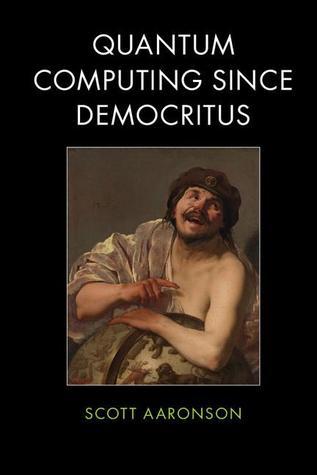
Written by noted quantum computing theorist Scott Aaronson, this book takes readers on a tour through some of the deepest ideas of maths, computer science and physics. Full of insights, arguments and philosophical perspectives, the book covers an amazing array of topics. Beginning in antiquity with Democritus, it progresses through logic and set theory, computability and complexity theory, quantum computing, cryptography, the information content of quantum states and the interpretation of quantum mechanics. There are also extended discussions about time travel, Newcomb's Paradox, the anthropic principle and the views of Roger Penrose. Aaronson's informal style makes this fascinating book accessible to readers with scientific backgrounds, as well as students and researchers working in physics, computer science, mathematics and philosophy.
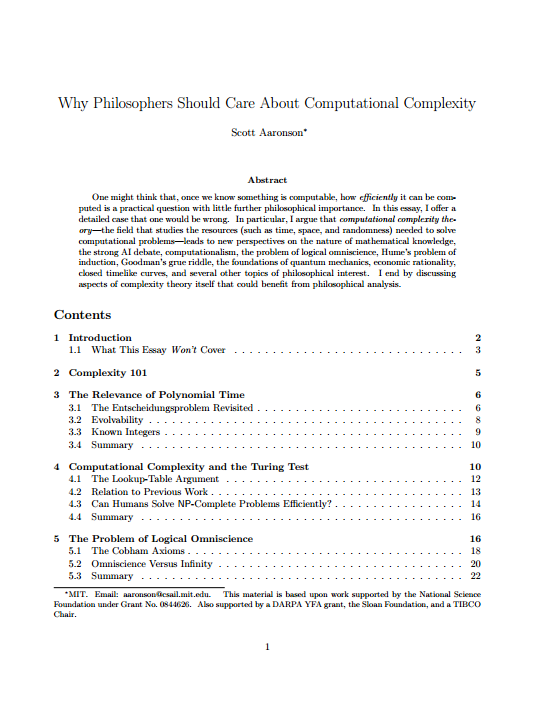
One might think that, once we know something is computable, how efficiently it can be computed is a practical question with little further philosophical importance. In this essay, I offer a detailed case that one would be wrong. In particular, I argue that computational complexity theory—the field that studies the resources (such as time, space, and randomness) needed to solve computational problems—leads to new perspectives on the nature of mathematical knowledge, the strong AI debate, computationalism, the problem of logical omniscience, Hume’s problem of induction and Goodman’s grue riddle, the foundations of quantum mechanics, economic rationality, closed timelike curves, and several other topics of philosophical interest. I end by discussing aspects of complexity theory itself that could benefit from philosophical analysis.

In honor of Alan Turing's hundredth birthday, I unwisely set out some thoughts about one of Turing's obsessions throughout his life, the question of physics and free will. I focus relatively narrowly on a notion that I call "Knightian freedom": a certain kind of in-principle physical unpredictability that goes beyond probabilistic unpredictability. Other, more metaphysical aspects of free will I regard as possibly outside the scope of science. I examine a viewpoint, suggested independently by Carl Hoefer, Cristi Stoica, and even Turing himself, that tries to find scope for "freedom" in the universe's boundary conditions rather than in the dynamical laws. Taking this viewpoint seriously leads to many interesting conceptual problems. I investigate how far one can go toward solving those problems, and along the way, encounter (among other things) the No-Cloning Theorem, the measurement problem, decoherence, chaos, the arrow of time, the holographic principle, Newcomb's paradox, Boltzmann brains, algorithmic information theory, and the Common Prior Assumption. I also compare the viewpoint explored here to the more radical speculations of Roger Penrose. The result of all this is an unusual perspective on time, quantum mechanics, and causation, of which I myself remain skeptical, but which has several appealing features. Among other things, it suggests interesting empirical questions in neuroscience, physics, and cosmology; and takes a millennia-old philosophical debate into some underexplored territory.
More than a speculative technology, quantum computing seems to challenge our most basic intuitions about how the physical world should behave. In this thesis I show that, while some intuitions from classical computer science must be jettisoned in the light of modern physics, many others emerge nearly unscathed; and I use powerful tools from computational complexity theory to help determine which are which.In the first part of the thesis, I attack the common belief that quantum computing resembles classical exponential parallelism, by showing that quantum computers would face serious limitations on a wider range of problems than was previously known. In particular, any quantum algorithm that solves the collision problem -- that of deciding whether a sequence of n integers is one-to-one or two-to-one -- must query the sequence Ω(n1/5) times. This resolves a question that was open for years; previously no lower bound better than constant was known. A corollary is that there is no "black-box" quantum algorithm to break cryptographic hash functions or solve the Graph Isomorphism problem in polynomial time. I also show that relative to an oracle, quantum computers could not solve NP-complete problems in polynomial time, even with the help of nonuniform "quantum advice states"; and that any quantum algorithm needs Ω(2n/4/n) queries to find a local minimum of a black-box function on the n-dimensional hypercube. Surprisingly, the latter result also leads to new classical lower bounds for the local search problem. Finally, I give new lower bounds on quantum one-way communication complexity, and on the quantum query complexity of total Boolean functions and recursive Fourier sampling.The second part of the thesis studies the relationship of the quantum computing model to physical reality. I first examine the arguments of Leonid Levin, Stephen Wolfram, and others who believe quantum computing to be fundamentally impossible. I find their arguments unconvincing without a "Sure/Shor separator" -- a criterion that separates the already-verified quantum states from those that appear in Shor's factoring algorithm. I argue that such a separator should be based on a complexity classification of quantum states, and go on to create such a classification. Next I ask what happens to the quantum computing model if we take into account that the speed of light is finite -- and in particular, whether Grover's algorithm still yields a quadratic speedup for searching a database. Refuting a claim by Benioff, I show that the surprising answer is yes. Finally, I analyze hypothetical models of computation that go even beyond quantum computing. I show that many such models would be as powerful as the complexity class PP, and use this fact to give a simple, quantum computing based proof that PP is closed under intersection. On the other hand, I also present one model -- wherein we could sample the entire history of a hidden variable -- that appears to be more powerful than standard quantum computing, but only slightly so.
Speaking Truth to Parallelism: Dispatches from the Frontier of Quantum Computing Theory
by Scott Aaronson
Rating: 3.5 ⭐
Cognition Switch: An Artefact for the Transmission of New IdeasIssue #4: March 2019Featuring Ideas by: James Q Whitman, Costica Bradatan, Angela Kennedy, Matthew Francis, David Munns, Chris Kempes, Van Savage, Neil Levy, Stefani Engelstein, Walter Vannini, Tom Winterbottom, Lori Miller Kase, Matthew Karp, Philip Goff, and Scott Aaronson
