
George Gilder
30 Books Written
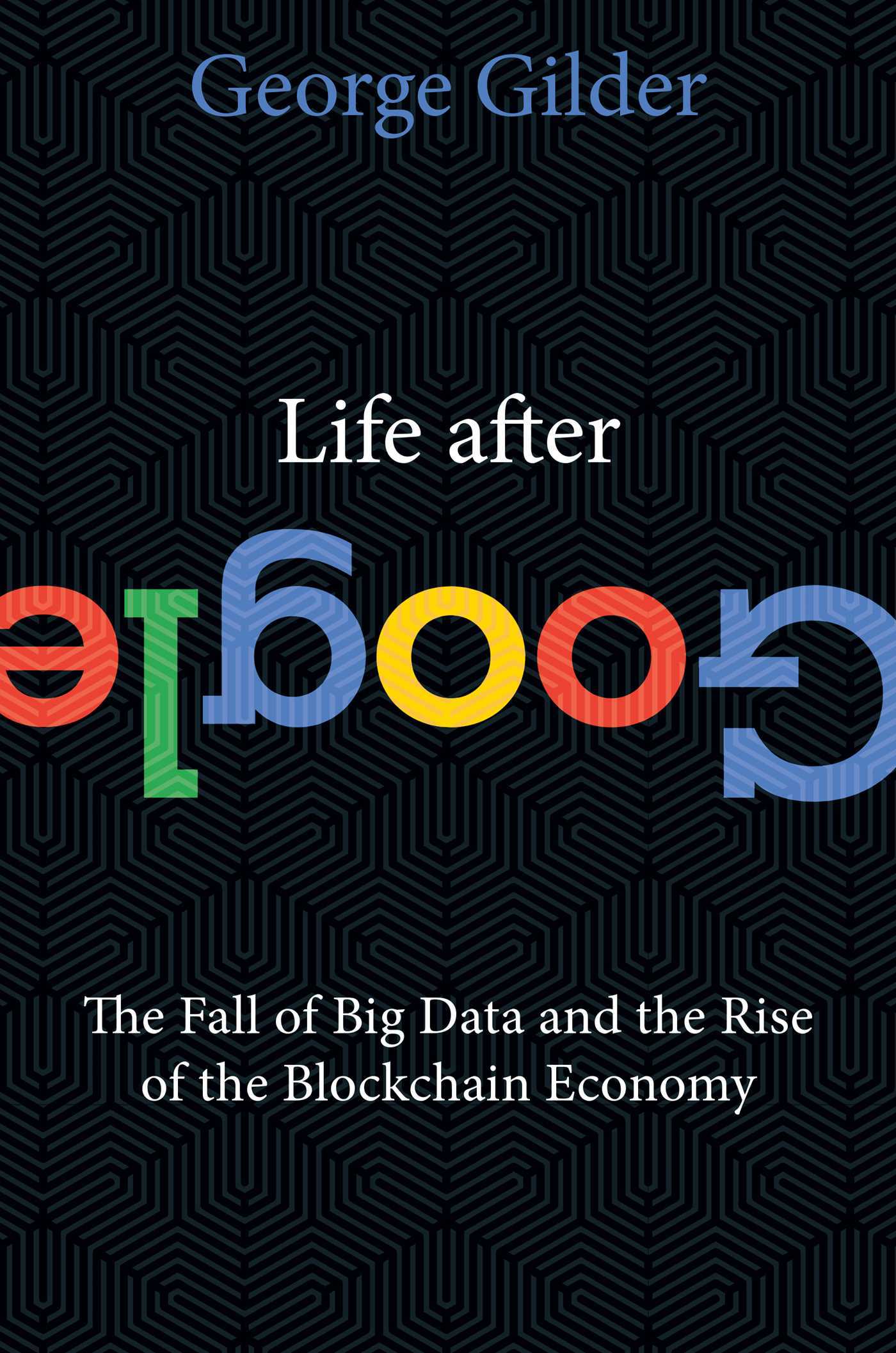
Life After Google: The Fall of Big Data and the Rise of the Blockchain Economy
by George Gilder
Rating: 3.5 ⭐
• 2 recommendations ❤️
A FINANCIAL TIMES BOOK OF THE MONTHFROM THE WALL STREET " Nothing Mr. Gilder says or writes is ever delivered at anything less than the fullest philosophical decibel.. . Mr. Gilder sounds less like a tech guru than a poet, and his words tumble out in a romantic cascade."“Google’s algorithms assume the world’s future is nothing more than the next moment in a random process. George Gilder shows how deep this assumption goes, what motivates people to make it, and why it’s the future depends on human action.” — Peter Thiel, founder of PayPal and Palantir Technologies and author of Zero to Notes on Startups, or How to Build the FutureThe Age of Google, built on big data and machine intelligence, has been an awesome era. But it’s coming to an end. In Life after Google, George Gilder—the peerless visionary of technology and culture—explains why Silicon Valley is suffering a nervous breakdown and what to expect as the post-Google age dawns.Google’s astonishing ability to “search and sort” attracts the entire world to its search engine and countless other goodies—videos, maps, email, calendars….And everything it offers is free, or so it seems. Instead of paying directly, users submit to advertising. The system of “aggregate and advertise” works—for a while—if you control an empire of data centers, but a market without prices strangles entrepreneurship and turns the Internet into a wasteland of ads.The crisis is not just economic. Even as advances in artificial intelligence induce delusions of omnipotence and transcendence, Silicon Valley has pretty much given up on security. The Internet firewalls supposedly protecting all those passwords and personal information have proved hopelessly permeable.The crisis cannot be solved within the current computer and network architecture. The future lies with the “cryptocosm”—the new architecture of the blockchain and its derivatives. Enabling cryptocurrencies such as bitcoin and ether, NEO and Hashgraph, it will provide the Internet a secure global payments system, ending the aggregate-and-advertise Age of Google.Silicon Valley, long dominated by a few giants, faces a “great unbundling,” which will disperse computer power and commerce and transform the economy and the Internet.Life after Google is almost here.For fans of "Wealth and Poverty," "Knowledge and Power," and "The Scandal of Money."

Wealth and Poverty: A New Edition for the Twenty-First Century
by George Gilder
Rating: 4.1 ⭐
• 2 recommendations ❤️
Hailed as “the guide to capitalism,” the New York Times bestseller Wealth and Poverty by George F. Gilder is one of the most famous economic books of all time and has sold more than one million copies since its first release. In this influential classic, Gilder explains and makes the case for supply-side economics, proves the moral superiority of free-market capitalism, and shows why supply-side economics are more effective at decreasing poverty than government-regulated markets.Now, in this new and completely updated edition of Wealth and Poverty, Gilder compares America’s current economic challenges with her past economic problems–particularly those of the late 1970s–and explains why Obama’s big-government, redistributive policies are doing more harm than good for the poor.Making the case that supply-side economics and free market policies are–and always will be–the answer to decreasing America’s poverty rate and increasing her prosperity, Wealth & Poverty offers solutions to America’s current economic problems and hope to those who fear that our best days are behind us.

Knowledge and Power: The Information Theory of Capitalism and How it is Revolutionizing our World
by George Gilder
Rating: 3.9 ⭐
• 2 recommendations ❤️
Ronald Reagan’s most-quoted living author—George Gilder—is back with an all-new paradigm-shifting theory of capitalism that will upturn conventional wisdom, just when our economy desperately needs a new direction.America’s struggling economy needs a better philosophy than the college student's "I can't be out of money, I still have checks in my checkbook!" We’ve tried a government spending spree, and we’ve learned it doesn’t work. Now is the time to rededicate our country to the pursuit of free market capitalism, before we’re buried under a mound of debt and unfunded entitlements. But how do we navigate between government spending that's too big to sustain and financial institutions that are "too big to fail?" In Knowledge and Power , George Gilder proposes a bold new theory on how capitalism produces wealth and how our economy can regain its vitality and its growth.Gilder breaks away from the supply-side model of economics to present a new economic the epic conflict between the knowledge of entrepreneurs on one side, and the blunt power of government on the other. The knowledge of entrepreneurs, and their freedom to share and use that knowledge, are the sparks that light up the economy and set its gears in motion. The power of government to regulate, stifle, manipulate, subsidize or suppress knowledge and ideas is the inertia that slows those gears down, or keeps them from turning at all.One of the twentieth century’s defining economic minds has returned with a new philosophy to carry us into the twenty-first. Knowledge and Power is a must-read for fiscal conservatives, business owners, CEOs, investors, and anyone interested in propelling America’s economy to future success.

The Scandal of Money: Why Wall Street Recovers but the Economy Never Does
by George Gilder
Rating: 3.7 ⭐
• 2 recommendations ❤️
Why do conservatives have such a hard time winning the economic debate in the court of public opinion? Simple, George Gilder says: conservatives misunderstand economics almost as badly as liberals do. Republicans have been running on tax cut proposals since the era of Harding and Coolidge without seriously addressing the key problems of a global economy in decline. Enough is enough. Gilder, author of New York Times bestseller Wealth and Poverty, proposes a completely new framework for understanding economic growth that will replace failed 20th century conservative economics and turn the economic debate—and the country—around.

The wellspring of capital will not be found on Wall Street or in the stuffy halls of corporate America, but instead in the hopes and dreams of people who want to create new products and new approaches to problem solving. It is this wellspring that will ultimately cleanse the soul of corporate America corrupted by power and age. George Gilder's 1984 classic was substantially revised for the 1990s and remains relevant today. This authoritative book looks at what went right in the 1980s and how we can jump-start the economy of the new millenium, featuring unforgettable portraits of entrepreneurs of today and tomorrow, from Bill Gates to members of the dynamic Cuban immigrant community of Miami.

Life After Television: The Coming Transformation of Media and American Life
by George Gilder
Rating: 3.9 ⭐
“In Life After Television , George Gilder imagines a world in which the boob tube has given way to the living room telecomputer. . . . Mr. Gilder’s case is galvanic, at times even intoxicating.” ―Jim Holt, Wall Street Journal In his visionary new book George Gilder brilliantly and persuasively outlines the sweeping new developments in computer and fiber optic technology that spell certain death to traditional television and telephony. In their places, he argues, will emerge a new paradigm in which people-to-people communications give way to links among computers to be found in every home and office. The rise of the telecomputer (or “teleputer”) will utterly transform the way we do business, educate our children, and spend our leisure time, and will imperil such large, centralized, top-down organizations as cable networks, phone companies, government bureaucracies, and multinational corporations.

"Timely when originally published, Men and Marriage is essential now given the the warlike climate of male-female relationships, unfortunately fostered by radical feminism." Rush LimbaughMen and Marriage is a critical commentary that asks the burning question, How can society survive the pervasive disintegration of the family? A profound crisis faces modern social order as traditional family relationships become almost unrecognizable.George Gilder's Men and Marriage is a revised and expanded edition of his 1973 landmark work, Sexual Suicide . He examines the deterioration of the family, the well-defined sex roles it offered, and how this change has shifted the focus of our society. Poverty, for instance, stems from the destruction of the family when unmarried parents are abandoned by their lovers or older women are divorced because society approves of their husbands' younger girlfriends.Gilder claims that men will only fulfill their paternal obligations when women lead them to do so, and that this civilizing influence, balanced with proper economic support, is the most important part of maintaining a productive, healthy, loving society.He offers a concrete plan for rebuilding the family in America. His solutions challenge readers to return to these roles and reestablish the family values that were once so crucial in staving off the ills that plague our country. Gilder insists that it is time to reexamine what "liberation" has wrought and at what cost. Only a return to traditional family values, he contends, can stem the tide of disaster.George Gilder is the author of Wealth and Poverty, the best-selling critique of Reaganomics, The Spirit of Enterprise, Visible Man, Naked Nomads, and The Party That Lost Its Head . He was a speechwriter for Ronald Reagan and now writes regularly for The Wall Street Journal and National Review about material advances and their effect on society. His most recent books include two other well-known social commentaries, Microcosm and Life After Television. Also available in paperback.

Israel is the crucial battlefield for Capitalism and Freedom in our time. George Gilder's global best-seller Wealth and Poverty made the moral case for capitalism. Now Gilder makes the case for Israel, portraying a conflict of barbarism and envy against civilization and creativity. Gilder reveals Israel as a leader of human civilization, technological progress, and scientific advance. Tiny Israel stands behind only the United States in its contributions to the hi-tech economy. Israel has become the world's paramount example of the blessings of freedom. Hatred of Israel, like anti-Semitism through history, arises from resentment of Jewish success. Rooted in a Marxist zero-sum-game theory of economics, this vision has fueled the anti-Semitic rantings of Hitler, Arafat, Osama, and history's other notorious haters. Faced with a contest between murderous regimes sustained by envy and Nazi ideology, and a free, prosperous, and capitalist, Israel—whose side are you on?

The computer age is over. After a cataclysmic global run of thirty years, it has given birth to the age of the telecosm - the world enabled and defined by new communications technology. Chips and software will continue to make great contributions to our lives, but the action is elsewhere. To seek the key to great wealth and to understand the bewildering ways that high tech is restructuring our lives, look not to chip speed but to communication power, or bandwidth. Bandwidth is exploding, and its abundance is the most important social and economic fact of our time.George Gilder is one of the great technological visionaries, and the man who put the 's' in 'telecosm' (Telephony magazine). He is equally famous for understanding and predicting the nuts and bolts of complex technologies, and for putting it all together in a soaring view of why things change, and what it means for our daily lives. His track record of futurist predictions is one of the best, often proving to be right even when initially opposed by mighty corporations and governments. He foresaw the power of fiber and wireless optics, the decline of the telephone regime, and the explosion of handheld computers, among many trends. His list of favored companies outpaced even the soaring Nasdaq in 1999 by more than double. His long-awaited Telecosm is a bible of the new age of communications. Equal parts science story, business history, social analysis, and prediction, it is the one book you need to make sense of the titanic changes underway in our lives. Whether you surf the net constantly or not at all, whether you live on your cell phone or hate it for its invasion of private life, you need this book.It has been less than two decades since the introduction of the IBM personal computer, and yet the enormous changes wrought in our lives by the computer will pale beside the changes of the telecosm. Gilder explains why computers will empty out, with their components migrating to the net; why hundreds of low-flying satellites will enable hand-held computers and communicators to become ubiquitous; why television will die; why newspapers and magazines will revive; why advertising will become less obnoxious; and why companies will never be able to waste your time again.Along the way you will meet the movers and shakers who have made the telecosm possible. From Charles Townes and Gordon Gould, who invented the laser, to the story of JDS Uniphase, the Intel of the Telecosm, to the birthing of fiberless optics pioneer TeraBeam, here are the inventors and entrepreneurs who will be hailed as the next Edison or Gates. From hardware to software to chips to storage, here are the technologies that will soon be as basic as the air we breathe.

Life after Capitalism: The Meaning of Wealth, the Future of the Economy, and the Time Theory of Money
by George Gilder
Rating: 3.5 ⭐
Author of national bestseller Life After Google and generation-defining Wealth and Poverty , venture capitalist, futurist, and pioneering thinker extraordinaire George Gilder pinpoints how the clash of creativity with power at the heart of economic systems leads to global cognitive dissonance and argues that the creation of the novel taps capitalism's infinite promise and is humanity's only path of escape from stagnation and tyranny. Gilder once more rocks the archetypes of modern information theory and economics with a paradigm-shifting salvo of sheer brilliance.The capitalist era is over—get ready for life after capitalism.For more than two hundred years, capitalism spread wealth around the globe, bringing unprecedented prosperity and progress, liberating human potential. But something has gone terribly wrong in the world economy.Creativity and faith in the future—capitalism’s crucial ingredients—seem to have run out. The elites think they can maintain a nation’s wealth by printing money and investing it in favored industries. Their trust in bureaucratic experts, their cautionary paranoia, and their delusional belief that they can “control” everything from the spread of a virus to the weather, are sucking the life out of the economy. Ordinary people, their freedoms restricted, their prospects dim, are losing their faith in their institutions.Such misguided corporatism and pride, confusion and despair, are the result of a deep misunderstanding of capitalism itself.The bestselling futurist and venture capitalist George Gilder explains why economics is not an incentive system to be manipulated but an information system to be freed. Material resources are essentially as plentiful as the atoms of the universe. What drives economic growth in a free market is our limitless human ingenuity and creativity.Prophetic, inspiring, and paradigm-shifting, Life after Capitalism is a once-in- a-generation classic.

This new book by New York Times bestselling author George Gilder tackles key questions about how monetarism distorts the economy and leads to misallocation of investment. Gilder covers a variety of topics, including Milton Friedman's greatest "error," money supply and velocity, the perils of high-volume trading, Bitcoin and how it mimics gold, and why a gold standard is superior to targeting based on a basket of commodities.

From Simon & Schuster, Microcosm is the provocative national bestseller by the author of Wealth and Poverty .George Gilder's Microcosm is the crystal ball of the next technological era. Leading scientists, engineers, and entrepreneurs provide vivid accounts of the latest inventions, revealing how the new international balance of power really lies in information technology.

Pointing to the triumph of artificial intelligence over unaided humans in everything from games such as chess and Go to vital tasks such as protein folding and securities trading, many experts uphold the theory of a “singularity.” This is the trigger point when human history ends and artificial intelligence prevails in an exponential cascade of self-replicating machines rocketing toward godlike supremacy in the universe. Gaming AI suggests that this belief is both dumb and self-defeating. Displaying a profound and crippling case of professional amnesia, the computer science establishment shows an ignorance of the most important findings of its own science, from Kurt Gödel’s “incompleteness” to Alan Turing’s “oracle” to Claude Shannon’s “entropy.” Dabbling in quantum machines, these believers in machine transcendence defy the deepest findings of quantum theory. Claiming to create minds, they are clinically “out of their minds.” Despite the quasi-religious pretensions of techno-elites nobly saving the planet from their own devices, their faith in a techno-utopian singularity is a serious threat to real progress. An industry utterly dependent on human minds will not prosper by obsoleting both their customers and their creators. Gaming AI calls for a remedial immersion in the industry’s own heroic history and an understanding of the actual science of their own human minds.

Gender Studies, Social Studies, Sexual Studies

The Silicon Eye: Microchip Swashbucklers and the Future of High-Tech Innovation
by George Gilder
Rating: 3.8 ⭐
Technology insider George Gilder delivers a "compelling" ( Wired ) look under the hood at a genius-fueled startup. Thanks to the digital technology revolution, cameras are everywhere―PDAs, phones, anywhere you can put an imaging chip and a lens. Battling to usurp this two-billion-dollar market is a Silicon Valley company, Foveon, whose technology not only produces a superior image but also may become the eye in artificially intelligent machines. Behind Foveon are two legendary figures who made the personal computer possible: Carver Mead of Caltech, one of the founding fathers of information technology, and Federico Faggin, inventor of the CPU―the chip that runs every computer.George Gilder has covered the wizards of high tech for twenty-five years and has an insider's knowledge of Silicon Valley and the unpredictable mix of genius, drive, and luck that can turn a startup into a Fortune 500 company. The Silicon Eye is a rollicking narrative of some of the smartest―and most colorful―people on earth and their race to transform an entire industry. 13 illustrations

Tells the stories of successful U.S. entrepreneurs, looks at the effect of new businesses on the development of new technologies, and examines the current state of the economy

Book by Gilder, George F

In this book, George Gilder asserts that widespread antagonism toward the current state of Israel springs from, like anti-Semitism everywhere, envy of superior accomplishment. Israel’s sudden rise as a world capitalist and technological power, he argues, stems in part from the Jewish "culture of mind" and in part from Judaism itself, which, “perhaps more than any other religion, favors capitalist activity and provides a rigorous moral framework for it.” Critics of Israel—in the U.S., in the surrounding countries of the Middle East and in Western European nations that are facing socialist decline—have failed the “Israel Test” because they seek to tear down this country’s success rather than emulate it. America’s ability and desire to defend Israel will define our future survival as a “If Israel is destroyed,” he says, “capitalist Europe will likely die as well, and America, as the epitome of productive and creative capitalism spurred by Jews, will be in jeopardy.


Meet Mitchell "Sam" Brewer. Young. African-American. An ex-Marine with charm and intelligence. Highly valued by his employers in his state job. Yet Sam repeatedly gets into trouble - much of it the kind that lands him in hospitals and police stations. George Gilder, one of the most important sociopolitical authors of our time, brings us a life in which the ultimate trap is not racism, but the very system that's meant to help. Not since Claude Brown's "Manchild in the Promised Land" has there been such a forthright, unvarnished, and humanizing portrait of life and struggle for young African-American men in the inner city.From the author's new introduction decrying the lack of vision in welfare reform to the chilling postscript on the story's protagonist, "Visible Man" rings even more disturbingly true today than when it was first published.



Standard zlota w epoce pieniadza cyfrowego: Informacyjna teoria pieniadza
by George Gilder
Rating: 4.0 ⭐
Jest to niewielka, ale absolutnie rewelacyjna praca wybitnego mysliciela amerykanskiego. Standard zlota to praca formatu Noblowskiego. Takiej rewolucji w rozumieniu roli pieniadza nie wydano od co najmniej dwóch pokolen.

Legendarna wybitna ksiazka legendarnego autora Georgea Gildera w nowym wydaniu Socjolog z wyksztalcenia ekonomista z przekonania Gilder obala mity zwiazane z tzw bogactwem ukazujac zrodla nedzy i sposoby jej pokonania Oto przedsmak tej literatury S Kluczowym zagadnieniem ekonomii nie jest koordynacja bodzcow z jakims przypuszczalnym interesem publicznym lecz zharmonizowanie wiedzy i wladzy Inwestycje przedsiebiorstw przynosza zarowno owoce finansowe jak i epistemologiczne Kapitalizm laczy oba te wymiary Jesli gospodarki kapitalistyczne rosna to dlatego ze przydzielaja bogactwo jego tworcom ktorzy w procesie tworzenia bogactwa wlasnie udowodnili ze moga je zwiekszyc Test przedsiebiorczosci przynosi wiedze gdyz biznesplany sa falsyfikowane moga sie okazac mylne bo firmy moga zbankrutowac Wyniki inwestycji tworza zarowno pozytywne jak i negatywne sprzezenia zwrotne Bledy enronuja a sukcesy googluja Testy przedsiebiorczosci daja wladze w postaci zyskow po opodatkowaniu ktore mozna reinwestowac bez odwolywania sie do biurokratycznych komisji komitetow Kongresu zespolow ekspertow i stada politycznych administratorow

El Espiritu De Empresa/the Spirit of Enterprise
by George Gilder
Tells the stories of successful U.S. entrepreneurs, looks at the effect of new businesses on the development of new technologies, and examines the current state of the economy
Bogactwo I Ubóstwo - George Gilder [KSIĄŻKA]
by George Gilder

George Gilder pisarz ktorego najczesciej cytowal prezydent Ronald Reagan powraca z nowa przelomowa teoria kapitalizmu W Wiedzy i wladzy Gilder przedstawia nowa teorie tlumaczaca wytwarzanie bogactwa w kapitalizmie i opisuje jak amerykanska gospodarka moze odzyskac zywotnosc i ponownie zaczac sie rozwijac Jego zdaniem nastal czas aby gospodarka kierowala sie zasadami wolnorynkowego kapitalizmu inaczej zostanie pogrzebana pod kopcem dlugow Autor przekonuje ze kryzysy finansowe sa nieodlaczna cecha kapitalizmu i podstawa jego sukcesu stymulujac rozwoj Niezmiernie wazne jest to aby im zaradzac nie oslabiajac samego kapitalizmu Gilder wywodzi ze wizja dynamicznego i kreatywnego przedsiebiorstwa ma rowniez wymiar moralny Socjalizm jest reakcyjny gdyz zaklada stale systemy i wyznaczanie wielkosci produkcji z gory wiadomo juz wszystko popyt poprzedza podaz Socjalizm jest zatem deterministyczny kapitalizm altruistyczny z natury jest dawaniem gdyz zaklada pewne ryzyko wynikajace z niepewnosci Gilder podkresla dobrodziejstwa kreatywnosci ktora zawsze nas zaskakuje Zaskoczenie zas jest w jego opinii istota kapitalizmu a takze istota informacji i przedsiebiorczosci A poniewaz wiedza jest rozproszona rozproszona musi byc rowniez wladza George Gilder S intelektualny tytan autentyczny wspolczesny Prometeusz heroicznie przynosi ludzkosci ogien wiedzy iS wladzy Ralph Benko Forbes