
George Dyson
George Dyson is a scientific historian, the son of Freeman Dyson, brother of Esther Dyson, and the grandson of Sir George Dyson. When he was sixteen he went to live in British Columbia in Canada to pursue his interest in kayaking and escape his father's shadow. While there he lived in a treehouse at a height of 30 metres. He is the author of Project Orion: The Atomic Spaceship 1957-1965 and Darwin Among the Machines: The Evolution of Global Intelligence, in which he expanded upon the premise of Samuel Butler's 1863 article of the same name and suggested coherently that the internet is a living, sentient being. He is the subject of Kenneth Brower's book The Starship and the Canoe. Dyson was the founder of Dyson, Baidarka & Company, a designer of Aleut-style skin kayaks, and he is credited with the revival of the baidarka style of kayak. (from Wikipedia)
30 Books Written

Turing's Cathedral: The Origins of the Digital Universe
by George Dyson
Rating: 3.6 ⭐
• 2 recommendations ❤️
“It is possible to invent a single machine which can be used to compute any computable sequence,” twenty-four-year-old Alan Turing announced in 1936. In Turing’s Cathedral , George Dyson focuses on a small group of men and women, led by John von Neumann at the Institute for Advanced Study in Princeton, New Jersey, who built one of the first computers to realize Alan Turing’s vision of a Universal Machine. Their work would break the distinction between numbers that mean things and numbers that do things—and our universe would never be the same. Using five kilobytes of memory (the amount allocated to displaying the cursor on a computer desktop of today), they achieved unprecedented success in both weather prediction and nuclear weapons design, while tackling, in their spare time, problems ranging from the evolution of viruses to the evolution of stars. Dyson’s account, both historic and prophetic, sheds important new light on how the digital universe exploded in the aftermath of World War II. The proliferation of both codes and machines was paralleled by two historic the decoding of self-replicating sequences in biology and the invention of the hydrogen bomb. It’s no coincidence that the most destructive and the most constructive of human inventions appeared at exactly the same time. How did code take over the world? In retracing how Alan Turing’s one-dimensional model became John von Neumann’s two-dimensional implementation, Turing’s Cathedral offers a series of provocative suggestions as to where the digital universe, now fully three-dimensional, may be heading next.

In 1957, a small group of scientists, supported by the U.S. government, launched an attempt to build a four-thousand-ton spaceship propelled by nuclear bombs. The initial plan called for missions to Mars by 1965 and Saturn by 1970. After seven years of work, political obstacles brought the effort to a halt.The Orion team, led by the American bomb-designer Theodore B. Taylor, included the physicist Freeman Dyson, whose son George was five years old when the existence of the project was first announced. In Project Orion, George Dyson has synthesized hundreds of hours of interviews and thousands of pages of newly excavated documents, still only partially declassified, to piece together one of the most tantalizing "what if" stories of the twentieth century.

Traces the course of and personalities involved in the information revolution and illuminates the development of artificial intelligence

Named one of WIRED ’s "The Best Pop Culture That Got Us Through 2020"In Analogia , technology historian George Dyson presents a startling look back at the analog age and life before the digital revolution―and an unsettling vision of what comes next.In 1716, the philosopher and mathematician Gottfried Wilhelm Leibniz spent eight days taking the cure with Peter the Great at Bad Pyrmont in Saxony, trying to persuade the tsar to launch a voyage of discovery from Russia to America and to adopt digital computing as the foundation for a remaking of life on earth. In two classic books, Darwin Among the Machines and Turing’s Cathedral , George Dyson chronicled the realization of the second of Leibniz’s visions. In Analogia , his pathbreaking new book, he brings the story full circle, starting with the Russian American expedition of 1741 and ending with the beyond-digital revolution that will completethe transformation of the world.Dyson enlists a startling cast of characters, from the time of Catherine the Great to the age of machine intelligence, and draws heavily on his own experiences at the Institute for Advanced Study in Princeton, New Jersey, and onward to the rain forest of the Northwest Coast. We are, Dyson reveals, entering a new epoch in human history, one driven by a generation of machines whose powers are no longer under programmable control.Includes black-and-white illustrations
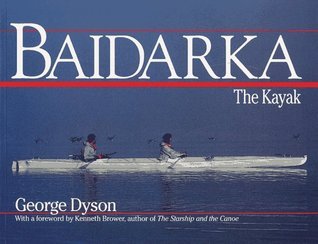
This classic book tells of George Dyson's rediscovery of the Aleut baidarka (sea kayak) and his far-ranging travels with his boats.

A FINANCIAL TIMES BOOK OF THE YEAR 2020How did we end up in a world where humans coexist with technologies we can no longer fully control or understand?George Dyson plots an unexpected course through the past 300 years to reveal the hidden connections that underpin our digital age, ending with a premonition of what lies ahead.From an eighteenth-century Russian voyage across the North Pacific, to the mirror signals that heralded the age of digital telecommunications and the invention of the vacuum tube, Analogia interweaves historical adventure with scientific insight in a deeply personal story that frames the pursuit - and cost - of the digital revolution in a captivating new light.

La reveladora historia de cómo surgió el universo digital tras la Segunda Guerra Mundial. «Es posible inventar una sola máquina que pueda utilizarse para computar cualquier secuencia computable», anunció en 1936 un joven Alan Turing de veinticuatro años. En los años 40 y 50 un reducido grupo de hombres y mujeres, liderado por John von Neumann, se reunió en Princeton, New Jersey, para comenzar la construcción de una de los primeros ordenadores que materializaría la visión de Alan Turing de una máquina universal. Los códigos generados en ese embrión de universo de 5 kilobytes (menos memoria de lo que requiere un solo icono en la pantalla de un ordenador actual) rompieron la distinción entre números que significan cosas y números que hacen cosas, y nuestro universo cambió para siempre. La catedral de Turing es la historia de la invención más constructiva del siglo XX, el ordenador digital, de quiénes y cómo la crearon. Un relato histórico y profético que nos cuenta cómo el código logró conquistar el mundo y se aventura a plantear el futuro del universo digital. La crítica ha dicho...«No es solo un libro extraordinario sobre ciencia. Es un libro extraordinario, punto.»The Globe and Mail «Si quieres estar mentalmente preparado para la próxima revolución informática, el libro de Dyson es imprescindible. Pero también es imprescindible si solo quieres una historia apasionada de cómo los científicos de verdad (como mínimo algunos) piensan y trabajan.»Literary Review «Fascinante. [...] Las historias sobre la creación siempre valen la pena, en especial cuando son el origen de poderes capaces de cambiar el mundo. [...] Dyson cuenta el curioso pacto fáustico que permitió que los matemáticos experimentaran con la construcción de ordenadores más poderosos que ayudarían a fabricar bombas más destructivas.»San Francisco Chronicle «Ningún otro libro sobre los orígenes de la era digital logra establecer las conexiones entre las enseñanzas del nacimiento de los ordenadores y su posible futuro.»The Guardian «La historia de la invención de los ordenadores se ha contado en muchas ocasiones y desde distintos puntos de vista, pero nunca con tanta autoridad y profusiónde detalles como lo hace George Dyson. [...] La catedral de Turing fascinará a los amantes de la informática.»The Seattle Times «Una crónica detallada y amena sobre el nacimiento de la informática moderna. [...] El libro de Dyson nos recuerda que detrás de todas las pantallas táctiles, la inteligencia artificial y los implantes cerebrales no opera la brujería, sino una máquina inventada en New Jersey.»The Oregonian «El mejor libro que he leído sobre los orígenes de los ordenadores; no es solo erudito, sino también deslumbrante, idiosincrásico y peculiar.»The Boston Globe

Subtitled “A Musician’s Apology”, this slender book consists of the composer and administrator’s thoughts on the state of music and music education in Great Britain at the end of his career.

Fiddling White Rome Burns - A Musician's Apology
by George Dyson
Saint Paul's Voyage to Melita. A Setting of Acts xxvii for Tenor Solo, Chorus and Orchestra. Vocal Score
by George Dyson

extremely rare,very good condition
The new music
by George Dyson

Concerto for Violin and Orchestra ... Piano Score
by George Dyson
The Canterbury Pilgrims: Vocal Score
by George Dyson
Portraits chosen from the Prologue to Chaucer's Canterbury Tales and set to music. Vocal score for chorus, three soloists (soprano, tenor and baritone) and piano.
Voluntary in D. [Organ.]
by George Dyson

Piccola storia della musica
by George Dyson
Questo libro, opera di un grande musicista e compositore inglese, è il riuscito tentativo di tratteggiare con aderente naturalezza le tappe del "progresso" dalla musica rituale dei popoli primitivi alla musica gregoriana, dalla sensuale polifonia pre-rinascimentale allo sviluppo della musica strumentale del Cinquecento, sino al virtuosismo orchestrale del tardo Romanticismo, senza tralasciare di approfondire il fenomeno della diffusione della radio e della musica incisa. Eliminando ogni aridità sistematica e manualistica, Dyson ha saputo centrare lo svolgimento delle diverse forme musicali nel particolare movimento culturale che le ha determinate, offrendo così non una fredda storia della musica, ma una serena valutazione di tutti i fenomeni, spirituali e pratici, che hanno concorso al suo "progresso".
Form and function of the Baidarka: The framework of design
by George Dyson
Ye that do your Master's will: Anthem for SATB and organ
by George Dyson

100 149 The Progress Of Music
by George Dyson
This work has been selected by scholars as being culturally important, and is part of the knowledge base of civilization as we know it. This work was reproduced from the original artifact, and remains as true to the original work as possible. Therefore, you will see the original copyright references, library stamps (as most of these works have been housed in our most important libraries around the world), and other notations in the work. This work is in the public domain in the United States of America, and possibly other nations. Within the United States, you may freely copy and distribute this work, as no entity (individual or corporate) has a copyright on the body of the work.As a reproduction of a historical artifact, this work may contain missing or blurred pages, poor pictures, errant marks, etc. Scholars believe, and we concur, that this work is important enough to be preserved, reproduced, and made generally available to the public. We appreciate your support of the preservation process, and thank you for being an important part of keeping this knowledge alive and relevant.

Dyson Magnificat & Nunc Dimittis in F
by George Dyson
New Music
by George Dyson
Leather Binding on Spine and Corners with Golden Leaf Printing on round Spine (extra customization on request like complete leather, Golden Screen printing in Front, Color Leather, Colored book etc.) Reprinted in 2022 with the help of original edition published long back [1926]. This book is printed in black & white, sewing binding for longer life, Printed on high quality Paper, re-sized as per Current standards, professionally processed without changing its contents. As these are old books, we processed each page manually and make them readable but in some cases some pages which are blur or missing or black spots. If it is multi volume set, then it is only single volume, if you wish to order a specific or all the volumes you may contact us. We expect that you will understand our compulsion in these books. We found this book important for the readers who want to know more about our old treasure so we brought it back to the shelves. Hope you will like it and give your comments and suggestions. - English, Pages 168. EXTRA 10 DAYS APART FROM THE NORMAL SHIPPING PERIOD WILL BE REQUIRED FOR LEATHER BOUND BOOKS. COMPLETE LEATHER WILL COST YOU EXTRA US$ 25 APART FROM THE LEATHER BOUND BOOKS. {FOLIO EDITION IS ALSO AVAILABLE.} Complete The new music, by George Dyson. 1926 Dyson, George, -.