
Brian Christian
Brian Christian is an acclaimed author and researcher whose work explores the human implications of computer science. He is known for his bestselling series of books: The Most Human Human (2011) uses his experience as a human “confederate” in the Turing test to examine what chatbots reveal about the nature of language and communication. It was named a Wall Street Journal bestseller, a New York Times Editors’ Choice, and a New Yorker favorite book of the year. Algorithms to Live By (2016), co-authored with Tom Griffiths, applies computational principles to everyday human decision making, painting a counterintuitively human picture of rationality. It was named a #1 Audible bestseller, Amazon best science book of the year, and MIT Technology Review best book of the year. The Alignment Problem (2020) is a nuanced investigation of the ethics and safety challenges confronting the field of AI, and a portrait of the community of researchers working to address them. Nature called it “Meticulously researched and superbly written,” and The New York Times called it “The best book on the key technical and moral questions of AI.” Microsoft CEO Satya Nadella named it one of the books that most inspired him. The Alignment Problem was a Finalist for Los Angeles Times Best Science & Technology Book of the Year and won the Excellence in Science Communication Award from the National Academies of Sciences, Engineering, and Medicine. As a researcher, Christian’s work spans from computational cognitive science to AI alignment and has appeared in peer-reviewed journals from Dædalus to Cognitive Science, and he is a recipient of the Clarendon Scholarship, the University of Oxford’s most competitive research scholarship. He is affiliated with the AI Policy and Governance Working Group at the Institute for Advanced Study in Princeton, the Center for Human-Compatible AI and the Center for Information Technology Research in the Interest of Society at UC Berkeley, and the Human Information Processing Lab at the University of Oxford. As a writer, Christian’s work has been translated into nineteen languages, and has appeared in The New Yorker, The Atlantic, Wired, The Wall Street Journal, The Guardian, and The Paris Review. His writing has won several literary awards, including fellowships at Bread Loaf, Yaddo, and MacDowell, publication in Best American Science & Nature Writing, and an award from the Academy of American Poets. As a software developer, Christian has contributed to a number of foundational open-source projects, including Ruby on Rails and Bundler. He served for nine years as Director of Technology for the innovative literary publisher McSweeney’s, where he led a small team responsible for the company’s technical stack. As a speaker and public intellectual, Christian has been a featured guest on The Daily Show, The Ezra Klein Show, and Radiolab, and has lectured at Microsoft, Google, Meta, Yale, the Santa Fe Institute, and the London School of Economics. He has advised business executives as well as Cabinet Members, Parliamentarians, and administrators in six countries about matters ranging from decision making to AI. Born in Wilmington, Delaware, Christian studied computer science and philosophy at Brown University, poetry and nonfiction at the University of Washington, and psychology and computational neuroscience at the University of Oxford. He lives in San Francisco and the UK.
4 Books Written
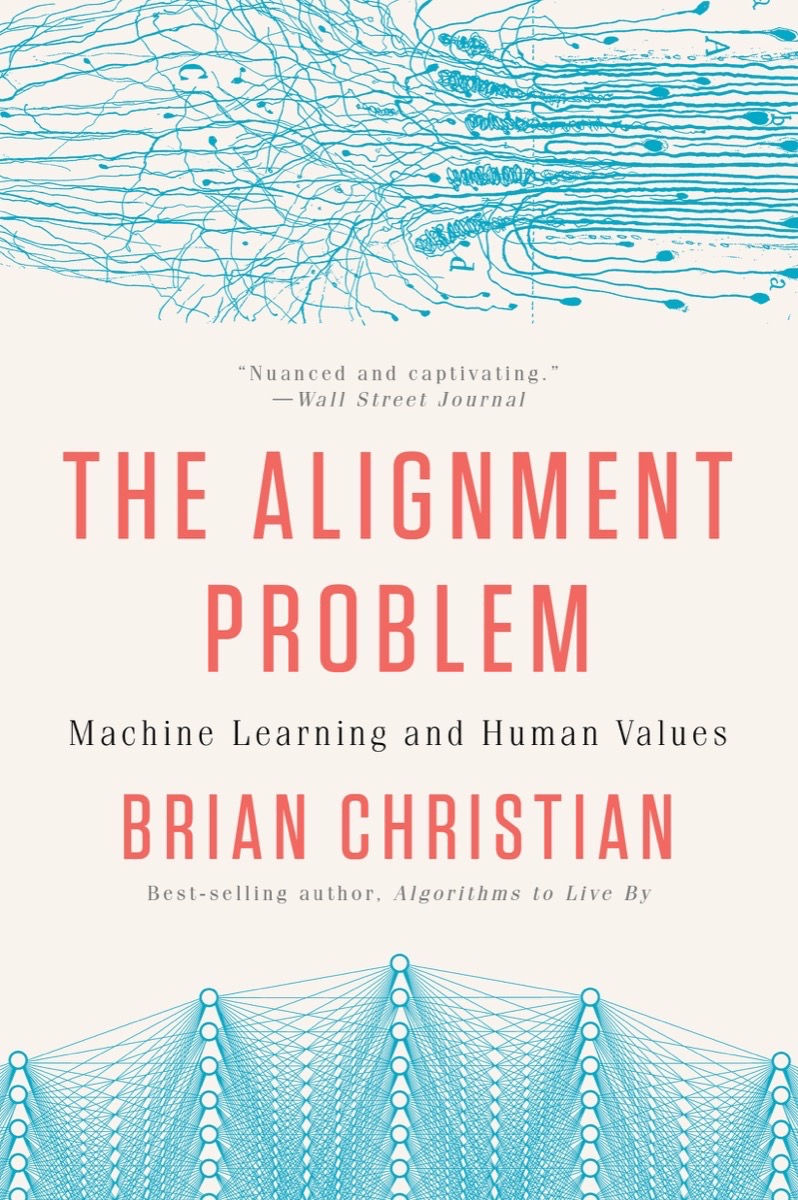
The Alignment Problem: Machine Learning and Human Values
by Brian Christian
Rating: 4.3 ⭐
• 2 recommendations ❤️
A jaw-dropping exploration of everything that goes wrong when we build AI systems and the movement to fix them. Today’s “machine-learning” systems, trained by data, are so effective that we’ve invited them to see and hear for us―and to make decisions on our behalf. But alarm bells are ringing. Recent years have seen an eruption of concern as the field of machine learning advances. When the systems we attempt to teach will not, in the end, do what we want or what we expect, ethical and potentially existential risks emerge. Researchers call this the alignment problem. Systems cull résumés until, years later, we discover that they have inherent gender biases. Algorithms decide bail and parole―and appear to assess Black and White defendants differently. We can no longer assume that our mortgage application, or even our medical tests, will be seen by human eyes. And as autonomous vehicles share our streets, we are increasingly putting our lives in their hands. The mathematical and computational models driving these changes range in complexity from something that can fit on a spreadsheet to a complex system that might credibly be called “artificial intelligence.” They are steadily replacing both human judgment and explicitly programmed software. In best-selling author Brian Christian’s riveting account, we meet the alignment problem’s “first-responders,” and learn their ambitious plan to solve it before our hands are completely off the wheel. In a masterful blend of history and on-the ground reporting, Christian traces the explosive growth in the field of machine learning and surveys its current, sprawling frontier. Readers encounter a discipline finding its legs amid exhilarating and sometimes terrifying progress. Whether they―and we―succeed or fail in solving the alignment problem will be a defining human story. The Alignment Problem offers an unflinching reckoning with humanity’s biases and blind spots, our own unstated assumptions and often contradictory goals. A dazzlingly interdisciplinary work, it takes a hard look not only at our technology but at our culture―and finds a story by turns harrowing and hopeful.
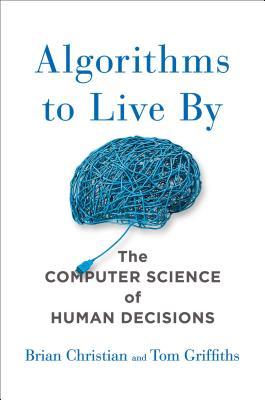
Algorithms to Live By: The Computer Science of Human Decisions
by Brian Christian
Rating: 4.1 ⭐
• 2 recommendations ❤️
A fascinating exploration of how insights from computer algorithms can be applied to our everyday lives, helping to solve common decision-making problems and illuminate the workings of the human mindAll our lives are constrained by limited space and time, limits that give rise to a particular set of problems. What should we do, or leave undone, in a day or a lifetime? How much messiness should we accept? What balance of new activities and familiar favorites is the most fulfilling? These may seem like uniquely human quandaries, but they are not: computers, too, face the same constraints, so computer scientists have been grappling with their version of such issues for decades. And the solutions they've found have much to teach us.In a dazzlingly interdisciplinary work, acclaimed author Brian Christian and cognitive scientist Tom Griffiths show how the algorithms used by computers can also untangle very human questions. They explain how to have better hunches and when to leave things to chance, how to deal with overwhelming choices and how best to connect with others. From finding a spouse to finding a parking spot, from organizing one's inbox to understanding the workings of memory, Algorithms to Live By transforms the wisdom of computer science into strategies for human living.

The Most Human Human: What Talking with Computers Teaches Us About What It Means to Be Alive
by Brian Christian
Rating: 3.9 ⭐
The Most Human Human is a provocative, exuberant, and profound exploration of the ways in which computers are reshaping our ideas of what it means to be human. Its starting point is the annual Turing Test, which pits artificial intelligence programs against people to determine if computers can “think.”Named for computer pioneer Alan Turing, the Turing Test convenes a panel of judges who pose questions—ranging anywhere from celebrity gossip to moral conundrums—to hidden contestants in an attempt to discern which is human and which is a computer. The machine that most often fools the panel wins the Most Human Computer Award. But there is also a prize, bizarre and intriguing, for the Most Human Human.In 2008, the top AI program came short of passing the Turing Test by just one astonishing vote. In 2009, Brian Christian was chosen to participate, and he set out to make sure Homo sapiens would prevail.The author’s quest to be deemed more human than a computer opens a window onto our own nature. Interweaving modern phenomena like customer service “chatbots” and men using programmed dialogue to pick up women in bars with insights from fields as diverse as chess, psychiatry, and the law, Brian Christian examines the philosophical, biological, and moral issues raised by the Turing Test.One central definition of human has been “a being that could reason.” If computers can reason, what does that mean for the special place we reserve for humanity?
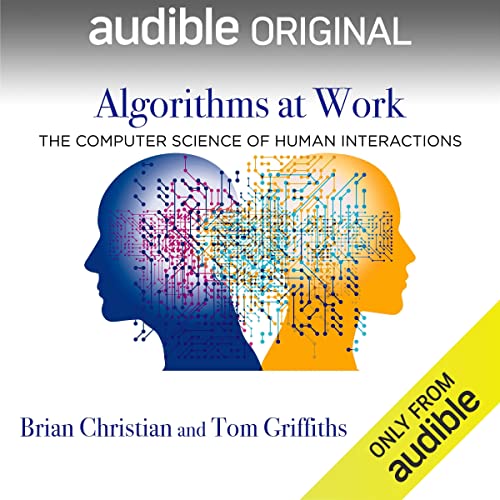
In this highly intoxicating original series, researchers Brian Christian and Tom Griffiths, authors of the best-selling smash hit, Algorithms to Live By, tackle some of the biggest ideas in computer science today—and, in the process, illuminate cutting-edge ways of understanding how we live, work and play.They take us inside a tomato factory where no one has a job title to shed new light on decentralized network structures; visit an Olympic fencer to explore the game theory of when to make the first move; and tour the birthplace of the internet, a buzzing laboratory on the border of France and Switzerland, to examine the true—and truly human—limits to what a network of nearly one million machines can achieve.Along the way, they interview key figures in the world of computer science—from Google's Vice President of Infrastructure Eric Brewer to ‘the godfather of distributed systems’ Leslie Lamport—plus preeminent neuroscientists, sociologists, and even the co-founder of Instagram.Algorithms at Work is a playful and deeply inquisitive exploration of the overlapping questions of computer science and society. The result is six episodes that examine the world in unexpected and memorable ways.