Loading themes...
Explore the best books about Engineering theme.


Highly effective thinking is an art that engineers and scientists can be taught to develop. By presenting actual experiences and analyzing them as they are described, the author conveys the developmental thought processes employed and shows a style of thinking that leads to successful results is something that can be learned. Along with spectacular successes, the author also conveys how failures contributed to shaping the thought processes.Provides the reader with a style of thinking that will enhance a person's ability to function as a problem-solver of complex technical issues. Consists of a collection of stories about the author's participation in significant discoveries, relating how those discoveries came about and, most importantly, provides analysis about the thought processes and reasoning that took place as the author and his associates progressed through engineering problems.

The computer revolution brought with it new methods of getting work done—just look at today's news for reports of hard-driven, highly-motivated young software and online commerce developers who sacrifice evenings and weekends to meet impossible deadlines. Tracy Kidder got a preview of this world in the late 1970s when he observed the engineers of Data General design and build a new 32-bit minicomputer in just one year. His thoughtful, prescient book, The Soul of a New Machine, tells stories of 35-year-old "veteran" engineers hiring recent college graduates and encouraging them to work harder and faster on complex and difficult projects, exploiting the youngsters' ignorance of normal scheduling processes while engendering a new kind of work ethic.These days, we are used to the "total commitment" philosophy of managing technical creation, but Kidder was surprised and even a little alarmed at the obsessions and compulsions he found. From in-house political struggles to workers being permitted to tease management to marathon 24-hour work sessions, The Soul of a New Machine explores concepts that already seem familiar, even old-hat, less than 20 years later. Kidder plainly admires his subjects; while he admits to hopeless confusion about their work, he finds their dedication heroic. The reader wonders, though, what will become of it all, now and in the future. —Rob Lightner

Imagine, if you can, the world in the year 2100.In Physics of the Future, Michio Kaku—the New York Times bestselling author of Physics of the Impossible—gives us a stunning, provocative, and exhilarating vision of the coming century based on interviews with over three hundred of the world's top scientists who are already inventing the future in their labs. The result is the most authoritative and scientifically accurate description of the revolutionary developments taking place in medicine, computers, artificial intelligence, nanotechnology, energy production, and astronautics.In all likelihood, by 2100 we will control computers via tiny brain sensors and, like magicians, move objects around with the power of our minds. Artificial intelligence will be dispersed throughout the environment, and Internet-enabled contact lenses will allow us to access the world's information base or conjure up any image we desire in the blink of an eye.Meanwhile, cars will drive themselves using GPS, and if room-temperature superconductors are discovered, vehicles will effortlessly fly on a cushion of air, coasting on powerful magnetic fields and ushering in the age of magnetism.Using molecular medicine, scientists will be able to grow almost every organ of the body and cure genetic diseases. Millions of tiny DNA sensors and nanoparticles patrolling our blood cells will silently scan our bodies for the first sign of illness, while rapid advances in genetic research will enable us to slow down or maybe even reverse the aging process, allowing human life spans to increase dramatically.In space, radically new ships—needle-sized vessels using laser propulsion—could replace the expensive chemical rockets of today and perhaps visit nearby stars. Advances in nanotechnology may lead to the fabled space elevator, which would propel humans hundreds of miles above the earth's atmosphere at the push of a button.But these astonishing revelations are only the tip of the iceberg. Kaku also discusses emotional robots, antimatter rockets, X-ray vision, and the ability to create new life-forms, and he considers the development of the world economy. He addresses the key questions: Who are the winner and losers of the future? Who will have jobs, and which nations will prosper?All the while, Kaku illuminates the rigorous scientific principles, examining the rate at which certain technologies are likely to mature, how far they can advance, and what their ultimate limitations and hazards are. Synthesizing a vast amount of information to construct an exciting look at the years leading up to 2100, Physics of the Future is a thrilling, wondrous ride through the next 100 years of breathtaking scientific revolution. (From the Hardcover Edition)(Duration: 15:39:15)

An adventure deep inside the everyday materials that surround us, packed with surprising stories and fascinating science. Why is glass see-through? What makes elastic stretchy? Why does a paper clip bend? Why does any material look and behave the way it does? These are the sorts of questions that Mark Miodownik a globally-renowned materials scientist has spent his life exploring In this book he examines the materials he encounters in a typical morning, from the steel in his razor and the graphite in his pencil to the foam in his sneakers and the concrete in a nearby skyscraper.

Straight from the programming trenches, The Pragmatic Programmer cuts through the increasing specialization and technicalities of modern software development to examine the core process--taking a requirement and producing working, maintainable code that delights its users. It covers topics ranging from personal responsibility and career development to architectural techniques for keeping your code flexible and easy to adapt and reuse. Read this book, and you'll learn how toFight software rot; Avoid the trap of duplicating knowledge; Write flexible, dynamic, and adaptable code; Avoid programming by coincidence; Bullet-proof your code with contracts, assertions, and exceptions; Capture real requirements; Test ruthlessly and effectively; Delight your users; Build teams of pragmatic programmers; and Make your developments more precise with automation. Written as a series of self-contained sections and filled with entertaining anecdotes, thoughtful examples, and interesting analogies, The Pragmatic Programmer illustrates the best practices and major pitfalls of many different aspects of software development. Whether you're a new coder, an experienced programmer, or a manager responsible for software projects, use these lessons daily, and you'll quickly see improvements in personal productivity, accuracy, and job satisfaction. You'll learn skills and develop habits and attitudes that form the foundation for long-term success in your career. You'll become a Pragmatic Programmer.

The latest edition of this classic is updated with new problem sets and material The Second Edition of this fundamental textbook maintains the book's tradition of clear, thought-provoking instruction. Readers are provided once again with an instructive mix of mathematics, physics, statistics, and information theory.All the essential topics in information theory are covered in detail, including entropy, data compression, channel capacity, rate distortion, network information theory, and hypothesis testing. The authors provide readers with a solid understanding of the underlying theory and applications. Problem sets and a telegraphic summary at the end of each chapter further assist readers. The historical notes that follow each chapter recap the main points.The Second Edition features: * Chapters reorganized to improve teaching * 200 new problems * New material on source coding, portfolio theory, and feedback capacity * Updated referencesNow current and enhanced, the Second Edition of Elements of Information Theory remains the ideal textbook for upper-level undergraduate and graduate courses in electrical engineering, statistics, and telecommunications.
Book is in Good condition

As Einstein pointed out in his famous equation, E=MC2, all matter can be described as energy. It is everywhere; it is everything. In this engaging book, prolific author and academic Vaclav Smil provides an introduction to the far-reaching term and gives the reader a greater understanding of energy's place in both past and present society. Starting with an explanation of the concept, he goes on to cover such exciting topics as the inner workings of the human body, and the race for more efficient and environmentally friendly fuels. With global warming becoming a mainstream political issue, this guide will help shed light on the science behind it and efforts to prevent it, and how our seemingly insignificant daily decisions affect energy consumption. Whether you're after insight or dinner table conversation, "Energy: A Beginner's Guide" will amaze and inform, uncovering the science behind one of the most important concepts in our universe.

If all measures of human advancement in the last hundred centuries were plotted on a graph, they would show an almost perfectly flat line—until the eighteenth century, when the Industrial Revolution would cause the line to shoot straight up, beginning an almost uninterrupted march of progress. In The Most Powerful Idea in the World , William Rosen tells the story of the men responsible for the Industrial Revolution and the machine that drove it—the steam engine. In the process he tackles the question that has obsessed historians ever What made eighteenth-century Britain such fertile soil for inventors? Rosen’s answer focuses on a simple notion that had become enshrined in British law the century that people had the right to own and profit from their ideas. The result was a period of frantic innovation revolving particularly around the promise of steam power. Rosen traces the steam engine’s history from its early days as a clumsy but sturdy machine, to its coming-of-age driving the wheels of mills and factories, to its maturity as a transporter for people and freight by rail and by sea. Along the way we enter the minds of such inventors as Thomas Newcomen and James Watt, scientists including Robert Boyle and Joseph Black, and philosophers John Locke and Adam Smith—all of whose insights, tenacity, and ideas transformed first a nation and then the world. William Rosen is a masterly storyteller with a keen eye for the “aha!” moments of invention and a gift for clear and entertaining explanations of science. The Most Powerful Idea in the World will appeal to readers fascinated with history, science, and the hows and whys of innovation itself.

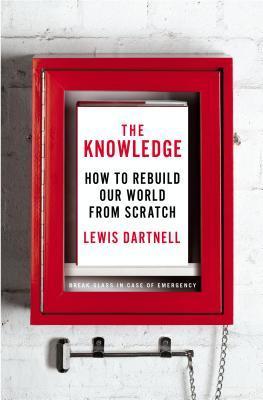
How would you go about rebuilding a technological society from scratch? If our technological society collapsed tomorrow, perhaps from a viral pandemic or catastrophic asteroid impact, what would be the one book you would want to press into the hands of the postapocalyptic survivors? What crucial knowledge would they need to survive in the immediate aftermath and to rebuild civilization as quickly as possible—a guide for rebooting the world? Human knowledge is collective, distributed across the population. It has built on itself for centuries, becoming vast and increasingly specialized. Most of us are ignorant about the fundamental principles of the civilization that supports us, happily utilizing the latest—or even the most basic—technology without having the slightest idea of why it works or how it came to be. If you had to go back to absolute basics, like some sort of postcataclysmic Robinson Crusoe, would you know how to re-create an internal combustion engine, put together a microscope, get metals out of rock, accurately tell time, weave fibers into clothing, or even how to produce food for yourself? Regarded as one of the brightest young scientists of his generation, Lewis Dartnell proposes that the key to preserving civilization in an apocalyptic scenario is to provide a quickstart guide, adapted to cataclysmic circumstances. The Knowledge describes many of the modern technologies we employ, but first it explains the fundamentals upon which they are built. Every piece of technology rests on an enormous support network of other technologies, all interlinked and mutually dependent. You can’t hope to build a radio, for example, without understanding how to acquire the raw materials it requires, as well as generate the electricity needed to run it. But Dartnell doesn’t just provide specific information for starting over; he also reveals the greatest invention of them all—the phenomenal knowledge-generating machine that is the scientific method itself. This would allow survivors to learn technological advances not explicitly explored in The Knowledge as well as things we have yet to discover. The Knowledge is a brilliantly original guide to the fundamentals of science and how it built our modern world as well as a thought experiment about the very idea of scientific knowledge itself.

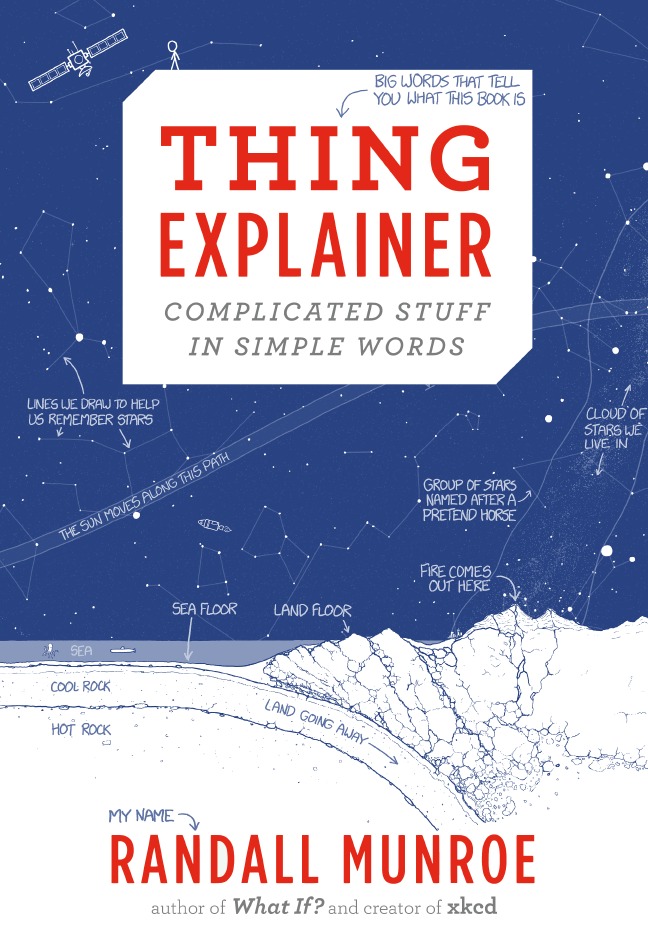
In Thing Explainer: Complicated Stuff in Simple Words, things are explained in the style of Up Goer Five, using only drawings and a vocabulary of the 1,000 (or "ten hundred") most common words. Explore computer buildings (datacenters), the flat rocks we live on (tectonic plates), the things you use to steer a plane (airliner cockpit controls), and the little bags of water you're made of (cells).

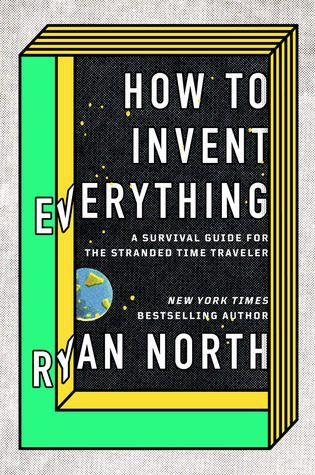
What would you do if a time machine hurled you thousands of years into the past. . . and then broke? How would you survive? Could you improve on humanity's original timeline? And how hard would it be to domesticate a giant wombat? With this book as your guide, you'll survive--and thrive--in any period in Earth's history. Bestselling author and time-travel enthusiast Ryan North shows you how to invent all the modern conveniences we take for granted--from first principles. This illustrated manual contains all the science, engineering, art, philosophy, facts, and figures required for even the most clueless time traveler to build a civilization from the ground up. Deeply researched, irreverent, and significantly more fun than being eaten by a saber-toothed tiger, How to Invent Everything will make you smarter, more competent, and completely prepared to become the most important and influential person ever.

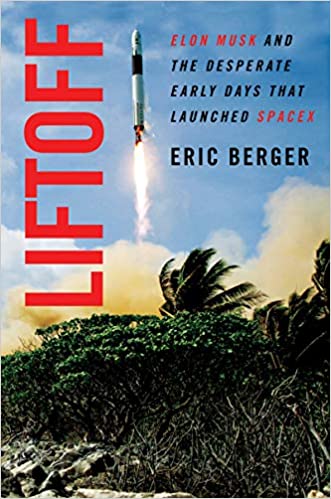
"This is as important a book on space as has ever been written and it's a riveting page-turner, too." —Homer Hickam, #1 New York Times Bestselling Author of Rocket BoysThe dramatic inside story of the historic flights that launched SpaceX—and Elon Musk—from a shaky startup into the world's leading-edge rocket company.SpaceX has enjoyed a miraculous decade. Less than 20 years after its founding, it boasts the largest constellation of commercial satellites in orbit, has pioneered reusable rockets, and in 2020 became the first private company to launch human beings into orbit. Half a century after the space race it is private companies, led by SpaceX, standing alongside NASA pushing forward into the cosmos, and laying the foundation for our exploration of other worlds.But before it became one of the most powerful players in the aerospace industry, SpaceX was a fledgling startup, scrambling to develop a single workable rocket before the money ran dry. The engineering challenge was immense; numerous other private companies had failed similar attempts. And even if SpaceX succeeded, they would then have to compete for government contracts with titans such as Lockheed Martin and Boeing, who had tens of thousands of employees and tens of billions of dollars in annual revenue. SpaceX had fewer than 200 employees and the relative pittance of $100 million in the bank.In Liftoff, Eric Berger, senior space editor at Ars Technica, takes readers inside the wild early days that made SpaceX. Focusing on the company’s first four launches of the Falcon 1 rocket, he charts the bumpy journey from scrappy underdog to aerospace pioneer. We travel from company headquarters in El Segundo, to the isolated Texas ranchland where they performed engine tests, to Kwajalein, the tiny atoll in the Pacific where SpaceX launched the Falcon 1. Berger has reported on SpaceX for more than a decade, enjoying unparalleled journalistic access to the company’s inner workings. Liftoff is the culmination of these efforts, drawing upon exclusive interviews with dozens of former and current engineers, designers, mechanics, and executives, including Elon Musk. The enigmatic Musk, who founded the company with the dream of one day settling Mars, is the fuel that propels the book, with his daring vision for the future of space.Filled with never-before-told stories of SpaceX’s turbulent beginning, Liftoff is a saga of cosmic proportions.

Dyson has become a byword for high-performing products, technology, design, and invention. Now, James Dyson, the inventor and entrepreneur who made it all happen, tells his remarkable and inspirational story in A Life , “one of the year’s most relevant and revelatory business books” ( The Wall Street Journal ) .Famously, over a four-year period, James Dyson made 5,127 prototypes of the cyclonic vacuum cleaner that would transform the way houses are cleaned around the world. In devoting all his resources to iteratively setbacks came hard-fought success. His products—including vacuum cleaners, hair dryer and hair stylers, and fans and purifiers—are not only revolutionary technologies, but design classics. This was a legacy of his time studying at the Royal College of Art in the 1960s, when he was inspired by some of the most famous artists, designers, and inventors of the era, as well as his engineering heroes such as Frank Whittle and Alex Issigonis.In A Life , Dyson reveals how he came to set up his own company and led it to become one of the most inventive technology companies in the world. It is a compelling and dramatic tale, with many obstacles overcome. Dyson has always looked to the future, even setting up his own university to help provide the next generation of engineers and designers. For, as he says, “everything changes all the time, so experience is of little use.”Whether you are someone who has an idea for a better product, an aspiring entrepreneur, whether you appreciate great design or a page-turning read, A Life is an “entertaining and inspiring memoir” ( Kirkus Reviews , starred review) that offers motivation, hope, and much more.

Widely considered one of the best practical guides to programming, Steve McConnell’s original code complete has been helping developers write better software for more than a decade. Now this classic book has been fully updated and revised with leading-edge practices—and hundreds of new code samples—illustrating the art and science of software construction. Capturing the body of knowledge available from research, academia, and everyday commercial practice, McConnell synthesizes the most effective techniques and must-know principles into clear, pragmatic guidance. No matter what your experience level, development environment, or project size, this book will inform and stimulate your thinking—and help you build the highest quality code.Discover the timeless techniques and strategies that help you:

The period between 1867 and 1914 remains the greatest watershed in human history since the emergence of settled agricultural the time when an expansive civilization based on synergy of fuels, science, and technical innovation was born. At its beginnings in the 1870s were dynamite, the telephone, photographic film, and the first light bulbs. Its peak decade - the astonishing 1880s - brought electricity - generating plants, electric motors, steam turbines, the gramophone, cars, aluminum production, air-filled rubber tires, and prestressed concrete. And its post-1900 period saw the first airplanes, tractors, radio signals and plastics, neon lights and assembly line production. This book is a systematic interdisciplinary account of the history of this outpouring of European and American intellect and of its truly epochal consequences. It takes a close look at four fundamental classes of these epoch-making formation, diffusion, and standardization of electricsystems; invention and rapid adoption of internal combustion engines; the unprecedented pace of new chemical syntheses and material substitutions; and the birth of a new information age. These chapters are followed by an evaluation of the lasting impact these advances had on the 20th century, that is, the creation of high-energy societies engaged in mass production aimed at improving standards of living.

The practice of building software is a “new kid on the block” technology. Though it may not seem this way for those who have been in the field for most of their careers, in the overall scheme of professions, software builders are relative “newbies.” In the short history of the software field, a lot of facts have been identified, and a lot of fallacies promulgated. Those facts and fallacies are what this book is about. There’s a problem with those facts–and, as you might imagine, those fallacies. Many of these fundamentally important facts are learned by a software engineer, but over the short lifespan of the software field, all too many of them have been forgotten. While reading Facts and Fallacies of Software Engineering , you may experience moments of “Oh, yes, I had forgotten that,” alongside some “Is that really true?” thoughts. The author of this book doesn’t shy away from controversy. In fact, each of the facts and fallacies is accompanied by a discussion of whatever controversy envelops it. You may find yourself agreeing with a lot of the facts and fallacies, yet emotionally disturbed by a few of them! Whether you agree or disagree, you will learn why the author has been called “the premier curmudgeon of software practice.” These facts and fallacies are fundamental to the software building field–forget or neglect them at your peril!

Paradigms of AI Programming is the first text to teach advanced Common Lisp techniques in the context of building major AI systems. By reconstructing authentic, complex AI programs using state-of-the-art Common Lisp, the book teaches students and professionals how to build and debug robust practical programs, while demonstrating superior programming style and important AI concepts. The author strongly emphasizes the practical performance issues involved in writing real working programs of significant size. Chapters on troubleshooting and efficiency are included, along with a discussion of the fundamentals of object-oriented programming and a description of the main CLOS functions. This volume is an excellent text for a course on AI programming, a useful supplement for general AI courses and an indispensable reference for the professional programmer.

A fundamental software engineering project management guide based on the practical requirements of "Taming Wild Software Schedules". Emphasizes possible, realistic and "best practice" approaches for managers, technical leads and self-managed teams. The author emphasizes efficient development concepts with an examination of rapid development strategies and a study of classic mistakes, within the context of software-development fundamentals and risk management. Dissects the core issues of rapid development, lifecycle planning, estimation and scheduling. Contains very good and practical discussions of customer-oriented development, motivation and teamwork. Explains such fundamental requirements as team structure, feature-set control (the dreaded feature creep in every project), availability and use of productivity tools and project recovery options. Relevant case studies are analyzed and discussed within the context of specific software development problems. Over 200 pages in this publication are devoted to a summary of best practices, everything from the daily build and smoke test, through prototyping, model selection, measurement, reuse, and the top-10 risks list. This publication is definitely recommended and will become a classic in the field, just as the author's prior publication, "Code Complete" already is.

From the development of the U-2 to the Stealth fighter, the never-before-told story behind the high-stakes quest to dominate the skies Skunk Works is the true story of America's most secret & successful aerospace operation. As recounted by Ben Rich, the operation's brilliant boss for nearly two decades, the chronicle of Lockheed's legendary Skunk Works is a drama of cold war confrontations and Gulf War air combat, of extraordinary feats of engineering & achievement against fantastic odds. Here are up-close portraits of the maverick band of scientists & engineers who made the Skunk Works so renowned. Filled with telling personal anecdotes & high adventure, with narratives from the CIA & from Air Force pilots who flew the many classified, risky missions, this book is a portrait of the most spectacular aviation triumphs of the 20th century.

This informally written text provides students with a clear introduction into the subject of linear algebra. Topics covered include matrix multiplication, row reduction, matrix inverse, orthogonality and computation. The self-teaching book is loaded with examples and graphics and provides a wide array of probing problems, accompanying solutions, and a glossary. Chapter 1: Introduction to Vectors; Chapter 2: Solving Linear Equations; Chapter 3: Vector Spaces and Subspaces; Chapter 4: Orthogonality; Chapter 5: Determinants; Chapter 6: Eigenvalues and Eigenvectors; Chapter 7: Linear Transformations; Chapter 8: Applications; Chapter 9: Numerical Linear Algebra; Chapter 10: Complex Vectors and Matrices; Solutions to Selected Exercises; Final Exam. Matrix Factorizations. Conceptual Questions for Review. Glossary: A Dictionary for Linear Algebra Index Teaching Codes Linear Algebra in a Nutshell.

J. E. Gordon's classic introduction to the properties of materials used in engineering answers some fascinating and fundamental questions about how the structural world around us works. Gordon focuses on so-called strong materials--such as metals, wood, ceramics, glass, and bone--explaining in engaging and accessible terms the unique physical and chemical basis for their inherent structural qualities. He also shows how an in-depth understanding of these materials’ intrinsic strengths--and weaknesses--guides our engineering choices, allowing us to build the structures that support our society. This work is an enduring example of first-rate scientific communication. Philip Ball's introduction describes Gordon's career and the impact of his innovations in materials research, while also discussing how the field has evolved since Gordon wrote this enduring example of first-rate scientific communication.

In a book that Business Insider noted as one of the "14 Books that inspired Elon Musk," J.E. Gordon strips engineering of its confusing technical terms, communicating its founding principles in accessible, witty prose.For anyone who has ever wondered why suspension bridges don't collapse under eight lanes of traffic, how dams hold back--or give way under--thousands of gallons of water, or what principles guide the design of a skyscraper, a bias-cut dress, or a kangaroo, this book will ease your anxiety and answer your questions. Or Why Things Don't Fall Down is an informal explanation of the basic forces that hold together the ordinary and essential things of this world--from buildings and bodies to flying aircraft and eggshells. In a style that combines wit, a masterful command of his subject, and an encyclopedic range of reference, Gordon includes such chapters as "How to Design a Worm" and "The Advantage of Being a Beam," offering humorous insights in human and natural creation.Architects and engineers will appreciate the clear and cogent explanations of the concepts of stress, shear, torsion, fracture, and compression. If you're building a house, a sailboat, or a catapult, here is a handy tool for understanding the mechanics of joinery, floors, ceilings, hulls, masts--or flying buttresses.Without jargon or oversimplification, Structures opens up the marvels of technology to anyone interested in the foundations of our everyday lives.

This textbook takes an innovative approach to the teaching of classical mechanics, emphasizing the development of general but practical intellectual tools to support the analysis of nonlinear Hamiltonian systems. The development is organized around a progressively more sophisticated analysis of particular natural systems and weaves examples throughout the presentation. Explorations of phenomena such as transitions to chaos, nonlinear resonances, and resonance overlap to help the student to develop appropriate analytic tools for understanding. Computational algorithms communicate methods used in the analysis of dynamical phenomena. Expressing the methods of mechanics in a computer language forces them to be unambiguous and computationally effective. Once formalized as a procedure, a mathematical idea also becomes a tool that can be used directly to compute results.The student actively explores the motion of systems through computer simulation and experiment. This active exploration is extended to the mathematics. The requirement that the computer be able to interpret any expression provides strict and immediate feedback as to whether an expression is correctly formulated. The interaction with the computer uncovers and corrects many deficiencies in understanding.

Most people are baffled by how computers work and assume that they will never understand them. What they don't realize—and what Daniel Hillis's short book brilliantly demonstrates—is that computers' seemingly complex operations can be broken down into a few simple parts that perform the same simple procedures over and over again.Computer wizard Hillis offers an easy-to-follow explanation of how data is processed that makes the operations of a computer seem as straightforward as those of a bicycle. Avoiding technobabble or discussions of advanced hardware, the lucid explanations and colorful anecdotes in The Pattern on the Stone go straight to the heart of what computers really do.Hillis proceeds from an outline of basic logic to clear descriptions of programming languages, algorithms, and memory. He then takes readers in simple steps up to the most exciting developments in computing today—quantum computing, parallel computing, neural networks, and self-organizing systems.Written clearly and succinctly by one of the world's leading computer scientists, The Pattern on the Stone is an indispensable guide to understanding the workings of that most ubiquitous and important of machines: the computer.

An objective, comprehensive, and accessible examination of today's most crucial preserving the environment in the face of society's insatiable demand for energy. In Energy at the Crossroads , Vaclav Smil considers the twenty-first century's crucial how to reconcile the modern world's unceasing demand for energy with the absolute necessity to preserve the integrity of the biosphere. With this book he offers a comprehensive, accessible guide to today's complex energy issues—how to think clearly and logically about what is possible and what is desirable in our energy future. After a century of unprecedented production growth, technical innovation, and expanded consumption, the world faces a number of critical energy challenges arising from unequal resource distribution, changing demand patterns, and environmental limitations. The fundamental message of Energy at the Crossroads is that our dependence on fossil fuels must be reduced not because of any imminent resource shortages but because the widespread burning of oil, coal, and natural gas damages the biosphere and presents increasing economic and security problems as the world relies on more expensive supplies and Middle Eastern crude oil. Smil begins with an overview of the twentieth century's long-term trends and achievements in energy production. He then discusses energy prices, the real cost of energy, and "energy linkages"—the effect energy issues have on the economy, on quality of life, on the environment, and in wartime. He discusses the pitfalls of forecasting, giving many examples of failed predictions and showing that unexpected events can disprove complex models. And he examines the pros and cons not only of fossil fuels but also of alternative fuels such as hydroenergy, biomass energy, wind power, and solar power. Finally, he considers the future, focusing on what really matters, what works, what is realistic, and which outcomes are most desirable.

Barely fifty years ago a computer was a gargantuan, vastly expensive thing that only a handful of scientists had ever seen. The world’s brightest engineers were stymied in their quest to make these machines small and affordable until the solution finally came from two ingenious young Americans. Jack Kilby and Robert Noyce hit upon the stunning discovery that would make possible the silicon microchip, a work that would ultimately earn Kilby the Nobel Prize for physics in 2000. In this completely revised and updated edition of The Chip , T.R. Reid tells the gripping adventure story of their invention and of its growth into a global information industry. This is the story of how the digital age began.

Dr. Smil is the world's authority on nitrogenous fertilizer. The industrial synthesis of ammonia from nitrogen and hydrogen has been of greater fundamental importance to the modern world than the invention of the airplane, nuclear energy, space flight, or television. The expansion of the world's population from 1.6 billion people in 1900 to today's six billion would not have been possible without the synthesis of ammonia. In Enriching the Earth , Vaclav Smil begins with a discussion of nitrogen's unique status in the biosphere, its role in crop production, and traditional means of supplying the nutrient. He then looks at various attempts to expand natural nitrogen flows through mineral and synthetic fertilizers. The core of the book is a detailed narrative of the discovery of ammonia synthesis by Fritz Haber—a discovery scientists had sought for over one hundred years—and its commercialization by Carl Bosch and the chemical company BASF. Smil also examines the emergence of the large-scale nitrogen fertilizer industry and analyzes the extent of global dependence on the Haber-Bosch process and its biospheric consequences. Finally, it looks at the role of nitrogen in civilization and, in a sad coda, describes the lives of Fritz Haber and Carl Bosch after the discovery of ammonia synthesis.

Ignition! is the inside story of the Cold War era search for a rocket propellant that could be trusted to take man into space. A favorite of Tesla and SpaceX founder Elon Musk, listeners will want to tune into this "really good book on rocket[s]," available for the first time in audio.Ignition! is the story of the search for a rocket propellant which could be trusted to take man into space. This search was a hazardous enterprise carried out by rival labs who worked against the known laws of nature, with no guarantee of success or safety.Acclaimed scientist and sci-fi author John Drury Clark writes with irreverent and eyewitness immediacy about the development of the explosive fuels strong enough to negate the relentless restraints of gravity. The resulting volume is as much a memoir as a work of history, sharing a behind-the-scenes view of an enterprise that eventually took men to the moon, missiles to the planets, and satellites to outer space. A classic work in the history of science, listeners will want to get their hands on this influential classic, available for the first time in decades.

From the component design, to the subsystem design, to the engine systems design, engine development and flight-vehicle application, this how-to text bridges the gap between basic physical and design principles and actual rocket-engine design as it's done in industry.

Six Easy Essentials of Physics Explained by Its Most Brilliant Teacher is a publishing first. This set couples a book containing the six easiest chapters from Richard P. Feynman's landmark work, Lectures on Physics —specifically designed for the general, non-scientist reader—with the actual recordings of the late, great physicist delivering the lectures on which the chapters are based. Nobel Laureate Feynman gave these lectures just once, to a group of Caltech undergraduates in 1961 and 1962, and these newly released recordings allow you to experience one of the Twentieth Century's greatest minds—as if you were right there in the classroom.

Comprehensive Introduction to Manufacturing Management text covering the behavior laws at work in factories. Examines operating policies and strategic objectives. Hopp presents the concepts of manufacturing processes and controls within a "physics" or "laws of nature" analogy--a novel approach. There is enough quantitative material for an engineer's course, as well as narrative that a management major can understand and apply.

The sheer volume of talk about energy, energy prices, and energy policy on both sides of the political aisle suggests that we must know something about energy. But according to Peter Huber and Mark Mills, the things we "know" are mostly myths. In The Bottomless Well , Huber and Mills debunk the myths and show how a better understanding of energy will radically change our views and policies on a number of very controversial issues. They explain why demand will never go down, why most of what we think of as "energy waste" actually benefits us; why greater efficiency will never lead to energy conservation; and why the energy supply is infinite-it's quality of energy that's scarce and expensive. The Bottomless Well will also revolutionize our thinking about the automotive industry (gas prices don't matter and the hybrid engine is irrelevant), coal and uranium, the much-maligned power grid (it's the worst system we could have except for all the others), what energy supplies mean for jobs and GDP, and many other hotly debated subjects.

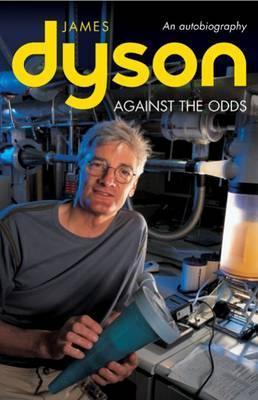
How did a maverick English inventor manage to design, market and make money from his own invention, toppling market leaders in the process? This inspirational autobiography tells the remarkable story behind James Dyson and his most successful invention to date Â- the Dual Cyclone. This revolutionary (bagless) vacuum cleaner has taken the market by storm, but not without years of personal struggle and crises for its inventor. Faced with little or no support at every turn, DysonÂ's extraordinary story shows how his unswerving optimism and self-belief has brought him spectacular success.

On December 31, 1999, after nearly a century of rule, the United States officially ceded ownership of the Panama Canal to the nation of Panama. That nation did not exist when, in the mid-19th century, Europeans first began to explore the possibilities of creating a link between the Atlantic and Pacific oceans through the narrow but mountainous isthmus; Panama was then a remote and overlooked part of Colombia.All that changed, writes David McCullough in his magisterial history of the Canal, in 1848, when prospectors struck gold in California. A wave of fortune seekers descended on Panama from Europe and the eastern United States, seeking quick passage on California-bound ships in the Pacific, and the Panama Railroad, built to serve that traffic, was soon the highest-priced stock listed on the New York Exchange. To build a 51-mile-long ship canal to replace that railroad seemed an easy matter to some investors. But, as McCullough notes, the construction project came to involve the efforts of thousands of workers from many nations over four decades; eventually those workers, laboring in oppressive heat in a vast malarial swamp, removed enough soil and rock to build a pyramid a mile high. In the early years, they toiled under the direction of French entrepreneur Ferdinand de Lesseps, who went bankrupt while pursuing his dream of extending France's empire in the Americas. The United States then entered the picture, with President Theodore Roosevelt orchestrating the purchase of the canal—but not before helping foment a revolution that removed Panama from Colombian rule and placed it squarely in the American camp.

In Go To , Steve Lohr chronicles the history of software from the early days of complex mathematical codes mastered by a few thousand to today's era of user-friendly software and over six million professional programmers worldwide. Lohr maps out the unique seductions of programming, and gives us an intimate portrait of the peculiar kind of genius that is drawn to this blend of art, science, and engineering, introducing us to the movers and shakers of the 1950s and the open-source movement of today. With original reporting and deft storytelling, Steve Lohr shows us how software transformed the world, and what it holds in store for our future.

An authoritative introduction to "fuzzy logic" brings readers up to speed on the "smart" products and computers that will change all of our lives in the future.

While John McPhee was working on his previous book, Rising from the Plains, he happened to walk by the engineering building at the University of Wyoming, where words etched in limestone said: "Strive on--the control of Nature is won, not given." In the morning sunlight, that central phrase--"the control of nature"--seemed to sparkle with unintended ambiguity. Bilateral, symmetrical, it could with equal speed travel in opposite directions. For some years, he had been planning a book about places in the world where people have been engaged in all-out battles with nature, about (in the words of the book itself) "any struggle against natural forces--heroic or venal, rash or well advised--when human beings conscript themselves to fight against the earth, to take what is not given, to rout the destroying enemy, to surround the base of Mt. Olympus demanding and expecting the surrender of the gods." His interest had first been sparked when he went into the Atchafalaya--the largest river swamp in North America--and had learned that virtually all of its waters were metered and rationed by a U.S. Army Corps of Engineers' project called Old River Control.In the natural cycles of the Mississippi's deltaic plain, the time had come for the Mississippi to change course, to shift its mouth more than a hundred miles and go down the Atchafalaya, one of its distributary branches. The United States could not afford that--for New Orleans, Baton Rouge, and all the industries that lie between would be cut off from river commerce with the rest of the nation. At a place called Old River, the Corps therefore had built a great fortress--part dam, part valve--to restrain the flow of the Atchafalaya and compel the Mississippi to stay where it is.In Iceland, in 1973, an island split open without warning and huge volumes of lava began moving in the direction of a harbor scarcely half a mile away. It was not only Iceland's premier fishing port (accounting for a large percentage of Iceland's export economy) but it was also the only harbor along the nation's southern coast. As the lava threatened to fill the harbor and wipe it out, a physicist named Thorbjorn Sigurgeirsson suggested a way to fight against the flowing red rock--initiating an all-out endeavor unique in human history. On the big island of Hawaii, one of the world's two must eruptive hot spots, people are not unmindful of the Icelandic example. McPhee went to Hawaii to talk with them and to walk beside the edges of a molten lake and incandescent rivers.Some of the more expensive real estate in Los Angeles is up against mountains that are rising and disintegrating as rapidly as any in the world. After a complex coincidence of natural events, boulders will flow out of these mountains like fish eggs, mixed with mud, sand, and smaller rocks in a cascading mass known as debris flow. Plucking up trees and cars, bursting through doors and windows, filling up houses to their eaves, debris flows threaten the lives of people living in and near Los Angeles' famous canyons. At extraordinary expense the city has built a hundred and fifty stadium-like basins in a daring effort to catch the debris.Taking us deep into these contested territories, McPhee details the strategies and tactics through which people attempt to control nature. Most striking in his vivid depiction of the main contestants: nature in complex and awesome guises, and those who would attempt to wrest control from her--stubborn, often ingenious, and always arresting characters.

Continuing his exploration of the organization of complexity and the science of design, this new edition of Herbert Simon's classic work on artificial intelligence adds a chapter that sorts out the current themes and tools -- chaos, adaptive systems, genetic algorithms -- for analyzing complexity and complex systems. There are updates throughout the book as well. These take into account important advances in cognitive psychology and the science of design while confirming and extending the book's basic thesis: that a physical symbol system has the necessary and sufficient means for intelligent action. The chapter "Economic Reality" has also been revised to reflect a change in emphasis in Simon's thinking about the respective roles of organizations and markets in economic systems."People sometimes ask me what they should read to find out about artificial intelligence. Herbert Simon's book The Sciences of the Artificial is always on the list I give them. Every page issues a challenge to conventional thinking, and the layman who digests it well will certainly understand what the field of artificial intelligence hopes to accomplish. I recommend it in the same spirit that I recommend Freud to people who ask about psychoanalysis, or Piaget to those who ask about child psychology: If you want to learn about a subject, start by reading its founding fathers." -- George A. Miller

Addressing the sustainable energy crisis in an objective manner, this enlightening book analyzes the relevant numbers and organizes a plan for change on both a personal level and an international scale—for Europe, the United States, and the world. In case study format, this informative reference answers questions surrounding nuclear energy, the potential of sustainable fossil fuels, and the possibilities of sharing renewable power with foreign countries. While underlining the difficulty of minimizing consumption, the tone remains positive as it debunks misinformation and clearly explains the calculations of expenditure per person to encourage people to make individual changes that will benefit the world at large.

Take the guesswork out of using regular expressions. With more than 140 practical recipes, this cookbook provides everything you need to solve a wide range of real-world problems. Novices will learn basic skills and tools, and programmers and experienced users will find a wealth of detail. Each recipe provides samples you can use right away. This revised edition covers the regular expression flavors used by C#, Java, JavaScript, Perl, PHP, Python, Ruby, and VB.NET. You’ll learn powerful new tricks, avoid flavor-specific gotchas, and save valuable time with this huge library of practical solutions.

Used extensively as a reference source for the FAA Knowledge Exams, this resource includes basic knowledge that is essential for all pilots, from beginning students to those pursuing advanced pilot certificates. This updated guide covers a wide array of fundamental subjects, including principles of flight, aircraft and engine structures, charts and graphs, performance calculations, weather theory, reports, forecasts, and flight manuals. Required reading for pilots for more than 25 years and formerly published as an Advisory Circular (AC 61-23C), this new edition is now listed as an official FAA Handbook.

The laws of thermodynamics drive everything that happens in the universe. From the sudden expansion of a cloud of gas to the cooling of hot metal--everything is moved or restrained by four simple laws. Written by Peter Atkins, one of the world's leading authorities on thermodynamics, this powerful and compact introduction explains what these four laws are and how they work, using accessible language and virtually no mathematics. Guiding the reader a step at a time, Atkins begins with Zeroth (so named because the first two laws were well established before scientists realized that a third law, relating to temperature, should precede them--hence the jocular name zeroth), and proceeds through the First, Second, and Third Laws, offering a clear account of concepts such as the availability of work and the conservation of energy. Atkins ranges from the fascinating theory of entropy (revealing how its unstoppable rise constitutes the engine of the universe), through the concept of free energy, and to the brink, and then beyond the brink, of absolute zero. About the Series: Combining authority with wit, accessibility, and style, Very Short Introductions offer an introduction to some of life's most interesting topics. Written by experts for the newcomer, they demonstrate the finest contemporary thinking about the central problems and issues in hundreds of key topics, from philosophy to Freud, quantum theory to Islam.

This bold and controversial argument shows why energy transitions are inherently complex and prolonged affairs, and how ignoring this fact raises unrealistic expectations that the United States and other global economies can be weaned quickly from a primary dependency on fossil fuels.Energy transitions are fundamental processes behind the evolution of human they both drive and are driven by technical, economic, and social changes. In a bold and provocative argument, Energy History, Requirements, Prospects describes the history of modern society's dependence on fossil fuels and the prospects for the transition to a nonfossil world. Vaclav Smil, who has published more on various aspects of energy than any working scientist, makes it clear that this transition will not be accomplished easily, and that it cannot be accomplished within the timetables established by the Obama administration.The book begins with a survey of the basic properties of modern energy systems. It then offers detailed explanations of universal patterns of energy transitions, the peculiarities of changing energy use in the world's leading economies, and the coming shifts from fossil fuels to renewable conversions. Specific cases of these transitions are analyzed for eight of the world's leading energy consumers. The author closes with perspectives on the nature and pace of the coming energy transition to renewable conversions.

The many books on globalization published over the past few years range from claims that the world is flat to an unlikely rehabilitation of Genghis Khan as a pioneer of global commerce. Missing from these accounts is a consideration of the technologies behind the creation of the globalized economy. What makes it possible for us to move billions of tons of raw materials and manufactured goods from continent to continent? Why are we able to fly almost anywhere on the planet within twenty-four hours? In Prime Movers of Globalization , Vaclav Smil offers a history of two key technical developments that have driven the high-compression non-sparking internal combustion engines invented by Rudolf Diesel in the 1890s and the gas turbines designed by Frank Whittle and Hans-Joachim Pabst von Ohain in the 1930s. The massive diesel engines that power cargo ships and the gas turbines that propel jet engines, Smil argues, are more important to the global economy than any corporate structure or international trade agreement. Smil compares the efficiency and scale of these two technologies to prime movers of the past, including the sail and the steam engine. The lengthy processes of development, commercialization, and diffusion that the diesel engine and the gas turbine went through, he argues, provide perfect examples of gradual technical advances that receive little attention but have resulted in epochal shifts in global affairs and the global economy.

How much further should the affluent world push its material consumption? Does relative dematerialization lead to absolute decline in demand for materials? These and many other questions are discussed and answered in Making the Modern Materials and Dematerialization. Over the course of time, the modern world has become dependent on unprecedented flows of materials. Now even the most efficient production processes and the highest practical rates of recycling may not be enough to result in dematerialization rates that would be high enough to negate the rising demand for materials generated by continuing population growth and rising standards of living. This book explores the costs of this dependence and the potential for substantial dematerialization of modern economies. Making the Modern Materials and Dematerialization considers the principal materials used throughout history, from wood and stone, through to metals, alloys, plastics and silicon, describing their extraction and production as well as their dominant applications. The evolving productivities of material extraction, processing, synthesis, finishing and distribution, and the energy costs and environmental impact of rising material consumption are examined in detail. The book concludes with an outlook for the future, discussing the prospects for dematerialization and potential constrains on materials. This interdisciplinary text provides useful perspectives for readers with backgrounds including resource economics, environmental studies, energy analysis, mineral geology, industrial organization, manufacturing and material science.

A revelatory look at our national power grid--how it developed, its current flaws, and how it must be completely reimagined for our fast-approaching energy future.America's electrical grid, an engineering triumph of the twentieth century, is turning out to be a poor fit for the present. It's not just that the grid has grown old and is now in dire need of basic repair. Today, as we invest great hope in new energy sources--solar, wind, and other alternatives--the grid is what stands most firmly in the way of a brighter energy future. If we hope to realize this future, we need to reimagine the grid according to twenty-first-century values. It's a project which forces visionaries to work with bureaucrats, legislators with storm-flattened communities, moneymen with hippies, and the left with the right. And though it might not yet be obvious, this revolution is already well under way. Cultural anthropologist Gretchen Bakke unveils the many facets of America's energy infrastructure, its most dynamic moments and its most stable ones, and its essential role in personal and national life. The grid, she argues, is an essentially American artifact, one which developed with us: a product of bold expansion, the occasional foolhardy vision, some genius technologies, and constant improvisation. Most of all, her focus is on how Americans are changing the grid right now, sometimes with gumption and big dreams and sometimes with legislation or the brandishing of guns.The Grid tells--entertainingly, perceptively--the story of what has been called "the largest machine in the world": its fascinating history, its problematic present, and its potential role in a brighter, cleaner future.

Increase profitability, elevate work culture, and exceed productivity goals through DevOps practices.More than ever, the effective management of technology is critical for business competitiveness. For decades, technology leaders have struggled to balance agility, reliability, and security. The consequences of failure have never been greater whether it's the healthcare.gov debacle, cardholder data breaches, or missing the boat with Big Data in the cloud.And yet, high performers using DevOps principles, such as Google, Amazon, Facebook, Etsy, and Netflix, are routinely and reliably deploying code into production hundreds, or even thousands, of times per day.Following in the footsteps of The Phoenix Project, The DevOps Handbook shows leaders how to replicate these incredible outcomes, by showing how to integrate Product Management, Development, QA, IT Operations, and Information Security to elevate your company and win in the marketplace."Table of contentsPrefaceSpreading the Aha! MomentIntroductionPART I: THE THREE WAYS1. Agile, continuous delivery and the three ways2. The First Way: The Principles of Flow3. The Second Way: The Principle of Feedback4. The Third Way: The Principles of Continual LearningPART II: WHERE TO START5. Selecting which value stream to start with6. Understanding the work in our value stream…7. How to design our organization and architecture8. How to get great outcomes by integrating operations into the daily work for developmentPART III: THE FIRST WAY: THE TECHNICAL PRACTICES OF FLOW9. Create the foundations of our deployment pipeline10. Enable fast and reliable automated testing11. Enable and practice continuous integration12. Automate and enable low-risk releases13. Architect for low-risk releasesPART IV: THE SECOND WAY: THE TECHNICAL PRACTICES OF FEEDBACK14*. Create telemetry to enable seeing abd solving problems15. Analyze telemetry to better anticipate problems16. Enable feedbackso development and operation can safely deploy code17. Integrate hypothesis-driven development and A/B testing into our daily work18. Create review and coordination processes to increase quality of our current workPART V: THE THRID WAY: THE TECHNICAL PRACTICES OF CONTINUAL LEARNING19. Enable and inject learning into daily work20. Convert local discoveries into global improvements21. Reserve time to create organizational learning22. Information security as everyone’s job, every day23. Protecting the deployment pipelinePART VI: CONCLUSIONA call to actionConclusion to the DevOps HandbookAPPENDICES1. The convergence of Devops2. The theory of constraints and core chronic conflicts3. Tabular form of downward spiral4. The dangers of handoffs and queues5. Myths of industrial safety6. The Toyota Andon Cord7. COTS Software8. Post-mortem meetings9. The Simian Army10. Transparent uptimeAdditional ResourcesEndnotes

The revered New York Times bestselling author traces the development of technology from the Industrial Age to the Digital Age to explore the single component crucial to advancement—precision—in a superb history that is both an homage and a warning for our future.The rise of manufacturing could not have happened without an attention to precision. At the dawn of the Industrial Revolution in eighteenth-century England, standards of measurement were established, giving way to the development of machine tools—machines that make machines. Eventually, the application of precision tools and methods resulted in the creation and mass production of items from guns and glass to mirrors, lenses, and cameras—and eventually gave way to further breakthroughs, including gene splicing, microchips, and the Hadron Collider.Simon Winchester takes us back to origins of the Industrial Age, to England where he introduces the scientific minds that helped usher in modern production: John Wilkinson, Henry Maudslay, Joseph Bramah, Jesse Ramsden, and Joseph Whitworth. It was Thomas Jefferson who later exported their discoveries to the fledgling United States, setting the nation on its course to become a manufacturing titan. Winchester moves forward through time, to today’s cutting-edge developments occurring around the world, from America to Western Europe to Asia.As he introduces the minds and methods that have changed the modern world, Winchester explores fundamental questions. Why is precision important? What are the different tools we use to measure it? Who has invented and perfected it? Has the pursuit of the ultra-precise in so many facets of human life blinded us to other things of equal value, such as an appreciation for the age-old traditions of craftsmanship, art, and high culture? Are we missing something that reflects the world as it is, rather than the world as we think we would wish it to be? And can the precise and the natural co-exist in society?

Providing unique, accessible lessons on engineering, this title in the bestselling 101 Things I Learned® series is a perfect resource for students, recent graduates, general readers, and even seasoned professionals. An experienced civil engineer presents the physics and fundamentals underlying the many fields of engineering. Far from a dry, nuts-and-bolts exposition, 101 Things I Learned® in Engineering School uses real-world examples to show how the engineer's way of thinking can illuminate questions from the simple to the Why shouldn't soldiers march across a bridge? Why do buildings want to float and cars want to fly? What is the difference between thinking systemically and thinking systematically? This informative resource will appeal to students, general readers, and even experienced engineers, who will discover within many provocative insights into familiar principles.

Back in the 60s we were all sure there would be flying cars in our future. Were the futurists and SF writers of the day just wrong? Or has something more interesting and important happened? Will we ever get flying cars? This book offers a compelling analysis of the past and a surprising view of the future.

The brain is made up of 85 billion neurons, which are connected by over 100 trillion synapses. For over a century, a diverse array of researchers have been trying to find a language that can be used to capture the essence of what these neurons do and how they communicate – and how those communications create thoughts, perceptions and actions. The language they were looking for was mathematics, and we would not be able to understand the brain as we do today without it.In Models of the Mind, author and computational neuroscientist Grace Lindsay explains how mathematical models have allowed scientists to understand and describe many of the brain's processes, including decision-making, sensory processing, quantifying memory, and more. She introduces readers to the most important concepts in modern neuroscience, and highlights the tensions that arise when bringing the abstract world of mathematical modelling into contact with the messy details of biology.Each chapter focuses on mathematical tools that have been applied in a particular area of neuroscience, progressing from the simplest building block of the brain – the individual neuron – through to circuits of interacting neurons, whole brain areas and even the behaviours that brains command. Throughout Grace will look at the history of the field, starting with experiments done on neurons in frog legs at the turn of the twentieth century and building to the large models of artificial neural networks that form the basis of modern artificial intelligence. She demonstrates the value of describing the machinery of neuroscience using the elegant language of mathematics, and reveals in full the remarkable fruits of this endeavour.

Successful teams are fundamental to create successful outcomes for any business, across all industries, to include building and running modern software systems, and successful organizations take care in designing and evolving their team structures. In TEAM TOPOLOGIES DevOps consultants Matthew Skelton and Manuel Pais share secrets of successful team patterns and interactions to help readers choose and evolve the right team patterns for their organization, making sure to keep the software healthy and optimize value streams. TEAM TOPOLOGIES will help readers discover: Team patterns used by successful organizations Common team patterns to avoid with modern software systems When and why to use different team patternsHow to evolve teams effectivelyHow to split software and align to teams

Before the era of overpowered PCs and home consoles, there was a time when video-game enthusiasts could only experience the very best and the most challenging in places called "arcades".In these locations, players of all ages and origins gathered to take their passion to a level no consumer grade hardware could.The arcades of the early 90s were a highly competitive environment where publishers only had a few seconds to catch a player's attention, and more importantly their quarters. It was during that time that a young company named Capcom managed to elevate itself above the competition and turn itself into an icon.This book is an engineering love letter to the platform that allowed this metamorphosis. If you have always wanted to learn about the machine behind the legendary CPS-1 titles Street Fighter II, Ghouls 'n Ghosts, and Final Fight, the "Book of CP-System" is for you.Inside, you will find the hardware of the CPS-1 described and explained in excruciating detail. The software is also covered with a fully detailed modern pipeline, turning code and assets into ROMs.Jump in and discover a world of one hundred explanatory illustrations, sprinkled with typos and broken English to remind you this isn't just a dream!