Loading genres...
Explore the best books about Money genre.

More than one million hardcovers soldNow available for the first time in paperback!The Classic Text Annotated to Update Graham's Timeless Wisdom for Today's Market ConditionsThe greatest investment advisor of the twentieth century, Benjamin Graham taught and inspired people worldwide. Graham's philosophy of "value investing" -- which shields investors from substantial error and teaches them to develop long-term strategies -- has made The Intelligent Investor the stock market bible ever since its original publication in 1949.Over the years, market developments have proven the wisdom of Graham's strategies. While preserving the integrity of Graham's original text, this revised edition includes updated commentary by noted financial journalist Jason Zweig, whose perspective incorporates the realities of today's market, draws parallels between Graham's examples and today's financial headlines, and gives readers a more thorough understanding of how to apply Graham's principles.Vital and indispensable, this HarperBusiness Essentials edition of The Intelligent Investor is the most important book you will ever read on how to reach your financial goals.

The time was the 1980s. The place was Wall Street. The game was called Liar’s Poker. Michael Lewis was fresh out of Princeton and the London School of Economics when he landed a job at Salomon Brothers, one of Wall Street’s premier investment firms. During the next three years, Lewis rose from callow trainee to bond salesman, raking in millions for the firm and cashing in on a modern-day gold rush. Liar’s Poker is the culmination of those heady, frenzied years—a behind-the-scenes look at a unique and turbulent time in American business. From the frat-boy camaraderie of the forty-first-floor trading room to the killer instinct that made ambitious young men gamble everything on a high-stakes game of bluffing and deception, here is Michael Lewis’s knowing and hilarious insider’s account of an unprecedented era of greed, gluttony, and outrageous fortune. .

A million copy seller, Henry Hazlitt’s Economics in One Lesson is a classic economic primer. But it is also much more, having become a fundamental influence on modern “libertarian” economics of the type espoused by Ron Paul and others.Considered among the leading economic thinkers of the “Austrian School,” which includes Carl Menger, Ludwig von Mises, Friedrich (F.A.) Hayek, and others, Henry Hazlitt (1894-1993), was a libertarian philosopher, an economist, and a journalist. He was the founding vice-president of the Foundation for Economic Education and an early editor of The Freeman magazine, an influential libertarian publication. Hazlitt wrote Economics in One Lesson, his seminal work, in 1946. Concise and instructive, it is also deceptively prescient and far-reaching in its efforts to dissemble economic fallacies that are so prevalent they have almost become a new orthodoxy.Many current economic commentators across the political spectrum have credited Hazlitt with foreseeing the collapse of the global economy which occurred more than 50 years after the initial publication of Economics in One Lesson. Hazlitt’s focus on non-governmental solutions, strong — and strongly reasoned — anti-deficit position, and general emphasis on free markets, economic liberty of individuals, and the dangers of government intervention make Economics in One Lesson, every bit as relevant and valuable today as it has been since publication.

Rich Dad Poor Dad is Robert's story of growing up with two dads — his real father and the father of his best friend, his "rich dad" — and the ways in which both men shaped his thoughts about money and investing. The book explodes the myth that you need to earn a high income to be rich and explains the difference between working for money and having your money work for you.

The #1 New York Times bestseller: "It is the work of our greatest financial journalist, at the top of his game. And it's essential reading."—Graydon Carter, Vanity FairThe real story of the crash began in bizarre feeder markets where the sun doesn't shine and the SEC doesn't dare, or bother, to tread: the bond and real estate derivative markets where geeks invent impenetrable securities to profit from the misery of lower- and middle-class Americans who can't pay their debts. The smart people who understood what was or might be happening were paralyzed by hope and fear; in any case, they weren't talking.Michael Lewis creates a fresh, character-driven narrative brimming with indignation and dark humor, a fitting sequel to his #1 bestseller Liar's Poker. Out of a handful of unlikely-really unlikely-heroes, Lewis fashions a story as compelling and unusual as any of his earlier bestsellers, proving yet again that he is the finest and funniest chronicler of our time.

Based on author Sebastian Mallaby's unprecedented access to the industry, including three hundred hours of interviews, More Money Than God tells the inside story of hedge funds, from their origins in the 1960s and 1970s to their role in the financial crisis of 2007-2009. Wealthy, powerful, and potentially dangerous, hedge fund moguls have become the It Boys of twenty-first century capitalism. Ken Griffin of Citadel started out trading convertible bonds from his dorm room at Harvard. Julian Robertson staffed his hedge fund with college athletes half his age, then he flew them to various retreats in the Rockies and raced them up the mountains. Paul Tudor Jones posed for a magazine photograph next to a killer shark and happily declared that a 1929-style crash would be "total rock-and-roll" for him. Michael Steinhardt was capable of reducing underlings to sobs. "All I want to do is kill myself," one said. "Can I watch?" Steinhardt responded. Finance professors have long argued that beating the market is impossible, and yet drawing on insights from physics, economics, and psychology, these titans have cracked the market's mysteries and gone on to earn fortunes. Their innovation has transformed the world, spawning new markets in exotic financial instruments and rewriting the rules of capitalism. More than just a history, More Money Than God is a window on tomorrow's financial system. Hedge funds have been left for dead after past financial panics: After the stock market rout of the early 1970s, after the bond market bloodbath of 1994, after the collapse of Long Term Capital Management in 1998, and yet again after the dot-com crash in 2000. Each time, hedge funds have proved to be survivors, and it would be wrong to bet against them now. Banks such as CitiGroup, brokers such as Bear Stearns and Lehman Brothers, home lenders such as Fannie Mae and Freddie Mac, insurers such as AIG, and money market funds run by giants such as Fidelity-all have failed or been bailed out. But the hedge fund industry has survived the test of 2008 far better than its rivals. The future of finance lies in the history of hedge funds.

A #1 New York Times bestseller and arguably the best business narrative ever written, Barbarians at the Gate is the classic account of the fall of RJR Nabisco. An enduring masterpiece of investigative journalism by Bryan Burrough and John Helyar, it includes a new afterword by the authors that brings this remarkable story of greed and double-dealings up to date twenty years after the famed deal. The Los Angeles Times calls Barbarians at the Gate, “Superlative.” The Chicago Tribune raves, “It’s hard to imagine a better story...and it’s hard to imagine a better account.” And in an era of spectacular business crashes and federal bailouts, it still stands as a valuable cautionary tale that must be heeded.

The bestselling success book of all time—now revised and updated for the 21st century.Think and Grow Rich has been called the “Granddaddy of All Motivational Literature.” It was the first book to boldly ask, “What makes a winner?” The man who asked and listened for the answer, Napoleon Hill, is now counted in the top ranks of the world's winners himself. The most famous of all teachers of success spent “a fortune and the better part of a lifetime of effort” to produce the “Law of Success” philosophy that forms the basis of his books and that is so powerfully summarized in this one.In the original Think and Grow Rich, published in 1937, Hill draws on stories of Andrew Carnegie, Thomas Edison, Henry Ford, and other millionaires of his generation to illustrate his principles. In the updated version, Arthur R. Pell, Ph.D., a nationally known author, lecturer, and consultant in human resources management and an expert in applying Hill's thought, deftly interweaves anecdotes of how contemporary millionaires and billionaires, such as Bill Gates, Mary Kay Ash, Dave Thomas, and Sir John Templeton, achieved their wealth. Outmoded or arcane terminology and examples are faithfully refreshed to preclude any stumbling blocks to a new generation of readers.

The Richest Man in Babylon is an early twentieth century classic about financial investment and monetary success. Through a series of enlightening parables set in the heart of ancient Babylon, Clason provided his readers with economic tips and tools for financial success. Here his text is interpreted for today and offers you 52 simple, powerful and proven techniques to manage your finances. Karen McCreadies interpretation of Clason's work illustrates the timeless nature of his insights by bringing them to life through modern case studies.

The personally revealing and complete biography of the man known everywhere as “The Oracle of Omaha”—for fans of the HBO documentary Becoming Warren BuffettHere is the book recounting the life and times of one of the most respected men in the world, Warren Buffett. The legendary Omaha investor has never written a memoir, but now he has allowed one writer, Alice Schroeder, unprecedented access to explore directly with him and with those closest to him his work, opinions, struggles, triumphs, follies, and wisdom.Although the media track him constantly, Buffett himself has never told his full life story. His reality is private, especially by celebrity standards. Indeed, while the homespun persona that the public sees is true as far as it goes, it goes only so far. Warren Buffett is an array of paradoxes. He set out to prove that nice guys can finish first. Over the years he treated his investors as partners, acted as their steward, and championed honesty as an investor, CEO, board member, essayist, and speaker. At the same time he became the world’s richest man, all from the modest Omaha headquarters of his company Berkshire Hathaway. None of this fits the term “simple.”When Alice Schroeder met Warren Buffett she was an insurance industry analyst and a gifted writer known for her keen perception and business acumen. Her writings on finance impressed him, and as she came to know him she realized that while much had been written on the subject of his investing style, no one had moved beyond that to explore his larger philosophy, which is bound up in a complex personality and the details of his life. Out of this came his decision to cooperate with her on the book about himself that he would never write.Never before has Buffett spent countless hours responding to a writer’s questions, talking, giving complete access to his wife, children, friends, and business associates—opening his files, recalling his childhood. It was an act of courage, as The Snowball makes immensely clear. Being human, his own life, like most lives, has been a mix of strengths and frailties. Yet notable though his wealth may be, Buffett’s legacy will not be his ranking on the scorecard of wealth; it will be his principles and ideas that have enriched people’s lives. This book tells you why Warren Buffett is the most fascinating American success story of our time.Praise for The Snowball“Even people who don't care a whit about business will be intrigued by this portrait. . . . Schroeder, a former insurance-industry analyst, spent years interviewing Buffett, and the result is a side of the Oracle of Omaha that has rarely been seen.” — Time“Will mesmerize anyone interested in who Mr. Buffett is or how he got that way. The Snowball tells a fascinating story.” — New York Times“If the replication of any great achievement first requires knowledge of how it was done, then The Snowball , the most detailed glimpse inside Warren Buffett and his world that we likely will ever get, should become a Bible for capitalists.” — Washington Post“Riveting and encyclopedic.” — Wall Street Journal“A monumental biography . . . Schroeder got the best access yet of any Buffett biographer. . . . She deals out marvelously funny and poignant stories about Buffett and the conglomerate he runs, Berkshire Hathaway.” — Forbes“The most authoritative portrait of one of the most important American investors of our time.” — Los Angeles Times

At last, for a generation that's materially ambitious yet financially clueless comes I Will Teach You To Be Rich, Ramit Sethi's 6-week personal finance program for 20-to-35-year-olds. A completely practical approach delivered with a nonjudgmental style that makes readers want to do what Sethi says, it is based around the four pillars of personal finance— banking, saving, budgeting, and investing—and the wealth-building ideas of personal entrepreneurship.Sethi covers how to save time by not wasting it managing money; the guns and cars myth of credit cards; how to negotiate like an Indian—the conversation begins with "no"; why "Budgeting Doesn't Have to Suck!"; how to get things rolling—for real—with only $20; what most people don't understand about taxes; how to get a CEO to take you out to lunch; how to avoid the Super Mario Brothers trap by making your savings work harder than you do; the difference between cheap and frugal; the hidden relationship between money and food. Not to mention his first key lesson: Getting started is more important than being the smartest person in the room. Integrated with his website, where readers can use interactive charts, follow up on the latest information, and join the community, it is a hip blueprint to building wealth and financial security.Every month, 175,000 unique visitors come to Ramit Sethi's website, Iwillteachyoutoberich.com, to discover the path to financial freedom. They praise him thoughtfully ("Your site summarizes everything I want with my life—to be rich in finances, rich in experience, rich in family blessings," --Dan Esparza) and effusively ("Dude, you rock. I love this site!" --Richard Wu). The press has caught on, too: "Ramit Sethi is a rising star in the world of personal finance writing . . . one singularly attuned to the sensibilities of his generation. his style is part frat boy and part silicon Valley geek, with a little bit of San Francisco hipster thrown in" (San Francisco Chronicle). His writing is smart, his voice is full of attitude, and his ideas are uncommonly sound and refreshingly hype-free.

Howard Marks's "The Most Important Thing" distilled the investing insight of his celebrated client memos into a single volume and, for the first time, made his time-tested philosophy available to general readers. In this edition, Marks's wisdom is joined by the comments, insights, and counterpoints of four renowned investors and investment educators: Christopher C. Davis (Davis Funds), Joel Greenblatt (Gotham Capital), Paul Johnson (Nicusa Capital), and Seth A. Klarman (Baupost Group).These experts lend insight into such concepts as "second-level thinking," the price/value relationship, patient opportunism, and defensive investing. Marks also adds his own annotations, expanding on his book's original themes and issues. A new chapter addresses the importance of reasonable expectations, and a foreword by Bruce C. Greenwald, called "a guru to Wall Street's gurus" by the "New York Times," speaks on value investing, productivity, and the economics of information.***Howard Marks, the chairman and cofounder of Oaktree Capital Management, is renowned for his insightful assessments of market opportunity and risk. After four decades spent ascending to the top of the investment management profession, he is today sought out by the world's leading value investors, and his client memos brim with insightful commentary and a time-tested, fundamental philosophy. Now for the first time, all readers can benefit from Marks's wisdom, concentrated into a single volume that speaks to both the amateur and seasoned investor.Informed by a lifetime of experience and study, "The Most Important Thing" explains the keys to successful investment and the pitfalls that can destroy capital or ruin a career. Utilizing passages from his memos to illustrate his ideas, Marks teaches by example, detailing the development of an investment philosophy that fully acknowledges the complexities of investing and the perils of the financial world. Brilliantly applying insight to today's volatile markets, Marks offers a volume that is part memoir, part creed, with a number of broad takeaways.Marks expounds on such concepts as "second-level thinking," the price/value relationship, patient opportunism, and defensive investing. Frankly and honestly assessing his own decisions--and occasional missteps--he provides valuable lessons for critical thinking, risk assessment, and investment strategy. Encouraging investors to be "contrarian," Marks wisely judges market cycles and achieves returns through aggressive yet measured action. Which element is the most essential? Successful investing requires thoughtful attention to many separate aspects, and each of Marks's subjects proves to be the most important thing."This is that rarity, a useful book."--Warren Buffett

As today's preeminent doomsday investor Mark Spitznagel describes his Daoist and roundabout investment approach, "one gains by losing and loses by gaining." This is Austrian Investing, an archetypal, counterintuitive, and proven approach, gleaned from the 150-year-old Austrian School of economics, that is both timeless and exceedingly timely.In The Dao of Capital, hedge fund manager and tail-hedging pioneer Mark Spitznagel--with one of the top returns on capital of the financial crisis, as well as over a career--takes us on a gripping, circuitous journey from the Chicago trading pits, over the coniferous boreal forests and canonical strategists from Warring States China to Napoleonic Europe to burgeoning industrial America, to the great economic thinkers of late 19th century Austria. We arrive at his central investment methodology of Austrian Investing, where victory comes not from waging the immediate decisive battle, but rather from the roundabout approach of seeking the intermediate positional advantage (what he calls shi), of aiming at the indirect means rather than directly at the ends. The monumental challenge is in seeing time differently, in a whole new intertemporal dimension, one that is so contrary to our wiring.Spitznagel is the first to condense the theories of Ludwig von Mises and his Austrian School of economics into a cohesive and--as Spitznagel has shown--highly effective investment methodology. From identifying the monetary distortions and non-randomness of stock market routs (Spitznagel's bread and butter) to scorned highly-productive assets, in Ron Paul's words from the foreword, Spitznagel "brings Austrian economics from the ivory tower to the investment portfolio."The Dao of Capital provides a rare and accessible look through the lens of one of today's great investors to discover a profound harmony with the market process--a harmony that is so essential today.

The fascinating story of brothers Tyler and Cameron Winklevoss's big bet on crypto-currency and its dazzling pay-off.Planning to start careers as venture capitalists, the brothers quickly discover that no one will take their money after their fight with Zuckerberg. While nursing their wounds in Ibiza, they accidentally run into an eccentric character who tells them about a brand-new idea: cryptocurrency. Immersing themselves in what is then an obscure and sometimes sinister world, they begin to realize “crypto” is, in their own words, "either the next big thing or total bulls--t." There’s nothing left to do but make a bet.From the Silk Road to the halls of the Securities and Exchange Commission, Bitcoin Billionaires will take us on a wild and surprising ride while illuminating a tantalizing economic future. On November 26, 2017, the Winklevoss brothers became the first bitcoin billionaires. Here’s the story of how they got there—as only Ben Mezrich could tell it.

A Common-Sense Guide to Living Rich….Instead of Dying Rich Imagine if by the time you died, you did everything you were told to. You worked hard, saved your money, and looked forward to financial freedom when you retired. The only thing you wasted along the way was…your life. Die with Zero presents a startling new and provocative philosophy as well as practical guide on how to get the most out of your money—and out of your life. It’s intended for those who place lifelong memorable experiences far ahead of simply making and accumulating money for one’s so-called Golden Years. In short, Bill Perkins wants to rescue you from over-saving and under-living. Regardless of your age, Die with Zero will teach you Perkins’ plan for optimizing your life, stage by stage, so you’re fully engaged and enjoying what you’ve worked and saved for. You’ll discover how to maximize your lifetime memorable moments with “experience bucketing,” how to convert your earnings into priceless memories by following your “net worth curve,” and find out how to navigate whether to invest in, or delay, a meaningful adventure based on your “spend curve” and “personal interest rate.” Using his own life experiences as well as the inspiring stories and cautionary tales of others—and drawing on eye-opening insights about time, money, and happiness from psychological science and behavioral finance —Perkins makes a timely, convincing, and contrarian case for living large.

Since its hardcover publication in August of 1995, Buffett has appeared on the Wall Street Journal, New York Times, San Francisco Chronicle, Los Angeles Times, Seattle Times, Newsday and Business Week bestseller lists.Starting from scratch, simply by picking stocks and companies for investment, Warren Buffett amassed one of the epochal fortunes of the twentieth century—an astounding net worth of $10 billion, and counting. His awesome investment record has made him a cult figure popularly known for his seeming a billionaire who has a modest lifestyle, a phenomenally successful investor who eschews the revolving-door trading of modern Wall Street, a brilliant dealmaker who cultivates a homespun aura.Journalist Roger Lowenstein draws on three years of unprecedented access to Buffett’s family, friends, and colleagues to provide the first definitive, inside account of the life and career of this American original. Buffett explains Buffett’s investment strategy—a long-term philosophy grounded in buying stock in companies that are undervalued on the market and hanging on until their worth invariably surfaces—and shows how it is a reflection of his inner self.

With nearly a million copies sold, Security Analysis has been continuously in print for more than sixty years. No investment book in history had either the immediate impact, or the long-term relevance and value, of its first edition in 1934. By 1951, seventeen years past its original publication and more than a decade beyond its revised and acclaimed 1940 second edition, authors Benjamin Graham and David Dodd had seen business and investment markets travel from the depths of Depression to the heights of recovery, and had observed investor behavior during both the calm of peacetime and the chaos of World War II. The prescient thinking and insight displayed by Graham and Dodd in the first two editions of Security Analysis reached new heights in the third edition. In words that could just as easily have been written today as fifty years ago, they detail techniques and strategies for attaining success as individual investors, as well as the responsibilities of corporate decision makers to build shareholder value and transparency for those investors. The focus of the book, however, remains its timeless guidance and advice--that careful analysis of balance sheets is the primary road to investment success, with all other considerations little more than distractions. The authors had seen and survived the Great Depression as well as the political and financial instabilities of World War II and were now better able to outline a program for sensible and profitable investing in the latter half of the century. Security The Classic 1951 Edition marks the return of this long-out-of-print work to the investment canon. It will reacquaint you with the foundations of value investing--more relevant than ever in tumultuous twenty-first century markets--and allow you to own the third installment in what has come to be regarded as the most accessible and usable title in the history of investment publishing.

Andrew Ross Sorkin delivers the first true behind-the-scenes, moment-by-moment account of how the greatest financial crisis since the Great Depression developed into a global tsunami. From inside the corner office at Lehman Brothers to secret meetings in South Korea, and the corridors of Washington, Too Big to Fail is the definitive story of the most powerful men and women in finance and politics grappling with success and failure, ego and greed, and, ultimately, the fate of the world’s economy. “We’ve got to get some foam down on the runway!” a sleepless Timothy Geithner, the then-president of the Federal Reserve of New York, would tell Henry M. Paulson, the Treasury secretary, about the catastrophic crash the world’s financial system would experience. Through unprecedented access to the players involved, Too Big to Fail re-creates all the drama and turmoil, revealing neverdisclosed details and elucidating how decisions made on Wall Street over the past decade sowed the seeds of the debacle. This true story is not just a look at banks that were “too big to fail,” it is a real-life thriller with a cast of bold-faced names who themselves thought they were too big to fail.

Tony Robbins has coached and inspired more than 50 million people from over 100 countries. More than 4 million people have attended his live events. Oprah Winfrey calls him “super-human.” Now for the first time—in his first book in two decades—he’s turned to the topic that vexes us all: How to secure financial freedom for ourselves and our families. Based on extensive research and one-on-one interviews with more than 50 of the most legendary financial experts in the world—from Carl Icahn and Warren Buffett, to Ray Dalio and Steve Forbes—Tony Robbins has created a simple 7-step blueprint that anyone can use for financial freedom.Robbins has a brilliant way of using metaphor and story to illustrate even the most complex financial concepts—making them simple and actionable. With expert advice on our most important financial decisions, Robbins is an advocate for the reader, dispelling the myths that often rob people of their financial dreams. Tony Robbins walks readers of every income level through the steps to become financially free by creating a lifetime income plan. This book delivers invaluable information and essential practices for getting your financial house in order. MONEY Master the Game is the book millions of people have been waiting for.

A New York Times technology and business reporter charts the dramatic rise of Bitcoin and the fascinating personalities who are striving to create a new global money for the Internet age.Digital Gold is New York Times reporter Nathaniel Popper’s brilliant and engrossing history of Bitcoin, the landmark digital money and financial technology that has spawned a global social movement.The notion of a new currency, maintained by the computers of users around the world, has been the butt of many jokes, but that has not stopped it from growing into a technology worth billions of dollars, supported by the hordes of followers who have come to view it as the most important new idea since the creation of the Internet. Believers from Beijing to Buenos Aires see the potential for a financial system free from banks and governments. More than just a tech industry fad, Bitcoin has threatened to decentralize some of society’s most basic institutions.An unusual tale of group invention, Digital Gold charts the rise of the Bitcoin technology through the eyes of the movement’s colorful central characters, including an Argentinian millionaire, a Chinese entrepreneur, Tyler and Cameron Winklevoss, and Bitcoin’s elusive creator, Satoshi Nakamoto. Already, Bitcoin has led to untold riches for some, and prison terms for others.

The extraordinary life story of the former chairman of the Federal Reserve, whose absolute integrity provides the inspiration we need as our constitutional system and political tradition are being tested to the breaking point.As chairman of the Federal Reserve (1979-1987), Paul Volcker slayed the inflation dragon that was consuming the American economy and restored the world's faith in central bankers. That extraordinary feat was just one pivotal episode in a decades-long career serving six presidents.Told with wit, humor, and down-to-earth erudition, the narrative of Volcker's career illuminates the changes that have taken place in American life, government, and the economy since World War II. He vibrantly illustrates the crises he managed alongside the world's leading politicians, central bankers, and financiers. Yet he first found his model for competent and ethical governance in his father, the town manager of Teaneck, NJ, who instilled Volcker's dedication to absolute integrity and his "three verities" of stable prices, sound finance, and good government.

Gregory Zuckerman, the bestselling author of The Greatest Trade Ever and The Frackers, answers the question investors have been asking for decades: How did Jim Simons do it?Shortlisted for the Financial Times/McKinsey Business Book of the Year AwardJim Simons is the greatest money maker in modern financial history. No other investor--Warren Buffett, Peter Lynch, Ray Dalio, Steve Cohen, or George Soros--can touch his record. Since 1988, Renaissance's signature Medallion fund has generated average annual returns of 66 percent. The firm has earned profits of more than $100 billion; Simons is worth twenty-three billion dollars.Drawing on unprecedented access to Simons and dozens of current and former employees, Zuckerman, a veteran Wall Street Journal investigative reporter, tells the gripping story of how a world-class mathematician and former code breaker mastered the market. Simons pioneered a data-driven, algorithmic approach that's sweeping the world.As Renaissance became a market force, its executives began influencing the world beyond finance. Simons became a major figure in scientific research, education, and liberal politics. Senior executive Robert Mercer is more responsible than anyone else for the Trump presidency, placing Steve Bannon in the campaign and funding Trump's victorious 2016 effort. Mercer also impacted the campaign behind Brexit.The Man Who Solved the Market is a portrait of a modern-day Midas who remade markets in his own image, but failed to anticipate how his success would impact his firm and his country. It's also a story of what Simons's revolution means for the rest of us.

Please Note That The Following Individual Books As Per Original ISBN and Cover Image In this Listing shall be Dispatched The Almanack of Naval Ravikant, Hyperfocus, 24 Assets, The Profits Principles 4 Books Collection The Almanack of Naval Naval Ravikant is an entrepreneur, philosopher, and investor who has captivated the world with his principles for building wealth and creating long-term happiness. The Almanack of Naval Ravikant is a collection of Naval’s wisdom and experience from the last ten years, shared as a curation of his most insightful interviews and poignant reflections. This isn’t a how-to book, or a step-by-step gimmick.24 In every industry, there are companies that take off. They effortlessly hire talented people, attract loyal customers, create cool products and make lots of money. These companies seem to stand out and scale up quickly with support from investors, partners and the media. Sadly, most companies don’t perform this way. Most entrepreneurs aren’t building anything of value. They work hard, make sacrifices, struggle, dream, plan and strive, but in the end.The Profits Too many business owners work too many hours for not enough pay. They don't have time or the energy for family, friends, hobbies and relaxing. If they don't work, they don't get paid. You may think you own a business but, if these points ring true for you, chances are you actually own a job. In The Profits Principles Steven Briginshaw draws on his vast experience as a chartered accountant and business mentor to show exactly what you need to do to.

The incredible national bestseller that is changing people's lives -- and increasing their net worth! CAN YOU SPOT THE MILLIONAIRE NEXT DOOR? Who are the rich in this country? What do they do? Where do they shop? What do they drive? How do they invest? Where did their ancestors come from? How did they get rich? Can I ever become one of them? Get the answers in The Millionaire Next Door, the never-before-told story about wealth in America. You'll be surprised at what you find out....

With the stock market breaking records almost daily, leaving longtime market analysts shaking their heads and revising their forecasts, a study of the concept of risk seems quite timely. Peter Bernstein has written a comprehensive history of man's efforts to understand risk and probability, beginning with early gamblers in ancient Greece, continuing through the 17th-century French mathematicians Pascal and Fermat and up to modern chaos theory. Along the way he demonstrates that understanding risk underlies everything from game theory to bridge-building to winemaking.

“There are a few investment managers, of course, who are very good – though in the short run, it’s difficult to determine whether a great record is due to luck or talent. Most advisors, however, are far better at generating high fees than they are at generating high returns. In truth, their core competence is salesmanship. Rather than listen to their siren songs, investors – large and small – should instead read Jack Bogle’s The Little Book of Common Sense Investing .” – Warren Buffett, Chairman of Berkshire Hathaway, 2014 Annual Shareholder Letter. Investing is all about common sense. Owning a diversified portfolio of stocks and holding it for the long term is a winner’s game. Trying to beat the stock market is theoretically a zero-sum game (for every winner, there must be a loser), but after the substantial costs of investing are deducted, it becomes a loser’s game. Common sense tells us—and history confirms—that the simplest and most efficient investment strategy is to buy and hold all of the nation’s publicly held businesses at very low cost. The classic index fund that owns this market portfolio is the only investment that guarantees you with your fair share of stock market returns. To learn how to make index investing work for you, there’s no better mentor than legendary mutual fund industry veteran John C. Bogle. Over the course of his long career, Bogle—founder of the Vanguard Group and creator of the world’s first index mutual fund—has relied primarily on index investing to help Vanguard’s clients build substantial wealth. Now, with The Little Book of Common Sense Investing, he wants to help you do the same. Filled with in-depth insights and practical advice, The Little Book of Common Sense Investing will show you how to incorporate this proven investment strategy into your portfolio. It will also change the very way you think about investing. Successful investing is not easy. (It requires discipline and patience.) But it is simple. For it’s all about common sense. With The Little Book of Common Sense Investing as your guide, you’ll discover how to make investing a winner’s game: You’ll also find warnings about investment fads and fashions, including the recent stampede into exchange traded funds and the rise of indexing gimmickry. The real formula for investment success is to own the entire market, while significantly minimizing the costs of financial intermediation. That’s what index investing is all about. And that’s what this book is all about.

"An excellent primer for anyone struggling to keep profits ahead of costs. . . . Double Your Profits ' 'take no prisoners' approach is refreshing." - William Byham, bestselling coauthor of Zapp! One of the nation's foremost management consultants shares seventy-eight proven ways to cut costs dramatically, send sales through the roof, and double profits in just six months. This timeless profit-boosting guide, considered a top management resource by business powerhouse Jack Welch, presents insights that are notable for their aggressive approach and contrarian perspective. Bob Fifer, former chairman and CEO of Kaiser Associates, shows us how to turn the tables on hardball-playing suppliers and competitors. He also challenges outmoded assumptions and explains Whether you're a mid-level manager, senior executive, or Fortune 500 CEO, you'll find this book is required reading for growing your company and improving your bottom line.

"Simply the most important new stock book of the 1990s, to date. Buy it and read it." -Kenneth L. Fisher ForbesThe runaway bestseller-updated with new material included for the first time!"The Warren Buffett Way outlines his career and presents examples of how his investment techniques and methods evolved and the important individuals in that process. It also details the key investment decisions that produced his unmatched record of performance." -from the Foreword by Peter S. Lynch Bestselling author, One Up on Wall Street and Beating the Street". . . an extraordinarily useful account of the methods of an investor held by many to be the world's greatest." -The Wall Street Journal"Robert Hagstrom presents an in-depth examination of Warren Buffett's strategies, and the 'how and why' behind his selection of each of the major securities that have contributed to his remarkable record of success. His 'homespun' wisdom and philosophy are also part of this comprehensive, interesting, and readable book." -John C. Bogle Chairman, The Vanguard Group"It's first rate. Buffett gets a lot of attention for what he preaches, but nobody has described what he practices better than Hagstrom. Here is the lowdown on every major stock he ever bought and why he bought it. Fascinating. You could even try this at home." -John Rothchild Financial columnist Time magazine

IMPORTANT UPDATE: This audio is the new recording by D.J. Holte, which replaced the original inferior recording and also contains text that was added in the 2012 revised edition of 'MARKET WIZARDS'.What separates the world's top traders from the vast majority of unsuccessful investors? Jack Schwager sets out to answer tis question in his interviews with superstar money-makers including Bruce Kovner, Richard Dennis, Paul Tudor Jones, Michel Steinhardt, Ed Seykota, Marty Schwartz, Tom Baldwin.This classic interview-style investment text from a financial expert is a must-read for traders and professional financiers alike, as well as anyone interested in gaining insight into how the world of finance really works.Filled with anecdotes about market experiences, including the story of a trader who after wiping out several times, turned $30,000 into $80 million and an electrical engineer from MIT whose computerized trading has earned returns of 250,000 percent over sixteen years identifies the factors that define a successful trader.One of the most insightful, bestselling trading books of all time.RUNNING TIME ⇰ 14hrs. and 41mins.©2012 Jack D. Schwager (P)2012 Jack D. Schwager

In times like these, it's more important than ever to know the difference between making a living and making a life. Your Money or Your Life is even more relevant today than it was when the book first hit the stands, and a great publicity campaign will bring this already strong-selling book to a whole new audience.

Niall Ferguson follows the money to tell the human story behind the evolution of finance, from its origins in ancient Mesopotamia to the latest upheavals on what he calls Planet Finance. Bread, cash, dosh, dough, loot, lucre, moolah, readies, the wherewithal: Call it what you like, it matters. To Christians, love of it is the root of all evil. To generals, it’s the sinews of war. To revolutionaries, it’s the chains of labor. But in The Ascent of Money, Niall Ferguson shows that finance is in fact the foundation of human progress. What’s more, he reveals financial history as the essential backstory behind all history. With the clarity and verve for which he is known, Ferguson elucidates key financial institutions and concepts by showing where they came from. What is money? What do banks do? What’s the difference between a stock and a bond? Why buy insurance or real estate? And what exactly does a hedge fund do? This is history for the present. Ferguson travels to post-Katrina New Orleans to ask why the free market can’t provide adequate protection against catastrophe. He delves into the origins of the subprime mortgage crisis.

As president of the Federal Reserve Bank of New York and then as President Barack Obama’s secretary of the Treasury, Timothy F. Geithner helped the United States navigate the worst financial crisis since the Great Depression, from boom to bust to rescue to recovery. In a candid, riveting, and historically illuminating memoir, he takes readers behind the scenes of the crisis, explaining the hard choices and politically unpalatable decisions he made to repair a broken financial system and prevent the collapse of the Main Street economy. This is the inside story of how a small group of policy makers—in a thick fog of uncertainty, with unimaginably high stakes—helped avoid a second depression but lost the American people doing it. Stress Test is also a valuable guide to how governments can better manage financial crises, because this one won’t be the last.Stress Test reveals a side of Secretary Geithner the public has never seen, starting with his childhood as an American abroad. He recounts his early days as a young Treasury official helping to fight the international financial crises of the 1990s, then describes what he saw, what he did, and what he missed at the New York Fed before the Wall Street boom went bust. He takes readers inside the room as the crisis began, intensified, and burned out of control, discussing the most controversial episodes of his tenures at the New York Fed and the Treasury, including the rescue of Bear Stearns; the harrowing weekend when Lehman Brothers failed; the searing crucible of the AIG rescue as well as the furor over the firm’s lavish bonuses; the battles inside the Obama administration over his widely criticized but ultimately successful plan to end the crisis; and the bracing fight for the most sweeping financial reforms in more than seventy years. Secretary Geithner also describes the aftershocks of the crisis, including the administration’s efforts to address high unemployment, a series of brutal political battles over deficits and debt, and the drama over Europe’s repeated flirtations with the economic abyss. Secretary Geithner is not a politician, but he has things to say about politics—the silliness, the nastiness, the toll it took on his family. But in the end, Stress Test is a hopeful story about public service. In this revealing memoir, Tim Geithner explains how America withstood the ultimate stress test of its political and financial systems.

The instant New York Times bestseller from Shark Tank star and Fubu Founder Daymond John on why starting a business on a limited budget can be an entrepreneur's greatest competitive advantage.Daymond John has been practicing the power of broke ever since he started selling his home-sewn t-shirts on the streets of Queens. With a $40 budget, Daymond had to strategize out-of-the-box ways to promote his products. Luckily, desperation breeds innovation, and so he hatched an idea for a creative campaign that eventually launched the FUBU brand into a $6 billion dollar global phenomenon. But it might not have happened if he hadn’t started out broke - with nothing but hope and a ferocious drive to succeed by any means possible.Here, the FUBU founder and star of ABC’s Shark Tank shows that, far from being a liability, broke can actually be your greatest competitive advantage as an entrepreneur. Why? Because starting a business from broke forces you to think more creatively. It forces you to use your resources more efficiently. It forces you to connect with your customers more authentically, and market your ideas more imaginatively. It forces you to be true to yourself, stay laser focused on your goals, and come up with those innovative solutions required to make a meaningful mark. Drawing his own experiences as an entrepreneur and branding consultant, peeks behind-the scenes from the set of Shark Tank, and stories of dozens of other entrepreneurs who have hustled their way to wealth, John shows how we can all leverage the power of broke to phenomenal success. You’ll · Steve Aoki, the electronic dance music (EDM) deejay who managed to parlay a series of $100 gigs into becoming a global superstar who has redefined the music industry· Gigi Butler, a cleaning lady from Nashville who built cupcake empire on the back of a family recipe, her maxed out credit cards, and a heaping dose of faith· 11-year old Shark Tank guest Mo Bridges who stitched together a winning clothing line with just his grandma’s sewing machine, a stash of loose fabric, and his unique sartorial flairWhen your back is up against the wall, your bank account is empty, and creativity and passion are the only resources you can afford, success is your only option. Here you’ll learn how to tap into that Power of Broke to scrape, hustle, and dream your way to the top.

Bitcoin is the newest technology for money—find out how it fits in the future.Bitcoin is the digital age's novel, decentralized, and automated solution to the problem of money: accessible worldwide, controlled by nobody. Can this young upstart money challenge the global monetary order? Economist Saifedean Ammous traces the history of the technologies of money to seashells, limestones, cattle, salt, beads, metals, and government debt, explaining what gave these technologies their monetary role, what makes for sound money, and the benefits of a sound monetary regime to economic growth, innovation, culture, trade, individual freedom, and international peace.The monetary and historical analysis sets the stage for understanding the mechanics of the operation of Bitcoin, the reasons for its initial success, and the role it could play in an information economy. Rather than serving as a currency and network for consumer purchases, the author argues Bitcoin is better suited as a store of value and network for settlement between large financial institutions. With an automated and perfectly predictable monetary policy, and the ability to perform final settlement of large sums across the world in a matter of minutes, Bitcoin's true importance may just lie in providing a decentralized, neutral, free-market alternative to national central banks.

The legendary investor shows how to identify and master the cycles that govern the markets.We all know markets rise and fall, but when should you pull out, and when should you stay in? The answer is never black or white, but is best reached through a keen understanding of the reasons behind the rhythm of cycles. Confidence about where we are in a cycle comes when you learn the patterns of ups and downs that influence not just economics, markets and companies, but also human psychology and the investing behaviors that result. If you study past cycles, understand their origins and remain alert for the next one, you will become keenly attuned to the investment environment as it changes. You’ll be aware and prepared while others get blindsided by unexpected events or fall victim to emotions like fear and greed. By following Marks’s insights — drawn in part from his iconic memos over the years to Oaktree’s clients — you can master these recurring patterns to have the opportunity to improve your results.

Widely respected and admired, Philip Fisher is among the most influential investors of all time. His investment philosophies, introduced almost forty years ago, are not only studied and applied by today's financiers and investors, but are also regarded by many as gospel. This book is invaluable reading and has been since it was first published in 1958. The updated paperback retains the investment wisdom of the original edition and includes the perspectives of the author's son Ken Fisher, an investment guru in his own right in an expanded preface and introduction "I sought out Phil Fisher after reading his Common Stocks and Uncommon Profits ...A thorough understanding of the business, obtained by using Phil's techniques...enables one to make intelligent investment commitments."― Warren Buffet

In 1982, the Dow hovered below 1000. Then, the market rose and rapidly gained speed until it peaked above 11,000. Noted journalist and financial reporter Maggie Mahar has written the first book on the remarkable bull market that began in 1982 and ended just in the early 2000s. For almost two decades, a colorful cast of characters such as Abby Joseph Cohen, Mary Meeker, Henry Blodget, and Alan Greenspan came to dominate the market news.This inside look at that 17-year cycle of growth, built upon interviews and unparalleled access to the most important analysts, market observers, and fund managers who eagerly tell the tales of excesses, presents the period with a historical perspective and explains what really happened and why.

The definitive work concerning Warren Buffett and intelligent investment philosophy, this is a collection of Buffett's letters to the shareholders of Berkshire Hathaway written over the past few decades that together furnish an enormously valuable informal education. The letters distill in plain words all the basic principles of sound business practices. They are arranged and introduced by a leading apostle of the "value" school and noted author, Lawrence Cunningham. Here in one place are the priceless pearls of business and investment wisdom, woven into a delightful narrative on the major topics concerning both managers and investors. These timeless lessons are ever-more important in the current environment.

This unique and fundamentally liberating book shows us that examining our attitudes toward money—earning it, spending it, and giving it away—can offer surprising insight into our lives, our values, and the essence of prosperity.Lynne Twist, a global activist and fundraiser, has raised more than $150 million for charitable causes. Through personal stories and practical advice, she demonstrates how we can replace feelings of scarcity, guilt, and burden with experiences of sufficiency, freedom, and purpose. In this Nautilus Award-winning book, Twist shares from her own life, a journey illuminated by remarkable encounters with the richest and poorest, from the famous (Mother Teresa and the Dalai Lama) to the anonymous but unforgettable heroes of everyday life.

"Once I picked it up I did not put it down until I finished. . . . What Schwed has done is capture fully-in deceptively clean language-the lunacy at the heart of the investment business."-- From the Foreword by Michael Lewis, Bestselling author of Liar's Poker ". . . one of the funniest books ever written about Wall Street."-- Jane Bryant Quinn, The Washington Post "How great to have a reissue of a hilarious classic that proves the more things change the more they stay the same. Only the names have been changed to protect the innocent."-- Michael Bloomberg "It's amazing how well Schwed's book is holding up after fifty-five years. About the only thing that's changed on Wall Street is that computers have replaced pencils and graph paper. Otherwise, the basics are the same. The investor's need to believe somebody is matched by the financial advisor's need to make a nice living. If one of them has to be disappointed, it's bound to be the former."-- John Rothchild, Author, A Fool and His Money , Financial Columnist, Time magazine Humorous and entertaining, this book exposes the folly and hypocrisy of Wall Street. The title refers to a story about a visitor to New York who admired the yachts of the bankers and brokers. Naively, he asked where all the customers' yachts were? Of course, none of the customers could afford yachts, even though they dutifully followed the advice of their bankers and brokers. Full of wise contrarian advice and offering a true look at the world of investing, in which brokers get rich while their customers go broke, this book continues to open the eyes of investors to the reality of Wall Street.

New chapter by Soros on the secrets to his success along with a new Preface and Introduction. New Foreword by renowned economist Paul Volcker "An extraordinary . . . inside look into the decision-making process of the most successful money manager of our time. Fantastic."― The Wall Street Journal George Soros is unquestionably one of the most powerful and profitable investors in the world today. Dubbed by BusinessWeek as "the Man who Moves Markets," Soros made a fortune competing with the British pound and remains active today in the global financial community. Now, in this special edition of the classic investment book, The Alchemy of Finance, Soros presents a theoretical and practical account of current financial trends and a new paradigm by which to understand the financial market today. This edition's expanded and revised Introduction details Soros's innovative investment practices along with his views of the world and world order. He also describes a new paradigm for the "theory of reflexivity" which underlies his unique investment strategies. Filled with expert advice and valuable business lessons, The Alchemy of Finance reveals the timeless principles of an investing legend. This special edition will feature a new chapter by Soros on the secrets of his success and a new Foreword by the Honorable Paul Volcker, former Chairman of the Federal Reserve. George Soros (New York, NY) is President of Soros Fund Management and Chief Investment Advisor to Quantum Fund N.V., a $12 billion international investment fund. Besides his numerous ventures in finance, Soros is also extremely active in the worlds of education, culture, and economic aid and development through his Open Society Fund and the Soros Foundation.

Benoit B. Mandelbrot, one of the century's most influential mathematicians, is world-famous for making mathematical sense of a fact everybody knows but that geometers from Euclid on down had never Clouds are not round, mountains are not cones, coastlines are not smooth. To these classic lines we can now add another Markets are not the safe bet your broker may claim. In his first book for a general audience, Mandelbrot, with co-author Richard L. Hudson, shows how the dominant way of thinking about the behavior of markets-a set of mathematical assumptions a century old and still learned by every MBA and financier in the world-simply does not work. As he did for the physical world in his classic The Fractal Geometry of Nature , Mandelbrot here uses fractal geometry to propose a new, more accurate way of describing market behavior. The complex gyrations of IBM's stock price and the dollar-euro exchange rate can now be reduced to straightforward formulae that yield a far better model of how risky they are. With his fractal tools, Mandelbrot has gotten to the bottom of how financial markets really work, and in doing so, he describes the volatile, dangerous (and strangely beautiful) properties that financial experts have never before accounted for. The result is no less than the foundation for a new science of finance.

N'allez pas croire que pourGagner en Bourse, il faut maîtriser des techniques incroyablement complexes ou avoirpercé les mystères des martingales les plus astucieuses.Peter Lynch , qui manie l'humour avec un rare à-propos, est fermementconvaincu que l'amateur a plus de chances de gagner qu'un expert des marchés. Il suffitde regarder autour de vous et d'appliquer à la Bourse les mêmes règles de bon sens quedans la vie de tous les jours pour choisir les actions qui vont voir leurs coursdécupler. Écrit "à l'américaine", dans un style simple et imagé, le livrede Peter Lynch va vous faire découvrir la Bourse comme vous ne l'avezjamais imaginée.

#1 New York Times , Wall Street Journal , and USA Today Bestseller! Secrets of the Millionaire Mind reveals the missing link between wanting success and achieving it! Have you ever wondered why some people seem to get rich easily, while others are destined for a life of financial struggle? Is the difference found in their education, intelligence, skills, timing, work habits, contacts, luck, or their choice of jobs, businesses, or investments? The shocking answer is: None of the above! In his groundbreaking Secrets of the Millionaire Mind , T. Harv Eker states: "Give me five minutes, and I can predict your financial future for the rest of your life!" Eker does this by identifying your "money and success blueprint." We all have a personal money blueprint ingrained in our subconscious minds, and it is this blueprint, more than anything, that will determine our financial lives. You can know everything about marketing, sales, negotiations, stocks, real estate, and the world of finance, but if your money blueprint is not set for a high level of success, you will never have a lot of money—and if somehow you do, you will most likely lose it! The good news is that now you can actually reset your money blueprint to create natural and automatic success. Secrets of the Millionaire Mind is two books in one. Part I explains how your money blueprint works. Through Eker's rare combination of street smarts, humor, and heart, you will learn how your childhood influences have shaped your financial destiny. You will also learn how to identify your own money blueprint and "revise" it to not only create success but, more important, to keep and continually grow it. In Part II you will be introduced to seventeen "Wealth Files," which describe exactly how rich people think and act differently than most poor and middle-class people. Each Wealth File includes action steps for you to practice in the real world in order to dramatically increase your income and accumulate wealth. If you are not doing as well financially as you would like, you will have to change your money blueprint. Unfortunately your current money blueprint will tend to stay with you for the rest of your life, unless you identify and revise it, and that's exactly what you will do with the help of this extraordinary book. According to T. Harv Eker, it's simple. If you think like rich people think and do what rich people do, chances are you'll get rich too!
In The New Market Wizards, successful traders relate the financial strategies that have rocketed them to success. Asking questions that readers with an interest or involvement in the financial markets would love to pose to the financial superstars, Jack D. Schwager encourages these financial wizards to share their insights. Entertaining, informative, and invaluable, The New Market Wizards is destined to become another Schwager classic.

McKinsey & Company's #1 best-selling guide to corporate valuation--the fully updated seventh editionValuation has been the foremost resource for measuring company value for nearly three decades. Now in its seventh edition, this acclaimed volume continues to help financial professionals around the world gain a deep understanding of valuation and help their companies create, manage, and maximize economic value for their shareholders.This latest edition has been carefully revised and updated throughout, and includes new insights on topics such as digital, ESG (environmental, social and governance), and long-term investing, as well as fresh case studies.Clear, accessible chapters cover the fundamental principles of value creation, analyzing and forecasting performance, capital structure and dividends, valuing high-growth companies, and much more. The Financial Times calls the book "one of the practitioners' best guides to valuation."This book:Provides complete, detailed guidance on every crucial aspect of corporate valuation Explains the strategies, techniques, and nuances of valuation every manager needs to know Covers both core and advanced valuation techniques and management strategies Features/Includes a companion website that covers key issues in valuation, including videos, discussions of trending topics, and real-world valuation examples from the capital markets For over 90 years, McKinsey & Company has helped corporations and organizations make substantial and lasting improvements in their performance. Through seven editions and 30 years, Valuation: Measuring and Managing the Value of Companies, has served as the definitive reference for finance professionals, including investment bankers, financial analysts, CFOs and corporate managers, venture capitalists, and students and instructors in all areas of finance.

A Best Book For Investors Pick by the Wall Street Journal ’s “Weekend Investor” Whether you’re considering your first 401k contribution, contemplating retirement, or anywhere in between, A Random Walk Down Wall Street is the best investment guide money can buy. In this new edition, Burton G. Malkiel shares authoritative insights spanning the full range of investment opportunities―including valuable new material on cryptocurrencies like bitcoin, and “tax-loss harvesting”―to help you chart a calm course through the turbulent waters of today’s financial markets.

Praise for THOU SHALL PROSPER"Rabbi Daniel Lapin's wisdom has helped untold numbers of people, including me, grow in our business, family, and spiritual lives. In Thou Shall Prosper, Rabbi Lapin has done it again. This book tells it like it is in a helpful, honest, hopeful, informative way. He offers valid, useful information based on ancient wisdom and modern experience."-Zig Ziglar, author and motivational teacher"Is it practical to apply spiritual lessons to the hardheaded world of business? In this potentially life-changing book, Rabbi Daniel Lapin proves that it's impractical not to use those lessons-and to bring ancient, timeless wisdom to contemporary problems. This unique approach provides an organized, supremely useful view of the world, combining common sense and unexpected, even startling insight. No matter how successful or sophisticated you may be, this remarkable work will enrich your understanding of the important, exciting process of building wealth."-Michael Medved, nationally syndicated radio host and author of Hollywood vs. America"Rabbi Daniel Lapin is a light unto the nations. A risk-taking rabbi of immense wisdom, his books have already influenced countless Jews and non-Jews with the eternal truths of the Hebrew Bible. Now, in this highly insightful and controversial new book, Rabbi Lapin unearths the golden nuggets of Jewish business genius. By emphasizing the unique talents of the Jewish way of life, Rabbi Lapin demonstrates how Judaism's spiritual regimen can be translated into tangible material rewards, with the bottom line being directly affected. A thoroughly engaging, enriching, and thought-provoking book."-Rabbi Shmuley Boteach, author of Kosher Sex and Judaism for Everyone"Rabbi Lapin is an unorthodox Orthodox rabbi. He understands the Biblical nature of economic freedom as well as he understands the Bible: uniquely well. Prosperity must have a purpose and Rabbi Lapin explores the wellsprings of the Judeo-Christian heritage to elucidate those purposes. In so doing, he also illuminates the road to greater prosperity for all. I really enjoyed this book and I heartily recommend it to people of all faiths."-The Honorable Jack Kemp

Of Galbraith's classic examination of the 1929 financial collapse, the Atlantic Monthly said:"Economic writings are seldom notable for their entertainment value, but this book is. Galbraith's prose has grace and wit, and he distills a good deal of sardonic fun from the whopping errors of the nation's oracles and the wondrous antics of the financial community." Now, with the stock market riding historic highs, the celebrated economist returns with new insights on the legacy of our past and the consequences of blind optimism and power plays within the financial community.

Now with a new introduction describing the fallout of America’s consumer credit boom, 1994’s wildly acclaimed bestseller A Piece of the Action tells the story of how millions of middle class Americans went from being savers to borrowers and investors through the invention of credit cards, mutual funds, and IRAs—resulting in profound societal change.Tracing the invention of products like credit cards, mutual funds, and individual retirement accounts, A Piece of the Action tells the stories of a handful of men who transformed the way Americans think about and deal with their money: men like Charles Merrill, the flamboyant founder of Merrill Lynch; Peter Lynch, the investing guru who managed the Fidelity Magellan Fund; and Charles Schwab, who transformed his eponymous company into the nation’s biggest discount broker. These innovations produced a genuine revolution—the democratization of money—in which the middle class became financial players.Author Joe Nocera’s 2013 introduction describes where this revolution took those who embraced it, that is, practically all of us. We have gone into debt, made dicey investments, and lived through many bursting bubbles. We used the financial tools we now had at our disposal to act on bets and dares we didn’t yet understand. We bet on the Internet, borrowed on our homes, and compromised our retirements in pursuit of the American dream.A Piece of the Action is an important piece of financial and social history, and Nocera’s 2013 critique of the uses of the revolution is a powerful warning and admonition to understand what is at stake before we act.

When Money Dies is the classic history of what happens when a nation’s currency depreciates beyond recovery. In 1923, with its currency effectively worthless (the exchange rate in December of that year was one dollar to 4,200,000,000,000 marks), the German republic was all but reduced to a barter economy. Expensive cigars, artworks, and jewels were routinely exchanged for staples such as bread; a cinema ticket could be bought for a lump of coal; and a bottle of paraffin for a silk shirt. People watched helplessly as their life savings disappeared and their loved ones starved. Germany’s finances descended into chaos, with severe social unrest in its wake.Money may no longer be physically printed and distributed in the voluminous quantities of 1923. However, “quantitative easing,” that modern euphemism for surreptitious deficit financing in an electronic era, can no less become an assault on monetary discipline. Whatever the reason for a country’s deficit necessity or profligacy, unwillingness to tax or blindness to expenditure it is beguiling to suppose that if the day of reckoning is postponed economic recovery will come in time to prevent higher unemployment or deeper recession. What if it does not? Germany in 1923 provides a vivid, compelling, sobering moral tale.

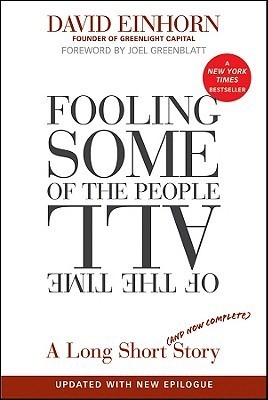
A revealing look at Wall Street, the financial media, and financial regulators by David Einhorn, the President of Greenlight CapitalCould 2008's credit crisis have been minimized or even avoided? In 2002, David Einhorn-one of the country's top investors-was asked at a charity investment conference to share his best investment advice. Short sell Allied Capital. At the time, Allied was a leader in the private financing industry. Einhorn claimed Allied was using questionable accounting practices to prop itself up. Sound familiar? At the time of the original version of "Fooling Some of the People All of the Time: A Long Short Story" the outcome of his advice was unknown. Now, the story is complete and we know Einhorn was right. In 2008, Einhorn advised the same conference to short sell Lehman Brothers. And had the market been more open to his warnings, yes, the market meltdown might have been avoided, or at least minimized.Details the gripping battle between Allied Capital and Einhorn's Greenlight CapitalIlluminates how questionable company practices are maintained and, at times, even protected by Wall StreetDescribes the failings of investment banks, analysts, journalists, and government regulatorsDescribes how many parts of the Allied Capital story were replayed in the debate over Lehman Brothers"Fooling Some of the People All of the Time" is an important call for effective government regulation, free speech, and fair play.

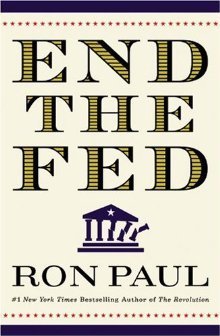
In the post-meltdown world, it is irresponsible, ineffective, and ultimately useless to have a serious economic debate without considering and challenging the role of the Federal Reserve.Most people think of the Fed as an indispensable institution without which the country's economy could not properly function. But in END THE FED, Ron Paul draws on American history, economics, and fascinating stories from his own long political life to argue that the Fed is both corrupt and unconstitutional. It is inflating currency today at nearly a Weimar or Zimbabwe level, a practice that threatens to put us into an inflationary depression where $100 bills are worthless. What most people don't realize is that the Fed -- created by the Morgans and Rockefellers at a private club off the coast of Georgia -- is actually working against their own personal interests. Congressman Paul's urgent appeal to all citizens and officials tells us where we went wrong and what we need to do fix America's economic policy for future generations.

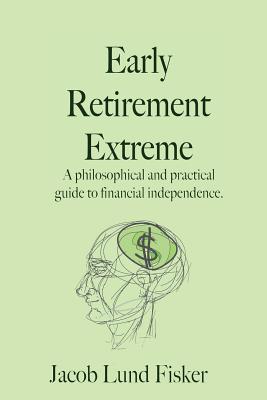
A strategic combination of smart financial choices, simple living, and increased self-reliance brought me financial independence at 30 and allowed me to retire from my profession at 33. Early Retirement Extreme shows how I did it and how anyone can formulate their own plan for financial independence. The book provides the principles and framework for a systems theoretical strategy for attaining that independence in 5-10 years. It teaches how a shift in focus from consuming to producing can help people out of the consumer trap, and offers a path to achieving the freedom necessary to pursue interests other than working for a living. The principles in Early Retirement Extreme show how to break the financial chains that hold people back from doing what they truly want to do. The framework has been used by many people over the last few years to accomplish a variety of goals. It provides people a means to achieve almost any goal, whether it’s debt-free living, extended travel, a sabbatical, a career change, time off to raise a child, a traditional retirement, or simply a desire for a more resilient and self-sufficient lifestyle. The book was initially written for people in their 20s and 30s, but its ideas aren’t limited to early retirees. Middle-aged people in the grips of consumerism can use the principles to take back control of their lives. People closer to retirement age who don’t feel adequately prepared can use it to set themselves up for a comfortable retirement in a relatively short period of time. Anyone worried about their financial future can use the principles in Early Retirement Extreme to make their future more secure.

Recommended Reading by Warren Buffet in his March 2013 Letter to Shareholders How speculation has come to dominate investment—a hard-hitting look from the creator of the first index fund.Over the course of his sixty-year career in the mutual fund industry, Vanguard Group founder John C. Bogle has witnessed a massive shift in the culture of the financial sector. The prudent, value-adding culture of long-term investment has been crowded out by an aggressive, value-destroying culture of short-term speculation. Mr. Bogle has not been merely an eye-witness to these changes, but one of the financial sector’s most active participants. In The Clash of the Cultures, he urges a return to the common sense principles of long-term investing.Provocative and refreshingly candid, this book discusses Mr. Bogle's views on the changing culture in the mutual fund industry, how speculation has invaded our national retirement system, the failure of our institutional money managers to effectively participate in corporate governance, and the need for a federal standard of fiduciary duty.Mr. Bogle recounts the history of the index mutual fund, how he created it, and how exchange-traded index funds have altered its original concept of long-term investing. He also presents a first-hand history of Wellington Fund, a real-world case study on the success of investment and the failure of speculation. The book concludes with ten simple rules that will help investors meet their financial goals. Here, he presents a common sense strategy that "may not be the best strategy ever devised. But the number of strategies that are worse is infinite."The Clash of the Investment vs. Speculation completes the trilogy of best-selling books, beginning with Bogle on The First 50 Years (2001) and Don't Count on It! (2011)

Warren Buffett built Berkshire Hathaway into something remarkable— and Fortune journalist Carol Loomis had a front-row seat for it all. When Carol Loomis first mentioned a little-known Omaha hedge fund manager in a 1966 Fortune article, she didn’t dream that Warren Buffett would one day be considered the world’s greatest investor—nor that she and Buffett would quickly become close personal friends. As Buffett’s fortune and reputation grew over time, Loomis used her unique insight into Buffett’s thinking to chronicle his work for Fortune, writing and proposing scores of stories that tracked his many accomplishments—and also his occasional mistakes. Now Loomis has collected and updated the best Buffett articles Fortune published between 1966 and 2012, including thirteen cover stories and a dozen pieces authored by Buffett himself. Loomis has provided commentary about each major article that supplies context and her own informed point of view. Readers will gain fresh insights into Buffett’s investment strategies and his thinking on management, philanthropy, public policy, and even parenting. Some of the highlights include:The 1966 A. W. Jones story in which Fortune first mentioned Buffett. The first piece Buffett wrote for the magazine, 1977’s “How Inf lation Swindles the Equity Investor.” Andrew Tobias’s 1983 article “Letters from Chairman Buffett,” the first review of his Berkshire Hathaway shareholder letters. Buffett’s stunningly prescient 2003 piece about derivatives, “Avoiding a Mega-Catastrophe.” His unconventional thoughts on inheritance and philanthropy, including his intention to leave his kids “enough money so they would feel they could do anything, but not so much that they could do nothing.” Bill Gates’s 1996 article describing his early impressions of Buffett as they struck up their close friendship. Scores of Buffett books have been written, but none can claim this work’s combination of trust between two friends, the writer’s deep understanding of Buffett’s world, and a very long-term perspective.

Peter Bevelin begins A Few Lessons for Investors and Managers with Warren Buffett's wisdom, "I am a better investor because I am a businessman and a better businessman because I am an investor." This book is about how managers and investors can increase their chance of success and reduce the chance of harm if managers think more like investors and investors more like businessmen.There are a lot of books about Warren Buffett, but A Few Lessons for Investors and Managers is different. It tells in a short-easy-to-read way about what managers and investors can learn from Buffett. This is a selection of useful and timeless wisdom where Warren Buffett in his own words tells us how to think about business valuation, what is a good and bad business, acquisitions and their traps, yardsticks, compensation issues, how to reduce risk, corporate governance, the importance of trust and the right culture, learning from mistakes, and more.

Two professors combine their fascinating and cutting-edge research in behavioral science to explain how money can buy happiness—if you follow five core principles of smart spending.Most people recognize that they need professional advice on how to earn, save, and invest their money. When it comes to spending that money, most people just follow their intuitions. But scientific research shows that those intuitions are often wrong.Happy Money offers a tour of research on the science of spending, explaining how you can get more happiness for your money. Authors Elizabeth Dunn and Michael Norton have outlined five principles—from choosing experiences over stuff to spending money on others—to guide not only individuals looking for financial security, but also companies seeking to create happier employees and provide “happier products” to their customers. Dunn and Norton show how companies from Google to Pepsi to Charmin have put these ideas into action.Along the way, Dunn and Norton explore fascinating research that reveals that luxury cars often provide no more pleasure than economy models, that commercials can actually enhance the enjoyment of watching television, and that residents of many cities frequently miss out on inexpensive pleasures in their hometowns. By the end of this “lively and engaging book” (Dan Gilbert, author of Stumbling on Happiness ), you’ll be asking yourself one simple question every time you reach for your Am I getting the biggest happiness bang for my buck?

An ex-Wall Street trader improved on Moneyball 's famed sabermetrics to place bets that would beat the Vegas odds on Major League Baseball games--with a 41 percent return in his first year. Trading Bases explains how he did it.After the fall of Lehman Brothers, Joe Peta needed a new employer. He found a new job in New York City but lost that, too, when an ambulance mowed him down as he crossed the street on foot. In search of a way to cheer himself up while he recuperated in a wheelchair, Peta started watching baseball again, as he had growing up. That's when inspiration hit: Why not apply his outstanding risk-analysis skills to improve on sabermetrics, the method made famous by Moneyball --and beat the only market in town, the Vegas betting line? Why not treat MLB like the S&P 500?In Trading Bases , Peta shows how to subtract luck--in particular "cluster luck," as he puts it--from a team's statistics to best predict how it will perform in the next game and over the whole season. His baseball "hedge fund" returned an astounding 41 percent in 2011-- with daily volatility similar to funds he used to trade for. Peta takes readers to the ballpark in San Francisco, trading floors and baseball bars in New York, and sports books in Vegas, all while tracing the progress of his wagers. Far from writing a dry, do-it-yourself guidebook, Peta weaves a story that is often humorous, and occasionally touching; the topic may be "Big Data" but it's as entertaining as a Bill Simmons column. Trading Bases is all about the love of critical reasoning, trading cultures, risk management, and baseball. And not necessarily in that order.

The Chief Investment Officer of Merrill Lynch Wealth Management explains why goals, not markets, should be the primary focus of your investment strategy—and offers a practical, innovative framework for making smarter choices about aligning your goals to your investment strategy. Today all of us bear the burden of investing wisely, but too many of us are preoccupied with the wrong priorities—increasing returns at all costs, finding the next star fund manager, or beating “the market.” Unfortunately conventional portfolio theory and the grand debates in finance have offered investors only incomplete solutions. What is needed, argues Ashvin B. Chhabra, is a framework that shifts the focus of investment strategy from portfolios and markets to individuals and the objectives that really things like protecting against unexpected financial crises, paying for education or retirement, and financing philanthropy and entrepreneurship. The Aspirational Investor is a practical, innovative approach to managing wealth based on key goals and the careful allocation of risks rather than responding to the whims of the financial markets. Chhabra introduces his “Wealth Allocation Framework,” which accommodates the three seemingly incompatible objectives that must underpin every sound wealth management the need for financial security in the face of known and unknowable risks; the need to maintain current living standards over time despite inflation; and the need to pursue aspirational goals for wealth creation. Chhabra reveals some surprising facts about wealth creation, reinterprets the success formulas of investing greats like Warren Buffett, and closes the gap between theory and practice by simplifying our understanding of key asset classes and laying out a concise roadmap for identifying, prioritizing, and quantifying financial goals. Raising the bar for what we should expect from our investment portfolios—and our financial advisors— The Aspirational Investor sets us on a path to more confident and fulfilling financial lives.

NEW YORK TIMES BESTSELLER • A roadmap to what lies ahead and the decisions we must make now to stave off the next global economic and financial crisis, from one of the world’s most influential economic thinkers and the author of When Markets Collide“The one economic book you must read now . . . If you want to understand [our] bifurcated world and where it’s headed, there is no better interpreter than Mohamed El-Erian.”— Time Our current economic path is coming to an end. The signposts are all around sluggish growth, rising inequality, stubbornly high pockets of unemployment, and jittery financial markets, to name a few. Soon we will reach a fork in the One path leads to renewed growth, prosperity, and financial stability, the other to recession and market disorder.In The Only Game in Town, El-Erian casts his gaze toward the future of the global economy and markets, outlining the choices we face both individually and collectively in an era of economic uncertainty and financial insecurity. Beginning with their response to the 2008 global crisis, El-Erian explains how and why our central banks became the critical policy actors—and, most important, why they cannot continue is this role alone. They saved the financial system from collapse in 2008 and a multiyear economic depression, but lack the tools to enable a return to high inclusive growth and durable financial stability. The time has come for a policy handoff, from a prolonged period of monetary policy experimentation to a strategy that better targets what ails economies and distorts the financial sector—before we stumble into another crisis.The future, critically, is not predestined. It is up to us to decide where we will go from here as households, investors, companies, and governments. Using a mix of insights from economics, finance, and behavioral science, this book gives us the tools we need to properly understand this turning point, prepare for it, and come out of it stronger. A comprehensive, controversial look at the realities of our global economy and markets, The Only Game in Town is required reading for investors, policymakers, and anyone interested in the future.

Words of wisdom from Charlie Munger—Warren Buffett’s longtime business partner and the visionary Vice Chairman of Berkshire Hathaway—collected and interpreted with an eye towards investing by David Clark, coauthor of the bestselling Buffettology series.Born in Omaha, Nebraska in 1924, Charlie Munger studied mathematics at the University of Michigan, trained as a meteorologist at Cal Tech Pasadena while in the Army, and graduated magna cum laude from Harvard Law School without ever earning an undergraduate degree. Today, Munger is one of America’s most successful investors, the Vice Chairman of Berkshire Hathaway, and Warren Buffett’s business partner for almost forty years. Buffett says “Berkshire has been built to Charlie’s blueprint. My role has been that of general contractor.” Munger is an intelligent, opinionated businessman whose ideas can teach professional and amateur investors how to be successful in finance and life.Like The Tao of Warren Buffett and The Tao of Te Ching, The Tao of Charlie Munger is a compendium of pithy quotes including, “Knowing what you don’t know is more useful than being brilliant” and “In my whole life, I have known no wise people who didn’t read all the time—none, zero.” This collection, culled from interviews, speeches, and questions and answers at the Berkshire Hathaway and Wesco annual meetings, offers insights into Munger’s amazing financial success and life philosophies. Described by Business Insider as “sharp in his wit and investing wisdom,” Charlie Munger’s investment tips, business philosophy, and rules for living are as unique as his life story, intelligent as he clearly is, and as successful as he has been.

The story of billionaire trader Steven Cohen, the rise and fall of his hedge fund SAC Capital, and the largest insider trading investigation in history for readers of The Big Short, Den of Thieves, and Dark MoneySteven A. Cohen changed Wall Street. He and his fellow pioneers of the hedge fund industry didn't lay railroads, build factories, or invent new technologies. Rather, they made their billions through speculation, by placing bets in the market that turned out to be right more often than wrong and for this, they gained not only extreme personal wealth but formidable influence throughout society. Hedge funds now oversee more than $3 trillion in assets, and the competition between them is so fierce that traders will do whatever they can to get an edge.Cohen was one of the industry's biggest success stories, the person everyone else in the business wanted to be. Born into a middle-class family on Long Island, he longed from an early age to be a star on Wall Street. He mastered poker in high school, went off to Wharton, and in 1992 launched the hedge fund SAC Capital, which he built into a $15 billion empire, almost entirely on the basis of his wizard like stock trading. He cultivated an air of mystery, reclusiveness, and excess, building a 35,000-square-foot mansion in Greenwich, Connecticut, flying to work by helicopter, and amassing one of the largest private art collections in the world. On Wall Street, Cohen was revered as a genius: one of the greatest traders who ever lived.That image was shattered when SAC Capital became the target of a sprawling, seven-year investigation, led by a determined group of FBI agents, prosecutors, and SEC enforcement attorneys. Labeled by prosecutors as a magnet for market cheaters whose culture encouraged the relentless pursuit of edge and even black edge, which is inside information SAC Capital was ultimately indicted and pleaded guilty to charges of securities and wire fraud in connection with a vast insider trading scheme, even as Cohen himself was never charged.Black Edge offers a revelatory look at the gray zone in which so much of Wall Street functions. It's a riveting, true-life legal thriller that takes readers inside the government's pursuit of Cohen and his employees, and raises urgent and troubling questions about the power and wealth of those who sit at the pinnacle of modern Wall Street.

In 2005, Joel Greenblatt published a book that is already considered one of the classics of finance literature. In The Little Book that Beats the Market—a New York Times bestseller with 300,000 copies in print—Greenblatt explained how investors can outperform the popular market averages by simply and systematically applying a formula that seeks out good businesses when they are available at bargain prices. Now, with a new Introduction and Afterword for 2010, The Little Book that Still Beats the Market updates and expands upon the research findings from the original book. Included are data and analysis covering the recent financial crisis and model performance through the end of 2009. In a straightforward and accessible style, the book explores the basic principles of successful stock market investing and then reveals the author’s time-tested formula that makes buying above average companies at below average prices automatic. Though the formula has been extensively tested and is a breakthrough in the academic and professional world, Greenblatt explains it using 6th grade math, plain language and humor. He shows how to use his method to beat both the market and professional managers by a wide margin. You’ll also learn why success eludes almost all individual and professional investors, and why the formula will continue to work even after everyone “knows” it. While the formula may be simple, understanding why the formula works is the true key to success for investors. The book will take readers on a step-by-step journey so that they can learn the principles of value investing in a way that will provide them with a long term strategy that they can understand and stick with through both good and bad periods for the stock market. As the Wall Street Journal stated about the original edition, “Mr. Greenblatt…says his goal was to provide advice that, while sophisticated, could be understood and followed by his five children, ages 6 to 15. They are in luck. His ‘Little Book’ is one of the best, clearest guides to value investing out there.”

A brilliantly reported, global look at universal basic income--a stipend given to every citizen--and why it might be necessary for our age of rising inequality, persistent poverty, and dazzling technology Imagine if every month the government deposited $1,000 into your checking account, with nothing expected in return. It sounds crazy, but it has become one of the most influential and hotly debated policy ideas of our time. Futurists, radicals, libertarians, socialists, union representatives, feminists, conservatives, Bernie supporters, development economists, child-care workers, welfare recipients, and politicians from India to Finland to Canada to Mexico--all are talking about UBI.In this sparkling and provocative book, economics writer Annie Lowrey looks at the global UBI movement. She travels to Kenya to see how a UBI is lifting the poorest people on earth out of destitution, India to see how inefficient government programs are failing the poor, South Korea to interrogate UBI's intellectual pedigree, and Silicon Valley to meet the tech titans financing UBI pilots in expectation of a world with advanced artificial intelligence and little need for human labor.Lowrey examines the potential of such a sweeping policy and the challenges the movement faces, among them contradictory aims, uncomfortable costs, and, most powerfully, the entrenched belief that no one should get something for nothing. She shows how this arcane policy offers not only a potential answer for our most intractable economic and social problems, but also a better foundation for our society in this age of turbulence and marvels.

A New York Times Bestseller The leading thinker and most visible public advocate of modern monetary theory -- the freshest and most important idea about economics in decades -- delivers a radically different, bold, new understanding for how to build a just and prosperous society.Stephanie Kelton's brilliant exploration of modern monetary theory (MMT) dramatically changes our understanding of how we can best deal with crucial issues ranging from poverty and inequality to creating jobs, expanding health care coverage, climate change, and building resilient infrastructure. Any ambitious proposal, however, inevitably runs into the buzz saw of how to find the money to pay for it, rooted in myths about deficits that are hobbling us as a country.Kelton busts through the myths that prevent us from taking action: that the federal government should budget like a household, that deficits will harm the next generation, crowd out private investment, and undermine long-term growth, and that entitlements are propelling us toward a grave fiscal crisis.MMT, as Kelton shows, shifts the terrain from narrow budgetary questions to one of broader economic and social benefits. With its important new ways of understanding money, taxes, and the critical role of deficit spending, MMT redefines how to responsibly use our resources so that we can maximize our potential as a society. MMT gives us the power to imagine a new politics and a new economy and move from a narrative of scarcity to one of opportunity.
Ready for a change in black economics? Join the Bitcoin revolution. Bitcoin and Black America is a dynamic new book that explores the synergy between black economics, Bitcoin and blockchain technology. The global financial system is changing and the digital revolution will not be televised. We explore how to incorporate cryptocurrency in your business, job and educational institution. This book also outlines the need for separation from the racist banking system and a comprehensive list of black professionals actively working in the Blockchain industry.

Supermaker is a guide to business and career development by Jaime acclaimed entrepreneur, founder of Schmidt's Naturals, and icon of the Maker Movement.In Supermaker, she shares how you too can start or grow your own business with advice on branding, product development, social media marketing, scaling, PR, and customer engagement, all based on her own hard-won mastery.In just seven years, Jaime Schmidt went from making natural products in her Portland, Oregon, kitchen to turning her brand into a household name and selling her company to Unilever—without sacrificing the integrity of her product or her creative vision.• Readers learn how to get ahead on their own terms and while maintaining their commitment to fair and sustainable principles.• A valuable resource to the ever-growing community of business owners and entrepreneurs who want to go from maker to magnate.• Candid advice from an industry disruptor.Following her growth from farmers' market stand to international brand, Jaime's book is a riveting mix of inspiration, the honest airing of mistakes, and indispensable instruction. Supermaker empowers and unites the next generation of entrepreneurs.• A go-to guide for the passion-to-profit journey.• The perfect read for aspiring entrepreneurs, makers, creatives, and anyone with an interest in natural products, selling your products online, retail strategy, and digital marketing.• Great for anyone who enjoyed Start Something That Matters by Blake Mycoskie, Craft, Turn Your Creative Hobby into a Business by Meg Mateo Ilasco, and The Girls' Guide to Starting Your Own Candid Advice, Frank Talk, and True Stories for the Successful Entrepreneur by Caitlin Friedman.

" Winning the Loser's Game is considered by many to be a classic analysis of investing." Financial Planning The premise of the bestselling Winning the Loser's Game that individual investors can achieve far greater success working with financial markets than against themhas grown increasingly popular in today's hard-to-predict markets. The latest edition of this concise yet comprehensive classic offers updated strategies to leverage the power of time and compounding, protect against down cycles, and more.

Over 6.4 billion people participate in a $36.5 trillion global economy, designed and overseen by no one. How did this marvel of self-organized complexity evolve? How is wealth created within this system? And how can wealth be increased for the benefit of individuals, businesses, and society? In The Origin of Wealth, Eric D. Beinhocker argues that modern science provides a radical perspective on these age-old questions, with far-reaching implications. According to Beinhocker, wealth creation is the product of a simple but profoundly powerful evolutionary formula: differentiate, select, and amplify. In this view, the economy is a "complex adaptive system" in which physical technologies, social technologies, and business designs continuously interact to create novel products, new ideas, and increasing wealth. Taking readers on an entertaining journey through economic history, from the Stone Age to modern economy, Beinhocker explores how "complexity economics" provides provocative insights on issues ranging from creating adaptive organizations to the evolutionary workings of stock markets to new perspectives on government policies. A landmark book that shatters conventional economic theory, The Origin of Wealth will rewire our thinking about how we came to be here—and where we are going.

One of Wall Street's most creative and influential minds offers provocative new ways of thinking about the stock market, investing, and how we make decisions.

A lively, original, and challenging history of stock market speculation from the 17th century to present day.Is your investment in that new Internet stock a sign of stock market savvy or an act of peculiarly American speculative folly? How has the psychology of investing changed—and not changed—over the last five hundred years?In Devil Take the Hindmost , Edward Chancellor traces the origins of the speculative spirit back to ancient Rome and chronicles its revival in the modern world: from the tulip scandal of 1630s Holland, to “stockjobbing” in London's Exchange Alley, to the infamous South Sea Bubble of 1720, which prompted Sir Isaac Newton to comment, “I can calculate the motion of heavenly bodies, but not the madness of people.”Here are brokers underwriting risks that included highway robbery and the “assurance of female chastity”; credit notes and lottery tickets circulating as money; wise and unwise investors from Alexander Pope and Benjamin Disraeli to Ivan Boesky and Hillary Rodham Clinton.From the Gilded Age to the Roaring Twenties, from the nineteenth century railway mania to the crash of 1929, from junk bonds and the Japanese bubble economy to the day-traders of the Information Era, Devil Take the Hindmost tells a fascinating story of human dreams and folly through the ages.

The stock market is big news today. Over 50 percent of the American public own stocks directly or indirectly, meaning that the financial well-being of tens of millions of people is directly tied to the market. Alan Greenspan has stated that it is not possible to understand the modern economy without understanding the stock market. But this has not always been so.Many people now alive can remember a very different time, when the stock market was little more than a primitive insiders' game, viewed by most Americans with skepticism and suspicion. In Toward Rational Exuberance , B. Mark Smith, a professional stock trader with two decades of practical experience, tells the story of how this stunning transformation occurred. It is a fascinating story, involving colorful personalities, dramatic events, and revolutionary new ideas. In the course of the narrative, Smith traces the evolution of popular theories of stock market behavior, showing how they have greatly influenced the way the investing public views the market. But he also shows how some of these theories are based on faulty interpretations of market history that may lead investors astray. Freshly updated, this is a timely -- and definitive -- account of the market's true history and dangerous myths.

Examines how investors are being exploited and deceived by both financial institutions and corporate America, discussing such topics as broker compensation, fair disclosure, and 401(k) investments.

In his most widely appealing book yet, one of today's leading authors of popular anthropology looks at the intriguing history and peculiar nature of money, tracing our relationship with it from the time when primitive men exchanged cowrie shells to the imminent arrival of the all-purpose electronic cash card.

What happens inside our brains when we think about money? Quite a lot, actually, and some of it isn't good for our financial health. In Your Money and Your Brain, Jason Zweig explains why smart people make stupid financial decisions -- and what they can do to avoid these mistakes. Zweig, a veteran financial journalist, draws on the latest research in neuroeconomics, a fascinating new discipline that combines psychology, neuroscience, and economics to better understand financial decision making. He shows why we often misunderstand risk and why we tend to be overconfident about our investment decisions. Your Money and Your Brain offers some radical new insights into investing and shows investors how to take control of the battlefield between reason and emotion. Your Money and Your Brain is as entertaining as it is enlightening. In the course of his research, Zweig visited leading neuroscience laboratories and subjected himself to numerous experiments. He blends anecdotes from these experiences with stories about investing mistakes, including confessions of stupidity from some highly successful people. Then he draws lessons and offers original practical steps that investors can take to make wiser decisions. Anyone who has ever looked back on a financial decision and said, "How could I have been so stupid?" will benefit from reading this book.

For more than twenty-five years, The Only Investment Guide You'll Ever Need has been America's favorite finance guide, winning the allegiance of more than a million readers across the country. Now this indispensable book has been fully revised and updated-covering all the new tax laws-and reorganized with a new user-friendly design. Concise, witty, and truly understandable, Andrew Tobias shows you how to use your money to your best advantage-no matter how much or how little you have.o How to spend smarter-and save $1,000 or moreo When to invest in stocks, and howo The ins and outs of investing on the Interneto Tax strategies, from tuition to retiremento Whom-if anyone-you can trust to manage your moneyand much, much moreHow to spend smarter--and save $1,000 or moreWhen to invest in stocks, and howThe ins and outs of investing on the InternetTax strategies, from tuition to retirementThe basics of life insuranceWho--if anyone--you can trust to manage your moneyThe inside skinny on annuities, real estate, and Social Securityand much, much more

Identifies the fastest growing markets, and discusses recession strategies, modern consumers, targeted prospects, technology, and management

A comprehensive and practical guide to the stock market from a successful fund manager—filled with case studies, important background information, and all the tools you’ll need to become a stock market genius.Fund manager Joel Greenblatt has been beating the Dow (with returns of 50 percent a year) for more than a decade. And now, in this highly accessible guide, he’s going to show you how to do it, too. You’re about to discover investment opportunities that portfolio managers, business-school professors, and top investment experts regularly miss—uncharted areas where the individual investor has a huge advantage over the Wall Street wizards. Here is your personal treasure map to special situations in which big profits are possible, -Spin-offs-Restructurings-Merger Securities-Rights Offerings-Recapitalizations-Bankruptcies-Risk ArbitragePrepared with the tools from this guide, it won’t be long until you’re a stock market genius!

“This book is not just a bargain, it’s a steal. It’s filled with practical, workable advice for anyone wanting to build wealth.”―Mike Summey, co-author of the bestselling The Weekend Millionaire’s Secrets to Investing in Real Estate Anyone who seeks financial wealth must first learn the fundamental truths and models that drive it. The Millionaire Real Estate Investor represents the collected wisdom and experience of over 100 millionaire investors from all walks of life who pursued financial wealth and achieved the life-changing freedom it delivers. This book--in straightforward, no nonsense, easy-to-read style--reveals their proven strategies. The Millionaire Real Estate Investor is your handbook to the tried and true financial wealth building vehicle that rewards patience and perseverance and is available to all--real estate. You'll

Take your real estate career to the highest level "Whether you are just getting started or a veteran in the business, "The Millionaire Real Estate Agent" is the step-by-step handbook for seeking excellence in your profession and in your life." --Mark Victor Hansen, cocreator, #1" New York Times" bestselling series "Chicken Soup for the Soul""This book presents a new paradigm for real estate and should be required reading for real estate professionals everywhere."--Robert T. Kiyosaki, "New York Times" bestselling author of "Rich Dad, Poor Dad""The Millionaire Real Estate Agent "explains: Three concepts that drive production Economic, organizational, and lead generation models that are the foundations of any high-achiever's business How to "Earn a Million," "Net a Million," and "Receive a Million" in annual income

John C. Bogle shares his extensive insights on investing in mutual fundsSince the first edition of "Common Sense on Mutual Funds" was published in 1999, much has changed, and no one is more aware of this than mutual fund pioneer John Bogle. Now, in this completely updated "Second Edition, " Bogle returns to take another critical look at the mutual fund industry and help investors navigate their way through the staggering array of investment alternatives that are available to them.Written in a straightforward and accessible style, this reliable resource examines the fundamentals of mutual fund investing in today's turbulent market environment and offers timeless advice in building an investment portfolio. Along the way, Bogle shows you how simplicity and common sense invariably trump costly complexity, and how a low cost, broadly diversified portfolio is virtually assured of outperforming the vast majority of Wall Street professionals over the long-term.Written by respected mutual fund industry legend John C. BogleDiscusses the timeless fundamentals of investing that apply in any type of marketReflects on the structural and regulatory changes in the mutual fund industryOther titles by Bogle: "The Little Book of Common Sense Investing" and "Enough."Securing your financial future has never seemed more difficult, but you'll be a better investor for having read the "Second Edition" of "Common Sense on Mutual Funds."

What Are You Waiting For?This book will change the way you think about investing-and the results will prove it!"This is the simple hands-on, how-to and why book many readers have been looking for."-Scott Burns, syndicated columnistDaniel Solin cuts through the financial hype to show you exactly how to invest-with an easy-to-follow four-step plan that lets you create and monitor your investment portfolio in ninety minutes or less...and put your investment earnings in the top 5 percent of all professionally managed money.If you want to gamble, go to Las Vegas-or try stock picking and market timing. If you want to be a Smart Investor, follow this effortless and effective plan." The Smartest Investment Book You'll Ever Read will provide the enlightenment and gumption to free yourself from the clutches of the investment industry and the wisdom and direction necessary to get yourself back on track."-William Bernstein, author of A Splendid Exchange and The Four Pillars of InvestingEvery day you wait costs you money. Take control of your financial future now!

The third in the bestselling Market Wizards series, this time focusing on the barometer of the economy - the stock market.It has been nearly a decade since the publication of the highly successful The New Market Wizards. The interim has witnessed the most dynamic bull market in US stock history, a collapse in commodity prices, dramatic failures in some of the world′s leading hedge funds, the burst of the Internet bubble, a fall into recession and subsequent rumblings of recovery. Who have been the market wizards during this tumultuous financial period? How did some traders manage to significantly outperform a stockmarket that during its heyday moved virtually straight up?This book will feature interviews with a variety of traders who achieved phenomenal financial success during the glory days of the Internet boom. In contrast with the first two Market Wizard books, which included traders from a broad financial spectrum - stocks, bonds, currencies and futures - this volume will focus on traders in the stockmarket.

Bogle on Mutual Funds is a straightforward assessment of the industry written for the investor who wants a true and unflinching portrayal. Bogle not only explains the basic principles of canny mutual fund investing, but Bogle on Mutual Funds also explores its subtle nuances and exposes the hype and fads that often lure investors into making unwise decisions. This conscientious guide offers strategies for developing a diversified portfolio that will weather the markets short-term variations. Bogle warns the reader of the major pitfalls common to mutual fund investing. Ideal for investors at every level of expertise, Bogle on Mutual Funds shows how Design a portfolio of funds to meet your current financial objectives; Recognize excessive fees, minimize taxes, evaluate investment risk, and spot false advertising claims; Balance risk and return through asset allocation strategy and tactics, astute fund selection, and effective use of index funds; Understand the important role of cost, the third leg (along with risk and return) of the eternal triangleof investing; Interpret the data found in such sources as syndicated newspapers, Morningstar Mutual Funds, and other mutual fund guides, and use that information to make better investment decisions.

There is no one better qualified to tell us about the failures of the American financial system and the grotesque abuses that have taken place in recent years than John Bogle, who as founder and former chief executive of the Vanguard mutual funds group has seen firsthand the innermost workings of the financial industry. A zealous advocate for the small investor for more than fifty years, Bogle has championed the restoration of integrity in industry practices. As an astute observer and commentator, he knows that a trustworthy business and financial complex is essential to America’s continuing leadership in the world and to social and economic progress at home.This book tells not just a story about what went wrong but, more important, the story of why we lost our way and of how we can right our course. Bogle argues for a return to a governance structure in which owners’ capital that has been put at risk is used in their interests rather than in the interests of corporate and financial managers. Given that ownership is now consolidated in the hands of relatively few large mutual and pension funds, the specific reforms Bogle details in this book are essential as well as practical. Every investor, analyst, Wall-Streeter, policy maker, and businessperson should read this deeply informed book.

John Bogle on Investing is the first comprehensive review of the career and contributions of this dynamic investing icon. From Jack Bogle's never-before-published 1951 Princeton thesis to more than two dozen essays covering five decades of investing, it is a 50-year compendium of the work and wisdom of one of the world's most important financial figures. Investors at all levels will profit from insights including:

Capital Ideas traces the origins of modern Wall Street, from the pioneering work of early scholars and the development of new theories in risk, valuation, and investment returns, to the actual implementation of these theories in the real world of investment management. Bernstein brings to life a variety of brilliant academics who have contributed to modern investment theory over the Louis Bachelier, Harry Markowitz, William Sharpe, Fischer Black, Myron Scholes, Robert Merton, Franco Modigliani, and Merton Miller. Filled with in-depth insights and timeless advice, Capital Ideas reveals how the unique contributions of these talented individuals profoundly changed the practice of investment management as we know it today.

How to Write a Good Advertisement is a short course in writing powerful, hard-hitting copy that can help you make your products and services irresistible to potential customers. This remarkable book has turned many novice mail-order entrepreneurs into expert copywriters and many experienced copywriters into masters of their trade

Profit through good times and bad with a resilient, diversified portfolio The Intelligent Asset Allocator has helped thousands of people like you build wealth through carefully diversified portfolios. Now, with global markets in constant flux, balancing risk and reward is more critical than ever. Self-taught investor William Bernstein offers no gimmicks, inside secrets, or magic solutions―just the facts about investing and calm, smart advice on how to build and manage a portfolio designed for the long run. This is all you need, despite claims of the advisors and pundits looking to profit from your hard-earned money. This easy-to-understand guide provides everything you need, including: * The basics of finance―historical, psychological, and institutional* Time-tested strategies for improving the risk/reward ratio* Ways to sharpen your focus to improve portfolio management Bernstein walks you through the fundamentals of important topics like multiple-asset portfolios, optimal asset allocations, market efficiency, and strategy implementation. No one knows the future of markets. Your forecast is as good as that of the last financial pundit you saw on TV. Trust your instincts, trust your research, and trust the proven-effect approach of The Intelligent Asset Allocator , and your portfolio will deliver returns through the blue skies and storms of financial markets.

John J. Murphy has updated his landmark bestseller Technical Analysis of the Futures Markets , to include all of the financial markets. This outstanding reference has already taught thousands of traders the concepts of technical analysis and their application in the futures and stock markets. Covering the latest developments in computer technology, technical tools, and indicators, the second edition features new material on candlestick charting, intermarket relationships, stocks and stock rotation, plus state-of-the-art examples and figures. From how to read charts to understanding indicators and the crucial role technical analysis plays in investing, readers gain a thorough and accessible overview of the field of technical analysis, with a special emphasis on futures markets. Revised and expanded for the demands of today's financial world, this book is essential reading for anyone interested in tracking and analyzing market behavior.

The acclaimed Million Dollar Consulting gives consultants the tools and advice they need to grow a firm that rakes in at least $1 million per year. Alan Weiss, "the consultant's consultant," shows step-by-step how to raise capital, reel in new clients, set fees, accelerate growth, and more. This updated and expanded edition will appeal to both Weiss's many current fans and a whole new generation of readers looking for the best advice available for anyone who wants to build a million-dollar consulting/speaking career.

Inside the House of Money lifts the veil on the typically opaque world of hedge funds, offering a rare glimpse at how today's highest paid money managers approach their craft. Author Steven Drobny demystifies how these star traders make billions for well-heeled investors, revealing their theories, strategies and approaches to markets. Drobny, cofounder of Drobny Global Advisors, an international macroeconomic research and advisory firm, has tapped into his network and beyond in order assemble this collection of thirteen interviews with the industry's best minds. Along the way, you'll get an inside look at firsthand trading experiences through some of the major world financial crises of the last few decades. Whether Russian bonds, Pakistani stocks, Southeast Asian currencies or stakes in African brewing companies, no market or instrument is out of bounds for these elite global macro hedge fund managers. Highly accessible and filled with in-depth expert opinion, Inside the House of Money is a must-read for financial professionals and anyone else interested in understanding the complexities at stake in world financial markets. "The ruminations of supposedly hush-hush hedge fund operators are richly illuminating." -- New York Times

You've come up with a brilliant idea for a brand-new product or service you know could make you rich. Or maybe you currently own a business that pays the bills, and your dream is to become a fabulous millionairre. But how? How to Make Millions with Your Ideas has all the answers. This book is packed with the true stories and proven advice of ordinary people who began with just an idea, a simple product, or a fledgling business and wound up with millions. It examines the methods and principles of dozens of successful entrepreneurs, including author Dan Kennedy's surefire, easy-to-follow Millionaire Maker Strategies. It helps you determine which of the three paths to success are best for you and guides you step-by-step down that path on your way to fortune. Discover: The 8 best ways to make a fortune from scratch How to turn a hobby into a million-dollar enterprise How to sell an existing business for millions The power of electronic media to help make you rich The "Million Dollar Rolodex" of contacts and information you can use to get on the road to wealth

The the best poker professionals in the world The a wealthy banker from Dallas The the richest poker stakes of all time... In 2001, a rich stranger from Texas descended upon the high-stakes poker room in the opulent Bellagio casino in Las Vegas. A self-made billionaire by the name of Andy Beal, the stranger challenged some of the world's greatest poker players-including Doyle Brunson, Chip Reese, Howard Lederer, and Jennifer Harman-to heads-up matches in the richest poker game ever played This is that story...Beginning the scintillating contest that would shock the world of poker, Andy and each opponent had $1 million, betting $10,000 and $20,000 per round. As the games intensified over the coming months and Andy developed into a great player, he realized how he could take his adversaries out of their comfort zone-he raised the stakes to put everything they had on the line. By the time the battle of wits ended, there was more than $20 million on the table. For the first time ever, here is the detailed, true account of the Big Game that has already achieved legendary status in poker lore. Putting you railside to observe the pulse-pounding action, where you can almost hear the distinct sound of clay chips on felt, Michael Craig takes you inside the iron-nerved mind and pathological psyche of the professional gambler. Filled with vivid characters, sensational tales, and riveting human drama, The Professor, the Banker, and the Suicide King is a unique, suspenseful journey into the world of people who live on the razor's edge of fortune-where incredible wealth, or utter ruin, turns on the flip of a card.