Loading themes...
Explore the best books about Professional Development theme.


The definitive guide to working with -- and surviving -- bullies, creeps, jerks, tyrants, tormentors, despots, backstabbers, egomaniacs, and all the other assholes who do their best to destroy you at work.What an asshole!How many times have you said that about someone at work? You're not alone! In this groundbreaking book, Stanford University professor Robert I. Sutton builds on his acclaimed Harvard Business Review article to show you the best ways to deal with assholes...and why they can be so destructive to your company. Practical, compassionate, and in places downright funny, this guide offers: Strategies on how to pinpoint and eliminate negative influences for goodIlluminating case histories from major organizationsA self-diagnostic test and a program to identify and keep your own inner jerk from coming outThe No Asshole Rule is a New York Times, Wall Street Journal, USA Today and Business Week bestseller.
Il est communément admis que si nous travaillons dur, nous réussirons mieux, et que si nous réussissons, alors nous serons heureux. Si nous pouvons décrocher ce poste génial, obtenir cette nouvelle promotion, perdre ces cinq kilos, le bonheur suivra. Mais si c'était l'inverse ? Un excellent ouvrage de psychologie positive, plein d'humour, par le cotuteur du cours de Tal Ben-Shahar à Harvard. S'appuyant sur sept principes, testés d'Argentine au Zimbabwe, Shawn Achor nous montre comment développer son optimisme et décupler son potentiel à la maison comme au travail. Comment se fixer des objectifs, dépenser de l'argent pour des activités et non pour des objets, ruser avec soi-même pour abandonner ses mauvaises habitudes et se donner l'opportunité d'être fier de soi, contrecarrer " l'effet Tetris " qui nous enferme dans un champ de possibilités réduit, et reprogrammer notre cerveau pour être plus créatif, plus motivé, plus énergique, et plus productif. Un essai stimulant, abondant en anecdotes amusantes, et étayé par l'expérience de l'auteur comme professeur et comme consultant, qui parle aussi bien aux étudiants qu'aux traders de Manhattan ou aux écoliers d'Afrique...

Ten years after the worldwide bestseller Good to Great, Jim Collins returns withanother groundbreaking work, this time to why do some companies thrive inuncertainty, even chaos, and others do not? Based on nine years of research,buttressed by rigorous analysis and infused with engaging stories, Collins andhis colleague Morten Hansen enumerate the principles for building a truly greatenterprise in unpredictable, tumultuous and fast-moving times. This book isclassic contrarian, data-driven and uplifting.

You’ll never see leadership the same way again after reading this book.These fifteen commitments are a distillation of decades of work with CEOs and other leaders. They are radical or provocative for many. They have been game changers for us and for our clients. We trust that they will be for you too.Our experience is that unconscious leadership is not sustainable. It won’t work for you, your team or your organization in the long term. Unconscious leadership can deliver short term results, but the costs of living and leading unconsciously are great.Fear drives most leaders to make choices that are at odds with healthy relationships, vitality and balance. This fear leaves a toxic residue that won’t be as easily tolerated in an increasingly complex business environment.Conscious leadership offers the antidote to fear. These pages contain a comprehensive road map to guide you to shift from fear-based to trust-based leadership. Once you learn and start practicing conscious leadership you’ll get results in the form of more energy, clarity, focus and healthier relationships. You’ll do more and more of what you are passionate about, and less of what you do out of obligation. You’ll have more fun, be happier, experience less drama and be more on purpose. Your team will get results as well. They’ll be more collaborative, creative, energized and engaged. They’ll solve issues faster, and once resolved the issues won’t resurface. Drama and gossip will all but disappear, and the energy and resources that fueled them will be redirected towards innovation and creativity.Any one of these commitments will change your life. All of them together are revolutionary. Leaders who practice the 15 · End blame and criticism· Speak candidly, openly and honestly, in a way that invites others to do the same· Find their unique genius· Let go of taking everything—especially themselves and their problems—so seriously· Create win for all solutions· Experience a new relationship to time and money where there is always enoughWhat do you need to bring to the table?Be curious.Sounds so simple, and yet in our experience it’s a skill few have mastered. Most of us are far more interested in being right and proving it, than we are in learning, growing and shifting out of our old patterns. By default we gravitate towards the familiar. We’re asking you to take a chance and explore the unfamiliar. You’ll get scared and reactive. We all do. So what? Just stay curious and let us introduce you to a whole new world of leadership.

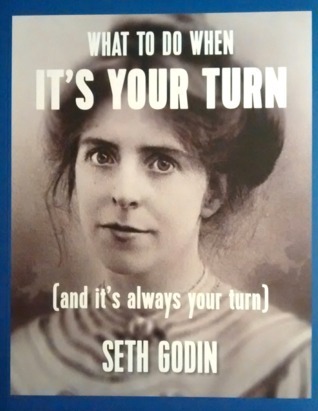
Seth Godin has pushed the boundaries again by creating a new book format that reads more like a magazine. The book is in full color and is a collection of short stories and essays that help the reader know "what to do when it's your turn" in life.

A guide to the role of solitude in good leadership, including profiles of historical and contemporary figures who have used solitude to lead with courage, creativity, and strength.Throughout history, leaders have used solitude as a matter of course. Eisenhower wrote memoranda to himself during World War II as a way to think through complex problems. Martin Luther King found moral courage while sitting alone at his kitchen table one night during the Montgomery bus boycott. Jane Goodall used her intuition in the jungles of Central Africa while learning how to approach chimps. Solitude is a state of mind, a space where you can focus on your own thoughts without distraction, with a power to bring mind and soul together in clear-eyed conviction. Like a great wave that saturates everything in its path, however, handheld devices and other media now leave us awash with the thoughts of others. We are losing solitude without even realizing it.To find solitude today, a leader must make a conscious effort. This book explains why the effort is worthwhile and how to make it. Through gripping historical accounts and firsthand interviews with a wide range of contemporary leaders, Raymond Kethledge (a federal court of appeals judge) and Michael Erwin (a West Pointer and three-tour combat veteran) show how solitude can enhance clarity, spur creativity, sustain emotional balance, and generate the moral courage necessary to overcome adversity and criticism. Anyone who leads anyone-including oneself-can benefit from solitude. With a foreword by Jim Collins (author of the bestseller Good to Great), Lead Yourself First is a rallying cry to reclaim solitude-and all the benefits, both practical and sublime, that come with it.

In her #1 NYT bestsellers, Brené Brown taught us what it means to dare greatly, rise strong and brave the wilderness. Now, based on new research conducted with leaders, change makers and culture shifters, she’s showing us how to put those ideas into practice so we can step up and lead. Leadership is not about titles, status and power over people. Leaders are people who hold themselves accountable for recognising the potential in people and ideas, and developing that potential. This is a book for everyone who is ready to choose courage over comfort, make a difference and lead.When we dare to lead, we don't pretend to have the right answers; we stay curious and ask the right questions. We don't see power as finite and hoard it; we know that power becomes infinite when we share it and work to align authority and accountability. We don't avoid difficult conversations and situations; we lean into the vulnerability that’s necessary to do good work.But daring leadership in a culture that's defined by scarcity, fear and uncertainty requires building courage skills, which are uniquely human. The irony is that we're choosing not to invest in developing the hearts and minds of leaders at the same time we're scrambling to figure out what we have to offer that machines can't do better and faster. What can we do better? Empathy, connection and courage to start.Brené Brown spent the past two decades researching the emotions that give meaning to our lives. Over the past seven years, she found that leaders in organisations ranging from small entrepreneurial start-ups and family-owned businesses to non-profits, civic organisations and Fortune 50 companies, are asking the same questions:How do you cultivate braver, more daring leaders? And, how do you embed the value of courage in your culture?Dare to Lead answers these questions and gives us actionable strategies and real examples from her new research-based, courage-building programme.Brené writes, ‘One of the most important findings of my career is that courage can be taught, developed and measured. Courage is a collection of four skill sets supported by twenty-eight behaviours. All it requires is a commitment to doing bold work, having tough conversations and showing up with our whole hearts. Easy? No. Choosing courage over comfort is not easy. Worth it? Always. We want to be brave with our lives and work. It's why we're here.’

#1 WALL STREET JOURNAL BESTSELLER & INSTANT NEW YORK TIMES BESTSELLERA game-changing approach to marketing, sales, and advertising.For the first time Seth Godin offers the core of his marketing wisdom in one compact, accessible, timeless package. This is Marketing shows you how to do work you're proud of, whether you're a tech startup founder, a small business owner, or part of a large corporation.No matter what your product or service, this book will help you reframe how it's presented to the world, in order to meaningfully connect with people who want it. Seth employs his signature blend of insight, observation, and memorable examples to teach How to build trust and permission with your target market.* The art of positioning--deciding not only who it's for, but who it's not for.* Why the best way to achieve your goals is to help others become who they want to be.* Why the old approaches to advertising and branding no longer work.* The surprising role of tension in any decision to buy (or not).* How marketing is at its core about the stories we tell ourselves about our social status.You can do work that matters for people who care. This book shows you the way.'A very accessible way into Godin's thinking . . . Godin writes in pacy, jargon-free prose and this book is interesting and useful for anyone who wants an insight into how, and why, we buy things or change our habits in any way ' The Financial TimesIf you enjoyed reading this, check out Seth Godin's Purple Cow, a true business classic.

From Stephen R. Covey's eldest son comes a revolutionary new path towards productivity and satisfaction. Trust, says Stephen M.R. Covey, is the very basis of the new global economy, and he shows how trust—and the speed at which it is established with clients, employees and constituents —is the essential ingredient for any high–performance, successful organization. For business leaders and public figures in any arena, The Speed of Trust offers an unprecedented and eminently practical look at exactly how trust functions in our every transaction and relationship—from the most personal to the broadest, most indirect interaction—and how to establish trust immediately so that you and your organization can forego the time–killing, bureaucratic check–and–balance processes so often deployed in lieu of actual trust.

With a new introduction by the authorWarren Bennis's formative years, in the 1930s and '40s, were characterized by severe economic hardship and a world war that showcased the extreme depths and heights to which leaders could drive their followers. Today's environment is similarly chaotic, turbulent, and uncertain. On Becoming a Leader has served for nearly fifteen years as a beacon of insight, delving into the qualities that define leadership, the people who exemplify it, and the strategies that anyone can apply to become an effective leader. This new edition features a provocative introduction on the challenges and opportunities facing leaders today, with additional updates and current references throughout.

The story of Captain D. Michael Abrashoff and his command of USS Benfold has become legendary inside and outside the Navy. Now Abrashoff offers this fascinating tale of top-down change for anyone trying to navigate today's uncertain business seas.When Captain Abrashoff took over as commander of USS Benfold, a ship armed with every cutting-edge system available, it was like a business that had all the latest technology but only some of the productivity. Knowing that responsibility for improving performance rested with him, he realized he had to improve his own leadership skills before he could improve his ship. Within months he created a crew of confident and inspired problem-solvers eager to take the initiative and take responsibility for their actions. The slogan on board became "It's your ship," and Benfold was soon recognized far and wide as a model of naval efficiency.How did Abrashoff do it? Against the backdrop of today's United States Navy-Benfold was a key player in our Persian Gulf fleet-Abrashoff shares his secrets of successful management including:* See the ship through the eyes of the crew: By soliciting a sailor's suggestions, Abrashoff drastically reduced tedious chores that provided little additional value.* Communicate, communicate, communicate: The more Abrashoff communicated the plan, the better the crew's performance. His crew would eventually call him "Megaphone Mike," since they heard from him so often.* Create discipline by focusing on purpose: Discipline skyrocketed when Abrashoff's crew believed that what they were doing was important.* Listen aggressively: After learning that many sailors wanted to use the GI Bill, Abrashoff brought a test official aboard the ship-and held the SATs forty miles off the Iraqi coast.From achieving amazing cost savings to winning the highest gunnery score in the Pacific Fleet, Captain Abrashoff's extraordinary campaign sent shock waves through the U.S. Navy. It can help you change the course of your ship, no matter where your business battles are fought.

The acclaimed Million Dollar Consulting gives consultants the tools and advice they need to grow a firm that rakes in at least $1 million per year. Alan Weiss, "the consultant's consultant," shows step-by-step how to raise capital, reel in new clients, set fees, accelerate growth, and more. This updated and expanded edition will appeal to both Weiss's many current fans and a whole new generation of readers looking for the best advice available for anyone who wants to build a million-dollar consulting/speaking career.

"Ideas move mountains, especially in turbulent times. Lovemarks is the product of the fertile-iconoclast mind of Kevin Roberts, CEO Worldwide of Saatchi & Saatchi. Roberts argues vociferously, and with a ton of data to support him, that traditional branding practices have become stultified. What's needed are customer Love affairs. Roberts lays out his grand scheme for mystery, magic, sensuality, and the like in his gloriously designed book Lovemarks."-Tom PetersTom Peters, one of the most influential business thinkers of all time, described the first edition of Lovemarks: the future beyond brands as "brilliant." He also announced it as the "Best Business Book" published in the first five years of this century. Now translated into fourteen languages, with more than 150,000 copies in print, Lovemarks is back in a revised edition featuring a new chapter on the peculiarly human experience of shopping. The new chapter, "Diamonds in the Mine," is an insightful collection of ideas for producers and consumers, for owners of small stores and operators of superstores. So forget making lists! Shopping, says Kevin Roberts, is an emotional event. With this as a starting point, he looks at the history of shopping and how it has changed so dramatically over the last ten years. Using the Lovemark elements of Mystery, Sensuality, and Intimacy, Roberts delves into the secrets of success that can be used to create the ultimate shopping experience.

If you work nonstop without a break...worry about offending others and back down too easily...explain too much when asked for information....or "poll" your friends and colleagues before making a decision, chances are you have been bypassed for promotions and ignored when you expressed your ideas. Although you may not be aware of it, girlish behaviors such as these are sabotaging your career!Dr. Lois Frankel reveals why some women roar ahead in their careers while others stagnate. She's spotted a unique set of behaviors--101 in all--that women learn in girlhood that sabotage them as adults. Now, in this groudbreaking guide, she helps you eliminate these unconscious mistakes that could be holding you back--and offers invaluable coaching tips you can easily incorporate into your social and business skills. If you recognize and change the behaviors that say "girl" not "woman", the results will pay off in carrer opportunites you never thought possible--and in an image that identifies you as someone with the power and know-how to occupy the corner office.

Whether you're dealing with an under performing employee, disagreeing with your spouse about money or child-rearing, negotiating with a difficult client, or simply saying "no," or "I'm sorry," or "I love you," we attempt or avoid difficult conversation every day. Based on fifteen years of research at the Harvard Negotiation Project, Difficult Conversations walks you through a step-by-step proven approach to having your toughest conversations with less stress and more success. You will learn: -- how to start the conversation without defensiveness-- why what is not said is as important as what is-- ways of keeping and regaining your balance in the face of attacks and accusations-- how to decipher the underlying structure of every difficult conversationFilled with examples from everyday life, Difficult Conversations will help you on your job, at home, or out of the world. It is a book you will turn to again and again for advice, practical skills, and reassurance.

Book discusses the days of General Marshall and his experiences where he served in Europe and the Pacific as a combat officer in the Second World War.

Practical exercises and hands-on tools to bring to life the timeless advice found in the author’s best-selling book, The Five Dysfunctions of a Team In the years following the publication of Patrick Lencioni's best seller, The Five Dysfunctions of a Team , fans have been clamoring for more information on how to implement the ideas outlined in the book. In Overcoming the Five Dysfunctions of a Team, Lencioni offers specific, practical guidance for overcoming the five dysfunctions, using tools, exercises, assessments, and real-world examples. He examines questions that all teams must ask themselves: Are we really a team? How are we currently performing? Are we prepared to invest the time and energy required to be a great team? Written concisely and to the point, this guide gives leaders, line managers, and consultants alike the tools they need to get their teams up and running quickly and effectively.

A bold new way to tackle tough business problems—even if you draw like a second grader When Herb Kelleher was brainstorming about how to beat the traditional hub-and- spoke airlines, he grabbed a bar napkin and a pen. Three dots to represent Dallas, Houston, and San Antonio. Three arrows to show direct flights. Problem solved, and the picture made it easy to sell Southwest Airlines to investors and customers. Used properly, a simple drawing on a humble napkin is more powerful than Excel or PowerPoint. It can help crystallize ideas, think outside the box, and communicate in a way that people simply “get”. In this book Dan Roam argues that everyone is born with a talent for visual thinking, even those who swear they can’t draw. Drawing on twenty years of visual problem solving combined with the recent discoveries of vision science, this book shows anyone how to clarify a problem or sell an idea by visually breaking it down using a simple set of visual thinking tools – tools that take advantage of everyone’s innate ability to look, see, imagine, and show. THE BACK OF THE NAPKIN proves that thinking with pictures can help anyone discover and develop new ideas, solve problems in unexpected ways, and dramatically improve their ability to share their insights. This book will help readers literally see the world in a new way.

The authors of the New York Times bestseller Crucial Conversations show you how to achieve personal, team, and organizational success by healing broken promises, resolving violated expectations, and influencing good behavior.Behind the problems that routinely plague organizations and families, you'll find individuals who are either unwilling or unable to deal with failed promises. Others have broken rules, missed deadlines, failed to live up to commitments, or just plain behaved badly—and nobody steps up to the issue. Or they do, but do a lousy job and create a whole new set of problems. Accountability suffers and new problems spring up. New research demonstrates that these disappointments aren't just irritating, they're costly—sapping organizational performance by twenty to fifty percent and accounting for up to ninety percent of divorces.Crucial Confrontations teaches skills drawn from 10,000 hours of real-life observations to increase confidence in facing issues like:- An employee speaks to you in an insulting tone that crosses the line between sarcasm and insubordination. Now what?- Your boss just committed you to a deadline you know you can't meet—and not-so-subtly hinted he doesn't want to hear complaints about it.- Your son walks through the door sporting colorful new body art that raises your blood pressure by forty points. Speak now, pay later.- An accountant wonders how to step up to a client who is violating the law. Can you spell unemployment?- Family members fret over how to tell granddad that he should no longer drive his car. This is going to get ugly.- A nurse worries about what to say to an abusive physician. She quickly remembers "how things work around here" and decides not to say anything.Everyone knows how to run for cover, or if adequately provoked, step up to these confrontations in a way that causes a real ruckus. That we have down pat. Crucial Confrontations teaches you how to deal with violated expectations in a way that solves the problem at hand, and doesn't harm the relationship—and in fact, even strengthens it.Crucial Confrontations borrows from twenty years of research involving two groups. More than 25,000 people helped the authors identify those who were most influential during crucial confrontations. They spent 10,000 hours watching these people, documented what they saw, and then trained and tested with more than 300,000 people. Second, they measured the impact of crucial confrontations improvements on organizational and team performance—the results were immediate and sustainable: twenty to fifty percent improvements in measurable performance.

Are you a genius or a genius maker? We've all had experience with two dramatically different types of leaders. The first type drain intelligence, energy, and capability from the ones around them and always need to be the smartest ones in the room. These are the idea killers, the energy sappers, the diminishers of talent and commitment. On the other side of the spectrum are leaders who use their intelligence to amplify the smarts and capabilities of the people around them. When these leaders walk into a room, lightbulbs go off over people's heads, ideas flow, and problems get solved. These are the leaders who inspire employees to stretch themselves to deliver results that surpass expectations. These are the Multipliers. And the world needs more of them, especially now, when leaders are expected to do more with less. In this engaging and highly practical book, leadership expert Liz Wiseman and management consultant Greg McKeown explore these two leadership styles, persuasively showing how Multipliers can have a resoundingly positive and profitable effect on organizations—getting more done with fewer resources, developing and attracting talent, and cultivating new ideas and energy to drive organizational change and innovation. In analyzing data from more than 150 leaders, Wiseman and McKeown have identified five disciplines that distinguish Multipliers from Diminishers. These five disciplines are not based on innate talent; indeed, they are skills and practices that everyone can learn to use, even lifelong and recalcitrant Diminishers. Lively, real-world case studies and practical tips and techniques bring to life each of these principles, showing you how to become a Multiplier too, whether you are a new or an experienced manager. Just imagine what you could accomplish if you could harness all the energy and intelligence around you. Multipliers will show you how.

Do you have a grip on your business, or does your business have a grip on you? Don't let common problems and frustrations run you and your business. Get a grip and gain control with the Entrepreneurial Operating System. Inside Traction, you'll learn the secrets of strengthening the Six Key Components of your business. You'll discover simple yet powerful ways to run your company that will give you and your leadership team more focus, more growth, and more enjoyment. Based on years of real-world implementation in over 100 companies, the Entrepreneurial Operating System is a practical method for achieving the business success you have always envisioned. Successful organizations are applying it every day to run profitable, frustration-free businesses -- and you can too.
The Game of Numbers is written in four essential parts, rather than in multiple chapters. Those four parts BELIEF. Our ability to persist in a long-term, high-volume prospecting effort is primarily a function of the experience we believe we are having. Most of us unconsciously believe that when we prospect someone who says "no," we experience the "pain" of "rejection." Because there is so much "no" in high-volume prospecting, most advisors get taken out by the perceived pain. BEHAVIOR. Belief dictates behavior. Just as a belief in the "pain" of "rejection" must cause its victims to stop prospecting, a belief in the power of prospecting with your own authentic self, combined with an unwavering faith in the efficacy of the law of large numbers, must lead to long-term success. It is a mathematical certainty. ENDURANCE. This section of TGON lays out a daily prospecting program based on the training program of an endurance athlete. In this methodology, you discover the basic level of prospecting your anxiety will allow you to complete. You standardize this into a daily program. Then, as you get stronger, you expand your capacity slowly but consistently – as a runner or a swimmer does – training, but not straining. SKILL. This last section of the book develops a series of specific skills, including a variety of very low-key conversation-opening scripts, non-threatening offers that get appointments, and thought-provoking ways to handle Q&A/objections.

In spite of soaring tuition costs, more and more students go to college every year. A bachelor’s degree is now required for entry into a growing number of professions. And some parents begin planning for the expense of sending their kids to college when they’re born. Almost everyone strives to go, but almost no one asks the fundamental question posed by Academically Adrift: are undergraduates really learning anything once they get there?For a large proportion of students, Richard Arum and Josipa Roksa’s answer to that question is a definitive no. Their extensive research draws on survey responses, transcript data, and, for the first time, the state-of-the-art Collegiate Learning Assessment, a standardized test administered to students in their first semester and then again at the end of their second year. According to their analysis of more than 2,300 undergraduates at twenty-four institutions, 45 percent of these students demonstrate no significant improvement in a range of skills—including critical thinking, complex reasoning, and writing—during their first two years of college. As troubling as their findings are, Arum and Roksa argue that for many faculty and administrators they will come as no surprise—instead, they are the expected result of a student body distracted by socializing or working and an institutional culture that puts undergraduate learning close to the bottom of the priority list.Academically Adrift holds sobering lessons for students, faculty, administrators, policy makers, and parents—all of whom are implicated in promoting or at least ignoring contemporary campus culture. Higher education faces crises on a number of fronts, but Arum and Roksa’s report that colleges are failing at their most basic mission will demand the attention of us all.

In a reporting tour de force that made national headlines and The New York Times bestseller list, award-winning journalist Steven Brill takes an uncompromising look at the adults who are fighting over America’s failure to educate its children—and points the way to reversing that failure. In a reporting tour de force, award-winning journalist Steven Brill takes an uncompromising look at the adults who are fighting over America’s failure to educate its children—and points the way to reversing that failure. Brill not only takes us inside their roller-coaster battles, he also concludes with a surprising prescription for what it will take from both sides to put the American dream back in America’s schools.

Listen to people in every field and you'll hear a call for more sophisticated leadership—for leaders who can solve more complex problems than the human race has ever faced. But these leaders won't simply come to the fore; we have to develop them, and we must cultivate them as quickly as is humanly possible. Changing on the Job is a means to this end. As opposed to showing readers how to play the role of a leader in a "paint by numbers" fashion, Changing on the Job builds on theories of adult growth and development to help readers become more thoughtful individuals, capable of leading in any scenario. Moving from the theoretical to the practical, and employing real-world examples, author Jennifer Garvey Berger offers a set of building blocks to help cultivate an agile workforce while improving performance. Coaches, HR professionals, thoughtful leaders, and anyone who wants to flourish on the job will find this book a vital resource for developing their own capacities and those of the talent that they support.

The bestselling authors of the classic Difficult Conversations teach us how to turn evaluations, advice, criticisms, and coaching into productive listening and learningWe swim in an ocean of feedback. Bosses, colleagues, customers—but also family, friends, and in-laws—they all have “suggestions” for our performance, parenting, or appearance. We know that feedback is essential for healthy relationships and professional development—but we dread it and often dismiss it.That’s because receiving feedback sits at the junction of two conflicting human desires. We do want to learn and grow. And we also want to be accepted just as we are right now. Thanks for the Feedback is the first book to address this tension head on. It explains why getting feedback is so crucial yet so challenging, and offers a powerful framework to help us take on life’s blizzard of off-hand comments, annual evaluations, and unsolicited advice with curiosity and grace.The business world spends billions of dollars and millions of hours each year teaching people how to give feedback more effectively. Stone and Heen argue that we’ve got it backwards and show us why the smart money is on educating r e ceivers— in the workplace and in personal relationships as well.Coauthors of the international bestseller Difficult Conversations , Stone and Heen have spent the last ten years working with businesses, nonprofits, governments, and families to determine what helps us learn and what gets in our way. With humor and clarity, they blend the latest insights from neuroscience and psychology with practical, hard-headed advice. The book is destined to become a classic in the world of leadership, organizational behavior, and education.

The new way to transform a sales culture with clarity, authenticity, and emotional intelligence .Too often, the sales process is all about fear.Customers are afraid that they will be talked into making a mistake; salespeople dread being unable to close the deal and make their quotas. No one is happy.Mahan Khalsa and Randy Illig offer a better way. Salespeople, they argue, do best when they focus 100 percent on helping clients succeed. When customers are successful, both buyer and seller win. When they aren't, both lose. It's no longer sufficient to get clients to buy; a salesperson must also help the client reduce costs, increase revenues, and improve productivity, quality, and customer satisfaction.This book shares the unique FranklinCovey Sales Performance Group methodology that will help · Start new business from scratch in a way both salespeople and clients can feel good about · Ask hard questions in a soft way · Close the deal by opening minds

In business, performance is key. In performance, how you organize can be the key to growth. In the past five years, the business world has seen the birth of a new breed of company - the Exponential Organization - that has revolutionized how a company can accelerate its growth by using technology.

MORE THAN HALF A MILLION COPIES Learn the simple techniques you'll need to approach your biggest challenges with confidence. Have you ever left a nerve-racking challenge and immediately wished for a do over? Maybe after a job interview, a performance, or a difficult conversation? The very moments that require us to be genuine and commanding can instead cause us to feel phony and powerless. Too often we approach our lives' biggest hurdles with dread, execute them with anxiety, and leave them with regret.By accessing our personal power, we can achieve "presence," the state in which we stop worrying about the impression we're making on others and instead adjust the impression we've been making on ourselves. As Harvard professor Amy Cuddy's revolutionary book reveals, we don't need to embark on a grand spiritual quest or complete an inner transformation to harness the power of presence. Instead, we need to nudge ourselves, moment by moment, by tweaking our body language, behavior, and mind-set in our day-to-day lives.Amy Cuddy has galvanized tens of millions of viewers around the world with her TED talk about "power poses." Now she presents the enthralling science underlying these and many other fascinating body-mind effects, and teaches us how to use simple techniques to liberate ourselves from fear in high-pressure moments, perform at our best, and connect with and empower others to do the same.Brilliantly researched, impassioned, and accessible, Presence is filled with stories of individuals who learned how to flourish during the stressful moments that once terrified them. Every reader will learn how to approach their biggest challenges with confidence instead of dread, and to leave them with satisfaction instead of regret." Presence feels at once concrete and inspiring, simple but ambitious — above all, truly powerful." — New York Times Book Review

“Bob Chapman, CEO of the $1.7 billion manufacturing company Barry-Wehmiller, is on a mission to change the way businesses treat their employees.” – Inc. MagazineStarting in 1997, Bob Chapman and Barry-Wehmiller have pioneered a dramatically different approach to leadership that creates off-the-charts morale, loyalty, creativity, and business performance. The company utterly rejects the idea that employees are simply functions, to be moved around, "managed" with carrots and sticks, or discarded at will. Instead, Barry-Wehmiller manifests the reality that every single person matters, just like in a family. That’s not a cliché on a mission statement; it’s the bedrock of the company’s success.During tough times a family pulls together, makes sacrifices together, and endures short-term pain together. If a parent loses his or her job, a family doesn’t lay off one of the kids. That’s the approach Barry-Wehmiller took when the Great Recession caused revenue to plunge for more than a year. Instead of mass layoffs, they found creative and caring ways to cut costs, such as asking team members to take a month of unpaid leave. As a result, Barry-Wehmiller emerged from the downturn with higher employee morale than ever before. It’s natural to be skeptical when you first hear about this approach. Every time Barry-Wehmiller acquires a company that relied on traditional management practices, the new team members are skeptical too. But they soon learn what it’s like to work at an exceptional workplace where the goal is for everyone to feel trusted and cared for—and where it’s expected that they will justify that trust by caring for each other and putting the common good first. Chapman and coauthor Raj Sisodia show how any organization can reject the traumatic consequences of rolling layoffs, dehumanizing rules, and hypercompetitive cultures. Once you stop treating people like functions or costs, disengaged workers begin to share their gifts and talents toward a shared future. Uninspired workers stop feeling that their jobs have no meaning. Frustrated workers stop taking their bad days out on their spouses and kids. And everyone stops counting the minutes until it’s time to go home. This book chronicles Chapman’s journey to find his true calling, going behind the scenes as his team tackles real-world challenges with caring, empathy, and inspiration. It also provides clear steps to transform your own workplace, whether you lead two people or two hundred thousand. While the Barry-Wehmiller way isn’t easy, it is simple. As the authors put "Everyone wants to do better. Trust them. Leaders are everywhere. Find them. People achieve good things, big and small, every day. Celebrate them. Some people wish things were different. Listen to them. Everybody matters. Show them."
Does it feel like you work in a "red ocean filled with sharks?" Eat or be eaten. Fierce competition. Continual battling over scarce resources. What if there was another path? What if you could create your own blue oasis where profits are higher, marketing is as natural as breathing, and competition is nearly nonexistent? This nirvana can be a reality when you practice the principles of Giftology. In this unusual un-marketing resource you’ll discover… *Why Giftology isn’t an expense…it’s an investment that can pay off with huge dividends. *How to practice Giftology on a tight budget… it’s easy and very effective. *How Giftology turns existing clients into your best salespeople. *Why (and how) gifts with a relatively low value can trump something expensive. *When is the best time to send gifts? (The answer may surprise you.) *How to unleash a “Referral Factory,” a small army of influencers vouching for you--no gimmicks, no catches. *Find out how Giftology can transform your supply chain. *The ten worst gifts…definitely avoid these. (This info’s available in the expanded bonus resource. Just click the link inside! It’s my gift to you.) The average person is hit with at least thirty thousand messages a day, courtesy of that “red ocean filled with sharks.” Giftology neutralizes that deadly philosophy and equips you with every tool you need to make your message a priority. Every time. Get your copy today!

The first definitive book exploring the science of self-awareness, the meta-skill of the 21st century, Insight is a fascinating journey into everyone's favorite topic: themselves. Do you know who you really are? Do you ever wonder how other people really see you? Though we are usually confident that we do, we are wrong more often than we think. And if we could see ourselves through others eyes, we might be really surprised. Yet regardless of our line of work or stage of life, success depends on understanding who we are and how we come across. Research shows that self-awareness means better work performance, smarter life choices, deeper, more meaningful relationships, and a more fulfilling career. There s just one problem: people can be remarkably poor judges of their behavior, performance, and impact on others. And despite the lip service given today to feedback, in the business world and beyond, it s rare to get candid, objective data on what we re doing well, and where we could stand to improve. Of course, at work and in life, we ve all come across people with a stunning lack of self-awareness but how often do we consider whether we might have the same problem? And if we did, how would we even know it? Drawing on her three-year, first-of-its-kind study of people who have dramatically improved their self-awareness, organizational psychologist Tasha Eurich reveals why we don t know ourselves as well as we think and what to do about it. Alongside her research, she integrates hundreds of academic studies and her 15 years of work with Fortune 500 clients, challenging conventional wisdom to reveal many surprising truths like why introspection is the enemy of insight, how experience isn t a bullet train to self-knowledge, and just how far others will go to avoid telling us the truth about ourselves. Readers will learn battle-tested techniques and tools to improve self-awareness and thus their work performance, leadership skills, interpersonal relationships, and more. Insight is a guide surviving and thriving in an unaware world."

How businesses and other organizations can improve their performance by tapping the power of differences in how people thinkWhat if workforce diversity is more than simply the right thing to do in order to make society more integrated and just? What if diversity can also improve the bottom line of businesses and other organizations facing complex challenges in the knowledge economy? It can. And The Diversity Bonus shows how and why.Scott Page, a leading thinker, writer, and speaker whose ideas and advice are sought after by corporations, nonprofits, universities, and governments around the world, makes a clear and compellingly pragmatic case for diversity and inclusion. He presents overwhelming evidence that teams that include different kinds of thinkers outperform homogenous groups on complex tasks, producing what he calls "diversity bonuses." These bonuses include improved problem solving, increased innovation, and more accurate predictions--all of which lead to better performance and results.Page shows that various types of cognitive diversity--differences in how people perceive, encode, analyze, and organize the same information and experiences--are linked to better outcomes. He then describes how these cognitive differences are influenced by other kinds of diversity, including racial and gender differences--in other words, identity diversity. Identity diversity, therefore, can also produce bonuses.Drawing on research in economics, psychology, computer science, and many other fields, The Diversity Bonus also tells the stories of people and organizations that have tapped the power of diversity to solve complex problems. And the book includes a challenging response from Katherine Phillips of the Columbia Business School.The result changes the way we think about diversity in the workplace--and far beyond it.

"If you think you might lose, you've already lost" is just one of Moore's rules for leading self and others... "Hal Moore personified outstanding leadership. Whatever your profession might be, his leadership approach of Competence, Judgment, and Character is more relevant today than ever. Mike Guardia brings alive General Moore's approach in a compelling, concise way " - Don R. Knauss, Former Chairman & CEO, The Clorox Company "Hal Moore was not only a great leader. He was also a great student and teacher of leadership. Mike Guardia has distilled General Moore's wisdom into this excellent book. Moore's lessons apply to the boardroom as well as the battlefield. " - H.R. McMaster, author of Dereliction of Lyndon Johnson, Robert McNamara, The Joint Chiefs of Staff and the Lies that Led to VietnamHal Moore led his life by a set of principles - a code developed through years of experience, trial-and-error, and the study of leaders of every stripe. In a career spanning more than thirty years, Moore's life touched upon many historical the Occupation of Japan, the Korean War, Vietnam, and the refashioning of the US Army into an all-volunteer force. At each juncture, he learned critical lessons and had opportunities to affect change through measured responses. Hal Moore on Leadership offers a comprehensive guide to the principles that helped shape Moore's success both on and off the battlefield. They are strategies for the outnumbered, outgunned, and seemingly hopeless. They apply to any leader in any organization - business or military. These lessons and principles are nothing theoretical or scientific. They are simply rules of thumb learned and practiced by a man who spent his entire adult life leading others and perfecting his art of leadership.

A transformative exploration of the power, purpose, and benefits of gatherings in our lives: at work, at school, at home and beyond.Every day we find ourselves in gatherings, Priya Parker says in The Art of Gathering. If we can understand what makes these gatherings effective and memorable, then we can reframe and redirect them to benefit everyone, host and guest alike. Parker defines a gathering as three or more people who come together for a specific purpose. When we understand why we gather, she says -- to acknowledge, to learn, to challenge, to change -- we learn how to organize gatherings that are relevant and memorable: from an effective business meeting to a thought-provoking conference; from a joyful wedding to a unifying family dinner. Drawing on her experience as a strategic facilitator who's worked with such organizations as the World Economic Forum, the Museum of Modern Art, and the retail company Fresh, Parker explains how ordinary people can create remarkable occasions, large and small. In dozens of fascinating examples, she breaks down the alchemy of these experiences to show what goes into the good ones and demonstrates how we can learn to incorporate those elements into all of our gatherings. The result is a book that's both journey and guide, full of big ideas with real-world applications that will change the way you look at a business meeting, a parent-teacher conference, and a backyard barbecue.

In a book inspired by her popular TED talk, New York Times bestselling author Reshma Saujani empowers women and girls to embrace imperfection and bravery.Imagine if you lived without the fear of not being good enough. If you didn't care how your life looked on Instagram, or worry about what total strangers thought of you. Imagine if you could let go of the guilt, and stop beating yourself up for tiny mistakes. What if, in every decision you faced, you took the bolder path?Too many of us feel crushed under the weight of our own expectations. We run ourselves ragged trying to please everyone, all the time. We lose sleep ruminating about whether we may have offended someone, pass up opportunities that take us out of our comfort zones, and avoid rejection at all costs.There's a reason we act this way, Reshma says. As girls, we were taught to play it safe. Well-meaning parents and teachers praised us for being quiet and polite, urged us to be careful so we didn't get hurt, and steered us to activities at which we could shine.The problem is that perfect girls grow up to be women who are afraid to fail. It's time to stop letting our fears drown out our dreams and narrow our world, along with our chance at happiness.By choosing bravery over perfection, we can find the power to claim our voice, to leave behind what makes us unhappy, and go for the things we genuinely, passionately want. Perfection may set us on a path that feels safe, but bravery leads us to the one we're authentically meant to follow.In Brave, Not Perfect, Reshma shares powerful insights and practices to help us override our perfect girl training and make bravery a lifelong habit. By being brave, not perfect, we can all become the authors of our biggest, boldest, and most joyful life.

An expert on the psychology of decision making at Berkeley’s Haas School of Business helps readers calibrate their confidence, arguing that some confidence is good, but overconfidence can hinder growth.A surge of confidence can feel fantastic—offering a rush of energy, even a dazzling vision of the future. It can give us courage and bolster our determination when facing adversity. But if that self-assurance leads us to pursue impossible goals, it can waste time, money, and energy. Self-help books and motivational speakers tell us that the more confident we are, the better. But this way of thinking can lead to enormous trouble.Decades of research demonstrates that we often have an over-inflated sense of self and are rarely as good as we believe. Perfectly Confident is the first book to bring together the best psychological and economic studies to explain exactly what confidence is, when it can be helpful, and when it can be destructive in our lives. Confidence is an attitude that takes into account both personal feelings and the facts. Don Moore identifies the ways confidence behaves in real life and raises thought-provoking questions. How optimistic should you be about an uncertain future? What justifies your confidence in something amorphous and subjective like your attractiveness or sense of humor? Moore reminds us that the key to success is to avoid being both over- and under-confident. In this essential guide, he shows how to become perfectly confident—how to strive for and maintain the well-calibrated, adaptive confidence that can elevate all areas of our lives.

"The author makes a compelling case that we often start solving a problem before thinking deeply about whether we are solving the right problem. If you want the superpower of solving better problems, read this book." -- Eric Schmidt, former CEO, GoogleAre you solving the right problems? Have you or your colleagues ever worked hard on something, only to find out you were focusing on the wrong problem entirely? Most people have. In a survey, 85 percent of companies said they often struggle to solve the right problems. The consequences are severe: Leaders fight the wrong strategic battles. Teams spend their energy on low-impact work. Startups build products that nobody wants. Organizations implement "solutions" that somehow make things worse, not better. Everywhere you look, the waste is staggering. As Peter Drucker pointed out, there's nothing more dangerous than the right answer to the wrong question.There is a way to do better.The key is reframing, a crucial, underutilized skill that you can master with the help of this book. Using real-world stories and unforgettable examples like "the slow elevator problem," author Thomas Wedell-Wedellsborg offers a simple, three-step method - Frame, Reframe, Move Forward - that anyone can use to start solving the right problems. Reframing is not difficult to learn. It can be used on everyday challenges and on the biggest, trickiest problems you face. In this visually engaging, deeply researched book, you’ll learn from leaders at large companies, from entrepreneurs, consultants, nonprofit leaders, and many other breakthrough thinkers.It's time for everyone to stop barking up the wrong trees. Teach yourself and your team to reframe, and growth and success will follow.

Wall Street Journal Bestseller New York Times bestselling author Dan Heath explores how to prevent problems before they happen, drawing on insights from hundreds of interviews with unconventional problem solvers.So often in life, we get stuck in a cycle of response. We put out fires. We deal with emergencies. We stay downstream, handling one problem after another, but we never make our way upstream to fix the systems that caused the problems. Cops chase robbers, doctors treat patients with chronic illnesses, and call-center reps address customer complaints. But many crimes, chronic illnesses, and customer complaints are preventable. So why do our efforts skew so heavily toward reaction rather than prevention? Upstream probes the psychological forces that push us downstream—including “problem blindness,” which can leave us oblivious to serious problems in our midst. And Heath introduces us to the thinkers who have overcome these obstacles and scored massive victories by switching to an upstream mindset. One online travel website prevented twenty million customer service calls every year by making some simple tweaks to its booking system. A major urban school district cut its dropout rate in half after it figured out that it could predict which students would drop out—as early as the ninth grade. A European nation almost eliminated teenage alcohol and drug abuse by deliberately changing the nation’s culture. And one EMS system accelerated the emergency-response time of its ambulances by using data to predict where 911 calls would emerge—and forward-deploying its ambulances to stand by in those areas. Upstream delivers practical solutions for preventing problems rather than reacting to them. How many problems in our lives and in society are we tolerating simply because we’ve forgotten that we can fix them?

Discover nine common business decision-making traps -- and learn practical tools for avoiding them -- in this "masterful," research-based guide from a professor of strategic thinking. (Daniel Kahneman, author of Thinking, Fast and Slow)We all make decisions all the time. It's so natural that we hardly stop to think about it. Yet even the smartest and most experienced among us make frequent and predictable errors. So, what makes a good decision? Should we trust our intuitions, and if so, when? How can we avoid being tripped up by cognitive biases when we are not even aware of them?In You're About to Make a Terrible Mistake!, strategy professor and management consultant Olivier Sibony draws on dozens of fascinating and engaging case studies to show how cognitive biases routinely lead all of us -- including even the most renowned business titans -- into nine common decision-making traps. But instead of rehashing the same old "debiasing" techniques that fail managers time and again, Sibony explains that the best way to avoid the pitfalls of cognitive bias is to craft an effective decision-making architecture in your organization -- a system of techniques and processes that leverage collective intelligence to help leaders make the best decisions possible -- and provides 40 concrete methods for doing so.Distinctive in the clarity and practicality of its message, You're About to Make a Terrible Mistake! distills the latest developments in behavioral economics and cognitive psychology into actionable tools for making smart, effective decisions in business and beyond. "Succinct, accurate, and even-handed. I loved it!" (Angela Duckworth, bestselling author of Grit) "The best, funniest, most useful guide to cognitive bias in business. If you make decisions, you need to read this book." (Safi Bahcall, bestselling author of Loonshots)