Loading themes...
Explore the best books about Stem theme.


Famous the world over for the creative brilliance of his insights into the physical world, Nobel Prize-winning physicist Richard Feynman also possessed an extraordinary talent for explaining difficult concepts to the nonscientist. QED--the edited version of four lectures on quantum electrodynamics that Feynman gave to the general public at UCLA as part of the Alix G. Mautner Memorial Lecture series--is perhaps the best example of his ability to communicate both the substance and the spirit of science to the layperson.The focus, as the title suggests, is quantum electrodynamics (QED), the part of the quantum theory of fields that describes the interactions of the quanta of the electromagnetic field-light, X rays, gamma rays--with matter and those of charged particles with one another. By extending the formalism developed by Dirac in 1933, which related quantum and classical descriptions of the motion of particles, Feynman revolutionized the quantum mechanical understanding of the nature of particles and waves. And, by incorporating his own readily visualizable formulation of quantum mechanics, Feynman created a diagrammatic version of QED that made calculations much simpler and also provided visual insights into the mechanisms of quantum electrodynamic processes.In this book, using everyday language, spatial concepts, visualizations, and his renowned "Feynman diagrams" instead of advanced mathematics, Feynman successfully provides a definitive introduction to QED for a lay readership without any distortion of the basic science. Characterized by Feynman's famously original clarity and humor, this popular book on QED has not been equaled since its publication.

In the fall of 1980, Genentech, Inc., a little-known California genetic engineering company, became the overnight darling of Wall Street, raising over $38 million in its initial public stock offering. Lacking marketed products or substantial profit, the firm nonetheless saw its share price escalate from $35 to $89 in the first few minutes of trading, at that point the largest gain in stock market history. Coming at a time of economic recession and declining technological competitiveness in the United States, the event provoked banner headlines and ignited a period of speculative frenzy over biotechnology as a revolutionary means for creating new and better kinds of pharmaceuticals, untold profit, and a possible solution to national economic malaise. Drawing from an unparalleled collection of interviews with early biotech players, Sally Smith Hughes offers the first book-length history of this pioneering company, depicting Genentech’s improbable creation, precarious youth, and ascent to immense prosperity. Hughes provides intimate portraits of the people significant to Genentech’s science and business, including cofounders Herbert Boyer and Robert Swanson, and in doing so sheds new light on how personality affects the growth of science. By placing Genentech’s founders, followers, opponents, victims, and beneficiaries in context, Hughes also demonstrates how science interacts with commercial and legal interests and university research, and with government regulation, venture capital, and commercial profits. Integrating the scientific, the corporate, the contextual, and the personal, Genentech tells the story of biotechnology as it is not often told, as a risky and improbable entrepreneurial venture that had to overcome a number of powerful forces working against it.

In 2010, French mathematician Cédric Villani received the Fields Medal, the most coveted prize in mathematics, in recognition of a proof which he devised with his close collaborator Clément Mouhot to explain one of the most surprising theories in classical physics. Birth of a Theorem is Villani’s own account of the years leading up to the award. It invites readers inside the mind of a great mathematician as he wrestles with the most important work of his career.But you don’t have to understand nonlinear Landau damping to love Birth of a Theorem. It doesn’t simplify or overexplain; rather, it invites readers into collaboration. Villani’s diaries, emails, and musings enmesh you in the process of discovery. You join him in unproductive lulls and late-night breakthroughs. You’re privy to the dining-hall conversations at the world’s greatest research institutions. Villani shares his favorite songs, his love of manga, and the imaginative stories he tells his children. In mathematics, as in any creative work, it is the thinker’s whole life that propels discovery—and with Birth of a Theorem, Cédric Villani welcomes you into his.

A gorgeously illustrated deep dive into the immune system that will forever change how you think about your body, from the creator of the popular science YouTube channel Kurzgesagt—In a NutshellYou wake up and feel a tickle in your throat. Your head hurts. You're mildly annoyed as you get the kids ready for school and dress for work yourself. Meanwhile, an epic war is being fought, just below your skin. Millions are fighting and dying for you to be able to complain as you head out the door.So what, exactly, is your immune system?Second only to the human brain in its complexity, it is one of the oldest and most critical facets of life on Earth. Without it, you would die within days. In Immune, Philipp Dettmer, the brains behind the most popular science channel on YouTube, takes readers on a journey through the fortress of the human body and its defenses. There is a constant battle of staggering scale raging within us, full of stories of invasion, strategy, defeat, and noble self-sacrifice. In fact, in the time you've been reading this, your immune system has probably identified and eradicated a cancer cell that started to grow in your body.Each chapter delves into an element of the immune system, including defenses like antibodies and inflammation as well as threats like bacteria, allergies, and cancer, as Dettmer reveals why boosting your immune system is actually nonsense, how parasites sneak their way past your body's defenses, how viruses work, and what goes on in your wounds when you cut yourself.Enlivened by engaging graphics and immersive descriptions, Immune turns one of the most intricate, interconnected, and confusing subjects—immunology—into a gripping adventure through an astonishing alien landscape. Immune is a vital and remarkably fun crash course in what is arguably, and increasingly, the most important system in the body.

The period between 1867 and 1914 remains the greatest watershed in human history since the emergence of settled agricultural the time when an expansive civilization based on synergy of fuels, science, and technical innovation was born. At its beginnings in the 1870s were dynamite, the telephone, photographic film, and the first light bulbs. Its peak decade - the astonishing 1880s - brought electricity - generating plants, electric motors, steam turbines, the gramophone, cars, aluminum production, air-filled rubber tires, and prestressed concrete. And its post-1900 period saw the first airplanes, tractors, radio signals and plastics, neon lights and assembly line production. This book is a systematic interdisciplinary account of the history of this outpouring of European and American intellect and of its truly epochal consequences. It takes a close look at four fundamental classes of these epoch-making formation, diffusion, and standardization of electricsystems; invention and rapid adoption of internal combustion engines; the unprecedented pace of new chemical syntheses and material substitutions; and the birth of a new information age. These chapters are followed by an evaluation of the lasting impact these advances had on the 20th century, that is, the creation of high-energy societies engaged in mass production aimed at improving standards of living.

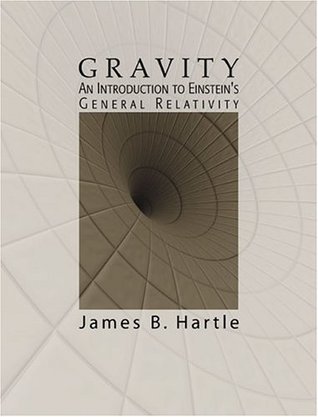
The aim of this groundbreaking new book is to bring general relativity into the undergraduate curriculum and make this fundamental theory accessible to all physics majors. Using a "physics first" approach to the subject, renowned relativist James B. Hartle provides a fluent and accessible introduction that uses a minimum of new mathematics and is illustrated with a wealth of exciting applications. The emphasis is on the exciting phenomena of gravitational physics and the growing connection between theory and observation. The Global Positioning System, black holes, X-ray sources, pulsars, quasars, gravitational waves, the Big Bang, and the large scale structure of the universe are used to illustrate the widespread role of how general relativity describes a wealth of everyday and exotic phenomena.

Called by some "the theory of everything," superstrings may solve a problem which has eluded physicists for the past 50 years -- the final unification of the two great theories of the twentieth century, general relativity and quantum field theory. This is a course-tested comprehensive introductory graduate text on superstrings which stresses the most current areas of interest, not covered in other presentation, including: string field theory, multi loops, Teichmueller spaces, conformal field theory, and four-dimensional strings. The book begins with a simple discussion of point particle theory, and uses the Feynman path integral technique to unify the presentation of superstrings. Prerequisites are an aquaintance with quantum mechanics and relativity. This second edition has been revised and updated throughout.

x^n + y^n = z^n, where n represents 3, 4, 5, ...no solution"I have discovered a truly marvelous demonstration of this proposition which this margin is too narrow to contain."With these words, the seventeenth-century French mathematician Pierre de Fermat threw down the gauntlet to future generations. What came to be known as Fermat's Last Theorem looked simple; proving it, however, became the Holy Grail of mathematics, baffling its finest minds for more than 350 years. In Fermat's Enigma--based on the author's award-winning documentary film, which aired on PBS's "Nova"--Simon Singh tells the astonishingly entertaining story of the pursuit of that grail, and the lives that were devoted to, sacrificed for, and saved by it. Here is a mesmerizing tale of heartbreak and mastery that will forever change your feelings about mathematics.

Einstein's General Theory of Relativity leads to two remarkable predictions: first, that the ultimate destiny of many massive stars is to undergo gravitational collapse and to disappear from view, leaving behind a 'black hole' in space; and secondly, that there will exist singularities in space-time itself. These singularities are places where space-time begins or ends, and the presently known laws of physics break down. They will occur inside black holes, and in the past are what might be construed as the beginning of the universe. To show how these predictions arise, the authors discuss the General Theory of Relativity in the large. Starting with a precise formulation of the theory and an account of the necessary background of differential geometry, the significance of space-time curvature is discussed and the global properties of a number of exact solutions of Einstein's field equations are examined. The theory of the causal structure of a general space-time is developed, and is used to study black holes and to prove a number of theorems establishing the inevitability of singualarities under certain conditions. A discussion of the Cauchy problem for General Relativity is also included in this 1973 book.

"A gem…An unforgettable account of one of the great moments in the history of human thought." —Steven PinkerProbing the life and work of Kurt Gödel, Incompleteness indelibly portrays the tortured genius whose vision rocked the stability of mathematical reasoning—and brought him to the edge of madness.

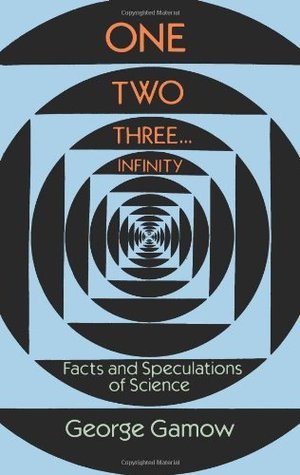
Whatever your level of scientific expertise, chances are you'll derive a great deal of pleasure, stimulation, and information from this unusual and imaginative book. It belongs in the library of anyone curious about the wonders of the scientific universe.One of the world's foremost nuclear physicists (celebrated for his theory of radioactive decay, among other accomplishments), George Gamow possessed the unique ability of making the world of science accessible to the general reader. He brings that ability to bear in this delightful expedition through the problems, pleasures, and puzzles of modern science.In the pages of this book readers grapple with such crucial matters as whether it is possible to bend space , why a rocket shrinks , the " end of the world problem ," excursions into the fourth dimension , and a host of other tantalizing topics for the scientifically curious Brimming with amusing anecdotes and provocative problems, One Two Three . . . Infinity also includes over 120 delightful pen-and-ink illustrations by the author , adding another dimension of good-natured charm to these wide-ranging explorations.". . . full of intellectual treats and tricks, of whimsy and deep scientific philosophy. It is highbrow entertainment at its best, a teasing challenge to all who aspire to think about the universe." — New York Herald TribuneDover publishes an impressive collection of popular science books including technology and invention, space and time, basic machines and computers, forces and fields, chaos, biographies of Einstein and Newton, and much more.

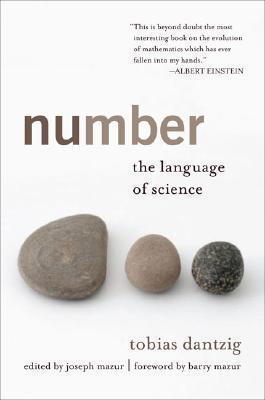
Number is an eloquent, accessible tour de force that reveals how the concept of number evolved from prehistoric times through the twentieth century. Tobias Dantzig shows that the development of math—from the invention of counting to the discovery of infinity—is a profoundly human story that progressed by “trying and erring, by groping and stumbling.” He shows how commerce, war, and religion led to advances in math, and he recounts the stories of individuals whose breakthroughs expanded the concept of number and created the mathematics that we know today.

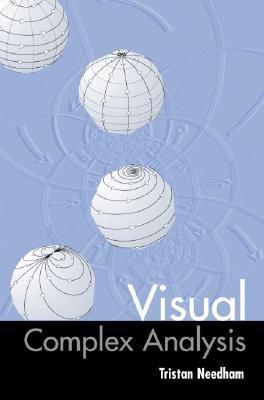
FROM THE Please do NOT buy this original 1997 edition! I have created a new, greatly improved (and cheaper!) edition, which was published on February 28th, 2023:Visual Complex 25th Anniversary Edition (with a new Foreword by Roger Penrose)**************************************************************************************************This radical first course on complex analysis brings a beautiful and powerful subject to life by consistently using geometry (not calculation) as the means of explanation. Aimed at undergraduate students in mathematics, physics, and engineering, the book's intuitive explanations, lack of advanced prerequisites, and consciously user-friendly prose style will help students to master the subject more readily than was previously possible. The key to this is the book's use of new geometric arguments in place of the standard calculational ones. These geometric arguments are communicated with the aid of hundreds of diagrams of a standard seldom encountered in mathematical works. A new approach to a classical topic, this work will be of interest to students in mathematics, physics, and engineering, as well as to professionals in these fields.

A leading physicist delves into relativity and experimental applicationsGravitation and Cosmology: Principles and Applications of the General Theory of Relativity offers a Nobel laureate's perspectives on the wealth of data technological developments have brought to expand upon Einstein's theory. Unique in basing relativity on the Principle of Equivalence of Gravitation and Inertia over Riemannian geometry, this book explores relativity experiments and observational cosmology to provide a sound foundation upon which analyses can be made. Covering special and general relativity, tensor analysis, gravitation, curvature, and more, this book provides an engaging, insightful introduction to the forces that shape the universe.
![The Whole Shebang: A State-of-the-Universe[s] Report](https://m.media-amazon.com/images/S/compressed.photo.goodreads.com/books/1347278841i/310330.jpg)
From the prizewinning author who has been called "the greatest science writer in the world" comes this delightfully comprehensive and comprehensible report on how science today envisions the universe as a whole. Timothy Ferris provides a clear, elegantly written overview of current research and a forecast of where cosmological theory is likely to go in the twenty-first century. He explores the questions that have occurred to even casual readers -- who are curious about nature on the largest scales: What does it mean to say that the universe is "expanding," or that space is "curved"? -- and sheds light on the possibility that our universe is only one among many universes, each with its own physical laws and prospects for the emergence of life.

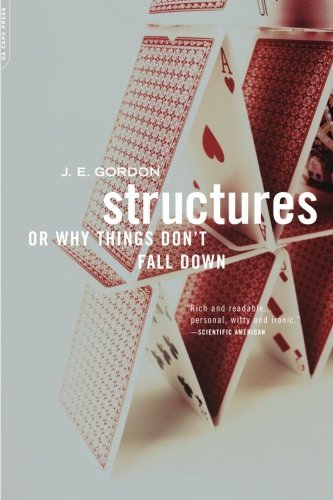
J. E. Gordon's classic introduction to the properties of materials used in engineering answers some fascinating and fundamental questions about how the structural world around us works. Gordon focuses on so-called strong materials--such as metals, wood, ceramics, glass, and bone--explaining in engaging and accessible terms the unique physical and chemical basis for their inherent structural qualities. He also shows how an in-depth understanding of these materials’ intrinsic strengths--and weaknesses--guides our engineering choices, allowing us to build the structures that support our society. This work is an enduring example of first-rate scientific communication. Philip Ball's introduction describes Gordon's career and the impact of his innovations in materials research, while also discussing how the field has evolved since Gordon wrote this enduring example of first-rate scientific communication.

In a book that Business Insider noted as one of the "14 Books that inspired Elon Musk," J.E. Gordon strips engineering of its confusing technical terms, communicating its founding principles in accessible, witty prose.For anyone who has ever wondered why suspension bridges don't collapse under eight lanes of traffic, how dams hold back--or give way under--thousands of gallons of water, or what principles guide the design of a skyscraper, a bias-cut dress, or a kangaroo, this book will ease your anxiety and answer your questions. Or Why Things Don't Fall Down is an informal explanation of the basic forces that hold together the ordinary and essential things of this world--from buildings and bodies to flying aircraft and eggshells. In a style that combines wit, a masterful command of his subject, and an encyclopedic range of reference, Gordon includes such chapters as "How to Design a Worm" and "The Advantage of Being a Beam," offering humorous insights in human and natural creation.Architects and engineers will appreciate the clear and cogent explanations of the concepts of stress, shear, torsion, fracture, and compression. If you're building a house, a sailboat, or a catapult, here is a handy tool for understanding the mechanics of joinery, floors, ceilings, hulls, masts--or flying buttresses.Without jargon or oversimplification, Structures opens up the marvels of technology to anyone interested in the foundations of our everyday lives.

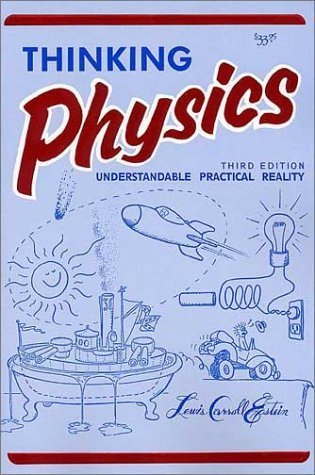
Lewis Carroll Epstein explains deep ideas in physics in an easy-to-understand way. Thinking Physics is a perfect beginner’s guide to an amazingly wide range of physics-related questions. The book targets topics that science teachers and students spend time wondering about, like wing lift. Epstein elucidates the familiar but misunderstood — such as how tides work — along with more obscure but fascinating phenomena like the “Bernoulli sub” and the “artificial aurora” created by hydrogen bombs. Broken into many short sections and peppered with Epstein’s own playful hand-drawn illustrations, the book does not simply give the right answer: It also goes into the answers that seem right but are wrong and shows why they are wrong — a rarity in science books. Thinking Physics is a rigorously correct, lighthearted, and cleverly designed Q and A book for physicists of all ages.

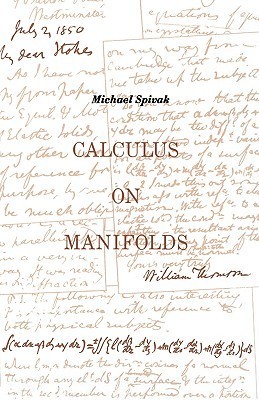
This little book is especially concerned with those portions of ”advanced calculus” in which the subtlety of the concepts and methods makes rigor difficult to attain at an elementary level. The approach taken here uses elementary versions of modern methods found in sophisticated mathematics. The formal prerequisites include only a term of linear algebra, a nodding acquaintance with the notation of set theory, and a respectable first-year calculus course (one which at least mentions the least upper bound (sup) and greatest lower bound (inf) of a set of real numbers). Beyond this a certain (perhaps latent) rapport with abstract mathematics will be found almost essential.

An entertaining and accessible look at the role of serendipity in major medical and scientific breakthroughs of the twentieth century explains how chance and lucky accidents led to the discovery of such medical advances as penicillin, chemotherapy drugs, X-rays, Valium, the Pap smear, and Viagra.

". . . Nothing less than a major contribution to the scientific culture of this world." — The New York Times Book ReviewThis major survey of mathematics, featuring the work of 18 outstanding Russian mathematicians and including material on both elementary and advanced levels, encompasses 20 prime subject areas in mathematics in terms of their simple origins and their subsequent sophisticated developement. As Professor Morris Kline of New York University noted, "This unique work presents the amazing panorama of mathematics proper. It is the best answer in print to what mathematics contains both on the elementary and advanced levels."Beginning with an overview and analysis of mathematics, the first of three major divisions of the book progresses to an exploration of analytic geometry, algebra, and ordinary differential equations. The second part introduces partial differential equations, along with theories of curves and surfaces, the calculus of variations, and functions of a complex variable. It furthur examines prime numbers, the theory of probability, approximations, and the role of computers in mathematics. The theory of functions of a real variable opens the final section, followed by discussions of linear algebra and nonEuclidian geometry, topology, functional analysis, and groups and other algebraic systems.Thorough, coherent explanations of each topic are further augumented by numerous illustrative figures, and every chapter concludes with a suggested reading list. Formerly issued as a three-volume set, this mathematical masterpiece is now available in a convenient and modestly priced one-volume edition, perfect for study or reference."This is a masterful English translation of a stupendous and formidable mathematical masterpiece . . ." — Social Science

This landmark text offers a rigorous full-year graduate level course on gravitation physics, teaching students • Grasp the laws of physics in flat spacetime• Predict orders of magnitude• Calculate using the principal tools of modern geometry• Predict all levels of precision• Understand Einstein's geometric framework for physics• Explore applications, including pulsars and neutron stars, cosmology, the Schwarzschild geometry and gravitational collapse, and gravitational waves• Probe experimental tests of Einstein's theory• Tackle advanced topics such as superspace and quantum geometrodynamicsThe book offers a unique, alternating two-track pathway through the • In many chapters, material focusing on basic physical ideas is designated asTrack 1 . These sections together make an appropriate one-term advanced/graduate level course (mathematical vector analysis and simple partial-differential equations). The book is printed to make it easy for readers to identify these sections.• The remaining Track 2 material provides a wealth of advanced topics instructors can draw from to flesh out a two-term course, with Track 1 sections serving as prerequisites.

Ignition! is the inside story of the Cold War era search for a rocket propellant that could be trusted to take man into space. A favorite of Tesla and SpaceX founder Elon Musk, listeners will want to tune into this "really good book on rocket[s]," available for the first time in audio.Ignition! is the story of the search for a rocket propellant which could be trusted to take man into space. This search was a hazardous enterprise carried out by rival labs who worked against the known laws of nature, with no guarantee of success or safety.Acclaimed scientist and sci-fi author John Drury Clark writes with irreverent and eyewitness immediacy about the development of the explosive fuels strong enough to negate the relentless restraints of gravity. The resulting volume is as much a memoir as a work of history, sharing a behind-the-scenes view of an enterprise that eventually took men to the moon, missiles to the planets, and satellites to outer space. A classic work in the history of science, listeners will want to get their hands on this influential classic, available for the first time in decades.

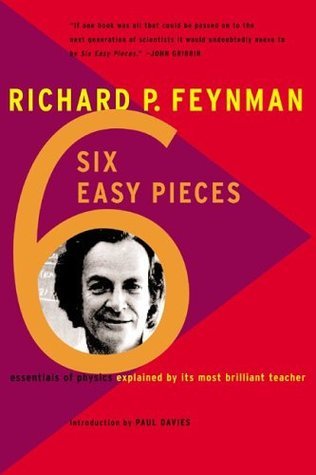
Six Easy Essentials of Physics Explained by Its Most Brilliant Teacher is a publishing first. This set couples a book containing the six easiest chapters from Richard P. Feynman's landmark work, Lectures on Physics —specifically designed for the general, non-scientist reader—with the actual recordings of the late, great physicist delivering the lectures on which the chapters are based. Nobel Laureate Feynman gave these lectures just once, to a group of Caltech undergraduates in 1961 and 1962, and these newly released recordings allow you to experience one of the Twentieth Century's greatest minds—as if you were right there in the classroom.

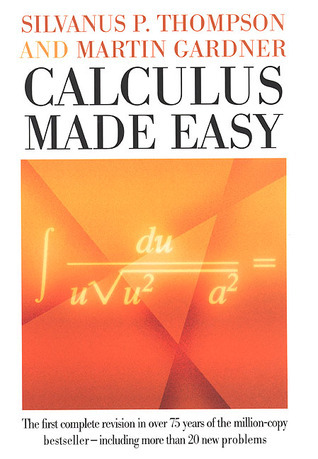
Calculus Made Easy by Silvanus P. Thompson and Martin Gardner has long been the most popular calculus primer.This major revision of the classic math text makes the subject at hand still more comprehensible to readers of all levels. With a new introduction, three new chapters, modernized language and methods throughout, and an appendix of challenging and enjoyable practice problems, Calculus Made Easy has been thoroughly updated for the modern reader.

In the Messenger Lectures, originally delivered at Cornell University & recorded for TV by the BBC, Feynman offers an overview of selected physical laws & gathers their common features into one broad principle of invariance. He maintains at the outset that the importance of a physical law isn't "how clever we are to have found it out, but...how clever nature is to pay attention to it" & tends his discussions toward a final exposition of the elegance & simplicity of all scientific laws. Rather than an essay on the most significant achievements in modern science, The Character of Physical Law is a statement of what is most remarkable in nature. His enlightened approach, wit & enthusiasm make this a memorable exposition of the scientist's craft. The Law of Gravitation is the principal example. Relating the details of its discovery & stressing its mathematical character, he uses it to demonstrate the essential interaction of mathematics & physics. He views mathematics as the key to any system of scientific laws, suggesting that if it were possible to fill out the structure of scientific theory completely, the result would be an integrated set of axioms. The principles of conservation, symmetry & time-irreversibility are then considered in relation to developments in classical & modern physics. In his final lecture he develops his own analysis of the process & future of scientific discovery. Like any set of oral reflections, The Character of Physical Law has value as a demonstration of a mind in action. The reader is particularly lucky in Feynman. One of the most eminent & imaginative modern physicists, he was Professor of Theoretical Physics at the California Institute of Technology until his death in 1988. He's best known for work on the quantum theory of the electromagnetic field, as well as for later research in the field of low-temperature physics. In 1954 he received the Albert Einstein Award for an "outstanding contribution to knowledge in mathematical & physical sciences"; in 1965 he was appointed to Foreign Membership in the Royal Society & was awarded the Nobel Prize.

Using interviews with and writings by 30 astronauts and cosmonauts, Frank White shows how experiences such as circling the Earth every 90 minutes and viewing it from the moon have profoundly affected our space travelers' perceptions of themselves, their world, and the future. He shows how the rest of us, who have participated imaginatively in these great adventures, have also been affected psychologically by them.

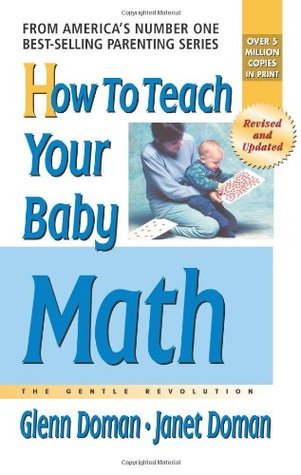
*** OVER 13 MILLION COPIES SOLD ***Time and again, the work performed at The Institutes for the Achievement of Human Potential has demonstrated that children from birth to age six are capable of learning better and faster than older children. How To Teach Your Baby To Read shows just how easy it is to teach a young child to read, while How To Teach Your Baby Math presents the simple steps for teaching mathematics through the development of thinking and reasoning skills. Both books explain how to begin and expand each program, how to make and organize necessary materials, and how to more fully develop your child’s reading and math potential.How to Give Your Baby Encyclopedic Knowledge shows how simple it is to develop a program that cultivates a young child’s awareness and understanding of the arts, science, and nature―to recognize the insects in the garden, to learn about the countries of the world, to discover the beauty of a Van Gogh painting, and much more. How To Multiply Your Baby’s Intelligence provides a comprehensive program for teaching your young child how to read, to understand mathematics, and to literally multiply his or her overall learning potential in preparation for a lifetime of success.The Gentle Revolution Series :The Institutes for the Achievement of Human Potential has been successfully serving children and teaching parents for five decades. Its goal has been to significantly improve the intellectual, physical, and social development of all children. The groundbreaking methods and techniques of The Institutes have set the standards in early childhood education. As a result, the books written by Glenn Doman, founder of this organization, have become the all-time best-selling parenting series in the United States and the world.

In 1931 Kurt Gödel published his fundamental paper, "On Formally Undecidable Propositions of Principia Mathematica and Related Systems." This revolutionary paper challenged certain basic assumptions underlying much research in mathematics and logic. Gödel received public recognition of his work in 1951 when he was awarded the first Albert Einstein Award for achievement in the natural sciences--perhaps the highest award of its kind in the United States. The award committee described his work in mathematical logic as "one of the greatest contributions to the sciences in recent times."However, few mathematicians of the time were equipped to understand the young scholar's complex proof. Ernest Nagel and James Newman provide a readable and accessible explanation to both scholars and non-specialists of the main ideas and broad implications of Gödel's discovery. It offers every educated person with a taste for logic and philosophy the chance to understand a previously difficult and inaccessible subject.New York University Press is proud to publish this special edition of one of its bestselling books. With a new introduction by Douglas R. Hofstadter, this book will appeal to students, scholars, and professionals in the fields of mathematics, computer science, logic and philosophy, and science.

The revised and updated edition includes three completely new chapters on the prediction and control of chaotic systems. It also incorporates new information regarding the solar system and an account of complexity theory. This witty, lucid and engaging book makes the complex mathematics of chaos accessible and entertaining. Presents complex mathematics in an accessible style. Includes three new chapters on prediction in chaotic systems, control of chaotic systems, and on the concept of chaos. Provides a discussion of complexity theory.

The first edition of Jim Watson's classic textbook Molecular Biology of the Gene appeared in 1965. This new edition, written with five new authors, has been brought fully up to date, and incorporates insights very recently derived from genome sequencing in a variety of organisms. The book isan authoritative and comprehensive survey of the fundamentals of molecular biology, from basic mechanisms to the elaborate role of gene regulation in embryonic development and evolution. Although updated, the twentyDSone chapters of the new edition retain the distinctive and celebrated features ofthe original work, including introductory chapters on the history of genetics and molecular biology and an emphasis throughout on the chemical underpinnings of molecular biology. The new team of authors brings to this edition awardDSwinning teaching experience and outstanding research achievements.By revealing the intellectual framework and experimental approaches that made new discoveries in the field possible, the new edition highlights the significance of the molecular approach for all of biology.

A brilliant research mathematician who has devoted his career to teaching kids reveals math to be creative and beautiful and rejects standard anxiety-producing teaching methods. Witty and accessible, Paul Lockhart’s controversial approach will provoke spirited debate among educators and parents alike and it will alter the way we think about math forever.

The laws of thermodynamics drive everything that happens in the universe. From the sudden expansion of a cloud of gas to the cooling of hot metal--everything is moved or restrained by four simple laws. Written by Peter Atkins, one of the world's leading authorities on thermodynamics, this powerful and compact introduction explains what these four laws are and how they work, using accessible language and virtually no mathematics. Guiding the reader a step at a time, Atkins begins with Zeroth (so named because the first two laws were well established before scientists realized that a third law, relating to temperature, should precede them--hence the jocular name zeroth), and proceeds through the First, Second, and Third Laws, offering a clear account of concepts such as the availability of work and the conservation of energy. Atkins ranges from the fascinating theory of entropy (revealing how its unstoppable rise constitutes the engine of the universe), through the concept of free energy, and to the brink, and then beyond the brink, of absolute zero. About the Series: Combining authority with wit, accessibility, and style, Very Short Introductions offer an introduction to some of life's most interesting topics. Written by experts for the newcomer, they demonstrate the finest contemporary thinking about the central problems and issues in hundreds of key topics, from philosophy to Freud, quantum theory to Islam.

The many books on globalization published over the past few years range from claims that the world is flat to an unlikely rehabilitation of Genghis Khan as a pioneer of global commerce. Missing from these accounts is a consideration of the technologies behind the creation of the globalized economy. What makes it possible for us to move billions of tons of raw materials and manufactured goods from continent to continent? Why are we able to fly almost anywhere on the planet within twenty-four hours? In Prime Movers of Globalization , Vaclav Smil offers a history of two key technical developments that have driven the high-compression non-sparking internal combustion engines invented by Rudolf Diesel in the 1890s and the gas turbines designed by Frank Whittle and Hans-Joachim Pabst von Ohain in the 1930s. The massive diesel engines that power cargo ships and the gas turbines that propel jet engines, Smil argues, are more important to the global economy than any corporate structure or international trade agreement. Smil compares the efficiency and scale of these two technologies to prime movers of the past, including the sail and the steam engine. The lengthy processes of development, commercialization, and diffusion that the diesel engine and the gas turbine went through, he argues, provide perfect examples of gradual technical advances that receive little attention but have resulted in epochal shifts in global affairs and the global economy.

How shall we improve human health? One answer by eradication. The Gates Foundation announced in 2007 that their goal is malaria eradication; another of their priorities is polio eradication. Eradication means the complete elimination of a disease through deliberate human intervention. It stands for an absolute in public health. This book by the award-winning historian of medicine Nancy Leys Stepan is an accessible, beautifully written, and deeply researched examination of one of the most controversial issues in public health today. The eradication of disease might seem like an absolute good. But critics of eradication argue that the huge resources needed to achieve eradication could be better allocated toward developing primary health services and general improvement in health. This book aims to look at the benefits and drawbacks of single-minded efforts to rid the world of particular diseases, one at a time. The sweep of the book is impressive, from the origins of the idea of complete eradication in the early twentieth century until the present-day campaigns against polio, Guinea worm disease, and now malaria. The author places eradication's story in its many contexts, from imperialism, changing notions of public health, the history of medicine and its technologies, the development of international health agencies such as the World Health Organization, and the impact of the Cold War on the shift of attention to disease in developing countries. At the center of this narrative is Dr. Fred Lowe Soper (1893-1977), a U.S.-trained doctor who became the arch-eradicationist of his time. His campaigns to eradicate hookworm disease, yaws, yellow fever, malaria, and smallpox are treated in compelling detail, as are the roles of international health agencies such as the Rockefeller Foundation and the World Health Organization. Throughout the book Stepan draws attention to the way that the ideal of eradication has repeatedly arisen, phoenix-like, from its setbacks. In a powerful conclusion, she uses the example of the current campaign to eradicate Guinea worm disease to argue that, today, under the right circumstances, eradication and primary health care need not be in conflict, as they were in the past, but can form mutually reinforcing policies to improve the health and well-being of populations, especially the poorest and most disease-burdened populations of the world.

While the physical sciences are a continuously evolving source of technology and of understanding about our world, they have become so specialized and rely on so much prerequisite knowledge that for many people today the divide between the sciences and the humanities seems even greater than it was when C. P. Snow delivered his famous 1959 lecture, "The Two Cultures." In A Cultural History of Physics , Hungarian scientist and educator Károly Simonyi succeeds in bridging this chasm by describing the experimental methods and theoretical interpretations that created scientific knowledge, from ancient times to the present day, within the cultural environment in which it was formed. Unlike any other work of its kind, Simonyi’s seminal opus explores the interplay of science and the humanities to convey the wonder and excitement of scientific development throughout the ages. These pages contain an abundance of excerpts from original resources, a wide array of clear and straightforward explanations, and an astonishing wealth of insight, revealing the historical progress of science and inviting readers into a dialogue with the great scientific minds that shaped our current understanding of physics. Beautifully illustrated, accurate in its scientific content and broad in its historical and cultural perspective, this book will be a valuable reference for scholars and an inspiration to aspiring scientists and humanists who believe that science is an integral part of our culture.

A Wall Street Journal Best Book of 2013A world-class physicist and a citizen scientist combine forces to teach Physics 101—the DIY wayThe Theoretical Minimum is a book for anyone who has ever regretted not taking physics in college—or who simply wants to know how to think like a physicist. In this unconventional introduction, physicist Leonard Susskind and hacker-scientist George Hrabovsky offer a first course in physics and associated math for the ardent amateur. Unlike most popular physics books—which give readers a taste of what physicists know but shy away from equations or math—Susskind and Hrabovsky actually teach the skills you need to do physics, beginning with classical mechanics, yourself. Based on Susskind's enormously popular Stanford University-based (and YouTube-featured) continuing-education course, the authors cover the minimum—the theoretical minimum of the title—that readers need to master to study more advanced topics.An alternative to the conventional go-to-college method, The Theoretical Minimum provides a tool kit for amateur scientists to learn physics at their own pace.

The Emergent Multiverse presents a striking new account of the "many worlds" approach to quantum theory. The point of science, it is generally accepted, is to tell us how the world works and what it is like. But quantum theory seems to fail to do this: taken literally as a theory of the world, it seems to make crazy claims: particles are in two places at once; cats are alive and dead at the same time. So physicists and philosophers have often been led either to give up on the idea that quantum theory describes reality, or to modify or augment the theory. The Everett interpretation of quantum mechanics takes the apparent craziness seriously, and asks, "what would it be like if particles really were in two places at once, if cats really were alive and dead at the same time?" The answer, it turns out, is that if the world were like that--if it were as quantum theory claims--it would be a world that, at the macroscopic level, was constantly branching into copies--hence the more sensationalist name for the Everett interpretation, the "many worlds theory." But really, the interpretation is not sensationalist at all: it simply takes quantum theory seriously, literally, as a description of the world. Once dismissed as absurd, it is now accepted by many physicists as the best way to make coherent sense of quantum theory. David Wallace offers a clear and up-to-date survey of work on the Everett interpretation in physics and in philosophy of science, and at the same time provides a self-contained and thoroughly modern account of it--an account which is accessible to readers who have previously studied quantum theory at undergraduate level, and which will shape the future direction of research by leading experts in the field.

Often calculus and mechanics are taught as separate subjects. It shouldn't be like that. Learning calculus without mechanics is incredibly boring. Learning mechanics without calculus is missing the point. This textbook integrates both subjects and highlights the profound connections between them.This is the deal. Give me 350 pages of your attention, and I'll teach you everything you need to know about functions, limits, derivatives, integrals, vectors, forces, and accelerations. This book is the only math book you'll need for the first semester of undergraduate studies in science.With concise, jargon-free lessons on topics in math and physics, each section covers one concept at the level required for a first-year university course. Anyone can pick up this book and become proficient in calculus and mechanics, regardless of their mathematical background.Visit http://minireference.com for more details.

Our Mathematical Universe is a journey to explore the mysteries uncovered by cosmology and to discover the nature of reality. Our Big Bang, our distant future, parallel worlds, the sub-atomic and intergalactic - none of them are what they seem. But there is a way to understand this immense strangeness - mathematics. Seeking an answer to the fundamental puzzle of why our universe seems so mathematical, Tegmark proposes a radical idea: that our physical world not only is described by mathematics, but that it is mathematics. This may offer answers to our deepest questions: How large is reality? What is everything made of? Why is our universe the way it is?Table of ContentsPreface 1 What Is Reality? Not What It Seems • What’s the Ultimate Question? • The Journey Begins Part One: Zooming Out 2 Our Place in Space Cosmic Questions • How Big Is Space? • The Size of Earth • Distance to the Moon • Distance to the Sun and the Planets • Distance to the Stars • Distance to the Galaxies • What Is Space? 3 Our Place in TimeWhere Did Our Solar System Come From? • Where Did theGalaxies Come From? • Where Did the Mysterious MicrowavesCome From? • Where Did the Atoms Come From? 4 Our Universe by NumbersWanted: Precision Cosmology • Precision Microwave-Background Fluctuations • Precision Galaxy Clustering • The Ultimate Map of Our Universe • Where Did Our Big Bang Come From? 5 Our Cosmic Origins What’s Wrong with Our Big Bang? • How Inflation Works • The Gift That Keeps on Giving • Eternal Inflation 6 Welcome to the Multiverse The Level I Multiverse • The Level II Multiverse • Multiverse Halftime Roundup Part Two: Zooming In 7 Cosmic Legos Atomic Legos • Nuclear Legos • Particle-Physics Legos • Mathematical Legos • Photon Legos • Above the Law? • Quanta and Rainbows • Making Waves • Quantum Weirdness • The Collapse of Consensus • The Weirdness Can’t Be Confined • Quantum Confusion 8 The Level III Multiverse The Level III Multiverse • The Illusion of Randomness • Quantum Censorship • The Joys of Getting Scooped • Why Your Brain Isn’t a Quantum Computer • Subject, Object and Environment • Quantum Suicide • Quantum Immortality? • Multiverses Unified • Shifting Views: Many Worlds or Many Words? Part Three: Stepping Back 9 Internal Reality, External Reality and Consensus Reality External Reality and Internal Reality • The Truth, the Whole Truth and Nothing but the Truth • Consensus Reality • Physics: Linking External to Consensus Reality 10 Physical Reality and Mathematical Reality Math, Math Everywhere! • The Mathematical Universe Hypothesis • What Is a Mathematical Structure? 11 Is Time an Illusion? How Can Physical Reality Be Mathematical? • What Are You? • Where Are You? (And What Do You Perceive?) • When Are You? 12 The Level IV Multiverse Why I Believe in the Level IV Multiverse • Exploring the Level IV Multiverse: What’s Out There? • Implications of the Level IV Multiverse • Are We Living in a Simulation? • Relation Between the MUH, the Level IV Multiverse and Other Hypotheses •Testing the Level IV Multiverse 13 Life, Our Universe and Everything How Big Is Our Physical Reality? • The Future of Physics • The Future of Our Universe—How Will It End? • The Future of Life •The Future of You—Are You Insignificant? Acknowledgments Suggestions for Further Reading Index

From the best-selling author of Seven Brief Lessons on Physics comes a new book about the mind-bending nature of the universe What are time and space made of? Where does matter come from? And what exactly is reality? Scientist Carlo Rovelli has spent his whole life exploring these questions and pushing the boundaries of what we know. Here he explains how our image of the world has changed throughout centuries. Fom Aristotle to Albert Einstein, Michael Faraday to the Higgs boson, he takes us on a wondrous journey to show us that beyond our ever-changing idea of reality is a whole new world that has yet to be discovered.

All the beauty of modern physics in fewer than a hundred pages.This is a book about the joy of discovery. A playful, entertaining, and mind-bending introduction to modern physics, it's already a major bestseller in Italy and the United Kingdom. Carlo Rovelli offers surprising—and surprisingly easy to grasp—explanations of general relativity, quantum mechanics, elementary particles, gravity, black holes, the complex architecture of the universe, and the role humans play in this weird and wonderful world. He takes us to the frontiers of our knowledge: to the most minute reaches of the fabric of space, back to the origins of the cosmos, and into the workings of our minds. “Here, on the edge of what we know, in contact with the ocean of the unknown, shines the mystery and the beauty of the world,” Rovelli writes. “And it’s breathtaking.”

The revered New York Times bestselling author traces the development of technology from the Industrial Age to the Digital Age to explore the single component crucial to advancement—precision—in a superb history that is both an homage and a warning for our future.The rise of manufacturing could not have happened without an attention to precision. At the dawn of the Industrial Revolution in eighteenth-century England, standards of measurement were established, giving way to the development of machine tools—machines that make machines. Eventually, the application of precision tools and methods resulted in the creation and mass production of items from guns and glass to mirrors, lenses, and cameras—and eventually gave way to further breakthroughs, including gene splicing, microchips, and the Hadron Collider.Simon Winchester takes us back to origins of the Industrial Age, to England where he introduces the scientific minds that helped usher in modern production: John Wilkinson, Henry Maudslay, Joseph Bramah, Jesse Ramsden, and Joseph Whitworth. It was Thomas Jefferson who later exported their discoveries to the fledgling United States, setting the nation on its course to become a manufacturing titan. Winchester moves forward through time, to today’s cutting-edge developments occurring around the world, from America to Western Europe to Asia.As he introduces the minds and methods that have changed the modern world, Winchester explores fundamental questions. Why is precision important? What are the different tools we use to measure it? Who has invented and perfected it? Has the pursuit of the ultra-precise in so many facets of human life blinded us to other things of equal value, such as an appreciation for the age-old traditions of craftsmanship, art, and high culture? Are we missing something that reflects the world as it is, rather than the world as we think we would wish it to be? And can the precise and the natural co-exist in society?

Time is a mystery that does not cease to puzzle us. Philosophers, artists and poets have long explored its meaning while scientists have found that its structure is different from the simple intuition we have of it. From Boltzmann to quantum theory, from Einstein to loop quantum gravity, our understanding of time has been undergoing radical transformations. Time flows at different speeds in different places, the past and the future differ far less than we might think and the very notion of the present evaporates in the vast universe. With his extraordinary charm and sense of wonder, bringing together science, philosophy and art, Carlo Rovelli unravels this mystery, inviting us to imagine a world where time is in us and we are not in time.

The untold story of the heretical thinkers who dared to question the nature of our quantum universeEvery physicist agrees quantum mechanics is among humanity's finest scientific achievements. But ask what it means, and the result will be a brawl. For a century, most physicists have followed Niels Bohr's Copenhagen interpretation and dismissed questions about the reality underlying quantum physics as meaningless. A mishmash of solipsism and poor reasoning, Copenhagen endured, as Bohr's students vigorously protected his legacy, and the physics community favored practical experiments over philosophical arguments. As a result, questioning the status quo long meant professional ruin. And yet, from the 1920s to today, physicists like John Bell, David Bohm, and Hugh Everett persisted in seeking the true meaning of quantum mechanics. What Is Real? is the gripping story of this battle of ideas and of the courageous scientists who dared to stand up for truth.

From Jim Holt, the New York Times bestselling author of Why Does the World Exist?, comes an entertaining and accessible guide to the most profound scientific and mathematical ideas of recent centuries in When Einstein Walked with Gödel Excursions to the Edge of Thought.Does time exist? What is infinity? Why do mirrors reverse left and right but not up and down? In this scintillating collection, Holt explores the human mind, the cosmos, and the thinkers who've tried to encompass the latter with the former. With his trademark clarity and humor, Holt probes the mysteries of quantum mechanics, the quest for the foundations of mathematics, and the nature of logic and truth. Along the way, he offers intimate biographical sketches of celebrated and neglected thinkers, from the physicist Emmy Noether to the computing pioneer Alan Turing and the discoverer of fractals, Benoit Mandelbrot. Holt offers a painless and playful introduction to many of our most beautiful but least understood ideas, from Einsteinian relativity to string theory, and also invites us to consider why the greatest logician of the twentieth century believed the U.S. Constitution contained a terrible contradiction--and whether the universe truly has a future.

An eye-opening exploration of blood, the lifegiving substance with the power of taboo, the value of diamonds, and the promise of breakthrough scienceBlood carries life, yet the sight of it makes people faint. It is a waste product and a commodity pricier than oil. It can save lives and transmit deadly infections. Each one of us has roughly nine pints of it, yet many don’t even know their own blood type. And for all its ubiquity, the few tablespoons of blood discharged by 800 million women are still regarded as taboo; menstruation is perhaps the single most demonized biological event.Rose George, author of The Big Necessity, is renowned for her intrepid work on topics that are invisible but vitally important. In Nine Pints, she takes us from ancient practices of bloodletting to modern “hemovigilance” teams that track blood-borne diseases. She introduces Janet Vaughan, who set up the world’s first system of mass blood donation during the Blitz, and Arunachalam Muruganantham, known as “Menstrual Man” for his work on sanitary pads for developing countries. She probes the lucrative business of plasma transfusions, in which the U.S. is known as the “OPEC of plasma.” And she looks to the future, as researchers seek to bring synthetic blood to a hospital near you.Spanning science and politics, stories and global epidemics, Nine Pints reveals our life's blood in an entirely new light.

A luminous guide to how the radical new science of counterfactuals can reveal the full scope of our universe. There is a vast class of properties, which science has so far neglected, that relate not only to what is true the actual but to what could be true: the counterfactual. This is the science of can and can't.A pioneer in the field, Chiara Marletto explores the extraordinary promise that this revolutionary approach holds for confronting existing technological challenges, from delivering next-generation processors to designing AI. But by contemplating the possible as well as the actual, Marletto goes deeper still, showing how counterfactuals can break down barriers to knowledge and form a more complete, abundant and rewarding picture of the universe itself.