Loading themes...
Explore the best books about Read For School theme.

An astonishing effort on the part of the leading Klingon scholars of today, telling a story of blood, honour and vengeance in true Klingon tradition. With the English-language version printed on the left and the Klingon on the right, this best-known of Shakespeare's plays, a tour-de-force of Elizabethan theatre, can now be read and understood in the great warrior tongue even by non-Klingon speakers. As General Chang (Christopher Plummer) was heard to remark in the movie Star Trek IV: The Undiscovered Country: "Shakespeare is better in the original Klingon."Building on the groundwork of linguist Marc Okrand, author of The Klingon Dictionary, who constructed a fully spoken language out of what began as little more than a background prop, the Klingon Language Institute in Flourtown, Pennsylvania, is dedicated to the study and teaching of Klingon as a living tongue. Translating the great works of literature, Hamlet among them, is central to their philosophy of education and discovery.
“I got you to look after me, and you got me to look after you, and that's why.” They are an unlikely pair: George is "small and quick and dark of face"; Lennie, a man of tremendous size, has the mind of a young child. Yet they have formed a "family," clinging together in the face of loneliness and alienation. Laborers in California's dusty vegetable fields, they hustle work when they can, living a hand-to-mouth existence. But George and Lennie have a plan: to own an acre of land and a shack they can call their own.While the powerlessness of the laboring class is a recurring theme in Steinbeck's work of the late 1930s, he narrowed his focus when composing Of Mice and Men, creating an intimate portrait of two men facing a world marked by petty tyranny, misunderstanding, jealousy, and callousness. But though the scope is narrow, the theme is universal: a friendship and a shared dream that makes an individual's existence meaningful.A unique perspective on life's hardships, this story has achieved the status of timeless classic due to its remarkable success as a novel, a Broadway play, and three acclaimed films.

A classic work of American literature that has not stopped changing minds and lives since it burst onto the literary scene, The Things They Carried is a ground-breaking meditation on war, memory, imagination, and the redemptive power of storytelling. The Things They Carried depicts the men of Alpha Company: Jimmy Cross, Henry Dobbins, Rat Kiley, Mitchell Sanders, Norman Bowker, Kiowa, and the character Tim O’Brien, who has survived his tour in Vietnam to become a father and writer at the age of forty-three. Taught everywhere—from high school classrooms to graduate seminars in creative writing—it has become required reading for any American and continues to challenge readers in their perceptions of fact and fiction, war and peace, courage and fear and longing. The Things They Carried won France's prestigious Prix du Meilleur Livre Etranger and the Chicago Tribune Heartland Prize; it was also a finalist for the Pulitzer Prize and the National Book Critics Circle Award.

What he hears will change everything. Egged on by his wife, he decides to kill in order to gain the Scottish crown. How many people will have to die in Macbeth's pursuit of power? With armies, ghosts and magic against him, will Macbeth survive in this tale of greed and betrayal? Getting the crown is one thing - keeping it is quite another.

Target for principles of economics, surveys of economics, international economics, international trade, or managerial economics. No prior economics is assumed, but the material can be taught at all levels. Written as a novel, the book makes the complex concepts, issues and terminology of international trade understandable for students. Professors complain that their students cannot grasp the nature of how some economic tools are used or how they work in life. This novel bridges the gap of concepts with applications by use of a fictional story. David Ricardo comes to life to discuss international trade theory and policy with Ed Johnson, a fictional American television manufacturer seeking trade protection from television manufacturers. Their dialogue is a sophisticated, rigorous discussion of virtually every major issue in trade theory and policy. To illustrate the positive and normative effects of international trade and trade policy, Ricardo takes the reader and Ed Johnson into the future to see an America of free trade and an America of complete self-sufficiency. The fictional element brings these topics to life so that students gain the intuition and understanding of how trade changes the lives of people and the industries they work in. The fundamental intuition of how international markets function including general equilibrium effects and policy analysis is provided.

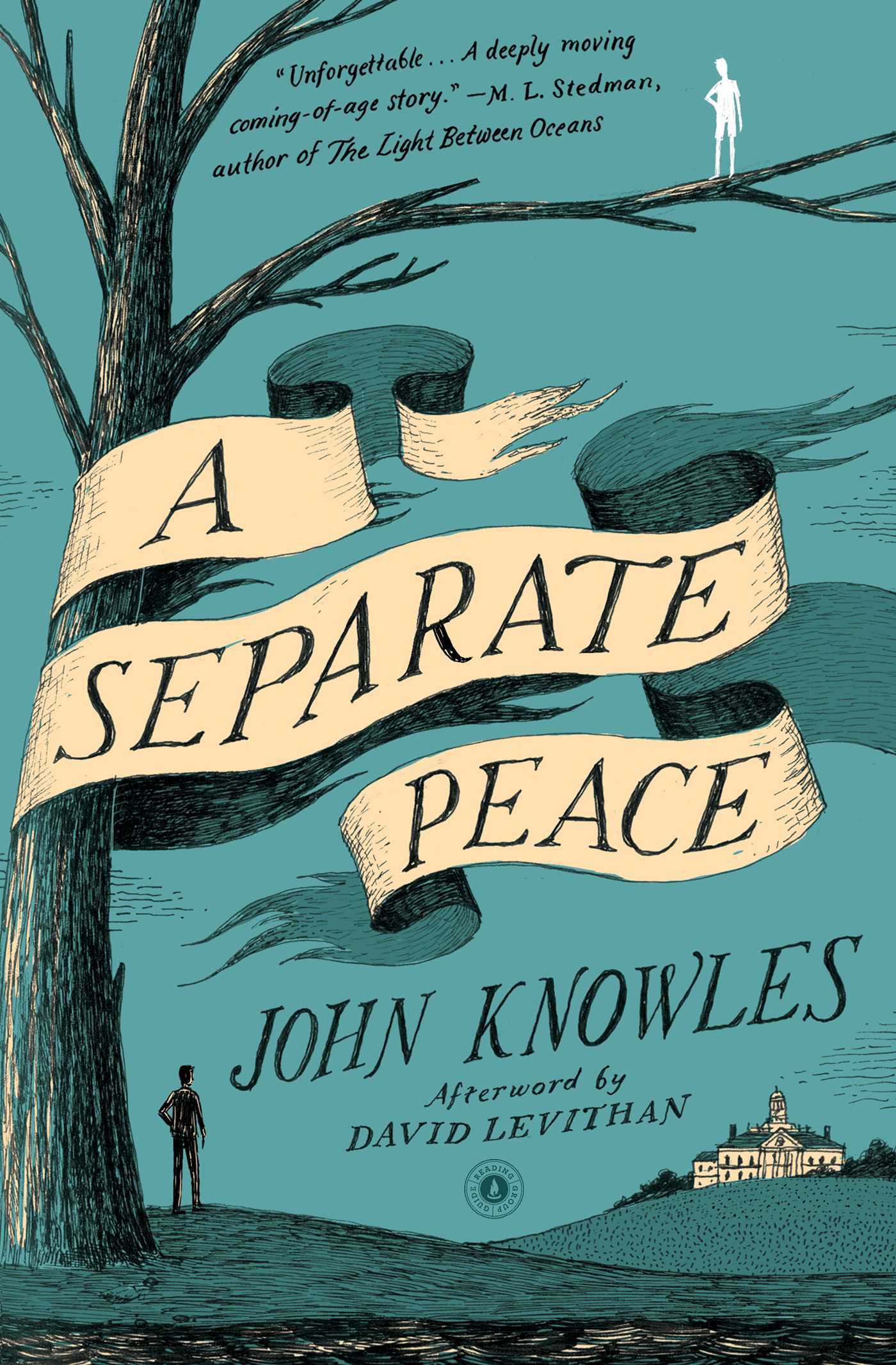
An American classic and great bestseller for over thirty years, A Separate Peace is timeless in its description of adolescence during a period when the entire country was losing its innocence to the second world war.Set at a boys boarding school in New England during the early years of World War II, A Separate Peace is a harrowing and luminous parable of the dark side of adolescence. Gene is a lonely, introverted intellectual. Phineas is a handsome, taunting, daredevil athlete. What happens between the two friends one summer, like the war itself, banishes the innocence of these boys and their world.A bestseller for more than thirty years, A Separate Peace is John Knowles crowning achievement and an undisputed American classic.

« Qui n'a jamais rêvé de devenir un objet ? Mieux même, un objet d'admiration ?Tel est le pacte que scellent un artiste excentrique et un jeune homme désespéré. Le premier, avide de scandale, propose au second, avide d'exister, de le transformer en oeuvre d'art. Après tout, il n'a rien à y perdre, sinon la liberté. »Parce qu'il se sent médiocre et inexistant, un jeune homme sur le point de se suicider accepte l'accord que lui propose un artiste mégalomane : celui-ci lui achète son âme et son corps pour en faire une sculpture vivante, sublime ou monstrueuse, et une marchandise planétaire.Cette fable excentrique, inquiétante et comique nous entraîne dans un monde rongé par le narcissisme, le culte du simulacre et de l'apparence, le totalitarisme de l'image : le nôtre.

Rappelle-toi BarbaraIl pleuvait sans cesse sur Brest ce jour làEt tu marchais sourianteÉpanouie ravie ruisselanteSous la pluieRappelle-toi Barbara...Oh BarbaraQuelle connerie la guerreQu'es-tu devenue maintenantSous cette pluie de ferDe feu d'acier et de sangEt celui qui te serrait dans ses brasAmoureusementEst-il mort disparu ou bien encore vivant...

Composed toward the end of the first millennium, Beowulf is the elegiac narrative of the adventures of Beowulf, a Scandinavian hero who saves the Danes from the seemingly invincible monster Grendel and, later, from Grendel's mother. He then returns to his own country and dies in old age in a vivid fight against a dragon. The poem is about encountering the monstrous, defeating it, and then having to live on in the exhausted aftermath. In the contours of this story, at once remote and uncannily familiar at the beginning of the twenty-first century, Nobel laureate Seamus Heaney finds a resonance that summons power to the poetry from deep beneath its surface. Drawn to what he has called the "four-squareness of the utterance" in Beowulf and its immense emotional credibility, Heaney gives these epic qualities new and convincing reality for the contemporary reader.

Like his father and grandfather before him, Kino is a poor diver, gathering pearls from the gulf beds that once brought great wealth to the kings of Spain and now provide Kino, Juana, and their infant son with meager subsistence. Then, on a day like any other, Kino emerges from the sea with a pearl as large as a sea gull’s egg, as “perfect as the moon.” With the pearl comes hope, the promise of comfort and of security…A story of classic simplicity, based on a Mexican folk tale, The Pearl explores the secrets of man’s nature, greed, the darkest depths of evil, and the luminous possibilities of love.

Measure for Measure is among the most passionately discussed of Shakespeare’s plays. In it, a duke temporarily removes himself from governing his city-state, deputizing a member of his administration, Angelo, to enforce the laws more rigorously. Angelo chooses as his first victim Claudio, condemning him to death because he impregnated Juliet before their marriage.Claudio’s sister Isabella, who is entering a convent, pleads for her brother’s life. Angelo attempts to extort sex from her, but Isabella preserves her chastity. The duke, in disguise, eavesdrops as she tells her brother about Angelo’s behavior, then offers to ally himself with her against Angelo.

Anthem is Ayn Rand's classic tale of a dystopian future of the great "We"—a world that deprives individuals of a name or independence—that anticipates her later masterpieces, The Fountainhead and Atlas Shrugged. They existed only to serve the state. They were conceived in controlled Palaces of Mating. They died in the Home of the Useless. From cradle to grave, the crowd was one—the great WE.In all that was left of humanity, there was only one man who dared to think, seek, and love. He lived in the dark ages of the future. In a loveless world, he dared to love the woman of his choice. In an age that had lost all trace of science and civilization, he had the courage to seek and find knowledge. But these were not the crimes for which he would be hunted. He was marked for death because he had committed the unpardonable sin: He had stood forth from the mindless human herd. He was a man alone. He had rediscovered the lost and holy word—I."I worship individuals for their highest possibilities as individuals, and I loathe humanity, for its failure to live up to these possibilities." —Ayn Rand

Excerpt from Dei Delitti e Delle PeneAlcuni avanzi di leggi di: un antico popolo conquistatore fatte compilare da 'un principei. Che dodici secoli fa regnava in Constantinopoli, frammischi'ate poscia co' riti Longobardi, ed invoice in farraginosi volumi di privati ed oscuri interpetri, for mano quella tradizione di opi nioni, che da' una gran parte dell' europa ha tuttavia il nome di leggi; ed e cosa funesta quanto.About the PublisherForgotten Books publishes hundreds of thousands of rare and classic books. Find more at www.forgottenbooks.comThis book is a reproduction of an important historical work. Forgotten Books uses state-of-the-art technology to digitally reconstruct the work, preserving the original format whilst repairing imperfections present in the aged copy. In rare cases, an imperfection in the original, such as a blemish or missing page, may be replicated in our edition. We do, however, repair the vast majority of imperfections successfully; any imperfections that remain are intentionally left to preserve the state of such historical works.

Brand New International Paper-back Edition Same as per description, **Economy edition, May have been printed in Asia with cover stating Not for sale in US. Legal to use despite any disclaimer on cover. Save Money. Contact us for any queries. Best Customer Support! All Orders shipped with Tracking Number

He was born a congenital amputee, his arms ending at his elbows and his legs at his knees. But that didn’t stop Kyle Maynard from becoming a champion, on the wrestling mat and in his life.No Excuses is the inspiring story of Kyle’s battle against the odds. You’ll learn about the family who supported him, the coach who trained him, and the faith that strengthened him to face the toughest fights.

Universally condemned in 1890 when it was written, Hedda Gabler has since become one of Ibsen's most frequently performed plays. Its title role is elusive and complex: Hedda is an intelligent and ambitious woman, who has no means of finding personal fulfilment in the stifling world of late nineteenth-century bourgeois society. Too frightened of scandal to become involved with a brilliant, wayward writer, she opts for a conventional but loveless marriage in the hope of finding surrogate satisfaction through her husband's career.

Nous sommes au bord de la voie ferrée, dans un hôtel du Nebraska, en 1898. C'est dans cet hôtel que se fabrique l'Amérique, et des Américains qui donc n'en sont pas encore, s'y rencontrent. Il y a le Suédois, l'homme de l'Est, le père irlandais, le jeune fils, et l'incontournable cow-boy. Ils improvisent une table et jouent aux cartes. Mais c'est en fait leur devenir qu'ils jouent.

A simple story of a "strong man" whose life is dominated by fear and anger, Things Fall Apart is written with remarkable economy and subtle irony. Uniquely and richly African, at the same time it reveals Achebe's keen awareness of the human qualities common to men of all times and places.

In Othello, Shakespeare creates a powerful drama of a marriage that begins with fascination (between the exotic Moor Othello and the Venetian lady Desdemona), with elopement, and with intense mutual devotion and that ends precipitately with jealous rage and violent deaths. He sets this story in the romantic world of the Mediterranean, moving the action from Venice to the island of Cyprus and giving it an even more exotic coloring with stories of Othello's African past. Shakespeare builds so many differences into his hero and heroine—differences of race, of age, of cultural background—that one should not, perhaps, be surprised that the marriage ends disastrously. But most people who see or read the play feel that the love that the play presents between Othello and Desdemona is so strong that it would have overcome all these differences were it not for the words and actions of Othello's standard-bearer, Iago, who hates Othello and sets out to destroy him by destroying his love for Desdemona. As Othello succumbs to Iago's insinuations that Desdemona is unfaithful, fascination—which dominates the early acts of the play—turns to horror, especially for the audience. We are confronted by spectacles of a generous and trusting Othello in the grip of Iago's schemes; of an innocent Desdemona, who has given herself up entirely to her love for Othello only to be subjected to his horrifying verbal and physical assaults, the outcome of Othello's mistaken convictions about her faithlessness.

The curse placed on Oedipus lingers and haunts a younger generation in this new and brilliant translation of Sophocles' classic drama. The daughter of Oedipus and Jocasta, Antigone is an unconventional heroine who pits her beliefs against the King of Thebes in a bloody test of wills that leaves few unharmed. Emotions fly as she challenges the king for the right to bury her own brother. Determined but doomed, Antigone shows her inner strength throughout the play.Antigone raises issues of law and morality that are just as relevant today as they were more than two thousand years ago. Whether this is your first reading or your twentieth, Antigone will move you as few pieces of literature can.To make this quintessential Greek drama more accessible to the modern reader, this Prestwick House Literary Touchstone Edition includes a glossary of difficult terms, a list of vocabulary words, and convenient sidebar notes. By providing these, it is our intention that readers will more fully enjoy the beauty, wisdom, and intent of the play.

Shamela is a brilliant parody of Samuel Richardson's PAMELA, in which a virtuous servant girl long resists her master's advances and is eventually 'rewarded' with marriage. Fielding's far more spirited and sexually honest heroine, by contrast, merely uses coyness and mock modesty as techniques to catch a rich husband. Joseph Andrews, Fielding's first full-length novel, can also be seen as a response to Richardson, as the lascivious Lady Booby sets out to seduce her comically chaste servant Joseph, (himself in love with the much-put-upon Fanny Goodwill). As in Tom Jones, Fielding takes a huge cast of characters out on the road and exposes them to many colourful and often hilarious adventures.

Molière's classic tale of the Seducer of Seville, an uproariously funny story flawlessly translated by the Pulitzer Prize winning poet.Don Juan, the "Seducer of Seville," originated as a hero-villain of Spanish folk legend, is a famous lover and scoundrel who has made more than a thousand sexual conquests. One of Molière's best-known plays, Don Juan was written while Tartuffe was still banned on the stages of Paris, and shared much with the outlawed play. Modern directors transformed Don Juan in every new era, as each director finds something new to highlight in this timeless classic. Richard Wilbur's flawless translation will be the standard for generations to come, as have his translations of Molière's other plays. Witty, urbane, and poetic in its prose, Don Juan is, most importantly, as funny now as it was for audiences when it was first presented.About the translator:Richard Wilbur, National Book Award winner, is one of America's great living poets. He has won every major literary award (including two Pulitzer Prizes) and has a devoted poetry following, and is anthologized in every important volume on the subject. He is a member of the American Institute of Arts and Letters, the American Academy of Arts and Sciences, and the Academy of American Poets. He has written, translated, and/or edited twenty-five books.

What difference did printing make? Although the importance of the advent of printing for the Western world has long been recognized, it was Elizabeth Eisenstein in her monumental, two-volume work, The Printing Press as an Agent of Change, who provided the first full-scale treatment of the subject. This illustrated and abridged edition provides a stimulating survey of the communications revolution of the fifteenth century. After summarizing the initial changes, and introducing the establishment of printing shops, it considers how printing effected three major cultural movements: the Renaissance, the Reformation, and the rise of modern science. First Edition Hb (1984) 0-521-25858-8 First Edition Pb (1984) 0-521-27735-3

Born a slave circa 1818 (slaves weren't told when they were born) on a plantation in Maryland, Douglass taught himself to read and write. In 1845, seven years after escaping to the North, he published Narrative, the first of three autobiographies. This book calmly but dramatically recounts the horrors and the accomplishments of his early years—the daily, casual brutality of the white masters; his painful efforts to educate himself; his decision to find freedom or die; and his harrowing but successful escape.An astonishing orator and a skillful writer, Douglass became a newspaper editor, a political activist, and an eloquent spokesperson for the civil rights of African Americans. He lived through the Civil War, the end of slavery, and the beginning of segregation. He was celebrated internationally as the leading black intellectual of his day, and his story still resonates in ours.

'For a salesman, there is no rock bottom to life. He don't put a bolt to a nut, he don't tell you the law or give you medicine. He's a man way out there in the blue, riding on a smile and a shoeshine.'Willy Loman has been a salesman for 34 years. At 60, he is cast aside, his usefulness now exhausted. With no future to dream about he must face the crushing disappointments of his past. He takes one final brave action, but is he heroic at last?, or a self-deluding fool?

Heart of Darkness, a novel by Joseph Conrad, was originally a three-part series in Blackwood's Magazine in 1899. It is a story within a story, following a character named Charlie Marlow, who recounts his adventure to a group of men onboard an anchored ship. The story told is of his early life as a ferry boat captain. Although his job was to transport ivory downriver, Charlie develops an interest in investing an ivory procurement agent, Kurtz, who is employed by the government. Preceded by his reputation as a brilliant emissary of progress, Kurtz has now established himself as a god among the natives in “one of the darkest places on earth.” Marlow suspects something else of Kurtz: he has gone mad.A reflection on corruptive European colonialism and a journey into the nightmare psyche of one of the corrupted, Heart of Darkness is considered one of the most influential works ever written.

This young people's version of the adult bestseller, Outcasts United: An American Town, a Refugee Team, and One Woman's Quest to Make a Difference, is a complex and inspirational story about the Fugees, a youth soccer team made up of diverse refugees from around the world, and their formidable female coach, Luma Mufleh. Clarkston, Georgia, was a typical southern town until it became a refugee resettlement center. The author explores how the community changed with the influx of refugees and how the dedication of Lumah Mufleh and the entire Fugees soccer team inspired an entire community.

Ranging from finely honed legal argument to dry and sometimes savage humor to private correspondence and political rhetoric of unsurpassed grandeur, the writings collected in this volume are at once the literary testament of the greatest writer ever to occupy the White House and a documentary history of America in Abraham Lincoln's time. They record Lincoln's campaigns for public office; the evolution of his stand against slavery; his pyrotechnic debates with Stephen Douglas; his conduct of the Civil War; and the great public utterances of his presidency, including the Emancipation Proclamation and the Gettysburg Address.For the first time, the authoritative editions of works by major American novelists, poets, scholars, and essayists collected in the hardcover volumes of The Library of America are being published singly in a series of handsome paperback books. A distinguished writer has contributed an introduction for each volume, which also includes a chronology of the author's life and career, an essay on the text, and notes.

A new educational paradigm for youth mindfulness. “If you are a teacher, or an educator, or involved in school administration and curriculum development, the book you hold in your hands has the potential to transform your life, the lives of your students, and the life of the school itself, as well as education in America.”―Jon Kabat-Zinn, PhD, from the ForewordWith attention spans waning and stress on the rise, many teachers are looking for new ways to help students concentrate, learn, and thrive. The Way of Mindful Education is a practical guide for cultivating attention, compassion, and well-being not only in these students, but also in teachers themselves. Packed with lesson plans, exercises, and considerations for specific age groups and students with special needs, this working manual demonstrates the real world application of mindfulness practices in K-12 classrooms. Part I, Why Mindful Education Matters, explains what mindfulness is, the science behind its benefits for students and educators, and the inspiring work that is already underway in the Mindful Education movement. In Part II, Begin with Yourself, we are reminded that in order to teach mindfully, we need to be mindful. Here teachers will learn the when, where, and how of mindfulness so they can effectively embody its practices with their students. Mindfulness practices offer teachers self-care and attention skills that prepare them to teach with greater energy and mastery. Discover how simple exercises can help manage stress, focus attention, develop compassion, and savor positive experiences in everyday life. Part III, Cultivating a Mindful Classroom, explores the qualities of a mindful teacher, the ingredients of a mindful learning environment, and helpful skills for appropriate, supportive work with cultural diversity, student stress and trauma, and varying age groups and developmental stages. Finally, in Part IV, Mindful Education Curriculum, we learn eighteen ready-to-use mindfulness lessons for use in schools. These practical exercises, designed to foster skills like embodiment, attention, heartfulness, and interconnectedness, can be readily adapted for any age group and population, and the author draws from his extensive personal experience to offer a wealth of tips for introducing them to students in real-time. Decades of research indicate the impressive benefits of mindfulness in social, emotional, and cognitive development, and as an antidote to emotional dysregulation, attention deficits, and social difficulties. This book invites teachers, administrators, and anyone else involved in education to take advantage of this vital tool and become purveyors of a mindful, compassionate, ethical, and effective way of teaching. 30 illustrations

Black students' minds and bodies are under attack. We're fighting back."Again the folks at Rethinking Schools have stepped out to produce a timely volume that should become a central staple in how we understand race and the radical imaginary in K-12 classrooms. The heft and depth of Teaching for Black Lives stands as a revolutionary tool in the resistance against racist, fascist, white nationalist ideology in education." - David Stovall, Professor of African American Studies and Educational Policy Studies, University of Illinois Chicago.CONTENTSSection 1 — Making Black Lives Matter in Our SchoolsSection 2 — Enslavement, Civil Rights, and Black LiberationSection 3 — Gentrification, Displacement, and Anti-BlacknessSection 4 — Discipline, the Schools-to-Prison Pipeline, and Mass IncarcerationSection 5 — Teaching Blackness, Loving Blackness, and Exploring Identity