
Sophocles
Sophocles (497/496 BC-406/405 BC), (Greek: Σοφοκλής ; German: Sophokles , Russian: Софокл , French: Sophocle ) was an ancient Greek tragedian, known as one of three from whom at least one play has survived in full. His first plays were written later than, or contemporary with, those of Aeschylus; and earlier than, or contemporary with, those of Euripides. Sophocles wrote over 120 plays, but only seven have survived in a complete form: Ajax, Antigone, Women of Trachis, Oedipus Rex, Electra, Philoctetes, and Oedipus at Colonus. For almost fifty years, Sophocles was the most celebrated playwright in the dramatic competitions of the city-state of Athens which took place during the religious festivals of the Lenaea and the Dionysia. He competed in thirty competitions, won twenty-four, and was never judged lower than second place. Aeschylus won thirteen competitions, and was sometimes defeated by Sophocles; Euripides won four. The most famous tragedies of Sophocles feature Oedipus and Antigone: they are generally known as the Theban plays, though each was part of a different tetralogy (the other members of which are now lost). Sophocles influenced the development of drama, most importantly by adding a third actor (attributed to Sophocles by Aristotle; to Aeschylus by Themistius), thereby reducing the importance of the chorus in the presentation of the plot. He also developed his characters to a greater extent than earlier playwrights.
29 Books Written

The curse placed on Oedipus lingers and haunts a younger generation in this new and brilliant translation of Sophocles' classic drama. The daughter of Oedipus and Jocasta, Antigone is an unconventional heroine who pits her beliefs against the King of Thebes in a bloody test of wills that leaves few unharmed. Emotions fly as she challenges the king for the right to bury her own brother. Determined but doomed, Antigone shows her inner strength throughout the play.Antigone raises issues of law and morality that are just as relevant today as they were more than two thousand years ago. Whether this is your first reading or your twentieth, Antigone will move you as few pieces of literature can.To make this quintessential Greek drama more accessible to the modern reader, this Prestwick House Literary Touchstone Edition includes a glossary of difficult terms, a list of vocabulary words, and convenient sidebar notes. By providing these, it is our intention that readers will more fully enjoy the beauty, wisdom, and intent of the play.
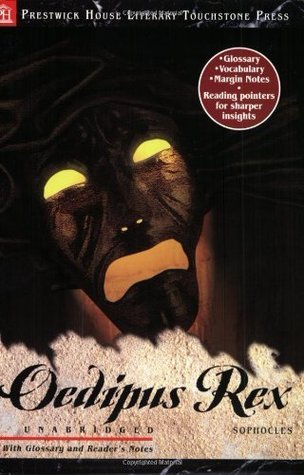
"...what man wins more happiness than just its shape and the ruin when that shape collapses?"Sophocles' Oedipus Rex has never been surpassed for the raw and terrible power with which its hero struggles to answer the eternal question, "Who am I?" The play, a story of a king who acting entirely in ignorance kills his father and marries his mother, unfolds with shattering power; we are helplessly carried along with Oedipus towards the final, horrific truth. To make Oedipus more accessible for the modern reader, our Prestwick House Literary Touchstone Classics includes a glossary of the more difficult words, as well as convenient sidebar notes to enlighten the reader on aspects that may be confusing or overlooked. We hope that the reader may, through this edition, more fully enjoy the beauty of the verse, the wisdom of the insights, and the impact of the drama.

English versions of Sophocles’ three great tragedies based on the myth of Oedipus, translated for a modern audience by two gifted poets.

This volume contains three masterpieces by the Greek playwright Sophocles, widely regarded since antiquity as the greatest of all the tragic poets. The vivid translations, which combine elegance and modernity, are remarkable for their lucidity and accuracy, and are equally suitable for reading for pleasure, study, or theatrical performance. The selection of Antigone, Oedipus the King, and Electra not only offers the reader the most influential and famous of Sophocles' works, it also presents in one volume the two plays dominated by a female heroic figure, and the experience of the two great dynasties featured in Greek tragedy--the houses of Oedipus and Agamemnon.

The latest title to join the acclaimed Greek Tragedy in New Translations series, Sophocles' Oedipus at Colonus tells the story of the last day in the life of Oedipus. It was written at the end of the fifth century BCE in Athens, in the final years of the "Golden Age" of Athenian culture, and in the last year of Sophocles' own life. At the center of the play is the mysterious transformation of Oedipus from an old and blind beggar, totally dependent on his daughters, to the man who rises from his seat and, without help, leads everyone to the place where he is destined to die. In the background of this transformation stands the grove of the Furies, the sacred place of the implacable goddesses who pursue the violators of blood relationships. Although Oedipus, who killed his father and married his mother, is an obvious target of the Furies' vengeance, he enters their grove at the beginning of the play, sure that it is the resting place Apollo has predicted for him. The reversals and paradoxes in the play speak to the struggle that Oedipus' life and the action of the play bring vividly before how do we as humans, subject to constant change, find stable ground on which to stand and define our moral lives? Sophocles offers his play as a witness to the remarkable human capacity to persevere in this struggle.

Locked into a bloody cycle of murder and reprisal, Electra, haunted by her father's assassination, is consumed by grief and a thirst for vengeance. When her brother Orestes at last returns, she urges him to a savage and terrifying conclusion.

"These authoritative translations consign all other complete collections to the wastebasket."Robert Brustein, The New Republic"This is it. No qualifications. Go out and buy it everybody."Kenneth Rexroth, The Nation"The translations deliberately avoid the highly wrought and affectedly poetic; their idiom is contemporary....They have life and speed and suppleness of phrase."Times Education Supplement"These translations belong to our time. A keen poetic sensibility repeatedly quickens them; and without this inner fire the most academically flawless rendering is dead."Warren D. Anderson, American Oxonian"The critical commentaries and the versions themselves...are fresh, unpretentious, above all, functional."Commonweal"Grene is one of the great translators."Conor Cruise O'Brien, London Sunday Times"Richmond Lattimore is that rara avis in our age, the classical scholar who is at the same time an accomplished poet."Dudley Fitts, New York Times Book Review

Written in the fifth century B.C., Sophocles' tragedy concerns the shame and death of Ajax, a Greek who had won fame for his prodigious strength in the Trojan War. A brutal farewell to the valor and values of the heroic world, the play moves through a series of reversals: old allies become enemies, honor becomes disgrace, and divine power becomes temporal authority.

Collects the full texts of Sophocles's seven extant ancient Greek plays, including updated translations of Oedipus the King, Oedipus at Colonus, Antigone, Ajax, Electra, Philoctetes, and The Women of Trachis, accompanied by stage directions, prefaces to each play, and other helpful notes. Original.

Philoctetes is a play written by Sophocles, an ancient Greek playwright, that tells the story of Philoctetes, a Greek warrior who was abandoned on a deserted island for ten years after being bitten by a snake. The play begins when Odysseus and Neoptolemus, two Greek soldiers, are sent to retrieve Philoctetes and his magical bow, which is needed to win the Trojan War. However, Philoctetes is filled with anger and resentment towards the Greeks who abandoned him, and initially refuses to help them. As the play progresses, the characters grapple with issues of loyalty, betrayal, and the morality of using trickery to achieve a desired outcome. Philoctetes is torn between his desire for revenge and his duty to his fellow Greeks, while Odysseus and Neoptolemus struggle with their own consciences as they try to convince Philoctetes to join their cause. The play is known for its exploration of complex moral and ethical issues, as well as its portrayal of the human condition. It is considered one of Sophocles' greatest works, and has been studied and performed for And yet I wonder not; for if aright I judge, from angry heaven the sentence came, And Chrysa was the cruel source of all; Nor doth this sad disease inflict him still Incurable, without assenting gods?This scarce antiquarian book is a facsimile reprint of the old original and may contain some imperfections such as library marks and notations. Because we believe this work is culturally important, we have made it available as part of our commitment for protecting, preserving, and promoting the world's literature in affordable, high quality, modern editions, that are true to their original work.


Mutability; uncertainty; a universe of precipitous these themes are at the heart of Sophocles' tragic vision. But nowhere are they elaborated with more urgency than in Women of Trachis . There are no subtle shifts of Fortune's favors in this tragedy, only stunning and total reversals, a relentless spinning of her fickle wheel. Thesis moves to crushing antithesis with an unparalleled violence at the moment of transformation.Thought to have been written about 440 BC, midway through the poet's career, Women of Trachis has long suffered from neglect by scholars despite its sophistication and raw energy. This translation at last rescues the immense lyrical power and tragic grandeur of the play from obscurity, restoring the music of a poetry originally meant to be sung and danced collectively.
Oedipus Rex is the greatest of the Greek tragedies, a profound meditation on the human condition. The story of the mythological king, who is doomed to kill his father and marry his mother, has resonated in world culture for almost 2,500 years. But Sophocles’ drama as originally performed was much more than a great story—it was a superb poetic script and exciting theatrical experience. The actors spoke in pulsing rhythms with hypnotic forward momentum, making it hard for audiences to look away. Interspersed among the verbal rants and duels were energetic songs performed by the chorus. David Mulroy’s brilliant verse translation of Oedipus Rex recaptures the aesthetic power of Sophocles’ masterpiece while also achieving a highly accurate translation in clear, contemporary English. Speeches are rendered with the same kind of regular iambic rhythm that gave the Sophoclean originals their drive. The choral parts are translated as fluid rhymed songs. Mulroy also supplies an introduction, notes, and appendixes to provide helpful context for general readers and students.


Escritos por um homem que, como poucos, viveu e exprimiu a sua condição de homem, nelas se evidenciam as figuras de Édipo e Antígona que, dos tempos áureos da Grécia, chegam até nós em toda a sua nobreza e dimensão.

All That You've Seen Here Is God: New Versions of Four Greek Tragedies Sophocles' Ajax, Philoctetes, Women of Trachis; Aeschylus' Prometheus Bound
by Sophocles
Rating: 4.3 ⭐
These contemporary translations of four Greek tragedies speak across time and connect readers and audiences with universal themes of war, trauma, suffering, and betrayal. Under the direction of Bryan Doerries, they have been performed for tens of thousands of combat veterans, as well as prison and medical personnel around the world. Striking for their immediacy and emotional impact, Doerries brings to life these ancient plays, like no other translations have before.

Un mito che attraversa più di due millenni e la cui presenza nella storia della civiltà occidentale è pressoché ininterrotta. Antigone ribelle, Antigone dolente, Antigone eroica, Antigone martire... sempre e per sempre Antigone, la donna per la quale, anche a prezzo della morte, il diritto privato è superiore al diritto pubblico. Due capolavori del teatro moderno, opera di Anouilh e Brecht, sfidano l'Antigone di Sofocle e ripropongono assieme alla storia esemplare, una domanda a cui è difficile dare una perchè il mito greco continua a dominare ininterrottamente nell'immaginario occidentale?

"Aiace, probabilmente la più antica delle tragedie di Sofocle, è il dramma di una follia: a Troia, dopo la morte di Achille le armi dell'eroe sono passate ad Odisseo; Aiace, il più forte tra i guerrieri achei e quindi il più degno della simbolica eredità di Achille, impazzisce per il dolore e, dopo una notte di imprese folli e sanguinarie, in un barlume di consapevolezza si suicida. "Elettra" narra la vicenda di una vendetta e di un matricidio: la figlia di Agamennone e Clitennestra, Elettra, sprona il fratello Oreste a vendicare la morte del padre uccidendo i suoi assassini, Clitennestra e il suo amante Egisto.

"All men make mistakes, but a good man yields when he knows his course is wrong, and repairs the evil. The only crime is pride." Sophocles, Antigone

Nacido en Colono poco antes de las Guerras Médicas, Sófocles (h. 495-h. 406 a.C.) vivió la época del apogeo y el esplendor de la democracia ateniense, así como el ambiente intelectual de la sofística. Más joven que Esquilo y mayor que Eurípides, su obra representa el equilibrio y la perfección del género trágico. Sus tragedias exploran la suerte del hombre en relación con el orden universal y propugnan un nuevo tipo de héroe, alejado por igual del héroe aristocrático y del ideal sofístico que hacía al hombre centro del mundo. Este volumen reúne cuatro de sus obras más importantes, como son "Áyax", "Las traquinias", "Antígona" y "Edipo rey". Traducción y prólogo de José María Lucas de Dios
Sophocles (497/6-406 BCE), with Aeschylus and Euripides, was one of the three great tragic poets of Athens, and is considered one of the world's greatest poets. The subjects of his plays were drawn from mythology and legend. Each play contains at least one heroic figure, a character whose strength, courage, or intelligence exceeds the human norm—but who also has more than ordinary pride and self-assurance. These qualities combine to lead to a tragic end. Hugh Lloyd-Jones gives us, in two volumes, a new translation of the seven surviving plays. Volume I contains Oedipus Tyrannus (which tells the famous Oedipus story), Ajax (a heroic tragedy of wounded self-esteem), and Electra (the story of siblings who seek revenge on their mother and her lover for killing their father).

Sophocles with Aeschylus and Euripides, was one of the three great tragic poets of Athens, and is considered one of the world's greatest poets. The subjects of his plays were drawn from mythology and legend. Each play contains at least one heroic figure, a character whose strength, courage, or intelligence exceeds the human norm - but who also has more than ordinary pride and self-assurance. These qualities combine to lead to a tragic end.Loeb Classical Library, #21. Volume 2 of 3 of the Loeb Classical Library Sophocles.Volume II contains Oedipus at Colonus (the climax of the fallen hero’s life), Antigone (a conflict between public authority and an individual woman’s conscience), The Women of Trachis (a fatal attempt by Heracles’s wife to regain her husband’s love), and Philoctetes (Odysseus’s intrigue to bring an unwilling hero to the Trojan War).

Réunit des extr. de "OEdipe à Colone", "Antigone" et "Électre" de Sophocle, de "Les Sept contre Thèbes" et "Les Choéphores" d'Eschyle, et de "Les Phéniciennes", "Électre" et "Oreste" d'Euripide.

Brand NEW. We ship worldwide


في هذا الكتاب تم اختيار مجموعة من المسرحيات التمثيلية اليونانية للأديب سوفوكليس، وهي جاءت على النحو التالي: الكترا، إياس، انتيجونا، أويدبيوس ملكاً، أو يديبوس في كولونا، فيلو كتيتيس.

Oedipus the King and Other Tragedies: Oedipus the King, Aias, Philoctetes, Oedipus at Colonus
by Sophocles
Rating: 4.2 ⭐
Oedipus the King * Aias * Philoctetes * Oedipus at ColonusSophocles stands as one of the greatest dramatists of all time, and one of the most influential on artists and thinkers over the centuries. In these four tragedies he portrays the extremes of human suffering and emotion, turning the heroic myths into supreme works of poetry and dramatic action. Oedipus the King follows Oedipus, the 'man of sorrow', who has unwittingly chosen to enact his prophesied course by murdering his father and marrying his mother. In Aias , the great warrior confronts the harrowing humiliation inflicted upon him, while Philoctetes sees a once-noble hero nursing his resentment after ten years of marooned isolation. In Oedipus at Colonus the blind Oedipus, who has wandered far and wide as a beggar, finally meets his mysterious death.These original and distinctive verse translations convey the vitality of Sophocles' poetry and the vigour of the plays in performance. Each play is accompanied by an introduction and substantial notes on topographical and mythical references and interpretation.ABOUT THE For over 100 years Oxford World's Classics has made available the widest range of literature from around the globe. Each affordable volume reflects Oxford's commitment to scholarship, providing the most accurate text plus a wealth of other valuable features, including expert introductions by leading authorities, helpful notes to clarify the text, up-to-date bibliographies for further study, and much more.

Considerada por Aristóteles como la más perfecta de las tragedias griegas en muchos aspectos, Edipo Rey de Sófocles (c. 496-406 a.C. ) es un drama de revelación que propone la búsqueda de lo que se esconde tras las apariencias, la indagación en la esencia de lo que uno es.La peste y una larga epidemia asolan Tebas. Tras la consulta al oráculo de Delfos, Edipo entenderá que el remedio a ese mal exige vengar la muerte del anterior monarca, Layo.Con un manejo magistral de la ironía trágica, el gran dramaturgo griego nos ofrece el paulatino desvelamiento de los detalles del ascenso del protagonista al trono, así como el descubrimiento final de su condición de parricida y esposo de la viuda de su padre, su propia madre.