Loading themes...
Explore the best books about American Revolution theme.

An epic narrative documents the fight to create the United States of America, beginning with the deterioration in relations between England and her colonists and chronicling the events of the American Revolution until the last British flag was lowered during the siege of Yorktown. Reprint.
After more than two decades, this dramatic and concise single-volume distillation of James Thomas Flexner's definitive four-volume biography "George Washington," which received a Pulitzer Prize citation and a National Book Award for the fourth volume, has itself become an American classic. Now in a new trade paperback edition, this masterful work explores the Father of Our Country - sometimes an unpopular hero, a man of great contradictions, but always a towering historical figure, who remains, as Flexner writes in these pages, "a fallible human being made of flesh and blood and spirit - not a statue of marble and wood... a great and good man." The author unflinchingly paints a portrait of Washington: slave owner, brave leader, man of passion, reluctant politician, and fierce general. His complex character and career are neither glorified nor vilified here; rather, Flexner sets up a brilliant counterpoint between Washington's public and private lives and gives us a challenging look at the man who has become as much a national symbol as the American flag.

With meticulous research and page-turning suspense, Patriots brings to life the American Revolution—the battles, the treacheries, and the dynamic personalities of the men who forged our freedom.George Washington, John Adams, Samuel Adams, Ben Franklin, Thomas Jefferson, Patrick Henry—these heroes were men of intellect, passion, and ambition. From the secret meetings of the Sons of Liberty to the final victory at Yorktown and the new Congress, Patriots vividly re-creates one of history's great eras.

From one of the great political journalists of our time comes a boldly argued reinterpretation of the central event in our collective past--a book that portrays the American Revolution not as a clash of ideologies but as a Machiavellian struggle for power.

In 1787, the American union was in disarray. The incompatible demands of the separate states threatened its existence; some states were even in danger of turning into the kind of tyranny they had so recently deposed. A truly national government was needed, one that could raise money, regulate commerce, and defend the states against foreign threats–without becoming as overbearing as England. So thirty-six-year-old James Madison believed. That summer, the Virginian was instrumental in organizing the Constitutional Convention, in which one of the world’s greatest documents would be debated, created, and signed. Inspired by a sense of history in the making, he kept the most extensive notes of any attendee.Now two esteemed scholars have made these minutes accessible to everyone. Presented with modern punctuation and spelling, judicious cuts, and helpful notes–plus fascinating background information on every delegate and an overview of the tumultuous times–here is the great drama of how the Constitution came to be, from the opening statements to the final votes. This Modern Library Paperback Classic also includes an Introduction and appendices from the authors.

It sounds like a fairy tale. He is a boy dressed in silks and white wigs and given the finest of classical educations. Raised by a group of rational philosophers known only by numbers, the boy and his mother -- a princess in exile from a faraway land -- are the only persons in their household assigned names. As the boy's regal mother, Cassiopeia, entertains the house scholars with her beauty and wit, young Octavian begins to question the purpose behind his guardians' fanatical studies. Only after he dares to open a forbidden door does he learn the hideous nature of their experiments -- and his own chilling role in them. Set against the disquiet of Revolutionary Boston, M. T. Anderson's extraordinary novel takes place at a time when American Patriots rioted and battled to win liberty while African slaves were entreated to risk their lives for a freedom they would never claim. The first of two parts, this deeply provocative novel reimagines the past as an eerie place that has startling resonance for readers today.

The enthralling, often surprising story of John Adams, one of the most important and fascinating Americans who ever lived.In this powerful, epic biography, David McCullough unfolds the adventurous life-journey of John Adams, the brilliant, fiercely independent, often irascible, always honest Yankee patriot -- "the colossus of independence," as Thomas Jefferson called him -- who spared nothing in his zeal for the American Revolution; who rose to become the second President of the United States and saved the country from blundering into an unnecessary war; who was learned beyond all but a few and regarded by some as "out of his senses"; and whose marriage to the wise and valiant Abigail Adams is one of the moving love stories in American history. Like his masterly, Pulitzer Prize-winning biography Truman, David McCullough's John Adams has the sweep and vitality of a great novel. It is both a riveting portrait of an abundantly human man and a vivid evocation of his time, much of it drawn from an outstanding collection of Adams family letters and diaries. In particular, the more than one thousand surviving letters between John and Abigail Adams, nearly half of which have never been published, provide extraordinary access to their private lives and make it possible to know John Adams as no other major American of his founding era. As he has with stunning effect in his previous books, McCullough tells the story from within -- from the point of view of the amazing eighteenth century and of those who, caught up in events, had no sure way of knowing how things would turn out. George Washington, Benjamin Franklin, John Jay, the British spy Edward Bancroft, Madame Lafayette and Jefferson's Paris "interest" Maria Cosway, Alexander Hamilton, James Madison, the scandalmonger James Callender, Sally Hemings, John Marshall, Talleyrand, and Aaron Burr all figure in this panoramic chronicle, as does, importantly, John Quincy Adams, the adored son whom Adams would live to see become President. Crucial to the story, as it was to history, is the relationship between Adams and Jefferson, born opposites -- one a Massachusetts farmer's son, the other a Virginia aristocrat and slaveholder, one short and stout, the other tall and spare. Adams embraced conflict; Jefferson avoided it. Adams had great humor; Jefferson, very little. But they were alike in their devotion to their country. At first they were ardent co-revolutionaries, then fellow diplomats and close friends. With the advent of the two political parties, they became archrivals, even enemies, in the intense struggle for the presidency in 1800, perhaps the most vicious election in history. Then, amazingly, they became friends again, and ultimately, incredibly, they died on the same day -- their day of days -- July 4, in the year 1826. Much about John Adams's life will come as a surprise to many readers. His courageous voyage on the frigate Boston in the winter of 1778 and his later trek over the Pyrenees are exploits that few would have dared and that few readers will ever forget. It is a life encompassing a huge arc -- Adams lived longer than any president. The story ranges from the Boston Massacre to Philadelphia in 1776 to the Versailles of Louis XVI, from Spain to Amsterdam, from the Court of St. James's, where Adams was the first American to stand before King George III as a representative of the new nation, to the raw, half-finished Capital by the Potomac, where Adams was the first President to occupy the White House. This is history on a grand scale -- a book about politics and war and social issues, but also about human nature, love, religious faith, virtue, ambition, friendship and betrayal, and the far-reaching consequences of noble ideas. Above all, John Adams is an enthralling, often surprising story of one of the most important and fascinating Americans who ever lived.

In this unique biography of Thomas Jefferson, leading journalist and social critic Christopher Hitchens offers a startlingly new and provocative interpretation of our Founding Father. Situating Jefferson within the context of America's evolution and tracing his legacy over the past two hundred years, Hitchens brings the character of Jefferson to life as a man of his time and also as a symbolic figure beyond it.Conflicted by power, Jefferson wrote the Declaration of Independence and acted as Minister to France yet yearned for a quieter career in the Virginia legislature. Predicting that slavery would shape the future of America's development, this professed proponent of emancipation elided the issue in the Declaration and continued to own human property. An eloquent writer, he was an awkward public speaker; a reluctant candidate, he left an indelible presidential legacy.Jefferson's statesmanship enabled him to negotiate the Louisiana Purchase with France, doubling the size of the nation, and he authorized the Lewis and Clark expedition, opening up the American frontier for exploration and settlement. Hitchens also analyzes Jefferson's handling of the Barbary War, a lesser-known chapter of his political career, when his attempt to end the kidnapping and bribery of Americans by the Barbary states, and the subsequent war with Tripoli, led to the building of the U.S. navy and the fortification of America's reputation regarding national defense.In the background of this sophisticated analysis is a large historical drama: the fledgling nation's struggle for independence, formed in the crucible of the eighteenth-century Enlightenment, and, in its shadow, the deformation of that struggle in the excesses of the French Revolution. This artful portrait of a formative figure and a turbulent era poses a challenge to anyone interested in American history -- or in the ambiguities of human nature.

An alternate cover edition can be found here.Pulitzer Prize-winning author Ron Chernow presents a landmark biography of Alexander Hamilton, the Founding Father who galvanized, inspired, scandalized, and shaped the newborn nation.In the first full-length biography of Alexander Hamilton in decades, Ron Chernow tells the riveting story of a man who overcame all odds to shape, inspire, and scandalize the newborn America. According to historian Joseph Ellis, Alexander Hamilton is “a robust full-length portrait, in my view the best ever written, of the most brilliant, charismatic and dangerous founder of them all.”Few figures in American history have been more hotly debated or more grossly misunderstood than Alexander Hamilton. Chernow’s biography gives Hamilton his due and sets the record straight, deftly illustrating that the political and economic greatness of today’s America is the result of Hamilton’s countless sacrifices to champion ideas that were often wildly disputed during his time. “To repudiate his legacy,” Chernow writes, “is, in many ways, to repudiate the modern world.” Chernow here recounts Hamilton’s turbulent life: an illegitimate, largely self-taught orphan from the Caribbean, he came out of nowhere to take America by storm, rising to become George Washington’s aide-de-camp in the Continental Army, coauthoring The Federalist Papers, founding the Bank of New York, leading the Federalist Party, and becoming the first Treasury Secretary of the United States.Historians have long told the story of America’s birth as the triumph of Jefferson’s democratic ideals over the aristocratic intentions of Hamilton. Chernow presents an entirely different man, whose legendary ambitions were motivated not merely by self-interest but by passionate patriotism and a stubborn will to build the foundations of American prosperity and power. His is a Hamilton far more human than we’ve encountered before—from his shame about his birth to his fiery aspirations, from his intimate relationships with childhood friends to his titanic feuds with Jefferson, Madison, Adams, Monroe, and Burr, and from his highly public affair with Maria Reynolds to his loving marriage to his loyal wife Eliza. And never before has there been a more vivid account of Hamilton’s famous and mysterious death in a duel with Aaron Burr in July of 1804.Chernow’s biography is not just a portrait of Hamilton, but the story of America’s birth seen through its most central figure. At a critical time to look back to our roots, Alexander Hamilton will remind readers of the purpose of our institutions and our heritage as Americans.

In retrospect, it seems as if the American Revolution was inevitable. But was it? In Founding Brothers, Joseph J. Ellis reveals that many of those truths we hold to be self-evident were actually fiercely contested in the early days of the republic. Ellis focuses on six crucial moments in the life of the new nation, including a secret dinner at which the seat of the nation's capital was determined--in exchange for support of Hamilton's financial plan; Washington's precedent-setting Farewell Address; and the Hamilton and Burr duel. Most interesting, perhaps, is the debate (still dividing scholars today) over the meaning of the Revolution. In a fascinating chapter on the renewed friendship between John Adams and Thomas Jefferson at the end of their lives, Ellis points out the fundamental differences between the Republicans, who saw the Revolution as a liberating act and hold the Declaration of Independence most sacred, and the Federalists, who saw the revolution as a step in the building of American nationhood and hold the Constitution most dear. Throughout the text, Ellis explains the personal, face-to-face nature of early American politics--and notes that the members of the revolutionary generation were conscious of the fact that they were establishing precedents on which future generations would rely. In Founding Brothers, Ellis (whose American Sphinx won the National Book Award for nonfiction in 1997) has written an elegant and engaging narrative, sure to become a classic. Highly recommended. --Sunny Delaney

“A riveting, massively documented epic [that] overturns textbook clichés…. This impassioned study throws valuable light on our history.” ― Publishers Weekly Empire of Fortune focuses on the so-called “French and Indian War”―the bitter last-ditch struggle between the British and the French empires in the New World. Challenging traditional historians, Francis Jennings reveals in absorbing detail the political and military realities behind the myths.

Among the most influential authors and reformers of his age, Thomas Paine (1737–1809) was born in England but went on to play an important role in both the American and French Revolutions. In 1774, he emigrated to America where, for a time, he helped to edit the Pennsylvania Magazine. On January 10, 1776, he published his pamphlet Common Sense, a persuasive argument for the colonies' political and economic separation from Britain.Common Sense cites the evils of monarchy, accuses the British government of inflicting economic and social injustices upon the colonies, and points to the absurdity of an island attempting to rule a continent. Credited by George Washington as having changed the minds of many of his countrymen, the document sold over 500,000 copies within a few months.Today, Common Sense remains a landmark document in the struggle for freedom, distinguished not only by Paine's ideas but also by its clear and passionate presentation. Designed to ignite public opinion against autocratic rule, the pamphlet offered a careful balance between imagination and judgment, and appropriate language and expression to fit the subject. It immediately found a receptive audience, heartened Washington's despondent army, and foreshadowed much of the phrasing and substance of the Declaration of Independence.

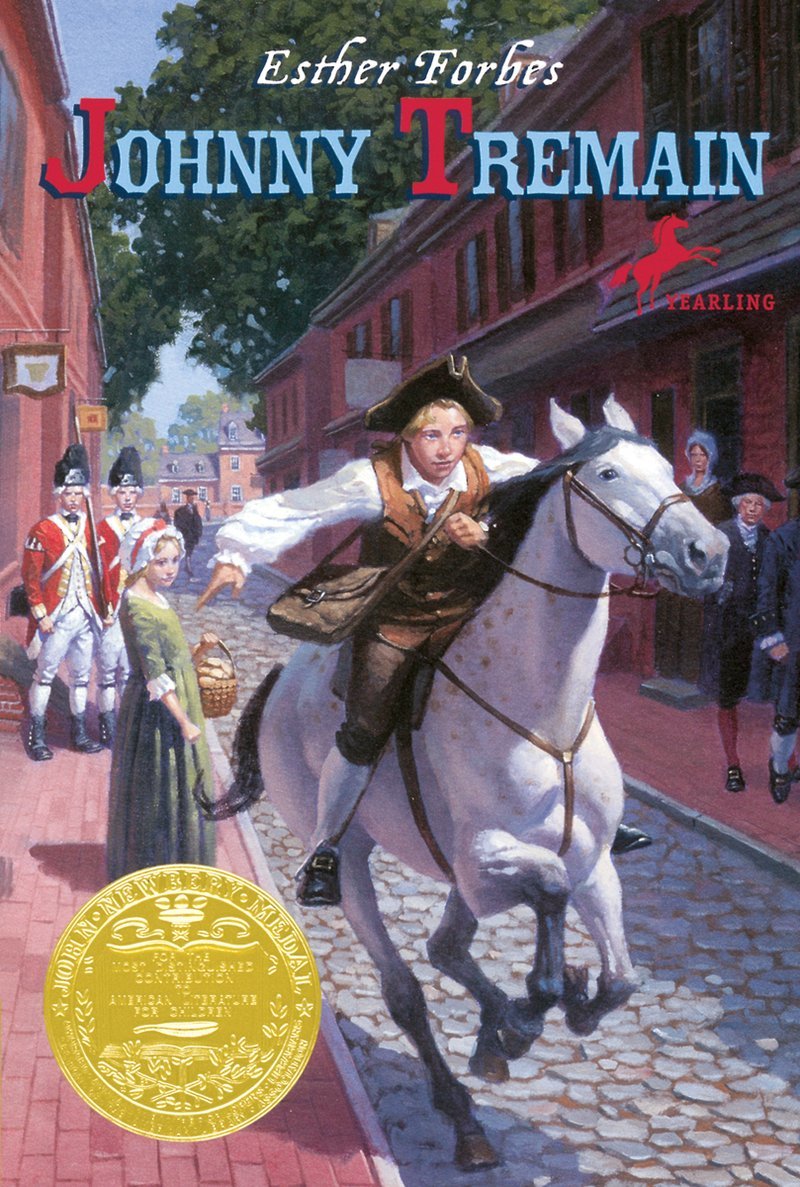
Johnny Tremain, a young apprentice silversmith, is caught up in the danger and excitement of 1775 Boston, just before the Revolutionary War. But even more gripping than living through the drama of Revolutionary Boston is the important discovery Johnny makes in his own life.

In 1776, an elite group of soldiers were handpicked to serve as George Washington’s bodyguards. Washington trusted them; relied on them. But unbeknownst to Washington, some of them were part of a treasonous plan. In the months leading up to the Revolutionary War, these traitorous soldiers, along with the Governor of New York William Tryon and Mayor David Mathews, launched a deadly plot against the most important member of the military: George Washington himself.This is the story of the secret plot and how it was revealed. It is a story of leaders, liars, counterfeiters, and jailhouse confessors. It also shows just how hard the battle was for George Washington—and how close America was to losing the Revolutionary War.Taking place during the most critical period of our nation’s birth, The First Conspiracy tells a remarkable and previously untold piece of American history that not only reveals George Washington’s character, but also illuminates the origins of America’s counterintelligence movement that led to the modern day CIA.

In the initial volume of the Revolution Trilogy Rick Atkinson recounts the first twenty-one months of America’s violent war for independence. From the battles at Lexington and Concord in spring 1775 to those at Trenton and Princeton in winter 1777, American militiamen and then the ragged Continental Army take on the world’s most formidable fighting force. It is a saga alive with astonishing characters: Henry Knox, the former bookseller with an uncanny understanding of artillery; Nathanael Greene, the bumpkin who becomes a brilliant battle captain; Benjamin Franklin, who proves to be the wiliest of diplomats; George Washington, the commander in chief who learns the difficult art of leadership when the war seems all but lost. The story is also told from the British perspective, making the mortal conflict between the redcoats and the rebels all the more compelling.

The last king of America, George III, has been ridiculed as a complete disaster who frittered away the colonies and went mad in his old age. The truth is much more nuanced and fascinating--and will completely change the way readers and historians view his reign and legacy.Most Americans dismiss George III as a buffoon--a heartless and terrible monarch with few, if any, redeeming qualities. The best-known modern interpretation of him is Jonathan Groff's preening, spitting, and pompous take in Hamilton, Lin-Manuel Miranda's Broadway masterpiece. But this deeply unflattering characterization is rooted in the prejudiced and brilliantly persuasive opinions of eighteenth-century revolutionaries like Thomas Paine and Thomas Jefferson, who needed to make the king appear evil in order to achieve their own political aims. After combing through hundreds of thousands of pages of never-before-published correspondence, award-winning historian Andrew Roberts has uncovered the truth: George III was in fact a wise, humane, and even enlightened monarch who was beset by talented enemies, debilitating mental illness, incompetent ministers, and disastrous luck.In The Last King of America, Roberts paints a deft and nuanced portrait of the much-maligned monarch and outlines his accomplishments, which have been almost universally forgotten. Two hundred and forty-five years after the end of George III's American rule, it is time for Americans to look back on their last king with greater understanding: to see him as he was and to come to terms with the last time they were ruled by a monarch.