
Theodore Draper
Theodore H. "Ted" Draper was an American historian and political writer. Draper is best known for the 14 books he completed during his life, including work regarded as seminal on the formative period of the American Communist Party, the Cuban Revolution, and the Iran-Contra Affair. Draper was a fellow of the American Academy of Arts and Sciences and the 1990 recipient of the Herbert Feis Award for Nonacademically Affiliated Historians from the American Historical Association.
30 Books Written

From one of the great political journalists of our time comes a boldly argued reinterpretation of the central event in our collective past--a book that portrays the American Revolution not as a clash of ideologies but as a Machiavellian struggle for power.

The 84th Infantry Division In The Battle Of Germany: November 1944-May 1945
by Theodore Draper
Rating: 4.3 ⭐
In early November 1944, five months after D-Day, the “Railsplitter” division landed on Omaha beach. Through the course of the next six months it would see some of the most ferocious fighting of the entire war. As soon as they landed they drove quickly into the Netherlands to prepare for an offensive into Nazi Germany. Their movements were dramatically altered as the German forces attempted to launch a momentous counter-offensive against the allies. The 84th division was sent to Belgium to plug a gap in the Allied line and fought back against the last ditch effort of Nazi forces. Draper takes the reader through every engagement that the division took part in from the first shots fired in anger through to crossing the Rhine into Germany and finally taking Hannover and making contact with Soviet forces in May 1945. Lt. Theodore Draper’s book is a unique account of the allied invasion of Germany. Rather relying on secondhand stories of the division’s actions months after the events had occurred, Draper was encouraged to go direct to the source, to the men themselves, from the commanding general to any private, for the most complete, firsthand information on every action. This book is largely based on hundreds of pages of such interviews, most of them within 48 hours of the unit’s relief and many of them while the unit was still fighting. “Though ostensibly a divisional history, Draper’s well-informed and interesting account is useful for an understanding of the war on the western front in general.” Robert Gale Woolbert, Foreign Affairs “This is the whole operation of the battle of Germany on the broad and individual level, the Siegfried Line, the fight to the Rhine, the Ardennes, the mad race to the Elbo, with credit attributed to men, companies, battalions where it is due.” Kirkus Reviews Theodore Draper was an American historian and political writer. He wrote many notable books during his career on a variety of subjects. During the Second World War he was inducted into the U. S. Army and worked in the historical section of the 84th Infantry Division. His book The 84th Infantry Division In The Battle Of Germany : November 1944-May 1945 was first published in 1946 and he passed away in 2006.

Details the origins of the Iran-Contra scandal, the roles of Reagan, Bush, CIA Director Casey, and others, and argues that President Reagan clearly set the policy then feigned ignorance to escape blame

In this definitive history of the evolution of the Com- munist Party in America--from its early background through its founding in 1919 to its emergence as a legal entity in the 1920s--Theodore Draper traces the native and foreign strains that comprised the party. He emphasizes its shifting policies and secrets as well as its open activities. He makes clear how the party in its infancy "was transformed from a new expression of American radicalism to the American appendage of a Russian revolutionary power," a fact that Draper develops in his succeeding volume, American Communism and Soviet Russia. In his special, prescient way, Theodore Draper himself had the final words on American "It is like a museum of radical politics. In its various stages, it has virtually been all things to all men... There are many ways of trying to understand such a movement, but the first task is historical. In some respects, there is no other way to understand it, or at least to avoid seriously misunderstanding it. Every other approach tends to be static, one-sided or unbalanced." Draper correctly notes that the formative period of the American Communist movement has remained a largely untold and even unknown story. In part, the reasons for this are that the Communist movement, although a child of the West, grew to power in the Soviet East. But Draper rescues this chapter with deep appreciation for the fact that communism was not something that happened just in Russia, but also in the United States. This is a must read for scholars and laypersons alike. This volume is conceived as an independent and self-contained study of the American Communist movement. Draper correctly notes that the formative period is largely untold and even unknown. In part, the reasons for this are that the Communist movement, although a child of the West, grew to power in the Soviet East. Draper appreciates the fact that communism was not something that happened only in Russia, but also took place in the United States. That experience is the focus of this volume.

American Communism and Soviet Russia: With a new introduction by the author
by Theodore Draper
Rating: 4.1 ⭐
This companion volume to The Roots of American Communism brings to completion what the author describes as the essence of the relationship of American Communism to Soviet Russia in the first decade after the Bolsheviks seized power. The outpouring of new archive materials makes it plain that Draper's premise is direct and to the point: The communist movement "was transformed from a new expression of American radicalism to the American appendage of a Russian revolutionary power." Each generation must find this out for itself, and no better guide exists than the work of master historian Theodore Draper. American Communism and Soviet Russia is acknowledged to be the classic, authoritative history of the critical formative period of the American Communist Party. Based on confidential minutes of the top party committees, interviews with party leaders, and public records, this book carefully documents the influence of the Soviet Union on the fundamental nature of American Communism. Draper's reflections on that period in this edition are a fitting capstone to this pioneering effort.

El nacionalismo negro en Estados Unidos no es un fenómeno nuevo; y el estudio de sus antecedentes, que se remontan hasta hace casi dos siglos, ofrece un interés no sólo erudito, ya que ayuda a comprender más profundamente las características de sus plantaciones contemporáneas.
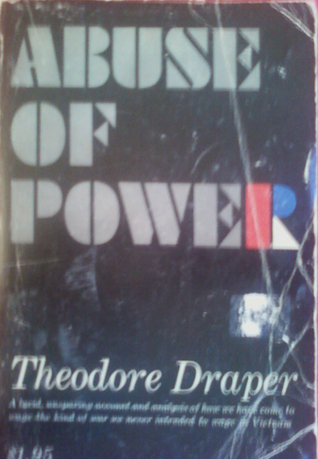
"Mr. Draper believes that recent years have seen the suppression of political by military instrumentalities in the conduct of American foreign policy. After an opening chapter which briefly traces this process in two smaller instances - Cuba and the Dominican Republic - he devotes the rest of this book to a painstaking inquiry which seeks to dissolve the confusion that still envelops the story of our presence in Vietnam."


Theodore Draper was and eminent and gifted thinker. In this book from the 1970's and 80's he deals with the subjects of nuclear policy, the Western Alliance, Vietnam, Israel and the Arabs, and Communism.

Theodore Draper is one of America's most trenchant and informed critics. A Present of Things Past gathers together ten of his most recent and most powerful selected essays, in which Draper, with his customary acuity and wit, tackles a host of issues that define America's political culture. A Present of Things Past is concerned with a reexamination of the Second World War in both its military and its political aspects; the trajectory of American conservatism as it manifested itself during the Reagan years; the rise of Gorbachev and the history of "reform" in the Soviet Union; the revisionist debate over the origins and history of American communism; and the persistent mystery of a man named Max Eitingon, who was, depending on one's reading of the sources, either an important figure in the history of psychoanalysis or an agent of the Soviet secret police, or both. In "American Hubris," Draper illuminates the assumptions that have guided American foreign policy in the postwar period, and concludes that our costly misadventures--in Korea, Vietnam, Lebanon, and elsewhere--cannot be considered a string of aberrations. They were, he argues, a consequence of the Truman Doctrine. In "Reagan's Junta," Draper "This is supposed to have been the era of the imperial presidency. It has turned out to be the era of presidencies that have tried to make themselves imperial-and failed." Throughout these compelling essays, Draper demonstrates the uses and abuses to which history has been put by ideologues of both the left and the right. He finds unacceptable, for example, the practice of many journalists of fictionalizing their sources. The New York Times has called Draper "one of the clearer-eyed observers of the issues that torment us." A Present of Things Past enhances that reputation.

Israel and World: 2
by Theodore Draper
Israel And World Roots Of The Third Arab-israeli War

84th Infantry Division in the Battle of the Ardennes: December 1944 - January 1945
by Theodore Draper
This work has been selected by scholars as being culturally important, and is part of the knowledge base of civilization as we know it. This work was reproduced from the original artifact, and remains as true to the original work as possible. Therefore, you will see the original copyright references, library stamps (as most of these works have been housed in our most important libraries around the world), and other notations in the work. This work is in the public domain in the United States of America, and possibly other nations. Within the United States, you may freely copy and distribute this work, as no entity (individual or corporate) has a copyright on the body of the work.As a reproduction of a historical artifact, this work may contain missing or blurred pages, poor pictures, errant marks, etc. Scholars believe, and we concur, that this work is important enough to be preserved, reproduced, and made generally available to the public. We appreciate your support of the preservation process, and thank you for being an important part of keeping this knowledge alive and relevant.


Second printing of this edition, 1968. "The authoritative inside history of the American Communist party in the years when all its patterns were being set by Moscow" (cover blurb).

Merriam Press World War 2 History Series. The 84th Infantry Division was one of the units that helped reduce the “Bulge” in January 1945 and this is the story of their participation. Foreword; Historical Notes; At All Cost; May 1940-December 1944; From Germany to the Ardennes; The Wide, Open Spaces; How to Look for Trouble; The Battle of Verdenne; Post-mortem I; The Battle of the Bulge; The Big Picture; The First Day; Hole in the Crust; Life in the Ardennes; The Turning Point; The Capture of La Roche; From Les Tailles to Dinez; One for the Books; End of the Bulge; Beho to Gouvy to Ourthe; The Last Mile; Post-mortem II. 8 photos.
The Six weeks' War May 10 - June 25, 1940
by Theodore Draper

La Revuelta de 1965: Un Estudio de Caso de Politíca Estadounidense en la República Dominicana
by Theodore Draper

El nacionalismo negro en Estados Unidos
by Theodore Draper
Madrid. 18 cm. 213 p. Encuadernación en tapa blanda de editorial ilustrada. Colección 'El Libro de Bolsillo. Secció Humanidades', numero coleccion(v. 357). Traductor, Manuel de la Escalera. Nacionalismo negro. Estados Unidos. Escalera, Manuel de la. 1895-1994 .. Este libro es de segunda mano y tiene o puede tener marcas y señales de su anterior propietario.

El redescubirmiento del nacionalismo negro
by Theodore Draper

Additional Contributor Is Robert E. McHaffie.

The 84th Infantry Division in the Battle of Germany
by Theodore Draper
Book by Theodore Draper

American Business and Public Policy: The politics of foreign trade
by Theodore Draper
American Business and Public Policy is a study of the politics of foreign trade. It challenges fifty years of writ-ing on pressure politics. It includes nine hundred interviews with heads of corporations, including 166 of the 200 largest corporations; another 500 interviews with congressmen, lob-byists, journalists, and opinion leaders; and eight community studies making this book the most intensive survey in print of the politics of business. It is a realistic behavioral examination of a major type of economic decision.The authors introduce their study with a history of the tariff as a political issue in American politics and a history of American tariff legislation in the years from Europe's trade recovery under the Marshall Plan to the challenge of the Common Market. They examine in succession the changing attitudes of the general public and the political actions of the business community, the lobbies, and Congress.American Business and Public Policy is a contribution to social theory in several of its branches. It is a contribution to understanding the business community, to the social psychol-ogy of communication and attitude change, to the study of political behavior in foreign policy.American Business and Public Policy is at once a study of a classic issue in American politics the tariff; decision-making, particularly the relation of economic to social-psycho-logical theories of behavior; business communication what businessmen read about world affairs, what effect foreign travel has on them, where they turn for political advice, and how they seek political help; pressure politics, lobbying, and the Congressional process.

The Roots of American Communism
by Theodore Draper
In this definitive history of the evolution of the Com- munist Party in America--from its early background through its founding in 1919 to its emergence as a legal entity in the 1920s--Theodore Draper traces the native and foreign strains that comprised the party. He emphasizes its shifting policies and secrets as well as its open activities. He makes clear how the party in its infancy "was transformed from a new expression of American radicalism to the American appendage of a Russian revolutionary power," a fact that Draper develops in his succeeding volume, American Communism and Soviet Russia.In his special, prescient way, Theodore Draper himself had the final words on American Communism: "It is like a museum of radical politics. In its various stages, it has virtually been all things to all men... There are many ways of trying to understand such a movement, but the first task is historical. In some respects, there is no other way to understand it, or at least to avoid seriously misunderstanding it. Every other approach tends to be static, one-sided or unbalanced."Draper correctly notes that the formative period of the American Communist movement has remained a largely untold and even unknown story. In part, the reasons for this are that the Communist movement, although a child of the West, grew to power in the Soviet East. But Draper rescues this chapter with deep appreciation for the fact that communism was not something that happened just in Russia, but also in the United States. This is a must read for scholars and laypersons alike.This volume is conceived as an independent and self-contained study of the American Communist movement. Draper correctly notes that the formative period is largely untold and even unknown. In part, the reasons for this are that the Communist movement, although a child of the West, grew to power in the Soviet East. Draper appreciates the fact that communism was not something that happened only in Russia, but also took place in the United States. That experience is the focus of this volume.

American Business and Public Policy: The Politics of Foreign Trade
by Theodore Draper
American Business and Public Policy is a study of the politics of foreign trade. It challenges fifty years of writ-ing on pressure politics. It includes nine hundred interviews with heads of corporations, including 166 of the 200 largest corporations; another 500 interviews with congressmen, lob-byists, journalists, and opinion leaders; and eight community studies making this book the most intensive survey in print of the politics of business. It is a realistic behavioral examination of a major type of economic decision.The authors introduce their study with a history of the tariff as a political issue in American politics and a history of American tariff legislation in the years from Europe's trade recovery under the Marshall Plan to the challenge of the Common Market. They examine in succession the changing attitudes of the general public and the political actions of the business community, the lobbies, and Congress.American Business and Public Policy is a contribution to social theory in several of its branches. It is a contribution to understanding the business community, to the social psychol-ogy of communication and attitude change, to the study of political behavior in foreign policy.American Business and Public Policy is at once a study of a classic issue in American politics�the tariff; decision-making, particularly the relation of economic to social-psycho-logical theories of behavior; business communication�what businessmen read about world affairs, what effect foreign travel has on them, where they turn for political advice, and how they seek political help; pressure politics, lobbying, and the Congressional process.

The Satirist (Classics in Communication and Mass Culture
by Theodore Draper
Satire takes as its subject the absurdity of human beings, their societies, and the institutions they create. For centuries, satirists themselves, scholars, critics, and psychologists have speculated about the satirist's reasons for writing, temperament, and place in society. The conclusions they have reached are sometimes contradictory, sometimes complementary, sometimes outlandish. In this volume, Leonard Feinberg brings together the major theories about the satirist, to provide in one book a summary of the problems that specialists have examined intensively in numerous books and articles. In part 1, Feinberg examines the major theories about the motivation of the satirist, and then proposes that "adjustment" comes most closely to answering this question. In his view, the satirist resolves his ambivalent relation to society through a playfully critical distortion of the familiar. The personality of the satirist, the apparently paradoxical elements of his nature, the problem of why so many great humorists are sad men, and the contributions of psychoanalysts are explored in part 2, where Feinberg contends that the satirist is not as abnormal as he has sometimes been made to seem, and that if he is a neurotic he shares traits of emotional or social alienation with many others. Part 3 explores the beliefs of satirists and their relation to the environment within which they function, particularly in the contexts of politics, religion, and philosophy. Feinberg stresses the ubiquity of the satirist and suggests that there are a great many people with satiric temperaments who fail to attain literary expression. Ranging with astonishing breadth, both historical and geographical, The Satirist serves as both an introduction to the subject and an essential volume for scholars. Brian A. Connery's introduction provides an overview of Feinberg's career and situates the volume in the intellectual currents in which it was written.