
Christopher Hitchens
Christopher Hitchens was a British-American author, journalist, and literary critic known for his sharp wit, polemical writing, and outspoken views on religion, politics, and culture. He was a prolific essayist and columnist, contributing to publications such as The Atlantic, Vanity Fair, Slate, and The Nation. A staunch critic of totalitarianism and organized religion, Hitchens became one of the most prominent public intellectuals of his time. His book God Is Not Great: How Religion Poisons Everything (2007) became a bestseller and solidified his place as a leading figure in the New Atheism movement. He was equally fearless in political criticism, taking on figures across the ideological spectrum, from Henry Kissinger (The Trial of Henry Kissinger, 2001) to Bill and Hillary Clinton (No One Left to Lie To, 1999). Originally a socialist and supporter of left-wing causes, Hitchens later distanced himself from the left, particularly after the September 11 attacks, when he became a vocal advocate for the U.S. invasion of Iraq. His ideological shift, combined with his formidable debating skills, made him a controversial yet highly respected figure. Hitchens was also known for his literary criticism, writing extensively on figures such as George Orwell, Thomas Jefferson, and Karl Marx. His memoir, Hitch-22 (2010), reflected on his personal and intellectual journey. In 2010, he was diagnosed with esophageal cancer but continued to write and speak publicly until his death in 2011. His fearless engagement with ideas, incisive arguments, and commitment to reason remain influential long after his passing.
28 Books Written

God Is Not Great: How Religion Poisons Everything
by Christopher Hitchens
Rating: 4.1 ⭐
• 2 recommendations ❤️
In the tradition of Bertrand Russell's Why I Am Not a Christian and Sam Harris's recent bestseller, The End of Faith , Christopher Hitchens makes the ultimate case against religion. With a close and erudite reading of the major religious texts, he documents the ways in which religion is a man-made wish, a cause of dangerous sexual repression, and a distortion of our origins in the cosmos. With eloquent clarity, Hitchens frames the argument for a more secular life based on science and reason, in which hell is replaced by the Hubble Telescope's awesome view of the universe, and Moses and the burning bush give way to the beauty and symmetryof the double helix.

“If Hitchens didn't exist, we wouldn't be able to invent him.” ―Ian McEwan A stylish new paperback edition of HITCH-22, the incendiary memoir of a brilliant contrarian and one of Hitchens’ most wry and provocative works.In this timeless and candid memoir, Hitchens re-traces the footsteps of his life to date, from his childhood in Portsmouth, with his adoring, tragic mother and reserved Naval officer father; to his life in Washington DC, the base from which from he would launch fierce attacks on tyranny of all kinds. Along the way, he recalls the girls, boys and booze; the friendships and the feuds; the grand struggles and lost causes; and the mistakes and misgivings that have characterised his life.HITCH-22 is, by turns, moving and funny, charming and infuriating, enraging and inspiring. It is an indispensable companion to the life and thought of our pre-eminent political writer.

"If the courts and lawyers of this country will not do their duty, we shall watch as the victims and survivors of this man pursue justice and vindication in their own dignified and painstaking way, and at their own expense, and we shall be put to shame."Forget Pinochet, Milosevic, Hussein, Kim Jong-il, or Gaddafi: America need look no further than its own lauded leaders for a war criminal whose offenses rival those of the most heinous dictators in recent history-Henry Kissinger.Employing evidence based on firsthand testimony, unpublished documents, and new information uncovered by the Freedom of Information Act, and using only what would hold up in international courts of law, The Trial of Henry Kissinger outlines atrocities authorized by the former secretary of state in Indochina, Bangladesh, Chile, Cyprus, East Timor, and in the plight of the Iraqi Kurds, "including conspiracy to commit murder, kidnap, and torture."With the precision and tenacity of a prosecutor, Hitchens offers an unrepentant portrait of a felonious diplomat who "maintained that laws were like cobwebs," and implores governments around the world, including our own, to bring him swiftly to justice.
"I did not, I wish to state, become a journalist because there was no other 'profession' that would have me. I became a journalist because I did not want to rely on newspapers for information." Love, Poverty and War: Journeys and Essays showcases America's leading polemicist's rejection of consensus and cliché whether he's reporting from abroad in Indonesia, Kurdistan, Iraq, North Korea, or Cuba, or when his pen is targeted mercilessly at the likes of William Clinton, Mother Theresa ("a fanatic, a fundamentalist and a fraud"), the Dalai Lama, Noam Chomsky, Mel Gibson and Michael Bloomberg. Hitchens began the nineties as a "darling of the left" but has become more of an "unaffiliated radical" whose targets include those on the "left," who he accuses of "fudging" the issue of military intervention in the Balkans, Afghanistan and Iraq. Yet, as Hitchens shows in his reportage, cultural and literary criticism, and opinion essays from the last decade, he has not jumped ship and joined the right but is faithful to the internationalist, contrarian and democratic ideals that have always informed his work.

Blood, Class and Empire: The Enduring Anglo-American Relationship
by Christopher Hitchens
Rating: 3.7 ⭐
Since the end of the Cold War so-called experts have been predicting the eclipse of America's "special relationship" with Britain. But as events have shown, especially in the wake of 9/11, the political and cultural ties between America and Britain have grown stronger. Blood, Class and Empire examines the dynamics of this relationship, its many cultural manifestations -- the James Bond series, PBS "brit Kitsch," Rudyard Kipling -- and explains why it still persists. Contrarian, essayist and polemicist Christopher Hitchens notes that while the relationship is usually presented as a matter of tradition, manners, and common culture, sanctified by wartime alliance, the special ingredient is empire; transmitted from an ancien regime that has tried to preserve and renew itself thereby. England has attempted to play Greece to the American Rome, but ironically having encouraged the United States to become an equal partner in the business of empire, Britain found itself supplanted.

In this unique biography of Thomas Jefferson, leading journalist and social critic Christopher Hitchens offers a startlingly new and provocative interpretation of our Founding Father. Situating Jefferson within the context of America's evolution and tracing his legacy over the past two hundred years, Hitchens brings the character of Jefferson to life as a man of his time and also as a symbolic figure beyond it.Conflicted by power, Jefferson wrote the Declaration of Independence and acted as Minister to France yet yearned for a quieter career in the Virginia legislature. Predicting that slavery would shape the future of America's development, this professed proponent of emancipation elided the issue in the Declaration and continued to own human property. An eloquent writer, he was an awkward public speaker; a reluctant candidate, he left an indelible presidential legacy.Jefferson's statesmanship enabled him to negotiate the Louisiana Purchase with France, doubling the size of the nation, and he authorized the Lewis and Clark expedition, opening up the American frontier for exploration and settlement. Hitchens also analyzes Jefferson's handling of the Barbary War, a lesser-known chapter of his political career, when his attempt to end the kidnapping and bribery of Americans by the Barbary states, and the subsequent war with Tripoli, led to the building of the U.S. navy and the fortification of America's reputation regarding national defense.In the background of this sophisticated analysis is a large historical drama: the fledgling nation's struggle for independence, formed in the crucible of the eighteenth-century Enlightenment, and, in its shadow, the deformation of that struggle in the excesses of the French Revolution. This artful portrait of a formative figure and a turbulent era poses a challenge to anyone interested in American history -- or in the ambiguities of human nature.

Christopher Hitchens and His Critics: Terror, Iraq, and the Left
by Christopher Hitchens
Rating: 4.0 ⭐
Christopher Hitchens, political journalist, cultural critic, public intellectual and self-described contrarian, is one of the most controversial and prolific writers of his generation. His most recent book, God Is Not Great, was on the New York Times bestseller list in 2007 for months. Like his hero, George Orwell, Hitchens is a tireless opponent of all forms of cruelty, ideological dogma, religious superstition and intellectual obfuscation. Once a socialist, he now refers to himself as an unaffiliated radical. As a thinker, Hitchens is perhaps best viewed as post-ideological, in that his intellectual sources and solidarities are strikingly various (he is an admirer of both Leon Trotsky and Kingsley Amis) and cannot be located easily at any one point on the ideological spectrum. Since leaving Britain for the United States in 1981, Hitchens thinking has moved in what some see as contradictory directions, but he remains an unapologetic and passionate defender of the Enlightenment values of secularism, democracy, free expression, and scientific inquiry.The global turmoil of the recent past has provoked intense dispute and division among intellectuals, academics, and other commentators. Hitchens writing during this time, particularly after 9/11, is an essential reference point for understanding the genesis and meaning of that turmoil#151;and the challenges that accompany it. This volume brings together Hitchens most incisive reflections on the war on terror, the war in Iraq, and the state of the contemporary Left. It also includes a selection of critical commentaries on his work from his former leftist comrades, a set of exchanges between Hitchens and various left-leaning interlocutors (such as Studs Terkel, Norman Finkelstein, and Michael Kazin), and an introductory essay by the editors on the nature and significance of Hitchens contribution to the world of ideas and public debate. In response, Hitchens provides an original afterword, written for this collection.p pWhatever readers might think about Hitchens, he remains an intellectual force to be reckoned with. And there is no better place to encounter his current thinking than in this provocative volume.
On June 8, 2010, while on a book tour for his bestselling memoir, Hitch-22, Christopher Hitchens was stricken in his New York hotel room with excruciating pain in his chest and thorax. As he would later write in the first of a series of award-winning columns for "Vanity Fair," he suddenly found himself being deported "from the country of the well across the stark frontier that marks off the land of malady." Over the next eighteen months, until his death in Houston on December 15, 2011, he wrote constantly and brilliantly on politics and culture, astonishing readers with his capacity for superior work even in extremis.Throughout the course of his ordeal battling esophageal cancer, Hitchens adamantly and bravely refused the solace of religion, preferring to confront death with both eyes open. In this account of his affliction, he describes the torments of illness, discusses its taboos, and explores how disease transforms experience and changes our relationship to the world around us. By turns personal and philosophical, Hitchens embraces the full panoply of human emotions as cancer invades his body and compels him to grapple with the enigma of mortality.
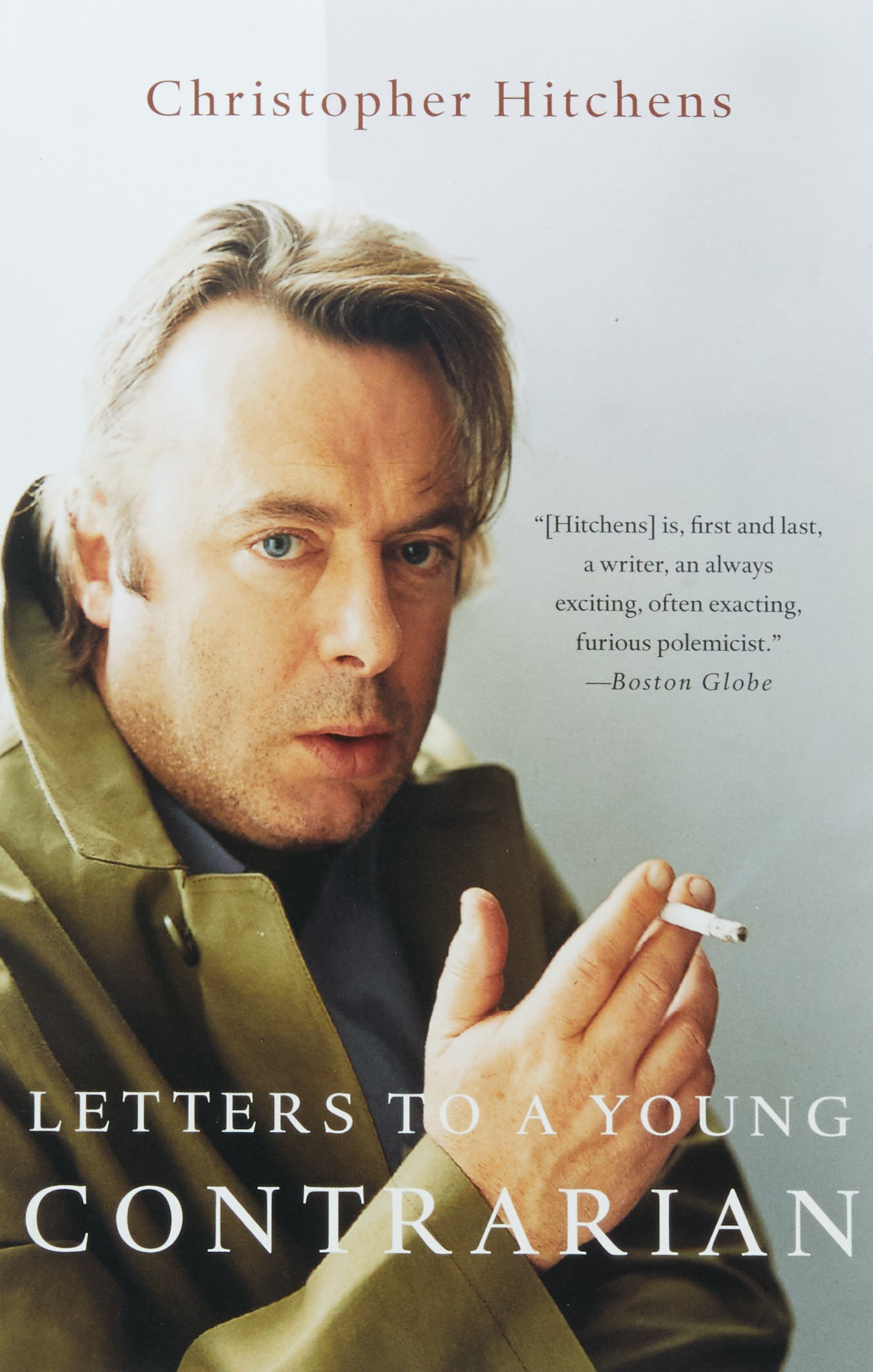
From bestselling author and provocateur Christopher Hitchens, the classic guide to the art of principled dissent and disagreementIn Letters to a Young Contrarian, bestselling author and world-class provocateur Christopher Hitchens inspires the radicals, gadflies, mavericks, rebels, and angry young (wo)men of tomorrow. Exploring the entire range of "contrary positions"—from noble dissident to gratuitous nag—Hitchens introduces the next generation to the minds and the misfits who influenced him, invoking such mentors as Emile Zola, Rosa Parks, and George Orwell. As is his trademark, Hitchens pointedly pitches himself in contrast to stagnant attitudes across the ideological spectrum. No other writer has matched Hitchens's understanding of the importance of disagreement—to personal integrity, to informed discussion, to true progress, to democracy itself.

In this widely acclaimed biographical essay, Christopher Hitchens assesses the life, the achievements, and the myth of the great political writer and participant George Orwell. In true emulative and contrarian style, Hitchens is both admiring and aggressive, sympathetic yet critical, taking true measure of his subject as hero and problem. Answering both the detractors and the false claimants, Hitchens tears down the façade of sainthood erected by the hagiographers and rebuts the critics point by point. He examines Orwell and his perspectives on fascism, empire, feminism, and Englishness, as well as his outlook on America, a country and culture towards which he exhibited much ambivalence. Whether thinking about empires or dictators, race or class, nationalism or popular culture, Orwell's moral outlook remains indispensable in a world that has undergone vast changes in the fifty years since his death. Combining the best of Hitchens's polemical punch and intellectual elegance in a tightly woven and subtle argument, this book addresses not only why Orwell matters today, but how he will continue to matter in a future, uncertain world. Christopher Hitchens, one of the most incisive minds of our own age, meets Orwell on the page in this provocative encounter of wit, contention and moral truth.

Thomas Paine was one of the greatest advocates of freedom in history, and his Declaration of the Rights of Man, first published in 1791, is the key to his reputation. Inspired by his outrage at Edmund Burke’s attack on the French Revolution, Paine’s text is a passionate defense of man’s inalienable rights. Since its publication, Rights of Man has been celebrated, criticized, maligned, suppressed, and co-opted. But in Thomas Paine’s Rights of Man, the polemicist and commentator Christopher Hitchens, “at his characteristically incisive best,” marvels at its forethought and revels in its contentiousness (The Times, London). Hitchens is a political descendant of the great pamphleteer, “a Tom Paine for our troubled times.” (The Independent, London) In this “engaging account of Paine’s life and times [that is] well worth reading” he demonstrates how Paine’s book forms the philosophical cornerstone of the United States, and how, “in a time when both rights and reason are under attack,” Thomas Paine’s life and writing “will always be part of the arsenal on which we shall need to depend.” (New Statesman)

The death of Christopher Hitchens in December 2011 prematurely silenced a voice that was among the most admired of contemporary writers. For more than forty years, Hitchens delivered to numerous publications on both sides of the Atlantic essays that were astonishingly wide-ranging and provocative. The judges for the PEN/Diamonstein-Spielvogel Award for the Art of the Essay, posthumously bestowed on Hitchens, praised him for the way he wrote “with fervor about the books and writers he loved and with unbridled venom about ideas and political figures he loathed.” He could write, the judges went on to say, with “undisguised brio, mining the resources of the language as if alert to every possibility of color and inflection.” He was, as Benjamin Schwarz, his editor at The Atlantic magazine, recalled, “slashing and lively, biting and funny—and with a nuanced sensibility and a refined ear that he kept in tune with his encyclopedic knowledge and near photographic memory of English poetry.” And as Michael Dirda, writing in the Times Literary Supplement, observed, Hitchens “was a flail and a scourge, but also a gift to readers everywhere.”The author of five previous volumes of selected writings, including the international bestseller Arguably, Hitchens left at his death nearly 250,000 words of essays not yet published in book form. And Yet… assembles a selection that usefully adds to Hitchens’s oeuvre. It ranges from the literary to the political and is, by turns, a banquet of entertaining and instructive delights, including essays on Orwell, Lermontov, Chesterton, Fleming, Naipaul, Rushdie, Pamuk, and Dickens, among others, as well as his laugh-out-loud self-mocking “makeover.” The range and quality of Hitchens’s essays transcend the particular occasions for which they were originally written. Often prescient, always pugnacious, and formidably learned, Hitchens was a polemicist for the ages. With this posthumous volume, his reputation and his readers will continue to grow.Christopher Hitchens was the cartographer of his own literary and political explorations. He sought assiduously to affirm—and to reaffirm—the ideas of secularism, reason, libertarianism, internationalism, and solidarity, values always under siege and ever in need of defending. Henry James once remarked, “Nothing is my last word on anything.” For Hitchens, as for James, there was always more to be said.

Presents an eyewitness account of the 2003 war in Iraq while arguing that the war actually began in 1990 when Saddam Hussein invaded Kuwait, and discusses how the conflict has divided public opinion.


Among his many books, perhaps none have sparked more outrage than The Missionary Position, Christopher Hitchens's meticulous study of the life and deeds of Mother Teresa. A Nobel Peace Prize recipient beatified by the Catholic Church in 2003, Mother Teresa of Calcutta was celebrated by heads of state and adored by millions for her work on behalf of the poor. In his measured critique, Hitchens asks only that Mother Teresa's reputation be judged by her actions-not the other way around.With characteristic elan and rhetorical dexterity, Hitchens eviscerates the fawning cult of Teresa, recasting the Albanian missionary as a spurious, despotic, and megalomaniacal operative of the wealthy who long opposed measures to end poverty, and fraternized, for financial gain, with tyrants and white-collar criminals throughout the world.

The first new book of essays by Christopher Hitchens since 2004, Arguably offers an indispensable key to understanding the passionate and skeptical spirit of one of our most dazzling writers, widely admired for the clarity of his style, a result of his disciplined and candid thinking. Topics range from ruminations on why Charles Dickens was among the best of writers and the worst of men to the haunting science fiction of J.G. Ballard; from the enduring legacies of Thomas Jefferson and George Orwell to the persistent agonies of anti-Semitism and jihad. Hitchens even looks at the recent financial crisis and argues for the enduring relevance of Karl Marx. The book forms a bridge between the two parallel enterprises of culture and politics. It reveals how politics justifies itself by culture, and how the latter prompts the former. In this fashion, Arguably burnishes Christopher Hitchens' credentials as (to quote Christopher Buckley) our "greatest living essayist in the English language."

The Four Horsemen: The Conversation That Sparked an Atheist Revolution
by Christopher Hitchens
Rating: 4.0 ⭐
In 2007, Christopher Hitchens, Richard Dawkins, Sam Harris, and Daniel Dennett filmed a conversation on religion, ethics, and the new atheism. The documentary went viral. Now, in print for the first time, this edition features new essays by Dawkins, Harris, and Dennett and an introduction by Stephen Fry.At the dawn of the new atheist movement, the thinkers who became known as "the four horsemen," the heralds of religion's unravelling—Christopher Hitchens, Richard Dawkins, Sam Harris, and Daniel Dennett—sat down over cocktails for a filmed conversation. What followed was this rigorous, pathbreaking, and enthralling conversation that was released on YouTube and soon went viral. This is intellectual inquiry at its sincere and probing, funny and unpredictable, reminding us just how varied and colorful the threads of modern atheism are.Now, this landmark conversation is being published for the first time. The living participants, Dawkins, Harris, and Dennett, have all contributed new material to mark the evolution of their own thinking and highlight particularly resonant aspects of this epic exchange. Each of these men contends with the most fundamental questions of human existence as they challenge each other to articulate their own stance on god and religion, cultural criticism, spirituality without religion, debate with people of faith, and living an ethical life.

In No One Left to Lie To, Christopher Hitchens portrays President Bill Clinton as one of the most ideologically skewed and morally negligent politicians of recent times. In a blistering polemic which shows that Clinton was at once philanderer and philistine, crooked and corrupt, Hitchens challenges perceptions - of liberals and conservatives alike - of this highly divisive figure.With blistering wit and meticulous documentation, Hitchens masterfully deconstructs Clinton's abject propensity for pandering to the Left while delivering to the Right and argues that the president's personal transgressions were inseparable from his political corruption.

In a brilliant essay on the death of Osama bin Laden, Christopher Hitchens insists that the necessity to resist the threat of theocratic fanaticism is by no means cancelled. Hitchens argues that bin Laden and his adherents represented the most serious and determined and bloodthirsty attempt to revive totalitarian and racist ideology since 1945. Further, that while the unending struggle for reason is entitled to take some especial comfort in his demise, the values of secularism, libertarianism, internationalism, and solidarity will always need to be defended and reaffirmed.

'Why, when the subject of royalty or monarchy is mentioned, do the British bid adieu to every vestige of proportion, modesty, humour and restraint? 'This is not a call for the monarchy’s abolition by fiat; illusions cannot be abolished. This is an invitation to think. In this scathing essay, Christopher Hitchens looks at the relationship of the press and the public to the royal family, unpacking the tautology and contradictory arguments that prop it up. In his inimitable style, Hitchens argues that our desire not to profane or disturb the monarchy is a failure of reason and a confusion of reality. Fealty to the magic of monarchy stops us looking objectively at our own history and hinders open-minded criticism of our present. It is time we outgrew it.With the Queen’s Diamond Jubilee upon us, during a time of recession, high unemployment and national debt, Hitchens’ 10,000-word critique is even more relevant today than when it was first published in 1990. Part of the Brain Shots series, the pre-eminent source for high quality, short-form digital non-fiction.'Christopher is one of the most terrifying rhetoricians that the world has yet seen.' Martin Amis

The gloves come off in this electric exchange, originally hosted by Christianity Today, as leading atheist Christopher Hitchens (author of God Is Not Great) and Christian apologist Douglas Wilson (author of Letter from a Christian Citizen) go head-to-head on this divisive question. The result is entertaining and provocative a glimpse into the ongoing debate."

Hitchens vs. Blair: Be It Resolved Religion Is a Force for Good in the World
by Christopher Hitchens
Rating: 3.8 ⭐
Intellectual juggernaut and staunch atheist Christopher Hitchens goes head-to-head with former British Prime Minister Tony Blair, one of the Western world’s most openly devout political leaders, on the highly charged topic of religion. Few world leaders have had a greater hand in shaping current events than Blair; few writers have been more outspoken and polarizing than Hitchens. Here they square off on the contentious questions that continue to dog the topic of religion in our globalized How does faith influence our actions? What is the role of people of faith in the public sphere? Is religious doctrine rigid, or should we allow for flexibility in our interpretations? First debated in 2010 and now available in print form for the first time, the book includes candid interviews post-debate interviews with Hitchens and Blair. Sharp, provocative, and thoroughly engrossing, Hitchens vs. Blair is a rigorous and electrifying intellectual sparring match. Two formidable minds. One powerfully charged debate.

Christopher Hitchens: The Last Interview and Other Conversations
by Christopher Hitchens
Rating: 4.1 ⭐
This selection of interviews showcases the remarkable career of one of this generation’s greatest and most divisive thinkers—featuring a foreword by Stephen Fry. “ . . . pulls together some of Hitchens’s greatest dialogues, each sparkling with intelligence and wit.” —New York Times Book ReviewIf someone says I’m doing this out of faith, I say, Why don’t you do it out of conviction? One of his generation’s greatest public intellectuals, and perhaps its fiercest, Christopher Hitchens was a brilliant interview subject. This collection—which spans from his early prominence as a hero of the Left to his controversial support for the wars in Iraq and Afghanistan toward the end of his life—showcases Hitch’s trademark wit on subjects as diverse as his mistrust of the media, his love of literature, his dislike of the Clintons, and his condemnation of all things religious. Beginning with an introduction and tribute from his longtime friend Stephen Fry, this collection culminates in Hitchens’s fearless final interview with Richard Dawkins, which shows a man as unafraid of death as he was of everything in life.

The global turmoil of the last few years has severely tested every analyst and commentator. Few have written with such insight as Christopher Hitchens about the large events — or with such discernment and wit about the small tell-tale signs of a disordered culture.For the Sake of Argument ranges from the political squalor of Washington, as a beleaguered Bush administration seeks desperately to stave off disaster and Clinton prepares for power; to the twilight of Stalinism in Prague; from the Jewish quarter of Damascus in the aftermath of the Gulf War to the embattled barrios of Central America and the imperishable resistance of Sarajevo, as a difficult peace is negotiated with ruthless foes. Hitchens’s unsparing account of Western realpolitik in the end shows it to rest on delusion as well as deception.The reader will find in these pages outstanding essays on political assassination in America as well as a scathing review of the evisceration of politics by pollsters and spin-doctors. Hitchens’s knowledge of the tortuous history of revolutions in the twentieth century helps him explain both the New York intelligentsia's flirtation with Trotskyism and the frailty of Communist power structures in Eastern Europe.Hitchens's pointed reassessments of Graham Greene, P. G. Wodehouse and C. L. R. James, or his riotous celebration of drinking and smoking, display an engaging enthusiasm and an acerbic wit. Equally entertaining is his unsparing rogues’ gallery, which gives us unforgettable portraits of the lugubrious “Dr.” Kissinger, the comprehensively reactionary “Mother” Teresa, the preposterous Paul Johnson and the predictable P. J. O’Rourke.

A celebration of Percy Shelley’s assertion that ‘poets are the unacknowledged legislators of the world’, these thirty-plus essays on writers from Oscar Wilde to Salman Rushdie dispel the myth of politics as a stone tied to the neck of literature; Norman Podhoretz’s ‘bloody crossroads’. Instead Hitchens argues that when all parties in the state were agreed on a matter, it was the individual pens that created the space for a true moral argument.

Hitchens has written a great deal of bracing good sense on politics & literature in the past decades. Much of it has been collected between the covers of this well-packed book. Since these pieces originally appeared in journals as wide-ranging as the TLS, Grand Street, Harper's, Mother Jones, The Nation & Spectator, only the most avid admirer would be likely to have come across them all. In addition to the predictable, eloquent Reagan-bashing, there are thoughtful essays on Paul Scott & his Raj Quartet, the contradictions of George Orwell, the Brideshead phenomenon, that very independent-minded Israeli Professor Israel Shahak, Conor Cruise O'Brien, even something as up-to-date as a perceptive review of Bonfire of the Vanities. Hitchens writes clearly, from a well-stocked mind, & is free of the cant that affects many political journalists. Why the kinds of views that he & his very kindred spirit Alexander Cockburn express so well never receive an airing on TV, where they'd reach a much wider audience, remains a source of shame to a supposedly free medium. In any case, book & magazine readers can feel fortunate that publishers suffer no such self-imposed restraints. -- Publishers Weekly

Journalist Christopher Hitchens examines events leading up to the partition of Cyprus and its legacy. He argues that the intervention of four major foreign powers Turkey, Greece, Britain, and the United States turned a local dispute into a major disaster. In a new Afterword, Hitchens reviews the implications of Cyprus's applications for European Union membership and more. 224 pp.

Christopher Hitchens was a star writer wherever he wrote, and the same was true of the London Review of Books, to which he contributed sixty pieces over two decades. Anthologised here for the first time, this selection of his finest LRB reviews, diaries and essays (along with a smattering of ferocious letters) finds Hitchens at his very best.Familiar bêtes noires - Kennedy, Nixon, Kissinger, Clinton - rub shoulders with lesser-known preoccupations: P.G. Wodehouse, Princess Margaret and, magisterially, Isaiah Berlin. Here is Hitchens on the (first) Gulf War and the 'Salman Rushdie Acid Test', on being spanked by Mrs Thatcher in the House of Lords and taking his son to the Oscars, on America's homegrown Nazis and 'Acts of Violence in Grosvenor Square' in 1968.Edited by the London Review of Books, with an introduction by James Wolcott, this collection recaptures, ten years after his death, 'a Hitch in time': barnstorming, cauterising, and ultimately uncontainable