Loading genres...
Explore the best books about South Africa genre.

Drawing on his tours in South Africa as a correspondent for the "New York Times," the author details the absurdities, rationalizations, inequities, and cruelties of apartheid, showing what it means to suffer and survive under the restrictions of racial separation

A tale of bitterness and division with the main plot focusing on the divisions and boundaries that Apartheid and international capitalism create within South African society.

When her ex-husband commits suicide after the failure of his anti-government activities, Liz Van Den Sandt struggles to decide whether to become involved in the South African Black nationalist movement

As a depiction of South Africa, this novel is more revealing than a thousand news dispatches as it tells the story of a young woman cast in the role of a young revolutionary, trying to uphold a heritage handed on by martyred parents while carving out a sense of one's self.

Set in South Africa under white rule, Doris Lessing's first novel is both a riveting chronicle of human disintegration and a beautifully understated social critique. Mary Turner is a self-confident, independent young woman who becomes the depressed, frustrated wife of an ineffectual, unsuccessful farmer. Little by little the ennui of years on the farm work their slow poison, and Mary's despair progresses until the fateful arrival of an enigmatic and virile black servant, Moses. Locked in anguish, Mary and Moses -- master and slave -- are trapped in a web of mounting attraction and repulsion. Their psychic tension explodes in an electrifying scene that ends this disturbing tale of racial strife in colonial South Africa.The Grass Is Singing blends Lessing's imaginative vision with her own vividly remembered early childhood to recreate the quiet horror of a woman's struggle against a ruthless fate.

The establishment of South Africa's Truth and Reconciliation Commission was a pioneering international event. Never had any country sought to move forward from despotism to democracy both by exposing the atrocities committed in the past and achieving reconciliation with its former oppressors. At the center of this unprecedented attempt at healing a nation has been Archbishop Desmond Tutu, whom President Nelson Mandela named as Chairman of the Truth and Reconciliation Commission. With the final report of the Commission just published, Archbishop Tutu offers his reflections on the profound wisdom he has gained by helping usher South Africa through this painful experience.In No Future Without Forgiveness, Tutu argues that true reconciliation cannot be achieved by denying the past. But nor is it easy to reconcile when a nation "looks the beast in the eye." Rather than repeat platitudes about forgiveness, he presents a bold spirituality that recognizes the horrors people can inflict upon one another, and yet retains a sense of idealism about reconciliation. With a clarity of pitch born out of decades of experience, Tutu shows readers how to move forward with honesty and compassion to build a newer and more humane world.

Set in a beautifully rendered 1990s Cape Town, Zoë Wicomb’s celebrated novel revolves around Marion Campbell, who runs a travel agency but hates traveling, and who, in post-apartheid society, must negotiate the complexities of a knotty relationship with Brenda, her first black employee. As Alison McCulloch noted in the New York Times, “Wicomb deftly explores the ghastly soup of racism in all its unglory—denial, tradition, habit, stupidity, fear—and manages to do so without moralizing or becoming formulaic.”Caught in the narrow world of private interests and self-advancement, Marion eschews national politics until the Truth and Reconciliation Commission throws up information that brings into question not only her family’s past but her identity and her rightful place in contemporary South African society. “Stylistically nuanced and psychologically astute” (Kirkus), Playing in the Light is as powerful in its depiction of Marion’s personal journey as it is in its depiction of South Africa’s bizarre, brutal history.

A compact, profoundly inspiring book that captures the spirit of Nelson Mandela, distilling the South African leader’s wisdom into 15 vital life lessonsWe long for heroes and have too few. Nelson Mandela, who died in 2013 at the age of ninety-five, is the closest thing the world has to a secular saint. He liberated a country from a system of violent prejudice and helped unite oppressor and oppressed in a way that had never been done before.Now Richard Stengel, the editor of Time magazine, has distilled countless hours of intimate conversation with Mandela into fifteen essential life lessons. For nearly three years, including the critical period when Mandela moved South Africa toward the first democratic elections in its history, Stengel collaborated with Mandela on his autobiography, Long Walk to Freedom , and traveled with him everywhere. Eating with him, watching him campaign, hearing him think out loud, Stengel came to know all the different sides of this complex man and became a cherished friend and colleague.In Mandela’s Way, Stengel recounts the moments in which “the grandfather of South Africa” was tested and shares the wisdom he why courage is more than the absence of fear, why we should keep our rivals close, why the answer is not always either/or but often “both,” how important it is for each of us to find something away from the world that gives us pleasure and satisfaction—our own garden. Woven into these life lessons are remarkable stories—of Mandela’s childhood as the protégé of a tribal king, of his early days as a freedom fighter, of the twenty-seven-year imprisonment that could not break him, and of his fulfilling remarriage at the age of eighty.This uplifting book captures the spirit of this extraordinary man—warrior, martyr, husband, statesman, and moral leader—and spurs us to look within ourselves, reconsider the things we take for granted, and contemplate the legacy we’ll leave behind.

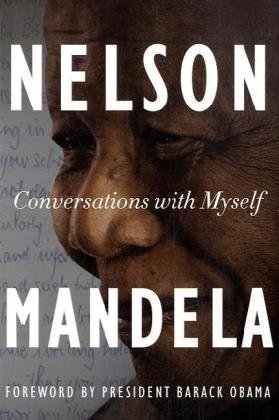
Nelson Mandela is widely considered to be one of the most inspiring and iconic figures of our age. Now, after a lifetime of taking pen to paper to record thoughts and events, hardships and victories, he has bestowed his entire extant personal papers, which offer an unprecedented insight into his remarkable life.A singular international publishing event, Conversations with Myself draws on Mandela's personal archive of never-before-seen materials to offer unique access to the private world of an incomparable world leader. Journals kept on the run during the anti-apartheid struggle of the early 1960s; diaries and draft letters written in Robben Island and other South African prisons during his twenty-seven years of incarceration; notebooks from the postapartheid transition; private recorded conversations; speeches and correspondence written during his presidency--a historic collection of documents archived at the Nelson Mandela Foundation is brought together into a sweeping narrative of great immediacy and stunning power. An intimate journey from Mandela's first stirrings of political consciousness to his galvanizing role on the world stage, Conversations with Myself illuminates a heroic life forged on the front lines of the struggle for freedom and justice.While other books have recounted Mandela's life from the vantage of the present, Conversations with Myself allows, for the first time, unhindered insight into the human side of the icon.

During the final fifteen years of the Cold War, southern Africa underwent a period of upheaval, with dramatic twists and turns in relations between the superpowers. Americans, Cubans, Soviets, and Africans fought over the future of Angola, where tens of thousands of Cuban soldiers were stationed, and over the decolonization of Namibia, Africa's last colony. Beyond lay the great South Africa. Piero Gleijeses uses archival sources, particularly from the United States, South Africa, and the closed Cuban archives, to provide an unprecedented international history of this important theater of the late Cold War.These sources all point to one by humiliating the United States and defying the Soviet Union, Fidel Castro changed the course of history in southern Africa. It was Cuba's victory in Angola in 1988 that forced Pretoria to set Namibia free and helped break the back of apartheid South Africa. In the words of Nelson Mandela, the Cubans "destroyed the myth of the invincibility of the white oppressor . . . [and] inspired the fighting masses of South Africa."

A colorful, moving, and dramatic memoir of personal transformation, set against one of the most famous game reserves in the world.When Nelson Mandela was released after twenty-seven years of imprisonment, he needed a place to recover and adjust to his new life. He went to Londolozi Game Reserve. Founded over eighty years ago by Boyd Varty's great-grandfather, Londolozi started as a hunting safari. But in 1973, Boyd's visionary father, Dave, transformed it into a nature reserve, creating a blueprint for modern-day conservation. This transformation is the backdrop of Boyd's family history and his own personal odyssey.Alongside his feisty, daring sister, Bronwyn, Boyd grows up learning to track lions, raise leopard cubs, and pilot Land Rovers. The two of them tag along with their larger-than-life uncle, John, who repeatedly flung them in danger's way to capture the best footage for his legendary wildlife videos. Boyd survives harrowing rhino charges and a vicious crocodile attack, but his most difficult challenge was a private crisis of purpose. After a period of intense spiritual questing, Boyd reconnects with nature and is able to "rediscover the track."With conviction, hope and humor, Boyd sweeps readers along his journey of discovery and rediscovery, making a passionate claim for the power of the wild to heal and restore the human spirit.