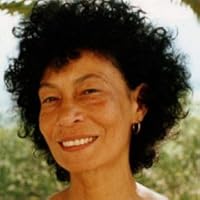
Zoë Wicomb
Zoë Wicomb attended the University of the Western Cape, and after graduating left South Africa for England in 1970, where she continued her studies at Reading University. She lived in Nottingham and Glasgow and returned to South Africa in 1990, where she taught for three years in the department of English at the University of the Western Cape She gained attention in South Africa and internationally with her first work, a collection of short stories , You Can't Get Lost in Cape Town (1987), which takes place during the apartheid era. Her second novel, David's Story (2002), takes place in 1991 toward the close of the apartheid era and uses the ambiguous classification of coloureds to explore racial identity. Playing in the Light, her third novel, released in 2006, covers similar terrain conceptually, though this time set in contemporary South Africa and centering around a white woman who learns that her parents were actually coloured. She published her second collection of short stories, The One That Got Away. The stories, set mainly in Cape Town and Glasgow, explore a range of human relationships: marriage, friendships, family ties or relations with servants. She was a winner of the 2013 Windham–Campbell Literature Prize for Fiction. Zoe Wicomb resides in Glasgow where she teaches creative writing and post-colonial literature at the University of Strathclyde.
14 Books Written

“In her ambitious third novel, Wicomb explores South Africa’s history through a woman’s attempt to answer questions surrounding her past” ( The New Yorker ). Set in a beautifully rendered 1990s Cape Town, Windham Campbell Prize winner Zoë Wicomb’s celebrated novel revolves around Marion Campbell, who runs a travel agency but hates traveling, and who, in post-apartheid society, must negotiate the complexities of a knotty relationship with Brenda, her first black employee. As Alison McCulloch noted in the New York Times , “Wicomb deftly explores the ghastly soup of racism in all its unglory―denial, tradition, habit, stupidity, fear―and manages to do so without moralizing or becoming formulaic.” Caught in the narrow world of private interests and self-advancement, Marion eschews national politics until the Truth and Reconciliation Commission throws up information that brings into question not only her family’s past but her identity and her rightful place in contemporary South African society. “Stylistically nuanced and psychologically astute,” Playing in the Light is as powerful in its depiction of Marion’s personal journey as it is in its depiction of South Africa’s bizarre, brutal history ( Kirkus Reviews , starred review). “Post-apartheid South Africa is indeed a new world . . . With this novel, Wicomb proves a keen guide.” ― The New York Times “Delectable . . . Wicomb’s prose is as delightful and satisfying in its culmination as watching the sun set over the Atlantic Ocean.” ― The Christian Science Monitor “[A] thoughtful, poetic novel.” ― The Times (London)

You Can't Get Lost in Cape Town is among the only works of fiction to explore the experience of “Coloured” citizens in apartheid-era South Africa, whose mixed heritage traps them, as Bharati Mukherjee wrote in the New York Times, “in the racial crucible of their country." Frieda Shenton, the daughter of Coloured parents in rural South Africa, is taught as a child to emulate whites: she is encouraged to learn correct English, to straighten her hair, and to do more than, as her father says, “peg out the madam’s washing.”While still a self-conscious and overweight adolescent, Frieda is sent away from home to be among the first to integrate a prestigious Anglican high school in Cape Town, and finds herself in a city where racial lines are so strictly drawn that it is not possible to step out of one’s place.At last, Frieda flees to England, only to return more than a decade later to a South Africa now in violent rebellion against apartheid—but still, seemingly, without a place for her. It is only as Frieda finds the courage to tell her “terrible stories” that she at last begins to create her own place in a world where she has always felt herself an exile.

A powerful post-apartheid novel and winner of South Africa’s M-Net Literary Award, hailed by J.M. Coetzee as “a tremendous achievement.” South Africa, 1991: Nelson Mandela is freed from prison, the African National Congress is now legal, and a new day dawns in Cape Town. David Dirkse, part of the underground world of activists, spies, and saboteurs in the liberation movement, suddenly finds himself above ground. With “time to think” after the unbanning of the movement, David searches his family tree, tracing his bloodline to the mixed-race “Coloured” people of South Africa and their antecedents among the indigenous people and early colonial settlers. But as David studies his roots, he soon learns that he’s on a hit list. Now caught in a web of surveillance and betrayal, he’s forced to rethink his role in the struggle for “nonracial democracy,” the loyalty of his “comrades,” and his own conceptions of freedom. Mesmerizing and multilayered, Wicomb’s award-winning novel delivers a moving examination of the nature of political vision, memory, and truth. “A delicate, powerful novel, guided by the paradoxes of witnessing the certainties of national liberation and the uncertainties of ground-level hybrid identity, the mysteries of sexual exchange, the austerity of political fiction. Wicomb’s book belongs on a shelf with books by Maryse Condé and Yvette Christiansë.” —Gayatri Chakravorty Spivak, author of A Critique of Postcolonial Reason

"Mercia Murray is a woman of fifty-two years who has been left.” Abandoned by her partner in Scotland, where she has been living for twenty-five years, Mercia returns to her homeland of South Africa to find her family overwhelmed by alcoholism and secrets. Poised between her life in Scotland and her life in South Africa, she recollects the past with a keen sense of irony as she searches for some idea of home. In Scotland, her life feels unfamiliar; her apartment sits empty. In South Africa, her only brother is a shell of his former self, pushing her away. And yet in both places she is needed, if only she could understand what for. Plumbing the emotional limbo of a woman who is isolated and torn from her roots, October is a stark and utterly compelling novel about the contemporary experience of an intelligent immigrant, adrift among her memories and facing an uncertain middle age.With this pitch-perfect story, the "writer of rare brilliance” (The Scotsman) Zoë Wicomb—who received one of the first Donald Windham Sandy M. Campbell Literature Prizes for lifetime achievement—stands to claim her rightful place as one of the preeminent contemporary voices in international fiction.

A New York Times Top Historical Fiction Pick of 2020A stunningly original new novel exploring race, truth in authorship, and the legacy of past exploitation, from the Windham-Campbell lifetime achievement award winner When Zoë Wicomb burst onto the literary scene in 1987 with You Can't Get Lost in Cape Town, she was hailed by her literary contemporaries and reviewers alike. Since then, her carefully textured writing has cemented her reputation as being among the most distinguished writers working today and earned her one of the inaugural Windham Campbell Prizes for Lifetime Achievement in Fiction Writing.Wicomb's majestic new novel Still Life juggles with our perception of time and reality as Wicomb tells the story of an author struggling to write a biography of long-forgotten Scottish poet Thomas Pringle, whose only legacy is in South Africa where he is dubbed the "Father of South African Poetry."In her efforts to resurrect Pringle, the writer summons the specter of Mary Prince, the West Indian slave whose History Pringle had once published, along with Hinza, his adopted black South African son. At their side is Sir Nicholas Greene, a seasoned time traveler (and a character from Virginia Woolf's Orlando). Their adventures, as they travel across space and time to unlock the mysteries of Pringle's life, offer a poignant exploration of colonial history and racial oppression.

The appearance of Zoë Wicomb’s first set of short stories, You Can’t Get Lost in Cape Town, precipitated the founding of a fan club that has come to include the writers Toni Morrison, J.M. Coetzee, Bharati Mukherjee, and Gayatri Chakravorty Spivak, as well as critics at the New York Times, the Times of London, the Wall Street Journal, the New Yorker, and the Christian Science Monitor. Now, after two novels, Wicomb returns to the genre that first brought her international acclaim.Set mostly in Cape Town and Glasgow, Wicomb’s new collection of short stories straddles dual worlds. An array of characters drawn with extraordinary acuity inhabits a complexly interconnected, twenty-first-century universe. The twelve stories in this collection, most previously unpublished, explore a spectrum of human relationships: marriage, friendship, family ties, and relations with those who serve and are served. Wicomb’s intriguing characters include the adolescent girl Elsie, navigating between her new life in the icy city of Glasgow and her family’s vexed history in South Africa, and Dot and Julie, a pair of friends once united by the color of their skin and now discovering how time and marriage have divided their paths. Wicomb’s fluid, shifting technique questions conventional certainties and makes for exhilarating reading, full of ironic twists, ambiguities, and moments of startling insight.Long awaited, The One That Got Away showcases this brilliant, award-winning author at the height of her powers.

La gran mayoría de los africanos del siglo XXI será urbanita y, conscientes de que percibimos las ciudades a través de nuestra experiencia, conocimiento, miedos y deseos, hemos pedido a doce autores africanos que nos descubran las ciudades que les inspiran a través de historias que nos transportan a lugares como Abiyán, Lagos, Ciudad del Cabo, Dakar o Malabo. Vamos a redescubrirlas a través de unos ojos ajenos, africanos y globales. Prepare una maleta ficticia en la que acomodar sus zapatos predilectos para recorrer nuevas calles de la mano de autores de la talla de Véronique Tadjo, Trifonia Melibea, Noo Saro-Wiwa, Ken Bugul, Chimamanda Ngozi, Boubacar Boris Diop o Antonio Lozano, ente otros.adictorios.

Miradas es una selección de cuentos de dos de los escritores más interesantes de Sudáfrica.Zoë Wicomb, a través de su prosa compleja y profundamente evocadora, explora una multiplicidad de relaciones humanas y la experiencia de los ciudadanos "de color" en la era del apartheid en Sudáfrica.Ivan Vladislavic, imaginativo e ingenioso, muestra una mirada crítica de la realidad social, de manera indirecta, y presenta una perspectiva de la vida de Sudáfrica como un "mundo del revés".


In "Art Work" by Zoe Wicomb, South African Letty, who has lived and worked as a nurse in Glasgow for many years, struggles to come to terms with her nephew's desire to become an artist. She's raised Leo as her own, watched him flourish away from township life in Cape Town and gain excellent grades at school, so his career choice feels to her like a waste of his academic talent.Acclaimed as "an extraordinary writer" by Toni Morrison, Zoe Wicomb is Emeritus Professor of Creative Writing at Strathclyde University. Her critical work focuses on postcolonial theory and South African writing and culture. Her published works of fiction are "You Can't Get Lost in Cape Town", "David's Story", "Playing in the Light", and "The One That Got Away"; she will publish a new novel in 2014Available at: http://www.bbc.co.uk/programmes/b03xd9jg

The first collection of nonfiction critical writings by one of the leading literary figures of post-apartheid South AfricaThe most significant nonfiction writings of Zoë Wicomb, one of South Africa’s leading authors and intellectuals, are collected here for the first time in a single volume. This compilation features essays on the works of such prominent South African writers as Bessie Head, Nadine Gordimer, Njabulo Ndebele, and J. M. Coetzee, as well as on a wide range of cultural and political topics, including gender politics, sexuality, race, identity, nationalism, and visual art. Also presented here are a reflection on Nelson Mandela and a revealing interview with Wicomb. In these essays, written between 1990 and 2013, Wicomb offers insights into her nation’s history, politics, and people. In a world in which nationalist rhetoric is on the rise and right-wing populist movements are the declared enemies of diversity and pluralism, her essays speak powerfully to a host of current international issues.

UNE CLAIRIERE DANS LE BUSH
by Zoë Wicomb

Cenere sulla mia manica
by Zoë Wicomb
Raccolta di racconti strutturata in modo da organizzare un mondo coerente di rifratte prospettive e molteplici punti di vista. Come il poeta Arthur Nortje - un verso del quale dà il titolo al libro-Zoe Wicomb scrive dal di fuori e dall'esilio di chi, ad opera della lunga cultura segregazionista dell'apartheid, è stato scisso e strappato dalla propria comunità e quindi da una parte di se stesso. Ma Frieda Shenton, l'io narrante del testo, è anche una voce dal di dentro che dipana ·una storia di formazione femminile e, insieme, mille storie sudafricane, sfaccettate nell'ironia e distaccate in un tono malizioso che mantiene distanziate le emozioni, sottraendosi così a quella rappresentazione realista tipica di altre scrittrici sudafricane, da Nadine Goraimer a Miriam Tlali. L'ironia che permea questi racconti non impedisce però l'ingresso della tragedia, che compare fulminea in immagini conclusive, a siglare l'esistenza umana. Cenere sulla mia manica è un testo postmoderno di grande finezza, intessuto sulla trama rovente della resistenza sudafricana.