Loading genres...
Explore the best books about Psychoanalysis genre.

Of the various English translations of Freud's major works to appear in his lifetime, only one was authorized by Freud The Standard Edition of the Complete Psychological Works of Sigmund Freud under the general editorship of James Strachey. Freud approved the overall editorial plan, specific renderings of key words and phrases, and the addition of valuable notes, from bibliographical and explanatory. Many of the translations were done by Strachey himself; the rest were prepared under his supervision. The result was to place the Standard Edition in a position of unquestioned supremacy over all other existing versions.Newly designed in a uniform format, each new paperback in the Standard Edition opens with a biographical essay on Freud's life and work —along with a note on the individual volume—by Peter Gay, Sterling Professor of History at Yale.
The first of Erich Neumann's works to be translated into English, this eloquent book draws on a full range of world mythology to show that individual consciousness undergoes the same archetypal stages of development as has human consciousness as a whole. Neumann, one of Jung's most creative students and a renowned practitioner of analytical psychology in his own right, shows how the stages begin and end with the symbol of the Uroboros, or tail-eating serpent. The intermediate stages are projected in the universal myths of the World Creation, Great Mother, Separation of the World Parents, Birth of the Hero, Slaying of the Dragon, Rescue of the Captive, and Transformation and Deification of the Hero. Throughout the sequence the Hero is the evolving ego consciousness.

A provocative and enlightening look at spiritual unease and its contribution to the void in modern civilization Considered by many to be one of the most important books in the field of psychology, Modern Man in Search of a Soul is a comprehensive introduction to the thought of Carl Gustav Jung. In this book, Jung examines some of the most contested and crucial areas in the field of analytical psychology, including dream analysis, the primitive unconscious, and the relationship between psychology and religion. Additionally, Jung looks at the differences between his theories and those of Sigmund Freud, providing a valuable basis for anyone interested in the fundamentals of psychoanalysis.

Esta es la versión completa y definitiva de una de las obras más revolucionarias y centrales de C. G. Jung. A partir de la reconstrucción y examen de los procesos semiconscientes e inconscientes del caso de una joven, Jung muestra que la psicología no puede prescindir de la historia del espíritu humano. La fantasía creadora dispone del espíritu primitivo, con sus imágenes específicas, que se manifiestan en las mitologías de todos los pueblos y épocas e integran lo inconsciente colectivo.

Bollingen Series XX'Collected Works, The Symbolic Life' has 160 items representative of the author's numerous interests, his wide circle of professional & personal acquaintance, & his inquiring mind. Its contents span 60 years; they include forewords to books by pupils & colleagues, replies to journalistic questionnaires, encyclopedia articles, occasional addresses & letters on technical subjects.

Jung's last major work, completed in his 81st year, on the synthesis of the opposites in alchemy and psychology.

In ‘The Politics of Experience’ and the visionary ‘Bird of Paradise’, R.D. Laing shows how the straitjacket of conformity imposed on us all leads to intense feelings of alienation and a tragic waste of human potential. He throws into question the notion of normality, examines schizophrenia and psychotherapy, transcendence and ‘us and them’ thinking, and illustrates his ideas with a remarkable case history of a ten-day psychosis. ‘We are bemused and crazed creatures,’ Laing suggests. This outline of ‘a thoroughly self-conscious and self-critical human account of man’ represents a major attempt to understand our deepest dilemmas and sketch in solutions.‘Everyone in contemporary psychiatry owes something to R.D. Laing’ Anthony Clare, the Guardian.

When this best-seller was published, it put the mother-daughter relationship and female psychology on the map. The Reproduction of Mothering was chosen by Contemporary Sociology as one of the ten most influential books of the past twenty-five years. With a new preface by the author, this updated edition is testament to the formative effect that Nancy Chodorow's work continues to exert on psychoanalysis, social science, and the humanities.

This classic work is a monumental, integrated view of man's search for an understanding of the inner reaches of the mind. In an account that is both exhaustive and exciting, the distinguished psychiatrist and author demonstrates the long chain of development—through the exorcists, magnetists, and hypnotists—that led to the fruition of dynamic psychiatry in the psychological systems of Janet, Freud, Adler, and Jung.

Neumann examines how the Feminine has been experienced and expressed in many cultures from prehistory to our own time. Appearing as goddess and demon, gate and pillar, garden and tree, hovering sky and containing vessel, the Feminine is seen as an essential factor in the dialectical relation of individual consciousness, symbolized by the child, to the ungraspable matrix, symbolized by the Great Mother.

Aion: Researches into the Phenomenology of the Self , originally published in German in 1951, is one of the major works of Jung's later years. The central theme of the volume is the symbolic representation of the psychic totality through the concept of the Self, whose traditional historical equivalent is the figure of Christ. Jung demonstrates his thesis by an investigation of the Allegoria Christi, especially the fish symbol, but also of Gnostic and alchemical symbolism, which he treats as phenomena of cultural assimilation. The first four chapters, on the ego, the shadow, and the anima and animus, provide a valuable summation of these key concepts in Jung's system of psychology.

Since its publication in 1958, Existence has been regarded as the most important, complete and lucid account of the existentialist approach to psychology. From the works of the leading spokesmen of the existential analytical movement, the editors have selected classic case histories and other writings to define the new approach which seeks to understand mental illness, in the words of Rollo May, "...not as deviations from the conceptual yardstick of this or that psychiatrist...but as deviations in the structure of the particular patient's existence, the disruptions of his condition humaine."

Jung's only extended work in the field of parapsychology aims, on the one hand, to incorporate the findings of "extrasensory perception" (ESP) research into a general scientific point of view and, on the other, to ascertain the nature of the psychic factor in such phenomena. While he had advanced the "synchronicity" hypothesis as early as the 1920s, Jung gave a full statement only in 1951, in an Eranos lecture; the following year (he was seventy-seven) he published the present monograph in a volume with a related study by the physicist (and Nobel winner) Wolfgang Pauli. Together with a wealth of historical and contemporary material on "synchronicity," Jung describes an astrological experiment conducted to test his theory."The concept of synchronicity indicates a meaningful coincidence of two or more events, where something other than the probability of chance is involved. Chance is a statistical concept which 'explains' deviations within certain patterns of probability. Synchronicity elucidates meaningful arrangements and coincidence which somehow go beyond the calculations of probability. Pre-cognition, clairvoyance, telepathy, etc. are phenomena which are inexplicable through chance, but become empirically intelligible through the employment of the principle of synchronicity, which suggests a kind of harmony at work in the interrelation of both psychic and physical events."—The Journal of Religious Thought

This volume has become known as perhaps the best introduction to Jung's work. In these famous essays. "The Relations between the Ego and the Unconscious" and "On the Psychology of the Unconscious," he presented the essential core of his system. Historically, they mark the end of Jung's intimate association with Freud and sum up his attempt to integrate the psychological schools of Freud and Adler into a comprehensive framework.This is the first paperback publication of this key work in its revised and augmented second edition of 1966. The earliest versions of the Two Essays, "New Paths in Psychology" (1912) and "The Structure of the Unconscious" (1916), discovered among Jung's posthumous papers, are published in an appendix, to show the development of Jung's thought in later versions. As an aid to study, the index has been comprehensively expanded.

For the 75th anniversary, a new edition of the seminal work with an introduction by Pulitzer Prize-winning author Louis Menand. Civilization and Its Discontents may be Sigmund Freud's best-known work. Originally published in 1930, it seeks to answer ultimate questions: What influences led to the creation of civilization? How did it come to be? What determines its course? In this seminal volume of twentieth-century thought, Freud elucidates the contest between aggression, indeed the death drive, and its adversary eros. He speaks to issues of human creativity and fulfillment, the place of beauty in culture, and the effects of repression.Louis Menand, author of the Pulitzer Prize-winning The Metaphysical Club , contributor to The New Yorker, and professor of English at Harvard University, reflects on the importance of this work in intellectual thought and why it has become such a landmark book for the history of ideas.Not available in hardcover for decades, this beautifully rendered anniversary edition will be a welcome addition to readers' shelves.

On savait déjà que Wolfgang Pauli, l'un des plus grands physiciens de ce siècle et prix Nobel en 1946, avait suivi dans les années trente une cure analytique avec l'un des élèves de Carl Gustav Jung, cure dont la série de rêves a été étudiée par Jung lui-même dans Psychologie et alchimie .Ce que l'on savait moins jusqu'ici, et que l'on découvre avec jubilation dans ce livre, c'est que les relations avec Jung se sont étalées sur un quart de siècle, jusqu'à la disparition de Pauli en 1958.C'est donc à l'échange entre deux géants de ce siècle que nous assistons ici, dans l'effort de chacun pour comprendre le domaine de l'autre afin d'enrichir et d'approfondir sa propre réflexion : le but avoué étant de découvrir ce point d'unité dans le réel où la connaissance scientifique objective de la nature à travers ses règles et ses lois et la connaissance intérieure de la psyché et des manifestations de l'inconscient trouveraient une sorce ou une structure communes.Ainsi voit-on apparaître le concept révolutionnaire de synchronicité, Pauli s'intéresser à l'alchimie ou aux autres philosophies néo-platoniciennes, Jung s'initier à certaines des conceptions de la physique moderne, dans une recherche a deux voix, complémentaire et réciproque, qui représente au total l'une des entreprises scientifique et philosophique les plus originales et les plus audacieuses de notre siècle.

In this book, Dr. Jung, who has been the author of some of the most provocative hypotheses in modern psychology, describes what he regards as an authentic religious function in the unconscious mind. Using a wealth of material from ancient and medieval gnostic, alchemistic, and occultistic literature, he discusses the religious symbolism of unconscious processes and the possible continuity of religious forms that have appeared and reappeared through the centuries.

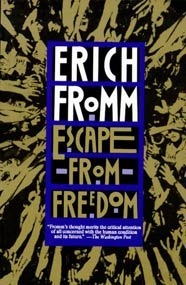
If humanity cannot live with the dangers and responsibilities inherent in freedom, it will probably turn to authoritarianism. This is the central idea of Escape from Freedom, a landmark work by one of the most distinguished thinkers of our time, and a book that is as timely now as when first published in 1941. Few books have thrown such light upon the forces that shape modern society or penetrated so deeply into the causes of authoritarian systems. If the rise of democracy set some people free, at the same time it gave birth to a society in which the individual feels alienated and dehumanized. Using the insights of psychoanalysis as probing agents, Fromm's work analyzes the illness of contemporary civilization as witnessed by its willingness to submit to totalitarian rule.

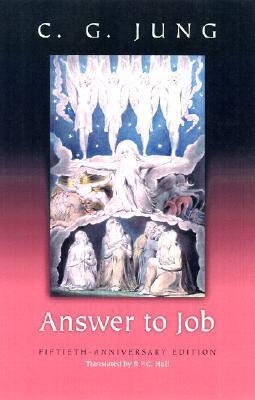
Jung has never pursued the "psychology of religion" apart from general psychology. The unique importance of his work lies rather in his discovery and treatment of religious, or potentially religious, factors in his investigation into the unconscious as a whole and in his general therapeutic practice. In Answer to Job, first published in Zurich in 1952, Jung employs the familiar language of theological discourse. Such terms as "God," "wisdom," and "evil" are the touchstones of his argument. And yet, Answer to Job, perhaps Jung's most controversial work, is not an essay in theology as much as it is an examination of the symbolic role that theological concepts play in a person's psychic life.

Freud's discovery that the dream is the means by which the unconscious can be explored is undoubtedly the most revolutionary step forward in the entire history of psychology. Dreams, according to his theory, represent the hidden fulfillment of our unconscious wishes.

A perennially best-selling and influential psychoanalytic work. When Otto Fenichel died suddenly at age 48, Anna Freud mourned the loss of "his inexhaustible knowledge of psychoanalysis and his inimitable way of organizing and presenting his facts." These qualities shine in his classic text, which has been a beacon to generations of psychoanalysts. Investigating the relationship between biological needs and external influences―the tensions and inhibitions that nurture neuroses―Fenichel concludes that "neuroses are social diseases," arising from the demands of civilization on the developing organism. For this 50th anniversary edition, distinguished psychoanalyst Leo Rangell has written an introduction to set the context of Fenichel's work and an epilogue to describe its influence.

A study of the analogies between alchemy, Christian dogma, and psychological symbolism. Revised translation, with new bibliography and index.