
Erich Neumann
Erich Neumann (Hebrew: אריך נוימן) was a psychologist, writer, and one of Carl Jung's most gifted students. Neumann received his Ph.D. from the University of Berlin in 1927. He practiced analytical psychology in Tel Aviv from 1934 until his death in 1960. For many years, he regularly returned to Zürich, Switzerland to give lectures at the C. G. Jung Institute. He also lectured frequently in England, France and the Netherlands, and was a member of the International Association for Analytical Psychology and president of the Israel Association of Analytical Psychologists. Erich Neumann contributed greatly to the field of developmental psychology and the psychology of consciousness and creativity. Neumann had a theoretical and philosophical approach to analysis, contrasting with the more clinical concern in England and the United States. His most valuable contribution to psychology was the empirical concept of "centroversion", a synthesis of extra- and introversion. However, he is best known for his theory of feminine development, a theory formulated in numerous publications, most notably The Great Mother. His works also elucidate the way mythology throughout history reveals aspects of the development of consciousness that are parallel in both the individual and society as a whole.
30 Books Written

This landmark book explores the Great Mother as a primordial image of the human psyche. Here the renowned analytical psychologist Erich Neumann draws on ritual, mythology, art, and records of dreams and fantasies to examine how this archetype has been outwardly expressed in many cultures and periods since prehistory. He shows how the feminine has been represented as goddess, monster, gate, pillar, tree, moon, sun, vessel, and every animal from snakes to birds. Neumann discerns a universal experience of the maternal as both nurturing and fearsome, an experience rooted in the dialectical relation of growing consciousness, symbolized by the child, to the unconscious and the unknown, symbolized by the Great Mother.Featuring a new foreword by Martin Liebscher, this Princeton Classics edition of The Great Mother introduces a new generation of readers to this profound and enduring work.

The Origins and History of Consciousness draws on a full range of world mythology to show how individual consciousness undergoes the same archetypal stages of development as human consciousness as a whole. Erich Neumann was one of C. G. Jung's most creative students and a renowned practitioner of analytical psychology in his own right. In this influential book, Neumann shows how the stages begin and end with the symbol of the Uroboros, the tail-eating serpent. The intermediate stages are projected in the universal myths of the World Creation, Great Mother, Separation of the World Parents, Birth of the Hero, Slaying of the Dragon, Rescue of the Captive, and Transformation and Deification of the Hero. Throughout the sequence, the Hero is the evolving ego consciousness.Featuring a foreword by Jung, this Princeton Classics edition introduces a new generation of readers to this eloquent and enduring work.

s/t: A Commentary on the Tale by ApuleiusRoutledge is now re-issuing this prestigious series of 204 volumes originally published between 1910 and 1965. The titles include works by key figures such as C.G. Jung, Sigmund Freud, Jean Piaget, Otto Rank, James Hillman, Erich Fromm, Karen Horney and Susan Isaacs. Each volume is available on its own, as part of a themed mini-set, or as part of a specially-priced 204-volume set. A brochure listing each title in the International Library of Psychology series is available upon request.

The modern world has witnessed a dramatic breakthrough of the dark, negative forces of human nature. The "old ethic," which pursued an illusory perfection by repressing the dark side, has lost its power to deal with contemporary problems. Erich Neumann was convinced that the deadliest peril now confronting humanity lay in the "scapegoat" psychology associated with the old ethic. We are in the grip of this psychology when we project our own dark shadow onto an individual or group identified as our "enemy," failing to see it in ourselves. The only effective alternative to this dangerous shadow projection is shadow recognition, acknowledgement, and integration into the totality of the self. Wholeness, not perfection, is the goal of the new ethic.

These essays by the famous analytical psychologist and student of creativity Erich Neumann belong in the context of the depth psychology of culture and reveal a prescient concern about the one-sidedness of patriarchal Western civilization. Neumann recommended a "cultural therapy" that he thought would redress a "fundamental ignorance" about feminine and masculine psychology, and he looked for societal healing to a "matriarchal consciousness" that forms the bridge between the feminine and the creative.Brought together here for the first time, the essays in the book discuss the psychological stages of woman's development, the moon and matriarchal consciousness, Mozart's Magic Flute, the meaning of the earth archetype for modern times, and the fear of the feminine. In Mozart's fantastic world, Neumann saw a true Auseinandersetzung --the conflict and coming-to-terms with each other of the matriarchal and the patriarchal worlds. Developing such a synthesis of the feminine and the masculine in the psychic reality of the individual and of the collective was, he argued, one of the fundamental, future-oriented tasks of both the society and the individual.

Four essays on the psychological aspects of art. A study of Leonardo treats the work of art, & art itself, not as ends in themselves, but rather as instruments of the artist's inner situation. Two other essays discuss the relation of art to its epoch & specifically the relation of modern art to our own time. An essay on Chagall views this artist in the context of the problems explored in the other studies.


In 1934, Erich Neumann, considered by many to have been Carl Gustav Jung's foremost disciple,sent Jung a handwritten "I will pursue your suggestion of elaborating on the 'SymbolicContributions' to the Jacob-Esau problem . . . The great difficulty is the rather depressingimpossibility of a publication." Now, eighty years later, in Jacob and On the CollectiveSymbolism of the Brother Motif , his important work is finally published. In this newly discovered manuscript, Neumann sowed the seeds of his later works. It provides awindow into his original thinking and creative writing regarding the biblical subject of Jacob andEsau and the application of the brother motif to analytical psychology. Neumann elaborates on the central role of the principle of opposites in the human soul,contrasting Jacob's introversion with Esau's extraversion, the sacred and the profane, the innerand the outer aspects of the God-image, the shadow and its projection, and how the old ethic-expressed, for example, in the expulsion of the scapegoat-perpetuates evil. Mark Kyburz, translator of C. G. Jung's The Red Book , has eloquently rendered Neumann's textinto English. Erel Shalit's editing and introduction provide an entrée into Neumann's work onthis subject, which will be of interest to a wide range of readers, from lay persons toprofessionals interested in Jungian psychology and Jewish and religious studies. Erich Neumann was born in Berlin in 1905. He emigrated to Israel in 1934 and lived in Tel Avivuntil his death in 1960. For many years he lectured and played a central role at Eranos, theseminal conference series in analytical psychology. His writings include Depth Psychology and aNew Ethic , The Origins and History of Consciousness , and The Great Mother . Thecorrespondence between C. G. Jung and Neumann was published in 2015. Dr. Erel Shalit is a Jungian psychoanalyst in Israel and founding director of the AnalyticalPsychotherapy Program at Bar Ilan University. He is the author of several books, including TheCycle of Life and The Hero and His Shadow . Dr. Mark Kyburz specializes in scholarly translation from German into English and is the co-translator of C. G. Jung's The Red Book (2009). He lives and works in Zürich, Switzerland.

This selection of essays by one of C. G. Jung's favorite and most creative students explores important connections between analytical psychology and the study of literature and art.Originally published in 1979.The Princeton Legacy Library uses the latest print-on-demand technology to again make available previously out-of-print books from the distinguished backlist of Princeton University Press. These editions preserve the original texts of these important books while presenting them in durable paperback and hardcover editions. The goal of the Princeton Legacy Library is to vastly increase access to the rich scholarly heritage found in the thousands of books published by Princeton University Press since its founding in 1905.

The description for this book, Archetypal World of Henry Moore, will be forthcoming.


The Roots of Jewish Consciousness, Volume One: Revelation and Apocalypse
by Erich Neumann
Rating: 3.7 ⭐
The Roots of Jewish Consciousness, Volume Revelation and Apocalypse is the first volume, fully annotated, of a major, previously unpublished, two-part work by Erich Neumann (1905–1960). It was written between 1934 and 1940, after Neumann, then a young philosopher and physician and freshly trained as a disciple of Jung, fled Berlin to settle in Tel Aviv. He finished the second volume of this work at the end of World War II. Although he never published either volume, he kept them the rest of his life.The challenge of Jewish survival frames Neumann’s work existentially. This survival, he insists, must be psychological and spiritual as much as physical. In Volume One, Revelation and Apocalypse, he argues that modern Jews must relearn what ancient Jews once understood but lost during the Babylonian that is, the individual capacity to meet the sacred directly, to receive revelation, and to prophesy. Neumann interprets scriptural and intertestamental (apocalyptic) literature through the lens of Jung’s teaching, and his reliance on the work of Jung is supplemented with references to Buber, Rosenzweig, and Auerbach. Including a foreword by Nancy Swift Furlotti and editorial introduction by Ann Conrad Lammers, readers of this volume can hold for the first time the unpublished work of Neumann, with useful annotations and insights throughout.These volumes anticipate Neumann’s later works, including Depth Psychology and a New Ethic, The Origins and History of Consciousness, and The Great Mother. His signature contribution to analytical psychology, the concept of the ego–Self axis, arises indirectly in Volume One, folded into Neumann’s theme of the tension between earth and YHWH. This unique work will appeal to Jungian analysts and psychotherapists in training and in practice, historians of psychology, Jewish scholars, biblical historians, teachers of comparative religion, as well as academics and students.
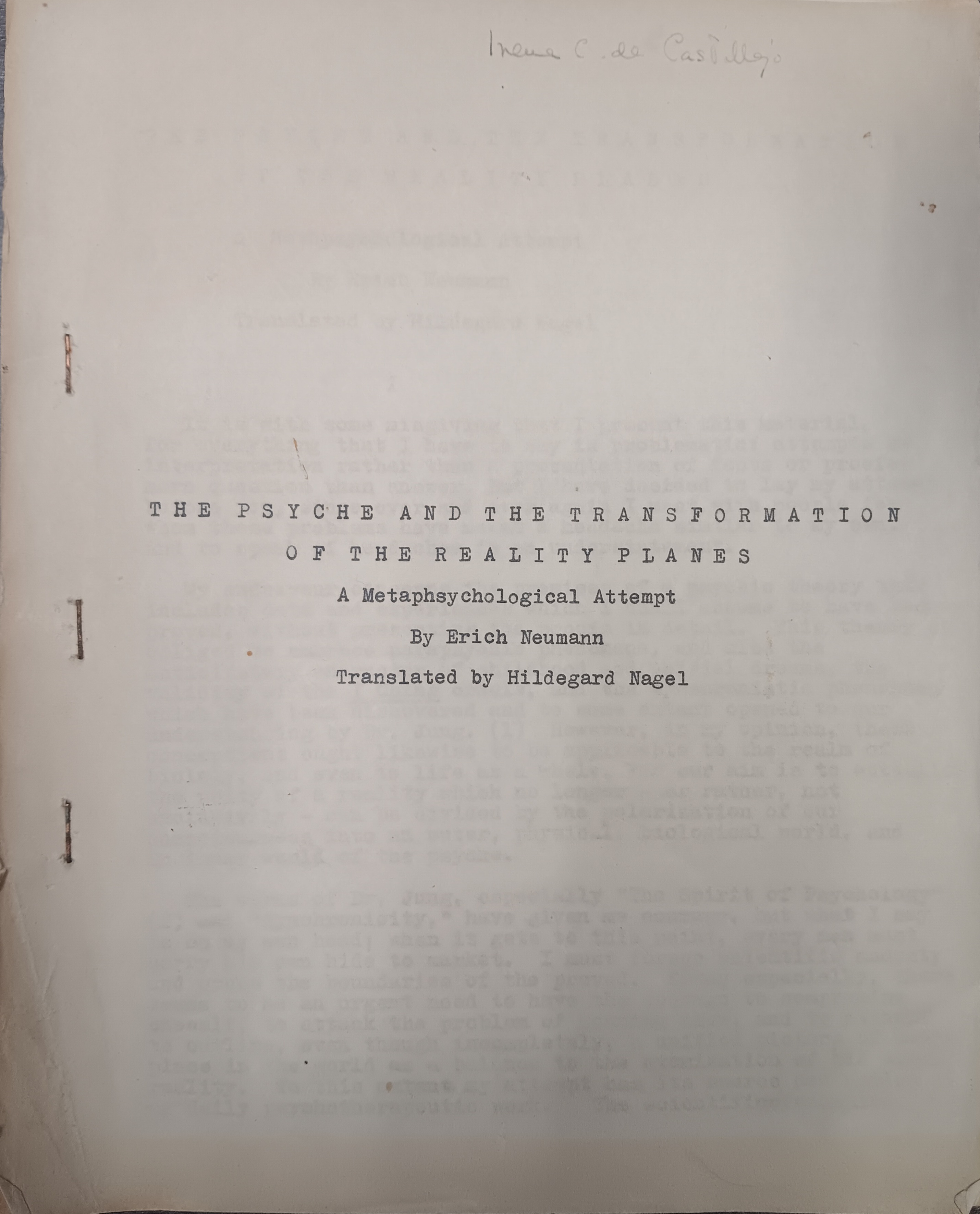
The Psyche and the Transformation of the Reality Planes: A Metaphysical Attempt
by Erich Neumann
Rating: 5.0 ⭐
Staple bound, typewriter printed. Seminar notes from Neumann's 1952 Eranos Lecture. The Eranos theme of 1952 is Men and Energy, and Neumann here presents the concept of Self-Ego.

The Roots of Jewish Consciousness, Volume Two: Hasidism is the second volume, fullyannotated, of a major, previously unpublished, two-part work by Erich Neumann (1905–1960). It was written between 1940 and 1945, after Neumann, then a young philosopher and physician and freshly trained as a disciple of Jung, fled Berlin to settle in Tel Aviv. He finished this work at the end of World War II. Although he never published it, he kept it the rest of his life.Volume Two, Hasidism, is devoted to the psychological and spiritual wisdom embodied in Jewish spiritual tradition. Relying on Jung’s concepts and Buber’s Hasidic interpretations, Neumann seeks alternatives to the legalism and anti-feminine bias that he says have dominated collective Judaism since the Second Temple. He argues that modern Jews can develop psychological wholeness through an appropriation of Hasidic legends, Talmudic texts, and Kabbalistic mysteries, including especially the Zohar. Exclusively, this volume includes a foreword by Moshe Idel. An appendix, Neumann’s four-lecture series from the 1940s, gives a glimpse of his intended, unpublished Part Three.These volumes anticipate Neumann’s later works, including Depth Psychology and a New Ethic, The Origins and History of Consciousness, and The Great Mother. In Volume Two, Hasidism, his concept of the ego–Self axis is developed in clearly psychological terms. Four previously unpublished essays, appended to Volume Two, illustrate Neumann’s developmental psychology, including his theme of primary and secondary personalization. This unique work will appeal to Jungian analysts and psychotherapists in training and in practice, historians of psychology, Jewish scholars, biblical historians, teachers of comparative religion, as well as academics and students.


The Israeli analytical psychologist Erich Neumann, whom C. G. Jung regarded as one of his most gifted students, devoted much of his later writing to the theme of creativity. This is the third volume of Neumann's essays on that subject. Neumann found his examples not only in the work of writers and artists--William Blake, Goethe, Rilke, Kafka, Klee, Chagall, Picasso, Trakl--but as well in that of physicists, biologists, psychiatrists, and philosophers. Confronting the problem of portraying men and women as creative beings, Neumann expanded the concepts of Jungian psychology with a more comprehensive definition of the archetype and a new concept--"unitary reality." Whether or not humanity can be restored to health from its present situation as a self-endangered species depends, according to Neumann, on whether we can experience ourselves as truly creative, in touch with our own being and the world's being. The six essays comprising this volume--"The Psyche and the Transformation of the Reality Planes," "The Experience of the Unitary Reality," "Creative Man and the `Great Experience,'" "Man and Meaning," "Peace as the Symbol of Life," and "The Psyche as the Place of Creation"--all originated as lectures at the Eranos Conferences in the years 1952 to 1960.Originally published in 1989.The Princeton Legacy Library uses the latest print-on-demand technology to again make available previously out-of-print books from the distinguished backlist of Princeton University Press. These editions preserve the original texts of these important books while presenting them in durable paperback and hardcover editions. The goal of the Princeton Legacy Library is to vastly increase access to the rich scholarly heritage found in the thousands of books published by Princeton University Press since its founding in 1905.

Ako žena želi da razume samu sebe, neophodno je da otkrije dubinsku psihologiju Ženskog koja prevazilazi muško-patrijarhalnu perspektivu koja je hiljadama godina bila svojstvena zapadne svesti.U ovoj knjizi Nojman je sakupio, proširio i preradio svoja tri eseja o psihologiju ženskog, koji se uzajamno dopunjuju i stapaju u studiju o ovoj temi. Oni razmatraju psihološke stadijume ženinog razvitka, Mesec i matrijarhalnu svet i Mocartovu Čarobnu frulu. Autor je u Mocartovom fantastičnom svetu video onaj istinski sukob i izmirenje muškog i ženskog sveta. Razvoj takve sinteze ženskog i muškog u psihičkoj stvarnosti pojedinca i kolektiva je, tvrdi, on, jedan od temeljnih, budućnosti orijentisanih zadataka i društva i pojedinca. U zapadnoj svesti - a to je ključna ideja ove knjige - preovlađuje sistem jednostranih muško-patrijarhalnih vrednosti i bazično nepoznavanje specifičnosti i različitosti ženske psihologije; takva situacija presudno je doprinela krizi koja potresa naše doba. Prema tome, prevrednovanje psihologije ženskog i novo shvatanje njegovog specifičnog karaktera danas je neizbežno – neizbežno ne samo radi psihičkog zdravlja pojedinca nego i zdravlja čitavog kolektiva.Ukoliko žena želi da razume samu sebe, ali i ukoliko muško-patrijarhalni svet oboleo od jednostranosti želi da ozdravi, neophodno je iznova otkriti tu „različitost“ ženske psihe. Analitička psihologija je prepoznala da je u nesvesnom muškarca prisutno i aktivno žensko, te da je u ženi prisutno i aktivno ono muško. Da bi se razumeli svi problemi u vezi s ljubavnim odnosom i brakom potrebna nam je dubinska psihologija ženskog koja bi vodila računa o tim novim saznanjima; ona će doprineti da i muškarci i žene potpunije razumeju vlastitu prirodu.

בספר זה מובאות, לראשונה בעברית, שלוש מסות אשר אותן כתב אריך נוימן בין השנים 1952-1959, שנותיו האחרונות לפני מותו בטרם עת. שלוש המסות נכתבו מלכתחילה כהרצאות לכנסי "ארנוס". בשלושתן מציג נוימן את המטא-פסיכולוגיה שהמשיג במהלך למעלה מעשר שנים של חשיבה תיאורטית. מסות אלה הן בבחינת מארג שהוא מלאכת מחשבת של חיבור תורת הנפש הארכיטיפית מבית מדרשו של יונג עם עמדה אקזיסטנציליסטית-דיאלוגית. הציר אגו-עצמי, אשר הנו מרכזי במטא-פסיכולוגיה של נוימן, הוא התרומה הייחודית של נוימן לפסיכולוגיה היונגיאנית. ציר זה מבטא מרכז ושלמות דיאלוגית, יחס של הדדיות גם בעולם הפנימי וגם כלפי העולם שבחוץ. שלוש המסות המובאות כאן מציגות שלושה היבטים של הציר אגו-עצמי .המסה "הנפש וגלגול מישורי המציאות" (1952) מציגה המשגה חדשה של מעמד האדם בעולם, במודל של שדות ידע, כשהציר אגו-עצמי חותך את כולם וסביבו מתמרכזת נפש האדם. נוימן מתאר שלושה מישורי מציאות או שדות ידע: שדה המציאות, השדה הארכיטיפאלי ושדה העצמי. שדות אלה מתקיימים תמיד בו-זמנית. במסה "האדם ומשמעות" (1957) מתמודד נוימן עם שאלת משמעות הקיום, תוך כדי כך שהוא מביא את עצמו כמאמין באלוהים וכמחובר למורשת היהודית. המשמעות והתקווה של חיי אנוש טמונים בקשר שבין אדם לאדם ובין כל אדם עם האנושות כולה – מה שמאפשר את התממשות היצירתיות. המסה "הנפש כמקום היצירה" (1959) מציגה את האבולוציה של מה שנוימן מכנה "רוח החיים היצירתית" של האדם, אשר חבויה כבר מראש בכל הבריאה. עמדתו הבסיסית של נוימן היא שהאבולוציה מוציאה מהכוח אל הפועל את הגרעין היצירתי של האדם בתוך עולמו.

So wie Mann und Frau von Natur her durch das Männliche in ihnen gezwungen werden, die Urbeziehung zu verlassen und den Weg zum Ich und zum Bewusstsein zu finden, so werden beide durch das Weibliche in ihnen gezwungen, auch diese Position wieder aufzugeben und zu einer Ganzheit vorzudringen, die Männliches und Weibliches umfasst.

El niño.: Estructura y dinámica de la personalidad en formación. (Traducciones Junguianas)
by Erich Neumann

Kunst und schöpferisches Unbewusstes
by Erich Neumann

Die Psyche als Ort der Gestaltung: Eranos-Aufsätze Band II
by Erich Neumann

Mensch und Kultur im Übergang: Krise und Erneuerung; Tiefenpsychologie und neue Ethik
by Erich Neumann

Einhorn Malbuch: Für Kinder im Alter von 8-12; Ein Zauber Kid Arbeitsmappe Spiel für das Lernen, Malen und vieles mehr!
by Erich Neumann
Brillanz und schöne Zeichnungen machen diese abwechslungsreiche Buch perfekt für Jungen und Mädchen, und Kinder, die Einhorn Färbung Bücher lieben Das Buch enthä • Alle Bilder sind auf großen.• Malbuch für Kinder hat eine wunderschöne Sammlung von 100 Einhorn-Illustrationen für Ihr Kind!• Tolle Zeichnungen unserer Einhorn-Freunde - man kann sie im Kosmos herumhüpfen sehen, Spaß im Gras haben und sich wie ein echtes Einhorn ausruhen. Das Buch ist bestens als Geschenk geeignet - vor allem beliebt bei Mädchen. Zeit in das Land der Einhörner und Regenbögen einzutauchen, Stress abzubauen und einfach mal spielerisch kreativ sein. ★Ganz viel Freude damit!

Four essays on the psychological aspects of art. A study of Leonardo treats the work of art, and art itself, not as ends in themselves, but rather as instruments of the artist's inner situation. Two other essays discuss the relation of art to its epoch and specifically the relation of modern art to our own time. An essay on Chagall views this artist in the context of the problems explored in the other studies.
Die Psyche als Ort der Gestaltung
by Erich Neumann

=Man the researcher and player. The mystical experience and creativity in human life