Loading genres...
Explore the best books about College genre.


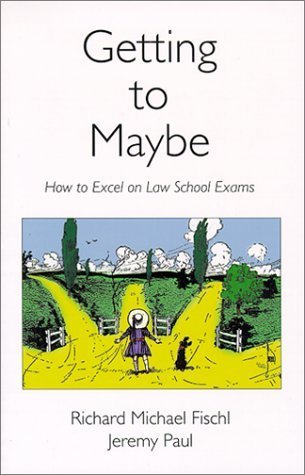
Professors Fischl and Paul explain law school exams in ways no one has before, all with an eye toward improving the reader's performance. The book begins by describing the difference between educational cultures that praise students for "right answers" and the law school culture that rewards nuanced analysis of ambiguous situations in which more than one approach may be correct. Enormous care is devoted to explaining precisely how and why legal analysis frequently produces such perplexing situations. But the authors don't stop with mere description. Instead, Getting to Maybe teaches how to excel on law school exams by showing the reader how legal analysis can be brought to bear on examination problems. The book contains hints on studying and preparation that go well beyond conventional advice. The authors also illustrate how to argue both sides of a legal issue without appearing wishy-washy or indecisive. Above all, the book explains why exam questions may generate feelings of uncertainty or doubt about correct legal outcomes and how the student can turn these feelings to his or her advantage. In sum, although the authors believe that no exam guide can substitute for a firm grasp of substantive material, readers who devote the necessary time to learning the law will find this book an invaluable guide to translating learning into better exam performance.

The only guide to getting ahead once you’ve gotten in—proven strategies for making the most of your college years, based on winning secrets from the country's most successful students What does it take to be a standout student? How can you make the most of your college years—graduate with honors, choose exciting activities, build a head-turning resume, and gain access to the best post-college opportunities? Based on interviews with star students at universities nationwide, from Harvard to the University of Arizona, How to Win at College presents seventy-five simple rules that will rocket you to the top of the class. These college-tested—and often surprising—strategies include:• Don’t do all your reading• Drop classes every term• Become a club president• Care about your grades, Ignore your GPA• Never pull an all-nighter• Take three days to write a paper• Always be working on a “grand project”• Do one thing better than anyone else you knowProving that success has little to do with being a genius workaholic, and everything to do with playing the game, How to Win at College is the must-have guide for making the most of these four important years—and getting an edge on life after graduation.

Looking to jumpstart your GPA? Most college students believe that straight A's can be achieved only through cramming and painful all-nighters at the library. But Cal Newport knows that real straight-A students don't study harder--they study smarter. A breakthrough approach to acing academic assignments, from quizzes and exams to essays and papers, "How to Become a Straight-A Student" reveals for the first time the proven study secrets of real straight-A students across the country and weaves them into a simple, practical system that anyone can master. You will learn how to: Streamline and maximize your study time Conquer procrastinationAbsorb the material quickly and effectivelyKnow which reading assignments are critical--and which are notTarget the paper topics that wow professorsProvide A+ answers on examsWrite stellar prose without the agony A strategic blueprint for success that promises more free time, more fun, and top-tier results, "How to Become a Straight-A Student" is the only study guide written by students for students--with the insider knowledge and real-world methods to help you master the college system and rise to the top of the class.

Internationally-renowned directing coach Weston demonstrates what constitutes a good performance, what actors want from a director, what directors do wrong, script analysis and preparation, how actors work, and shares insights into the director/actor relationship.

The Seventh Edition of Intermediate Microeconomics: A Modern Approach is distinguished by its remarkably up-to-date and rigorous yet accessible analytical approach. Professor Varian’s lucid prose guides students through the fundamentals of microeconomic analysis while emphasizing real-world economic problems and incorporating coverage of the most innovative subjects in the discipline. The Seventh Edition has been carefully updated and revised, adding a wealth of new applications and examples that analyze the important lessons offered by eBay, Google, Verizon, IBM, Microsoft, Bank of America, drug companies, the Yellow Pages, and more.

Here are some of the most-loved poems in the English language, chosen not merely for their popularity, but for their literary quality as well. Dating from the Middle Ages to the 20th century, these splendid poems remain evergreen in their capacity to engage our minds and refresh our spirits. Among them are "The Passionate Shepherd to His Love"; "Sonnet XVIII" ("Shall I compare thee to a summer's day?"); "Holy Sonnet X" ("Death, be not proud"); "To His Coy Mistress"; "I Wandered Lonely as a Cloud"; "Ode to the West Wind"; "The Children's Hour"; "The Raven"; "The Charge of the Light Brigade"; "O Captain! My Captain!"; "This Is My Letter to the World"; "When You Are Old"; "The Road Not Taken"; "First Fig."Works by many other poets — Milton, Blake, Burns, Coleridge, Byron, Keats, Emerson, the Brownings, Hardy, Housman, Kipling, Pound, and Auden among them — are included in this treasury, a perfect companion for quiet moments of reflection.

Awaiting his trial on charges of impiety and heresy, Socrates encounters Euthyphro, a self-proclaimed authority on matters of piety and the will of the gods. Socrates, desiring instruction in these matters, converses with Euthyphro, but as usual, the man who professes to know nothing fares better than the man who claims to be an expert. One of Plato’s well-known Socratic Dialogues, Euthyphro probes the nature of piety, and notably poses the so-called Euthyphro Dilemma: Do the gods love a thing because it is holy, or is a thing holy because it is loved by the gods?

Painting and Experience in Fifteenth Century Italy An introduction to 15th century Italian painting and the social history behind it, arguing that the two are interlinked and that the conditions of the time helped fashion distinctive elements in the painter's style. Serving as both an introduction to fifteenth-century Italian painting and as a text on how to interpret social history from the style of pictures in a given historical period, this new edition to Baxandall's pre-eminent scholarly volume examines early Renaissance painting, and explains how the style of painting in any society reflects the visual skills and habits that evolve out of daily life. Renaissance painting, for example, mirrors the experience of such activities as preaching, dancing, and gauging barrels. The volume includes discussions of a wide variety of painters, including Filippo Lippi, Fra Angelico, Stefano di Giovanni, Sandro Botticelli, Masaccio, Luca Signorelli, Boccaccio, and countless others. Baxandall also defines and illustrates sixteen concepts used by a contemporary critic of painting, thereby assembling the basic equipment needed to explore fifteenth-century art.

This book presents the major teachings of Mah y na Buddhism in a precise, dramatic, and even humorous form. For two millennia this S tra, called the jewel of the Mah y na S tras, has enjoyed immense popularity among Mah y na Buddhists in India, central and southeast Asia, Japan, and especially China, where its incidents were the basis for a style in art and literature prevalent during several centuries.Robert Thurman s translation makes available in relatively nontechnical English the Tibetan version of this key Buddhist scripture, previously known to the English-speaking world only through translations from Chinese texts. The Tibetan version is generally conceded to be more faithful to the original Sanskrit than are the Chinese texts. The Tibetan version also is clearer, richer, and more precise in its philosophical and psychological expression. The twelve books of the S tra are accompanied by an introduction and an epilogue by Dr. Thurman and by three glossaries: Sanskrit terms, numerical categories, and technical terms."

Commissioned by the Circle Repertory Company, Burn This first appeared at the Mark Taper Forum in Los angeles in 1987 to near-universal praise. Set in the bohemian art world of downtown New York, this vivid and challenging drama explores the spiritual and emotional isolation of Anna and Pale, two outcasts who meet in the wake of the accidental death by drowning of a mutual friend. Their determined struggle toward emotional honesty and liberation--by no means guaranteed at the play's ambiguous end--exemplifies the strength, humor, and complexity of all of Lanford Wilson's work and confirms his standing as one of America's greatest living playwrights.Lanford Wilson was born in Lebanon, Missouri, in 1938 and attended the University of Chicago. A founding member of the Circle Repertory Company in New York, he has seen many of his plays produced in theaters all over the United States and abroad. He is the recipient of many awards, including a Drama Desk Vernon Rice Award, the Pulitzer Prize, and two Obies.

The classic work that introduced the concept of the Garden City. Originally published in 1898 as A Peaceful Path to Real Reform and reissued in 1902 under its present title, Garden Cities of To-Morrow holds a unique place in town planning literature. The book led directly to two experiments in town-founding that have had a profound influence on practical urban development around the world. The book was also responsible for the introduction of the term Garden City, and set into motion ideas that helped transform town planning.

Conceptual Physics, Tenth Edition helps readers connect physics to their everyday experiences and the world around them with additional help on solving more mathematical problems. Hewitt's text is famous for engaging readers with analogies and imagery from real-world situations that build a strong conceptual understanding of physical principles ranging from classical mechanics to modern physics. With this strong foundation, readers are better equipped to understand the equations and formulas of physics, and motivated to explore the thought-provoking exercises and fun projects in each chapter. Included in the package is the workbook. Mechanics, Properties of Matter, Heat, Sound, Electricity and Magnetism, Light, Atomic and Nuclear Physics, Relativity. For all readers interested in conceptual physics.

Drawing on local Chinese histories, the memoirs of scholars, and other contemporary writings, Chinese historian Jonathan Spence reconstructs an extraordinary tale of rural tragedy in a remote corner of Shantung province in 17th-century China. Life in the county of T'an-ch'eng emerges as an endless cycle of floods, plagues, crop failures, banditry, and heavy taxation. Against this turbulent background a tenacious tax collector, an irascible farmer, and an unhappy wife act out a poignant drama at whose climax the wife, having run away from her husband, returns to him, only to die at his hands.

‘One swallow does not make a summer; neither does one day. Similarly neither can one day, or a brief space of time, make a man blessed and happy’In the Nicomachean Ethics, Aristotle sets out to examine the nature of happiness. He argues that happiness consists in ‘activity of the soul in accordance with virtue’, for example with moral virtues, such as courage, generosity and justice, and intellectual virtues, such as knowledge, wisdom and insight. The Ethics also discusses the nature of practical reasoning, the value and the objects of pleasure, the different forms of friendship, and the relationship between individual virtue, society and the State. Aristotle’s work has had a profound and lasting influence on all subsequent Western thought about ethical matters.J. A. K. Thomson’s translation has been revised by Hugh Tredennick, and is accompanied by a new introduction by Jonathan Barnes. This edition also includes an updated list for further reading and a new chronology of Aristotle’s life and works.Previously published as Ethics

Do Less, Live More, Get Accepted What if getting into your reach schools didn’t require four years of excessive A.P. classes, overwhelming activity schedules, and constant stress? In How to Be a High School Superstar, Cal Newport explores the world of relaxed superstars—students who scored spots at the nation’s top colleges by leading uncluttered, low stress, and authentic lives. Drawing from extensive interviews and cutting-edge science, Newport explains the surprising truths behind these superstars’ mixture of happiness and admissions success, · Why doing less is the foundation for becoming more impressive.· Why demonstrating passion is meaningless, but being interesting is crucial.· Why accomplishments that are hard to explain are better than accomplishments that are hard to do. These insights are accompanied by step-by-step instructions to help any student adopt the relaxed superstar lifestyle—proving that getting into college doesn’t have to be a chore to survive, but instead can be the reward for living a genuinely interesting life.

Much of what is written about colleges and universities ties rapidly rising tuition to dysfunctional behavior in the academy. Common targets of dysfunction include prestige games among universities, gold plated amenities, and bloated administration. This book offers a different view. To explain rising college cost, the authors place the higher education industry firmly within the larger economic history of the United States. The trajectory of college cost is similar to cost behavior in many other industries, and this is no coincidence. Higher education is a personal service that relies on highly educated labor. A technological trio of broad economic forces has come together in the last thirty years to cause higher education costs, and costs in many other industries, to rise much more rapidly than the inflation rate. The main culprit is economic growth itself.This finding does not mean that all is well in American higher education. A college education has become less reachable to a broad swathe of the American public at the same time that the market demand for highly educated people has soared. This affordability problem has deep roots. The authors explore how cost pressure, the changing wage structure of the US economy, and the complexity of financial aid policy combine to reduce access to higher education below what we need in the 21st century labor market.This book is a call to calm the rhetoric of blame and to instead find policies that will increase access to higher education while preserving the quality of our colleges and universities.

In spite of soaring tuition costs, more and more students go to college every year. A bachelor’s degree is now required for entry into a growing number of professions. And some parents begin planning for the expense of sending their kids to college when they’re born. Almost everyone strives to go, but almost no one asks the fundamental question posed by Academically Adrift: are undergraduates really learning anything once they get there?For a large proportion of students, Richard Arum and Josipa Roksa’s answer to that question is a definitive no. Their extensive research draws on survey responses, transcript data, and, for the first time, the state-of-the-art Collegiate Learning Assessment, a standardized test administered to students in their first semester and then again at the end of their second year. According to their analysis of more than 2,300 undergraduates at twenty-four institutions, 45 percent of these students demonstrate no significant improvement in a range of skills—including critical thinking, complex reasoning, and writing—during their first two years of college. As troubling as their findings are, Arum and Roksa argue that for many faculty and administrators they will come as no surprise—instead, they are the expected result of a student body distracted by socializing or working and an institutional culture that puts undergraduate learning close to the bottom of the priority list.Academically Adrift holds sobering lessons for students, faculty, administrators, policy makers, and parents—all of whom are implicated in promoting or at least ignoring contemporary campus culture. Higher education faces crises on a number of fronts, but Arum and Roksa’s report that colleges are failing at their most basic mission will demand the attention of us all.

Since their publications in 1982, Samuel Shirley's translations of Spinoza's Ethics and Selected Letters have been commended for their accuracy and readability. Now with the addition of his new translation of Treatise on the Emendation of the Intellect this enlarged edition will be even more useful to students of Spinoza's thought.

“Annie Baker’s John is so good on so many levels that it casts a unique and brilliant light… By not rushing things—by letting the characters develop as gradually and inevitably as rain or snowfall—Baker returns us to the naturalistic but soulful theatre that many of her contemporaries and near-contemporaries have disavowed in their rush to be 'postmodern.'”– New Yorker“ John , like any great play, raises a lot of questions–not just about the human experience, but also about the state of contemporary theater, it doesn’t provide many answers; it is not the playwright’s responsibility to do so.… In John she co-opts the viewer for her own aesthetic use, heightening the tension onstage and deepening the quiet relationships between her characters. Through John, she displays an understanding that the audience is part of the theatrical experience, an inevitability as certain as a Chekhovian gun.” – SlateThe week after Thanksgiving. A bed & breakfast in Gettysburg, Pennsylvania. A cheerful innkeeper. A young couple struggling to stay together. Thousands of inanimate objects, watching.The description by the playwright of the setting is simple, but Annie Baker’s compelling new work is revolutionary in theme and structure and challenges the boundaries of what theatre can be. A kind of magical super-realism permeates throughout this quietly evolving tale, with both the actors and the audience fully vested together in a mesmerizing exploration of the frailty and loneliness of human experience.

In her fourth collection, Aimee Nezhukumatathil hums a bright blue note—a sensuous love song to the Earth and its inhabitants. Oceanic is both a title and an ethos of radical inclusion, inviting in the grief of an elephant, the icy eyes of a scallop, “the ribs / of a silver silo,” and the bright flash of painted fingernails. With unmatched sincerity, Oceanic speaks to each reader as a cooperative part of the natural world—the extraordinary neighborhood to which we all belong. This is a poet ecstatically, emphatically, naming what it means to love a world in peril.

Celebrating thirty years, the 2018 edition of the Best American Poetry—“a ‘best’ anthology that really lives up to its title” (Chicago Tribune)—collects the most significant poems of the year, chosen by Poet Laureate of California Dana Gioia.In a review of Best American Poetry 2017, The Washington Post said, “The poems, ordered alphabetically by author, have a wonderful cohesion and flow, as if each contributes to a larger narrative about life today.” The guest editor for 2018, Dana Gioia, has an unconventional poetic background. Gioia has published five volumes of poetry, served as the Chairman of the National Endowment for the Arts, and currently sits as the Poet Laureate of California, but he is also a graduate of Stanford Business School and was once a Vice President at General Foods. He has studied opera and is a published librettist, in addition to his prolific work in critical essay writing and editing literary anthologies. Having lived several lives, Gioia brings an insightful, varied, eclectic eye to this year’s Best American Poetry.With his classic essay “Can Poetry Matter?”, originally run in The Atlantic in 1991, Gioia considered whether there is a place for poetry to be a part of modern American mainstream culture. Decades later, the debate continues, but Best American Poetry 2018 stands as evidence that poetry is very much present, relevant, and finding new readers.

Every parent wants the best for their child.That’s why they send them to college! But most parents struggle to pay for school and end up turning to student loans. That’s why the majority of graduates walk away with $35,000 in student loan debt and no clue what that debt will really cost them.Student loan debt doesn’t open doors for young adults—it closes them. They postpone getting married and starting a family. That debt even takes away their freedom to pursue their dreams. But there is a different way. Going to college without student loans is possible!In Debt-Free Degree, Anthony ONeal teaches parents how to get their child through school without debt, even if they haven’t saved for it. He also shows parents:-How to prepare their child for college-Which classes to take in high school-How and when to take the ACT and SAT-The right way to do college visits-How to choose a majorA college education is supposed to prepare a graduate for their future, not rob them of their paycheck and freedom for decades. Debt-Free Degree shows parents how to pay cash for college and set their child up to succeed for life.

A collection of the best science and nature articles written in 2021, selected by guest editor renowned marine biologist Dr. Ayana Elizabeth Johnson and series editor Jaime Green. Dr. Ayana Elizabeth Johnson, renowned marine biologist and co-founder of the All We Can Save climate initiative, compiles the best science and nature writing of the year.