Loading genres...
Explore the best books about Us Presidents genre.

Doris Kearns Goodwin's classic life of Lyndon Johnson, who presided over the Great Society, the Vietnam War & other defining moments the tumultuous '60s, is a monument in political biography. From the moment the author, then a young woman from Harvard, 1st encountered President Johnson at a White House dance in the spring of 67, she became fascinated by the man: his character, his enormous energy & drive, & his manner of wielding these gifts in an endless pursuit of power. As a member of his White House staff, she soon became his personal confidante. In the years before his death he revealed himself to her as to no other. Widely praised & enormously popular, Lyndon Johnson & the American Dream is a biography like few others. With insight & a richly engrossing style, the author renders LBJ in all his vibrant, conflicted humanity.PrefacePrologueGrowing up Education & the dream of success The making of a politician Rise to power in the senateThe senate leader The vice-presidencyThe transition yearThe great society Vietnam Things go wrongUnder siege in the White House The withdrawalEpilogueAcknowledgmentsAuthor's PostscriptNotesIndex


Master of the Senate, Book Three of The Years of Lyndon Johnson, carries Johnson’s story through one of its most remarkable periods: his twelve years, from 1949 to 1960, in the United States Senate.At the heart of the book is its unprecedented revelation of how legislative power works in America, how the Senate works, and how Johnson, in his ascent to the presidency, mastered the Senate as no political leader before him had ever done. It was during these years that all Johnson’s experience—from his Texas Hill Country boyhood to his passionate representation in Congress of his hardscrabble constituents to his tireless construction of a political machine—came to fruition. Caro introduces the story with a dramatic account of the Senate itself: how Daniel Webster, Henry Clay, and John C. Calhoun had made it the center of governmental energy, the forum in which the great issues of the country were thrashed out. And how, by the time Johnson arrived, it had dwindled into a body that merely responded to executive initiatives, all but impervious to the forces of change. Caro anatomizes the genius for political strategy and tactics by which, in an institution that had made the seniority system all-powerful for a century and more, Johnson became Majority Leader after only a single term-the youngest and greatest Senate Leader in our history; how he manipulated the Senate’s hallowed rules and customs and the weaknesses and strengths of his colleagues to change the “unchangeable” Senate from a loose confederation of sovereign senators to a whirring legislative machine under his own iron-fisted control. Caro demonstrates how Johnson’s political genius enabled him to reconcile the unreconcilable: to retain the support of the southerners who controlled the Senate while earning the trust—or at least the cooperation—of the liberals, led by Paul Douglas and Hubert Humphrey, without whom he could not achieve his goal of winning the presidency. He shows the dark side of Johnson’s ambition: how he proved his loyalty to the great oil barons who had financed his rise to power by ruthlessly destroying the career of the New Dealer who was in charge of regulating them, Federal Power Commission Chairman Leland Olds. And we watch him achieve the impossible: convincing southerners that although he was firmly in their camp as the anointed successor to their leader, Richard Russell, it was essential that they allow him to make some progress toward civil rights. In a breathtaking tour de force, Caro details Johnson’s amazing triumph in maneuvering to passage the first civil rights legislation since 1875. Master of the Senate, told with an abundance of rich detail that could only have come from Caro’s peerless research, is both a galvanizing portrait of the man himself—the titan of Capital Hill, volcanic, mesmerizing—and a definitive and revelatory study of the workings and personal and legislative power.

Many modern historians have painted Ulysses S. Grant as a butcher, a drunk, and a failure as president. Others have argued the exact opposite and portray him with saintlike levels of ethic and intellect.In Ulysses S. Grant: Triumph over Adversity 1822–1865, historian Brooks D. Simpson takes neither approach, recognizing Grant as a complex and human figure with human faults, strengths, and motivations. Simpson offers a balanced and complete study of Grant from birth to the end of the Civil War, with particular emphasis on his military career and family life and the struggles he overcame in his unlikely rise from unremarkable beginnings to his later fame as commander of the Union Army. Chosen as a New York Times Notable Book upon its original publication, Ulysses S. Grant is a readable, thoroughly researched portrait that sheds light on this controversial figure.

After more than two decades, this dramatic and concise single-volume distillation of James Thomas Flexner's definitive four-volume biography "George Washington," which received a Pulitzer Prize citation and a National Book Award for the fourth volume, has itself become an American classic. Now in a new trade paperback edition, this masterful work explores the Father of Our Country - sometimes an unpopular hero, a man of great contradictions, but always a towering historical figure, who remains, as Flexner writes in these pages, "a fallible human being made of flesh and blood and spirit - not a statue of marble and wood... a great and good man." The author unflinchingly paints a portrait of Washington: slave owner, brave leader, man of passion, reluctant politician, and fierce general. His complex character and career are neither glorified nor vilified here; rather, Flexner sets up a brilliant counterpoint between Washington's public and private lives and gives us a challenging look at the man who has become as much a national symbol as the American flag.

A masterful work by Pulitzer Prize–winning author David Herbert Donald, Lincoln is a stunning portrait of Abraham Lincoln’s life and presidency.Donald brilliantly depicts Lincoln’s gradual ascent from humble beginnings in rural Kentucky to the ever-expanding political circles in Illinois, and finally to the presidency of a country divided by civil war. Donald goes beyond biography, illuminating the gradual development of Lincoln’s character, chronicling his tremendous capacity for evolution and growth, thus illustrating what made it possible for a man so inexperienced and so unprepared for the presidency to become a great moral leader. In the most troubled of times, here was a man who led the country out of slavery and preserved a shattered Union—in short, one of the greatest presidents this country has ever seen.

Politically insightful, Nixonland recaptures the turbulent 60s & early 70s, revealing how Dick Nixon rose from the political grave to seize and hold the presidency. Perlstein's account begins with the '65 Watts riots, nine months after Johnson's landslide victory over Goldwater appeared to herald a permanent liberal consensus. Yet the next year, scores of liberals were tossed from Congress, America was more divided than ever and a disgraced politician was on his way to a shocking comeback.Between 1965 and 1972, America experienced a second civil war. From its ashes, today's political world was born. It was the era not only of Nixon, Johnson, Agnew, Humphrey, McGovern, Daley and Wallace; but Abbie Hoffman, Ronald Reagan, Angela Davis, Ted Kennedy, Charles Manson, John Lindsay and Jane Fonda. There are glimpses of Jimmy Carter, George H.W. Bush, Jesse Jackson, John Kerry and even of two ambitious young men named Karl Rove and Bill Clinton--and an unambitious young man named George W. Bush.Filled with prodigious research, driven by a powerful narrative, Perlstein's account of how America divided confirms his place as one of our country's most celebrated historians.

The American president has come to be the most powerful figure in the world—and back in the nineteenth century a great man held that office. William Lee Miller’s new book closely examines that great man in that hugely important Abraham Lincoln as president.Wars waged by American presidents have come to be pivotal historical events. Here Miller analyzes the commander in chief who coped with the profound moral dilemmas of America’s bloodiest war.In his acclaimed book Lincoln’s Virtues (“A fascinating account, sensitively written, rich in insight” —Arthur Schlesinger, Jr.), Miller explored Abraham Lincoln’s intellectual and moral development. Now he completes his “ethical biography,” showing the amiable and inexperienced backcountry politician transformed by constitutional alchemy into an oath-bound head of state, slapped in the face from the first minute of his presidency by decisions of the utmost gravity and confronted by the radical moral contradiction left by the nation’s universal ideals of Equality and Liberty and the monstrous injustice of human slavery.With wit and penetrating sensitivity, Miller shows us a Lincoln with unusual intellectual power, as he brings together the great themes that will be his legend—preserving the United States of America while ending the odious institution that corrupted the nation’s meaning. Miller finds in this superb politician a remarkable presidential an indomitable resolve, combined with the judgment that keeps it from being mindless stubbornness; and a supreme magnanimity, combined with the discriminating judgment that keeps it from being sentimentality. Here is the realistic war leader persisting after multiple defeats, pressing his generals to take the battle to the enemy, insisting that the objective was the destruction of Lee’s army and not the capture of territory, saying that breath alone kills no rebels, remarking that he regretted war does not admit of holy days, asking whether one could believe that he would strike lighter blows rather than heavier ones, or leave any card unplayed. And here is the pardoner, finding every excuse to keep from shooting the simple soldier boy who deserts. Here too is the eloquent leader who describes the national task in matchless prose, and who rises above vindictiveness and triumphalism as he guides the nation to a new birth of freedom.

BRAND NEW

The definitive biography of a larger-than-life president who defied norms, divided a nation, and changed Washington foreverAndrew Jackson, his intimate circle of friends, and his tumultuous times are at the heart of this remarkable book about the man who rose from nothing to create the modern presidency. Beloved and hated, venerated and reviled, Andrew Jackson was an orphan who fought his way to the pinnacle of power, bending the nation to his will in the cause of democracy. Jackson's election in 1828 ushered in a new and lasting era in which the people, not distant elites, were the guiding force in American politics. Democracy made its stand in the Jackson years, and he gave voice to the hopes and the fears of a restless, changing nation facing challenging times at home and threats abroad. To tell the saga of Jackson's presidency, acclaimed author Jon Meacham goes inside the Jackson White House. Drawing on newly discovered family letters and papers, he details the human drama-the family, the women, and the inner circle of advisers- that shaped Jackson's private world through years of storm and victory.One of our most significant yet dimly recalled presidents, Jackson was a battle-hardened warrior, the founder of the Democratic Party, and the architect of the presidency as we know it. His story is one of violence, sex, courage, and tragedy. With his powerful persona, his evident bravery, and his mystical connection to the people, Jackson moved the White House from the periphery of government to the center of national action, articulating a vision of change that challenged entrenched interests to heed the popular will- or face his formidable wrath. The greatest of the presidents who have followed Jackson in the White House-from Lincoln to Theodore Roosevelt to FDR to Truman-have found inspiration in his example, and virtue in his vision.Jackson was the most contradictory of men. The architect of the removal of Indians from their native lands, he was warmly sentimental and risked everything to give more power to ordinary citizens. He was, in short, a lot like his country: alternately kind and vicious, brilliant and blind; and a man who fought a lifelong war to keep the republic safe-no matter what it took.

NAMED ONE OF THE BEST BOOKS OF THE YEAR BY The Christian Science Monitor • St. Louis Post-Dispatch In his magisterial bestseller FDR, Jean Edward Smith gave us a fresh, modern look at one of the most indelible figures in American history. Now this peerless biographer returns with a new life of Dwight D. Eisenhower that is as full, rich, and revealing as anything ever written about America’s thirty-fourth president. As America searches for new heroes to lead it out of its present-day predicaments, Jean Edward Smith’s achievement lies in reintroducing us to a hero from the past whose virtues have become clouded in the mists of history. Here is Eisenhower the young dreamer, charting a course from Abilene, Kansas, to West Point, to Paris under Pershing, and beyond. Drawing on a wealth of untapped primary sources, Smith provides new insight into Ike’s maddening apprenticeship under Douglas MacArthur in Washington and the Philippines. Then the whole panorama of World War II unfolds, with Eisenhower’s superlative generalship forging the Allied path to victory through multiple reversals of fortune in North Africa and Italy, culminating in the triumphant invasion of Normandy. Smith also gives us an intriguing examination of Ike’s finances, details his wartime affair with Kay Summersby, and reveals the inside story of the 1952 Republican convention that catapulted him to the White House.Smith’s chronicle of Eisenhower’s presidential years is as compelling as it is comprehensive. Derided by his detractors as a somnambulant caretaker, Eisenhower emerges in Smith’s perceptive retelling as both a canny politician and a skillful, decisive leader. Smith convincingly portrays an Eisenhower who engineered an end to America’s three-year no-win war in Korea, resisted calls for preventative wars against the Soviet Union and China, and boldly deployed the Seventh Fleet to protect Formosa from invasion. This Eisenhower, Smith shows us, stared down Khrushchev over Berlin and forced the withdrawal of British, French, and Israeli forces from the Suez Canal. He managed not only to keep the peace—after Ike made peace in Korea, not one American soldier was killed in action during his tenure—but also to enhance America’s prestige in the Middle East and throughout the world.Domestically, Eisenhower reduced defense spending, balanced the budget, constructed the interstate highway system, and provided social security coverage for millions who were self-employed. Ike believed that traditional American values encompassed change and progress.Unmatched in insight, Eisenhower in War and Peace at last gives us an Eisenhower for our time—and for the ages.Praise for Eisenhower in War and Peace “[A] fine new biography . . . [Eisenhower’s] White House years need a more thorough exploration than many previous biographers have given them. Smith, whose long, distinguished career includes superb one-volume biographies of Grant and Franklin Roosevelt, provides just that.”—The Washington Post “Highly readable . . . [Smith] shows us that [Eisenhower’s] ascent to the highest levels of the military establishment had much more to do with his easy mastery of politics than with any great strategic or tactical achievements.”—The Wall Street Journal “Always engrossing . . . Smith portrays a genuinely admirable Eisenhower: smart, congenial, unpretentious, and no ideologue. Despite competing biographies from Ambrose, Perret, and D’Este, this is the best.”—Publishers Weekly (starred review)

“What was he like?”Jack Kennedy said the reason people read biography is to answer that basic question. With the verve of a novelist, Chris Matthews gives us just that. We see this most beloved president in the company of friends. We see and feel him close-up, having fun and giving off that restlessness of his. We watch him navigate his life from privileged, rebellious youth to gutsy American president. We witness his bravery in war and selfless rescue of his PT boat crew. We watch JFK as a young politician learning to play hardball and watch him grow into the leader who averts a nuclear war.What was he like, this person whose own wife called him “that elusive, unforgettable man”? The Jack Kennedy you discover here wanted never to be alone, never to be bored. He loved courage, hated war, lived each day as if it were his last.Chris Matthews’s extraordinary biography is based on personal interviews with those closest to JFK, oral histories by top political aide Kenneth O’Donnell and others, documents from his years as a student at Choate, and notes from Jacqueline Kennedy’s first interview after Dallas. You’ll learn the origins of his inaugural call to “Ask what you can do for your country.” You’ll discover his role in the genesis of the Peace Corps, his stand on civil rights, his push to put a man on the moon, his ban on nuclear arms testing. You’ll get, more than ever before, to the root of the man, including the unsettling aspects of his personal life. As Matthews writes, “I found a fighting prince never free of pain, never far from trouble, never accepting the world he found, never wanting to be his father’s son. He was a far greater hero than he ever wished us to know.”

The Presidents Club, established at Dwight Eisenhower's inauguration by Harry Truman and Herbert Hoover, is a complicated place: its members are bound forever by the experience of the Oval Office and yet are eternal rivals for history's favor. Among their secrets: How Jack Kennedy tried to blame Ike for the Bay of Pigs. How Ike quietly helped Reagan win his first race in 1966. How Richard Nixon conspired with Lyndon Johnson to get elected and then betrayed him. How Jerry Ford and Jimmy Carter turned a deep enmity into an alliance. The unspoken pact between a father and son named Bush. And the roots of the rivalry between Clinton and Barack Obama. Time magazine editors and presidential historians Nancy Gibbs and Michael Duffy offer a new and revealing lens on the American presidency, exploring the club as a hidden instrument of power that has changed the course of history.

The political biography of our time, now available in a four-volume hardcover set. Robert A. Caro's life of Lyndon Johnson is one of the richest, most intensive and most revealing examinations ever undertaken of an American president. It is the magnum opus of a writer perfectly suited to his the Pulitzer Prize-winning biographer-historian, chronicler also of Robert Moses in "The Power Broker," whose inspired research and profound understanding of the nature of ambition and the dynamics of power have made him a peerless explicator of political lives. "Taken together the installments of Mr. Caro's monumental life of Johnson . . . form a revealing prism by which to view the better part of a century in American life and politics during which the country experienced tumultuous and divisive social change. . .Gripping." --Michiko Kakutani, "The New York Times " "By writing the best presidential biography the country has ever seen, Caro has forever changed the way we think, and read, A

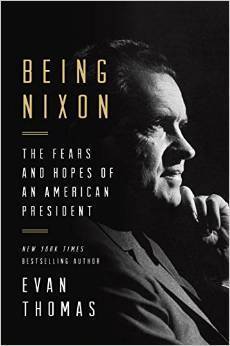
Evan Thomas delivers the best single-volume biography of Richard Nixon to date, a radical, unique portrait of a complicated figure who was both determinedly optimistic and tragically flawed. The New York Times bestselling author of Ike’s Bluff and Sea of Thunder, Thomas brings new life to one of American history’s most infamous, paradoxical, and enigmatic politicians, dispensing with myths to achieve an intimate and nuanced look at the actual man. What drove a painfully shy outcast in elite Washington society—a man so self-conscious he refused to make eye contact during meetings—to pursue power and public office? How did a president so attuned to the American political id that he won reelection in a historic landslide lack the self-awareness to recognize the gaping character flaws that would drive him from office and forever taint his legacy? In Being Nixon, Evan Thomas peels away the layers of the complex, confounding figure who became America’s thirty-seventh president. The son of devout Quakers, Richard Nixon (not unlike his rival John F. Kennedy) grew up in the shadow of an older, favored brother and thrived on conflict and opposition. Through high school and college, in the navy and in politics, he was constantly leading crusades and fighting off enemies real and imagined. As maudlin as he was Machiavellian, Nixon possessed the plainspoken eloquence to reduce American television audiences to tears with his career-saving “Checkers” speech; meanwhile, his darker half hatched schemes designed to take down his political foes, earning him the notorious nickname “Tricky Dick.” Drawing on a wide range of historical accounts, Thomas reveals the contradictions of a leader whose vision and foresight led him to achieve détente with the Soviet Union and reestablish relations with communist China, but whose underhanded political tactics tainted his reputation long before the Watergate scandal. One of the principal architects of the modern Republican Party and its “silent majority” of disaffected whites and conservative ex-Dixiecrats, Nixon was also deemed a liberal in some quarters for his efforts to desegregate Southern schools, create the Environmental Protection Agency, and end the draft. A deeply insightful character study as well as a brilliant political biography, Being Nixon offers a surprising look at a man capable of great bravery and extraordinary deviousness—a balanced portrait of a president too often reduced to caricature.Praise for Being Nixon“A biography of eloquence and breadth . . . No single volume about Nixon’s long and interesting life could be so comprehensive.” —Chicago Tribune “Terrifically engaging . . . a fair, insightful and highly entertaining portrait.”—The Wall Street Journal “Thomas has a fine eye for the telling quote and the funny vignette, and his style is eminently readable.”—The New York Times Book Review “Thomas proves an amiable and fair-minded tour guide.”—The Boston Globe “A measured, concise, and important American biography.”—Michael Beschloss, author of Presidential Courage

A sweeping reexamination of the Founding Father who transformed the United States in each of his political “lives”—as a revolutionary thinker, as a partisan political strategist, and as a president Over the course of his life, James Madison changed the United States three times: First, he designed the Constitution, led the struggle for its adoption and ratification, then drafted the Bill of Rights. As an older, cannier politician he co-founded the original Republican party, setting the course of American political partisanship. Finally, having pioneered a foreign policy based on economic sanctions, he took the United States into a high-risk conflict, becoming the first wartime president and, despite the odds, winning.Now Noah Feldman offers an intriguing portrait of this elusive genius and the constitutional republic he created—and how both evolved to meet unforeseen challenges. Madison hoped to eradicate partisanship yet found himself giving voice to, and institutionalizing, the political divide. Madison’s lifelong loyalty to Thomas Jefferson led to an irrevocable break with George Washington, hero of the American Revolution. Madison closely collaborated with Alexander Hamilton on the Federalist papers—yet their different visions for the United States left them enemies. Alliances defined Madison, too. The vivacious Dolley Madison used her social and political talents to win her husband new supporters in Washington—and define the diplomatic customs of the capital’s society. Madison’s relationship with James Monroe, a mixture of friendship and rivalry, shaped his presidency and the outcome of the War of 1812. We may be more familiar with other Founding Fathers, but the United States today is in many ways Madisonian in nature. Madison predicted that foreign threats would justify the curtailment of civil liberties. He feared economic inequality and the power of financial markets over politics, believing that government by the people demanded resistance to wealth. Madison was the first Founding Father to recognize the importance of public opinion, and the first to understand that the media could function as a safeguard to liberty. The Three Lives of James Madison is an illuminating biography of the man whose creativity and tenacity gave us America’s distinctive form of government. His collaborations, struggles, and contradictions define the United States to this day.

From a preeminent presidential historian comes a groundbreaking and often surprising narrative of America’s wartime chief executives It sometimes seems, in retrospect, as if America has been almost continuously at war. Ten years in the research and writing, Presidents of War is a fresh, magisterial, intimate look at a procession of American leaders as they took the nation into conflict and mobilized their country for victory. It brings us into the room as they make the most difficult decisions that face any President, at times sending hundreds of thousands of American men and women to their deaths. From James Madison and the War of 1812 to recent times, we see them struggling with Congress, the courts, the press, their own advisors and antiwar protesters; seeking comfort from their spouses, families and friends; and dropping to their knees in prayer. We come to understand how these Presidents were able to withstand the pressures of war—both physically and emotionally—or were broken by them. Beschloss’s interviews with surviving participants in the drama and his discoveries in original letters, diaries, once-classified national security documents, and other sources help him to tell this story in a way it has not been told before. Presidents of War combines the sense of being there with the overarching context of two centuries of American history. This important book shows how far we have traveled from the time of our Founders, who tried to constrain presidential power, to our modern day, when a single leader has the potential to launch nuclear weapons that can destroy much of the human race.

From one of America’s most respected journalists and modern historians comes the highly acclaimed, “splendid” ( The Washington Post ) biography of Jimmy Carter, the thirty-ninth president of the United States and Nobel Prize–winning humanitarian.Jonathan Alter tells the epic story of an enigmatic man of faith and his improbable journey from barefoot boy to global icon. Alter paints an intimate and surprising portrait of the only president since Thomas Jefferson who can fairly be called a Renaissance Man, a complex figure—ridiculed and later revered—with a piercing intelligence, prickly intensity, and biting wit beneath the patented smile. Here is a moral exemplar for our times, a flawed but underrated president of decency and vision who was committed to telling the truth to the American people.Growing up in one of the meanest counties in the Jim Crow South, Carter is the only American president who essentially lived in three his early life on the farm in the 1920s without electricity or running water might as well have been in the nineteenth; his presidency put him at the center of major events in the twentieth; and his efforts on conflict resolution and global health set him on the cutting edge of the challenges of the twenty-first.“One of the best in a celebrated genre of presidential biography,” ( The Washington Post ), His Very Best traces how Carter evolved from a timid, bookish child—raised mostly by a Black woman farmhand—into an ambitious naval nuclear engineer writing passionate, never-before-published love letters from sea to his wife and full partner, Rosalynn; a peanut farmer and civic leader whose guilt over staying silent during the civil rights movement and not confronting the white terrorism around him helped power his quest for racial justice at home and abroad; an obscure, born-again governor whose brilliant 1976 campaign demolished the racist wing of the Democratic Party and took him from zero percent to the presidency; a stubborn outsider who failed politically amid the bad economy of the 1970s and the seizure of American hostages in Iran but succeeded in engineering peace between Israel and Egypt, amassing a historic environmental record, moving the government from tokenism to diversity, setting a new global standard for human rights and normalizing relations with China among other unheralded and far-sighted achievements. After leaving office, Carter eradicated diseases, built houses for the poor, and taught Sunday school into his mid-nineties.This “important, fair-minded, highly readable contribution” ( The New York Times Book Review ) will change our understanding of perhaps the most misunderstood president in American history.

A groundbreaking, revelatory history of Abraham Lincoln’s plan to secure a just and lasting peace after the Civil War—a vision that inspired future presidents as well as the world’s most famous peacemakers, including Nelson Mandela, Mahatma Gandhi, and Martin Luther King, Jr. It is a story of war and peace, race and reconciliation.As the tide of the Civil War turned in the spring of 1865, Abraham Lincoln took a dangerous two-week trip to visit the troops on the front lines accompanied by his young son, seeing combat up close, meeting liberated slaves in the ruins of Richmond, and comforting wounded Union and Confederate soldiers.The power of Lincoln’s personal example in the closing days of the war offers a portrait of a peacemaker. He did not demonize people he disagreed with. He used humor, logic, and scripture to depolarize bitter debates. Balancing moral courage with moderation, Lincoln believed that decency could be the most practical form of politics, but he understood that people were more inclined to listen to reason when greeted from a position of strength. Ulysses S. Grant’s famously generous terms of surrender to General Robert E. Lee at Appomattox that April were a direct expression of the president’s belief that a soft peace should follow a hard war.While his assassination sent the country careening off course, Lincoln’s vision would be vindicated long after his death, inspiring future generations in their own quests to secure a just and lasting peace. As US General Lucius Clay, architect of the post-WWII German occupation, said when asked what guided his “I tried to think of the kind of occupation the South would have had if Abraham Lincoln had lived.”Lincoln and the Fight for Peace reveals how Lincoln’s character informed his commitment to unconditional surrender followed by a magnanimous peace. Even during the Civil War, surrounded by reactionaries and radicals, he refused to back down from his belief that there is more that unites us than divides us. But he also understood that peace needs to be waged with as much intensity as war. Lincoln’s plan to win the peace is his unfinished symphony, but in its existing notes, we can find an anthem that can begin to bridge our divisions today.