
Rick Perlstein
Eric S. "Rick" Perlstein (born 1969) is an American historian and journalist. He graduated from the University of Chicago with a B.A. in History in 1992. He is a former writer for The Village Voice and The New Republic and the author of numerous articles in other publications. Until March, 2009 he was a Senior Fellow at the Campaign for America's Future where he wrote for their blog about the failures of conservative governance. Perlstein is also the author of the books Before the Storm: Barry Goldwater and the Unmaking of the American Consensus (2001) and Nixonland: The Rise of a President and the Fracturing of America (2008). Before the Storm covers the rise of the conservative movement culminating in the nomination and campaign of Barry Goldwater and how the movement came to dominate the Republican Party despite Goldwater's loss. Nixonland covers American politics and society from 1964 to 1972, centering on Richard Nixon's attempt to rehabilitate himself politically and his eventual successful use of the resentment of settled society against the social unrest of the day to rebuild the Republican Party. His article for the Boston Review on how Democrats can win was published in book form under the title The Stock Ticker and the Superjumbo, together with responses.
5 Books Written

Nixonland: The Rise of a President and the Fracturing of America
by Rick Perlstein
Rating: 4.2 ⭐
• 2 recommendations ❤️
Politically insightful, Nixonland recaptures the turbulent 60s & early 70s, revealing how Dick Nixon rose from the political grave to seize and hold the presidency. Perlstein's account begins with the '65 Watts riots, nine months after Johnson's landslide victory over Goldwater appeared to herald a permanent liberal consensus. Yet the next year, scores of liberals were tossed from Congress, America was more divided than ever and a disgraced politician was on his way to a shocking comeback.Between 1965 and 1972, America experienced a second civil war. From its ashes, today's political world was born. It was the era not only of Nixon, Johnson, Agnew, Humphrey, McGovern, Daley and Wallace; but Abbie Hoffman, Ronald Reagan, Angela Davis, Ted Kennedy, Charles Manson, John Lindsay and Jane Fonda. There are glimpses of Jimmy Carter, George H.W. Bush, Jesse Jackson, John Kerry and even of two ambitious young men named Karl Rove and Bill Clinton--and an unambitious young man named George W. Bush.Filled with prodigious research, driven by a powerful narrative, Perlstein's account of how America divided confirms his place as one of our country's most celebrated historians.

Before the Storm: Barry Goldwater and the Unmaking of the American Consensus
by Rick Perlstein
Rating: 4.2 ⭐
Acclaimed historian Rick Perlstein chronicles the rise of the conservative movement in the liberal 1960s. At the heart of the story is Barry Goldwater, the renegade Republican from Arizona who loathed federal government, despised liberals, and mocked “peaceful coexistence” with the USSR. Perlstein's narrative shines a light on a whole world of conservatives and their antagonists, including William F. Buckley, Nelson Rockefeller, and Bill Moyers. Vividly written, Before the Storm is an essential book about the 1960s.
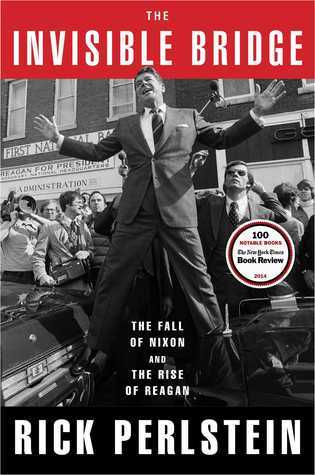
From the bestselling author of Nixonland: a dazzling portrait of America on the verge of a nervous breakdown in the tumultuous political and economic times of the 1970s.In January of 1973 Richard Nixon announced the end of the Vietnam War and prepared for a triumphant second term—until televised Watergate hearings revealed his White House as little better than a mafia den. The next president declared upon Nixon’s resignation “our long national nightmare is over”—but then congressional investigators exposed the CIA for assassinating foreign leaders. The collapse of the South Vietnamese government rendered moot the sacrifice of some 58,000 American lives. The economy was in tatters. And as Americans began thinking about their nation in a new way—as one more nation among nations, no more providential than any other—the pundits declared that from now on successful politicians would be the ones who honored this chastened new national mood.Ronald Reagan never got the message. Which was why, when he announced his intention to challenge President Ford for the 1976 Republican nomination, those same pundits dismissed him—until, amazingly, it started to look like he just might win. He was inventing the new conservative political culture we know now, in which a vision of patriotism rooted in a sense of American limits was derailed in America’s Bicentennial year by the rise of the smiling politician from Hollywood. Against a backdrop of melodramas from the Arab oil embargo to Patty Hearst to the near-bankruptcy of America’s greatest city, The Invisible Bridge asks the question: what does it mean to believe in America? To wave a flag—or to reject the glibness of the flag wavers?

A complex portrait of President Ronald Reagan that charts the rise of the modern conservative brand unlike ever before. After chronicling America’s transformation from a center-left to center-right nation for two decades, Rick Perlstein now focuses on the tumultuous life of President Ronald Reagan from 1976–1980. Within the book’s four-year time frame, Perlstein touches on themes of confluence as he discusses the four stories that define American politics up to the age of Trump. There is the rise of a newly aggressive corporate America diligently organizing to turn back the liberal tide: powerful unions, environmentalism, and unprecedentedly suffusing regulation. There is the movement of political mobilized conservative Christians, organizing to reverse the cultural institutionalization of the 1960s insurgencies. Third, there is the war for the Democratic Party, transformed under Jimmy Carter as a vehicle promoting “austerity” and “sacrifice”—a turn that spurs a counter-reaction from liberal forces who go to war with Carter to return the party to its populist New Deal patrimony. And finally, there is the ascendency of Ronald Reagan, considered washed up after his 1976 defeat for the Republican nomination and too old to run for president in any event, who nonetheless dramatically emerges as the heroic embodiment of America’s longing to transcend the 1970s dark storms—from Love Canal to Jonestown, John Wayne Gacy to the hostages in Iran. Perlstein explores the complex years of Ronald Reagan’s presidency offering new and timely insights to issues that still remain relevant today.

The Stock Ticker and the Superjumbo: How the Democrats Can Once Again Become America's Dominant Political Party
by Rick Perlstein
Rating: 3.5 ⭐
A majority of Americans tell pollsters they want more government intervention to reduce the gap between high- and lower-income citizens, and less than one-third consider high taxes to be a problem. Yet conservative Republicanism currently controls the political discourse. Why?Rick Perlstein probes this central paradox of today's political scene in his penetrating pamphlet. Perlstein explains how the Democrats' obsessive short-term focus on winning "swing voters," instead of cultivating loyal party-liners, has relegated Democrats to political stagnation. Perlstein offers a vigorous critique and far-reaching vision that is a thirty-year plan for Democratic victory.William A. GalstonAdolph Reed, Jr.Ruy TeixeiraDan CarolDaniel CantorRobert B. ReichMichael C. DawsonElaine KamarckRichard DelgadoStanley AronowitzPhilip KlinknerLarry M. Bartels