Loading genres...
Explore the best books about Science Nature genre.


New York Public Library Book for the TeenagerNew York Public Library Book to RememberPSLA Young Adult Top 40 Nonfiction Titles of the Year"Engaging...a lively, informative compendium of facts, theories, and musings."-Michiko Kakutani, New York TimesBehold the rat, dirty and disgusting! Robert Sullivan turns the lowly rat into the star of this most perversely intriguing, remarkable, and unexpectedly elegant New York Times bestseller.Love them or loathe them, rats are here to stay-they are city dwellers as much as (or more than) we are, surviving on the effluvia of our society. In Rats , the critically acclaimed bestseller, Robert Sullivan spends a year investigating a rat-infested alley just a few blocks away from Wall Street. Sullivan gets to know not just the beast but its friends and foes: the exterminators, the sanitation workers, the agitators and activists who have played their part in the centuries-old war between human city dweller and wild city rat.Sullivan looks deep into the largely unrecorded history of the city and its masses-its herds-of-rats-like mob. Funny, wise, sometimes disgusting but always compulsively readable, Rats earns its unlikely place alongside the great classics of nature writing.With an all-new Afterword by the author

Mr. Tompkins is back! The mild-mannered bank clerk with the short attention span and vivid imagination has inspired, charmed, and informed young and old alike since the publication of the hugely successful Mr Tompkins in Paperback (by George Gamow) in 1965. Now, this highly affable character returns to embark on a set of adventures that explore the extreme edges of the universe--the smallest, the largest, the fastest, and the farthest. Just by following the experiences and dreams of Mr. Tompkins, readers discover and come to know the merry dance of cosmic mysteries, including: Einstein's theory of relativity, bizarre effects near light-speed, the birth and death of the universe, black holes, quarks, space warps and antimatter, the fuzzy world of the quantum, and that ultimate cosmic mystery--love. The story of Mr. Tompkins' journey to the frontiers of modern physics will delight and inform all readers. Russell Stannard is a best-selling popular science writer and the author of the critically acclaimed Uncle Albert series of science books for children.

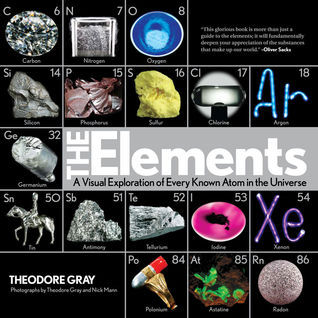
With more than 1 million copies sold worldwide, The Elements is the most entertaining, comprehensive, and visually arresting book on all 118 elements in the periodic table.Includes a poster of Theodore Gray's iconic photographic periodic table of the elements!Based on seven years of research and photography by Theodore Gray and Nick Mann, The Elements presents the most complete and visually arresting representation available to the naked eye of every atom in the universe. Organized sequentially by atomic number, every element is visualized by a big beautiful photograph that most closely represents it in its purest form. Several additional photographs show each element in slightly altered forms or as used in various practical ways. Also included are fascinating stories of the elements, told in Theo Grays inimitable style, as well as data on the properties of each, including atomic number, atomic symbol, atomic weight, density, atomic radius, as well as scales for electron filling order, state of matter, and an atomic emission spectrum.This work of solid science and stunning artistic photographs is the perfect gift book for every sentient creature in the universe.

The ongoing assault on climate science in the United States has never been more aggressive, more blatant, or more widely publicized than in the case of the Hockey Stick graph―a clear and compelling visual presentation of scientific data, put together by MichaelE. Mann and his colleagues, demonstrating that global temperatures have risen in conjunction with the increase in industrialization and the use of fossil fuels. Here was an easy-to-understand graph that, in a glance, posed a threat to major corporate energy interests and those who do their political bidding. The stakes were simply too high to ignore the Hockey Stick―and so began a relentless attack on a body of science and on the investigators whose work formed its scientific basis.The Hockey Stick achieved prominence in a 2001 UN report on climate change and quickly became a central icon in the "climate wars." The real issue has never been the graph's data but rather its implied threat to those who oppose governmental regulation and other restraints to protect the environment and planet. Mann, lead author of the original paper in which the Hockey Stick first appeared, shares the story of the science and politics behind this controversy. He reveals key figures in the oil and energy industries and the media frontgroups who do their bidding in sometimes slick, sometimes bare-knuckled ways. Mann concludes with the real story of the 2009 "Climategate" scandal, in which climate scientists' emails were hacked. This is essential reading for all who care about our planet's health and our own well-being.

A collection of the best science and nature writing from the past year.

Why do we breathe? What is money? How does the brain work? Why did life invent sex? Does time really exist? How does capitalism work - or not, as the case may be? Where do mountains come from? How do computers work? How did humans get to dominate the Earth? Why is there something rather than nothing?In What a Wonderful World, Marcus Chown, bestselling author of Quantum Theory Cannot Hurt You and the Solar System app, uses his vast scientific knowledge and deep understanding of extremely complex processes to answer simple questions about the workings of our everyday lives. Lucid, witty and hugely entertaining, it explains the basics of our essential existence, stopping along the way to show us why the Atlantic is widening by a thumbs' length each year, how money permits trade to time travel why the crucial advantage humans had over Neanderthals was sewing and why we are all living in a giant hologram.

From the formation of the Universe to today, countless major events have changed the course of life on Earth. Aligned with the online Big History Project supported by Bill Gates, Big History puts a wide-angle lens on 13.8 billion years of remarkable history and shows you how and why we got where we are today. With stunning visual timelines and special CGI reconstructions, you can see history's greatest events. Look back to our origins in the stars, explore everything from the birth of the Sun to modern technology, and see what the future holds for humans.Weaving together multiple disciplines including physics and sociology, and with a foreword by TED speaker Professor David Christian, Big History is a truly unique look at the history of the world.

When it comes to the climate, we don't need more marketing or anxiety. We need established facts and a plan for collective action. The climate is the fundamental issue of our time, and now we face a critical decision. Whether to be optimistic or fatalistic, whether to profess skepticism or to take action. Yet it seems we can barely agree on what is really going on, let alone what needs to be done. We urgently need facts, not opinions. Insights, not statistics. And a shift from thinking about climate change as a "me" problem to a "we" problem.The Carbon Almanac is a once-in-a-lifetime collaboration between hundreds of writers, researchers, thinkers, and illustrators that focuses on what we know, what has come before, and what might happen next. Drawing on over 1,000 data points, the book uses cartoons, quotes, illustrations, tables, histories, and articles to lay out carbon's impact on our food system, ocean acidity, agriculture, energy, biodiversity, extreme weather events, the economy, human health, and best and worst-case scenarios. Visually engaging and built to share, The Carbon Almanac is the definitive source for facts and the basis for a global movement to fight climate change.This isn't what the oil companies, marketers, activists, or politicians want you to believe. This is what's really happening, right now. Our planet is in trouble, and no one concerned group, corporation, country, or hemisphere can address this on its own. Self-interest only increases the problem. We are in this together. And it's not too late for concerted, collective action for change.