
Michael E. Mann
5 Books Written

The Hockey Stick and the Climate Wars: Dispatches from the Front Lines
by Michael E. Mann
Rating: 4.7 ⭐
• 2 recommendations ❤️
In its 2001 report on global climate, the Intergovernmental Panel on Climate Change of the United Nations prominently featured the "Hockey Stick," a chart showing global temperature data over the past one thousand years. The Hockey Stick demonstrated that temperature had risen with the increase in industrialization and use of fossil fuels. The inescapable conclusion was that worldwide human activity since the industrial age had raised CO2 levels, trapping greenhouse gases in the atmosphere and warming the planet. The Hockey Stick became a central icon in the "climate wars," and well-funded science deniers immediately attacked the chart and the scientists responsible for it. Yet the controversy has had little to do with the depicted temperature rise and much more with the perceived threat the graph posed to those who oppose governmental regulation and other restraints to protect our environment and planet. Michael E. Mann, lead author of the original paper in which the Hockey Stick first appeared, shares the real story of the science and politics behind this controversy. He introduces key figures in the oil and energy industries, and the media front groups who do their bidding in sometimes slick, bare-knuckled ways to cast doubt on the science. Mann concludes with an account of the "Climategate" scandal, the 2009 hacking of climate scientists' emails. Throughout, Mann reveals the role of science deniers, abetted by an uninformed media, in once again diverting attention away from one of the central scientific and policy issues of our time.

The New Climate War: The Fight to Take Back Our Planet
by Michael E. Mann
Rating: 3.9 ⭐
• 2 recommendations ❤️
A renowned climate scientist shows how fossil fuel companies have waged a thirty-year campaign to deflect blame and responsibility and delay action on climate change, and offers a battle plan for how we can save the planet. Recycle. Fly less. Eat less meat. These are some of the ways that we've been told can slow climate change. But the inordinate emphasis on individual behavior is the result of a marketing campaign that has succeeded in placing the responsibility for fixing climate change squarely on the shoulders of individuals.Fossil fuel companies have followed the example of other industries deflecting blame (think "guns don't kill people, people kill people") or greenwashing (think of the beverage industry's "Crying Indian" commercials of the 1970s). Meanwhile, they've blocked efforts to regulate or price carbon emissions, run PR campaigns aimed at discrediting viable alternatives, and have abdicated their responsibility in fixing the problem they've created. The result has been disastrous for our planet.In The New Climate War, Mann argues that all is not lost. He draws the battle lines between the people and the polluters-fossil fuel companies, right-wing plutocrats, and petrostates. And he outlines a plan for forcing our governments and corporations to wake up and make real change, including:A common-sense, attainable approach to carbon pricing- and a revision of the well-intentioned but flawed currently proposed version of the Green New Deal;Allowing renewable energy to compete fairly against fossil fuelsDebunking the false narratives and arguments that have worked their way into the climate debate and driven a wedge between even those who support climate change solutionsCombatting climate doomism and despair-mongeringWith immensely powerful vested interests aligned in defense of the fossil fuel status quo, the societal tipping point won't happen without the active participation of citizens everywhere aiding in the collective push forward. This book will reach, inform, and enable citizens everywhere to join this battle for our planet.

The Madhouse Effect: How Climate Change Denial Is Threatening Our Planet, Destroying Our Politics, and Driving Us Crazy
by Michael E. Mann
Rating: 4.1 ⭐
The award-winning climate scientist Michael E. Mann and the Pulitzer Prize-winning political cartoonist Tom Toles have been on the front lines of the fight against climate denialism for most of their careers. They have witnessed the manipulation of the media by business and political interests and the unconscionable play to partisanship on issues that affect the well-being of billions. The lessons they have learned have been invaluable, inspiring this brilliant, colorful escape hatch from the madhouse of the climate wars.The Madhouse Effect portrays the intellectual pretzels into which denialists must twist logic to explain away the clear evidence that human activity has changed Earth's climate. Toles's cartoons collapse counter-scientific strategies into their biased components, helping readers see how to best strike at these fallacies. Mann's expert skills at science communication aim to restore sanity to a debate that continues to rage against widely acknowledged scientific consensus. The synergy of these two climate science crusaders enlivens the gloom and doom of so many climate-themed books--and may even convert die-hard doubters to the side of sound science.
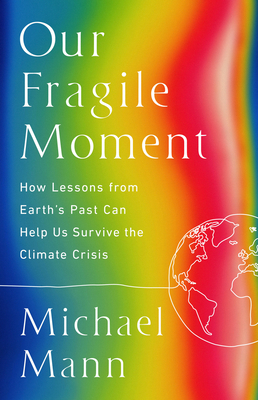
Our Fragile Moment: How Lessons from Earth's Past Can Help Us Survive the Climate Crisis
by Michael E. Mann
Rating: 4.2 ⭐
In this sweeping work of science and history, the renowned climate scientist and author of The New Climate War shows us the conditions on Earth that allowed humans not only to exist but thrive, and how they are imperiled if we veer off course. For the vast majority of its 4.54 billion years, Earth has proven it can manage just fine without human beings. Then came the first proto-humans, who emerged just a little more than 2 million years ago—a fleeting moment in geological time. What is it that made this benevolent moment of ours possible? Ironically, it’s the very same thing that now threatens us—climate change. The drying of the tropics during the Pleistocene period created a niche for early hominids, who could hunt prey as forests gave way to savannahs in the African tropics. The sudden cooling episode known as the “Younger Dryas” 13,000 years ago, which occurred just as Earth was thawing out of the last Ice Age, spurred the development of agriculture in the fertile crescent. The “Little Ice Age” cooling of the 16th-19th centuries led to famines and pestilence for much of Europe, yet it was a boon for the Dutch, who were able to take advantage of stronger winds to shorten their ocean voyages.The conditions that allowed humans to live on this earth are fragile, incredibly so. Climate variability has at times created new niches that humans or their ancestors could potentially exploit, and challenges that at times have spurred innovation. But there’s a relatively narrow envelope of climate variability within which human civilization remains viable. And our survival depends on conditions remaining within that range. In this book, renowned climate scientist Michael Mann will arm readers with the knowledge necessary to appreciate the gravity of the unfolding climate crisis, while emboldening them—and others--to act before it truly does become too late.

Dire Predictions: Understanding Global Warming - The Illustrated Guide to the Findings of the IPCC
by Michael E. Mann
Rating: 3.8 ⭐
Presents the scientific findings on the current climate change and global warming, including climate change projections, the Earth's adaptability, and how to solve global warming.