Loading genres...
Explore the best books about Health Care genre.

Why has the biotechnology industry failed to perform up to expectations—despite all its promise? In Science Business , Gary P. Pisano answers this question by providing an incisive critique of the industry. Pisano not only reveals the underlying causes of biotech's problems; he offers the most sophisticated analysis yet on how the industry works. And he provides clear prescriptions for companies, investors, and policy makers seeking ways to improve the industry's performance. According to Pisano, the biotech industry's problems stem from its special character as a science-based business. This character poses three unique business how to finance highly risky investments under profound uncertainty and long time horizons for R&D, how to learn rapidly enough to keep pace with advances in drug science knowledge, and how to integrate capabilities across a broad spectrum of scientific and technological knowledge bases.The key to fixing the industry? Business models, organisational structures, and financing arrangements that place greater emphasis on integration and long-term learning over shorter—term 'monetisation' of intellectual property. Pisano maintains that all industry players—biotech firms, investors, universities, pharmaceutical companies, government regulators—can play a role in righting the industry. The payoff? Valuable improvements in health care, and a shinier future for human well-being.


Few of the great stories of medicine are as palpably dramatic as the invention of open-heart surgery, yet, until now, no journalist has ever brought all of the thrilling specifics of this triumph to life.This is the story of the surgeon many call the father of open-heart surgery, Dr. C. Walton Lillehei, who, along with colleagues at University Hospital in Minneapolis and a small band of pioneers elsewhere, accomplished what many experts considered to be an impossible feat: He opened the heart, repaired fatal defects, and made the miraculous routine.Acclaimed author G. Wayne Miller draws on archival research and exclusive interviews with Lillehei and legendary pioneers such as Michael DeBakey and Christiaan Barnard, taking readers into the lives of these doctors and their patients as they progress toward their landmark achievement. In the tradition of works by Richard Rhodes and Tracy Kidder, King of Hearts tells the story of an important and gripping piece of forgotten science history.

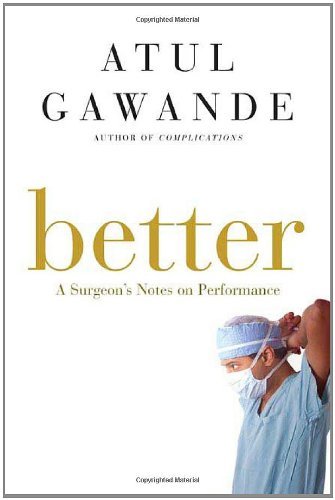
The struggle to perform well is universal: each one of us faces fatigue, limited resources, and imperfect abilities in whatever we do. But nowhere is this drive to do better more important than in medicine, where lives are on the line with every decision. In his new book, Atul Gawande explores how doctors strive to close the gap between best intentions and best performance in the face of obstacles that sometimes seem insurmountable. Gawande's gripping stories of diligence, ingenuity, and what it means to do right by people take us to battlefield surgical tents in Iraq, to labor and delivery rooms in Boston, to a polio outbreak in India, and to malpractice courtrooms around the country. He discusses the ethical dilemmas of doctors participation in lethal injections, examines the influence of money on modern medicine, and recounts the astoundingly contentious history of hand washing. And as in all his writing, Gawande gives us an inside look at his own life as a practicing surgeon, offering a searingly honest firsthand account of work in a field where mistakes are both unavoidable and unthinkable. At once unflinching and compassionate, Better is an exhilarating journey narrated by arguably the best nonfiction doctor-writer around (Salon). Gawande's investigation into medical professionals and how they progress from merely good to great provides rare insight into the elements of success, illuminating every area of human endeavor.

This book addresses the health of the whole world. Many simplifications were required for it to fit into a single textbook for students wanting to: 1) get an understanding of how the health of the world's population has changed over time; 2) learn about the main determinants for health; 3) how health can be measured and what the main idicators are for health and illness; 4)learn about what is causing illness, disability and death for large numbers of poeple; 5) to be acquainted with models and structures for health care around the world. The book is written from a public health perspective and shows the close link between health and social realities, money and the environment.

How shall we improve human health? One answer by eradication. The Gates Foundation announced in 2007 that their goal is malaria eradication; another of their priorities is polio eradication. Eradication means the complete elimination of a disease through deliberate human intervention. It stands for an absolute in public health. This book by the award-winning historian of medicine Nancy Leys Stepan is an accessible, beautifully written, and deeply researched examination of one of the most controversial issues in public health today. The eradication of disease might seem like an absolute good. But critics of eradication argue that the huge resources needed to achieve eradication could be better allocated toward developing primary health services and general improvement in health. This book aims to look at the benefits and drawbacks of single-minded efforts to rid the world of particular diseases, one at a time. The sweep of the book is impressive, from the origins of the idea of complete eradication in the early twentieth century until the present-day campaigns against polio, Guinea worm disease, and now malaria. The author places eradication's story in its many contexts, from imperialism, changing notions of public health, the history of medicine and its technologies, the development of international health agencies such as the World Health Organization, and the impact of the Cold War on the shift of attention to disease in developing countries. At the center of this narrative is Dr. Fred Lowe Soper (1893-1977), a U.S.-trained doctor who became the arch-eradicationist of his time. His campaigns to eradicate hookworm disease, yaws, yellow fever, malaria, and smallpox are treated in compelling detail, as are the roles of international health agencies such as the Rockefeller Foundation and the World Health Organization. Throughout the book Stepan draws attention to the way that the ideal of eradication has repeatedly arisen, phoenix-like, from its setbacks. In a powerful conclusion, she uses the example of the current campaign to eradicate Guinea worm disease to argue that, today, under the right circumstances, eradication and primary health care need not be in conflict, as they were in the past, but can form mutually reinforcing policies to improve the health and well-being of populations, especially the poorest and most disease-burdened populations of the world.

From Pulitzer Prize winner Amanda Bennett comes a moving, eye-opening, and beautifully written memoir—a love story of two unusual people, their complex marriage and deep devotion, and finally, Bennett’s quest to save her husband’s life. When Wall Street Journal reporter Amanda Bennett meets the eccentric, infuriating, yet somehow irresistible Terence Bryan Foley while on assignment in China, the last thing she expects is to marry him. They are so different—classic and bohemian, bow ties and batik, quirky and sensible. But Terence is persistent. “You are going to be somebody,” he tells her. “You’re going to need somebody to take care of you.” Though initially as combative as their courtship, their marriage brings with it stormy passion, deep love and respect, two beloved children, and a life together over two decades. Then comes illness, and the fight to win a longer life for Terence. The Cost of Hope chronicles the extraordinary measures Amanda and Terence take to preserve not only Terence’s life but also the life of their family. After his death, Bennett uses her skills as a veteran investigative reporter to determine the cost of their mission of hope. What she discovers raises important questions many people face, and vital issues about the intricacies of America’s healthcare system. Rich in humor, insight, and candor, The Cost of Hope is an unforgettable memoir, an inspiring personal story that sheds light on one of the most important turning points in life.

A visionary and completely original investigation that will change the way we think about health care: how and why it is failing, why expanding insurance coverage will only make things worse, and how it can be transformed into a transparent, affordable, successful system.In 2007, David Goldhill's father died from a series of infections acquired in a well-regarded New York hospital. The bill was for several hundred thousand dollars--and Medicare paid it. These circumstances left Goldhill angry and determined to understand how it was possible that world-class technology and well-trained personnel could result in such simple, inexcusable carelessness--and how a business that failed so miserably could be rewarded with full payment. Catastrophic Care is the eye-opening result. Goldhill explicates a health-care system that now costs nearly $2.5 trillion annually, bars many from treatment, provides inconsistent quality of care, offers negligible customer service, and in which an estimated 200,000 Americans die each year from errors. Above all, he exposes the fundamental fallacy of our entire system--that Medicare and insurance coverage make care cheaper and improve our health--and suggests a comprehensive new approach that could produce better results at more acceptable costs immediately by giving us, the patients, a real role in the process.

The definitive story of American health care today -- its causes, consequences, and confusions. In March 2010, the Affordable Care Act was signed into law. It was the most extensive reform of America's health care system since at least the creation of Medicare in 1965, and maybe ever. The ACA was controversial and highly political, and the law faced legal challenges reaching all the way to the Supreme Court; it even precipitated a government shutdown. It was a signature piece of legislation for President Obama's first term, and also a ball and chain for his second. Ezekiel J. Emanuel, a professor of medical ethics and health policy at the University of Pennsylvania who also served as a special adviser to the White House on health care reform, has written a brilliant diagnostic explanation of why health care in America has become such a divisive social issue, how money and medicine have their own -- quite distinct -- American story, and why reform has bedeviled presidents of the left and right for more than one hundred years. Emanuel also explains exactly how the ACA reforms are reshaping the health care system now. He forecasts the future, identifying six mega trends in health that will determine the market for health care to 2020 and beyond. His predictions are bold, provocative, and uniquely well-informed. Health care -- one of America's largest employment sectors, with an economy the size of the GDP of France -- has never had a more comprehensive or authoritative interpreter.

Moneyball meets medicine in this remarkable chronicle of one of the greatest scientific quests of our time—the groundbreaking program to answer the most essential question for humanity: how do we live and die?—and the visionary mastermind behind it.Medical doctor and economist Christopher Murray began the Global Burden of Disease studies to gain a truer understanding of how we live and how we die. While it is one of the largest scientific projects ever attempted—as breathtaking as the first moon landing or the Human Genome Project—the questions it answers are meaningful for every one of us: What are the world’s health problems? Who do they hurt? How much? Where? Why?Murray argues that the ideal existence isn’t simply the longest but the one lived well and with the least illness. Until we can accurately measure how people live and die, we cannot understand what makes us sick or do much to improve it. Challenging the accepted wisdom of the WHO and the UN, the charismatic and controversial health maverick has made enemies—and some influential friends, including Bill Gates who gave Murray a $100 million grant.In Epic Measures, journalist Jeremy N. Smith offers an intimate look at Murray and his groundbreaking work. From ranking countries’ healthcare systems (the U.S. is 37th) to unearthing the shocking reality that world governments are funding developing countries at only 30% of the potential maximum efficiency when it comes to health, Epic Measures introduces a visionary leader whose unwavering determination to improve global health standards has already changed the way the world addresses issues of health and wellness, sets policy, and distributes funding.

At a moment of drastic political upheaval, An American Sickness is a shocking investigation into our dysfunctional healthcare system - and offers practical solutions to its myriad problems.In these troubled times, perhaps no institution has unraveled more quickly and more completely than American medicine. In only a few decades, the medical system has been overrun by organizations seeking to exploit for profit the trust that vulnerable and sick Americans place in their healthcare. Our politicians have proven themselves either unwilling or incapable of reining in the increasingly outrageous costs faced by patients, and market-based solutions only seem to funnel larger and larger sums of our money into the hands of corporations. Impossibly high insurance premiums and inexplicably large bills have become facts of life; fatalism has set in. Very quickly Americans have been made to accept paying more for less. How did things get so bad so fast?Breaking down this monolithic business into the individual industries--the hospitals, doctors, insurance companies, and drug manufacturers--that together constitute our healthcare system, Rosenthal exposes the recent evolution of American medicine as never before. How did healthcare, the caring endeavor, become healthcare, the highly profitable industry? Hospital systems, which are managed by business executives, behave like predatory lenders, hounding patients and seizing their homes. Research charities are in bed with big pharmaceutical companies, which surreptitiously profit from the donations made by working people. Patients receive bills in code, from entrepreneurial doctors they never even saw.The system is in tatters, but we can fight back. Dr. Elisabeth Rosenthal doesn't just explain the symptoms, she diagnoses and treats the disease itself. In clear and practical terms, she spells out exactly how to decode medical doublespeak, avoid the pitfalls of the pharmaceuticals racket, and get the care you and your family deserve. She takes you inside the doctor-patient relationship and to hospital C-suites, explaining step-by-step the workings of a system badly lacking transparency. This is about what we can do, as individual patients, both to navigate the maze that is American healthcare and also to demand far-reaching reform. An American Sickness is the frontline defense against a healthcare system that no longer has our well-being at heart.

In Well, physician Sandro Galea examines what Americans miss when they fixate on healthcare: health.Americans spend more money on health than people anywhere else in the world. And what do they get for it? Statistically, not much. Americans today live shorter, less healthy lives than citizens of other rich countries, and these trends show no signs of letting up.The problem, Sandro Galea argues, is that Americans focus on the wrong things when they think about health. Our national understanding of what constitutes "being well" is centered on medicine -- the lifestyles we adopt to stay healthy, and the insurance plans and prescriptions we fall back on when we're not. While all these things are important, they've not proven to be the difference between healthy and unhealthy on the large scale.Well is a radical examination of the subtle and not-so-subtle factors that determine who gets to be healthy in America. Galea shows how the country's failing health is a product of American history and character -- and how refocusing on our national health can usher enlightenment across American life and politics.

Memorial Sloan Kettering radiologist, nationally recognized patient advocate, and Fox News contributor Nicole Saphier argues that we can’t fix the American healthcare system until we fix ourselves.The American health care system is collapsing, and people are looking for someone to blame. The truth is, this isn’t a government problem. It’s our own fault. In this thought-provoking book, board certified medical doctor Nicole Saphier calls on all Americans to take responsibility for their individual health.Americans are notoriously unhealthy—we eat too much, drink too much, and sit too much. When roughly 80% of cardiovascular disease and 40% of all cancer cases could be prevented by simple lifestyle changes, it is time to take a deeper look at the problem and ask who truly is responsible. Saphier contends that by getting healthier, we can reduce the astronomical cost of treatment and improve overall care. We don’t need socialized medicine—we need to take better care of ourselves.In Make America Healthy Again, Saphier combines historical events, economic trends, essential lifestyle advice, and her own perspective to offer concrete solutions to address this massive problem. As she examines a wide range of topics, including the leading causes of death, mental health stigma, social media, physician burnout, and the opioid crisis, Saphier offers a much-needed alternative perspective on the healthcare debate.The only way to lower health care costs for everyone is to stop incentivizing bad health decisions. Plans like “Medicare for all” would allow Americans to continue to eat poorly and lead sedentary lives. We can’t keep expecting doctors to fix behaviors that we have in our power to prevent, she argues. It’s only going to get worse unless we take action. It’s up to the American people to make America healthy again.