
Gary P. Pisano
10 Books Written

Science Business: The Promise, the Reality, and the Future of Biotech
by Gary P. Pisano
Rating: 3.7 ⭐
• 2 recommendations ❤️
Why has the biotechnology industry failed to perform up to expectations—despite all its promise? In Science Business , Gary P. Pisano answers this question by providing an incisive critique of the industry. Pisano not only reveals the underlying causes of biotech's problems; he offers the most sophisticated analysis yet on how the industry works. And he provides clear prescriptions for companies, investors, and policy makers seeking ways to improve the industry's performance. According to Pisano, the biotech industry's problems stem from its special character as a science-based business. This character poses three unique business how to finance highly risky investments under profound uncertainty and long time horizons for R&D, how to learn rapidly enough to keep pace with advances in drug science knowledge, and how to integrate capabilities across a broad spectrum of scientific and technological knowledge bases.The key to fixing the industry? Business models, organisational structures, and financing arrangements that place greater emphasis on integration and long-term learning over shorter—term 'monetisation' of intellectual property. Pisano maintains that all industry players—biotech firms, investors, universities, pharmaceutical companies, government regulators—can play a role in righting the industry. The payoff? Valuable improvements in health care, and a shinier future for human well-being.

This myth-busting book shows large companies can construct a strategy, system, and culture of innovation that creates sustained growth.Every company wants to grow, and the most proven way is through innovation. The conventional wisdom is that only disruptive, nimble startups can innovate; once a business gets bigger and more complex corporate arteriosclerosis sets in. Gary Pisano's remarkable research conducted over three decades, and his extraordinary on-the ground experience with big companies and fast-growing ones that have moved beyond the start-up stage, provides new thinking about how the scale of bigger companies can be leveraged for advantage in innovation.He begins with the simply reality that bigger companies are, well, different. Demanding that they "be like Uber" is no more realistic than commanding your dog to speak French. Bigger companies are complex. They need to sustain revenue streams from existing businesses, and deal with Wall Street's demands. These organizations require a different set of management practices and approaches -- a discipline focused on the strategies, systems and culture for taking their companies to the next level. Big can be beautiful, but it requires creative construction by leaders to avoid the creative destruction that is all-too-often the fate of too many.

Manufacturing’s central role in global innovationCompanies compete on the decisions they make. For years—even decades—in response to intensifying global competition, companies decided to outsource their manufacturing operations in order to reduce costs. But we are now seeing the alarming long-term effect of those in many cases, once manufacturing capabilities go away, so does much of the ability to innovate and compete. Manufacturing, it turns out, really matters in an innovation-driven economy.In Producing Prosperity , Harvard Business School professors Gary Pisano and Willy Shih show the disastrous consequences of years of poor sourcing decisions and underinvestment in manufacturing capabilities. They reveal how today’s undervalued manufacturing operations often hold the seeds of tomorrow’s innovative new products, arguing that companies must reinvest in new product and process development in the US industrial sector. Only by reviving this “industrial commons” can the world’s largest economy build the expertise and manufacturing muscle to regain competitive advantage. America needs a manufacturing renaissance—for restoring itself, and for the global economy as a whole.This will require major changes. Pisano and Shih show how company-level choices are key to the sustained success of industries and economies, and they provide business leaders with a framework for understanding the links between manufacturing and innovation that will enable them to make better outsourcing decisions. They also detail how government must change its support of basic and applied scientific research, and promote collaboration between business and academia.For executives, policymakers, academics, and innovators alike, Producing Prosperity provides the clearest and most compelling account yet of how the American economy lost its competitive edge—and how to get it back.

The Development Factory: Unlocking the Potential of Process Innovation
by Gary P. Pisano
Rating: 3.7 ⭐
Gary Pisano argues that the development of distinctive and superior process technologies is a key source of competitive advantage. In a multi-year study of international pharmaceutical firms (with references to a variety of other industries), he challenges the widely held product/process life cycle view of competition, which suggests that industries tend to emphasize either product innovation or process innovation. He also offers a set of recommendations for the practices and approaches that can be used to unlock the potential of process development. In doing so, he provides a window into the more general phenomenon of how organizations create, select, and implement new capabilities.

BRAND NEW, Exactly same ISBN as listed, Please double check ISBN carefully before ordering.

CIBA Vision: The Daily Disposable Lens Project (A),
by Gary P. Pisano
DescriptionExamines CIBA Vision's decision on whether to launch a major new R&D initiative to develop a low-cost, daily disposable contact lens, and how to organize such a project should it proceed. One group of executives favors setting up a small, autonomous project team organizationally and geographically isolated from the company's existing R&D operations. This approach will enable focus, but poses serious issues concerning future integration.Learning objective:To explore approaches to product development and operations in a global environment as well as approaches to building new organizational capabilities.Subjects Covered:Decision making; Globalization; Manufacturing strategy; Operations management; Organizational design; Product development; Production; R&D; StrategySetting:•Industry: Eye care•Industry: Medical equipment & devices•Company Revenue:SFr 750 m.•Event Year Begin:1992•Event Year End:1992http://hbsp.harvard.edu/
BMW: The 7Series Project (A),
by Gary P. Pisano
DescriptionExplores BMW's decision about how to manufacture prototype vehicles. Historically, BMW's prototypes were handcrafted by highly skilled artisans in the company's shop. A proposal has been made to alter the process so that prototypes are made in a way that can better uncover potential problems that may arise during final production. While the new approach is expected to make production start-up of new models smoother and reduce quality problems, there is some concern within the company that it will lead to less flexibility to change (and improve) designs during the development cycle. Explores different ways of competing on quality in a luxury product segment and how the product development process affects each of these. A second objective is to examine the notion of a prototyping strategy and the role prototyping plays in linking development strategy and manufacturing strategy.Subjects Covered:Decision making; Design; Manufacturing strategy; Product development; Prototypes; Quality control; R&DSetting:•Geographic:Germany•Industry: Automotive•Company Revenue:DM27.5 million revenues•Event Year Begin:1990•Event Year End:1990
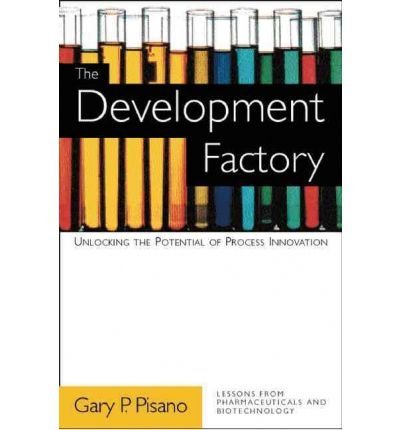
Gary Pisano proves that process innovation-not just product innovation-can be the key to competitive advantage. In a multi-year study of pharmaceutical and biotechnology firms, he shows that developing distinctive and superior process technologies can lower costs, improve quality, and increase flexibility. The Development Factory will help companies unlock the potential of process development and create and implement new capabilities.

Restoring American Competitiveness
by Gary P. Pisano
[Producing Prosperity: Why America Needs a Manufacturing Renaissance] [By: ] [October, 2012]
by Gary P. Pisano