
G.I. Gurdjieff
Georges Ivanovich Gurdjieff (Armenian: Գեորգի Իվանովիչ Գյուրջիև, Georgian: გიორგი გურჯიევი, Greek: Γεώργιος Γεωργιάδης, Russian: Гео́ргий Ива́нович Гюрджи́ев, Georgiy Ivanovich Gyurdzhiev, or Gurdjiev) was an influential Greek-Armenian mystic, spiritual teacher of the early to mid-20th century, and a self-professed 'teacher of dancing'. He taught that the vast majority of humanity lives their entire lives in a state of hypnotic "waking sleep," but that it was possible to transcend to a higher state of consciousness and achieve full human potential. Gurdjieff developed a method for doing so, calling his discipline "The Work" (connoting "work on oneself") or "the Method." According to his principles and instructions, Gurdjieff's method for awakening one's consciousness is different from that of the fakir, monk or yogi, so his discipline is also called (originally) the "Fourth Way." At one point he described his teaching as being "esoteric Christianity." At different times in his life, Gurdjieff formed and closed various schools around the world to teach the work. He claimed that the teachings he brought to the West from his own experiences and early travels expressed the truth found in ancient religions and wisdom teachings relating to self-awareness in people's daily lives and humanity's place in the universe. The title of his third series of writings, Life Is Real Only Then, When 'I Am', expresses the essence of his teachings. His complete series of books is entitled All and Everything.
30 Books Written

These are the memoirs of the great mystic and teacher who inspired a generation of disciples and followers before, during and briefing after the Second World War. In Meetings With Remarkable Men Gurdjieff introduces us to some of the companions he encountered in his travels to the most remote regions of Central Asia. With colorful episodes from his adventures, he brings to life the story of his own relentless search for a real and universal knowledge. The book can be read as a colorful narrative or psychological autobiography, but the meaning of its contents can be better appreciated in relation to the expositions of his previously published ideas.

A landmark exploration of the human condition with the goal of bringing self-awareness in one's daily lifeWith Beelzebub's Tales to His Grandson , G. I. Gurdjieff intended to "destroy, mercilessly . . . the beliefs and views about everything existing in the world." This novel beautifully brings to life the visions of humanity for which Gurdjieff has become esteemed. Beelzebub, a man of worldly (and other-worldly) wisdom, shares with his grandson the anecdotes, personal philosophies, and lessons learned from his own life.The reader is given a detailed discussion of all matters physical, natural, and spiritual, from the creation of the cosmos to man's teleological purpose in the universe. This edition of Beelzebub's Tales to His Grandson --the first single-volume paperback to appear in English--restores the original, authoritative translation.
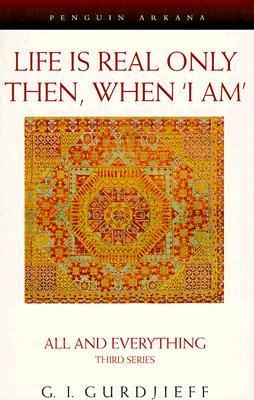
All and Ten Books, in Three Series, of which this is the Third Series. FIRST Three books under the title of "An Objectively Impartial Criticism of the Life of Man," or, "Beelzebub's Tales to His Grandson."SECOND Three books under the common title of "Meetings with Remarkable Men."THIRD Four books under the common title of "Life Is Real Only Then, When 'I Am.' " All written according to entirely new principles of logical reasoning and strictly directed towards the solution of the following three cardinal FIRST To destroy, mercilessly, without any compromises whatsoever, in the mentation and feelings of the reader, the beliefs and views, by centuries rooted in him, about everything existing in the world.SECOND To acquaint the reader with the material required for a new creation and to prove the soundness and good quality of it.THIRD To assist the arising, in the mentation and in the feelings of the reader, of a veritable, non-fantastic representation not of that illusory world which he now perceives, but of the world existing in reality. This unedited edition has been compiled from the typescripts from the papers of Solita Solano and Jane Heap.The chapters are in the following Book Introduction, First "Lecture-Talk," Second "Lecture-Talk," Third "Lecture-Talk," Fourth "Lecture-Talk," Fifth American Lecture.Book Prologue, The Outer and Inner World of Man.Numeration of each separate paragraph of Book IV has been retained. 978-0-9572481-8-2 (Muriel Draper & J. G. Bennett Typeset Edition) 978-0-9572481-6-8 (Facsimile Typescript Edition) 978-0-9954756-0-1 (The Set)

First published in 1975, this book has established itself as an authentic source for those interested in Gurdjieff's ideas and his approach to practical "work on oneself".

Are we able to say that life is governed by a group of conscious people? Where are they? Who are they? We see exactly the opposite: that life is governed by those who are the least conscious, by those who are most asleep.Provocative ideas such as these have attracted generations of thoughtful people to the methods of self-study and inner work devised by Gurdjieff, one of the most radical spiritual teachers of modern times. According to Gurdjieff, the wars raging at this very moment are nothing more than millions of sleeping people trying to annihilate millions of other sleeping people. Contrary to popular belief, there is no such thing as progress and evolution as long as humanity remains asleep. Two hundred conscious people could change the whole of life on the earth, Gurdjieff says. If we want to become those conscious people, we must learn how to change ourselves. With the help of self-knowledge and an understanding of our relation to the universe, we can awaken to a higher level of being—if we wish to change ourselves.All of Gurdjieff's fundamental principles and methods of transforming the intellect, emotions, and body, in the system known as the Fourth Way, are presented in this book in his own clear, precise words preserved by his closest pupils.Arranged in an orderly sequence of passages drawn from two primary sourcebooks —P. D. Ouspensky's In Search of the Miraculous, and Views from the Real World, recorded and arranged by Mme. Jeanne de Salzmann—this material is an indispensable introduction for those determined to undertake the efforts and practices necessary for awakening consciousness.All the basic concepts and methods are covered, including: • man is "asleep" • we have no unified "I" • the need for self-knowledge • functions of the human "machine" • states of consciousness • levels of being • three centers: moving, emotional, and thinking • personality and essence • the possibility of self-development • self-observation • remembering oneself • conscious evolution • the law of three forces • the ray of creation • the law of octaves • the Enneagram, a universal symbol • the variety of spiritual ways • esoteric Christianity • working in groups • the necessity of schools

First printed on 26 August 1933 by La Société Anonyme des Editions de l¿Ouest, this is the 75th anniversary edition, a reprint of the first edition. This edition has been digitally retypeset and is not a facsimile.

Librarian's note: This edition was published with ISBN 0-525-47349-1, which was also used on another work.

My ballet is not a mystery. The purpose of it is to present an interesting and beautiful spectacle. Of course, under the visible forms a certain sense is hidden, but I did not aim at demonstrating or emphasizing it. The chief position in this ballet is occupied by certain dances. I will explain this to you briefly. Imagine that in studying the laws of movement of the celestial bodies, let us say the planets of the solar system, you have constructed a special mechanism for the representation and recording of these laws. In this mechanism every planet is represented by a sphere of appropriate size and is placed at a strictly determined distance from the central sphere, which stands for the sun. You set the mechanism in motion, and all the spheres begin to turn and move in definite paths, reproducing in a lifelike way the laws which govern their movements. This mechanism reminds you of your knowledge. In the same way, in the rhythm of certain dances, in the precise movements and combinations of the dancers, certain laws are vividly recalled. Such dances are called sacred. During my journeys in the East, I often saw dances of this kind executed during the performance of sacred rites in some of the ancient temples. These ceremonies are inaccessible, and unknown to Europeans. Some of these dances are reproduced in The Struggle of the Magicians. Further, I may tell you that at the basis of The Struggle of the Magicians lie three thoughts; but, as I have no hope that they will be understood by the public if I present the ballet alone, I call it simply a spectacle.

Beelzebub's Tales to His An Objectively Impartial Criticism of the Life of Man by G. I. Gurdjieff.

With the outbreak of the Second World War, Gurdjieff's American and English students were unable to return to Nazi occupied Paris, nevertheless, Gurdjieff continued to teach despite difficult and dangerous wartime conditions. In 1938, Jeanne de Salzmann introduced her French work group to him, and with this nucleus, Gurdjieff held regular meetings at his Paris flat throughout the occupation. In question and answer format, Gurdjieff answers his students' questions on practical work in daily life and gives specific advice, guidance, and exercises. Among those present in Gurdjieff's company at this time were René Daumal, Luc Dietrich, Jeanne de Salzmann, Tcheslaw Tchekhovich, Henri Tracol and René Zuber. Thirty-three meetings held at 6, rue des Colonels Renard, ParisSecond edition with new materialComplete and unexpurgated

Beelzebub's Tales to His Grandson, Third Book: An Objectively Impartial Criticism of the Life of Man
by G.I. Gurdjieff
Rating: 4.5 ⭐
The teaching of G. I. Gurdjieff (1866-1949) has come to be recognized as one of the most original, enduring, and penetrating of our century. While Gurdjieff used many different means to transmit his vision of the human dilemma and human possibility, he gave special importance to his acknowledged masterwork, Beelzebub's Tales to His Grandson. Beelzebub's Tales is an "ocean of story" and of ideas that one can explore for a lifetime. It is majestic in scale and content, challengingly inventive in prose style, and, for those very reasons, often approached with apprehension. The first English language edition of the Russian original appeared in 1950. Since then, readers have recognized the need for a revised translation that would clarify the verbal surface while respecting the author's own thought and style. This revised edition, in preparation for many years under the direction of Gurdjieff's closest pupil, Jeanne de Salzmann, meets this need. Originally published in 1992, this translation offers a new experience of Gurdjieff's masterpiece for contemporary readers. It is presented in a sturdy cloth edition that echoes its original publication.Librarian's note: This edition was published with ISBN 0-525-47350-5, which has also been used on another work.

Incontri con Gurdjieff. Trascrizione integrale degli insegnamenti trasmessi a Parigi in Rue des Colonels-Renard 1941-1943
by G.I. Gurdjieff
Rating: 3.6 ⭐
È il 1941. In una Parigi devastata dalla guerra, G. I. Gurdjieff continua a insegnare nonostante i pericoli e le difficoltà del periodo. Col gruppo di lavoro che gli è stato presentato da Madame de Salzmann, il maestro armeno tiene regolari incontri nel suo appartamento, durante i quali risponde su questioni pratiche del Lavoro e dà consigli specifici, esercizi e direttive.
Guide and Index to Gurdjieff's All and Everything: Beezlebub's Tales To His Grandson
by G.I. Gurdjieff
Rating: 4.5 ⭐
Guide and Index to Gurdjieff's All and Beezlebub's Tales To His Grandson [hardcover] Ivanovitch Gurdjieff, Georges [Jun 01, 1979]

Le nom de Gurdjieff est aujourd'hui reconnu comme celui d'un grand maître spirituel, tel qu'il en apparaît dans l'histoire de l'humanité, à des époques de transition. Voyant la direction que prenait la civilisation moderne, Gurdjieff s'était donné comme tâche d'éveiller ses contemporains à la nécessité d'un développement intérieur qui leur ferait prendre conscience du sens réel de leur présence sur terre. Les notes rassemblées dans cet ouvrage se rapportent à quelques-unes des réunions qui se tenaient chaque soir autour de Gurdjieff, quelles que soient les circonstances. Ces textes ne sont pas une transcription directe. En effet, Gurdjieff ne permettait pas à ses élèves de prendre des notes au cours des réunions. Quelques auditeurs prévoyants, doués d'une mémoire exceptionnelle, s'efforçaient ensuite de reconstituer ce qu'ils avaient entendu. Sans chercher à présenter une synthèse des idées développées par Gurdjieff - comme P. D. Ouspensky l'a tenté avec maîtrise dans Fragments d'un enseignement inconnu - ces notes, si incomplètes soient-elles, ont été reconnues par ceux qui avaient assisté aux réunions comme aussi fidèles que possible à la parole de leur maître. Ces comptes rendus sont précédés de trois autres textes de caractère différent. Lueurs de vérité, datant de 1914, est le récit que fait un élève russe de sa première rencontre avec Gurdjieff, près de Moscou, avant la Révolution. Les deux autres textes, datant respectivement de 1918 et de 1924, sont des conférences données par Gurdjieff.

After a lifetime spent in the teaching of a system of knowledge which he gave only to a small circle of pupils, George Ivanovitch Gurdjieff decided shortly before his death in October 1949 to publish the first of a series of his books which expresses his ideas in the form of a cosmological epic based upon the legend of 'Beelzebub' - whose banishment to our Solar System brings him inte contact with mankind whose strange customs and problems he describes with deep compassion and at times with superb humour. This 'all-wise Beelzebub', with profound understanding af the weakness af humanity, paints the way towards the regeneration of mankind through the development of the inner possibilities of man and presents a teaching ef exceptional value for the world. All and Everything is of speclal significance now, when the world is helplessly struggling to control the intensification of technical achievement which threatens to destroy the essential values and purposes of life. This book rediscovers the path whleh man was destined to follow in the universal scheme and from which he has so far gone astray.

غوردجييف علم من أعلام التصوف الباطني. تميز بعمق نظرته وشموليتها، وبجرأة نادرة على كسر الأنماط الفكرية التقليدية. ساعده على ذلك تنوع ثقافته وغنى مخزونها. أسس مدرسة عرفت بإسمه.كتب غوردجييف العديد من الروائع. يضم هذا الكتاب الذي تقدمه دار الفرقد إلى القارئ العربي أفكاره ومفاهيمه ووجهات نظره الفلسفية التي ستسهم في إغناء المكتبة العربية الروحانية.إن تسليط دار الفرقد الضوء على المخزون الروحاني لدى الشعوب في الشرق والغرب يستهدف كشف العالم الداخلي للنفس البشرية التي لا نعرف عنها إلا القليل.

George I. Gurdjieff, profondo conoscitore della tradizione orale propria delle regioni a sud del Caucaso dove si incrociano culture diverse e antichissime, dopo aver viaggiato a lungo in Europa, Africa, Medio Oriente, Asia Centrale per raccogliere i frammenti sparsi delle antiche tradizioni di saggezza, si dedicò a ricostruire la conoscenza della verità e a trasmetterla agli occidentali attraverso l'insegnamento. Questo libro raccoglie una serie di testimonianze di quegli incontri così frequenti che Gurdjieff aveva coi suoi allievi.

With the outbreak of the Second World War, Gurdjieff's American and English students were unable to return to Nazi occupied Paris, nevertheless, Gurdjieff continued to teach despite difficult and dangerous wartime conditions. In 1938, Jeanne de Salzmann introduced her French work group to him, and with this nucleus, Gurdjieff held regular meetings at his Paris flat throughout the occupation. In question and answer format, Gurdjieff answers his students' questions on practical work in daily life and gives specific advice, guidance, and exercises. Among those present in Gurdjieff's company at this time were René Daumal, Luc Dietrich, Jeanne de Salzmann, Tcheslaw Tchekhovich, Henri Tracol and René Zuber. Thirty-four meetings held at 6, rue des Colonels Renard, Paris Second edition with new material Complete and unexpurgated

Incontri con Gurdjieff: Trascrizione integrale degli insegnamenti trasmessi a Parigi in Rue des Colonel-Renard 1944 - 1946
by G.I. Gurdjieff
Rating: 4.2 ⭐
Quelli di rue de Colonels-Renard sono stati gli ultimi allievi di G. I. Gurdjieff, che l'hanno seguito fino a poco prima della morte. Dopo il successo del primo volume, che raccoglieva i discorsi tenuti fino al 1943, fa seguito questa seconda parte che illumina ulteriormente l'interno degli ambienti in cui avvenivano questi incontri straordinari, e rende un po' meno sconosciuto l'insegnamento del mistico armeno.

エニアグラムの起源と歴史についてはさまざまな「伝説」が流布されているが、史実として確認されているのは、20世紀最大の神秘思想家とも言われるG・I・グルジェフが1910年代のロシアではじめてそれを教えたということだけであり、これはそのときの講義の内容の信頼できる記録である。 「幾何学的象徴に関する講話」(Lecture on Symbolism)とも呼ばれるこの講義録は、ウスペンスキー『奇跡を求めて』の十四章「エニアグラム」の情報源として使われた。ウスペンスキーによる記録がもっぱら理論的な記述に終始しているのに対し、この講義録は「そこに込められた意図、言葉の背後に隠された何か、内的に宿された意味」をめぐる示唆的な言及に満ちている。 エニアグラムの構造をめぐる理論的な説明に関しても、ウスペンスキーがその著書において言及しつつも深く掘り下げることをしなかったテーマとして、「三と四の関係」もしくは「三から四が生じるプロセス」が言及され、これは「三の法則」と「七の法則」がどのように結び付くのかに関する決定的な鍵を提供する。講義の内容に加えて、そのときに使われた図を収録している。 西欧での活動の初期において、グルジェフはこの講義の


Gurdjieff and the Women of the Rope: Notes of Meetings in Paris and New York 1935-1939 and 1948-1949
by G.I. Gurdjieff
Rating: 4.0 ⭐
During the mid-thirties in Paris, Gurdjieff drew together four Solita Solano, Kathryn Hulme, Alice Rohrer, and Elizabeth Gordon—and formed a special, mutually supporting work group. In allegory he You are going on a journey under my guidance, an “inner-world journey” like a high mountain climb where you must be roped together for safety, where each must think of the others on the rope, all for one and one for all. You must, in short, help each other “as hand washes hand,” each contributing to the company according to her lights, according to her means. Only faithful hard work on yourselves will get you where I want you to go, not your wishing. Among themselves they called their foursome “The Rope.” The company around Gurdjieff’s table, his principal teaching site, soon expanded to include Louise Davidson, Margaret Anderson, Georgette Leblanc, and Jane Heap.

Lang:- eng, Pages 35. Reprinted in 2015 with the help of original edition published long back[1948]. This book is in black & white, Hardcover, sewing binding for longer life with Matt laminated multi-Colour Dust Cover, Printed on high quality Paper, re-sized as per Current standards, professionally processed without changing its contents. We found this book important for the readers who want to know more about our old treasure so we brought it back to the shelves. Hope you will like it and give your comments and suggestions. Original Title: - Gurdjieff Contemplative Exercise 1948 Author:- Gurdjieff

Seeking a way to self-knowledge and a means of awakening to consciousness, people from many walks of life gathered in small groups around George Ivanovitch Gurdjieff in his Paris apartment from December 1941 until his death in October 1949. Notes taken during those meetings by pupils assigned by Gurdjieff himself have been preserved in the archives of the Gurdjieff Institute in Paris. This book presents a fresh translation of the original French notes of the meetings recorded in 1943.Through these notes a vivid portrait of Gurdjieff emerges. We gain new insight into his ways of working with his pupils as he responded to them according to their individual needs – with humour, patience, specific tasks, encouragement and above all immense knowledge and compassion. Those familiar with Gurdjieff’s writings will find his ideas enlivened here in the practicality of his oral teaching.Although various commentators have related their experiences of working with Gurdjieff, this book is not commentary. It chronicles directly the relationship between a master and his pupils, closely following the extraordinary exchanges that took place among them, illuminating the teaching and demonstrating its practice. It will take a unique place in the Gurdjieff canon.

SHEET MUSIC GURDJIEFF-DE HARTMANN Music for the Piano. Definitive Edition in 4 volumes. This is Volume 1 : Asian Songs and Rhythms.
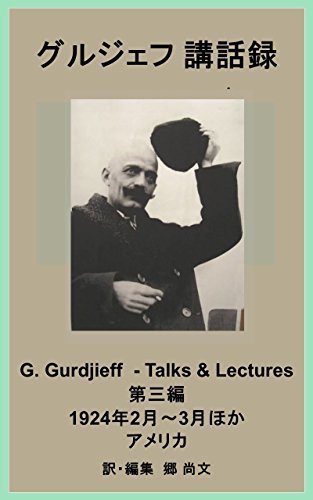
【2021年1月まで販売。以後1917~31統合版講話録に移行。】 一九二四年一月、グルジェフは三十五人の生徒を連れてフランスからアメリカへと向かい、ニューヨークなどでムーヴメンツの大掛かりな公演を行うほか、学院のアメリカ支部の設立に向けての活動を行った。この講話集第三編には、この初回のアメリカ訪問、およびその後の再訪での講話の記録を納めた。 フランスの学院での講話を集めた第二編に続き、頭・心・体の調和的発展を求める学院のアプローチの実践的な側面が詳細に語られる。 とくに重点的なトピックとして、自分に注意を向けることの難しさとリスク、頭と心の間での意思疎通の問題、機械的な考慮からの解放に向けての取り組み、人間が身の回りに作り出す「空気」とこの「空気」を通じての人と人の間での相互作用などが論じられるほか、よく知られた「二つの河」というモチーフをもって、全宇宙を貫く二つの流れと、それらとの関係における個人の立場が論じられる。また、ムーヴメンツ(舞踏)や音楽など、芸術をめぐる質疑応答の内容が豊富に収められている。 分量:約103,000字(単行本換算:約150ページ) 目次 第一部 アメリカ公演旅行(一九二

A magnum opus somehow similar with Ouspensky's Fragments, this version of the Gurdjieffian teaching contains all the theoretical and practical aspects along with never before published diagrams and a coherent presentation of Gurdjieff exercises, transmitted only orally until now. Written by C. Daly King - who received first hand information from Gurdjieff, Ouspensky and Orage - is now available for the first time to the general public. The only version with corrected text and remastered diagrams. Foreword - 9 - Premises - 15 - The Subject and the Attitude - 55 - Part 1. The body of knowledge. A scientific method. Impartiality. The fundamental questions. - 56 - Part 2. Levels of knowledge. The course of exposition. Language and terms. Reality and Unreality. - 62 - Part 3. What is the attitude? The map and the continents. Accuracy. The disease of suggestibility. - 76 - Part 4. Personal verification. The localities and the boat. - 80 - Part 5. Mankind in the Universe. The Law of the Octave. Examples of octavic relationships. The Law of the Three. Examples. - 82 - Part 6. The origin of the information. The Esoteric schools. Why the secrecy? - 96 - The Local Map - 101 - Part 1. Neurological structures. Normal vs. Abnormal. The point of departure. - 102 - Part 2. The functions of man. The centers. Heredity and environment. The Magnetic Centre. - 113 - Part 3. Functional Types. The “I”. Identification. Automatic roles. Consciousness. Free Will. The fallacy of reform. The Equipage. The Prince. - 129 - Part 4. Levels of consciousness. Man’s natural function in the Universe. The Myth of the Black Sheep. The Cosmic Ray. The Organic Kingdom. - 150 - Part 5. Mechanisms of bondage. Kundalini and Kundabuffer. Imagination. Self-Calming. The human potential. - 171 - Part 6. The potential centers. The universal octave. Centers and functions. The three foods. Digestion stages. - 181 - The Boat - 204 - Part 1. The Open Secret and the Hidden Secret. Warnings. The actual postulant. Between two chairs. - 205 - Part 2. The threefold image of oneself. Sincerity and humor. Sane objectivity. Organizing your work. The Portrait. Positive and negative human types. The life review. The nightly review. Personality and essence. Chief Feature. Animal Types. Dangers of self-knowledge. Impartiality towards oneself. - 209 - Part 3. The four states of consciousness. Self-Observation and Self-Consciousness. - 239 - Part 4. The four ways. The technique of Self-Observation. “I” and “it”. Dangers of breathing exercises. The second Participation. Common Sense. The third Experiment. Changing habits. The balanced day. The weather. The vow. Artificial reminders. Self-Remembering. - 254 - Part 5. The effects of Self-Observation on the organism. The organic location of digestion stages. Activation of centers. Subcentres. The three organic bodies. The second conscious shock. - 338 - Part 6. The first stage of the Method. The scientific procedure. Verification of conclusions. - 371 - Part 7. Voluntary Suffering and Conscious Labor. Negative emotions. Pondering. Sin-eating. The complete outline of the Method. - 378 - The Greater Map - 390 - Part 1. The outline of the universe. The hidden knowledge of genuine schools. - 391 - Part 2. The “I”. A normal human action. Sympathy and compassion. Conscience. Morality. The Comfort Bed. Useless worries. Faith, Hope and Love. Art. Symbols. The Enneagram. Man in the Universe. Information sources. - 395 - Part 3. The cosmoses. Atom. Hydrogen. Table of hydrogens. Universal relationships. Man’s energy sources. Types of reason. Prospects. - 447 - Part 4. Time dimensionality. The time-organ. The first dimension of time. Simultaneity. Memory. Three-dimensional time. Relative time. Incarnation and Reincarnation. Physical time. Recurrence. The life path. - 493 - Destination - 537 - Oragean Aphorisms - 538 - Summation - 563 - The Destiny of Man. - 569 - Reckoning - 571 - Appendix - 576 - The Ouspenskian Version - 577 -

G・I・グルジェフは、その主著である『ベルゼバブが孫に語った物語』の出版にあたり、その長大なまえがきである第一章について「だれもが読める」ように配慮させ、読者はまずその内容に親しんだうえで、物語を読み進めるかどうか決められるようにすることを望んだ。この見本版には、この第一章の内容を収録している。 分量:約4万字

ქართულ ენაზე პირველად გამოიცა "გიორგი გურჯიევის ცხოვრება და მოღვაწეობა თარიღებში". წიგნის შემდგენელია გურჯიევის თბილისის ინსტიტუტის დირექტორი ლევან ხეთაგური.

This is an unique edition where you can find - in one book - most of the exercises practiced in the Gurdjieff teaching. Transmitted by Gurdjieff himself - in public or privately printed texts - and also by his followers, some of them are available to the general public for the first time. Table of contents - 3 - The Portrait - 5 - The Two Portraits - 10 - The Time Circle - 11 - The Brain as a Stomach - 12 - The Globe - 14 - The Three Types - 16 - Life Review - 19 - The Nightly Review (first step) - 21 - The Nightly Review (complete) - 26 - The Gurdjieff Method - 27 - Self-observation - 31 - Participation - 57 - Experiment - 61 - Voluntary Suffering - 85 - Conscious Labor - 90 - Establishing constellations - 94 -